Disclosure: Some links in this post are affiliate links. As an Amazon Associate I earn from qualifying purchases, at no extra cost to you. Learn more
Specs are compiled from manufacturer listings and verified buyer reviews and can change over time — please confirm the key details on the product page before buying.
If you want drinking water that never touches a plastic pitcher, filter housing, or throwaway bottle, the fix is a filter built from glass and stainless steel. This guide covers seven of them, from countertop gravity systems to a glass pitcher and an under-sink unit, and tells you which one fits your kitchen and your water.
This guide is built by comparing the manufacturers’ published specifications and the patterns across verified customer reviews, so you get each pick’s real strengths and trade-offs instead of marketing spin.
Some picks store water in glass, some in steel, and a few still use a plastic filter cartridge or lid. Knowing which parts are glass, steel, or plastic is the whole decision here, and this guide on the best plastic free water filter breaks that down pick by pick.
Top Picks


How To Choose The Best Plastic Free Water Filter
“Plastic free” rarely means one hundred percent plastic free. On almost every filter here, the water sits in glass or stainless steel but passes through a plastic-bodied cartridge or under a plastic lid. Decide first which of those two you care about, then buy accordingly.
Where the water actually sits
This is the part you fill and the part you pour from. A borosilicate glass carafe or a 304 stainless steel chamber keeps the stored water off plastic entirely. A plastic-lined pitcher loses much of that advantage the moment water pools against the liner.
Look for the words “glass” or “304 stainless steel” describing the body, then check the lid and spigot. Several picks here use a plastic filter housing by necessity, but the bulk of the water only briefly touches it on the way through.
Pore size: what a micron rating really tells you
A micron is one thousandth of a millimeter, so smaller numbers mean a tighter sieve. The Purewell gravity system runs a 0.01μm hollow fiber membrane, while the GLACIER FRESH pitcher lists 0.2 microns. Tighter is not automatically better for taste, but it holds back finer sediment and microplastic particles.
Capacity and how often you refill
Gravity systems hold 2.25 gallons, which suits a family or a two-day supply for one heavy drinker. Glass pitchers hold 10 cups or 1.3 liters, so you refill more often but carry far less weight. Match the tank to your counter space and your arm, not to the spec sheet.
Flow rate and the waiting game
Gravity filters are slow by design — water drips through the media with no pump. The Purewell moves about 4 gallons per hour, the AquaEasy lists 1.2 liters per hour, and the Aarke runs 0.2 liters per minute. An under-sink unit like the Waterdrop bypasses the wait entirely because it runs off your water pressure.
Filters, lifespan, and the plastic you throw away
Every pick here uses a replaceable cartridge, and that cartridge is where most plastic waste comes from. Check the stated lifespan before you commit: Purewell rates each filter at 3000 gallons, AquaEasy at 6000 liters, and the GLACIER FRESH membrane at 264 gallons. Longer life means fewer cartridges in the bin.
Side-by-Side Comparison
| Model | Best For | Water-Contact Material | Capacity | Filtration / Flow | Amazon |
|---|---|---|---|---|---|
| Purewell 2.25G Gravity System★ Best Overall | Families wanting steel and a water-level window | Stainless steel chambers | 2.25 gallons | 0.01μm UF, 4 gallons/hour | Amazon |
| AquaEasy NSF/ANSI 372 Gravity SystemOff-Grid Ready | Off-grid and emergency water | 304 stainless steel, wooden stand | 2.25 gallons | 1.2 liters/hour | Amazon |
| GLACIER FRESH Purela 10-Cup Pitcher | Fridge-door and desk use | Borosilicate glass body | 10 cups | 0.2 microns, UF + carbon | Amazon |
| Waterdrop PT-09W Glass Pitcher | Certified filtration in a glass body | Glass with plastic inner liner | 10 cups | 5-stage, 8.5 oz/min | Amazon |
| Puro Glass Filter Pitcher | Pour-through filtering, two-pack | Glass body | 1.3 liters | Carbon, filters as it pours | Amazon |
| Aarke Purifier | Counter styling and steel cartridge | Glass carafe, stainless cartridge | 2.4L pitcher, 1.18L fill | 0.2 liters/minute | Amazon |
| Waterdrop TST-UF Under Sink | Whole-kitchen flow at the tap | 304 stainless steel housings | 8000 gallons rated | 0.01μm UF, up to 2.5 gpm | Amazon |
Detailed Reviews
1. Purewell 2.25G Gravity Water Filter System
Our pick — 4.5+★ from 750+ verified ratings; the strongest balance of quality and price.
Steel chambers, a window to watch the level, and the tightest pore size in this lineup.
The number that earns this one the top spot is 0.01μm — a hollow fiber membrane fine enough to hold back particles far smaller than most pitchers manage. Purewell also states it sieves out 99.99% of minuscule materials while other brands offer only a 0.2 microns pore size. In plain terms, you get a tighter sieve that still keeps a 4 gallon per hour flow, so a full 2.25 gallon chamber is ready in a couple of hours rather than a full day.
You will notice the taste first. Review pages keep coming back to it, and that fits the multi-stage media: a silver ion membrane (a filter layer that uses silver to help limit bacteria), an activated carbon block (a porous carbon filter that traps chemicals and odors), and the UF membrane (a fine filter that blocks tiny particles) work in sequence to cut chlorine, rust, sediment, and organic matter. The visible water-level window on the front changes daily use — you see when to top up without lifting the lid. Buyers report “2 weeks use: filters ~2 gal in ~1.5 hrs (faster after several fills); fast tap flow.”
The catch is the faucet, not the filter. Some owners find the metal spigot drips slightly after pouring, and a smaller group reports leakage when the bottom chamber is already full and the top gets another refill. Purewell’s own instructions warn against exactly that, so treat the fill order as part of the routine. Also worth knowing: this system does not lower the TDS value, so your reading stays high because the minerals stay in.
Where it earns its place
- The 0.01μm UF membrane is the finest pore size on this list, and it still flows at 4 gallons per hour.
- Stainless steel upper and lower chambers with a stand included, so nothing but the filter touches your water.
- Each black carbon filter is rated for up to 3000 gallons, and the pair covers 6000 gallons before both need changing.
- The transparent window shows the filtered level at a glance.
Worth knowing before you buy
- Refill with an empty bottom chamber or you can get leakage past the seal.
- It will not change your TDS reading, by design.
- Gravity flow slows near the end of a cycle.
Reach for this if: you have counter space and want a steel-bodied system that a family can pull from all day.
Think twice if: you want zero waiting — a gravity chamber always takes its time.
2. AquaEasy NSF/ANSI 372 Stainless Steel Gravity Filter System
A 304 steel gravity system with a wooden stand that needs no power and no plumbing.
Where the Purewell measures 8.8 inches across, this one sits at 8 inches — a slightly narrower footprint on the same 20 inch height, which matters on a narrow counter. Both hold 2.25 gallons. The AquaEasy differentiates on materials: food-grade 304 stainless steel in a matte black finish, two coconut shell activated carbon filters, a stainless steel spigot, and a wooden stand in the box. Set it on a counter, a campsite table, or a shelf during an outage and it works.
People keep this one because it simply works without fuss, from assembly through daily pouring. The tank holds enough that a household refills roughly once a day, and the filters are easy to swap when the time comes. One owner put it in a way that speaks for a lot of the feedback: “One owner put it plainly: no more plastic bottles piling up around the house.” Each set of filters is rated at 6000 liters (about 1,585 gallons) — enough for a typical household’s daily refills for a long stretch.
The honest limit is the flow. AquaEasy lists 1.2 liters per hour, which is genuinely slow — plan a morning refill for evening water. There is also a durability question worth flagging: one buyer’s “We have had it two months and now the water won’t completely drain from the upper chamber” points to a blockage or seal issue that can show up early. It is a lone report rather than a pattern, but if that happens, the troubleshooting instructions in the manual are the first stop.
Materials that matter: stainless contact surfaces, a steel spigot, and a stand included mean the water path is metal and carbon, with nothing plastic holding the bulk of the water.
The trade-off to plan for: at 1.2 liters per hour this is the slowest gravity fill in the lineup, so it rewards people who fill in advance rather than on demand.
Fits homes that lose power: an off-grid, no-plumbing system with a steel body and a stand already in the box.
Skip if you pour constantly: the slow per-hour flow will have you waiting.
3. GLACIER FRESH Purela 10-Cup Glass Water Pitcher
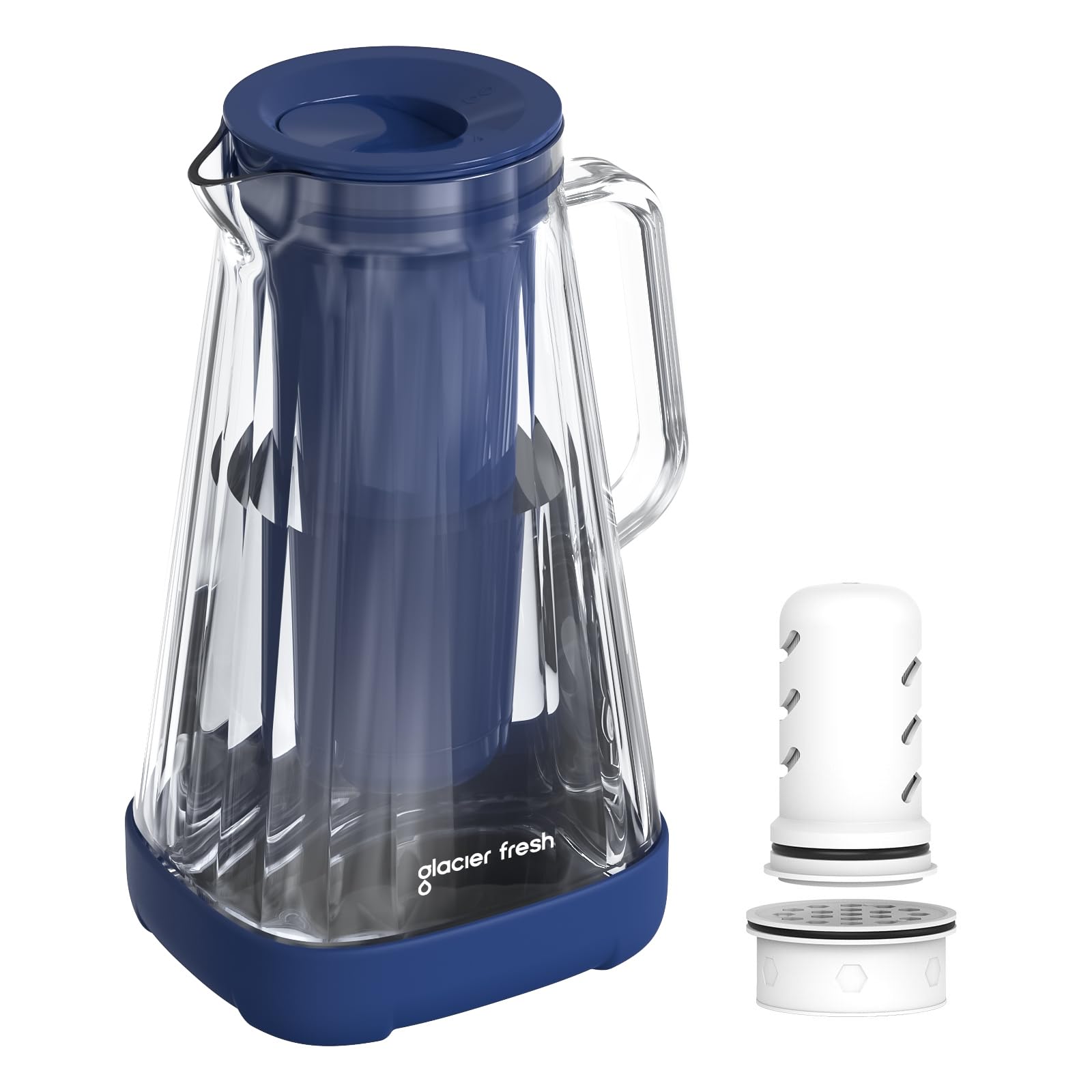
Handblown borosilicate glass around a two-stage filter, sized to fill a whole table.
Ten cups in one pour is the headline — enough for a family meal or a full day at a desk without a second trip to the tap. The body is handblown shatter-resistant borosilicate glass, and glass is the point here: nothing about the carafe leaches or holds onto odors the way a plastic pitcher can after a filter wears out.
The filtration is a two-part setup: an ultrafiltration membrane plus activated carbon fiber cotton, with micropores listed at 0.2 microns. GLACIER FRESH states it reduces 99% of chlorine, 96% of PFOA and PFOS, and coliform, and that independent lab tests show improved smell and taste. The filter quality is what stands out most in owner feedback, with the water taste close behind — the glass and the carbon together deliver water people describe as close to spring water from a tap.
Two things to weigh. Several owners say the material feels more like plastic than glass when it arrives, so set your expectation on feel rather than heft. Filtering speed is also slower than some brands — expect a couple of minutes under a slow stream. On upkeep, swap the carbon exchange filter after 40 gallons or 2 months, and the membrane micro filter every 264 gallons or 6 to 12 months.
What the glass buys you: a borosilicate carafe, a silicone base for grip on the counter, and a spout lid that keeps dust out between pours.
The honest catch: the filter and cover are plastic and they do sit in the water, which undercuts a strict no-plastic goal even though the carafe itself is glass.
The family-table choice: a glass carafe big enough that one fill covers dinner and the next morning.
Not for the impatient: the 0.2 micron media drips slowly compared with a wider-pore pitcher.
4. Waterdrop PT-09W 10-Cup Glass Water Filter Pitcher

Five filtration stages inside a glass body, with third-party certification behind the claims.
Certification is the differentiator you can verify. The filter here is certified against NSF/ANSI 42 for reducing chlorine, taste, and odor; NSF/ANSI 53 for reducing mercury; and NSF/ANSI 372 for lead-free materials. That is a paper trail most pitchers on this list do not carry, and it is why this pick suits anyone who wants the claims checked rather than stated.
Behind that sit five stages of media — advanced carbon fiber, ion exchange resin (a resin that swaps unwanted ions for better ones), and activated carbon block — which Waterdrop says were third-party lab tested to reduce chlorine, mercury, taste and odor, copper, cadmium, PFOA/PFOS (industrial chemicals), sand, and sediment. The flow rate is 8.5 oz/min, so an 8 oz cup fills in under a minute, which is quick for a glass pitcher. The filter lasts up to 100 gallons or 2 months, and a dial on top reminds you when to swap it.
Be clear about one thing before you buy: this pitcher is glass outside with a sturdy plastic inner liner, and Waterdrop says not to put it in the dishwasher. That liner is the compromise, and if a completely plastic-free water path is non-negotiable, the GLACIER FRESH pitcher above keeps more of the contact surface in glass. Note too that this model does not lower TDS.
Why it stands out
- NSF/ANSI 42, 53, and 372 certification on the filter itself.
- 8.5 oz/min flow fills a cup in under a minute.
- Filter rated up to 100 gallons or 2 months.
- Glass body with a filter-change dial on the lid.
The fine print
- A plastic inner liner sits behind the glass.
- Hand wash only — not dishwasher safe.
- TDS readings stay where they were.
Buy it for the paperwork: three NSF/ANSI certifications plus a fast 8.5 oz/min pour in a glass pitcher.
Look elsewhere if: you refuse a plastic liner anywhere near your water.
5. Puro Glass Water Filter Pitcher (2 Pack)

A pour-through glass pitcher that filters on the way out, so there is no waiting chamber.
Instead of a reservoir that drips into a lower tank, the Puro filters the water as it leaves the pitcher. Pour and you are done — no half-hour wait, no watching a level. That design is why the taste feedback runs so high on this one: 1.3 liters of glass-held water, carbon media pulling chlorine, lead, odors, rust, and impurities, and a controlled pour that resists spills. It comes as a two-pack, so one lives in the kitchen and one goes wherever you do.
The appearance is the other thing people notice — it looks like a carafe rather than an appliance, and it suits a bathroom vanity or a bedside table as easily as a fridge shelf. One owner’s rundown sums up the appeal: it removes the swimming-pool taste and smell from city water entirely, and the small footprint makes refilling and cleaning simple.
Three limitations come with that design. Glass can break — one owner lost a pitcher after about six months by knocking it, so keep it away from the sink edge. The diameter is narrow, which makes one-handed pouring feel heavy once it is full. And while the body is glass, the filter and top are plastic, though the water barely contacts them. One filter is rated to replace 1,600 water bottles.
Its real trick: filtering on the pour means you drink within seconds and never schedule a refill around a drip cycle.
Sized for one or two: at 1.3 liters this is a personal pitcher, and a household of four will pour it out fast.
For the solo drinker: a pour-through glass pitcher that gives you filtered water the moment you tip it.
Know the fragility: glass plus a narrow body means careful two-handed pouring.
6. Aarke Purifier Glass & Stainless Steel Pitcher
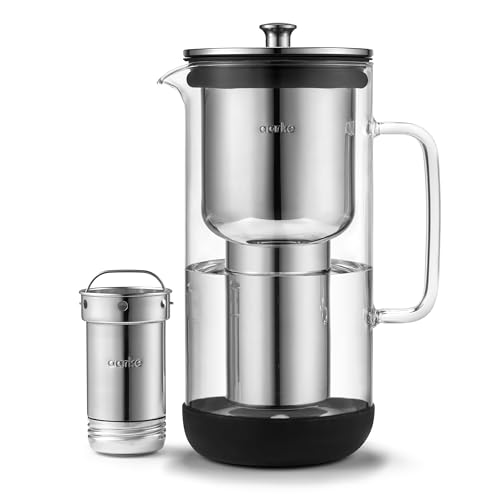
A refillable stainless steel cartridge inside a glass carafe — no disposable plastic filter pod at all.
Most pitchers here still use a plastic cartridge you throw away every couple of months. The Aarke swaps that for a patented, refillable stainless steel cartridge filled with granules developed with BWT, and a glass carafe around it. Refill bags are sold on their own and each one filters up to 120L. The result is a purifier whose waste stream is a bag of granules rather than a plastic housing.
The size is worth reading carefully, because it confuses people. The standard pitcher is 2.4L with a 1.18L (5 cup) fill capacity, and the larger Purifier holds 2.8L with a 1.66L (7 cup) fill. Both are built to fit a fridge door or sit on a counter. Flow runs at 0.2 liters per minute, and the glass and steel components are dishwasher-safe — a real convenience the Waterdrop pitcher above cannot offer.
Two honest notes. Granules need changing every 8 weeks, so keep a spare bag on hand. And the build is heavy and glass, so one-handed pouring from a full carafe takes care — the handle on the large version is made from recycled Ocean Bound Plastic, which is another small plastic touch in an otherwise glass-and-steel build.
The sustainability angle done differently: a steel cartridge you refill, a glass carafe, and granules sold separately instead of a sealed plastic pod.
Where the money goes: premium materials and a Swedish-designed body, not a bigger tank — the fill is 1.18 liters on the standard model.
For the counter-proud kitchen: a glass carafe with a refillable steel filter that looks good enough to leave out.
Weigh the capacity: a 5 cup fill means frequent top-ups in a busy house.
7. Waterdrop TST-UF Under Sink Water Filter System
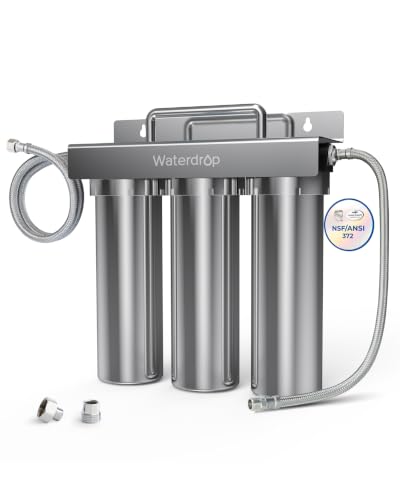
Filters at the tap itself, so there is no pitcher to fill and no counter space to give up.
An 8 ounce cup fills in 2.3 seconds at up to 1.59GPM — that is faucet speed, not gravity speed, and it is the whole argument for going under the sink. Six layers of filter media include a precision ultrafiltration membrane rated to reduce impurities larger than 0.01 microns, cutting chlorine, heavy metals, and odors. The housings are lead-free 304 stainless steel with a thick sealing ring, and they mount on the floor, on the wall, or straight onto the faucet without extra drilling.
Installation is the surprise — 135 of the mentions on this listing center on it, and the reports back it up. A renter described roughly a ten-minute apartment install with the supplied hoses matching an existing 3/8 setup and no adapters needed. It connects to most faucets with 1/2 inch or 3/8 inch female NPT threads, and Waterdrop will send free adapter fittings if you need a quick-connect match. No faucet is included.
The friction shows up in the same place the convenience lives. The push connectors and their clips are fiddly, the stainless housings can be stiff to unscrew when you change a filter, and the whole unit has to come off to swap media. Waterdrop also flags that it is not suitable for hot water or well water, and that it does not reduce TDS. Filter life is generous — 6 to 8 months for the PP stage, a year for the UF, and 12 to 24 months for the CT.
What makes it worth the effort
- Faucet-speed flow at up to 1.59GPM, with an 8 ounce cup in 2.3 seconds.
- 304 stainless steel housings and 0.01μm ultrafiltration.
- Mounts on the floor, wall, or faucet with no extra drilling.
- Staged filter life runs from 6 to 24 months depending on the stage.
Where it asks for patience
- Removing the unit is required for a filter change.
- The push-fit connectors and clips need careful seating to avoid leaks.
- Municipal cold water only — not for well water or hot lines.
Best for a busy kitchen tap: endless filtered water at full faucet pressure with no refilling and no counter footprint.
Not a fit for well water: Waterdrop designs this one for treated municipal supply.
Know the Specs
Microns and pore size
A micron is one thousandth of a millimeter, so a 0.01μm membrane has pores far finer than a 0.2 micron one. Finer pores catch more sediment and microplastic particles, but they can also slow the flow, which is why a gravity system lists its rate in gallons or liters per hour. If you mainly care about taste and speed, a 0.2 micron pitcher is fine; if you want the tightest sieve, look at the 0.01μm units here.
TDS and retained minerals
TDS stands for total dissolved solids, and it measures minerals in the water rather than contaminants. The Purewell and both Waterdrop systems deliberately do not lower TDS because they keep minerals like calcium and magnesium in. A high TDS reading on those units is not a failure — it is the design working as intended.
Gravity versus pressure-fed flow
A gravity filter relies on weight to push water through media, which means no electricity and no plumbing but a slow drip. A pressure-fed under-sink unit uses your home’s water pressure, so it delivers at faucet speed. Decide if you want portability and no installation, or speed and a permanent spot under the counter.
What “plastic free” really covers
Check each product for the body material, the filter housing, and the lid separately. Glass carafes and stainless steel chambers keep stored water off plastic, but the replaceable cartridge is usually plastic-bodied, and some pitchers use a plastic liner or lid. Read the parts list and decide which of those you can live with.
Common Questions
Is a glass pitcher really plastic free if the filter is plastic?
Does a 0.01 micron filter remove more than a 0.2 micron one?
Why does my filtered water still show a high TDS reading?
How often do I change the filter on a gravity system?
Can I use an under-sink filter with well water?
Will a gravity filter work during a power outage?
Do these filters remove microplastics from tap water?
How much water does a 2.25 gallon gravity system hold for daily use?
Are glass pitchers dishwasher safe?
Do I need a separate faucet for an under-sink filter?
The Bottom Line
The best plastic free water filter for most kitchens is the Purewell 2.25G Gravity System, because its 0.01μm membrane is the tightest sieve here and its steel chambers keep stored water off plastic. If you want filtration with certifications printed on the filter, the Waterdrop PT-09W carries NSF/ANSI 42, 53, and 372. And if you would rather never refill a pitcher again, the Waterdrop TST-UF under-sink unit fills a cup in 2.3 seconds.
How we choose
We do not accept paid placement. Every pick is matched to a real buyer and a real use-case; we do not hands-on test units.
Sources
Specifications: manufacturer listings and product documentation. Review insights: verified customer reviews, as of October 2026. Pricing: not shown on this page (it changes often); check the current price via the retailer link.
As an Amazon Associate, Aappliancez earns from qualifying purchases. This does not affect which products we feature.