Disclosure: Some links in this post are affiliate links. As an Amazon Associate I earn from qualifying purchases, at no extra cost to you. Learn more
Specs are compiled from manufacturer listings and verified buyer reviews and can change over time — please confirm the key details on the product page before buying.
Pine pollen tincture is a liquid drop you hold under your tongue, and the biggest divide between the bottles on this list is what the pollen is suspended in. Alcohol-based tinctures tend to taste sharp and piney, while glycerin-based ones lean sweet and gentle. The second big divider is the strength per serving, because a 600 mg squeeze and a 685 mg squeeze are not the same daily routine. Below are the five tinctures worth your attention, sorted by what they actually deliver.
This guide is built by comparing the manufacturers’ published specifications and the patterns across verified customer reviews, so you get each pick’s real strengths and trade-offs instead of marketing spin.
If you want the short version: pick your base first, then your strength. best pine pollen tincture decisions really come down to whether you can tolerate the taste of an alcohol extract or need the sweetness of glycerin.
Top Picks


How To Choose The Best Pine Pollen Tincture
Three things decide whether a pine pollen tincture fits your life: the liquid it is suspended in, how much pollen sits in each serving, and how many servings the bottle holds. Get those three right and the brand matters far less than you would think.
Alcohol Or Glycerin — Pick Your Base First
An alcohol tincture uses a concentrated alcohol suspension to carry the pollen extract. It tends to have a sharper, more pine-forward taste, and it is the style most people describe as bitter. A glycerin tincture swaps the alcohol for vegetable glycerin, which brings natural sweetness and is easier on digestion. Neither is better — the alcohol base is the classic extraction style, and the glycerin base is the one people who dislike bitter flavors reach for.
Serving Strength And Servings Per Bottle
The strength number on the label tells you how much pollen sits in one squeeze or dropper. A 600 mg serving and a 685 mg serving look almost identical on a bottle, but they add up differently over a month. Just as important is the servings count: a 4 fl oz bottle can hold 168 servings, and a 2 fl oz bottle can hold around 19.5 depending on the drop size and the daily dose the maker recommends. Read both numbers together — strength per serving tells you intensity, servings per bottle tells you how long you are set.
What The Extraction Ratio Means
A ratio like 1:2 describes how much raw pollen went in against how much finished liquid came out. A tighter ratio means a more concentrated extract per drop, which is why some bottles deliver the equivalent of 1.5 grams of raw pollen in a single serving. If you see “dual-stage extraction” on a label, it means the maker runs the pollen through the process twice to pull more out of the same plant material.
Side-by-Side Comparison
| Model | Best For | Base | Serving Strength | Servings Per Bottle | Amazon |
|---|---|---|---|---|---|
| Wild & Organic Pine Pollen Tincture★ Best Overall | Everyday alcohol-free drops | Vegetable glycerin | 600 mg | 168 | Amazon |
| BIO KRAUTER Pine Pollen TinctureStrongest Serving | Gentle sweet taste | Water, glycerin, pollen | 685 mg | 168 | Amazon |
| Forest Manna RAW Pine Pollen Tincture — 2 oz | Trying a concentrated extract | Alcohol suspension | Equivalent of 1.5 g raw pollen | ≈19.5 | Amazon |
| Secrets of the Tribe Pine Pollen Extract | Lab-tested alcohol extract | Alcohol extract | — | — | Amazon |
| Forest Manna RAW Pine Pollen Tincture — 4 oz | Committed daily use | Alcohol suspension | Equivalent of 1.5 g raw pollen | ≈39 | Amazon |
Detailed Reviews
1. Wild & Organic Pine Pollen Tincture 4 fl oz
Our pick — 4.0+★ from 550+ verified ratings; the strongest balance of quality and price.
The alcohol-free all-rounder that makes a 56-day habit easy to keep.
If you want a pine pollen tincture you can take three times a day without wincing, this is the one to start with. Each squeeze delivers 600 mg of pine pollen extract, suspended in vegetable glycerin instead of alcohol, so there is no burn and no bitter edge. The bottle holds 168 servings, which is a full 56-day supply at three doses a day.
The formula is vegan, free from GMOs, and carries no artificial additives. The list is also honest about one thing most labels hide — pine pollen is a botanical, so the color and taste shift with the season, the harvest, and the weather. That is why some bottles taste plainer than others. It is a genuine warning, not a defect.
What wins people over here is overall quality, closely followed by how mild the side-effect profile feels and the steady everyday lift in energy. The recurring gripe is texture: the pollen settles, so some buyers find the liquid cloudy and thick, and an occasional batch tastes rancid rather than piney. Shake it hard before every dose and that complaint largely disappears. A 4.0+ star average across 500+ reviews suggests most buyers never hit that snag.
What Earns It First Place
- 600 mg of pine pollen extract in every serving, taken three times daily
- Vegetable glycerin base — no alcohol bite, no sugar added
- 168 servings in the bottle, a 56-day run at the standard dose
- Vegan, non-GMO, no artificial additives
Worth Knowing Before You Buy
- Settles between pours — shake vigorously each time or the dose is uneven
- Taste and color vary batch to batch because it is a seasonal botanical
- An occasional bottle arrives cloudy and thick, or with an off taste
Settle on this one: first-time tincture buyers and anyone who dislikes the taste of alcohol extracts, because the glycerin carries the pollen sweet and smooth.
Know going in: the liquid separates, so a quick shake before each squeeze is part of the routine, not optional.
2. BIO KRAUTER Pine Pollen Tincture 4 Fl.Oz
The biggest measured dose on this list, in the shortest possible ingredient line.
Count the milligrams and this bottle leads the field. One serving carries 685 mg of pure pine pollen, which is 14% more per squeeze than the 600 mg you get from the Wild & Organic bottle above. If you are chasing the strongest single serving without switching to an alcohol extract, that gap is the reason to look here. The formula is three ingredients total: water, glycerin, and pine pollen powder. Nothing else, no added sugar, no bitterness.
That short list is the whole pitch. The pollen is wildcrafted Pinus massoniana, the bottle is vegan and non-GMO, and it is made in the USA with globally sourced ingredients. At 168 servings it also runs the same 56-day stretch as the Wild & Organic pick. The pollen settles here too, so the maker tells you to shake well before each squeeze — add one full squeeze to 2 oz of water or juice, three times daily.
Energy is the thing that shows up most in the feedback, and the sweet vegetable-glycerin taste earns genuine praise for being easier to swallow than capsules. The honest counterweight is effectiveness — opinions split hard, with plenty of buyers swearing by it and a real share saying it did nothing for them. That is the nature of a botanical; it is not a knock on the bottle. One buyer flagged a July batch that looked and smelled off, pointing to a storage or shipping miss rather than a formula problem. Fair warning on the practical side: the squeeze bulb is stiff to fill and the usage instructions are thin, so plan your dose before you start.
Against the top pick: this bottle wins on raw strength per serving, 685 mg versus 600 mg. Where it trails is consistency of experience — the Wild & Organic pick draws steadier feedback, while this one splits buyers down the middle on whether they feel anything at all.
The fiddly part: that stiff bulb and vague dosing guidance mean you will want to figure out your own routine rather than follow the label.
Reach for this if: you want the heaviest measured serving in a glycerin base and you are comfortable dialing in your own dose.
Look elsewhere if: you want clear day-one instructions and a taste that never varies — the alcohol-extract picks below spell out their routine more plainly.
3. Forest Manna RAW Pine Pollen Tincture 2 Fluid Ounce
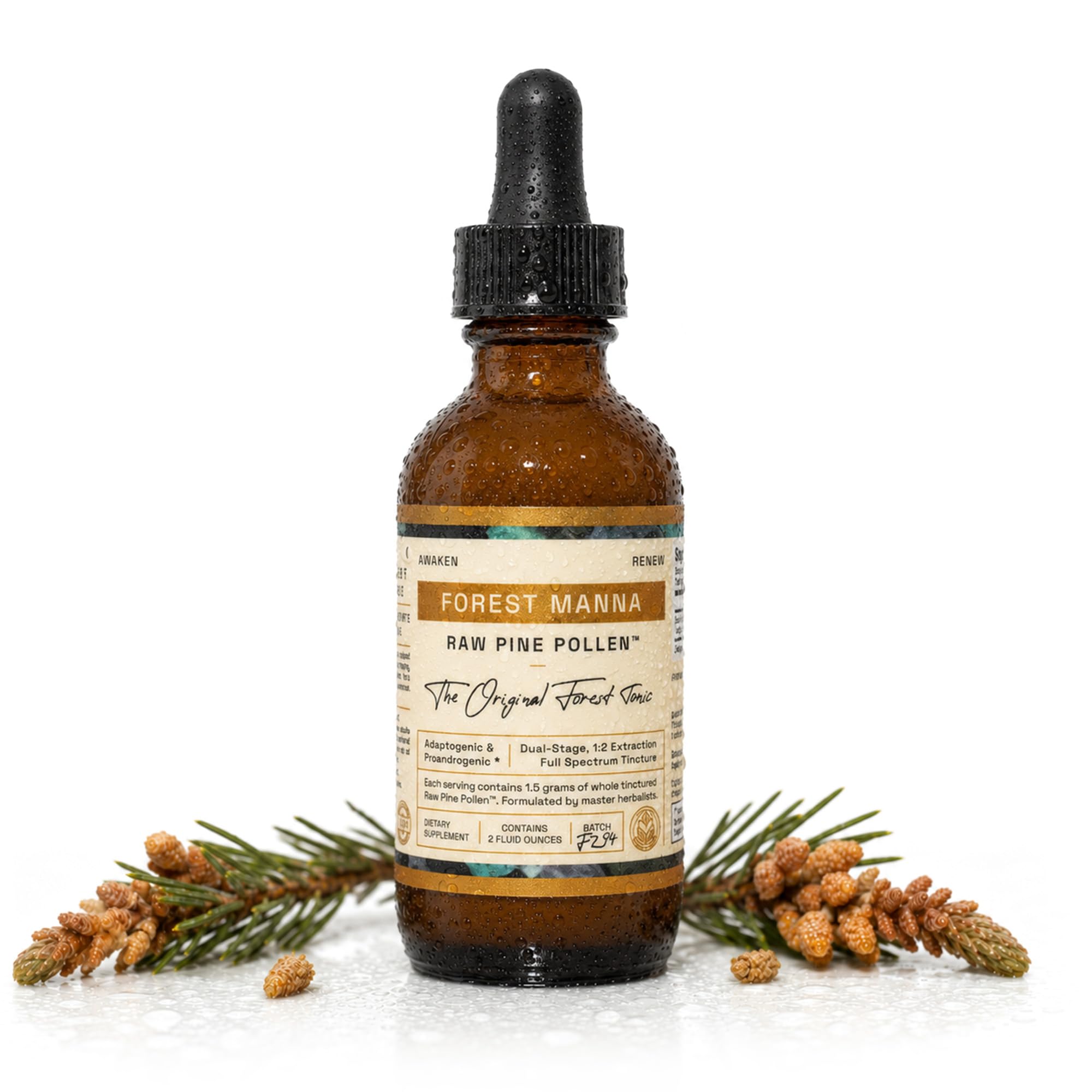
A tight 1:2 extraction that puts the equivalent of 1.5 grams of raw pollen in every serving.
This is the bottle to buy when you want to test a concentrated alcohol extract without committing to a large one. The maker runs a true dual-stage extraction at a 1:2 ratio — plant material in, concentrated liquid out — and each serving delivers the equivalent of 1.5 grams of RAW Pine Pollen in an alcohol suspension. The pollen is single-origin Pinus massoniana gathered at peak potency, and the formula is vegan, plant-based, gluten free, and Paleo friendly.
The size is the trade-off. A 2 fl oz bottle holds roughly 19.5 servings, so it is a short runway compared to the 168-serving glycerin bottles. What you are buying here is concentration and a clean single-origin story, not volume. It also comes in a notably compact package — 1.6 x 1.6 x 4.7 inches — which is why it slips into a travel bag or a desk drawer without a second thought. Compared with the Secrets of the Tribe bottle, that package is about 3.8 times smaller by dimension, so this is the one that travels.
Taste is the price of admission, and everyone who mentions it says the same thing: it does not taste good. The payoff is effectiveness, which is the aspect praised most here and matched by strong marks for quality. As one buyer put it, “It is the most effective brand of tinctures, and I have tried most of them on Amazon.” Keep an orange juice chaser nearby and the sharp pine edge is a ten-second problem. A handful of buyers still report no noticeable difference, so this is not a guaranteed hit for every body.
The case for the small bottle: a 1:2 dual-stage extraction at 1.5 grams of raw pollen per serving is a serious concentration, and the compact 2 fl oz frame makes it the easiest one here to carry.
Count the servings first: around 19.5 per bottle means this is a trial size in practice. If you already know you like alcohol extracts, jump to the 4 oz version below and get roughly 39 servings instead.
Best fit: seasoned tincture users who care more about extraction ratio and single-origin pollen than about a sweet taste.
Skip if: you are new to pine pollen and want a longer runway to judge it — the glycerin bottles give you 56 days to make up your mind.
4. Secrets of the Tribe Pine Pollen Liquid Extract 4 FL OZ

The paper-trail bottle — third-party tested, Scots pine, nothing artificial added.
If you want to see the testing story before you commit, this is the bottle that leads with it. The pollen is wildcrafted Scots Pine (Pinus sylvestris), dried, then run through a steam-distilled process and tested by a third party for herbicides, fillers, foreign substances, and confirmed herb ID. The formula skips artificial colors, flavors, sugar, sweeteners, preservatives, soy, dairy, and eggs, and it is made in the USA under a patent-pending extraction method.
It is a 4 fl oz alcohol extract, which is the same base style as the Forest Manna bottles but a different pine species entirely — Scots pine here versus Pinus massoniana there. If you have tried one species and shrugged, the other is worth a shot before you write off pine pollen altogether.
Effectiveness is the aspect praised most in the feedback, with energy close behind. One 49-year-old reviewer reported gains in strength, endurance, mental focus, and libido after three months on this extract. A reviewer in his late sixties taking it three times daily noted more energy after three weeks. Sublingual use shows up a lot — hold it under the tongue for a minute or so, then swallow. What this bottle will not do is flip a switch for everyone; one buyer who did not actually have low levels felt nothing, and that is a useful reminder that this is a plant extract, not a guarantee.
Why the testing matters: steam-distilled, third-party tested for fillers and foreign substances, and confirmed on herb ID — the transparency is the product here as much as the pollen.
Read the fine print: a 4 fl oz bottle at an alcohol base means you are getting months of supply at a steep taste, so commit to a sublingual routine before you open it.
For the label-readers: buyers who want lab testing and a full ingredient exclusion list spelled out before they put anything under their tongue.
Consider the alternative if: bitterness is your hard limit — the glycerin bottles at the top of this list exist precisely for that.
5. Forest Manna RAW Pine Pollen Tincture 4 Fluid Ounce

The same 1:2 extract as its small sibling, doubled into a roughly 39-serving bottle.
This is the larger half of the Forest Manna pair, and the only real difference from the 2 fl oz version is how long you are set. Same true dual-stage extraction, same 1:2 ratio, same single-origin Pinus massoniana RAW Pine Pollen at peak potency. Each serving still carries the equivalent of 1.5 grams of raw pollen. The 4 fl oz bottle simply stretches that to approximately 39 servings instead of 19.5. Same liquid, twice the runway.
It is a concentrated alcohol suspension, sweetened only by nothing at all — this one is unapologetically a pine-forward, bitter drop. Everything else follows the sibling: vegan, plant-based, gluten free, and Paleo friendly. The package runs 2 x 2 x 5.5 inches and 7.95 ounces, so it is still drawer-friendly even at the larger size.
Buyers rate this bottle on the same two things as the smaller one — effectiveness first, quality right behind. The recurring theme is that the taste is rough but the results justify it, and most people reach for juice to chase it down. A few buyers report no noticeable difference after adding it to their routine, which is the honest ceiling on any single-ingredient botanical. If you already know you like this extract, the 4 oz bottle is the practical way to buy it; if you are still deciding, start small.
The Reason To Upsize
- Approximately 39 servings per 4 fl oz bottle, roughly double the 2 oz version
- Same 1:2 dual-stage extraction and 1.5 g raw-pollen equivalent per serving
- Single-origin Pinus massoniana pollen, vegan, gluten free
- Still compact at 7.95 ounces and easy to store
The Honest Caveats
- Alcohol base means a sharp, bitter pine flavor with no sweetness to soften it
- No alcohol-free option in this line — glycerin fans should look to the top two picks
- Some owners mention no perceptible change even with consistent use
The confident repeat buy: anyone who has already used the Forest Manna extract and wants the same thing in a longer supply.
Not the starter: if you have never tried an alcohol pine pollen tincture, the 2 oz sibling is the cheaper way to find out whether the bitter taste is something you can live with.
Know the Specs
Base Liquid: Alcohol vs Glycerin
The base is what the pine pollen extract floats in, and it changes both taste and how you take it. An alcohol suspension is the classic method — concentrated, sharp, and very pine-forward. A vegetable glycerin base is sweet and gentle, which is why people who dislike bitter flavors tend to prefer it. One bottle here is even simpler: water, glycerin, and pine pollen powder, nothing more. Neither base is stronger by definition; the strength lives in the milligrams per serving, not the liquid carrying it.
Serving Strength And Extraction Ratio
Serving strength is how much pollen lands in one squeeze or dropper, measured in mg. The bottles here range from 600 mg up to 685 mg per serving, and one lists the equivalent of 1.5 grams of raw pollen instead of a simple milligram figure. The extraction ratio — like 1:2 — describes how much raw plant material went in against how much finished liquid came out; a tighter ratio means a more concentrated drop. Read strength and servings-per-bottle together, because a strong serving in a small bottle is a short trial, while a strong serving in a big bottle is a long supply.
Common Questions
How do you actually take a pine pollen tincture?
Why does my pine pollen tincture look cloudy or thick?
Is alcohol-free better than an alcohol tincture?
What does a 1:2 extraction ratio mean on the label?
How long does one bottle of pine pollen tincture last?
Do I need to cycle off pine pollen tincture?
Why do some people say pine pollen tincture did nothing for them?
Can I take a pine pollen tincture if I have a pine allergy?
What is the difference between the two Forest Manna bottles?
Does the label strength tell me how many servings I get?
The Bottom Line
For most people, the pine pollen tincture that makes the most sense is the Wild & Organic Pine Pollen Tincture, because the glycerin base keeps the daily three-squeeze routine pleasant while 168 servings carry you through a full 56 days without a reorder. If you want the heaviest measured serving instead, the BIO KRAUTER bottle packs 685 mg per squeeze in a three-ingredient formula. And for the buyer who wants a concentrated alcohol extract with a single-origin story, the Forest Manna 2 fl oz is the sharpest way in — just keep a juice chaser within reach, and upsize to the 4 fl oz once you know the bitter taste is one you can live with.
How we choose
We do not accept paid placement. Every pick is matched to a real buyer and a real use-case; we do not hands-on test units.
Sources
Specifications: manufacturer listings and product documentation. Review insights: verified customer reviews, as of October 2026. Pricing: not shown on this page (it changes often); check the current price via the retailer link.
As an Amazon Associate, Aappliancez earns from qualifying purchases. This does not affect which products we feature.