Disclosure: Some links in this post are affiliate links. As an Amazon Associate I earn from qualifying purchases, at no extra cost to you. Learn more
Specs are compiled from manufacturer listings and verified buyer reviews and can change over time — please confirm the key details on the product page before buying.
Occipital neuralgia pain starts at the base of your skull, and the wrong pillow keeps hammering that spot all night. You want a pillow that cradles the head low and supports the neck curve instead of pushing your chin toward your chest. The picks below are contour memory-foam pillows built for exactly that job, and the Latree 5X is the strongest all-rounder for most sleepers.
This guide is built by comparing the manufacturers’ published specifications and the patterns across verified customer reviews, so you get each pick’s real strengths and trade-offs instead of marketing spin.
Height, firmness and cover breathability decide whether a contour pillow helps or hurts, so each pick below is matched to a real sleep position. Here is the honest breakdown of the best pillow for occipital neuralgia.
Top Picks

How To Choose The Best Pillow for Occipital Neuralgia
With occipital neuralgia the tender spot is usually where the neck meets the skull, so the pillow has to hold your head in a neutral line and keep pressure off that junction. The single most useful thing you can do is start low and adjust upward, because a pillow that pushes your chin down shortens the neck and loads exactly the area that hurts.
Start with loft, not with claims
Loft is simply how tall the pillow sits under your head. Back sleepers generally do better on the lower contour, side sleepers need more height to fill the gap between ear and mattress, and stomach sleepers want the flattest layer available. A pillow that lets you flip it or strip a layer lets you find that height without buying three pillows.
Look for a hollow or dipped center
A hollow center cradles the back of the skull so the neck can rest on the raised contour instead of being shoved forward. That is the shape difference that separates a contour pillow from a standard bed pillow, and it is the first thing to check on any product page.
Match firmness to how you move at night
Slow-rebound memory foam (foam that springs back slowly and holds its shape) gives steady support without a bouncy feel. If you roll between your back and your side, plan on a few nights of adjustment — almost every contour pillow here asks for that, and it is normal rather than a fault.
Treat “cooling” as a fabric question
Mesh covers and breathable fabric help heat escape, but no pillow actively refrigerates your head. Hot sleepers should prioritize a 3D mesh or bamboo-blend cover and a removable, washable case so the surface stays fresh and dry.
Side-by-Side Comparison
| Model | Best For | Shape | Adjustability | Cover | Amazon |
|---|---|---|---|---|---|
| Latree 5X Pain Relief Cervical Neck Pillow★ Best Overall | Most sleepers, all positions | Butterfly contour with six zones | Two heights by flipping 180° | 3D mesh, 50% bamboo rayon | Amazon |
| zibroges Cervical Neck Pillow Queen SizeLayer Stripper | Buyers who want to strip a layer | Contour with massage bumps | Three-layer, middle layer removable | Ice silk | Amazon |
| VJASD Cervical Neck Pillow | Back sleepers and side sleepers | Butterfly with side wings | Dual height 4.2 in and 5 in | Cooling, machine washable | Amazon |
| LOFE Contour Pillow | Fine-tuning height and firmness | Contour, four stackable layers | 11 heights from 1.2 in to 6.1 in | 60% polyester, 40% rayon of bamboo | Amazon |
| Osteo Sustained Cervical Health Neck Pillow | Hot sleepers and allergy sufferers | Hollow-center, Queen size | Two heights by rotating 180° | 3D mesh fiber | Amazon |
Detailed Reviews
1. Latree 5X Pain Relief Cervical Neck Pillow
Our pick — 4.0+★ from 1,000+ verified ratings; the strongest balance of quality and price.
The butterfly-shaped all-rounder that cradles the skull base and gives your arms somewhere to go.
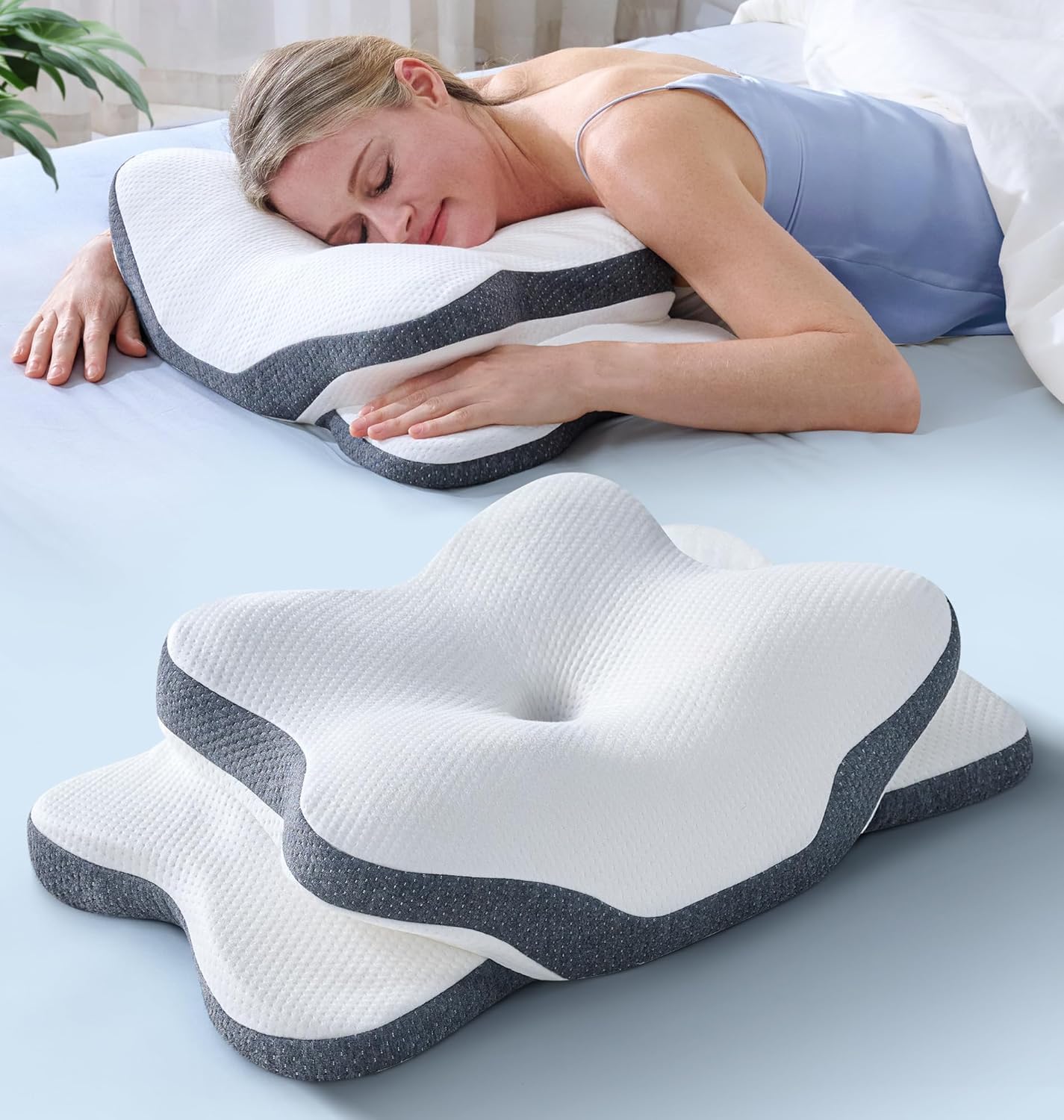
Latree builds this one around a hollow concave surface — a scooped dip that holds the back of your head while the raised contour sits under your neck. That geometry is the whole point for occipital neuralgia, because your skull base rests in the dip instead of getting pressed forward. The six contour zones and the built-in armrests mean side, back and stomach sleepers can all find a resting position on one pillow.
The foam is a 95% open-cell memory foam core, and “open cell” simply means the foam has more air pockets so heat can move out instead of pooling. The cover is a 50% bamboo rayon, 50% polyester blend, and Latree rates its 3D mesh at 3x the breathability of other contour pillows. You can flip the pillow 180 degrees to change the contour height without buying anything else. The core is OEKO-TEX, CertiPUR-US and ISPA certified, and the cover zips off for washing.
What wins people over is how it holds its shape — firm enough to actually lift the neck, still soft enough to settle the head into the dip. Owners who previously slept propped high report less morning stiffness. The recurring note is a too-hard feel for some back sleepers, and the low edge can sit a little high at the base of the scalp. Give it a few nights before you judge it.
What earns it first place
- Hollow concave surface keeps pressure off the skull base, which is the sore spot with occipital neuralgia
- Two contour heights by flipping the pillow 180 degrees — no extra purchase needed
- 3D mesh cover on a 50% bamboo rayon blend rated 3x the breathability of other contour pillows
- Armrest zones let side sleepers park a hand without torquing the shoulder
Where it asks something of you
- Firm foam can feel too hard for lighter back sleepers in the first week
- Expect an adjustment stretch — this is not an instant-comfort pillow
Reach for it if: you switch between side and back through the night and want one pillow that covers both without a second purchase.
Look elsewhere if: you need a genuinely soft pillow to fall asleep — the slow-rebound core is built for support, not plushness.
2. zibroges Cervical Neck Pillow Queen Size
Three stacked foam layers you can pull apart — the simplest height fix on this list.
If you have bought two contour pillows already and neither sat right, the appeal here is obvious. The zibroges uses a three-layer memory foam structure, and you simply remove the middle layer to drop the height and soften the feel. For a skull base that flares up when your chin tilts down, that removable middle layer is a real adjustment rather than a marketing line. The contour runs under the neck and the massage bumps are placed along the pressure points at the back of the neck.
The foam carries CertiPUR-US and OEKO-TEX certification, covering what it releases and how it smells. The cover is an ice silk fabric with what zibroges calls COLD SILK TECHNOLOGY — a smooth, cool-to-the-touch surface that is removable and machine washable. Note the listing describes it as a 2-count unit, so check exactly what your order includes before you plan around a single pillow.
Honest trade-off: the word “cooling” is doing heavy lifting here. Sleepers who run hot describe a warm head and a hot pillow by morning, so if night sweats are part of your problem, plan on a separate breathable case. The raised center also splits opinion — some back sleepers love the angle it holds, others find it does not cradle the neck the way a dipped contour does.
The case for the layer system: being able to pull a layer and re-test in the same night is worth more than any spec sheet claim, because neck height is personal and you only learn it by lying down.
Where it may not suit: hot sleepers and anyone who specifically wants a hollow dipped center under the skull rather than a raised one should keep reading.
Worth a look if: you want an adjustable-height contour pillow and you sleep cool enough that a warm surface is not a deal for you.
Better to pass if: you wake up sweating and need the cover itself to move heat away.
3. VJASD Cervical Neck Pillow
Two fixed neck heights in a butterfly shell — flip it and you have a different pillow.
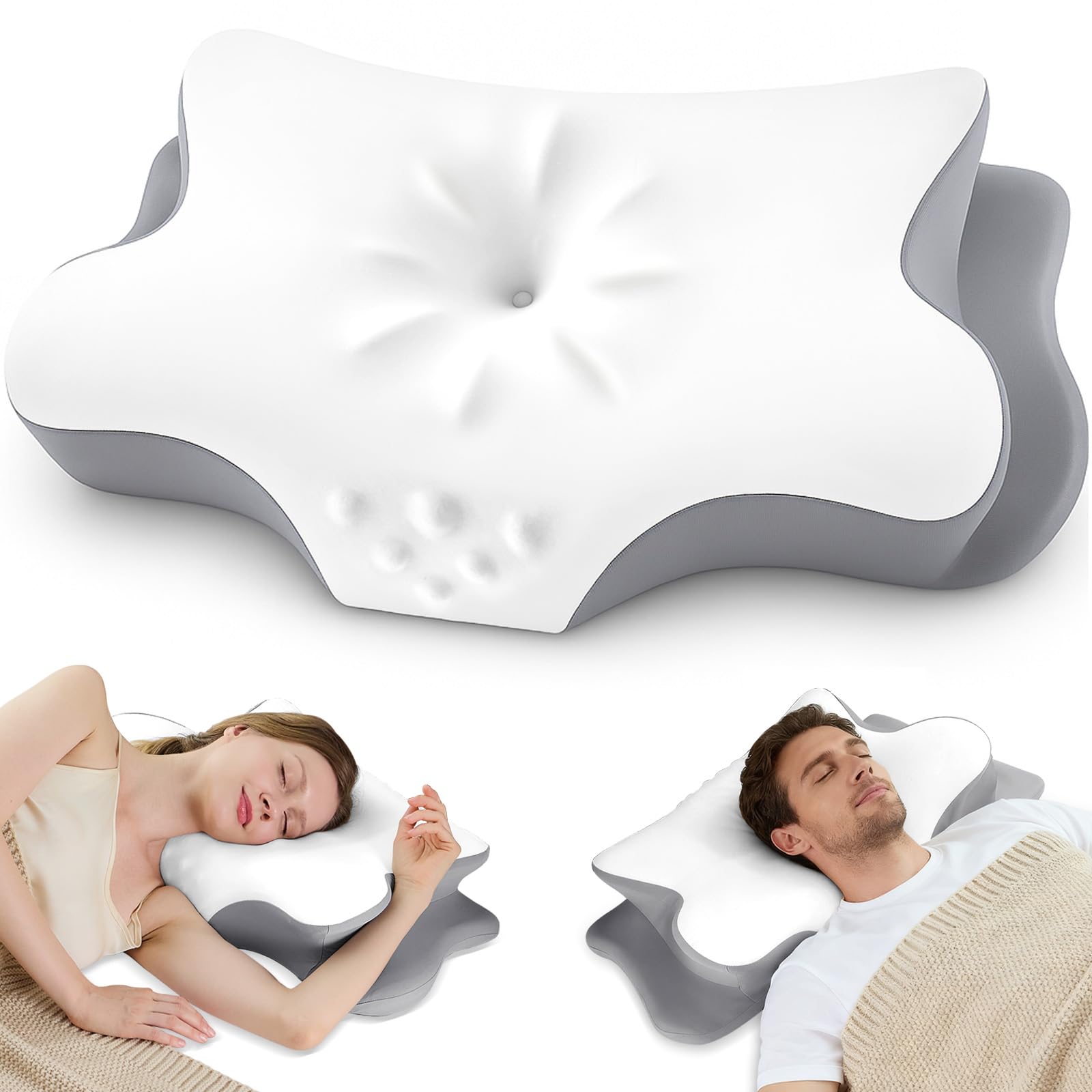
VJASD takes the opposite approach to the stackable layers above and gives you two hard numbers instead. The neck contour sits at 4.2 in (10.5 cm) on one side and 5 in (12.5 cm) on the other, and the side wings rise to 5.7 in (14.4 cm) to fill the gap under a cheek and shoulder. Flip the pillow for a lower back-sleeping side or a higher side-sleeping side. Those numbers matter because a skull base that aches on waking usually needs a lower lift than the average contour pillow offers.
The core is a high-density memory foam that rebounds rather than sinking, wrapped in a cover of 90% polyester and 10% spandex that is moisture-wicking and machine washable. The butterfly shape with its side flaps gives side sleepers somewhere to rest a forearm, which keeps the shoulder from rolling forward and dragging the neck with it.
What wins people over is the quality of the build — it is the most-praised thing about this pillow by a wide margin, with sleep quality right behind it. Buyers report neck pain and headaches easing after a one-to-two-week adjustment period. The catch is an adjustment window of roughly one to two weeks for some sleepers, and a minority never get comfortable with the raised contour at all. The bottom snap on the back-sleeping cavity is a light component, so treat it gently when you pull the cover off.
Fit guide: back sleepers on the 4.2 in side, side sleepers on the 5 in side, and broad shoulders on the 5.7 in wings.
The patience tax: budget a week or two before you decide — the foam is helping your alignment before your body stops arguing with it.
Pick it for: a low back-sleeping contour you can flip to a taller side-sleeping one, with wings that support a shoulder.
Skip past it if: you want infinite fine-tuning — this gives you two heights, not eleven.
4. LOFE Contour Pillow
Eleven possible heights from 1.2 in to 6.1 in — the most adjustable pillow in this lineup.
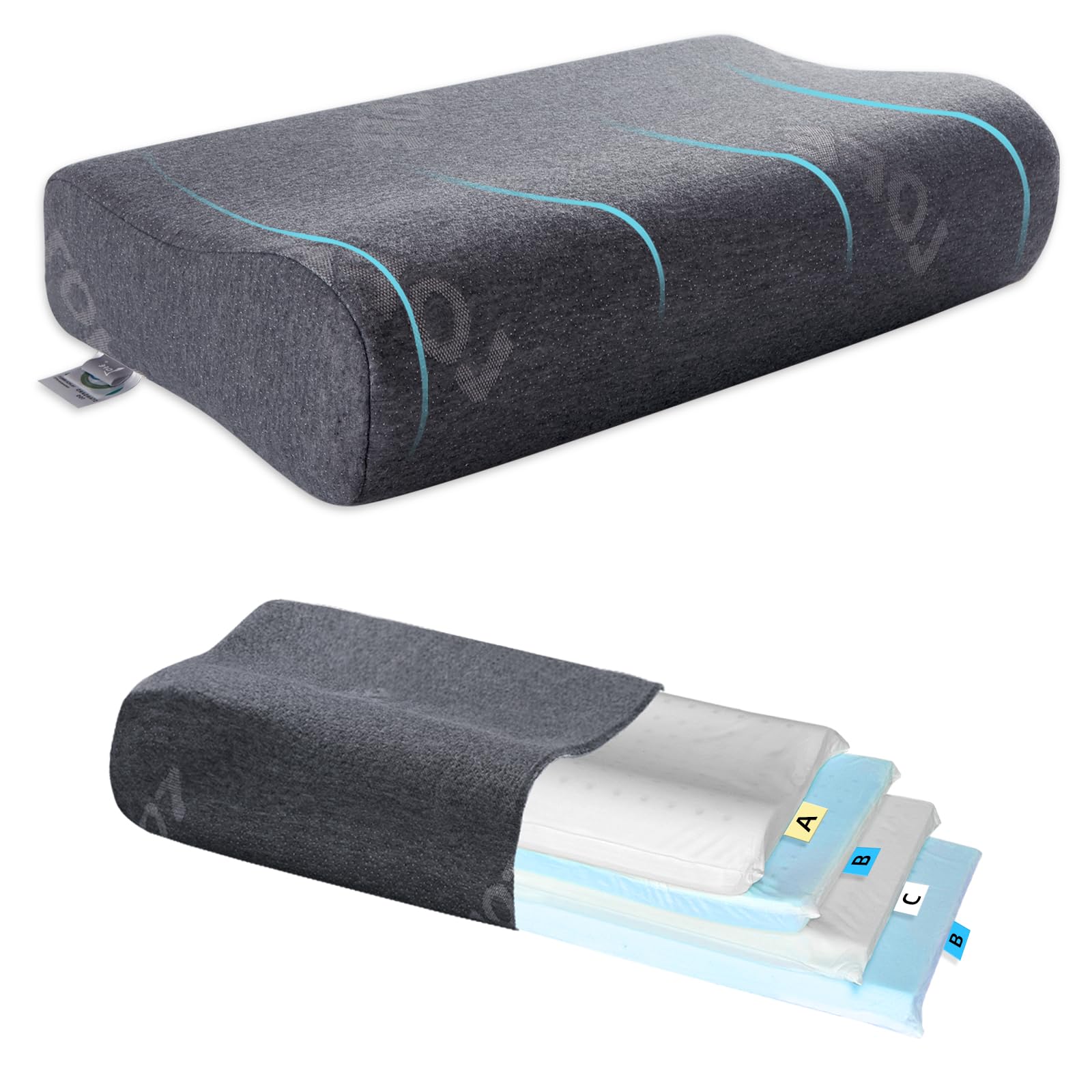
No other pillow here gives you this much range. LOFE uses four foam layers of different firmness — an ultra-soft white contour memory foam, a soft blue memory foam, and a firm white foam — and you stack and swap them to build 11 different heights from 1.2 in to 6.1 in. Each layer also works alone as a flat pillow, which is the flattest option in this article for stomach sleepers. If your neck hates whatever height you tried last, that is a real answer rather than another guess.
The CertiPUR-US certified foam is slow-rebounding, so each layer returns to shape instead of flattening. The cover is 60% polyester and 40% rayon of bamboo, breathable and removable for machine washing, and the pillow itself has ventilation holes to keep heat from building up. Adjustability is the third-most-praised trait in the reviews, right after overall quality.
Here is the honest part: the layers are not all cut to the same shape, and the thinner inserts do not match the curved top contour insert. Fine-tuning the right combination takes experimenting, and a side sleeper can find the finished stack slightly short on neck height. Heavier sleepers who want a denser foam may also find the softest layer too yielding. Work through it and you land on a setup almost no fixed pillow can match.
Why it earns the tuning crown
- 11 distinct heights from 1.2 in to 6.1 in, so you can dial in loft one layer at a time
- Layers double as standalone flat pillows for stomach sleepers
- Breathable polyester and rayon-of-bamboo cover with ventilation holes in the foam
What to expect while you fiddle
- Inserts vary in shape and density, so the ideal combo takes trial and error
- Some side sleepers find the finished height slightly low at the neck
Built for: tinkerers and anyone whose neck has rejected every fixed loft they have tried.
Think twice if: you want to unbox it and sleep — this pillow rewards a patient evening of stacking.
5. Osteo Sustained Cervical Health Neck Pillow
A hollow center that takes the pressure off the vertebrae and a mesh case built for hot heads.
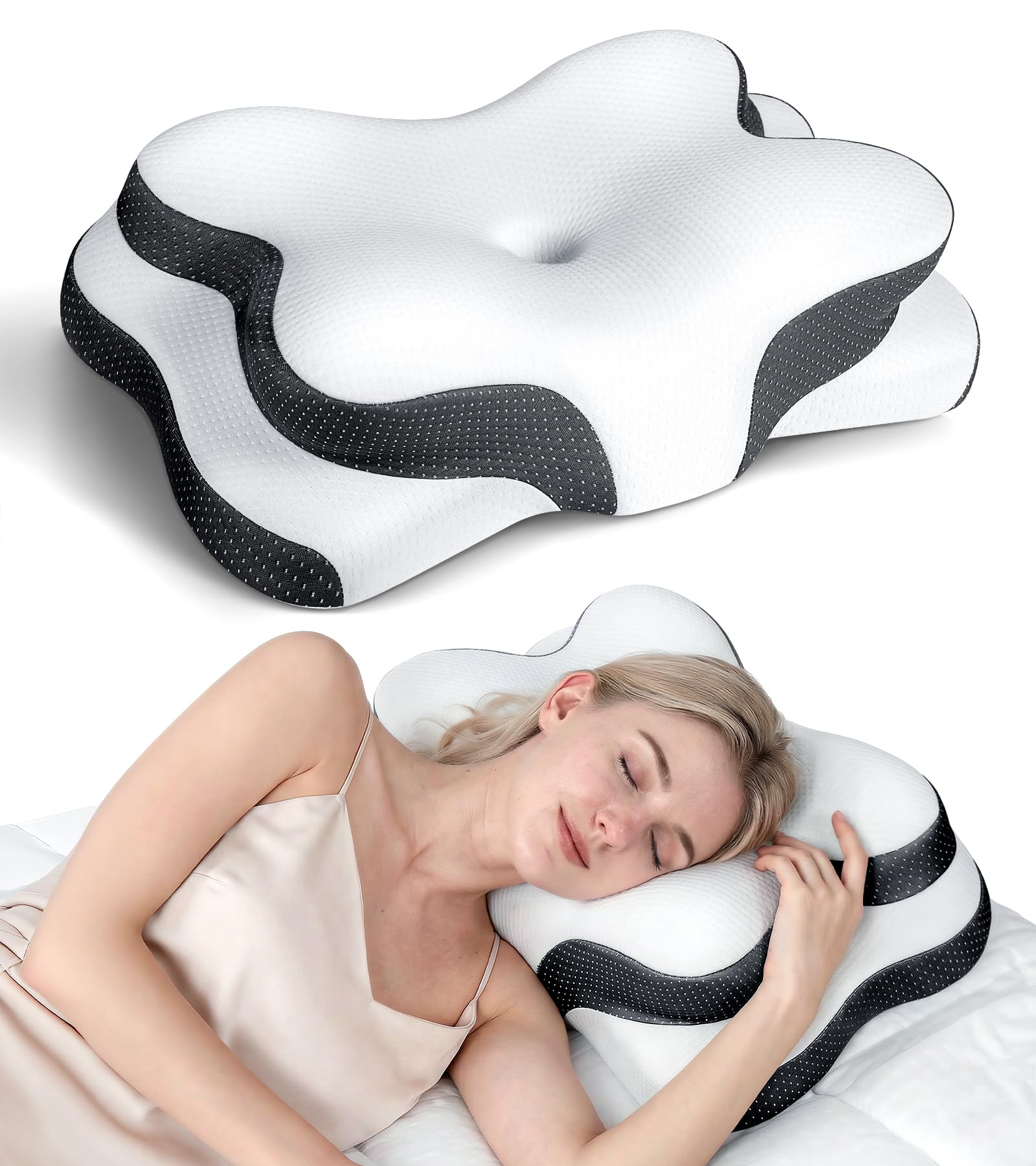
Osteo leans on one design idea: a hollow center that cradles the head and lets the neck sit on the contour instead of being pushed forward. Neck pain relief is the most-mentioned benefit in the feedback, with more than 550 mentions, followed by build quality. The Queen size measures 22.6 by 13.6 inches with a 4.1 and 3.9 inch split, and rotating the pillow 180 degrees gives you the higher or lower side.
Hot sleepers get the most attention here. The 3D mesh fiber pillowcase is open enough for heat to escape and air to cycle through, which separates it from a smooth cover that traps warmth. The foam is CertiPUR-US certified and OEKO-TEX approved; Osteo recommends airing it out for 48 hours before first use so it fully expands.
The trade-off is firmness and break-in. The foam is genuinely firm, and sitting up on a stack of pillows at night is a hard habit to break — the contour wants your head closer to the mattress than that. Plan on a few nights, possibly a couple of weeks, before your posture catches up. One edge worth knowing: some sleepers find arm room tight when lying on their side.
Breathability first: if your pillow turns warm and damp by 3 a.m., the 3D mesh fiber case is the practical reason to start here.
The break-in reality: this is a firm, posture-correcting pillow, and the first nights are about unlearning a high stack, not instant comfort.
Go here if: you overheat at night and want a firm hollow-center contour with a mesh case that lets air move.
Not your pick if: you need a pillow you can sink into on night one.
Know the Specs
Loft and contour height
Loft is how tall the pillow sits under your head, and it is the number most likely to make or break a pillow for occipital neuralgia. Too high and your chin drops, shortening the neck and loading the skull base. Too low and the neck curve has nothing to rest on. Dual-height designs give you two options by flipping the pillow; multi-layer designs let you strip foam until the height feels right.
Memory foam density and rebound
Slow-rebound memory foam (foam that springs back gradually) holds its shape night after night without going flat. Open-cell foam has more air pockets, which helps heat escape and keeps the surface from turning clammy. CertiPUR-US and OEKO-TEX are third-party certifications covering what the foam is made of and how it smells, so look for them if you are sensitive to odor.
Cover fabric and airflow
The cover is what touches your skin, so the material matters as much as the foam. A 3D mesh fabric lets air cycle through; bamboo rayon blends feel smooth and wick moisture; ice silk has a cool initial touch but can warm up under sustained body heat. Removable, machine-washable covers keep the surface fresh and extend how long the pillow feels new.
Adjustment period
Nearly every contour pillow asks for a few nights, sometimes a couple of weeks, before your body stops fighting the new alignment. That stretch is normal and not a sign the pillow is wrong — but if the height is clearly off after that window, change the layer or the side rather than pushing through pain.
Common Questions
What pillow height works best for occipital neuralgia?
Is a contour pillow better than a flat pillow for skull base pain?
How long should I give a new cervical pillow before deciding?
Can I use a contour pillow if I sleep on my side and my back?
Does memory foam smell when it is new?
Will a cooling cover actually stop me sweating at night?
Can I wash the pillow and the cover?
Does a firm pillow help or hurt a tender neck?
Will the pillow fit my normal pillowcase?
Can a new pillow replace treatment for occipital neuralgia?
The Bottom Line
The pillow that gives you the most control over neck height — in the shape that protects the base of your skull — wins this category. That is the relationship between loft and the hollow-center contour, and it is what the Latree 5X Pain Relief Cervical Neck Pillow gets right for most sleepers, with a hollow dip under the head and a contour under the neck. If you want to strip a layer until the height feels right, the zibroges Cervical Neck Pillow gives you that in one night. For the widest adjustment range on the list, the LOFE Contour Pillow lets you build 11 different heights out of four layers. And if night heat is part of the problem, the Osteo Sustained Cervical Health Neck Pillow puts its open mesh fiber case and hollow-center hollow first.
How we choose
We do not accept paid placement. Every pick is matched to a real buyer and a real use-case; we do not hands-on test units.
Sources
Specifications: manufacturer listings and product documentation. Review insights: verified customer reviews, as of October 2026. Pricing: not shown on this page (it changes often); check the current price via the retailer link.
As an Amazon Associate, Aappliancez earns from qualifying purchases. This does not affect which products we feature.