Disclosure: Some links in this post are affiliate links. As an Amazon Associate I earn from qualifying purchases, at no extra cost to you. Learn more
Specs are compiled from manufacturer listings and verified buyer reviews and can change over time — please confirm the key details on the product page before buying.
Here is the short answer: a phono preamp’s real job is to lift your cartridge’s tiny signal up to line level without adding noise or mangling the RIAA curve. Get that wrong and you will hear hiss, thin bass, or a hum you cannot chase away no matter how many cables you swap. Get it right and even a modest turntable suddenly sounds like it has room to breathe. This guide covers nine preamps that do the job cleanly, and explains in plain words which one fits your cartridge, your amplifier, and the way you actually listen.
This guide is built by comparing the manufacturers’ published specifications and the patterns across verified customer reviews, so you get each pick’s real strengths and trade-offs instead of marketing spin.
You will learn what gain and cartridge loading actually change, and how to pick a stage that suits your setup rather than the loudest review. The right match for most vinyl rigs is hiding in plain sight among the best phono preamp under $1000 options below.
Top Picks


How To Choose The Best Phono Preamp Under $1000
The mistake most first-time vinyl buyers make is assuming a preamp is a preamp. It is not. A phono stage has to take a signal far weaker than anything else in your hi-fi chain and boost it enormously while keeping that boost perfectly even across the frequency range. That boost figure is your gain, and every cartridge type needs a different amount of it.
Match the gain to your cartridge, not to the hype
Moving magnet (MM) cartridges — the common type that ships on most beginner and mid-level turntables — typically need less gain. Moving coil (MC) cartridges, which use a much smaller coil and are often step-ups for serious listeners, need considerably more. If you buy a stage with fixed gain and pair it with a low-output MC cartridge, the volume will feel weak and you will push your amp into hiss to compensate. Look for a stage that states its gain options in decibels and covers your cartridge.
Loading is the tone dial nobody tells you about
Loading is the electrical resistance and capacitance the cartridge “sees” from the preamp, measured in ohms and picofarads. Change it and you can shift the top-end response of a cartridge by a noticeable margin. Preamps that let you switch impedance and capacitance values let you fine-tune that relationship; fixed-loading models assume the factory value suits your cartridge and leave it there. If you plan to swap cartridges over time, adjustable loading is a real long-term asset rather than a spec-sheet bullet.
Where the noise comes from
A phono stage juggles a huge boost with a fragile signal, which is why the noise floor — the quiet background between tracks — separates good from mediocre designs. Grounding matters just as much as circuitry. Most hum complaints in this category trace back to a missing ground wire between turntable and preamp, or to a power supply plugged into a noisy strip. Before you blame the box, check your grounding.
Side-by-Side Comparison
| Model | Best For | Gain Options | Cartridge Support | Warranty | Amazon |
|---|---|---|---|---|---|
| Schiit Mani 2★ Best Overall | All-round flexibility | 35/45/50/60 dB | MM, MC, MI | 2 years parts and labor | Amazon |
| Parks Audio WaxwingThe Control Freak | Total control, digital out | Flexible, MM/MI/MC to 0.2mV | MM, MI, MC | — | Amazon |
| iFi Zen Phono 3Silent Runner | Quietest vinyl playback | Selectable MM and MC | MM, MC | — | Amazon |
| U-Turn Pluto 2 | MM-only simplicity | Fixed | MM only | 3 years | Amazon |
| Cambridge Audio Solo | Neutral MM detail | Fixed (MM) | MM only | — | Amazon |
| Ampapa A1 | Tube warmth, headphone out | Fixed | MM only | — | Amazon |
| Pro-Ject Phono Box S2 Ultra | Discrete MM/MC tuning | 4 gain levels | MM, MC | — | Amazon |
| Fosi Audio BOX X5 | Value MM/MC switching | 38/48/56/66 dB | MM, MC | 24 month manufacturer | Amazon |
| Pro-Ject Phono Box DC | Budget all-metal simplicity | Fixed | MM, MC | — | Amazon |
Detailed Reviews
1. Schiit Mani 2 Phono Preamp
The one box that handles nearly any cartridge you will ever bolt to a tonearm.
Schiit’s Mani 2 is the pick because it refuses to be boxed in. You get four gain steps — 35, 45, 50, and 60dB — so a humble moving magnet and a hungry low-output moving coil both land in a usable range. It also lets you choose 47KΩ, 200Ω, 47Ω, or 38Ω of loading, plus 47pF, 100pF, 150pF, or 200pF of capacitance, which is the electrical “weight” the cartridge sees and which shapes its top end. That combination of switchable gain and switchable loading is rare at any price, let alone here.
The noise performance is the other headline. Schiit rates the Mani 2 for super low noise and high RIAA accuracy, the standard playback curve that keeps bass and treble in proportion. In real systems that shows up as a dark, silent background between tracks. What wins people over most is exactly that — the sense of a much pricier component smuggled into a small box. It runs from a 16-volt DC supply and weighs 0.96 kg, so it stays put rather than sliding around the back of a shelf.
There is a genuine catch worth naming. The gain is high, which means the Mani 2 will happily amplify interference if you feed it with cheap cables — one buyer chased a hum down to bargain RCAs and cured it with better ones. It also has no front-panel volume control, and its 16-volt wall supply is bulky enough to fight for space on a crowded power strip.
What earns it the top spot
- Four gain steps from 35 to 60dB cover moving magnet and low-output moving coil alike
- Adjustable loading in both ohms and picofarads lets you tune the cartridge’s tonal balance
- Selectable 6dB/octave or 12dB/octave low-frequency filter at 15 Hz smooths out warped records
- Very quiet background and high RIAA accuracy for the tier
- Two-year parts and labor warranty backs the build
Where it asks for patience
- High gain exposes cheap RCA cables as noise — plan on decent interconnects
- No volume control, so you lean on your amplifier for level
- The 16-volt power brick is large and awkward on a power strip
Pick it when: you own or plan to own more than one cartridge type and want to stop shopping for a while.
Think twice if: you want a front-panel volume knob or a compact inline power supply.
2. Waxwing Phono DSP Preamp
A phono stage that behaves like studio gear and lets your phone do the tuning.
Most preamps give you a switch or two and send you on your way. The Waxwing hands you an app and a digital signal processor instead. Its MAGIC function gently reduces pops and clicks, GAIN covers moving magnet, moving iron, and moving coil cartridges down to 0.2mV, and AIR and WARMTH dial in the high end and the overall mix. There are hundreds of EQ settings for different LP formats, and a SUPER MONO mode that cleans up mono pressings.
For anyone building a digital chain, the optical out is the reason to care. The Waxwing converts your record to 24-bit/96kHz and can feed a room-correction processor or DAC directly — one owner runs a long coax run in an all-digital chain without issue. Functionality is the second-most-praised quality after sound, and it is easy to see why: this is a box that keeps unfolding new settings months after you buy it.
Parks Audio sells direct support from Shannon Parks himself, which is a genuine differentiator if you hit a snag. The honest limit is the app dependency. Output switching between analog and digital happens in software and only one output runs at a time, so anyone who wants to feed two destinations at once will need a workaround. The digital processing also means purists who want a purely analog path should look elsewhere.
Who this rewards: the tinkerer who enjoys tuning a cartridge and wants room correction or a DAC feed downstream. The optical output, wide gain range, and app-based EQ make this the most capable preamp in this group by a wide margin.
The honest trade-off: the Waxwing is a computer as much as a preamp. Expect to spend your first evening in the app learning its layers, and accept that analog and digital outputs are mutually exclusive.
Reach for this if: you want precise control over every parameter and can make use of the digital output.
Look elsewhere if: you want a pure analog path with no app, no menus, and no processing.
3. iFi Zen Phono 3 Phono Preamp
Built for the listener whose biggest enemy is the hiss between tracks.
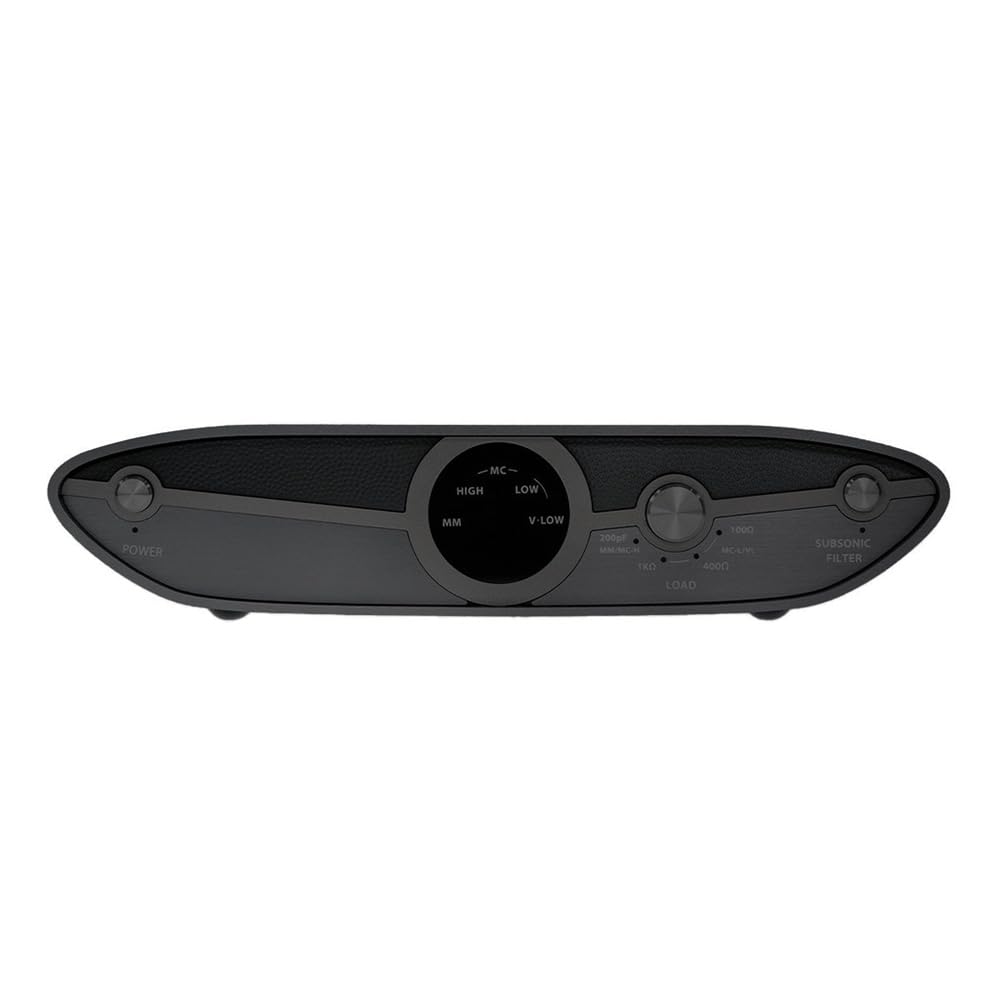
The Zen Phono 3 makes its pitch on noise. iFi rates the Zen Phono 3’s noise floor at -140dB, so hiss and hum drop below the music. A precision RIAA equalization stage keeps the playback curve accurate, and a balanced output gives you a lower-noise connection path if your amplifier accepts one. Selectable gain covers both moving magnet and moving coil cartridges, and an intelligent subsonic filter removes low-frequency rumble without touching the music.
What that means day to day: quiet passages stay quiet, and surface noise from older pressings does not get boosted into the room. Owners stepping up from a weak built-in stage report wider separation and a deeper soundstage, with detail the most repeated praise. The Black Stealth finish is matte, understated, and a step up from the usual shiny boxes.
There is one adjustment many moving coil fans will miss. MC loading is not user-adjustable on this model, so you take the factory value whether your cartridge loves it or not. The power supply is also external, which means one more brick behind the rack.
Why it earns a premium slot: noise is the hardest thing to fix downstream, and this box tackles it head-on with an ultra-low noise design, balanced output, and a smart rumble filter.
Plan around this: if you plan to move deep into moving coil territory and want to fine-tune loading, you will want a stage with adjustable impedance — this is not it.
Suits the listener: chasing the quietest possible background from a moving magnet cartridge or a high-output moving coil.
Not the tool for: cartridge tuners who want to dial in MC loading values by hand.
4. U-Turn Audio – Pluto 2 Phono Preamp (Black Aluminum)

The MM-only stalwart that brings three years of cover and a genuinely quiet circuit.
U-Turn’s Pluto 2 makes one decision for you and executes it well. It is a moving magnet only design, so if that is your cartridge — and for most turntable buyers it is — you are squarely in its lane. Inside, it uses WIMA film capacitors and precision resistors, dual high-performance gain stages to keep distortion low, and an active subsonic filter to strip out low-frequency noise. The aluminum enclosure shields the circuit from interference, and the whole thing weighs 10 ounces in a 1.4 x 4.5 x 3.85 inch footprint.
Where it separates itself is support. U-Turn backs it with a 3-year warranty and lifetime product support from its Woburn, MA workshop — genuinely the longest coverage in this group. Buyers report clearer detail and better channel separation than a turntable’s built-in stage from the first record. If you want the short version of what an external preamp does for a modest rig, the Pluto 2 is proof of the principle.
One design choice trips people up. There is no power switch, so it is always on and relies on your power strip for control. The other recurring note is grounding — it needs a ground wire to the turntable to stay hum-free, and skipping that step produces the classic buzz.
The case for it: an aluminum-shielded, dual-gain-stage moving magnet preamp with a 3-year warranty and the simplest signal path in this round-up. It is the value pick for a first upgrade.
One caution worth knowing: no adjustable loading, no MC support, and no power button — the Pluto 2 asks you to accept its defaults.
Take this home if: you run a moving magnet cartridge and value a long warranty over tweakability.
Pass on it if: you want MC compatibility or a power switch on the box itself.
5. Cambridge Audio Solo Moving Magnet Phono Preamplifier

A faithful, uncolored moving magnet stage that lets the recording speak.
Cambridge Audio’s Solo is a moving magnet preamp built around a switch-mode power supply — a fast, high-output, low-noise design — and surface-mount circuitry that keeps signal paths short. The pitch is accuracy rather than warmth: a black background and playback that does not editorialize. It stands 1.9 inches tall, 6.9 wide and 5.2 deep, wrapped in an aluminum chassis that feels like a step above its price.
Owners describe a neutral, uncolored sound with clean bass and a wide soundstage. It steps comfortably ahead of a receiver’s built-in phono stage, and the upgrade is the sort you notice on the first record. The switch-mode supply means no bulky wall wart competing for outlet space — a detail that becomes more valuable the bigger your rack grows.
Two caveats sit on this one. It is MM only, so moving coil cartridges are out unless you add a step-up. And the switching supply, while fast, means it wants clean power — hum that shows up on a shared strip often resolves when the turntable and preamp are separated.
The core appeal: near-black backgrounds, precise playback, and a self-contained supply in a compact metal box — for the listener who wants transparency.
Be sure to check: cartridge type. This is a moving magnet design only, and it has no loading adjustments.
Fit for: moving magnet owners who prize a neutral, honest presentation over colored warmth.
Skip if: you run moving coil or want switchable gain.
6. A1 Vacuum Tube Phono Preamp

Three products in one shell: phono stage, headphone amp, and a tone dial you will actually use.
The Ampapa A1 is the odd one out in the best way. It runs classic JAN 5654 vacuum tubes to bring a warm, rich character to a moving magnet signal, and it doubles as a headphone amplifier for models like the HD650 or DT770. Treble and bass knobs let you shape the sound without swapping hardware, and a pair of LED lights switch between warm orange and cool green depending on your mood. The die-cast aluminum shell and solid metal knobs look far more expensive than the asking tier suggests.
Where the A1 shines is system matching. One owner running it into a Kenwood integrated amp reported bigger bass, a wider soundstage, and more clarity than the amp’s own phono stage. It does not always get along with every amplifier — the same buyer found it tinny into solid-state monoblocks — so expect to experiment a little. The bass and treble controls are the real differentiator; they let you rescue a thin sounding system without buying anything else.
The trade-off is inherent to tubes. A glass tube is a consumable, and the A1’s character means it colors the sound — if you want absolute neutrality, this is not the pick. It is also moving magnet only, so plan on a step-up if you go MC.
Best for: the vinyl listener who wants a warmer, more musical presentation and the flexibility of a headphone output.
The catch: tubes color the sound and can need replacing over time. This is a character piece, not a transparency tool.
Built for: moving magnet users who want a warm tube voice and an integrated headphone amp.
Steer clear if: you need moving coil support or a flat, uncolored signal.
7. Pro-Ject Phono Box S2 Ultra Phono Preamp
No op-amps, switchable loading, and a metal shell built to keep noise out.
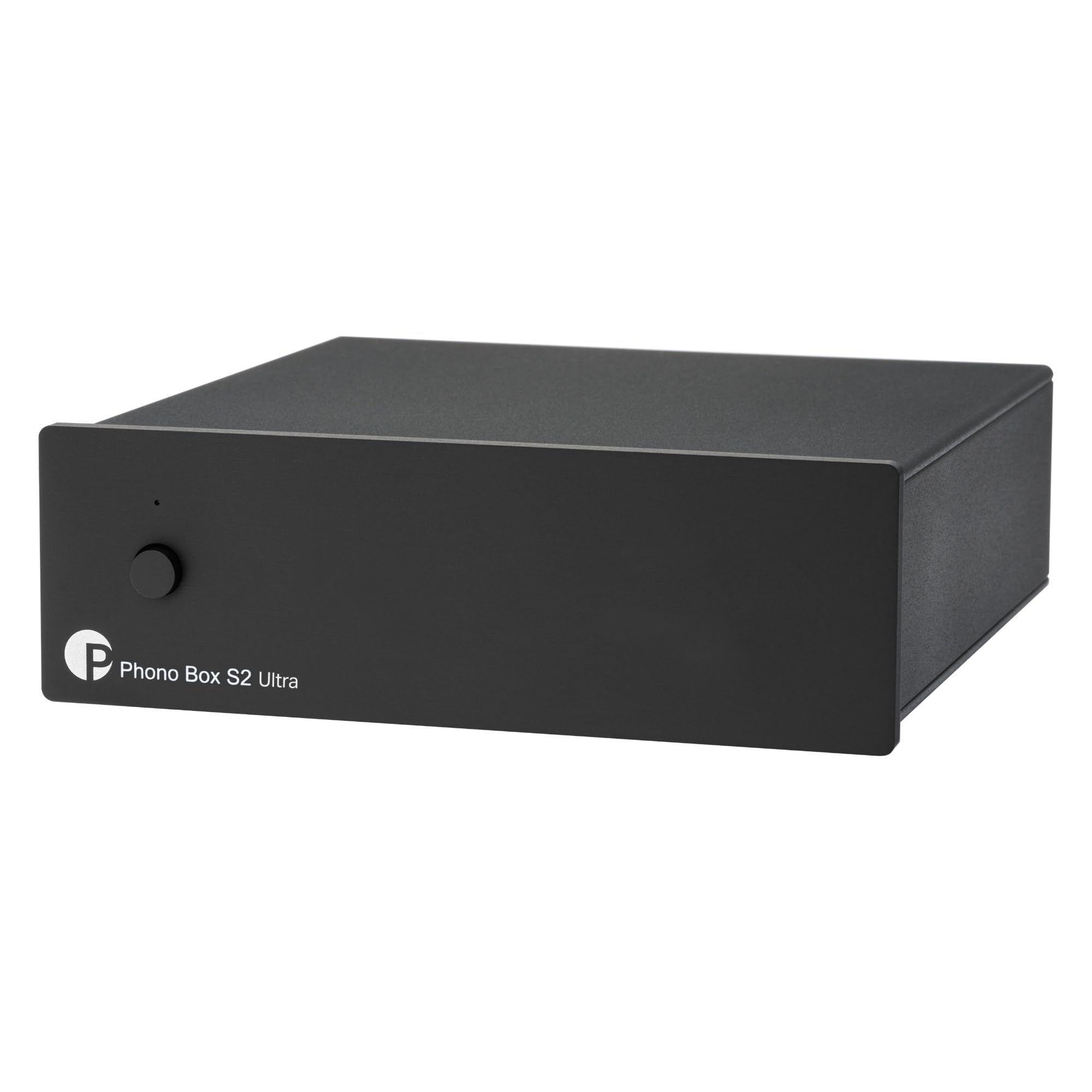
The Phono Box S2 Ultra earns its place on circuitry. It uses a fully discrete design — no op-amps, the ubiquitous chip amplifiers many budget stages rely on — along with high-quality polystyrene capacitors for accurate RIAA equalization. That combination of discrete circuitry and precise capacitors is what serious vinyl listeners pay extra for. Loading is switchable in both impedance and capacitance, there are four gain levels to cover MM and MC cartridges, and the metal housing shields the circuit from interference.
The result is a clean, detailed, natural presentation. Owners pairing it with an Ortofon 2M cartridge and a capable amp report crisp highs and tight bass, a clear step above a receiver’s onboard stage. It runs from a 18-volt DC supply, and the metalwork feels solid enough to survive shelf life. The tuning options mean you can dial in a cartridge’s tonal balance to taste rather than accepting one factory value.
The honest note is tonal. This preamp has a personality, and several owners describe it as lighter on bass than warmer competitors — one measured a notable drop after the low end. Treat the S2 Ultra as a detail and clarity tool rather than a bass-builder, and check your cartridge’s loading values match its DIP switch settings.
Where it wins: a discrete, op-amp-free signal path, polystyrene capacitors, and four gain levels with switchable loading in a shielded metal case.
Its bias: a crisp, uncolored character that favors the mids and highs. If you want warmth and weight in the bass, tune carefully or look elsewhere.
Choose this if: you are willing to set the DIP switches and want detail above all.
Consider alternatives if: your system is already lean and you want more low-end weight.
8. Fosi Audio Box X5 Phono Preamp

The value switch-hitter that covers MM and MC without asking for a tier-up budget.
The BOX X5 is the value story of the group. You get four gain settings — 38, 48, 56, and 66dB — a toggle for MM or MC cartridges, and precise RIAA equalization. Inside, Fosi lists 2% precision polyester film capacitors, green sleeve copper lead audio capacitors, 0.1% high-precision film resistors, gold-plated RCA jacks, and an OPA1612 op-amp. The all-aluminum chassis looks tidy on a desk, and a one-touch power button plus a convenient cartridge toggle make daily use painless. It measures 4.1 x 6.5 x 1.4 inches and runs on 120-volt AC with a 24 month manufacturer warranty.
Owners describe a thick, full, rich sound that beats their expectations for the entry tier. That 66dB top gain setting is genuinely useful for a low-output moving coil. It is a tough competitor against a built-in stage, and it does so without a preamp-shaped hole in your wallet.
Look closely at the power supply before you judge this one. Some early units shipped with a noisy brick that produced an audible hiss, and a replacement cured it. The MM/MC toggle and gain switch are also located on the chassis rather than in a remote app, which is convenient but limited compared to digitized geometry.
Where the value lands: four gain levels up to 66dB, MM/MC switching, gold-plated RCA jacks and an OPA1612 op-amp, backed by a 24 month manufacturer warranty.
What to check on arrival: the power supply. If a hiss appears, suspect the brick first before blaming the circuit.
The smart buy for: anyone stepping up from a built-in stage on a modest budget who wants MC capability and switchable gain.
Look elsewhere if: you want adjustable loading or can’t tolerate the possibility of a bad power brick.
9. Project Audio Phono Box DC Phono Preamp
A compact, no-frills all-rounder that quietly handles both cartridge types.
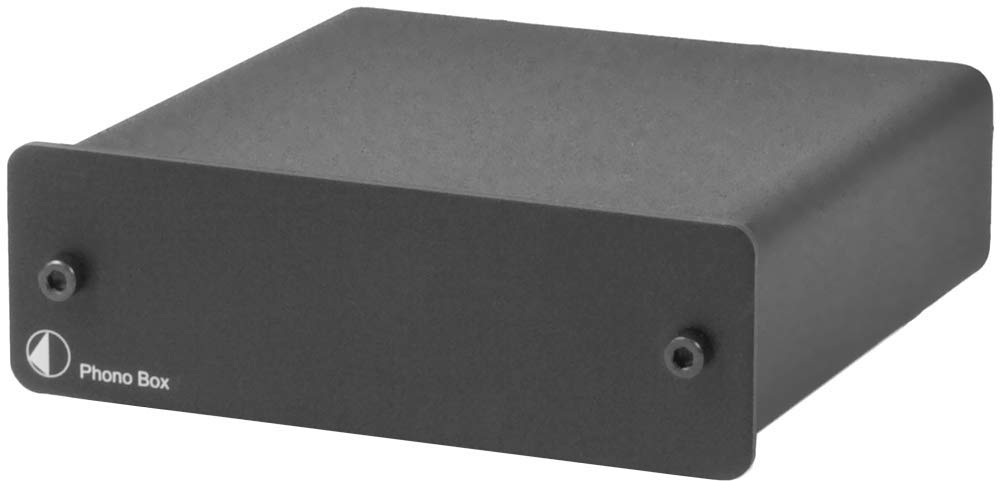
The Phono Box DC keeps things simple. A rear-panel switch selects moving magnet or moving coil, the compact chassis fits close to your turntable, and an ultra-low impedance output stage drives long cables without drama. Pro-Ject rates it for RIAA response accuracy of 0.5dB across 20-20,000 Hz, with total harmonic distortion of 0.01% for MM and 0.05% for MC. It ships in an all-metal case that feels substantial for the tier, and the always-on design means no LEDs to distract you at night.
Owners describe controlled, uncolored sound with realistic drums and detail that beats entry-level rivals. One buyer upgraded from a no-name and a Behringer unit and found the Pro-Ject cleaner, wider, and free of the speaker popping the cheaper boxes caused. If you want a stage you plug in once and forget, this fits that brief.
The compromise is adjustment. There is no gain knob and no loading selector — you take the factory settings and make do. The noise floor also draws mixed feedback; grounding and a clean outlet solve most of it, but this is not the quietest design in the group.
The strongest argument: a compact MM/MC stage with rated RIAA accuracy of 0.5dB, low distortion figures, and a solid metal chassis at the entry tier.
Its limitation: no gain or loading controls. It runs the cartridge as Pro-Ject intended, full stop.
A strong match for: plug-and-play listeners who want MM and MC flexibility without a single menu.
Think again if: you need to tune gain for an unusual cartridge.
Know the Specs
Gain in decibels, the amount your signal gets lifted
Gain is how much louder the preamp makes the tiny voltage from your cartridge. A moving magnet cartridge produces a stronger signal, so 38 to 45dB is often enough. A low-output moving coil produces a far smaller one and wants 56 to 66dB or more. If your volume feels weak even with the amp turned up, gain is the first thing to check.
Loading in ohms and picofarads, the tonal dial
Loading is the electrical resistance and capacitance the cartridge sees from the preamp. Switch the impedance between values like 47KΩ and 200Ω and you change the top-end behavior. Capacitance in picofarads does the same in finer increments. If you plan to swap cartridges, adjustable loading saves you from buying a new preamp each time.
RIAA accuracy, the playback curve
The RIAA curve is a standard playback equalization that rebalances bass and treble the way records were cut. A preamp that follows it accurately sounds natural and even. One that deviates can sound thin, boomy, or bright. Manufacturers quote this in decibels of accuracy across the frequency range, so tighter numbers are better.
Subsonic filters, taming warped vinyl
A subsonic filter strips out low-frequency rumble generated by warped records, motor vibration, or footfalls — the stuff your woofer should not be trying to reproduce. It is a low-pass for the very bottom of the audible band. Some preamps offer selectable slopes so you can fine-tune how aggressive the filter is.
Common Questions
Will a moving coil cartridge work with a moving magnet only preamp?
What gain setting should I start with on a moving magnet cartridge?
Why does my phono preamp hum, and can I fix it?
Can I connect a phono preamp to a soundbar or portable speaker?
Is a built-in turntable preamp good enough, or do I need a separate one?
What does the RIAA accuracy number actually tell me?
Do phono preamps wear out or need maintenance?
Does a subsonic filter hurt bass response?
Can I use a phono preamp with a receiver that has its own phono input?
What does “discrete circuitry” mean in a phono preamp?
The Bottom Line
For most vinyl rigs, the phono preamp under $1000 winner is the Schiit Mani 2 because its four gain settings and adjustable loading cover practically any cartridge you will ever own. If you want to tune the sound from your phone and feed a digital chain, the Parks Audio Waxwing is the one to reach for. And for a plug-and-play moving magnet stage with the longest warranty here, the U-Turn Pluto 2 quietly gets the job done. One last nudge: if you are still running a turntable’s built-in preamp, the upgrade to any of these is the cheapest, most obvious improvement left in your system.
How we choose
We do not accept paid placement. Every pick is matched to a real buyer and a real use-case; we do not hands-on test units.
Sources
Specifications: manufacturer listings and product documentation. Review insights: verified customer reviews, as of October 2026. Pricing: not shown on this page (it changes often); check the current price via the retailer link.
As an Amazon Associate, Aappliancez earns from qualifying purchases. This does not affect which products we feature.