Disclosure: Some links in this post are affiliate links. As an Amazon Associate I earn from qualifying purchases, at no extra cost to you. Learn more
Specs are compiled from manufacturer listings and verified buyer reviews and can change over time — please confirm the key details on the product page before buying.
You want to see a bird’s feather pattern from thirty yards, or pull a moon crater out of the night sky, and you want the phone in your pocket to be the screen and the camera. That is exactly what a phone scope does: it is a monocular or telephoto lens that clamps to your handset so the eyepiece view lands on your phone sensor. The catch most buyers hit first is that big magnification numbers on the box rarely match what you actually see, so the picks below are chosen on build, eyepiece fit, and real owner experience rather than headline specs. Here is the shortlist of what genuinely works with a phone attached.
This guide is built by comparing the manufacturers’ published specifications and the patterns across verified customer reviews, so you get each pick’s real strengths and trade-offs instead of marketing spin.
Magnification is only half the story — eyepiece diameter, prism glass, and a stable mount decide whether your photos come out sharp or shaky, so read on to find the phone scope that fits how you actually shoot.
Top Picks

How To Choose The Best Phone Scope
The single decision that ruins most phone-scope purchases is eyepiece fit. Every monocular here has an eyepiece of a certain outer diameter, and your phone clamp has to wrap that diameter without slipping. If the clamp is loose, your camera drifts off the lens and you get a black crescent around every photo. So before you buy anything, measure the eyepiece and check the adapter range.
Read the magnification label honestly
A marking like 80×100 means the maker claims 80-times magnification with a 100mm objective lens (the big front glass that gathers light). But on most phone scopes, that 80x only arrives when the phone’s own zoom is added on top. Expect usable, sharp images in the 10x to 15x range for most of these, and treat a huge number as a maximum claim rather than a normal view. Buyers of multiple scopes have called out the gap between the box number and what their eye sees.
Match the phone mount to your handset
Some adapters are made for a phones-within-a-width-range fit — for example a 2.36-inch to 3.44-inch grip band — and that is what keeps your camera centered over the eyepiece. A phone in a thick case can push past the limit, so check your phone’s width with the case on. If your phone is on the narrow side, a clamp that opens a little wider than its stated limit usually still grips, but a phone that is too wide is the real failure point.
Decide between a monocular and a dedicated phone lens
A monocular works with your eye or your phone, so it doubles as a spotting scope you use without a screen. A dedicated telephoto lens clips on for phone shots but is not a standalone viewer unless it ships with an eyecup. If you want to watch birds with your eye and grab a photo now and then, choose the monocular. If phone photography is the whole point, the lens is lighter and quicker.
Factor in the tripod and low-light glass
Handholding a phone scope at high zoom magnifies every shake, so a tripod is not a luxury. Look for a tripod plus a phone holder that locks together. Also look for BAK4 prism and FMC (fully multi-coated) glass — those are the two labels that tell you the optics gather light well and reduce glare, which is what lets a dawn or dusk view stay readable.
Side-by-Side Comparison
| Model | Best For | Magnification | Objective Lens | Weight | Amazon |
|---|---|---|---|---|---|
| Monocular Telescope 80X100 HD with Smartphone Adapter Tripod★ Best Overall | All-round birding and travel | 80x | 100mm | 1.4 lb | Amazon |
| tridaptor 3-Axis Universal Digiscoping AdapterPrecision Pick | Precise phone-to-scope alignment | — | — | 233.5 g | Amazon |
| MIAO LAB 30X Telephoto Lens | Moon and concert close-ups | 30x | — | — | Amazon |
| 15×55 Monocular Telescope for Adults | Daylight spotting and hiking | 15x | 55mm | 1.4 lb | Amazon |
| 80×100 Monocular Telescope for Smartphones (Amither) | Family-friendly wildlife viewing | 80x with phone zoom | — | 0.55 kg | Amazon |
| Monocular Telescope (VY889) | Budget-friendly starter scope | — | — | 16 oz | Amazon |
| Monocular-Telescope 80×100 High Definition (Dark Green) | Cheap one-handed carry | 80x claim | 21mm | — | Amazon |
Detailed Reviews
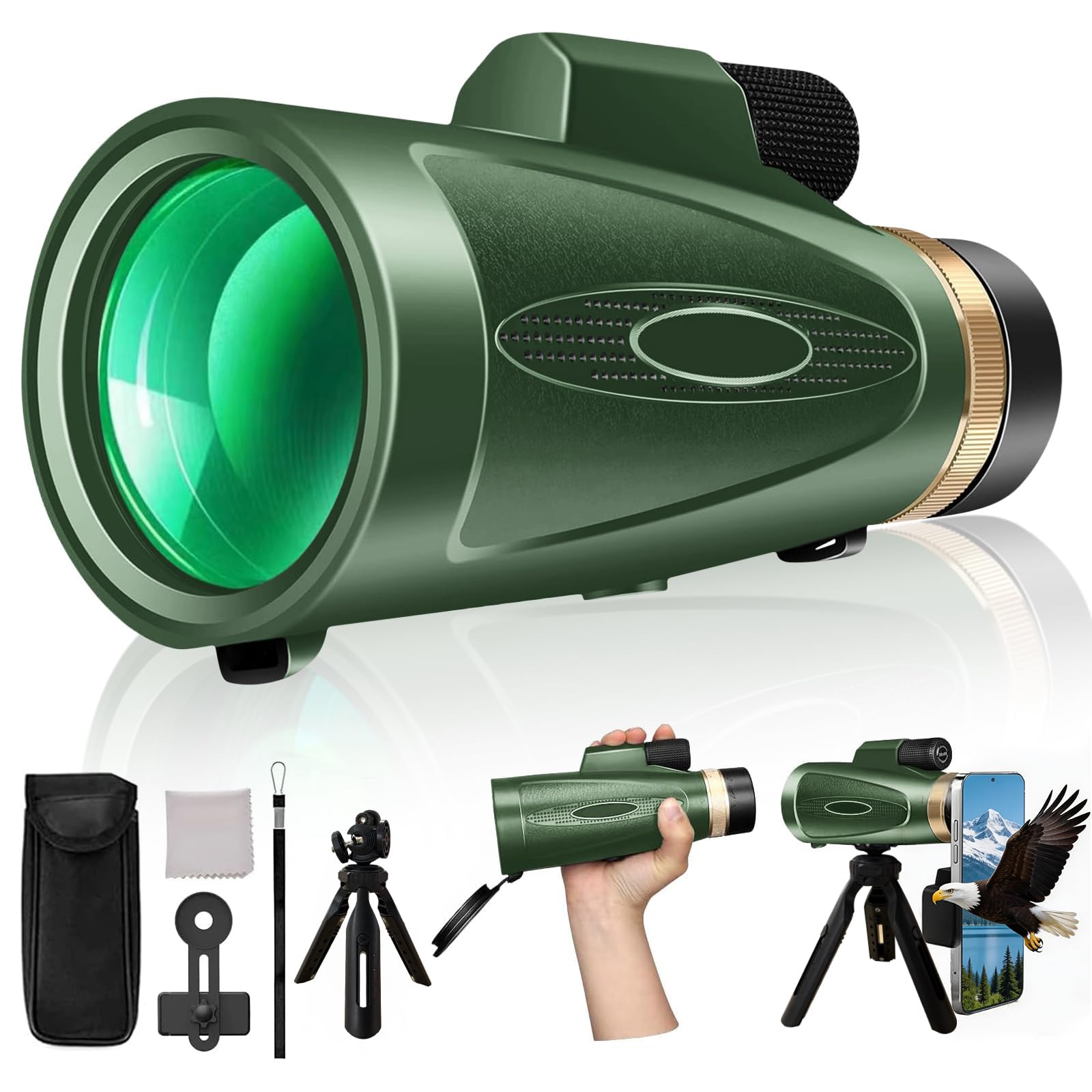
1. Monocular Telescope 80X100
Our pick — 4.5+★ from 100+ verified ratings; the strongest balance of quality and price.
The one that keeps feather pattern and color sharp when the bird is too far to trust your eyes.
The headline here is a pair of numbers that work together: 80x magnification and a 100mm objective lens (the front glass that decides how much light reaches your eye). In plain terms, that big front lens is why the view stays bright instead of grey at dusk. It pairs the BAK4 prism with an FMC multi-coated lens, and those two are the reason reflections drop and colors come through natural rather than washed out.
What wins people over is the clarity, and it is the thing the review pages keep returning to — the view holds fine detail like feather pattern without blurry edges. The phone setup earns its own praise, because the quick-alignment smartphone holder and the tripod turn a wobbling handheld peek into a stable photo you can actually share. As buyers report, “The rubberized body gives a secure, non-slip grip, and the included tripod steadies long observation sessions.”
It is reasonably compact at 1.4 pounds, light enough to carry on a hike but heavy enough to feel steady. On size, it runs larger than the VY889 monocular below — 7.48″D x 3.46″W x 3.86″H against 5.45″D x 4.69″W x 4.86″H. The honest catch is that the 80x figure is the ceiling, not the everyday view; expect to lean on the tripod and the phone zoom for the sharpest long-range shots. Twisting the adjustable eyecup also matters if you wear glasses, since it lets you set the exact eye relief.
What earns it first place
- Bright, color-true view from the 100mm objective lens and BAK4 prism
- Quick-alignment phone holder plus tripod make shareable photos easy
- Rubber armor gives a secure, non-slip grip during long sessions
- Full kit includes carry pouch, cleaning cloth, and adapter
- Adjustable eyecup suits glasses wearers and bare eyes alike
Where it asks a little patience
- The 80x is a maximum claim, so the sharpest practical view comes from the tripod plus phone zoom
- At 1.4 pounds it is a carry-on piece, not a pocket one
Go for it if: you want one scope that birds by eye and photographs by phone without fuss.
Think twice if: you need a truly pocketable viewer — the VY889 below is the lighter, smaller route.
2. tridaptor Universal Digiscoping Adapter
The fix for every blurry edge and half-lit shot your flimsy plastic clamp keeps producing.
If you already own a scope and the photos keep coming out with a dark crescent or a drifting phone, the problem is the adapter, not the optics. This one is machined aluminum with three axes of adjustment — left/right, up/down, and forward/back — so you can slide the camera to the right eye relief and kill the vignetting (that dark ring at the corners). The Z-axis (forward/back) twist is the piece cheap mounts skip, and it is what makes the difference between a framed shot and a cropped one.
You get fine control over your framing, and that is what owners talk about most. The fine screw drives let you nudge in tiny increments instead of jumping past the balance. It grips phones from 2.36 inches to 3.44 inches wide (60–87.5 mm), so it stays with you through a phone upgrade. The rubber pads protect both phone and eyepiece from scratches. Its eyepiece clamp spans 0.86 to 2.4 inches outer diameter (22–61 mm), covering most Vortex, Swarovski, Celestron, Nikon, Zeiss, Kowa, and Leupold glass.
Here is the part a buyer needs to hear clearly: measure your eyepiece before ordering. A few owners found the alignment fiddly at first, and the setup is deliberate rather than instant — this is a tool you fit once and leave fitted. It also adds 233.5 grams to the top of your scope, which you notice on a long stalk. Once aligned, though, the metal body holds position without the sagging and drifting that plastic holders suffer on every shot.
The trade-off in plain words: this is the premium answer to a fiddly problem, and it earns that by holding still. If your current mount slides out of alignment mid-session, this solves exactly that.
The measurement to make first: confirm your eyepiece outer diameter falls inside 0.86″–2.4″ and your phone width inside 2.36″–3.44″ — those two checks are the whole purchase.
Best matched to: anyone with a spotting scope or monocular already in the bag who wants phone photos worth keeping.
Not for: a buyer who wants a scope and mount in one box — start with the Best Overall instead.
3. MIAO LAB 30X Telephoto Lens for Phone
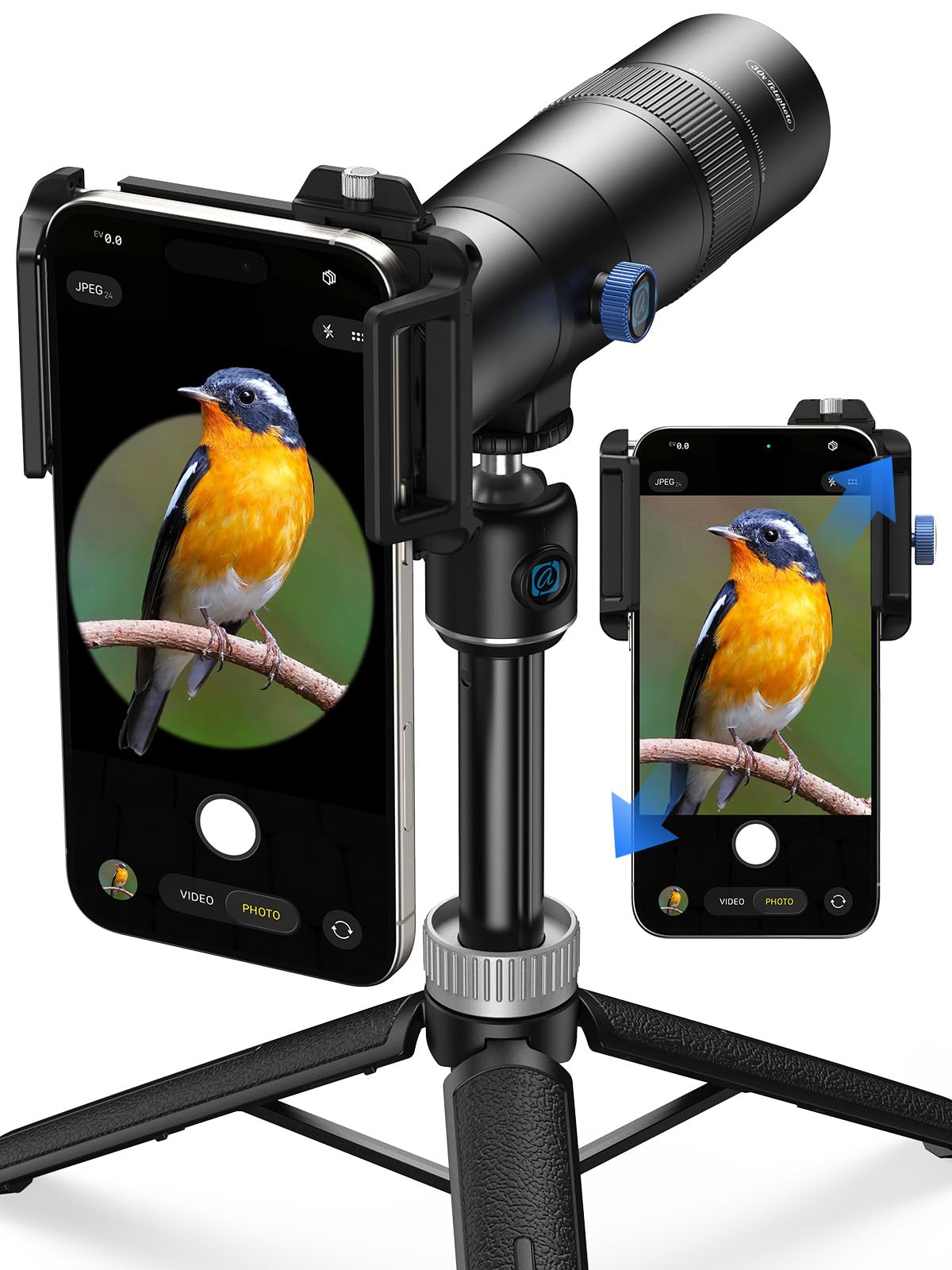
Clip-on reach for the moon, a stage, or a hawk on a far branch — no eyepiece needed.
This is a different kind of phone scope: a 30X telephoto lens that clips straight onto your phone’s main camera, built from aluminum alloy with multi-coated glass. It is not a monocular in the traditional sense, but fitting the included silicone eyecup turns it into a handheld viewer for real-time watching. The dual-mode trick is the draw — shoot through the phone, or pop the eyecup on and just look.
The phone clip fits most handsets from 2.8 to 3.9 inches wide (70–100 mm), and it is stated to exclude the iPhone Mini and SE series, so check your model first. The focus ring is manual, and a few owners have noted it is sensitive — small turns go a long way. Expect to spend a moment dialing it in. The included aluminum tripod and fixing ring steady long-range shots, and a lock screw holds the lens in place — a detail many rivals skip.
The practical limit is real: this is not a night-vision device, and it relies on your phone’s lens selection. Some owners found the phone auto-switching cameras caused dark frames in daylight until they set manual lens choice. That is a phone setting, not a lens flaw, but it is worth knowing before you blame the glass. The mount adjusts horizontally only, so a phone that sits slightly high or low can add a bit of shake.
Why phone photographers rate it
- 30X telephoto in an aluminum alloy body that travels easily
- Dual-mode design works as a clip-on lens or a handheld viewer with the eyecup
- Lock screw and fixing ring keep the lens secure on a tripod
- Adjustable phone clip spans 2.8–3.9 inches
What to accept going in
- Focus ring is sensitive and needs a gentle hand
- Mount adjusts horizontally only, so slight vertical misalignment can add shake
- No image stabilization — a steady tripod is essential at 30X
Worth reaching for if: your goal is moon photos, concert close-ups, or wildlife from a fixed spot rather than a general spotting scope.
Look elsewhere if: you want a standalone monocular as your primary viewer — the Best Overall is a truer fit.
4. 15×55 Monocular Telescope
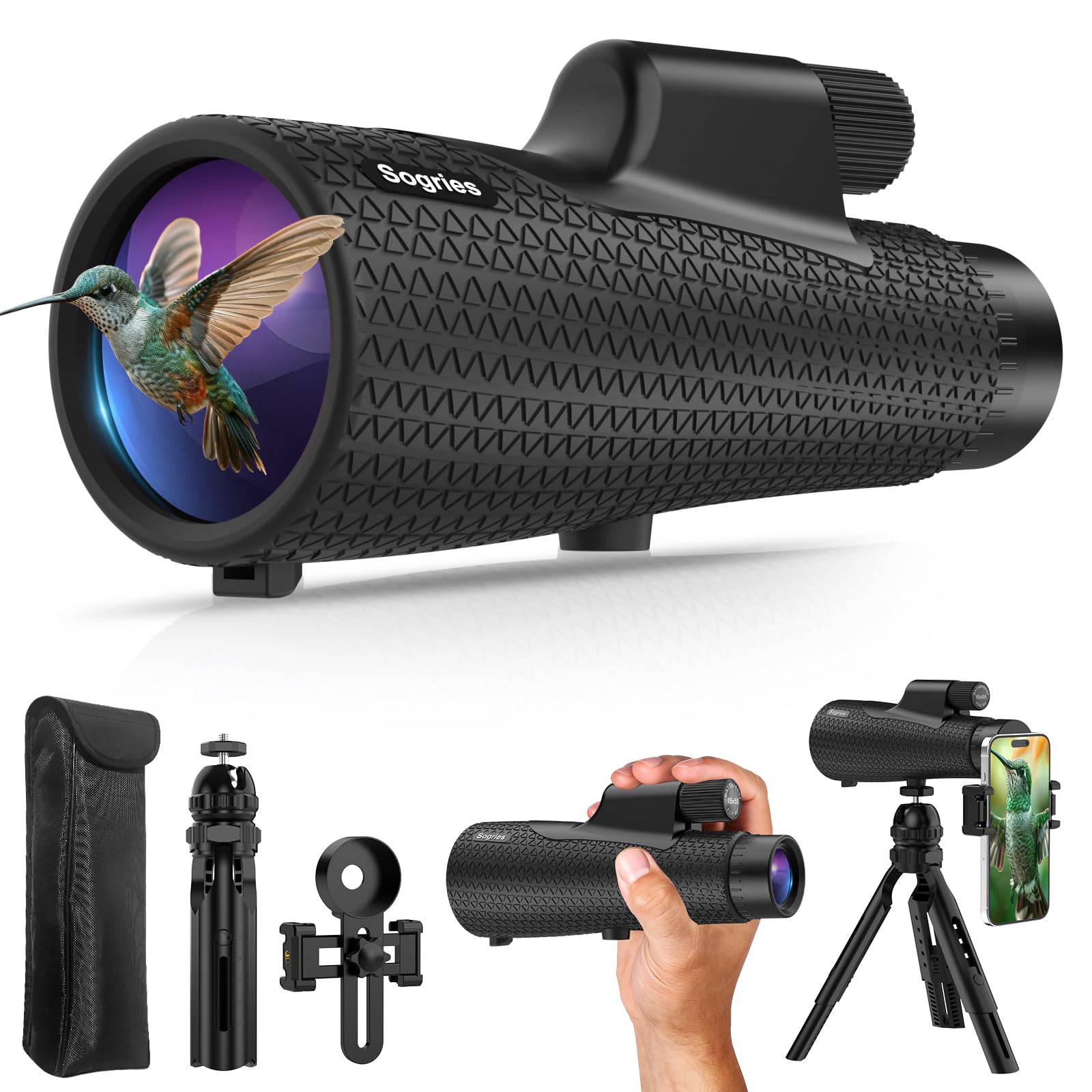
The rugged, honest 15x that suits a hike, a campsite, or a ballgame in good light.
Here is the number that tells you what to expect: 15x magnification with a 55mm objective lens. That is a daylight scope, and it is sharpest in good light — owners note that clarity drops off once the sun goes down. The BAK4 prism and FMC multi-coated lenses gather light and cut glare, keeping a morning view crisp. Shock-resistant rubber armor carries a waterproof and fogproof claim for rainy or dusty outings.
The build feels solid, and that is partly the weight — 1.4 pounds in hand reads as sturdy rather than flimsy. What people most reliably report is a clear image with smooth focus, and one buyer’s take captures the everyday value: “Clear optics, smooth focus, and a sharp view at moderate distance make it a handy camping scope.” The quick-align smartphone mount and tripod mount round it out, so you can grab a distant view as a photo too.
The one thing to know before you buy: the magnification is modest, and that is on purpose. This is a fixed-focus unit meant for a straight, honest view, not a zoom monster — pair it with a steady hand or the tripod and it delivers. The rubber armor and moderate weight make it a sensible pick for a hiker or camper who values a clear, durable view over a huge number on the box.
Where the value lives: tough outdoor build, a 15×55 view, and phone-and-tripod mounts all in one piece — it covers a lot of ground without costing like a specialist scope.
The honest limit: it is a daylight scope. Dawn, dusk, and deep shade are not its strong suit, so pair it with bright conditions.
Suits: the hiker or camper who wants a hardy, low-fuss scope with a shareable phone view.
Move on if: you need long-range zoom or low-light reach — the Best Overall carries a bigger objective for that.
5. 80×100 Monocular Telescope for Smartphones (Amither)

The wide-view family scope that hands a kid a distant world and shares it as a photo.
The spec worth pausing on is the field of view: 7 degrees, or 363 feet at 1,000 yards (121 meters at 1,000 meters). That is a wide sweep of the landscape in one look, which makes tracking a moving bird or a grandkid on a field much easier than a narrow tunnel view. The real 80X magnification is stated as achievable when paired with a 10X smartphone lens, and the dual focus helps you snap to a target fast.
Build quality is the aspect owners appreciate most, and it reads as sturdy and well made rather than toy-like. The BAK4 prism and FMC green film-coated lens gather light for targets with some light source, though the maker notes it does not work in complete darkness. The tripod and phone adapter take the waver out of long looks, and it handles most Android and iOS phones. It arrives with lens caps, a hand strap, and a storage bag in the box.
Expect the sharpest, steadiest image from the tripod, and accept that at 0.55 kg it is a bag item rather than a pocket one. The view is best at reasonable distances; for lunar-crater detail you will want a specialist optic. For family outings, backyard wildlife, and a scope the kids can actually handle, it does the job comfortably.
The case for the wide sweep
- 7-degree field of view and 363ft/1000yds FOV keep moving subjects in frame
- Sturdy build that kids and adults can both use
- BAK4 prism and FMC lens for a bright, natural-color image
- Full kit with tripod, adapter, caps, strap, and bag
Where expectations need settling
- Real 80X only arrives with a 10X phone lens attached
- It needs some light source on the target; not for total darkness
Picture this in the yard: a scope the whole family passes around, with a phone adapter for the shots you want to keep.
Pass if: you need crater-level detail on the moon or a pocket-size carry.
6. Monocular Telescope (VY889)

A light, small monocular you can hand to a child without wincing at the cost.
This one earns its spot on size and simplicity. It is a compact 16-ounce monocular built for one-handed use, with a large-lens design for a wide view and an adjustable eyecup that suits glasses wearers. The included tripod steadies the view, and the smartphone adapter lets you turn a bird sighting into a photo.
You can hand this scope to a kid without worry, and that is what people keep coming back to. It reads as a kid-friendly, lightweight scope with high resolution for its size. A buyer put the whole idea neatly: “A high-resolution monocular with a practical phone adapter for distant photos.” The protective bag in the box guards against scratches, and the light build makes it a natural walking companion.
You are not buying a giant jug of brightness here, and that is fine — the scope is small and versatile, so match it to daylight wildlife and quick looks. Set expectations at that level and it delivers. For the price of entry, it gets a first-time viewer outdoors with a working phone adapter attached.
The quiet win: 16 ounces of easy carry with a phone adapter and tripod — a starter scope you can actually keep in a daypack.
What you give up: it is a modest, small monocular, so long-distance detail and low light are not where it shines.
Reach for this if: you want a light, kid-friendly scope for backyard or trailhead viewing on a budget.
Look to the Best Overall if: you want feather-level detail at real distance.
7. Monocular-Telescope 80×100 High Definition (Dark Green)
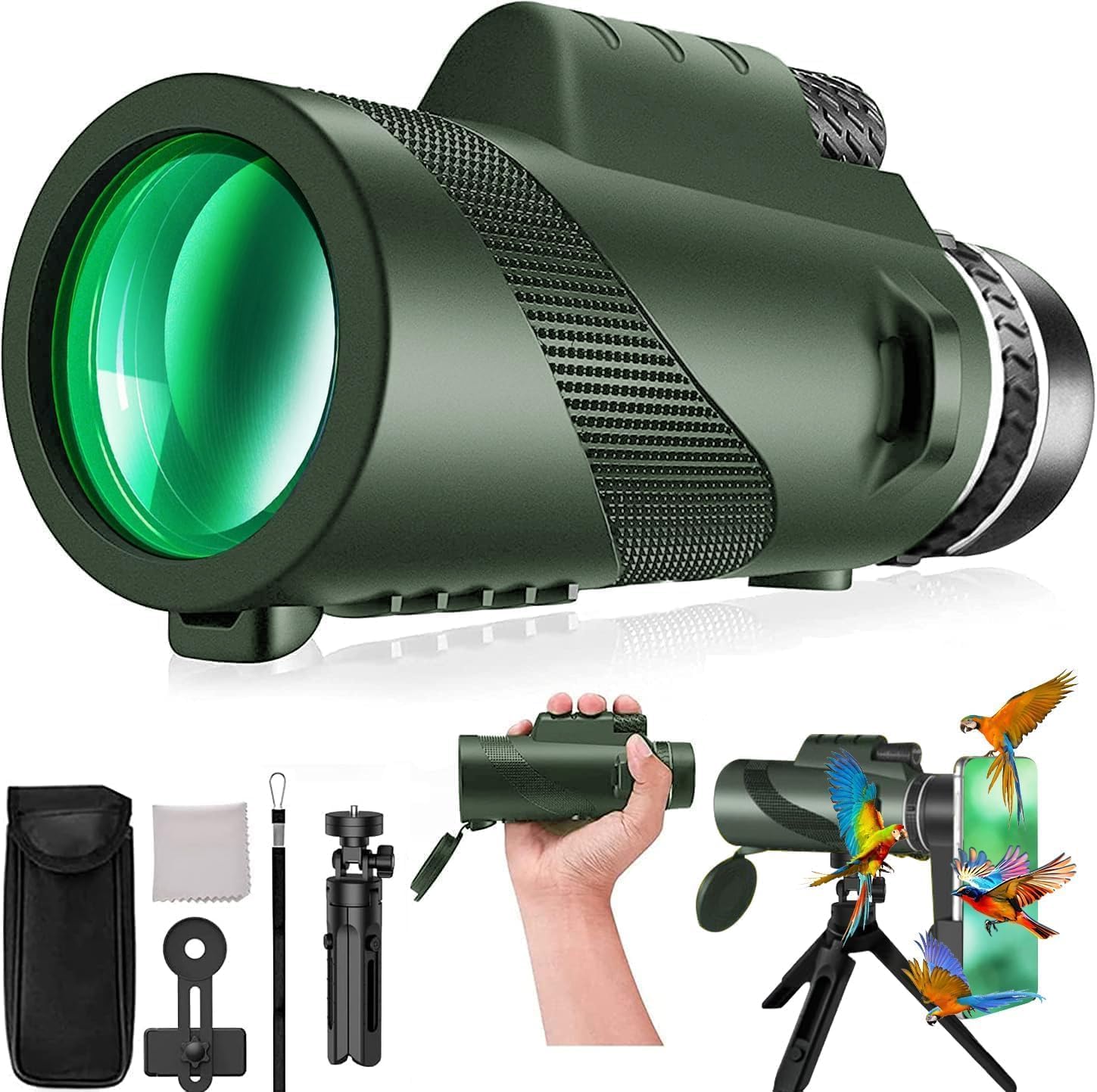
Small, cheap, and genuinely handy for a quick one-handed look at close range.
Buy this one for what it is: a small, lightweight monocular with a 21mm objective lens that fits in a jacket pocket and focuses one-handed. The adjustable eyecup twists to intermediate settings for a custom fit with or without glasses, and the quick-positioning phone adapter plus tripod let you grab a photo of whatever catches your eye. For a kid’s first scope or a spare in the truck, that combination is sensible.
The real talk on the 80×100 claim is where a buyer should focus. This is a compact, entry-level optic, and at high magnification the sharpest area sits toward the center of the field of view. Clarity is the part that lands — the picture is clear in the middle — but it is not a long-reach performer. Plan on using it for a few hundred feet of spotting, archery practice, or a quick look at wildlife, and it does that fine.
Treat the magnification number as marketing and judge it on the small, handy carry and one-handed focus. The phone adapter is a nice addition at this tier, and the whole thing disappears into a bag. If you want honest long-distance detail, step up to the Best Overall; if you want a pocketable spare, this is the cheapest way in.
Where it fits: a spare, lightweight scope for a kid, a glovebox, or a quick archery-practice peek — the small size and one-hand focus are its real strengths.
The number to ignore: the 80×100 label outruns the optics, so expect a clear center view at modest range rather than deep zoom.
Best for: a cheap, carry-anywhere first scope with a working phone adapter.
Step up if: real distance and feather detail matter — this one is a close-range spare.
Know the Specs
Magnification and the 80×100 label
Magnification tells you how many times closer a distant object appears. A marking like 80×100 pairs 80x magnification with a 100mm objective lens — the big front glass that decides light gathering. Larger objective lenses keep a view bright at dusk, while a small one (like the 21mm on the Dark Green pick) is easy to carry but dimmer at distance. The trap is that the headline number is usually a maximum arrived at with your phone’s own zoom stacked on top, so judge real sharpness on the eyepiece view at moderate range.
Objective lens and BAK4 prism
The objective lens is the front glass that gathers light; a BAK4 prism is a type of glass block inside the scope that bends light to your eye with fewer losses than cheaper prisms. Together with an FMC (fully multi-coated) coating — a layered anti-reflection film on the glass — you get a brighter, more contrasty image with less glare. That matters most when light is low: dawn birding, a shaded trail, or a moon shot. These are the labels that separate a clear image from a washed-out one.
Field of view
Field of view (FOV) is how wide a slice of the world you see at once, usually given in degrees or in feet at 1,000 yards. A 7-degree view, like the Amither’s 363 feet at 1,000 yards, keeps a moving subject in frame; a narrow view magnifies more but makes tracking a flying bird a chore. Pick a wider FOV for wildlife you have to follow, and accept a narrower one if sheer reach is your goal.
Eyepiece diameter and phone mounting
The eyepiece is where you look, and its outer diameter is the number that decides whether a phone clamp will wrap it. Adapters list a range — the tridaptor fits 0.86 to 2.4 inches — and phone grips list a phone-width range like 2.36 to 3.44 inches. If your eyepiece is fatter or your phone is wider than the stated range, the clamp will not seat, and you get the dreaded dark ring. Measure both before ordering.
Common Questions
Will a phone scope magnify as much as the box claims?
How do I know if my phone will fit the adapter?
What is the difference between a monocular and a clip-on telephoto lens?
Do I need a tripod to use a phone scope well?
Why does my phone photo have a dark ring around the edges?
Can I use a phone scope at night or for stargazing?
Will a phone scope work if I wear glasses?
Is a heavier scope better than a light one?
What is the difference between 80×100 and 15×55?
Can I share a phone scope with a child or beginner?
The Bottom Line
Your best all-round pick is the Monocular Telescope 80X100 HD with Smartphone Adapter Tripod. Its 100mm objective lens (the big front glass that gathers light) and BAK4 prism (a glass block that keeps the image bright and sharp) keep a bird’s color and detail clear. The quick-align phone holder makes a keepable photo easy. If precise phone alignment is the thing your shots keep missing, the tridaptor 3-Axis Adapter solves it in metal. And for the buyer who wants a pocketable spare or a kid’s first scope, the light, one-handed VY889 monocular is the easy way in — a genuine starter with a phone adapter attached.
How we choose
We do not accept paid placement. Every pick is matched to a real buyer and a real use-case; we do not hands-on test units.
Sources
Specifications: manufacturer listings and product documentation. Review insights: verified customer reviews, as of October 2026. Pricing: not shown on this page (it changes often); check the current price via the retailer link.
As an Amazon Associate, Aappliancez earns from qualifying purchases. This does not affect which products we feature.