Disclosure: Some links in this post are affiliate links. As an Amazon Associate I earn from qualifying purchases, at no extra cost to you. Learn more
Specs are compiled from manufacturer listings and verified buyer reviews and can change over time — please confirm the key details on the product page before buying.
Rooting a phone is not really about the phone — it is about whether the manufacturer lets you near the bootloader in the first place. Get that one detail wrong and you own a very expensive paperweight with a locked door. Every pick here was chosen because it either ships unlockable or has a community that has already done the hard work for you, and the rest of this page tells you which trade-offs you are actually accepting.
This guide is built by comparing the manufacturers’ published specifications and the patterns across verified customer reviews, so you get each pick’s real strengths and trade-offs instead of marketing spin.
Some of these phones hand you a clean open up, some need a code from the maker, and one of them has a chipset the custom-ROM crowd already knows by heart. Below you will find the 9 picks worth your money for a rooting project, sorted so the strongest all-rounders come first and the niche machines land at the end. This breakdown of the Best Phone for Rooting separates phones you can actually flash from phones that only look the part.
Top Picks


How To Choose The Best Phone for Rooting
The fastest way to waste money here is to buy a beautiful phone that refuses to open up. Rooting lives or dies on three things: whether the bootloader can be open up, whether your chipset has developer support, and whether the carrier you bought it from will let you near it. Everything else — camera megapixels, screen refresh rate, colour — is a bonus you should pick after those three are settled.
Start with the bootloader, not the camera
A bootloader is the small piece of software that decides what operating system your phone is allowed to start. Locking it is how manufacturers stop you installing anything they did not sign. Some brands hand you an open up code through a web form; others bury the toggle in developer settings; carrier-locked units often block the whole process. Always confirm the exact model number is unlockable before you buy, because the same phone name can ship in several regional variants with different rules.
Chipset support decides how much fun you get to have
Custom ROM builders follow chipsets, not brand logos. A phone running a widely used Snapdragon or MediaTek Dimensity chip with a large owner base gets builds, kernels, and recovery images for years. An obscure chip in a niche phone can leave you stranded with nothing to flash. If you want a long rooting life, favour the chip that thousands of other people already own.
RAM and storage are your flashing headroom
A second OS, a recovery partition, Magisk modules, and a pile of backups all eat space. Flash memory is the storage your apps and photos live on, and running short mid-flash is how people brick devices. 256GB is a comfortable floor for a tinkerer; 512GB lets you keep a full backup on-device and stop worrying.
Carrier locking is the silent deal-breaker
An open up phone from the manufacturer is not the same as an open up phone from a carrier. Several models here list exactly which US networks they work on, and Metro, Verizon, AT&T, and Cricket appear on the exclusion lists more than once. Read that line twice — no rooting guide can fix a radio that will not register on your network.
Side-by-Side Comparison
| Model | Best For | Battery | RAM + Storage | Chipset | Amazon |
|---|---|---|---|---|---|
| Motorola razr 2024★ Best Overall | Pocketable everyday root project | 4200mAh | 8GB / 256GB | — | Amazon |
| Xiaomi 14T ProFastest Charging | Fastest charging flash machine | 5000mAh | 12GB / 512GB | MediaTek Dimensity 9300+ | Amazon |
| BLU Bold N4 5GBest Value | Best value dual-screen tinkerer | 5000mAh | 8GB / 512GB | MediaTek 8-core 2.5GHz | Amazon |
| Xiaomi Redmi Note 14 Pro+ | Big-camera mid-range project | 5110mAh | 8GB / 256GB | Snapdragon 7s Gen 3 | Amazon |
| Google Pixel 7 | Cleanest software to modify | 4277mAh | 256GB | Google Tensor G2 | Amazon |
| 8849 Tank 3 Pro | Rugged tool with a projector | 23800mAh | 32GB / 512GB | MediaTek Dimensity 8200 | Amazon |
| Nothing Phone (3) | Quirky hardware, clean Android | 5150mAh | 256GB | Snapdragon 8s Gen 4 | Amazon |
| Google Pixel Fold | Foldable multi-window workhorse | 4821mAh | 256GB | Google Tensor G2 | Amazon |
| OnePlus 15R | Marathon battery for long sessions | 7400mAh | 12GB / 512GB | Snapdragon 8 Gen 5 | Amazon |
Detailed Reviews
1. Motorola razr 2024 8/256GB
Our pick — 4.0+★ from 550+ verified ratings; the strongest balance of quality and price.
The flip phone that folds small enough to vanish, yet still hands you a full Android to play with.
The headline number here is the 3.6-inch external display — the small screen on the outside you can use without opening the phone. That is a full 2.4 times larger than the panel on the previous razr generation, per Motorola’s own comparison. In practice you get a screen big enough to run most of your apps closed, which matters when you are flashing and rebooting: you can watch the boot sequence without unfolding the thing every time.
Inside sits a 4200mAh battery (milliamp-hours, the standard measure of phone battery size) paired with TurboPower 30W charging and wireless charging support. That 30W figure is the honest limiter next to the Xiaomi 14T Pro, which lists 120W — a 4.0x gap in charging power. Its 4200mAh cell also holds 19% less capacity than the Xiaomi’s 5000mAh. If your rooting sessions run long and you hate waiting on a cable, that difference shows up in real time.
It folds down small, and the vegan leather back keeps its grip in your hand. Owners coming from Pixel phones describe the crease as barely noticeable and the hinge as satisfying rather than loose. The 256GB of storage with 8GB of RAM is generous enough for a second partition and a full backup. The trade-off is durability chatter around the screen — folding panels are simply more delicate than a slab, and a small number of units arrive with display faults. Treat this as a phone you root carefully, not one you experiment on recklessly.
What earns it the top slot
- Bootloader-friendly Motorola software and an open up GSM build that connects easily to prepaid carriers — as buyers report, “it was open up, so I was able to connect it easily with my metro account.”
- 3.6″ external display lets you monitor a reboot or a flash without opening the fold.
- 256GB storage and 8GB RAM leave room for a custom ROM plus backups.
- Wireless charging means you can top up between tests without hunting for a cable.
Where it asks you to be careful
- A folding display is more fragile than a flat slab — some units have arrived with screen faults.
- 4200mAh is the smallest battery among the flagship-adjacent picks here.
- Some apps misbehave on the small outer screen, so launcher tweaks can look squished.
- The internal screen protector is not meant to be removed.
The 4.0+ star consensus reflects a phone people enjoy using daily, not a spec-sheet champion. It is the one to pick when you want a small, unlockable Android that disappears into a pocket and does not scream “project phone” while you are mid-flash.
Grab this one if: you want an unlockable, pocketable Android with a genuinely usable outer screen and 256GB to work in.
Think twice if: you plan brutal, extended flashing marathons — the 4200mAh cell and folding panel both reward a gentler hand.
2. Xiaomi 14T Pro 5G 512GB
A global-open up powerhouse with 120W charging and a chipset the ROM scene already knows.
Twelve gigabytes of RAM and 512GB of storage is the spec sheet that should get a tinkerer’s attention first. That is more working memory than most of the picks here and double the storage of the Pixel 7. A second ROM, a recovery environment, Magisk modules, and a stack of TWRP backups all sit comfortably inside it. The MediaTek Dimensity 9300+ at the core is a 4nm chip with a Cortex-X4 setup running up to 3.4GHz, and it is exactly the kind of mainstream silicon that custom kernels get built for.
Charging is the loudest number on the page: 120W HyperCharge on a 5000mAh battery. Against the Motorola razr above at 30W, that is a 4.0x gap in delivered power, and the 5000mAh cell holds 19% more capacity than the razr’s 4200mAh. Translation for a rooting session: you plug in, eat lunch, and come back to a full battery instead of watching a percentage tick. The 6.67-inch AMOLED runs a 2712 x 1220 resolution at 446 pixels per inch with a refresh rate up to 144Hz, so the screen is genuinely pleasant to stare at while you are waiting on a boot.
The catch is carrier reality. This is an international model with no US warranty, and Xiaomi states plainly that it works only with T-Mobile, Mint, and Tello — not Verizon, AT&T, Cricket, or Metro. Owners also note the box includes an EU charger, so US buyers need an adapter, and there is no microSD slot and no headphone jack. If you are already on a T-Mobile network and know it, those are minor. If you are not, they are disqualifying.
The Leica angle: A 50MP main sensor with OIS, a 50MP telephoto, and a 12MP ultra-wide, all wearing Leica branding and lens coatings — more camera than most rooting projects ever need, but pleasant to have.
The honest catch: Confirm your carrier before you buy. The T-Mobile/Mint/Tello restriction is written into the listing, and no amount of custom software fixes a radio that will not register.
Right for: T-Mobile and Mint users who want maximum RAM and storage plus the fastest charging on this list.
Wrong for: Verizon or AT&T households, where this phone simply will not work as a daily driver.
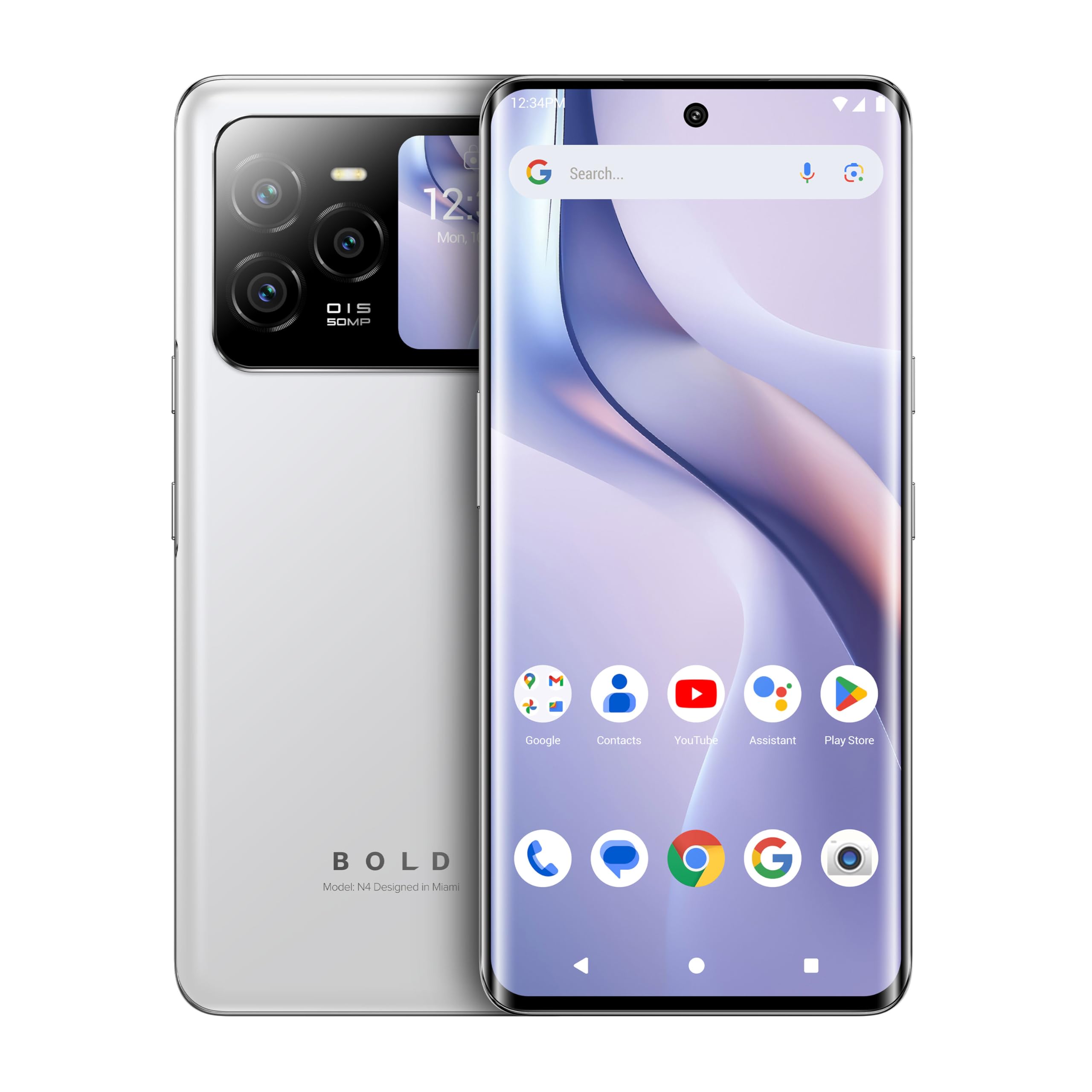
3. BLU Bold N4 5G
512GB of storage, a second screen on the back, and a US warranty at a mid-range ask.
Two things make the Bold N4 worth a look for a rooting project: 512GB of storage at an 8GB RAM tier, and a US-version build with a US warranty. That is a rare combination. Most budget phones make you choose between generous storage and local support. This one carries Android 15 from the start, which means you are starting from a recent base instead of immediately hunting for an OTA.
The hardware is more interesting than the spec sheet suggests. There is a 6.78-inch curved AMOLED main screen at 2340 x 1080, plus a 1.74-inch rear display for selfies, messages, and music controls. That rear panel is the kind of gimmick that usually turns out to be useless — owners say the opposite, describing it as functional rather than decorative. Charging is 66W and Motorola-free: BLU claims a 0 to 100% top-up in about 20 minutes on the 5000mAh cell, and buyers back that up. Functionality is the thing praised most here, and the value story is close behind it.
The honest limitation is the network. BLU lists T-Mobile, Metro PCS, and other GSM carriers, and explicitly excludes AT&T, Cricket, Verizon, and Sprint. There is also no microSD slot, which stings less when you already have 512GB. Accessory support is thin too — the curved edges make screen protectors fussy, and aftermarket cases are scarce, though a case is included in the box.
The real-world read: Buyers describe flagship-adjacent smoothness, a Mediatek 8-core 2.5GHz chip, a 120Hz refresh rate, and a 429 DPI panel in the same breath as phones that cost several times more.
The catch worth knowing: Future Android version updates are the recurring wish, so treat the software you get as largely the software you keep — which for a rooted phone is often the point.
Match for: GSM-carrier users who want a huge storage pool and a second screen without paying premium prices.
Not for: Verizon, AT&T, or Cricket lines, and anyone who needs a microSD slot or a deep accessory ecosystem.
4. XIAOMI Redmi Note 14 Pro+ Plus 5G 256GB

The 200MP camera phone that also happens to run a Snapdragon — and a 5110mAh battery.
The quiet selling point is the Snapdragon chip inside. The 7s Gen 3 is a 4nm octa-core chip (a processor built on a 4-nanometer process) running up to 2.5GHz with an Adreno GPU (the graphics chip), and it is the same family that custom recovery projects target first. The camera is still the headline — a 200MP main sensor with optical image stabilization (OIS: a physical stabilizer that fights hand shake) sitting on a 1/1.4-inch sensor — but it is the Snapdragon underneath that earns this phone its place on a rooting shortlist.
Battery is 5110mAh, and the box ships with a 120W HyperCharge setup. Xiaomi lists a 120W in-box charger in the camera-focused spec block and a 45W wall adapter in the accessory line, so check what actually arrives before you plan around fast charging. The screen is a 6.67-inch AMOLED at 2712 x 1220 with a 120Hz refresh rate and a 3000-nit peak brightness figure, protected by Corning Gorilla Glass Victus 2. Sharp and bright enough to read a flashing log in direct sun.
Here is the honest bit: this is a T-Mobile, Mint, and Tello phone in the US, and Xiaomi states that a SIM card must already be activated for US use. Dual SIM works, but there is no microSD slot. Owners switching from an iPhone describe it as everything they wanted at the price, and long-time Xiaomi owners mention the mid-range line keeps earning their trust. The 20+ ratings behind its 4.5+ score are a thin sample, though — it is a newer listing than the Pixel 7 below it.
Where it stands out: A Snapdragon chip, 256GB of storage, a 120Hz AMOLED, and a 200MP stabilized camera in one body — a lot of rooting-friendly hardware for the tier.
The line to read twice: The 45W adapter listed in the accessories does not match the 120W charger named in the spec block, so confirm the charger situation at checkout.
Best for: Snapdragon loyalists on T-Mobile networks who want a serious camera alongside their custom ROM.
Look elsewhere if: you are on Verizon or AT&T, need expandable storage, or want a long track record of reviews behind your purchase.
5. Google Pixel 7 256GB

Stock Android straight from Google, with a 4.0+ star record built on thousands of owners.
This is the phone the developer community points at when you want the shortest path from unboxing to a working custom ROM (a community-built version of Android). It runs Google’s own Android with no carrier skin to strip out, and it is open up for all major carriers. The Tensor G2 inside is among the most heavily documented chips for rooting and flashing. It is also the crowd favourite, with 4.0+ stars across 4,400+ owners — the deepest track record of any pick here.
The numbers behind that: a 6.3-inch display, a 4277mAh battery with Adaptive Battery, and a camera system with wide and ultrawide lenses plus up to 8x Super Res Zoom. Google rates the battery at over 24 hours, or up to 72 hours with Extreme Battery Saver on. The 256GB of storage is plenty for a second OS and backups. IP68 protection means dust and water resistance, and the Titan M2 chip handles the security layer — worth understanding before you start disabling things.
What buyers rave about is the camera, and they are not wrong: the photo processing is the reason many people pick this phone at all. The recurring gripes are more specific. The in-display fingerprint reader is the one genuinely divisive feature, described as hit-or-miss by enough people that face open up often becomes the fallback. Battery life is fine for a day but rarely more. If you are flashing frequently, plan on a mid-day charge.
Why tinkerers like it: Vanilla Android with no bloatware, direct Google updates, and the largest install base of any phone on this list — which is exactly what keeps custom builds alive.
The fair warning: The fingerprint sensor is the weakest link. If biometric open up is a daily habit for you, budget for the occasional PIN entry.
Pick it when: you want the best-documented, bloat-free base for rooting and you value camera quality over battery longevity.
Skip it when: you need two-day battery life or you are the type to be driven mad by a flaky fingerprint reader.
6. 8849 Tank 3 Pro 5G
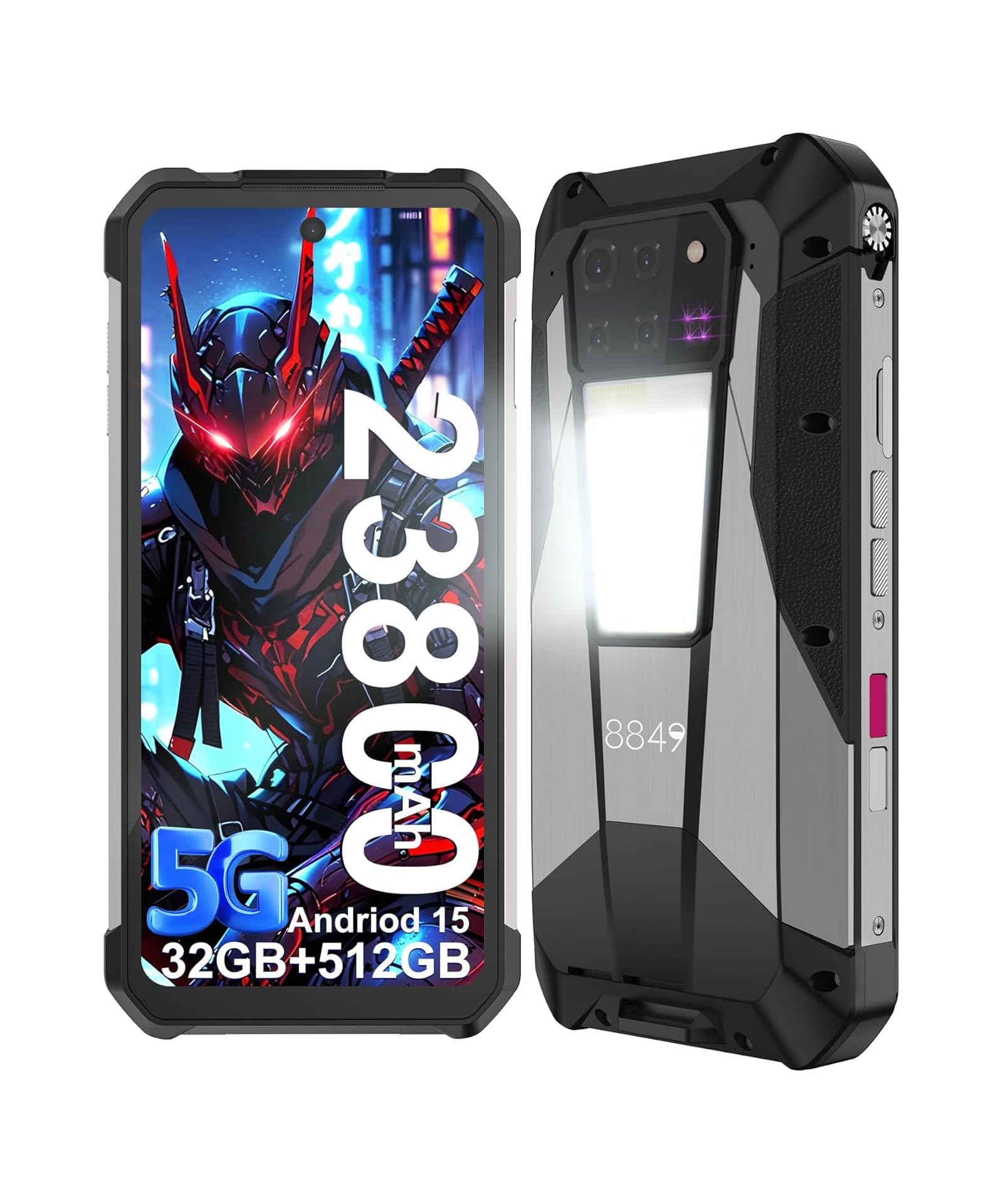
A 23800mAh brick with a projector and a camping light — the phone you root in a field.
Start with the number that makes everything else possible: 23800mAh. That is the battery, and it is rated for 1800 hours of standby. It also charges other devices over an OTG cable, so a flat battery in the field is not a crisis. Pair it with 120W charging (about 90% in roughly 1.5 hours, per the listing) and you have a device built for people who leave the grid.
The rest of the hardware is unusual in the best way. A 100-lumen projector (a light output of 100 lumens) sits on top with a 120Hz projection refresh rate and 854 x 480 output, so you can throw documents or a movie at a wall. There is a 1200-lumen camping light with five modes including SOS, a 200MP main camera, a 64MP night-vision camera, and 32GB of RAM listed as 16GB plus 16GB adjustable, backed by 512GB of storage and up to 2TB expandable. The MediaTek Dimensity 8200 is a 4nm octa-core chip at up to 3.1GHz.
The one thing you cannot ignore is weight: 696g. That is roughly two and a half times a normal phone, a trade-off the maker’s own listing acknowledges for the rugged shell and feature stack. Battery life is what people gush about — days between charges is the consistent theme. Durability is the mixed note; a small number of units have stopped working early, so treat the return window as part of the plan.
Reasons this earns its space
- 23800mAh battery with 1800 hours standby and power-bank output over OTG.
- 32GB RAM (16GB plus 16GB adjustable) and 512GB storage with 2TB expansion.
- Built-in 100-lumen projector plus a 1200-lumen camping light with SOS mode.
- Waterproof, shockproof, dustproof body with a 64MP night-vision camera.
What you are signing up for
- 696g of weight — this is a two-hand device, not a pocket one.
- Durability reports are mixed; a few units have failed early.
- No Android 15 or 16 support is the standing complaint from long-term owners.
- The projector resolution is modest, so text-heavy projection looks soft.
Built for: outdoor users who want a rooted phone that doubles as a power bank, a torch, and a projector.
Not built for: anyone who wants a phone that slips into a jeans pocket or expects long-term OS upgrades.
7. Nothing Phone (3) 256GB

Four 50MP cameras, a Snapdragon 8s Gen 4, and a light-up back nobody else has.
A full-core 3.2GHz Snapdragon 8s Gen 4 built on 4nm, paired with 24GB of LPDDR5X memory and UFS 4.0 flash storage. That is the kind of spec sheet that makes custom kernels worth writing. Add 256GB of room for your backups and modules, and a 6.67-inch 1.5K AMOLED at 460 pixels per inch with a 120Hz adaptive refresh, and this is a serious hardware platform rather than a novelty act.
The novelty act is the Glyph Interface — the light strips on the back that animate notifications, tools, and even games. It is the reason people stop and ask about this phone in public, and it is genuinely one of the few hardware ideas in recent years that does something a normal notification cannot. There is also an Essential Key on the side for capturing screens and recordings, plus a 5150mAh battery with wireless charging and an IP68 rating for dust and water.
Where it falls short of the Pixel 7 is the camera, and owners are honest about it: good, not Pixel-level. The other honest note is carrier support. It handles AT&T and T-Mobile bands fully, but Nothing itself says Verizon users need to have the IMEI whitelisted first and that Verizon is not recommended. If you are on T-Mobile or AT&T and want something with personality plus a clean Android base, this is a strong pick.
The draw: Unusual hardware, clean Nothing OS, and a Snapdragon 8s Gen 4 platform that has the memory and storage headroom to make rooting worthwhile.
The realistic caveat: Volume is limited, the camera trails the Pixel, and a locked unit has been reported — confirm yours is open up before you start flashing.
For you if: you want a distinctive phone with flagship-adjacent silicon and a genuinely unusual notification system.
Pass if: you are on Verizon, or if camera quality is the reason you are buying a phone at all.
8. Google Pixel Fold 256 GB

A Pixel that unfolds into a small tablet — and runs two apps side by side while it does.
Split Screen is the feature that justifies the fold. You drag two apps up from the taskbar and they open side by side, or you run two Chrome tabs next to each other to compare. For a rooted phone, that is genuinely useful: you can watch a flashing guide on one pane while your terminal app runs in the other. The Tensor G2 and Titan-class security stack underneath are the same Google silicon you already know from the Pixel 7, which means developer documentation is abundant.
The hardware specifics: a 4821mAh battery rated at 24 hours of talk time, with a 92-minute charge time listed, 256GB of storage, and a camera system built around a telephoto lens and an ultrawide lens. Google’s own materials describe it as a full Pixel phone on the outside that unfolds into a multitasking display. What owners praise most is the everyday function — it feels like a normal Pixel until you need the big screen.
Now the part you need to hear. Durability is the recurring negative, and it is named directly in the listing feedback: hinge fragility is a real consideration, and opening the phone in wet or dirty conditions is something to avoid. The screen quality and battery life both land as mixed rather than universal praise. Some stock ships with a low battery charge, which means a slow calibration routine before you trust the percentage. This is a secondary or enthusiast phone, not a beater.
The case for it: Unfold to a big multitasking canvas, fold to a pocketable Pixel — with Google’s clean software and the Tensor G2 that the rooting community already supports.
Be honest with yourself: This is a delicate foldable that rewards gentle handling. If you want to flash and re-flash for months, a slab is the safer bet.
Fits: people who want a foldable Pixel and can treat the hinge like the precision part it is.
Doesn’t fit: anyone planning aggressive daily flashing, or who wants a phone that shrugs off dust and rain.
9. OnePlus 15R 512GB

The 7400mAh battery that lasts a week — and a Snapdragon 8 Gen 5 to go with it.
Most rooting projects die of battery anxiety. This one does not. 7400mAh is the largest battery on this list by a wide margin, and it is paired with 80W SUPERVOOC charging. Customers note multi-day endurance and successful rooting on Android 16, the most relevant signal here for a flashing project. The Snapdragon 8 Gen 5, plus a dedicated touch response chip and a custom Wi-Fi chip, is silicon the developer scene is already circling.
Twelve gigabytes of RAM and 512GB of storage round out the flashing headroom. The display is a 165Hz, 1.5K AMOLED at 2800 x 1272 with 450 pixels per inch, driven by a 3200Hz touch response chip (that is the sampling rate — how often the screen registers your finger). OxygenOS 16 runs on top. Per OnePlus, it also carries the industry’s most complete set of IP ratings against dust and water.
The catch is size. A 7400mAh cell plus a 6.83-inch panel makes for a genuinely large phone, and owners say so, with some noting the included case is slick enough to slide off surfaces. The camera is decent rather than excellent, and there is no SD card slot — less of an issue with 512GB on board. If you want a phone that disappears into a pocket, this is not it.
The reason it wins on stamina: Custom ROM flashing is a battery hog, and 7400mAh with 80W charging means you are never stuck waiting for enough juice to try again.
The trade-off in your hand: Large and slick, this is a phone you grip deliberately. The upside is that multi-day battery life changes how you use a device.
Choose it if: you want the biggest battery here, top-tier Snapdragon silicon, and enough storage that backups never get tight.
Reconsider if: a smaller, grippier phone matters more to you than multi-day endurance.
Know the Specs
Snapdragon vs MediaTek, in plain terms
These are the two chip makers behind most Android phones. Snapdragon (Qualcomm) and MediaTek Dimensity are both mainstream, and both have large developer communities. The practical difference for rooting is not raw speed — it is how much custom software already exists for that specific chip. A wildly popular chip gets kernels, recoveries, and custom ROMs; an obscure one may get nothing. When a phone lists Snapdragon 7s Gen 3 or Snapdragon 8s Gen 4 or Dimensity 9300+, you are looking at silicon with real community support behind it.
Bootloader open up and why it matters
The bootloader is the first piece of software that runs when you power on, and it decides which operating system is allowed to load. open up it is what permits a custom recovery and a new ROM. Some brands give you an official open up tool or code request; others make the toggle available in developer settings. Carrier variants often block it entirely. Before you buy any phone for rooting, confirm that the exact model and region on the listing is unlockable.
Battery capacity and charging wattage
Capacity, measured in mAh, is how much energy the battery holds. Wattage is how fast you can refill it. Flashing sessions, reboots, and recovery work all drain battery faster than normal use, so a large cell paired with high wattage removes the most common interruption. On this list that ranges from a 4200mAh cell with 30W charging up to a 23800mAh cell with 120W charging.
RAM and storage headroom
RAM is the working memory your apps use while running; storage is the permanent flash where everything lives. A custom ROM, a recovery environment, Magisk modules, and full-device backups all consume both. 8GB of RAM and 256GB of storage is a workable floor; 12GB and 512GB lets you stop thinking about limits entirely.
Common Questions
Which of these phones can actually have its bootloader open up?
Will rooting break my warranty?
Does the Google Pixel 7 work on all US carriers?
Can I flash a custom ROM on the Xiaomi 14T Pro if I use Verizon?
How much storage do I need for a second ROM and backups?
Is a foldable phone a bad idea for rooting?
Do these phones have a microSD slot for extra storage?
Which phone on this list has the longest battery for flashing sessions?
Does the Nothing Phone (3) work on Verizon?
Is a bigger battery always better for a rooted phone?
What does it mean that the Xiaomi phones have no US warranty?
The Bottom Line
For most people chasing a phone they can actually root, the winner is the Motorola razr 2024. It folds into a pocket, it is an open up GSM phone that connects to prepaid carriers without a fight, and 256GB of storage with 8GB of RAM is enough room for a second ROM and a full backup. You also get a 3.6-inch outer screen that lets you watch a boot cycle without opening the hinge. Nothing here is a beginner’s toy, but this one is the easiest to live with.
For maximum flashing headroom and the fastest charging on the list, the Xiaomi 14T Pro hands you 12GB of RAM, 512GB of storage, and 120W HyperCharge on a 5000mAh cell — as long as you are on T-Mobile, Mint, or Tello. And if you want to walk into the process with the cleanest, best-documented software base, the Google Pixel 7 remains the phone the developer community reaches for first.
One last nudge that is not about hype: the OnePlus 15R is the only phone on this page whose own spec sheet pairs a Snapdragon 8 Gen 5 with a 7400mAh battery and 512GB of storage. Pick it if you want to root without ever worrying about a charger. Whatever you choose, read the carrier line on the listing twice — it is the one spec no custom ROM can fix.
How we choose
We do not accept paid placement. Every pick is matched to a real buyer and a real use-case; we do not hands-on test units.
Sources
Specifications: manufacturer listings and product documentation. Review insights: verified customer reviews, as of October 2026. Pricing: not shown on this page (it changes often); check the current price via the retailer link.
As an Amazon Associate, Aappliancez earns from qualifying purchases. This does not affect which products we feature.