Disclosure: Some links in this post are affiliate links. As an Amazon Associate I earn from qualifying purchases, at no extra cost to you. Learn more
Specs are compiled from manufacturer listings and verified buyer reviews and can change over time — please confirm the key details on the product page before buying.
If every call turns into “say that again,” the handset’s volume ceiling is usually the culprit, not your ears. The phones below each solve a different piece of that problem: some make the ring loud enough to carry across a house, some print what the caller says onto a screen, and some amplify the voice up to a real, stated gain level. Start with the pick that matches your specific frustration — a missed ring, a muffled voice, or words you cannot follow — and the rest of the list is easy to skim.
This guide is built by comparing the manufacturers’ published specifications and the patterns across verified customer reviews, so you get each pick’s real strengths and trade-offs instead of marketing spin.
You do not need every feature here — just the one that fixes your hardest moment: the ring you cannot hear, the voice you cannot follow, or the words you cannot catch. Below you will find the best phone for hearing impaired callers, sorted by what each one actually does well.
Top Picks


How To Choose The Best Phone for Hearing Impaired Callers
The mistake most people make is buying the loudest ringer they can find and expecting it to fix the conversation too. A loud ring tells you a call is arriving — it does nothing to help you understand the person on the other end. Those are two separate jobs, and no single number on a spec sheet covers both.
Separate the ring problem from the speech problem
If you miss calls because you cannot hear the phone from another room, you want a high dB ringer (a loudness rating in decibels) or a flashing light. If you hear the ring fine but cannot follow the conversation, you want amplification gain on the incoming voice. Some phones on this list do one job, some do both, and one skips audio entirely by showing captions on a screen.
Check what the phone plugs into
A landline handset needs an active phone line, and a captioned phone needs high-speed internet plus power. Bluetooth models pair to the cell phone you already carry. Decide which of those connections you actually have at home before you fall for a feature list.
Look for the physical details that decide daily use
Oversized buttons, photo speed-dial keys, and a high-contrast display matter more over months than any single audio figure. A phone with tiny buttons and a dim display will sit unused no matter how loud it rings.
Side-by-Side Comparison
| Model | Best For | Connection | Key Loudness Spec | Weight | Amazon |
|---|---|---|---|---|---|
| RENNY Loud Cell Phone Ringer Amplifier★ Best Overall | Making a cell phone ring across the house | Bluetooth to one cell phone | 117 dB ringer | 5 ounces | Amazon |
| Panasonic KX-TGD892SBest for Hearing Aids | Pairing hearing aids to a landline | Landline with Bluetooth output | Not stated | 1.2 pounds | Amazon |
| Hamilton CapTel 2400iSPNBT | Reading captions of every call | Internet plus phone service | 40dB amplified gain | 3 pounds | Amazon |
| AT&T BL102-2 | Stopping robocalls on a home line | Landline, DECT 6.0 | Not stated | 1.7 pounds | Amazon |
| VTech SN1127 | One-touch photo dialing for seniors | Corded landline | 90dB ringer, 40dB boost | 1.08 kg | Amazon |
| Serene Innovations HD40P | Memory and vision support | Corded, line-powered | 85 dB ringer, 26dB boost | 1.9 pounds | Amazon |
| Clarity E814CC | Clear speech in both directions | Corded plus cordless combo | Not stated | 3 pounds | Amazon |
Detailed Reviews
1. RENNY Loud Cell Phone Ringer Amplifier
Our pick — 4.0+★ from 600+ verified ratings; the strongest balance of quality and price.
A 117 dB siren and a white light that turn your silent cell phone into a whole-house alarm.
Most people in this category already own a smartphone they like — the problem is that it sits in a pocket on vibrate while a call goes unanswered in the next room. This box fixes exactly that. It pairs over Bluetooth to one phone and rings at 117 dB (decibels, the unit used to measure loudness), then flashes a bright white light at the same moment. Both alerts fire together, so a call reaches you whether you are in the kitchen with your back turned or asleep with the light off.
The setup takes about a minute, and after that it reconnects on its own with no Wi-Fi, internet, or app involved — the maker lists a working range of up to 150 feet from your phone. That is enough for most single-floor homes. It carries five ringtone options pitched at different frequencies, which matters because hearing loss rarely affects every pitch equally. A talking caller ID can announce the number out loud instead of ringing at all, though that function works with cell phones only. The best part is the price-to-usefulness math: a budget-friendly box that upgrades the cell phone you already carry instead of replacing it.
Two honest limits. There is no internal battery, so it must stay plugged into a wall outlet — put it where an outlet lives and where you spend your evenings. And it is not a speakerphone: there is no built-in microphone, so you still take the call on the handset or on your hearing aids. That microphone gap is deliberate, described as a privacy feature, but it does mean Renny is an alerting device, not a talking device.
What this box does well
- 117 dB ring plus a bright flashing light, so both your ears and your eyes get the alert
- Pairs up to 150 feet away over Bluetooth with no internet or app needed
- Five ringtones across different frequencies to suit different types of hearing loss
- Budget-friendly, and it upgrades the cell phone you already own
Where it stops short
- No microphone and no speakerphone, so it alerts you but cannot carry the conversation
- Needs a wall outlet at all times because there is no internal battery
Reach for this if: your cell phone is the only phone you want, and you keep missing calls from another room.
Look elsewhere if: you need the phone itself to be louder during conversation — this one only handles the ring.
2. Panasonic Expandable Cordless Phone System KX-TGD892S
The landline that pushes the call straight into your hearing aids, up to four pairs at once.
Here is the quiet advantage almost nobody advertises: rather than making the handset louder, this system hands the audio off to the devices already sitting in your ears. It pairs with up to four Bluetooth headphones, earbuds, hearing aids, or conference speakers, so the person you are talking to arrives through your own aids at their own settings. Buyers report it works with Kirkland KS-10 aids — the Phonak-derived model — and that pairing is a one-button job on the handset. It weighs 1.2 pounds, noticeably lighter to move around the house than the 3-pound Hamilton CapTel below.
The everyday features are aimed at a home line rather than a desk. Automated Call Block pre-blocks robocalls, telemarketing block catches announced callers, the one-touch button blocks more, and the call block directory holds up to 1,000 names and numbers. A digital answering machine stores up to 17 minutes of messages. The battery runs up to 10 hours of talk time with Bluetooth off, or 7 hours with it on. And there is a real catch worth knowing up front, in the words of one buyer: “The bluetooth functionality is good,but comes across on the quiet side for my hearing aids.” That is the honest ceiling — the handoff works, but the level arriving at your aids may need pushing up on the aid itself.
Expect the pairing to drop when your aids power off or when you leave the house, since the aids hold only two connections at a time; you reconnect when you come back. Also plan around the handset design — when it sits face-down in the cradle, the buttons can be pressed against the surface. Neither point ruins the phone. They just describe how it wants to be used: aids on, handset face-up.
Who it fits: anyone already wearing Bluetooth hearing aids who wants the landline to talk to them directly instead of through a speaker. It is the most natural fit here for an aid wearer who lives on a home line.
What to plan for: the Bluetooth level can arrive quieter than you would like, and you will re-pair after your aids switch off. Budget a minute for that each time.
Best match: a hearing-aid wearer who wants hands-free calls and a landline that blocks spam without extra gadgets.
Think twice if: you want the handset itself to be the loud part, or you dislike re-pairing Bluetooth after your aids power down.
3. Hamilton CapTel 2400iSPNBT Captioned Telephone
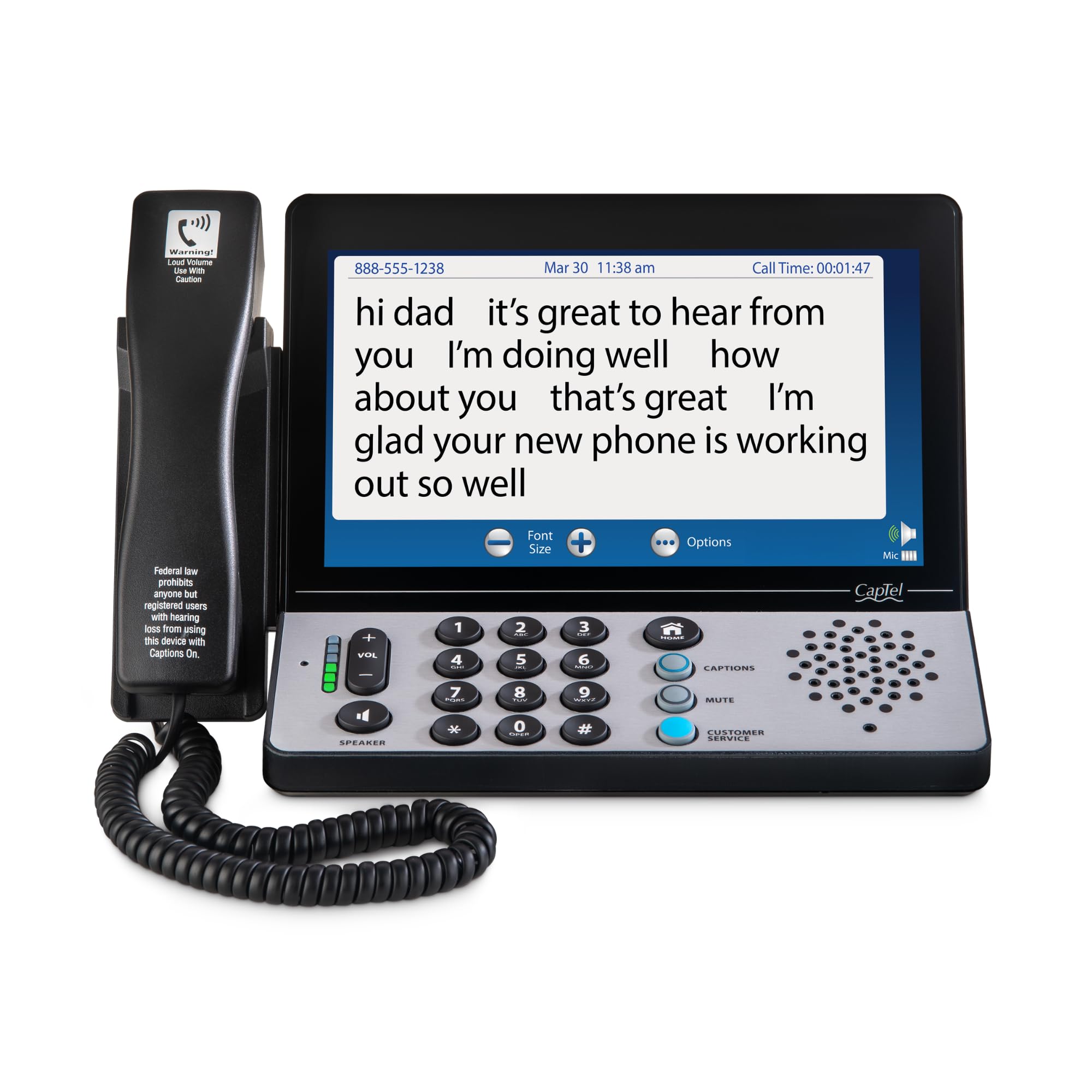
It types out what the other person is saying, live, on a screen large enough to read across a room.
For severe hearing loss, no amount of volume beats seeing the words. This is a captioned telephone (a phone that displays a live text transcript of the call) built around a large touchscreen, and it captions both incoming and outgoing calls so no word is guessed at. You can choose fully automated captions or assisted captions with live operator support, and the caption size and tone control are adjustable on screen. Audio still comes through, boosted by volume control up to 40dB amplified gain (a gain figure measured in decibels, the same loudness unit used for ringers).
The practical requirements are the part buyers should read twice. It needs high-speed internet, in some cases telephone service, and standard electrical power. It is FCC-certified and the captioning service is available only to US residents with hearing loss, with registration required. Setup wants a wired connection to your router via the included cable for captions to work, and the registration step means acknowledging a hearing impairment before the service switches on. None of that is hidden — it is simply the shape of a captioned phone.
What it changes is worth the setup effort. The built-in answering machine shows voicemail captions right on the screen, and a 24/7 US nationwide captioning service runs around the clock at no cost, so a message can be reread as text instead of replayed five times. At 3 pounds it is a desk fixture, not something you carry, and the 3.64 x 12.56 x 9.54 inch footprint wants a real tabletop. As buyers put it: “Works great for someone who has hearing loss got it for elderly and simple to use.”
Why the screen wins
- Live captions on both incoming and outgoing calls, with adjustable text size and tone
- Captioned voicemail you can read instead of replay
- Automatic or live-operator captioning, your choice
- 40dB amplified gain on the audio for anyone who still hears some speech
The conditions attached
- Needs high-speed internet, power, and — in some cases — telephone service
- US residents only, with hearing-loss registration required for the service
- Setup is easier with the router cable than over Wi-Fi
Made for: a household with reliable internet where hearing is severely limited and reading is easier than listening.
Rule it out if: you have no high-speed connection, or you live outside the US and cannot register for the captioning service.
4. AT&T BL102-2 DECT 6.0 Cordless Phone for Home
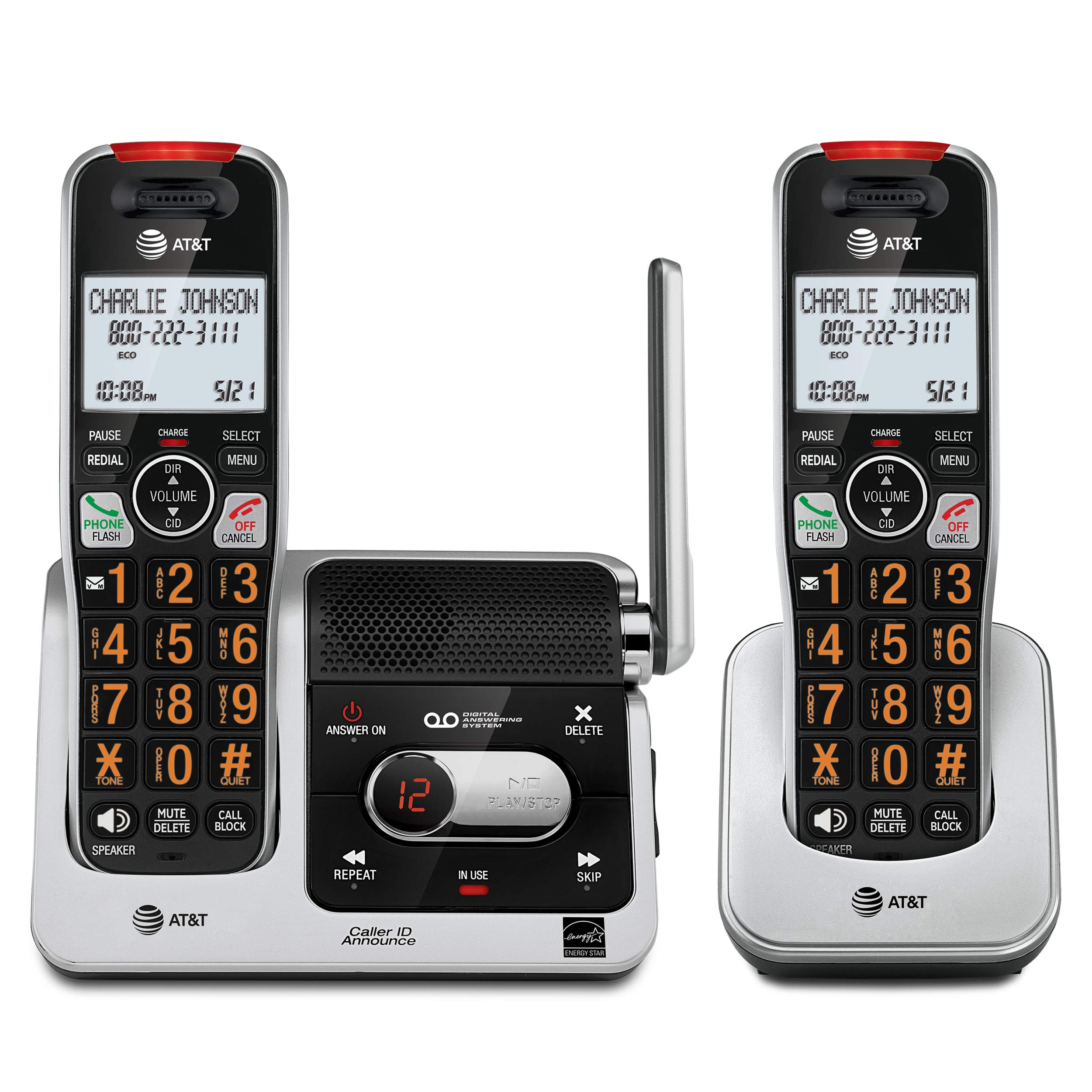
Robocalls get stopped before they ever ring, and the caller’s name gets announced out loud.
Half the frustration of a home phone for someone hard of hearing is not the voice quality — it is answering a call that turns out to be a machine. This system attacks that directly. Robocalls are blocked from ringing through even the first time, and a dedicated key on the handset blacklists any number in one touch. The call block directory stores up to 1,000 name and number entries. The handset then announces the caller’s name, so the phone does the screening out loud before anyone picks up.
For reading and dialing, the extra-large 2-inch screen carries high-contrast text, the font is enlarged, and the keypad is lit for low-light dialing — a real benefit for anyone with vision loss alongside hearing loss. The digital answering machine records up to 22 minutes of messages, outgoing announcements, and memos. A full-duplex speakerphone lets both people talk at once, and handset intercom covers moving around the house. Buyers speak warmly of what the blocking changes in daily life: “I wish I had found this sooner.”
The catch is documentation. Buyers consistently describe setup as something between easy and fiddly, and the printed material leans heavily on the call-blocking side. A fuller 110-page manual exists but is not in the box. Plan on patience for the first evening, and expect to walk an older user through it once. After that it settles down and works.
Sound and setup, honestly: speech quality is serviceable but not amplified the way a dedicated boost phone is — this pick earns its place on blocking and readability, not raw loudness.
The first hour: set it up yourself before handing it over. The included guide covers blocking well and everything else lightly.
Choose it when: scam and telemarketing calls are the reason the home phone went quiet in the first place.
Pass if: the primary need is extra loud incoming speech — the AT&T boosts readability more than volume.
5. VTech SN1127 Amplified Corded Phone

Eight photo buttons for the people you actually call, and a 90dB ringer that cuts through the house.
Dialing is often the step that breaks down before hearing does. This handset gives you eight large speed-dial keys, each able to hold a photo of the person on the other end, so reaching a daughter or a doctor is one touch instead of a memorized number. The ring hits 90dB (decibels, a loudness measure roughly in the range of heavy machinery at close range), with a bright flashing visual indicator riding along, so the alert reaches across rooms and reaches your eyes too.
On the audio side, a one-touch amplification button boosts incoming volume up to 40dB for clearer speech, and the oversized high-contrast buttons plus large display make dialing easy on low-vision eyes. It is a corded handset, which means it keeps working during power outages — a detail that matters more as you get older. Spoken caller ID, a visual ringer, and hearing aid compatibility round out the call experience, and the full-duplex speakerphone lets both sides talk naturally.
Two things to weigh. The corded design pins you to the base, so you cannot wander while talking the way a cordless set lets you. And sizing: it comes in at 1.08 kg, so it is a planted piece of furniture rather than something to move around. For a bedside or kitchen counter, that is exactly right.
Where the design pays off: the photo keys plus the 40dB boost plus the 90dB ring cover three separate problems in one unit, which is unusual at this point in the market.
Where it commits: it is corded and heavy, so plan a fixed spot for it and leave it there.
Go with it for: a fixed bedside or counter phone where one-touch photo dialing does the heavy lifting.
Look past it if: you need to move around the house while on a call.
6. Serene Innovations HD40P Amplified Big Button Phone

Built around pictures and a familiar handset, for the caller who cannot learn a new phone.
This is the phone you buy when the person using it cannot be taught a new interface — and for dementia or severe memory loss, that single constraint overrides every other spec. Each speed-dial button holds a portrait photo, so one touch calls family or a doctor. Volume adjusts, the ring comes in at 85 dB with a visual ring indicator, and the handset itself is the old familiar shape people already know how to hold.
The reason this one holds up in memory-care households is the power arrangement. It runs off the phone line itself and does not need electrical mains, so a power cut does not silence the phone. That is a big safety point for someone living alone or with a caregiver. The 26dB amplification boost raises incoming volume on top of the loud ringer. Buyers describe the practical effect plainly: “Purchased a cheaper one and patient couldn’t hear on it.This one is much nicer.”
Two hardware quirks turn up repeatedly. The receiver has to be seated fully in the cradle when hanging up, and getting it right takes a moment’s habit — a caregiver may want to check it after each call. Some users also note an occasional squealing sound. Neither is universal, and both are workable once you know to look for them. The trade is real, though: this pick reaches for dementia-friendly operation rather than all-purpose audio quality.
Why caregivers pick it
- Photo speed-dial for one-touch calling with no memorized numbers
- Runs off the phone line, so it keeps working through a power outage
- 85 dB ringer with a visual ring indicator
- 26dB amplification boost for clearer incoming speech
What to keep an eye on
- The receiver has to be fully seated in the cradle to hang up cleanly
- An occasional squealing sound has been noted
- Built for memory and vision support rather than pristine audio all-round
Holds up for: dementia, Alzheimer’s, or low-vision households where photos and a familiar receiver do the work.
Not the one for: a user with sharp memory who wants clean, simple audio and modern features.
7. Clarity E814CC Amplified Corded/Cordless Combo

A corded base and a cordless handset in one package, tuned for the clearest speech in both directions.
The pick that wins on raw audio for the person in the room who struggles most is this one. Its defining feature is clarity of speech — not just volume — and that means the person on the other end can hear you clearly too, not only you hearing them. For someone who has spent years relying on lip-reading or video calls, that two-way edge is the whole point. You get a corded handset on the base plus a cordless handset, and the extra handsets are available separately if a second room needs one.
The everyday details assume an older user’s eyes and hands. Large numbers, very loud volume, and a dual keypad make dialing straightforward. An answering machine is built in. The caveat worth knowing is not the audio — it is the learning curve. This is the most feature-dense phone on the list, and buyers describe a setup process that is easier to learn by experimenting than by following the included guide. One recurring design complaint: the message alert is an audible beep rather than a visual blinking light, which is frustrating precisely for the hearing-impaired audience.
The boost control also has a real working range. Turned up for one user it works well; on someone with hearing aids the highest setting can be too much, so dial it in together rather than setting it once. At 3 pounds it is a substantial unit, and its corded and cordless handsets are meant for a home base rather than carrying.
The audio case: this one edges out the Serene and VTech picks on two-way speech clarity — the person you are calling gets the benefit too, not just you.
The reality of setup: expect to spend a session with it. Begin with the base controls working, then add extras once the core is comfortable.
The one grievance worth flagging: a beep for messages instead of a blinking light is a genuine miss for a hearing-impaired buyer.
Pick it for: a user whose hardest problem is hearing the other person clearly and being heard back.
skip it if: you want a simple, no-learning-curve phone or a visual message indicator.
Know the Specs
Amplification gain in dB
dB, or decibels, is the unit used to describe how loud something is. A phone with amplification gain tilts the incoming voice upward so quiet syllables come through. The higher the figure, the more room you have to raise the voice before distortion. A 26dB phone helps a mild-to-moderate loss; 40dB gives more headroom for someone who needs extra push.
Ringer loudness in dB
A ringer figure is separate from speech amplification. A high dB ringer tells you a call is arriving from across a house. It does nothing for understanding the person on the other end. Look for a visual alert — a flashing light — as a second channel so the ring reaches you even when you cannot hear it.
Hearing-aid compatibility vs. Bluetooth pairing
Hearing-aid compatible means the handset works with the T-coil (a small receiver inside many hearing aids that couples magnetically to a phone handset). Bluetooth pairing is stronger: the phone sends the call directly into the aids as an audio stream. Pairing drops when the aids power off or leave the house, so re-connection is a normal part of the routine.
Line power, battery, and outage readiness
A corded phone running off the phone line itself does not need electrical mains and keeps working in a power cut. A cordless phone needs its base powered and a charged battery — Panasonic lists up to 10 hours of talk time with Bluetooth off, or 7 hours with it on. Cell-linked ringers like the RENNY need a wall outlet the whole time.
Common Questions
Will a captioned phone work if I only have a cell phone and no landline?
Can I connect my hearing aids to a cordless home phone?
What does 40dB amplification actually mean in practice?
Which phones still work during a power outage?
Is a loud ringer enough for someone with severe hearing loss?
How long can the Panasonic cordless handset run on a charge?
Does the photo speed-dial feature work for someone with dementia?
Can I add extra handsets to a cordless system later?
Why would a cell-phone ringer be better than a new landline phone?
What should I check before handing an amplified phone to an older parent?
The Bottom Line
The phone that earns the top spot is the RENNY Loud Cell Phone Ringer Amplifier for one practical reason: it upgrades the phone most people already carry, adds a 117 dB ring and a bright flasher, and does it without a landline, internet, or app. If the person on the other end of that call is the one struggling to hear — not just to notice the ring — reach for the Hamilton CapTel 2400iSPNBT and let live captions do the work. And if the real wish is to hear through hearing aids already in place, the Panasonic KX-TGD892S is the most natural fit, provided you expect to re-pair after the aids power off.
Each pick here fixes a different piece of the hearing-loss problem — the ring, the speech, the dialing, or the words on screen — so the right one is the one that matches your hardest moment. Start there, and treat the rest of the feature list as optional.
How we choose
We do not accept paid placement. Every pick is matched to a real buyer and a real use-case; we do not hands-on test units.
Sources
Specifications: manufacturer listings and product documentation. Review insights: verified customer reviews, as of October 2026. Pricing: not shown on this page (it changes often); check the current price via the retailer link.
As an Amazon Associate, Aappliancez earns from qualifying purchases. This does not affect which products we feature.