Disclosure: Some links in this post are affiliate links. As an Amazon Associate I earn from qualifying purchases, at no extra cost to you. Learn more
Specs are compiled from manufacturer listings and verified buyer reviews and can change over time — please confirm the key details on the product page before buying.
ATAK drains a phone fast. The mapping, the GPS locks, the radio links and the constant blue-force tracking can empty an ordinary phone before your shift is half done. So the phone you want for ATAK is not the thinnest or the prettiest one. You want a battery big enough to keep the map alive, a screen bright enough to read in sunlight, and a rugged body that survives a drop on a range. This guide covers seven phones that fit that job. Every spec below comes straight from the manufacturer listings and owner feedback.
This guide is built by comparing the manufacturers’ published specifications and the patterns across verified customer reviews, so you get each pick’s real strengths and trade-offs instead of marketing spin.
You will see which phones have the battery, brightness and carrier support that ATAK depends on, and which ones carry a real trade-off. Start with a rugged handset that can run mapping software all day on one charge — here is the honest lineup of the best phone for ATAK.
Top Picks


How To Choose The Best Phone for ATAK
ATAK is a mapping and situational-awareness app, and it leans hard on three things at once: a live GPS fix, a data link to receive position updates, and a screen you keep looking at for hours. A phone that handles a normal day of texting can still fall short here. Here is what to weigh before you buy.
Battery capacity is the first filter
Look at the capacity in mAh (milliamp-hours — a measure of how much charge the battery holds). A larger number means more hours with the screen on and the GPS active. The picks below range from 10,600 mAh up to 25,500 mAh. That spread decides whether you get one working day or several between charges.
Screen brightness in nits
A nit is a unit of screen brightness. The brighter the panel, the less you have to shade the screen with your hand to read a map in the open sun. Values in this set run from 450 nits up to 2200 nits peak. Match that to where you mostly operate — a shaded vehicle cab is forgiving, a bright ridge is not.
Carrier and 5G band support
These are open up global phones, and each one lists the exact 5G and LTE bands it covers. Check those bands against your carrier before you buy. If a phone is missing a band your network uses for data, the map can go stale even though calls still work. A missing data band is the most common reason these open up phones fail in the field.
Rugged rating and weight
An IP68 rating means the phone is dust-tight and protected against water immersion. IP69K adds protection against high-pressure water jets. Those ratings pay off in mud and rain. The trade-off is heft: these phones are heavy, and one model is listed at 825g (about 1.8 lb). Decide up front if you want a belt pouch or a lighter build.
Side-by-Side Comparison
| Model | Best For | Battery | RAM + Storage | Main Camera | Amazon |
|---|---|---|---|---|---|
| 8849 Tank 4 Pro★ Best Overall | Built-in projection in the field | 11600 mAh | 32GB + 512GB | 50 MP | Amazon |
| Blackview Rock 2 Pro 5GBest Value | Longest standby on a budget | 15000 mAh | 32GB + 256GB | 16 MP | Amazon |
| FOSSIBOT F113 | Biggest cell and loudest speaker | 20000 mAh | 36GB + 256GB | 50 MP | Amazon |
| 8849 Tank 4 | Bright AMOLED on a mid budget | 11600 mAh | 24GB + 512GB | 50 MP | Amazon |
| 8849 Tank 3 Pro | Multi-day field trips | 23800 mAh | 32GB + 512GB | 200 MP | Amazon |
| Ulefone Armor 34 PRO Plus | Largest screen and battery combo | 25500 mAh | 32GB + 512GB | 50 MP | Amazon |
| Ulefone Armor 28 Ultra | Thermal imaging and flagship speed | 10600 mAh | 32GB + 1TB | 50 MP | Amazon |
Detailed Reviews
1. 8849 Tank 4 Pro Projector Phone
Our pick — 4.0+★ from 80+ verified ratings; the strongest balance of quality and price.
A field tablet that also makes calls — and throws a map onto a wall when you need it.
The number that earns this phone the top spot is the charger: 120W. That is a fast-charging wattage (watts measure how quickly power flows in), and it is the highest in this lineup. Compare it to the Blackview Rock 2 Pro’s 33W and you have the biggest charging gap in the set, 120W against 33W. For ATAK that means a long day on the map does not have to end at a wall socket for hours.
The screen is a 6.73-inch AMOLED panel (organic pixels that switch off individually for true black) at 1440 x 3200 with a 120Hz refresh rate. That refresh rate is how many times per second the picture redraws — the higher it is, the smoother your map pans. Brightness reaches up to 1800 nits, which is what keeps that map legible under open sky rather than forcing you to cup your hand over the glass. Storage is 512GB with 2TB expandable, which leaves room for offline map packs and imagery, and the main camera is 50 MP.
The build and the battery are what win people over. Buyers describe the 11600mAh cell as lasting days, and one report has it sitting at only 50% after 8 hours of screen time — the exact workload an ATAK session throws at a phone. Projection is a real field extra. The built-in 720P DLP projector (a small light engine that throws an image onto a wall or screen) has auto focus and keystone correction. That lets you put a map or a plan onto a flat surface for a group brief instead of everyone crowding one screen. One catch: in the United States it only supports T-Mobile and Verizon, so verify your carrier first.
Where the Tank 4 Pro pulls ahead
- 120W charging, the fastest here, against 33W on the Blackview Rock 2 Pro
- 1440 x 3200 AMOLED at 120Hz with up to 1800 nits for sunlight reading
- 11600mAh battery that holds roughly half its charge through 8 hours of screen time
- 512GB storage, twice the Blackview’s 256GB, plus 2TB expandable
What to plan around
- Heavy and bulky — pocket carry is not the point of this phone
- US carrier support is limited to T-Mobile and Verizon
- Cameras are serviceable rather than a strong point
Reach for this if: you want the best all-round field phone here — big battery, daylight screen, fast charging and a projector for group briefings.
Think twice if: you carry your phone in a trouser pocket all day, or your carrier is not T-Mobile or Verizon in the US.
2. Blackview Rock 2 Pro 5G Rugged Phone
The entry-level pick that still carries a 15000mAh cell and a drop rating.
Where the Tank 4 Pro leans on speed, this one leans on endurance. The 15000mAh battery is the larger of the two — the Tank 4 Pro holds 11600mAh — and Blackview quotes 57 days of standby and 56.5 hours of continuous calls. That is enough headroom to leave the power bank at home on a shift.
The rugged side is certified too: IP68 and IP69K for dust and water, plus a 1.5-meter drop-proof design, so a slip out of a pack or a knock onto concrete should cost you scratches rather than a screen. The 6.67-inch display runs at 120Hz and up to 450 nits. The chipset is a MediaTek UMS9620 on Android 16, paired with 256GB of storage plus 2TB expandable.
The trade-off with this phone is well documented and it is weight. Blackview itself flags 558g before you buy, and the split in buyer reaction is exactly that — some find the heft reassuring, others find it too much to pocket. It also does not support AT&T, Cricket, Verizon, Straight Talk or U.S. Cellular, which is the thing to check before you commit. Quality is what gets praised most here, and durability shows up right behind it.
The honest read: buy this when budget matters and you want the longest standby of any pick here, with a light that doubles as a camping lamp and SOS signal. If you use a CDMA carrier, look elsewhere in this list.
Best for: the value-minded buyer who wants a big battery and a certified-tough body without paying for a projector or flagship chips.
One caveat: it is a two-hands phone — plan a belt pouch or pack strap rather than a front pocket.
3. FOSSIBOT F113 5G Rugged Phone

A 20000mAh brick that also happens to run a 110dB speaker and a 50-meter flashlight.
If ATAK is the app and battery is the bottleneck, this is the phone to look at: 20000mAh. FOSSIBOT quotes up to 2000 hours of standby, 163 hours of talk time and 35 hours of video playback from that cell, and it charges in 2.5 hours. The pairing of a long-running battery with a 33W charge rate is the practical combination for anyone living off a vehicle or a field charger.
The screen is a 6.78-inch panel with a 120Hz refresh rate and Gorilla Glass over it. Inside is a MediaTek Dimensity 7050 (2.6GHz max) with 36GB total RAM (12GB physical plus 24GB extended) and 256GB of storage, expandable to 2TB. The rugged rating is IP68 and IP69K plus MIL-STD-810H, which covers 1.5-meter immersion for 30 minutes and 1.5-meter drops.
Two field extras stand out. The 34mm speaker hits 110dB loudness at 3W peak output, so you can hear voice prompts over wind or an engine. The 50-meter high-brightness flashlight reaches far further than a phone torch normally does. Carriers matter here more than usual: it supports T-Mobile, Boost, Metro, Straight Talk, Consumer Cellular, Mint, Ultra Mobile, Red Pocket and Good2Go, but AT&T and Cricket are not supported.
What buyers notice: multi-day battery life and a genuinely powerful light both come through clearly, and the desktop-level processor speed gets called out alongside the rugged feel. The recurring note is weight — this is a heavy phone, and the odd unit has shown battery confusion. Size it as a tool, not a pocket device.
Choose this for: long deployments where you want the biggest cell in a mid-tier body, with a speaker loud enough for hands-free work and a flashlight that reaches across a lot.
Look elsewhere if: AT&T or Cricket is your carrier, or you need a one-hand phone.
4. 8849 Tank 4 Projector Phone
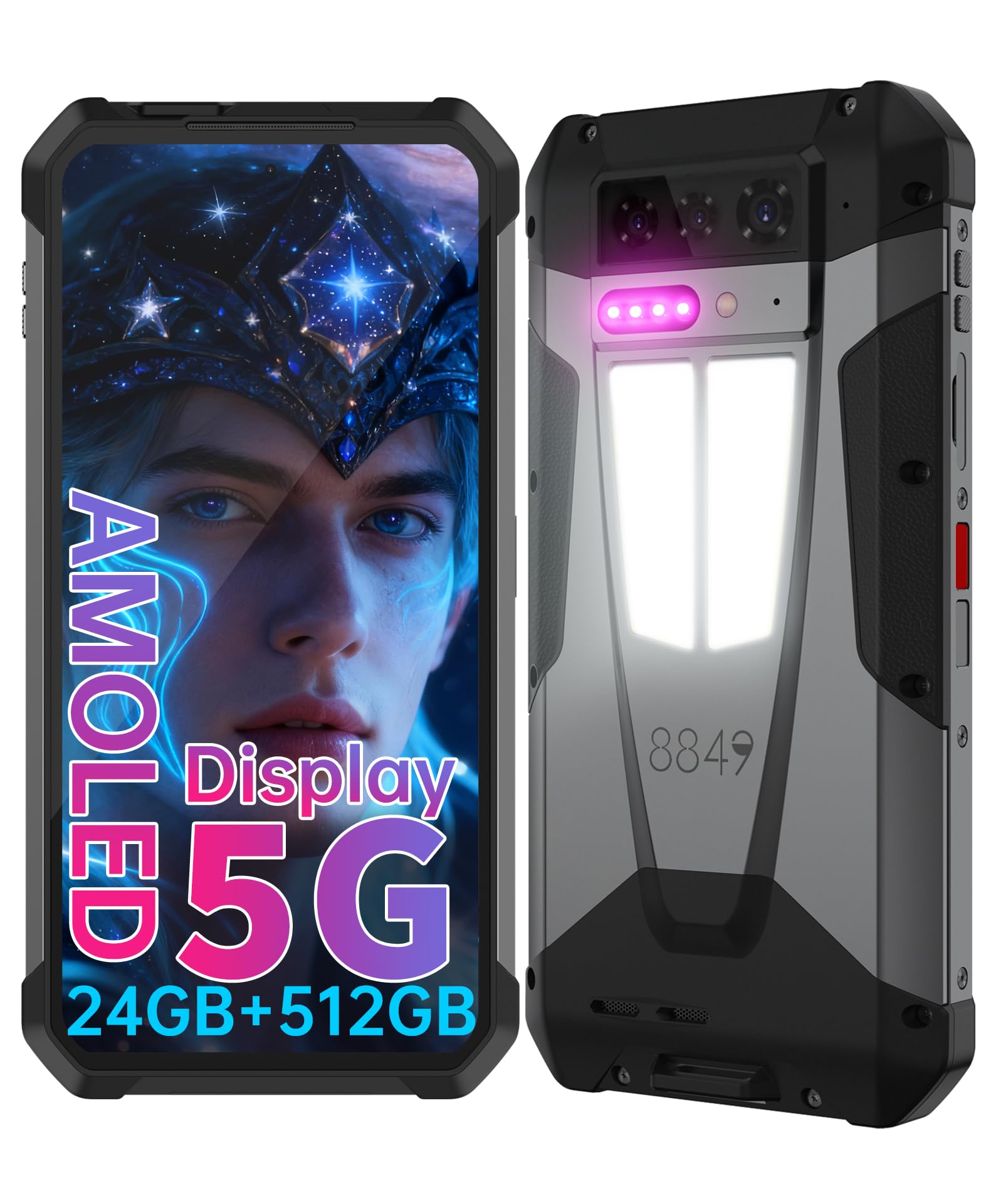
The 6.78-inch AMOLED sibling with the same 11600mAh cell and a lower charging rate.
This phone shares the Tank 4 Pro family but sits a tier lower on spec. The AMOLED screen is slightly larger at 6.78 inches and runs at 120Hz (a fast refresh rate that keeps motion smooth) with 1100 nits of brightness. That nit figure (a measure of screen brightness) tells you whether the map stays visible under sun, and 1100 is solid if not the brightest here. The 11600mAh battery carries OTG (on-the-go) support, so the phone can charge another device from its own cell.
Where it steps down: the charger is 66W against the Tank 4 Pro’s 120W, and the memory is 24GB RAM with 512GB storage versus the Pro’s 32GB. The processor is a MediaTek Dimensity 7300. For a lighter-duty ATAK load, both differences are fine — you just spend longer on the charger and juggle fewer background apps.
Owner feedback has an interesting angle on carriers. Verizon setup apparently needs a specific dialer code, and on T-Mobile the phone works once a network setting is adjusted, with owners reporting multi-day battery life. The 720P projector at 100 lumens is the same class as the Pro’s, with auto focus and keystone correction. Note the carrier limit: T-Mobile and Verizon only in the US.
The trade-off: the screen beats the Pro’s on paper size but loses on brightness and charging speed, so if maximum daylight visibility matters more than the specs sheet, take the Pro.
Worth it for: buyers who want a projector phone with an AMOLED screen and a big cell, without paying the Pro-tier price.
Not for you if: you need the fastest possible recharge or the largest RAM and storage on offer.
5. 8849 Tank 3 Pro Phone 5G
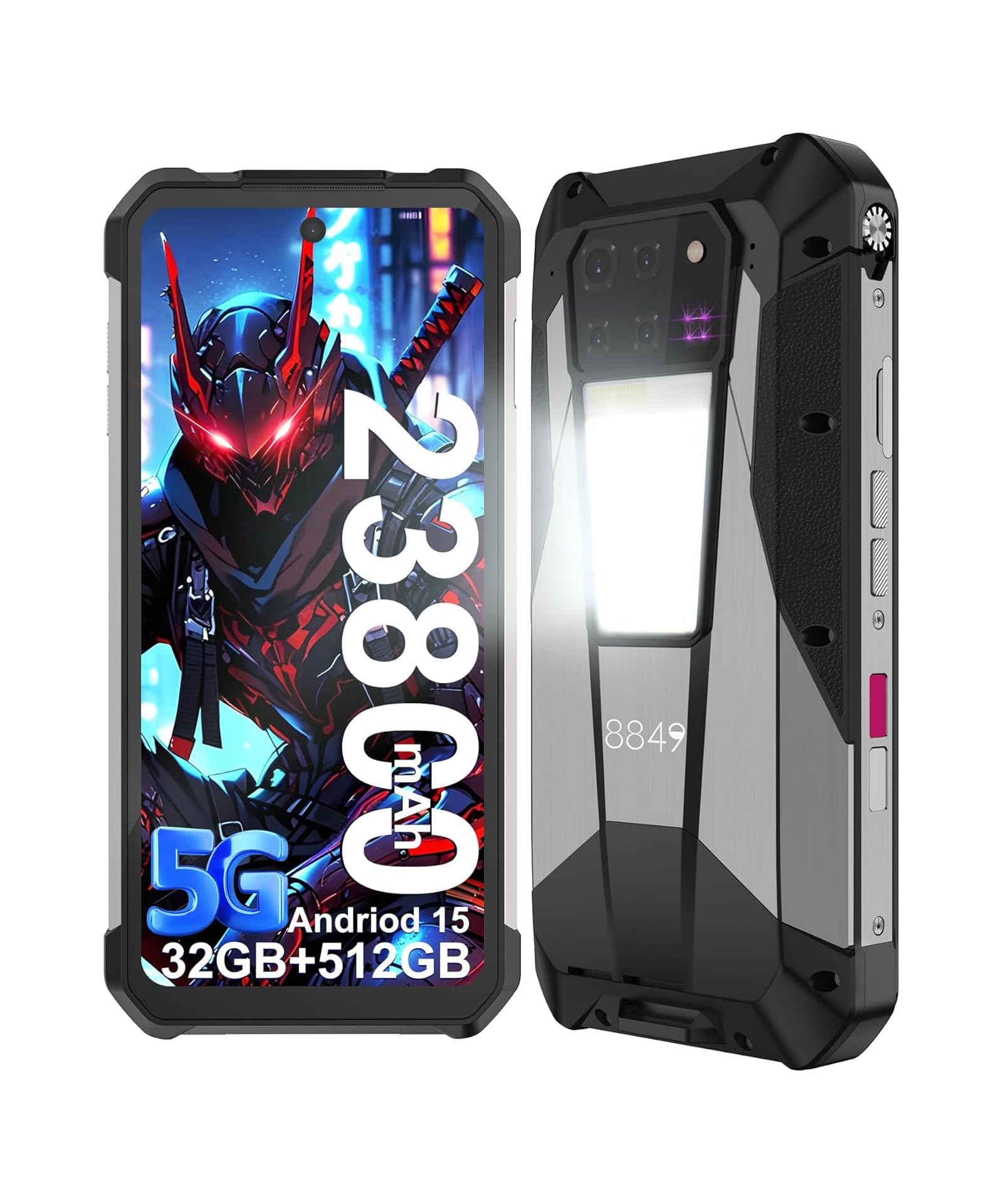
23800mAh and a 200MP camera — a two-week phone in the right conditions.
Most phones here are a day or two of endurance. This one goes further: 23800mAh and a listed 1800 hours of standby, charged at 120W. That capacity is built for multi-day field trips, and it is why the Tank 3 Pro sits this high on the list.
The screen is a 6.79-inch FHD+ panel at 2460 x 1080 with a 120Hz adaptive refresh rate. The chip inside is a MediaTek Dimensity 8200 on a 4nm process at 3.1GHz, paired with 32GB RAM and 512GB storage plus 2TB expansion. The camera is the headline spec elsewhere: 200MP main, 50MP front, and a 64MP night vision camera — that was not on the other Tank models listed.
The honest limit is weight and charging wear over time. At 696g it is deliberately heavy, and the maker frames that as the cost of durability. The recurring complaint in owner feedback is charging degradation over many months, and one report notes reliability questions after a short period. Size that against the capacity — the trade is real, but most buyers report getting days out of a charge and praise the projector for movie nights.
Worth knowing: the 200MP main camera beats every other body here on resolution, and 23800mAh is second only to the Ulefone Armor 34 PRO Plus. Reliability is the one thing to watch.
Pick this when: your trips run for days and you want the biggest cell one step below the very top of the range.
Bear in mind: the weight and the long-term charging feedback mean a rugged case and a tolerant belt are both worth budgeting for.
6. Ulefone Armor 34 PRO Plus 5G

The biggest battery and screen combo here — a map panel you can read from a step back.
Two numbers put this at the premium end: 25500mAh and a 6.95-inch FHD+ display. It pairs the largest battery here with the largest screen, so you get more hours of ATAK and more map visible without zooming. Standby is listed at 1380 hours, with 66W charging taking it to 90% in around 1.5 hours.
The chipset is a MediaTek Dimensity 7300 on a 4nm process at up to 2.5GHz, with 32GB RAM and 512GB storage plus 2TB expandable. The camera pair is a 50MP main with a large 1/1.31-inch sensor, plus a 64MP night vision camera and a 32MP front. The screen runs at 120Hz with an ultra-bright mode up to 600 nits, which is adequate rather than exceptional — the Tank 4 Pro’s 1800 nits is meaningfully brighter.
There is a 150-lumen projector built in at 854 x 480, and a 1100-lumen LED camping light at 6.5W output. The rugged rating is IP68, and the phone carries NFC for contactless payments plus quad-satellite navigation across GPS, BeiDou, GLONASS and Galileo. It does not support AT&T, Cricket, or CDMA carriers like Verizon and Straight Talk, so T-Mobile and Metro PCS are the networks to pair it with.
The honest size check: 825g and 1.29 inches thick is a deliberate commitment to the biggest battery. Quality is what draws the most praise here, with reliability split — some owners mention it running well, others hit app-loading problems. The projector is the feature most owners say made the purchase worth it.
Go here if: you want the biggest screen and cell in one body, with a projector for briefings and a light for camp.
Back away if: you need AT&T, Cricket, or Verizon, or you cannot live with an 825g device.
7. Ulefone Armor 28 Ultra Thermal Version

A flagship-grade chip with a thermal camera that reads heat in 640 x 512 — the specialist’s pick.
This is the only phone in the group with a thermal imaging camera, and it is a serious one: 640 x 512 resolution at 25Hz, driven by Ulefone’s ThermoVue T2 chip with an AI layer that boosts output. For ATAK that means spotting heat signatures the map and the naked eye miss. The chipset is a MediaTek Dimensity 9300+ on a 4nm process at up to 3.4GHz with a 12-core GPU, which puts it at the top of the processing pile.
Memory and storage are the biggest on offer: 32GB total RAM (16GB physical plus 16GB virtual) and 1TB of storage plus 2TB expansion. The main camera is built around a 1-inch IMX989 50MP sensor with 8K video recording, backed by a 50MP ultra-wide at a 117-degree field of view and a 64MP night vision camera. The main screen is a 6.67-inch AMOLED at 120Hz, reaching 900 nits in ultra-bright mode and peak 2200 nits — the brightest peak of any pick here.
Charging and connectivity are just as complete: 120W wired and 50W Qi wireless, USB 3.2 Gen 2 at up to 10Gbps, Wi-Fi 7, NFC, an IR blaster and Widevine L1. It carries IP68 and IP69K plus MIL-STD 810H. There is a 1.04-inch AMOLED sub-display on the back and a custom side key you can assign to your own shortcuts. It is not compatible with AT&T or Cricket.
What people flag: the standout praise is build quality and raw performance, with the thermal and night vision cameras landing well. The honest catch is the everyday camera — sharpness and zoom get called out as weaker than the spec list suggests, and the fingerprint button is sensitive. Thermal accuracy draws the odd note about calibration, so treat it as a scan tool rather than a precision instrument.
The right fit: you want thermal imaging, the fastest chip here, 1TB of storage and a pair of AMOLED screens in one waterproof body.
The mismatch: if your work is mostly camera-first, the imaging software here is the weaker half of a very strong phone.
Know the Specs
Battery capacity and runtime
Capacity is measured in mAh, and a bigger number usually means more hours with the screen lit and the GPS active. For ATAK, capacity matters more than almost any other spec. The cells here run from 10600mAh up to 25500mAh. Runtime also depends on the charger: a 120W rate refills a cell far faster than a 33W rate, so a big battery plus a slow charger is still a long stop. Match both figures, not one.
Screen nits and refresh rate
Nits measure brightness, and simply put, the more nits, the less you squint under open sky. The picks range from 450 nits up to 2200 nits peak. Refresh rate is measured in Hz — how many times the picture redraws per second. All the phones here run at 120Hz, which keeps maps and lists scrolling smoothly. Some list an “adaptive” or “ultra-bright” mode, which is a setting you should know to turn on when you step outside.
IP ratings explained
IP68 means the phone is sealed against dust and can survive water immersion; IP69K adds protection against high-pressure jets. MIL-STD-810H is a military drop and environmental test standard. Those are the marks a field phone should carry; the FOSSIBOT F113 lists 1.5-meter immersion for 30 minutes and 1.5-meter drops.
Carrier bands and 5G support
Every phone here lists the specific 5G and LTE bands it supports, plus the carriers it will work with. The important thing to check is whether your carrier is on the compatible list — several brands in this group exclude AT&T, Cricket, Verizon or Straight Talk. If your network is supported, the phone will work; if it is not, the data link ATAK depends on will not stay steady.
Common Questions
Can a rugged phone actually run ATAK for a full day?
Which of these phones work with T-Mobile for ATAK data?
Will a phone without AT&T support still work on other carriers?
How bright does a screen need to be to read a map outside?
Does a heavier phone protect better in the field?
Can I use the projector to brief a team in the field?
What does a night vision camera add to ATAK?
Is 256GB of storage enough for offline maps and records?
Do these phones support contactless payments?
Are these phones waterproof enough for rain and mud?
The Bottom Line
For most people running ATAK in the field, the phone for atak winner is the 8849 Tank 4 Pro. Its 120W charging and 1800-nit AMOLED screen give you the fastest refill plus a map you can actually read outside. If your priority is the longest possible endurance on one charge, reach for the Ulefone Armor 34 PRO Plus with its 25500mAh cell. And for thermal imaging in the dark, grab the Ulefone Armor 28 Ultra. It is the only phone here that shows you heat, and its build quality is what keeps winning people over.
How we choose
We do not accept paid placement. Every pick is matched to a real buyer and a real use-case; we do not hands-on test units.
Sources
Specifications: manufacturer listings and product documentation. Review insights: verified customer reviews, as of October 2026. Pricing: not shown on this page (it changes often); check the current price via the retailer link.
As an Amazon Associate, Aappliancez earns from qualifying purchases. This does not affect which products we feature.