Disclosure: Some links in this post are affiliate links. As an Amazon Associate I earn from qualifying purchases, at no extra cost to you. Learn more
Specs are compiled from manufacturer listings and verified buyer reviews and can change over time — please confirm the key details on the product page before buying.
Bagworms do their damage quietly: the little cone-shaped sacs hanging off your juniper or arborvitae look like dead needles until half the branch is already gone. The short answer is that a Spinosad-based or B.t.-based spray aimed at the young caterpillars, before the bags harden, is what most evergreen owners are looking for — and the picks below cover every job size from one shrub to a whole tree line.
This guide is built by comparing the manufacturers’ published specifications and the patterns across verified customer reviews, so you get each pick’s real strengths and trade-offs instead of marketing spin.
You will see concentrates you mix in a pump sprayer, hose-end bottles you just click onto a garden hose, and organic options that keep pollinators off the casualty list. Below is the practical breakdown of the best pesticide for bagworms.
Top Picks


How To Choose The Best Pesticide for Bagworms
Bagworms are not a spray-and-forget pest. The caterpillar builds a bag out of bits of your own foliage, and once that bag is thick the spray has a hard time reaching the worm inside. That single fact drives every buying decision below.
Match the active ingredient to the size of the worm
Spinosad and B.t. (Bacillus thuringiensis, a soil bacterium that only harms caterpillars that eat treated leaves) both work on the feeding worm, so they perform best while the larvae are small. Bifenthrin, a pyrethroid that disrupts an insect’s nerve signals, acts on contact and is listed against bagworms on several labels here. If your trees are already loaded with full-size bags, plan on a second spray rather than a stronger mix.
Decide between concentrate and hose-end
A concentrate means you measure and mix in a pump sprayer, which gives you the most control per gallon and the lowest cost per treatment. A hose-end bottle clicks straight onto your garden hose and mixes automatically, which is faster but empties quicker. Tall arborvitae and mature junipers usually want the pump sprayer so you can reach the top and soak the foliage evenly.
Check the label for your plants and your bees
Most of these products list vegetables, trees, shrubs, and ornamentals, but not every one. Read the target list on the label before you buy, especially if you are spraying edible crops. If you keep hives or see pollinators working the shrubs, a Spinosad or B.t. product is the gentler pick, and spraying in the evening keeps bees out of the way.
Side-by-Side Comparison
| Model | Best For | Active Ingredient | Form | Size | Amazon |
|---|---|---|---|---|---|
| Sevin Insect Killer Concentrate II★ Best Overall | Big gardens, broad pest list | Zeta Cypermethrin | Concentrate | 32 fl oz | Amazon |
| Spectracide TriazicideBest for Lawns | Lawn and landscape coverage | Gamma-Cyhalothrin (0.08%) | Concentrate | 32 fl oz | Amazon |
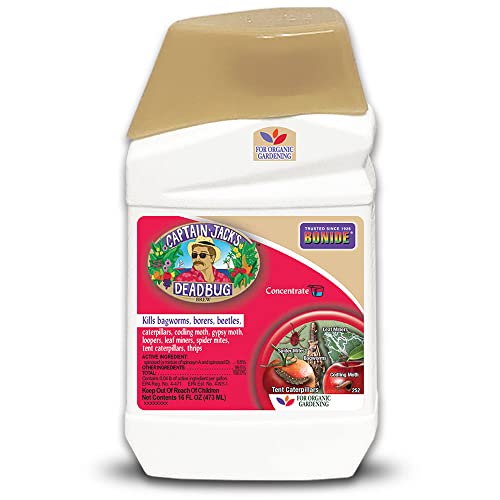
| Bonide Captain Jack’s Deadbug BrewOrganic Favorite | Organic gardens, mixed plants | Spinosad | Concentrate | 16 fl oz | Amazon |
| Fertilome Spinosad Insecticide | Bagworms on shrubs | Spinosad | Concentrate | 16 fl oz | Amazon |
| Monterey B.t. Caterpillar & Worm Killer | Small jobs, worm-specific | B.t. | Concentrate | 8 fl oz | Amazon |
| SUMMIT Caterpillar & Webworm Control | Fast hose-end bagworm spraying | — | Hose-end | 1 Quart | Amazon |
| Orthene 97.4% Acephate | Systemic knock-down on trees | Acephate 97.4% | Soluble powder | 0.773 lb | Amazon |
| Valent Dipel Pro DF | Large-area worm control | B.t. 54% | Powder | 1 lb | Amazon |
| Wisdom Pro L&H Bifenthrin | Multi-pest control around the yard | Bifenthrin 7.9% | Concentrate | 1 Quart | Amazon |
| Southern Ag Thuricide BT | Whole-property worm spraying | B.t. | Liquid | 1 Gallon | Amazon |
| Agrisel Bifenthrin Pro 7.9 | Large yard, low usage rates | Bifenthrin | Liquid | 1 Gallon | Amazon |
Detailed Reviews
1. Sevin Insect Killer Concentrate II, 32 Oz
Our pick — 4.5+★ from 3,500+ verified ratings; the strongest balance of quality and price.
A 32-ounce zeta-cypermethrin concentrate labeled for 500-plus insects, bagworms among them, and safe on blooms when mixed as directed.
The number worth starting with is 500-plus listed insects on the label. That is a bigger target list than most concentrates here, which means the same 32 fluid ounce bottle you buy for bagworms also handles Japanese beetles on the roses and whatever else shows up mid-season. The active ingredient is zeta cypermethrin, a contact insecticide that disturbs an insect’s nervous system, and the label states it will not harm your plants or blooms when used as directed.
Mixing is the routine kind: pour the concentrate into water in your sprayer and go. Owners who run pressure pump sprayers describe it as easy to work with, and the label calls for spraying early or at the first signs of damage — which matters with bagworms, since a small larva is far easier to stop than a full-grown one in a hardened bag. The manufacturer’s stated control window is 3 months, with the label excepting fire ants, fleas, ticks, and mosquitoes from that claim.
The catch you should plan around is that this is not a bagworm-specific product, so you are trading a narrow formula for wide coverage. It also is not the cheapest per-ounce option among the mid-range concentrates, and you need your own sprayer since the bottle is concentrate only. For a yard with several different pest problems, that trade is usually the right one.
What buyers keep coming back for
- Effectiveness is far and away what people write about, with pest control a clear second in the reviews — the label’s 500-plus insect list is why.
- Label states it won’t harm plants or blooms when used as directed, so roses and flowering shrubs stay safe.
- 3 months of stated control per application, with the listed exceptions spelled out on the label.
- People and pets can go back out once the spray has dried.
Where it asks a little more of you
- You supply the sprayer — concentrate only, no hose-end attachment.
- Broad-spectrum rather than bagworm-specific, so you pay for coverage you may not need.
Worth reaching for when: you want one bottle that handles bagworms plus the beetles, caterpillars, and assorted garden pests that arrive in the same season.
Keep shopping if: your only problem is bagworms on two shrubs and you would rather buy a targeted formula in a smaller bottle.
2. Spectracide Triazicide Insect Killer 32 Oz
A 32-ounce gamma-cyhalothrin concentrate — double the Bonide bottle’s volume — built for lawns and landscape beds.
Here is a straight size comparison: this bottle holds 32 fluid ounces at 2.4 pounds, while Bonide Captain Jack’s holds 16 fluid ounces at 1.2 pounds. So you get twice the volume and twice the weight in the same shelf category. If you are treating a lawn, a landscape bed, and a few trees in one pass, the larger bottle means fewer trips to the shelf.
The formula uses gamma-cyhalothrin at 0.08%, a contact insecticide that kills on touch above and below ground. The label lists 260-plus insects including grubs, most ants, fleas, and Japanese beetles. It is also labeled non-staining to most home siding depending on age and cleanliness, which is more than most concentrates bother to promise. Owners describe the spray nozzle working very well, and one reports it stopping chinch bugs that had destroyed a lawn the previous year.
Be honest with yourself about rain. The label’s long-control claim does not survive a downpour, and buyers report bugs returning within a week after heavy rain and needing a respray. A few also find the cost per ounce high for the coverage they get. Treat it as a spray-after-rain product and it does its job; expect a bottle to go faster in a stormy summer.
The honest read on coverage: for bagworms specifically this is a supporting player rather than a specialist, but as a general landscape spray on a big property it covers ground the smaller bottles cannot.
Pick this one if: you are spraying a lawn and landscape together and want one bottle to cover the whole job.
Look elsewhere if: your summers are wet and you want a spray that holds through repeated rain without reapplication.
3. Bonide Captain Jack’s Deadbug Brew, 16 oz Concentrate
A 16-ounce Spinosad concentrate with bagworms listed by name and a label claim of no significant impact on ladybugs and predatory mites.
The label here is unusually direct: it lists bagworms, borers, caterpillars, codling moths, and gypsy moths by name. The active ingredient is Spinosad, a naturally occurring soil bacterium collected, as the label tells it, from an abandoned rum distillery on a Caribbean island. It is approved for organic gardening, and the label states it does not significantly affect predatory beneficial insects, predatory mites, and spiders while it controls the target pests.
What wins people over is how it performs on plants that other sprays have already beaten up. Owners mention Spinosad clearing thrips on roses after two applications, with the second at half dose, after two months of pyrethrin and insecticidal soap had failed and damaged the plants. Leaf miners on tomatoes and thrips on anthurium come up the same way, and the spray has no odor, unlike neem oil.
The one limit to respect is resistance. The advice attached to that rose treatment was a maximum of 6 uses per season, so rotate rather than lean on it.
What it does best: chewing caterpillars and worms on ornamentals and edibles, without the pollinator and predatory-insect cost of a broad contact spray.
What to know going in: cap your season at 6 applications to keep the pest from building tolerance, and read the mixing chart for your sprayer size.
Choose it for: organic gardens and any yard where you want the caterpillars gone without nuking the beneficials.
Pass on it for: a mass landscape spray job where a larger bottle and a broader target list would serve you better.
4. Fertilome (16062) Spinosad Insecticide, 16 oz
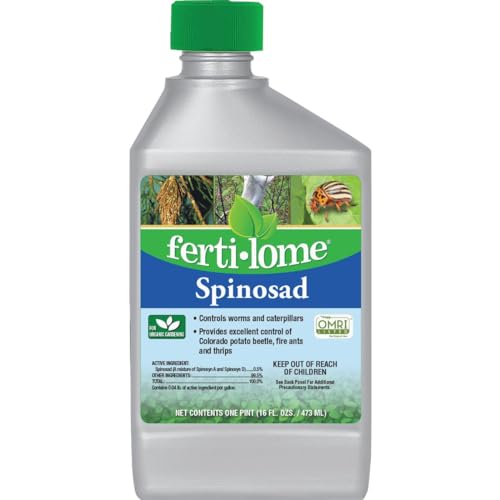
A 16-ounce OMRI-listed Spinosad concentrate that lists bagworms, tent caterpillars, and borers on the label at 4 tablespoons per gallon.
Fertilome spells out the bagworm job in the listing itself, alongside tent caterpillars, leafminers, borers, thrips, and worms. It is a Spinosad concentrate, OMRI listed for organic gardening — meaning it meets the Organic Materials Review Institute’s standards for certified organic production. Mixing is a clean, repeatable instruction: 4 tablespoons per gallon of water.
Bagworm results are the reason most people land here. The report that sticks is a gardener who sprayed shrubs for bagworms and simply said “Did the job.” Webworms, crickets, ants, and some grasshoppers come up the same way, and one user has used it for several years in a battery-operated sprayer around the house and plants as a barrier treatment.
Worth knowing before you buy: this listing is a smaller-volume option and the review history is thinner than the big-name bottles here, so you are buying on label fit rather than a long track record. The dilution rate is also fixed at 4 tablespoons per gallon, which is precise but leaves no room for a weaker maintenance mix.
Why it earns a spot
- Bagworms named directly in the product title and label, so there is no guesswork about fit.
- OMRI listed for organic gardening.
- Fixed dilution of 4 Tbs. per gallon makes mixing repeatable.
- Available as a concentrate or a ready-to-spray version.
Trade-offs to accept
- 16 fluid ounces is a modest bottle if you are treating a long tree line.
- A newer listing with a smaller review base than the established Spinosad brands.
The verdict: if bagworms are the specific problem and you want an organic Spinosad concentrate that names them, this is the most on-the-nose fit in the group.
One caution: the small bottle means big jobs will need a second purchase.
5. Monterey B.t. Caterpillar & Worm Killer, 8 oz with Spoon
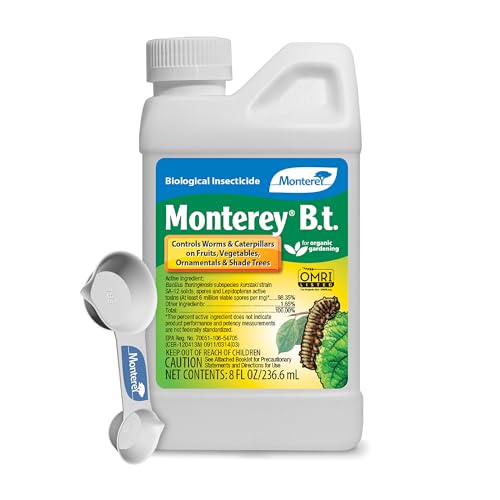
An 8-ounce B.t. concentrate with a measuring spoon included, sized for a few shrubs or a vegetable bed.
Eight fluid ounces is the smallest bottle in this group, and that is the point. The label targets caterpillars and worm-type insects by name — cabbage looper, bagworm, gypsy moth, fall cankerworm, elm spanworm — on broccoli, cabbage, melons, lettuce, tomatoes, shade trees, and ornamentals. It comes with a measuring spoon, so you are not guessing at the dose for a half-gallon sprayer.
Monterey’s B.t. is OMRI listed for organic gardening and, when used as directed, has no effect on birds, earthworms, or beneficial insects including honeybees and ladybugs. That matters if you spray where the bees are working. The formula mixes instantly with water and goes through either a trigger spray bottle or a pressure tank sprayer.
The honest limitation: value is the most contested point on this bottle. Some owners feel it is a great value and some feel it is not worth what they paid, so it pays to compare bottle size against the area you need to cover. B.t. also breaks down on the leaf in sunlight, so an evening spray works harder than a midday one.
Where it shines: worm-specific control on a small planting, with a built-in spoon and a pollinator-friendly profile.
Where it stops short: the small volume runs out fast in a full landscape job.
Reach for this if: you have a handful of shrubs or a vegetable bed and want a precisely dosed organic worm spray.
Look at a larger bottle if: you need to treat a long hedge or several trees in one session.
6. SUMMIT Caterpillar and Webworm Control, Hose End, 1 Quart

A 1-quart hose-end bottle that mixes with tap water as you spray, so there is no measuring and no sprayer to rinse.
The setup is the whole pitch here: a 1-quart hose-end bottle that connects straight to your garden hose and mixes as the water runs. That means no bucket, no measuring, and nothing to wash out afterward. It is listed for caterpillar and webworm control, and bagworms are the job most of these owners bring it home for.
Where it earns attention is the result on trees. Customers note trees looking notably healthier after treatment, which is a different kind of feedback than you usually get on a contact spray — the visible outcome is new growth rather than just dead worms on the ground. Connecting to the hose is described as easy on nearly every account.
The spray performance is the weak point, and the reviews are blunt about it. It doesn’t travel very far and sprays more like a bush than a directed stream, so getting soak into the top of a tall evergreen takes patience. Value is a split verdict too: some owners consider it well worth it, others less so. Get close to the foliage and it does the work.
Why it suits the casual crowd
- Hose-end design removes all mixing and sprayer cleanup.
- Trees visibly improve after treatment, with new healthy growth showing up in the feedback.
- Connect-it-and-spray simplicity for someone who does this once a season.
The gripes you should hear
- Spray performance is the most-discussed complaint — the pattern is coarse and the throw is short.
- Value splits opinion; some feel the coverage does not stretch as far as the label implies.
Suits best: the owner who wants a no-mixing hose-end bottle for a few trees and will work the spray close in.
Not ideal for: tall mature evergreens where you need a directed stream to reach the top.
7. Orthene 97.4% Acephate Systemic Soluble Insecticide

A 97.4% acephate soluble powder that the plant absorbs into its tissue, so feeding caterpillars dose themselves.
Systemic is the word that matters here. A systemic insecticide is taken up into the plant’s own tissue, so the pest gets a dose by feeding rather than by walking across a wet leaf. That is a real advantage on tall evergreens where you cannot soak every needle evenly. The product is 97.4% acephate in a 0.773-pound can, and the label lists tent caterpillar among the common rose and ornamental pests it controls.
The label also names aphids, Japanese beetles, rose budworm, leafrollers, grasshoppers, sawfly, scale, spittlebugs, whitefly, and thrips, so it covers a wide spread of both sucking and chewing pests on ornamentals. One can goes a long way because you are working with a near-pure soluble powder.
The trade-off is real and you should hear it before buying. Acephate has a strong odor, and that is the one recurring complaint about this product. It is not a spray you mix in the kitchen, and you will want to apply on a calm evening with some distance between you and the house. That odor buys you systemic reach that the contact sprays cannot match on a big tree.
The case for it: a systemic approach reaches feeding caterpillars even on foliage you cannot coat by hand.
The smell factor: the sharp acephate odor is the standing complaint, so plan the application rather than mixing on a whim.
Best matched to: a taller ornamental or fruit tree where a foliar spray will not reach every surface.
Think twice if: you want something you can spray casually around a patio or an open window.
8. Dipel Pro DF Biological Insecticide 1lb Bag

A 1-pound bag of 54% B.t. powder, OMRI listed and labeled fast acting against worms and caterpillars.
A dry powder changes the math. One pound of 54% Bacillus thuringiensis goes much further than a small liquid bottle by weight, and the biggest single reason owners buy it is that it is the most economical way to buy Bacillus thuringiensis. It is OMRI listed for organic gardening and labeled fast acting, with no time-to-harvest restriction on the label listed here.
It works on worms, caterpillars, and gnats, and the makers list B.t. as a biological insecticide that the caterpillar must ingest to be affected. Mixing goes into a sprayer like any soluble powder — this is a large-area tool rather than a two-shrub bottle.
The trade-off is durability on the leaf. Some owners say the bag lasts them a long time, but others note the active ingredient breaks down in sunlight within a few days, so timing matters more than dose. Spray late in the day so the product has a full night on the foliage before the sun does its work.
Why it earns a place: a 1-pound bag of 54% B.t. is the way to stock up for a whole season at a low cost per use.
What to plan around: sunlight breaks it down in a few days, so re-spray windows matter.
For the planner: someone with a rotation of shrubs and trees who wants an economical organic B.t. supply on hand.
Not for the one-off: a bag this size is more than a single small shrub needs.
9. Wisdom Pro L&H Insecticide Concentrate Quart

A quart of bifenthrin concentrate that names bagworms and works indoors as well as out.
The label lists bagworms directly, alongside gypsy moth caterpillars, leaf-feeding caterpillars, tent caterpillars, chinch bugs, ants, fleas, mosquitoes, spiders, and ticks. The active ingredient is bifenthrin at 7.9%, a pyrethroid that acts on the sodium channels of the insect’s nerve membrane, which causes paralysis and then death. That is a contact kill, not a systemic one.
Where bifenthrin shows off is fleas and mosquitoes. Owners describe eliminating a flea infestation that seven cans of fog and several spray cans had failed to touch, and cutting down backyard mosquitoes in the same treatment. For garage or roach work, a couple of ounces in a one-gallon hand pump sprayer does the job.
Two things to keep in mind. It is labeled for both indoors and outdoors, but not everyone has tried it inside yet, and one owner notes a light but tolerable odor. Application sites include residential, commercial, and industrial lawns and ornamentals, so read the label section for where you plan to spray before you mix.
What it delivers
- Bagworms named on the label alongside a wide list of caterpillars and lawn pests.
- Bifenthrin 7.9% concentrate in a full quart — a lot of doses per bottle.
- Flea and mosquito results strong enough that owners swap out foggers for it.
Points to weigh
- Light odor reported, though described as tolerable.
- Indoor use is labeled but less tested by owners than the outdoor applications.
Good fit for: a yard with fleas, mosquitoes, or roaches alongside the bagworms, where one concentrate covers several jobs.
Skip if: you want an organic or pollinator-friendly formulation, since bifenthrin is a synthetic pyrethroid.
10. Southern Ag Thuricide BT for Caterpillars & Worms, 1 Gallon

A full gallon of B.t. — the bottle you buy once and spray all season.
One gallon is 128 fluid ounces, and a B.t. concentrate mixes at 1 to 4 ounces per gallon of water. That is the recipe on the label, and it means a single jug of this makes a big pile of spray. It is a liquid B.t. intended for caterpillars and worms, so it is in the same biological family as the Bonide and Monterey products above — you get a far larger supply in one buy.
Bagworms and gypsy moth infestations are the two jobs this bottle gets bought for, and the results hold up. Owners also describe it working on leaf-rolling caterpillars on Cannas, and the value point comes up repeatedly — the general feeling is that the cost per use is low and the bottle lasts a long time. That is the whole reason to buy a gallon rather than an 8-ounce bottle.
Two things to know. This is a liquid concentrate, so you need a sprayer and you need to store a gallon somewhere cool and out of the sun. And because B.t. works on caterpillars that feed on the treated leaf, it will not clear a bagworm that has already closed its bag — you are targeting the young larvae. The store-it-and-reuse approach works well if you spray every spring when the hatch begins.
The value case: a 1-gallon jug at a 1-to-4-ounce dilution is a season’s worth of worm spray in one purchase.
The catch: you need room to store a gallon and a sprayer sized for mixing it properly.
Right for: a homeowner with a bagworm problem that comes back every spring and a sprayer already in the shed.
Too much for: a single shrub where a small bottle covers you through the season.
11. Agrisel Bifenthrin Pro 7.9 Insecticide, 1 Gallon
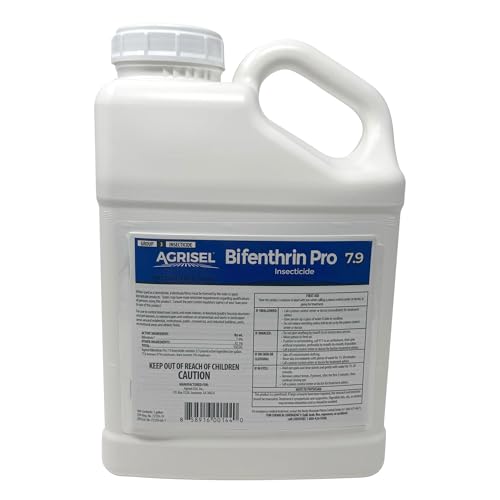
The gallon of bifenthrin for the yard that fights back all season — ants, ticks, fleas, and bagworms.
A gallon at low usage rates is the pitch: you mix a small amount into water and cover a lot of ground, so the jug goes a long way. The label list is broad — spiders, ants, fleas, mole crickets, stink bugs, and bagworms among them — and it is labeled for lawns, ornamentals, and agricultural settings. It weighs in at 9.2 pounds, so plan where it lives in the shed.
Mosquitoes and ants are the wins people keep mentioning. Owners describe spraying the exterior of the house and deck, finding dead bugs everywhere the next day and no more webs, and canceling a monthly professional service as a result. Another report covers a yard that had dozens of ticks despite repeated permethrin sprays, cleared with one application alongside an insect growth regulator. The label also says the formula is safe for pets 1 to 2 hours after application has dried.
Two real cautions. This product cannot be sold in Hawaii or New York, so check your state before ordering. And with 9.2 pounds of liquid, a leaky jug in transit is a real possibility — returns are handled, but inspect the box before you store it. On the timing front, spray when no rain is forecast and hold off mowing for a few days after.
Where it wins
- Broad-spectrum coverage across ants, fleas, ticks, mosquitoes, and bagworms.
- Low usage rates mean a gallon covers a lot of yard.
- Label says safe for pets 1 to 2 hours after the application dries.
- Reviewers point out cutting whole treatments out of their budget after switching.
Watch-outs
- Not for sale in Hawaii or New York.
- A 9.2-pound jug that can leak in transit if the seal is poor.
Best used by: the owner of a large yard with a mixed pest list who wants one jug to handle the season.
Check first if: you live in Hawaii or New York, where the label bars sale.
Know the Specs
Active ingredient families
The label front tells you a lot. Spinosad and B.t. are biological, meaning they come from bacteria and affect caterpillars that feed on treated foliage. Bifenthrin and cypermethrin are synthetic pyrethroids that kill on contact by disrupting nerve signals. Acephate is a systemic, taken up into the plant so the pest gets it by feeding. Match the family to how you can actually apply the product.
Concentrate vs. hose-end vs. powder
A concentrate gives you the most control and the lowest cost per treatment, but it needs a sprayer and a mixing chart. A hose-end bottle clips to your garden hose and mixes automatically — easy, but the throw is short and the bottle empties faster. A dry powder like B.t. 54% is the most economical by weight, but you measure it dry and store it sealed against moisture.
Organic listing and pollinator safety
OMRI listed means the Organic Materials Review Institute has verified the product against organic standards. That is a paper trail, not a promise of safety around bees — always read the specific label. Some B.t. and Spinosad labels state they don’t affect honeybees or ladybugs when used as directed, and spraying in the evening reduces exposure during the hours pollinators are active.
Dilution rates and coverage per bottle
A dilution rate like 4 tablespoons per gallon or 1 to 4 ounces per gallon tells you how far a bottle goes, and that is the key to comparing price fairly. A larger jug at a lean rate usually beats a small bottle at the same rate. For bagworms, work out how many gallons your hedge or tree line needs before you choose a size.
Common Questions
When should I spray for bagworms so the treatment actually works?
Do I need a systemic or a contact insecticide for bagworms on tall evergreens?
Will the bagworm spray hurt bees, ladybugs, or earthworms?
Does rain wash off a bagworm spray?
How much concentrate do I mix to treat a hedge of arborvitae?
Can I use a hose-end bottle for bagworms on a tall tree?
How many times per season can I spray a Spinosad product?
Is a B.t. product strong enough for a heavy bagworm infestation?
When can my pets go back on the lawn after spraying?
Are any of these bagworm products restricted in certain states?
The Bottom Line
For most people, the pesticide for bagworms winner is the Sevin Insect Killer Concentrate II because its label covers over 500 listed insects and still promises no harm to plants or blooms when used as directed. If you want an organic formula that names bagworms outright, grab the Fertilome Spinosad Insecticide. And for a whole property that needs a gallon rather than a bottle, the Southern Ag Thuricide BT is the one to reach for.
Whichever you pick, spray while the larvae are small and work the foliage until it is wet. Bagworms reward timing far more than they reward strength, so a modest bottle applied at the right moment beats a strong mix applied late.
How we choose
We do not accept paid placement. Every pick is matched to a real buyer and a real use-case; we do not hands-on test units.
Sources
Specifications: manufacturer listings and product documentation. Review insights: verified customer reviews, as of October 2026. Pricing: not shown on this page (it changes often); check the current price via the retailer link.
As an Amazon Associate, Aappliancez earns from qualifying purchases. This does not affect which products we feature.