Disclosure: Some links in this post are affiliate links. As an Amazon Associate I earn from qualifying purchases, at no extra cost to you. Learn more
Specs are compiled from manufacturer listings and verified buyer reviews and can change over time — please confirm the key details on the product page before buying.
You want your dog loose in the yard without a rope, and you do not want to pay a monthly fee for the privilege. That is the whole job. The catch is that “perimeter collar” covers two very different machines — a wired loop you bury around your property, or a GPS collar that draws a circle on your phone — and they fail in completely different ways. A buried wire holds its boundary because the wire never moves. A GPS collar is only as good as the sky above it and the battery inside it. Pick the wrong type and you spend your evenings re-charging a collar instead of watching your dog sniff the roses.
This guide is built by comparing the manufacturers’ published specifications and the patterns across verified customer reviews, so you get each pick’s real strengths and trade-offs instead of marketing spin.
Below you will find buried kits that last for years, GPS collars that set up in minutes, and a couple of systems you should size up carefully before you buy. Every pick here is a real containment collar, ranked so you can see which one suits your yard, your dog, and the way you actually live. These are the perimeter collars for dogs worth your attention right now.
Top Picks


How To Choose A Perimeter Collar For Your Dog
The first decision is not a brand. It is a shape of boundary. If your property is fixed and you plan to stay put, a buried wire kit gives you a line that does not care about cloud cover, tree canopy, or how many bars your phone shows. If you rent, travel, or move your dog between houses, a GPS collar travels with you. Neither one is better in the abstract — they solve different problems.
Wired loop or satellite boundary
A wired kit runs a physical cable around your property and a transmitter sends a signal along it. The boundary is wherever you laid the wire, so it stays put through storms and dead zones. The catch is installation: you are burying cable, and on rocky or frozen ground that is real work. A GPS collar, by contrast, needs no digging at all. You map a boundary in an app, and the collar compares its own position to that map. The trade-off is that satellite reception, battery life, and signal drift all come into play.
Correction levels and training modes
Every collar here starts with a warning — a tone, a vibration, or both — before any static correction. Look for adjustable levels rather than a fixed setting, because a bold husky and a nervous rescue need completely different starting points. Most systems let you begin with tone or vibration only and stay there until your dog reliably turns back. Plan on a couple of weeks of short, guided sessions with treats; the boundary only works once your dog understands the warning means something.
Waterproofing and neck fit
Check the IP rating first — that is the code telling you how well the collar survives water. A higher number means deeper or longer exposure, and a rating like IPX7 or IPX9K covers rain, puddles, and swimming. Then check the neck range: a collar built for a 90 lb lab will swim off a small terrier’s neck. A strap that will not tighten snugly lets the contact points shift, which is where false warnings come from. Measure your dog’s neck with a tape before you buy and match it to the listed range.
Side-by-Side Comparison
| Model | Best For | Boundary Type | Coverage | Water Rating | Amazon |
|---|---|---|---|---|---|
| Extreme Dog Fence Pro Grade 2-Dog 500 ft★ Best Overall | Fixed homes needing a rock-solid line | Buried wire | Up to 10 acres | Submersible to 10 ft | Amazon |
| FOCUSER Wireless Fence for 2 DogsEntry-Level Wireless | — | Wireless | — | — | Amazon |
| VERSMELO GPS Wireless Fence G726Best for Travel | Travel and open fields | GPS (no wire) | 33–1999 yd radius | IPX7 | Amazon |
| PetSafe Classic In-Ground Receiver Collar | Adding a dog to an existing wire | In-ground receiver | Depends on your fence | Waterproof | Amazon |
| MIMOFPET Wireless Fence for 2 Dogs X3 | Two dogs plus a training remote | Wireless + remote | 25–3500 ft | IPX7 | Amazon |
| Dogtra GPS Fence GF10UC | No-fee GPS on 3/4 acre or more | GPS (no wire) | Up to 30 fences | IPX9K | Amazon |
| Extreme Dog Fence Pro Grade 1-Dog 1000 ft | Up to an acre with a warranty | Buried wire | Up to 1 acre | Waterproof | Amazon |
| Halo Collar 5 | Owners who want live tracking too | GPS + cellular | Multiple fences | — | Amazon |
| SpotOn Omni GPS Fence Collar | Big, hard-to-fence rural land | GPS (no wire) | 1/2 acre to 100k+ acres | IP67 | Amazon |
Detailed Reviews
1. Underground Electric Dog Fence Kit, Pro Grade, 2-Dog, 500 ft
Our pick — 4.0+★ from 600+ verified ratings; the strongest balance of quality and price.
A buried cable that holds its line through storms, dead zones, and a dog who tests everything.
A wired loop does not drift, does not need satellites, and does not care that your phone has one bar. You lay 500 ft of boundary wire in the ground, the transmitter sends a signal along it, and the boundary is exactly where the cable sits. For a fixed home with a yard you plan to keep, that is the most predictable containment you can buy.
You get everything needed to finish the job in the box: heavy-duty boundary wire, 16 gauge twisted wire (thicker copper that carries the signal more reliably over distance), a digital transmitter, two collar receivers with batteries, training flags, splice kits, and 10 staples. The collar is submersible to 10 ft, so a dog that swims the pond or rolls in the mud keeps working. Three antennas, plus built-in battery check, temperature check, and wire check, mean the transmitter monitors its own health rather than leaving you to guess.
The honest catch is installation. Burying cable across an acre or more is a weekend of digging, and on rocky ground you may need to rent a trencher. Budget the time before you commit. Then watch the collars: the electrics here are built to last, but receiver batteries do age, and replacement collars are not cheap once the warranty lapses. One long-term owner put it plainly: “First collar lasted 11 months, replaced under 1-year warranty; second collar lasted only 12 months.”
What holds up over years
- 10-acre coverage from a single 500 ft wire loop — far beyond what a GPS circle manages reliably in trees
- Collar submersible to 10 ft, so swimming and rain are non-issues
- Three antennas plus battery, temperature, and wire diagnostics built into the transmitter
- Includes two receivers, flags, splices, and staples — a full kit, not a starter
Where it asks more of you
- Burying the wire is real labor; rocky or frozen ground may need a trencher
- Replacement collars after warranty add up, and batteries age over time
- No app, no live tracking — this is a boundary, not a locator
Ride with this if: your property is permanent, your yard has trees or dead zones, and you want a boundary that behaves the same on day 900 as day one.
Think twice if: you rent, move often, or cannot spare a full day of digging — a GPS collar will suit you better.
2. Electric Wireless Dog Fence System for 2 Dogs
A bare-bones two-collar wireless kit where the boundary behavior is the whole story.
This is the lightest thing on the list at 1.65 pounds for the pair, and the pitch is simple: two collars, no wire, no subscription. That pitch is also where the trouble starts. The boundary on a kit like this is not a mapped perimeter you draw; it relies on signal strength, and signal strength is exactly the thing that wobbles. When the collar misreads where it is, your dog gets a beep or a correction while standing safely in the middle of the yard.
That failure mode is the one buyers describe again and again. As one put it, “After a month one of the collars would randomly go off when my dog was inside the parameters.” Others note collars that beep in the safe zone, or one unit that never worked at all. One owner also reports sores and singed fur at the contact prongs. That should make any owner stop and test the collar on a low setting before trusting it. Given how small the sample of feedback is here, treat this as a kit to approach with caution and a careful trial period rather than an everyday set-and-forget tool.
Where the money goes: two rechargeable lithium-ion collars, a wireless base, and no subscription — a genuinely low outlay for a two-dog wireless setup.
The part that worries me: inconsistent boundaries and corrections that fire out of nowhere are the recurring theme, and that is a training problem you cannot fix with treats. If you buy it, run it on the lowest setting for a week and watch how the collars behave indoors before you rely on them outdoors.
Suited to: a patient buyer who wants to test a wireless boundary cheaply on a small, open yard and is willing to return it if the signal misbehaves.
Not the one for: anyone who needs dependable containment on day one, or a dog that will be left alone with a collar that can fire unexpectedly.
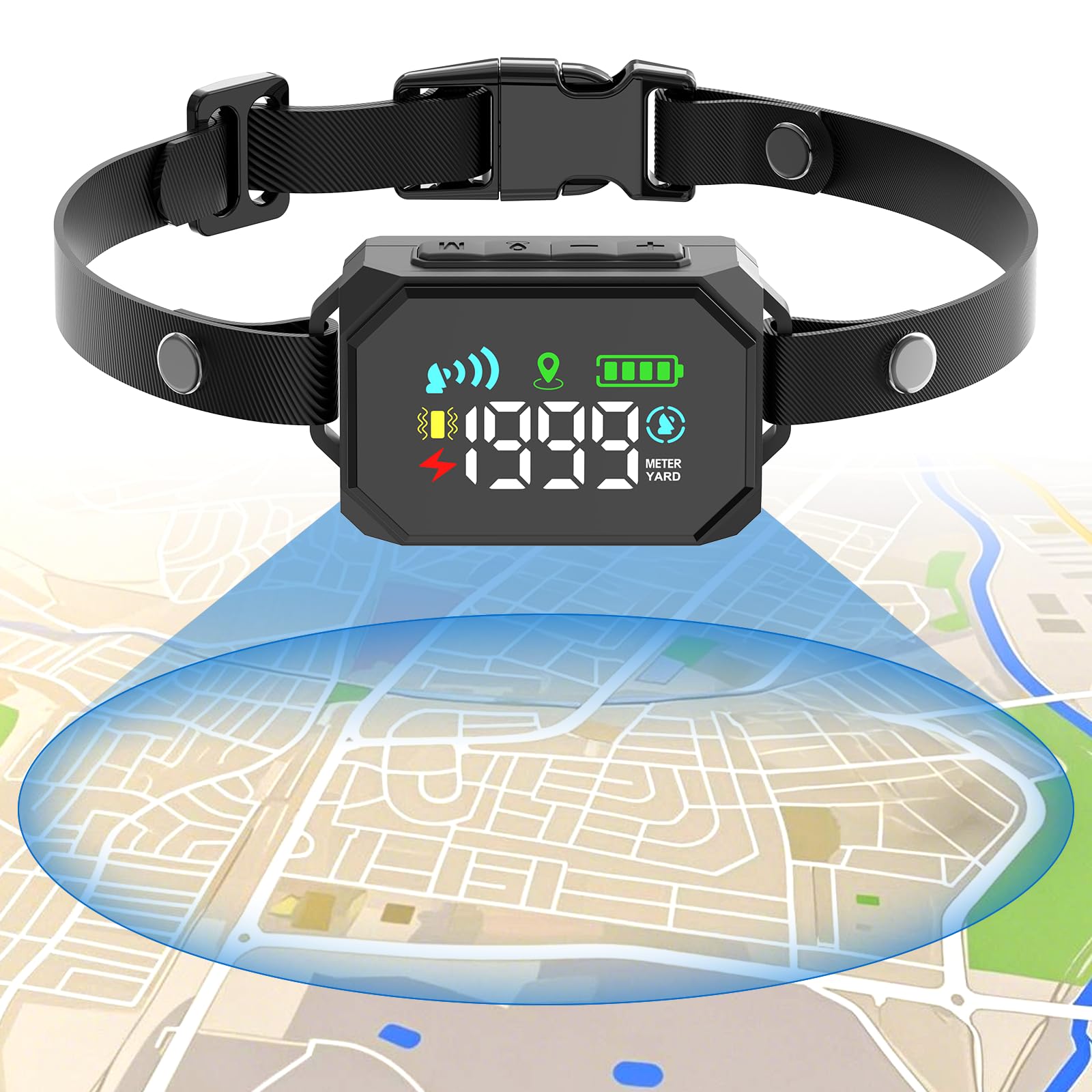
3. GPS Wireless Dog Fence Radius 33-1999 Yards
A pocket-sized GPS collar that turns a field into a dog park in about ten minutes.
Here is the number that reframes this category: this collar can draw a boundary from 33 up to 1999 yards in radius, which covers 0.7 up to 2593 acres. Compare that to the Extreme wire kit’s 10 acres and you are looking at a 259.3x gap in reach. Nothing buried gets close. That is why this is the pick for a farm, an open field, or a road trip where you want a dog park wherever you stop. It runs on a GPS receiver alone — no base station, no wires, no app subscription.
Setup is genuinely quick, and the collar is tiny next to the buried systems: 10.5 ounces against the Extreme 2-dog kit’s 11.73 pounds. The package is also a fraction of the size, at 9.06 x 3.86 x 1.85 inches versus 13.5 x 9.88 x 9.65 inches, so it packs in a glovebox. Six correction levels step from sound to vibration to static, and the collar drops into protection mode after two cycles so a dog that keeps pushing does not get hammered. It handles dogs over 18 lbs with necks from 9 to 26 inches, and the IPX7 rating means rain and puddles are fine.
The trade-off is battery and sky. This collar runs 24 to 36 hours per charge, and owners who push it report charging nightly. Reception is the other variable — some units struggle to lock a satellite signal at all, and a GPS boundary needs a clear view of the sky. That makes it a poor fit for dense woods, small suburban yards, or indoors. As one buyer warned flatly, “It dies way to quickly we had to charge it every night to ensure our dog didn’t test the boundary and get out.”
Go this route when: you have open space, you travel with your dog, and you want a boundary without a single shovel of dirt moved.
Choose differently if: your yard is small, wooded, or fenced by trees — the satellite lock will frustrate you and a wire loop will not.
4. PetSafe Classic In-Ground Fence Collar
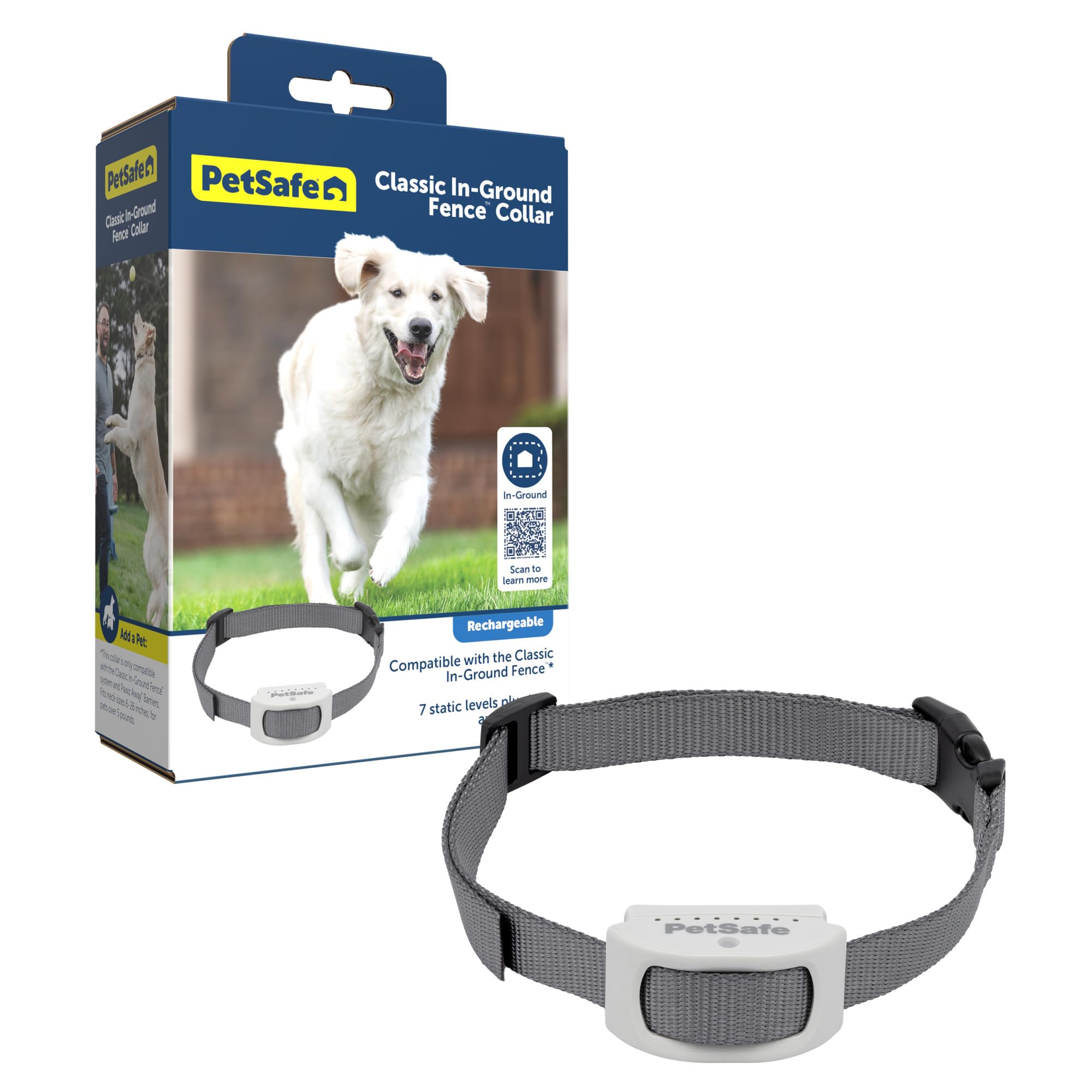
The collar you buy when the wire is already in the ground and another dog needs to join.
This is a receiver collar, not a full kit — which is exactly its value. If you already have an in-ground PetSafe loop running, this adds a dog without re-burying anything. Level 1 is tone plus vibration only, and levels 2 through 8 add increasing static correction, so you can give a nervous rescue a gentle start and a stubborn terrier a firmer line. It also works with Pawz Away barriers, so you can keep a dog off the couch or out of the garden with the same collar.
It is built for small pets too — dogs and cats from 5 lbs and up, six months and older. That is a far smaller floor than most collars here, which typically ask for 15 lbs or more. The waterproof receiver means potty breaks in the rain are fine, and the battery recharges in 2 to 3 hours with indicator lights to warn you before it dies. At 1.44 ounces it is the lightest collar on this list by a wide margin, which matters on a cat or a small terrier.
Two caveats worth knowing before you buy. First, compatibility: this is a PetSafe classic-system receiver, so it will not talk to every transmitter. Check your existing system’s model before ordering, since at least one owner had to return it and rebuild around a new setup. Second, the design is a dog fence collar first and a cat barrier second. It works for cats in some homes, but a strong-willed cat can simply ignore a tone. The American-based customer care line helps when you are mid-install and stuck.
Why it earns a slot: eight adjustable settings with a vibration-only starting point, a recharge in 2 to 3 hours, and a 5 lb minimum that opens this system up to pets the bigger collars cannot fit.
Check before you click: confirm your fence transmitter is the classic PetSafe system. Mismatched hardware is the single most common reason this collar gets sent back.
Made for: a household with an existing in-ground loop that wants to add a second or third pet without touching the yard.
Skip if: you need a complete fence starter kit or you have a cat that ignores every warning tone.
5. MIMOFPET Wireless Dog Fence for 2 Dogs, X3
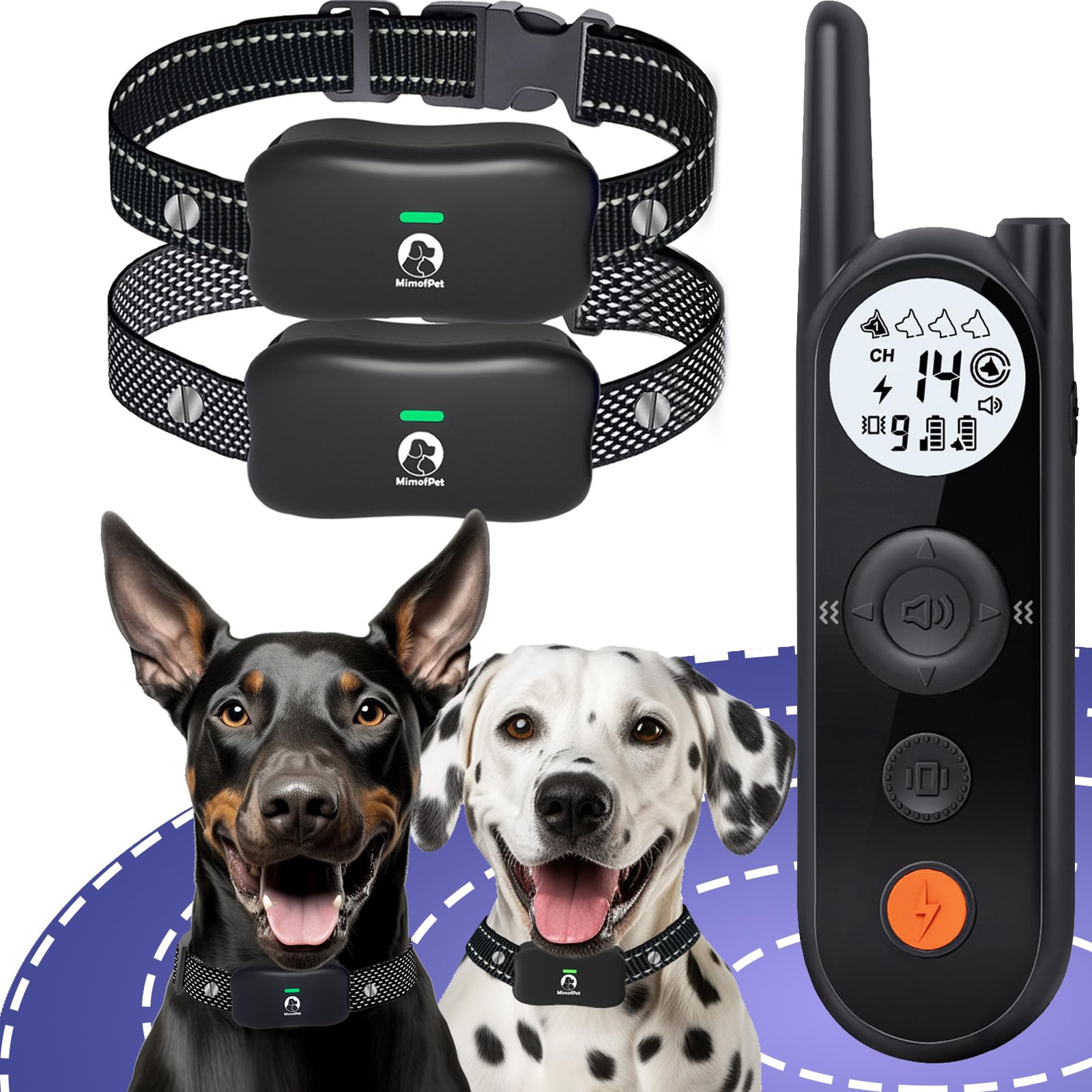
A two-dog wireless fence that doubles as a handheld training remote for off-leash walks.
Two jobs in one device is the draw. In fence mode, this collar sets a boundary from 25 feet out to 3500 feet in 14 adjustable range levels. In training mode, the remote gives you beep, vibration from 1 to 9 levels, and static from 1 to 30 levels, with a range that reaches up to 5900 ft. If your dog already walks off-leash and you want a fence in the yard plus a way to correct a straying dog on the trail, this covers both without buying two systems. Two collars ship in the box for a pair of dogs.
The battery spec tells you what kind of tool this is: up to 185 days on standby, or about 85 hours of continuous fence use. That is why the maker tells you to switch fence mode off when it is not needed. The IPX7 rating (waterproof enough to survive rain and a dunking) handles rain and water. There is a keypad lock to stop accidental button presses, plus two flashlight modes so you can find a dog in the dark.
The catch is precision. A handful of owners run into trouble on the fence side — boundaries are set by numbered levels rather than a measured distance in feet, so dialing in an exact line takes trial and error. Others find one training button fires both collars at once, which is a nuisance with two dogs behaving very differently. The battery and value question is genuinely mixed in the review pages, and the power-button design has been flagged as fragile on at least one unit. Buy it for the training-remote pairing, not as a precision perimeter.
Worth it if: you want one remote to handle two dogs both at home and on the trail, and you are prepared to tune the boundary by trial rather than by tape measure.
Look elsewhere if: you need a boundary you can set to the foot, or you want both collars acting independently at all times.
6. Dogtra GPS Fence with App

A GPS fence with an IPX9K shell and a design that works with the phone switched off.
Two things make this stand out. The first is the waterproof rating: IPX9K is the toughest on this list, rated for high-pressure, high-temperature water spray, which is overkill for a dog collar in the best way. The second is how it runs. You use the free app once, at setup, to map a circular or custom-shaped fence. After that the collar operates on its own — no phone nearby, no monthly fee, no data connection required. That is a significant advantage over cellular GPS collars that stop tracking when the signal drops.
The boundary is layered, not a single line: a warning zone, a primary fence, and two backup fences, each set to tone, vibration, or stimulation with 100 adjustable levels. Smart detection switches off correction while your dog is heading home, and a continuous beeping tone guides them back. You get up to 30 stored fences for travel, dogs from 15 lbs, and neck sizes from 10 to 30 inches with a 3/4 inch strap. Up to three dogs can share one fence profile through the app.
Be clear about what you are not getting: this is containment only, with no live tracking and no notifications. It is also designed for properties 3/4 acre or larger, and the maker says to remove the collar indoors — a GPS boundary that small just is not its strength. Then there is battery life, which is the point most owners bring up. Expect around a day between charges and plan on a nightly routine. At 8 ounces it is light enough for most medium and large dogs to forget.
The features that genuinely deliver
- No subscription and no phone needed once the fence is mapped
- IPX9K waterproofing — the highest rating in this lineup
- Three protection layers plus 100 adjustable levels and a come-home reminder tone
- Up to 30 stored fences and three dogs on one profile
The limits you should plan around
- Battery needs a nightly charge — the biggest recurring complaint
- No live tracking or breach notifications, by design
- Needs a property of 3/4 acre or more and the collar off indoors
- A traditional buckle is slower to get on an excited dog than a snap clip
Reach for this: if a no-fee GPS fence on a decent-sized property is the goal and you do not care about watching your dog’s dot move on a map.
Keep shopping if: you want real-time location alerts or you have a small suburban yard — a wired loop fits that better.
7. Underground Electric Dog Fence Kit 1-Dog 1000 ft

One dog, one acre, and a warranty that stretches from one year to five when you register.
This is the smaller sibling of the top pick, and the key difference is scope. One collar instead of two, and coverage up to 1 acre instead of 10. If you have a single dog on a modest lot, that is the right size — and you are not paying for a second receiver you will never use. The 1000 ft of heavy-duty boundary wire plus 50 ft of 16 gauge twisted wire is the entire loop; the kit also includes 50 flags, 2 splices, and 10 staples.
The collar is the nicer part. Eight independently adjustable correction levels plus a beep-only training setting, and a strap that fits necks from 6 inches to 26 inches — a much wider range than the other collars here, which rarely go below 10 inches. That range makes it usable on everything from a small terrier to a big shepherd. It also carries the longer warranty story: one year as sold, extended to five when you register the fence, backed by an American support line.
Two real risks to weigh. The first is weight and size: at 19.91 pounds this box is the heaviest item on the list, so plan a good workspace and expect the install to take time. The second is the collar life span rather than the fence. The wire and transmitter hold up well, but the receivers take the daily wear, and one long-term owner reports breakage that led to a replacement. Register the fence on day one — it is the single easiest thing you can do to protect your purchase.
Where it wins: a 6-to-26-inch neck range that fits almost any single dog, a beep-only starting level, and a warranty you can extend to five years just by registering.
The honest catch: the receipt alone does not add up to a finished job — you still need to bury 1000 ft of wire, and that is a weekend, not an afternoon.
Right answer for: one dog, one yard you own, and a buyer who wants a warranty-backed wire fence without paying for a second collar.
Not for you if: you are covering more than an acre, since the bigger 2-dog kit reaches 10 acres for the same installation effort.
8. Halo Collar 5 GPS Wireless Dog Fence, Midnight

A fence and a live locator rolled into one collar — with a membership on top.
Where the Dogtra and VERSMELO collars hand you a boundary and stop there, the Halo does both jobs. Dual-frequency L1 and L5 satellites, corrected in real time by ground stations, put its location within 2 feet of your dog’s actual position. It updates 20 times per second over Wi-Fi, Bluetooth, and cellular, and alerts your phone the moment your dog nears or crosses a line. For a dog on a busy road or a vanishing hound, that combination is the whole reason to spend here.
You can store multiple fences, including on rural properties and trails where other GPS collars drop out. At 4.16 ounces it is lighter than most, and the design handles large, medium, and small breeds. There is a built-in training program that walks you through teaching your dog what the sound, vibration, and optional static warnings mean, which is the part most owners skip and later regret.
Then there is the honest part: a subscription is required to activate GPS and fence features, and that membership is what open up tracking, cellular data, and fence creation. Several owners find the boundary signal wanders indoors and fire false warnings, so the collar should come off when your dog is inside. Some report the boundary behavior going unreliable after a few weeks, and the clips have needed reinforcing on at least one puppy. Test it on the lowest setting and remove it indoors, and it is a genuinely useful tool.
Pick this when: knowing where your dog is minute to minute is worth a membership fee to you, and a boundary alone would not give you enough confidence.
Weigh the cost first: the membership is ongoing, and if you only need a boundary line, the no-fee Dogtra does that job for less commitment.
9. SpotOn Omni GPS Dog Fence Collar Medium Dogs

The most accurate perimeter here, built for land big enough that a fence line would cost a fortune.
The number that defines this collar is 128 satellites — the orbiting signals it locks onto for a position fix. It is the only system here that names that figure, and it is why SpotOn boundaries hold under heavy tree canopy where other GPS collars drift. You can create unlimited fences of any shape from 1/2 acre to 100k+ acres, add off-limits zones and correction-free zones inside the fence, and use overlapping fences that share coordinates — a feature no other collar on this list claims. For a big, wooded, hilly property, that precision is what makes a GPS boundary trustworthy enough to bet a dog on.
The rest of the build suits hard country. It is IP67 rated for rain, snow, and swimming, with two alert tones and 30 levels of optional static correction plus vibration. Off-Grid mode lets you set a fence with no cell service or internet at all, which is the feature that matters when your horse paddock has no bars. Boundaries are stored on the collar, so they keep working when the phone is out of range. Fences run without a subscription, and the battery gives 40+ hours that way, or 25+ hours with a tracking subscription, or 35+ hours with Extended Battery Life Mode on.
Two things to plan for. The battery is the mixed note — the daily runtime lands most owners a single day, so a nightly charge is part of the routine. And the buckle has been the weak link for some, with at least one owner losing the collar in the field, so check the closure on arrival and consider a backup link. This is also a medium-dog collar with a 12 to 18 inch neck, so it is not the fit for a Great Dane or a toy breed. Get the size right and the accuracy does the rest.
Where it earns its keep: 128 satellites, unlimited fences from 1/2 acre to 100k+ acres, overlapping fences, and an Off-Grid mode that works with zero cell service.
The two-part caveat: battery is a one-day affair for most owners, and the buckle is the hardware to double-check — the collar, not the boundary, is the part most likely to let you down.
Built for: owners of medium dogs on wooded or remote land who need accurate boundaries more than they need a low price.
Avoid if: your property is under 1/2 acre, your dog’s neck is outside 12 to 18 inches, or a nightly charge is a deal you refuse to make.
Know the Specs
Boundary coverage in acres versus yards
Buried wire kits quote coverage in acres, because the wire is laid around a fixed area. The Extreme 2-dog kit covers up to 10 acres, and the 1-dog kit up to 1 acre. GPS collars quote a radius instead, which is the distance from the collar’s center point out to the edge. The VERSMELO runs from 33 to 1999 yards in radius, which the maker lists as 0.7 up to 2593 acres. A radius boundary is a circle, so a long narrow yard is a poor match — the circle wastes space at the corners. Know your property shape before you pick the type.
IP waterproof ratings explained
The IP code tells you how well the collar survives water, and the number after the X is the key one. IPX7 survives being submerged in water for a set time, which covers rain, puddles, and swimming. IPX9K adds protection against high-pressure, high-temperature spray, the toughest rating in this lineup. IP67 means it is sealed against dust and survives brief submersion — enough for a swim or a muddy roll. The Extreme wire collars sidestep the code and simply state submersible to 10 ft, which is a straight answer for a water-loving dog.
Common Questions
Will a GPS collar hold a boundary in heavy woods?
How long does it take to train a dog to respect the boundary?
Can I add an extra dog to a system I already own?
Does the collar need a subscription to work?
How long does the battery last on a GPS fence collar?
Can my dog swim with the collar on?
Is a wired fence better than a wireless one?
What neck size will these collars fit?
Will the collar correct my dog indoors?
What happens if a collar battery dies while my dog is out?
The Bottom Line
For most dog owners with a yard they plan to keep, the perimeter collars for dogs winner is the Extreme Dog Fence Pro Grade 2-Dog 500 ft kit — a buried wire boundary that never drifts, covers up to 10 acres, and ships with two waterproof collars ready to go. If you want a boundary without digging a single trench, the VERSMELO GPS collar sets up in about ten minutes and travels in a glovebox. And for big, wooded, or remote land where precision is the whole point, the SpotOn Omni is the collar to reach for. Whichever you choose, burying the wire once or charging the collar nightly are the two habits that decide whether the boundary holds — pick the one your routine can actually keep.
How we choose
We do not accept paid placement. Every pick is matched to a real buyer and a real use-case; we do not hands-on test units.
Sources
Specifications: manufacturer listings and product documentation. Review insights: verified customer reviews, as of October 2026. Pricing: not shown on this page (it changes often); check the current price via the retailer link.
As an Amazon Associate, Aappliancez earns from qualifying purchases. This does not affect which products we feature.