Disclosure: Some links in this post are affiliate links. As an Amazon Associate I earn from qualifying purchases, at no extra cost to you. Learn more
Specs are compiled from manufacturer listings and verified buyer reviews and can change over time — please confirm the key details on the product page before buying.
You want a wall that looks like real boards without a nail gun, a saw, or a contractor. The trick is knowing that peel and stick shiplap comes in two very different builds: vinyl rolls that wrap around corners and thick real-wood planks that feel like timber. Get that choice right and a weekend of work turns a tired wall into the room’s best corner. Get it wrong and you get peeling corners by month three.
This guide is built by comparing the manufacturers’ published specifications and the patterns across verified customer reviews, so you get each pick’s real strengths and trade-offs instead of marketing spin.
Each entry lists who it suits, where it struggles, and how much wall one pack actually covers, so you can match a peel and stick shiplap to your room instead of guessing.
Top Picks


How To Choose The Best Peel and Stick Shiplap
Start with the surface you’re covering, not the color. A smooth, dry, flat wall takes almost any peel and stick shiplap. A textured “orange peel” wall fights back and needs sanding and primer first. Renters covering drywall want something removable; anyone covering a ceiling or a backsplash wants permanent grip.
Rolls versus planks
A roll is one continuous sheet of vinyl you cut with scissors and lay in long strips — fast, cheap per square foot, and easy to wrap into corners. Planks are individual boards, usually real wood or a wood-composite, that you butt end to end for a true board-by-board look. Rolls hide wall flaws better; planks look more like genuine shiplap and handle close inspection.
Coverage and waste
Every listing states coverage in square feet, and that number assumes perfect cuts. Measure your wall height times width, then add extra for pattern matching and offcuts. Rolls give you one long run to work with; planks mean you’ll lose material at each end cut, so order more than the math says.
Adhesion and removability
Removable vinyl lifts cleanly when you want it gone — good for rentals. Real-wood planks usually use a permanent adhesive that grips hard and can pull paint or drywall paper when removed. Decide up front whether this wall is a forever wall or a lease-friendly patch.
Side-by-Side Comparison
| Model | Best For | Coverage | Material | Width | Amazon |
|---|---|---|---|---|---|
| Sevalo Contact Paper Shiplap★ Best Overall | Budget roll for cabinets and accent walls | 42.9 sq ft | Vinyl | 15.7 in | Amazon |
| YENHOME Shiplap Peel and Stick WallpaperWidest Roll | Widest vinyl roll for renters | 48.3 sq ft | Vinyl | 17.7 in | Amazon |
| Livelynine Wood Floor Contact Paper | Floors over walls | 43.3 sq ft | Vinyl | 15.8 in | Amazon |
| SINGULARWOOD Vinyl Wall Planks | Plank look without the wood | 18 sq ft | Vinyl | 6 in | Amazon |
| Timberchic Baxter Blonde | Smooth real-wood accent wall | 10 sq ft | Wood | 12–42 in lengths | Amazon |
| SINGULARWOOD Solid Wood Panels | Rustic ebony feature wall | 14.50 sq ft | Paulownia wood | 5 in | Amazon |
| TIMBERCHiC River Planks | Reclaimed statement wall | 10 sq ft | Reclaimed spruce and fir | 5 in | Amazon |
Detailed Reviews
1. Sevalo Contact Paper Shiplap
Our pick — 4.0+★ from 300+ verified ratings; the strongest balance of quality and price.
One roll covers 42.9 square feet of wall, and it lifts off again without leaving glue.
If you rent, the removable glue is the headline. This Sevalo roll is self-adhesive vinyl you peel and press, and the maker says it pulls away without damaging the surface or leaving residue behind — so a deposit stays safe. At 15.7 inches wide by 393 inches long, one roll wraps 42.9 square feet, which is roughly a small bathroom wall.
The back carries grid lines, so you can cut a straight edge with scissors rather than hunting for a T-square. That matters on cabinet fronts and shelf liners, where a crooked strip is instantly visible. It’s also abrasion- and tear-resistant, so a wiped-down backsplash won’t shred the vinyl.
What wins people over is how forgiving the sheet is during install — lift it, relay it, and wrinkles smooth out in your hands. The pattern also hides overlaps when you run strips vertically. Horizontally it refuses to line up, so keep your runs vertical on walls. The honest catch is that colors shift between batches and some buyers find the tone flatter than the photos, so measure first and buy every roll in one order.
Where It Holds Up
- Removable adhesive that the maker says won’t scar the surface or leave glue
- Grid lines on the backing let you cut straight without extra tools
- 42.9 sq ft per roll goes a long way on a cabinet or a half-wall
- Vertical overlaps blend because the straight-match pattern is forgiving
What To Plan Around
- Horizontal seams won’t align — run the strips vertically
- Color runs vary by batch, so order the full quantity at once
- Thin vinyl tears if fingernails catch a corner
Reach for this if: you’re covering cabinets, shelves, or a rental wall and want to undo it later.
Keep in mind: buy all your rolls together, because a second batch can read a shade off.
2. YENHOME 17.7″X393″ Shiplap Peel and Stick Wallpaper
The widest strip on this list means fewer seams to hide across a full wall.
Width is the quiet advantage here. This roll runs 17.7 inches across against the Sevalo’s 15.7 inches, so you lay fewer vertical strips and create fewer places for a seam to show. Add the 393-inch length and you get 48.3 square feet of coverage — the biggest single-roll figure among the vinyl options here.
It’s waterproof vinyl, so a wet towel or a splash on a bathroom or kitchen wall is not a problem. The backing has a grid for straight cuts, and the glue is peel and stick with no paste involved. The surface is flat and wipes clean, which is why classroom teachers keep using it on bulletin boards.
Appearance is the reason most people keep it. It reads convincingly as boards from across a room and makes a small bathroom feel bigger. Up close, though, the printed image gets soft and faint printer lines show if you stand within about a foot. The color also leans browner than the grey in the photos. Thickness is on the thin side, so a perfectly smooth wall flatters it most.
The up-close test: this is a wall covering that thrives at conversational distance. View it from where you actually sit, not nose to the plank.
Who it fits: renters and teachers who want a big wall covered in one order, on a smooth surface, with removable glue.
Pick this one when: the wall is large and smooth, and you want the fewest possible seams.
Look elsewhere if: your wall is textured or you need flawless detail at arm’s length.
3. Livelynine Wood Floor Contact Paper

Built for the floor first, but it sticks to a wall just as happily.
This one is a vinyl sheet measuring 15.8 by 394 inches, and it rolls out 43.3 square feet at 0.4MM thick. The PVC top layer is the part that matters on a kitchen or bathroom job — it doesn’t absorb water, so mopping and spills wipe right off. The grid on the backing lets you trim to size without professional tools.
Where it earns its place is floors: it lays over old linoleum or tile for a fast, cheap refresh, and it’s thin enough to transition cleanly at a doorway. On a wall it works as a shiplap-pattern accent in a bedroom or RV. Because it’s one continuous roll, you get long unbroken runs instead of plank ends.
Two things come up again and again. In high-traffic floor spots, the edges can lift where feet catch them — a baseboard or trim covers that neatly. And some batches print soft, so seams between panels don’t always line up perfectly. Treat it as a temporary fix that looks convincing from standing height — at this price, that’s a fair trade.
The floor-first verdict: cheap, waterproof, and easy to cut, it revives a worn floor for a fraction of new flooring.
The honest limit: high-traffic edges and seam alignment are where it shows its age.
Suits: renters and RV owners transforming a floor or a wall on a tight budget.
Rethink it if: you need the seams to be invisible forever in a busy hallway.
4. SINGULARWOOD Wall Panels
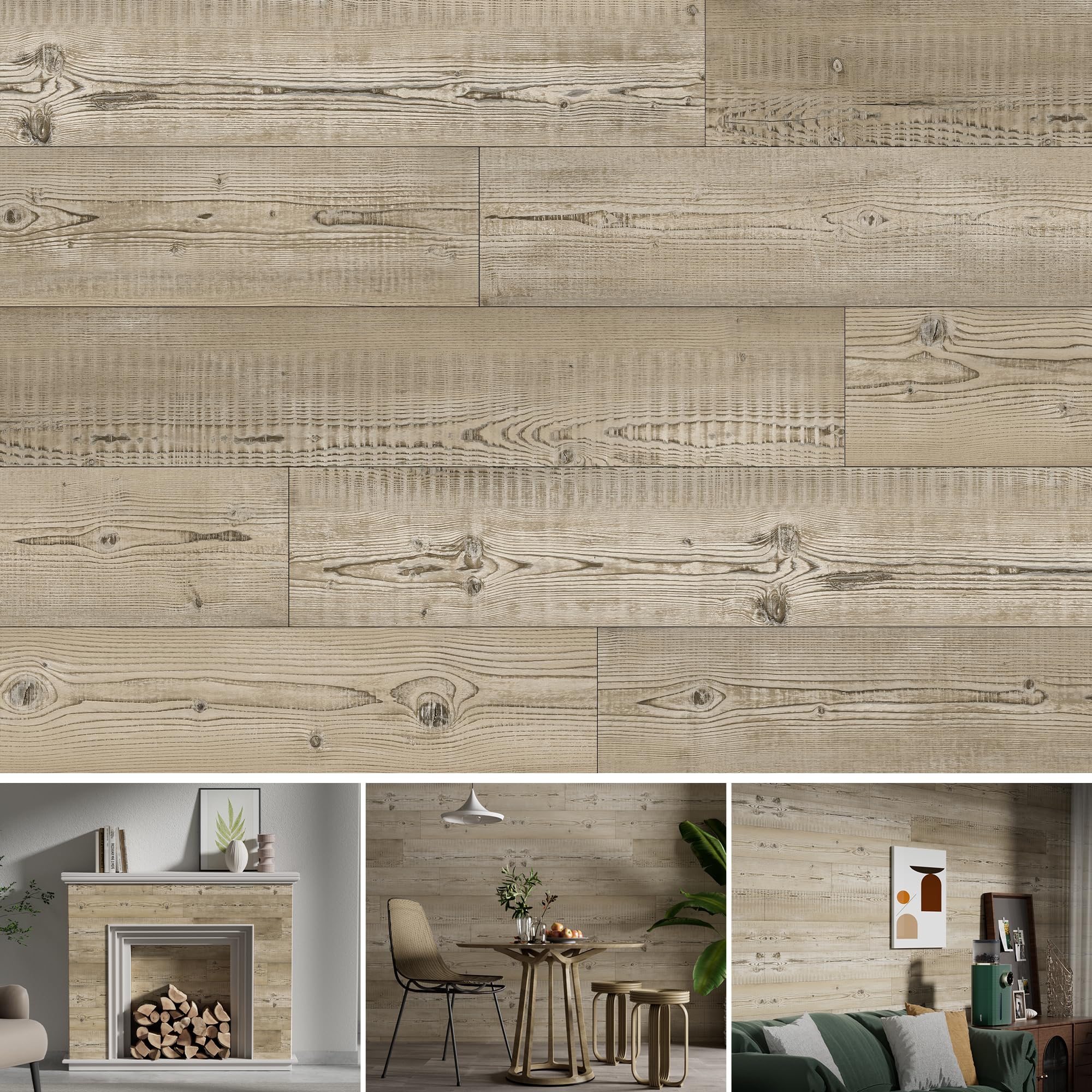
Individual planks that look like pine boards and stick with pressure alone.
Each plank here is a real board shape — 36 inches long, 6 inches wide, and 0.15 inches thick. You get 12 of them per box for 18 square feet of coverage, and you can mix colors and sizes to build your own pattern. Because they’re separate pieces, the finished wall reads as actual shiplap rather than a printed sheet.
The material is vinyl with a wood-look texture, and it’s water-proof, flame rated, and light-weight. Installation is a plain peel and stick, and the maker says walls need to be clean and dry. Orange-peel textured drywall won’t accept it directly — sand, prime, and let it cure, or add extra glue for reinforcement.
Cutting is the standout strength. People slice these clean with a box cutter and a clamp guide, which keeps a straight edge on every board. The one thing to respect is the glue: it grips hard. Position each plank with real care, because once it’s down, pulling it off takes surrounding paint with it. Plan your layout on the floor first.
The Wins
- True plank shape at 36 in by 6 in by 0.15 in thick
- Cuts straight with a box cutter and clamp guide
- Water-proof and flame rated for bathrooms and kitchens
- 18 sq ft across 12 planks lets you mix patterns and colors
The Watch-Outs
- Adhesive is strong enough to lift paint on removal
- Boxes can arrive with a damaged corner, so inspect before you start
- Textured walls need sanding and primer first
Best matched to: a smooth accent wall or door face where you want distinct boards.
Fair warning: measure and dry-fit first, because this glue does not like second chances.
5. Timberchic Reclaimed Wood Planks Baxter Blonde
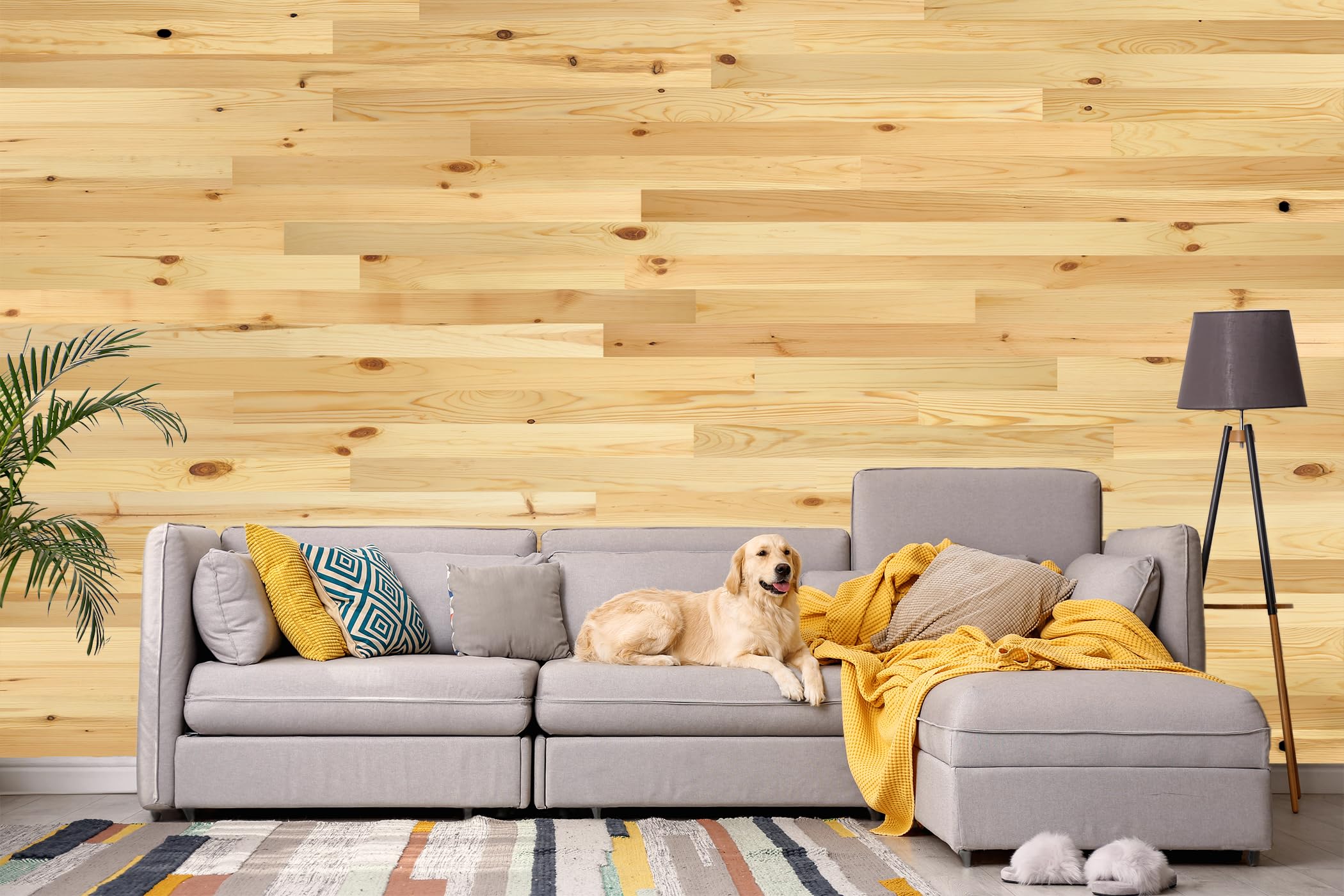
Genuine wood grain and 3M grip, with a smooth finish that skips the knot holes.
This is the smooth-finish option for anyone who wants wood, not vinyl. The planks are crafted from Red Pine and White Oak, and around 16 pieces arrive per pack in lengths from 12 to 42 inches. Each is 1/8 inch thick, and the whole pack covers 10 square feet. Because lengths vary, you assemble a staggered wall with fewer cuts than a uniform plank would need.
The backing is 3M adhesive, so there are no nails and no glue tub. The maker rates the planks fade- and warp-resistant, and a half-bath ceiling install held firm through months of Midwest humidity. Expect to use a sharp utility knife and to score carefully — the wood is thin and rewards a slow, deliberate cut.
Two honest notes. Coverage is 10 square feet per pack, so a full feature wall means several packs and a real budget. And the adhesive is permanent: removal will damage the surface underneath. That is the trade for a hold that lasts. If you want the option to change your mind later, a removable vinyl roll is the smarter route.
Why wood wins here: the grain is real, the finish is smooth, and the 3M hold is built to stay put.
What it asks of you: commit to the wall, and budget for several packs at 10 sq ft each.
Choose this for: a permanent accent wall, headboard, or kitchen island wrap in real wood.
Skip the wood route if: you may need to remove it later without tearing up the wall.
6. SINGULARWOOD Solid Wood Wall Panels, Wood Plank for Walls

Blackened wood planks with natural cracks and knots for a sauna-style wall.
These are 0.2 inch thick paulownia wood planks, each sized 35.5 inches long by 5 inches wide, and 12 come per pack for 14.50 square feet. The panels are carbonized at high temperature during manufacturing, which is why the timber carries its deep ebony tone. Some packs give off a slight smoke smell at first that fades within a couple of days — air them out before installing if that bothers you.
The look is the point. Authentic paulownia shows natural cracks and knots, so each plank carries its own character and the finished wall reads handmade rather than printed. It’s light, easy to handle, and goes onto a clean, dry, flat wall with peel and stick tape. Textured orange-peel walls are not recommended for direct application.
Plan your layout before anything touches the wall. The first piece must be perfectly level, and placement has to be exact because repositioning weakens the tape. A few thin planks crack when cut with a table saw, so use a hand saw and order extras. On the plus side, a wall can go up in about two hours with no special skills.
The character play: real carbonized wood with natural cracks and knots, installed in an afternoon.
Prep is everything: level the first plank, cut gently, and buy spare pieces.
Made for: a rustic feature wall, ceiling accent, or under-island panel in a black-wood scheme.
Worth knowing: thin planks can split on a table saw, so cut by hand and keep spares.
7. TIMBERCHiC Reclaimed Wood Planks River Planks
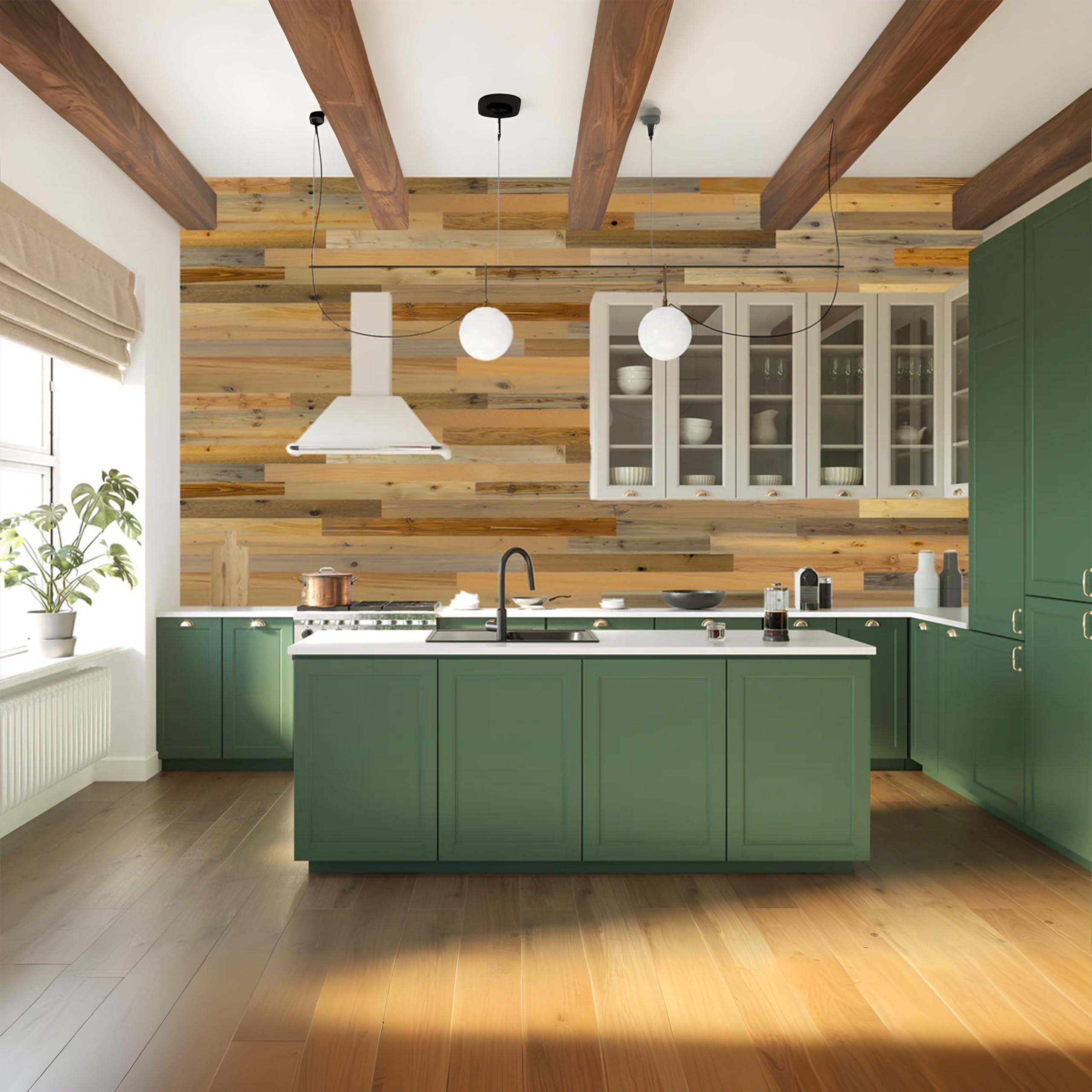
Wood pulled from a Maine riverbed, cut into 10 peel-and-stick statement planks.
This is the pick with a story attached. The timber is river-recovered spruce and fir, salvaged from the depths of the historic Penobscot River in Maine and naturally preserved without chemicals. Ten planks arrive per pack at 0.13 inches thick, and they’re cut with a utility knife or a miter saw without drama. Peel-and-stick 3M backing handles the hold.
A full accent wall can go up in under five hours with a handsaw, and the self-adhesive precut pieces mean fewer cuts even on angled walls. The finished look is genuinely reclaimed — warm, textural, and unlike a printed vinyl sheet. The maker rates the planks warp- and fade-resistant, and includes a sample pack so you can see the color in your own light first.
Where it asks patience is price and coverage. Ten square feet per pack means a large wall takes several packs, and the per-square-foot cost is the steepest of any pick here. Some boards carry a slight center curvature, which is fine on a small project but stands out across a big flat wall. A curated paint color paired with it is the reliable way to land the look.
The standout: authentic reclaimed wood with a real story, installed with nothing but pressure and a knife.
The reality check: 10 sq ft per pack makes it the most expensive cover per foot on this list.
The right buyer: you want a one-wall showpiece in true reclaimed timber and aren’t chasing the lowest cost per foot.
Rather not: a big flat wall where slight board curvature would catch the eye.
Know the Specs
Coverage in Square Feet
Every roll and pack lists a total area in square feet. That number assumes you waste nothing, which never happens on a real wall. Order extra for end cuts, pattern matching, and mistakes — on planks especially, since each end cut costs you material.
Thickness and Material
Vinyl rolls run thin and flexible so they wrap corners; real wood planks run thicker and feel like timber. Thinner material shows wall texture and flaws more, so smooth walls flatter it most. Textured walls need sanding and primer before anything sticks.
Roll Width
A wider roll like 17.7 inches covers more per pass than a 15.7-inch strip, which means fewer vertical seams on a large wall. More strips means more chances for a visible join, so width matters most on big open surfaces.
Removable vs Permanent
Removable vinyl lifts without damaging the surface, which keeps rentals and deposits safe. Permanent 3M adhesive on wood planks grips harder and resists lifting but can take paint with it on removal. Decide whether the wall is permanent before you peel the first strip.
Common Questions
Will peel and stick shiplap stay on a textured orange peel wall?
How much wall does one roll or pack actually cover?
Can I remove peel and stick shiplap without damaging the wall?
Which is better for a bathroom, vinyl or real wood?
Do the planks need nails or glue in addition to the adhesive?
How do I stop the seams from showing?
Will the color match the photos online?
Can I use shiplap vinyl on a floor?
How long does the installation take?
What tools do I actually need?
The Bottom Line
For most rooms, the peel and stick shiplap that balances cost, coverage, and removability is the Sevalo Contact Paper, because it covers 42.9 square feet of wall and lifts without leaving glue. If you want the widest strip and the fewest seams, reach for the YENHOME roll, which gives you 48.3 square feet across a broader 17.7-inch width. And when a permanent feature wall in genuine reclaimed timber is the goal, the TIMBERCHiC River Planks deliver the look no vinyl can match — just budget for several packs at 10 square feet each.
How we choose
We do not accept paid placement. Every pick is matched to a real buyer and a real use-case; we do not hands-on test units.
Sources
Specifications: manufacturer listings and product documentation. Review insights: verified customer reviews, as of October 2026. Pricing: not shown on this page (it changes often); check the current price via the retailer link.
As an Amazon Associate, Aappliancez earns from qualifying purchases. This does not affect which products we feature.