Disclosure: Some links in this post are affiliate links. As an Amazon Associate I earn from qualifying purchases, at no extra cost to you. Learn more
Specs are compiled from manufacturer listings and verified buyer reviews and can change over time — please confirm the key details on the product page before buying.
If you want fresh pasta at home, the real deciding factor is not how many attachments come in the box — it is whether the machine clamps still and rolls a sheet thin enough to see your hand through. A wobbly clamp and a loose crank handle will ruin your first batch faster than any recipe mistake. This guide separates the models that clamp down and stay put from the ones that slide and fight you every turn.
This guide is built by comparing the manufacturers’ published specifications and the patterns across verified customer reviews, so you get each pick’s real strengths and trade-offs instead of marketing spin.
You will see which rollers handle thin dumpling skins, which cutters slice clean strands, and where each machine cuts corners on build. Every pick below is chosen on published specs and owner review patterns, so you can match a roller to your counter and batch size.
Top Picks

How To Choose The Best Pasta Roller
A pasta roller is a simple machine with three jobs: squash dough into a sheet, feed that sheet through cutters, and hold itself still while you crank. The machines that fail usually do so on the clamp — they slide instead of holding still. So before you compare thickness dials, check how the clamp grips and how the handle seats into the shaft.
Start with the thickness range in millimeters
The dial setting is the whole point of owning a roller. A range that reaches down to 0.5 millimeters gets you thin wonton and ravioli skins; a range that only starts thicker leaves you hand-finishing delicate doughs. Look at both ends of the range, not just the number of settings.
Then look at the clamp and the crank
The clamp is a screw or lever that bites the counter edge so the machine does not slide while you work. Thick granite or an ogee-edged counter can leave nothing for the clamp to bite, so many owners mount the machine on a cutting board first. The crank is a bent handle that slots into the roller shaft — if the slot is loose, the handle drops out mid-pass and you re-thread it with doughy hands.
Decide between a standalone machine and a mixer attachment
A standalone hand-crank machine lives in a cabinet and needs no power. A stand-mixer attachment uses the mixer’s front hub to drive the rollers, which frees both your hands for feeding dough. If you already own a stand mixer, the attachment route takes less counter space and less cranking effort. If you do not, a standalone machine is the simpler purchase.
Know what the cutter can and cannot do
Widths are usually given in millimeters — a narrow cutter for spaghetti strands and a wider one for fettuccine. Some rollers ship with no cutter at all and only roll sheets, which suits lasagna and ravioli but not noodles. Others score the dough instead of cutting clean through, and you pull the strands apart by hand.
Side-by-Side Comparison
| Model | Best For | Thickness Range | Machine Type | Weight | Amazon |
|---|---|---|---|---|---|
| Shule Pasta Maker Machine★ Best Overall | All-round first machine | 0.5–3 millimeters | Hand crank, with 2 cutters | 4.4 pounds | Amazon |
| OVENTE Pasta Maker PA515RBest for Dumplings | Dumpling skins and small batches | 0.5–3 millimeters | Hand crank, with double cutter | 4.3 pounds | Amazon |
| VEVOR Pasta Roller Attachment | KitchenAid owners who only need sheets | 0.3–2 millimeters | Stand mixer attachment, roller only | 2 pounds | Amazon |
| AceChef 7-Setting Pasta Maker | Beginners who want both cutters | 7 settings | Hand crank, 2-in-1 cutter | 2.87 kg | Amazon |
| MZTOGR 3-in-1 Pasta Maker | Ravioli and drying-rack fans | 0.5–2.5 millimeters | Hand crank, cutter plus ravioli attachment | 6.5 pounds | Amazon |
| Coolcook 3-in-1 Pasta Attachment | Three shapes without swapping parts | 0.4–2 millimeters | Stand mixer attachment, roller plus two cutters | — | Amazon |
| Sailnovo 3-in-1 Pasta Maker | Family sessions and clay craft | 0.3–3 millimeters | Hand crank, 2 cutter widths | — | Amazon |
Detailed Reviews
1. Shule Pasta Maker Machine
Our pick — 4.0+★ from 900+ verified ratings; the strongest balance of quality and price.
A cast steel body that stays planted while you roll, even on the thinnest setting.
What you get here is a complete hand-crank setup: a cast stainless steel body, anodized aluminum roller and cutter, a hand crank with a plastic grip, and an adjustable clamp that bites the counter edge. The body weighs 4.4 pounds, which is the reason it does not chatter when you press dough through. That is more than double the 2-pound VEVOR mixer attachment, and the extra weight is what keeps the frame from walking when you press a stiff dough through.
The thickness dial runs from 0.5 to 3 millimeters, so you can take a sheet from a thick lasagna layer down to a delicate wonton wrapper without changing machines. Dough feeds up to 150 millimeters wide. The build quality is what wins people over most, and owners push this frame well beyond pasta — there is a steady craft crowd running polymer clay through it and reporting a well-made steel frame that cleans with corn starch rather than water. One owner put it plainly: “This works okay, good for beginners, but is cheaply made, will use it till it breaks, doesn’t feel very sturdy” — a fair note that the longevity here is not the same as a commercial machine.
Two cutters are included, one narrow and one wide, so spaghetti and fettuccine come off the same pass. Cleanup is a dry brush or cloth plus a small wooden stick for the pressing rollers — no water near the blades. A few owners note the cutter does not always slice fully through, which means pulling the last strands apart by hand. The crank handle can also work loose from its slot mid-crank.
What Holds Up Batch After Batch
- Cast stainless steel body at 4.4 pounds sits steady through a stiff dough.
- 0.5 to 3 millimeters of thickness covers thin dumpling skins and thick lasagna.
- Narrow and wide cutters both ship in the box.
- Dry-brush cleaning keeps the rollers free of water damage.
Where It Asks More of You
- Cutter sometimes leaves strands joined, so hand-finishing is part of the job.
- The crank handle can slip out of its slot while you turn.
- Counters with no overhang force you to mount it on a cutting board first.
Reach for this if: you want one hand-crank machine that rolls thin, cuts two widths, and does not wander across the counter.
Look elsewhere if: you expect years of heavy weekly use — this frame is built for home batches, not a pasta shop.
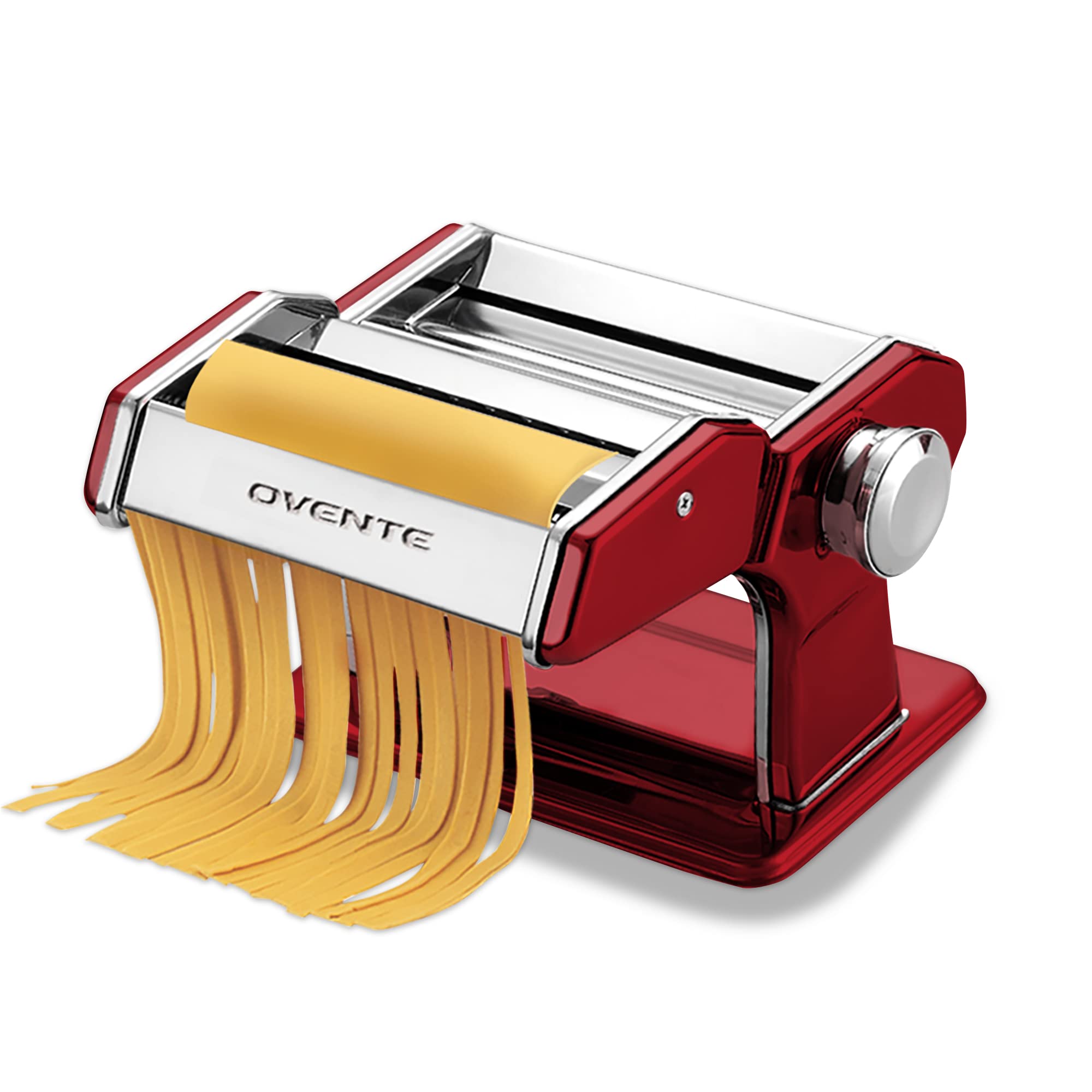
2. OVENTE PA515R Pasta Maker Machine
The metallic red body that takes dough down to dumpling-skin thin without a fight.
This one is a compact unit — it measures 7.7 inches long, 5 inches wide and 6 inches tall, and weighs 4.3 pounds. That footprint matters if your counter space is tight, and it is a smaller footprint than the Shule at 8.2 inches long. The 7-position dial takes dough from 3 millimeters at the thick end down to 0.5 millimeters at the thin end, which is the setting people reach for when making dumpling skins.
Owners lean on it for pierogi and ravioli in small batches, and it earns its keep there. The metal build feels solid in the hand, it is ready to use within minutes of unboxing, and the double cutter attachment turns out spaghetti or fettuccine without a second pass. Cleaning is a brush or toothpick job — the blade attachment should never see water or a dishwasher, because moisture dulls it.
The honest catch is the cutter itself. It rolls dough beautifully but does not always separate strands, and one owner’s fettuccine came out two or three noodles thick instead of individual strands. There is also a serious durability warning worth knowing: a longer-term owner reported the machine “One owner reported the crank seizing after seven months, with metal filings found in the pasta.” Treat that as the tail end of the curve rather than the norm, but it is real. The clamp screw is partly plastic and can loosen under heavy force, and thick ogee-edged counters need a cutting board underneath for the clamp to grab.
The best use case: dumplings, pierogi, and small ravioli batches where thin settings and quick cleanup matter more than volume.
The one wobble: the cutter leaves some strands joined, so budget a minute to pull them apart.
Suits you if: you want a compact, attractive machine for delicate doughs and short sessions.
Think twice if: you plan years of weekly noodle batches — the crank and cogs are the parts to watch.
3. VEVOR Pasta Maker Attachment

It plugs into your mixer hub and rolls sheets with both hands free.
If you already own a KitchenAid stand mixer, this attachment turns it into a pasta roller without taking up cabinet space. It clicks into the front power hub and the mixer does the cranking. At 2 pounds it is far lighter than the 4.4-pound Shule, so it stores in a drawer and travels to a friend’s kitchen without effort. The rolling shaft is 304 stainless steel, chosen for wear and rust resistance.
Eight thickness settings run from 0.3 to 2 millimeters, and the roller takes dough up to 5.51 inches wide. That range suits wide noodles, dumplings, tortillas and layer cakes. The build is what the reviews keep returning to — strong rollers that turn out consistent sheets, a snug fit on the mixer, and a clean surface that wipes down easily. This is a roller only; it does not cut pasta, so noodles, ravioli and lasagna are where it lives. There is no cutter to buy separately in the box, which keeps the price low for people who already own a knife and a board.
The adjustment knob has a bit of play, so you may find the thickness wheel a touch loose when you lock a setting. The numbers on the dial are also faint — some owners paint them for visibility. And this one is not dishwasher safe, so it stays a hand-wipe tool. For a mixer owner who only needs sheets, it is the cleanest path to fresh pasta.
Why Mixer Owners Pick It
- 2 pounds, so it stores in a drawer between batches.
- 8 settings from 0.3 to 2 millimeters cover thin sheets and wide noodles.
- 304 stainless steel rolling shaft resists rust and deformation.
- Fits all KitchenAid stand mixers with a simple hub connection.
The Trade-Offs to Weigh
- Rolls sheets only — no cutter for spaghetti or fettuccine.
- Thickness knob has noticeable play when locked.
- Dial numbers are hard to read without extra marking.
Pick this one when: your KitchenAid is already on the counter and you want lasagna, ravioli or knife-cut noodles with no cranking.
Keep looking if: you need spaghetti strands straight off the machine — there is no cutter here.
4. Pasta Maker 7 Thickness

Seven thickness levels and two cutter heads that cover most home pasta nights.
Here is the beginner-friendly package: a stainless steel base, a dough roller, a 2-in-1 cutter head with wide fettuccine at 4.5 millimeters and spaghetti at 2 millimeters, a hand crank, and a table clamp. The 3-in-1 design means you do not swap parts mid-batch. Set the 7-level dial, roll your sheet, then feed it straight into the cutter.
The clamp is the part that makes or breaks this machine, and it needs about two inches of counter overhang to bite. If you have that, it holds steady and the pasta rolls without tearing. Buyers report the 3-in-1 layout needs no part changes and cleans with a rag without dough clogging the rollers. Run a scrap of dough through first to lift any factory oil before your real batch.
The recurring gripe is the crank handle — it slots loosely and slips out while you turn, so you keep inward pressure to hold it. A few owners also find the machine shifts if the clamp is not tight. Both are small, fixable annoyances rather than failures. Everything else lands where you want it: even linguine strands, consistent thickness, straightforward setup.
Where it shines: the 2-in-1 cutter gives fettuccine and spaghetti widths from one head, and the 7 levels handle lasagna and wonton wrappers alike.
The one thing to fix: keep pressure on the handle so it does not drop out mid-crank.
For you if: you are buying your first roller and want both cutter widths without extra parts.
Not for you if: your counter has no overhang for the clamp to grab.
5. MZTOGR 3-in-1 Pasta Maker Machine
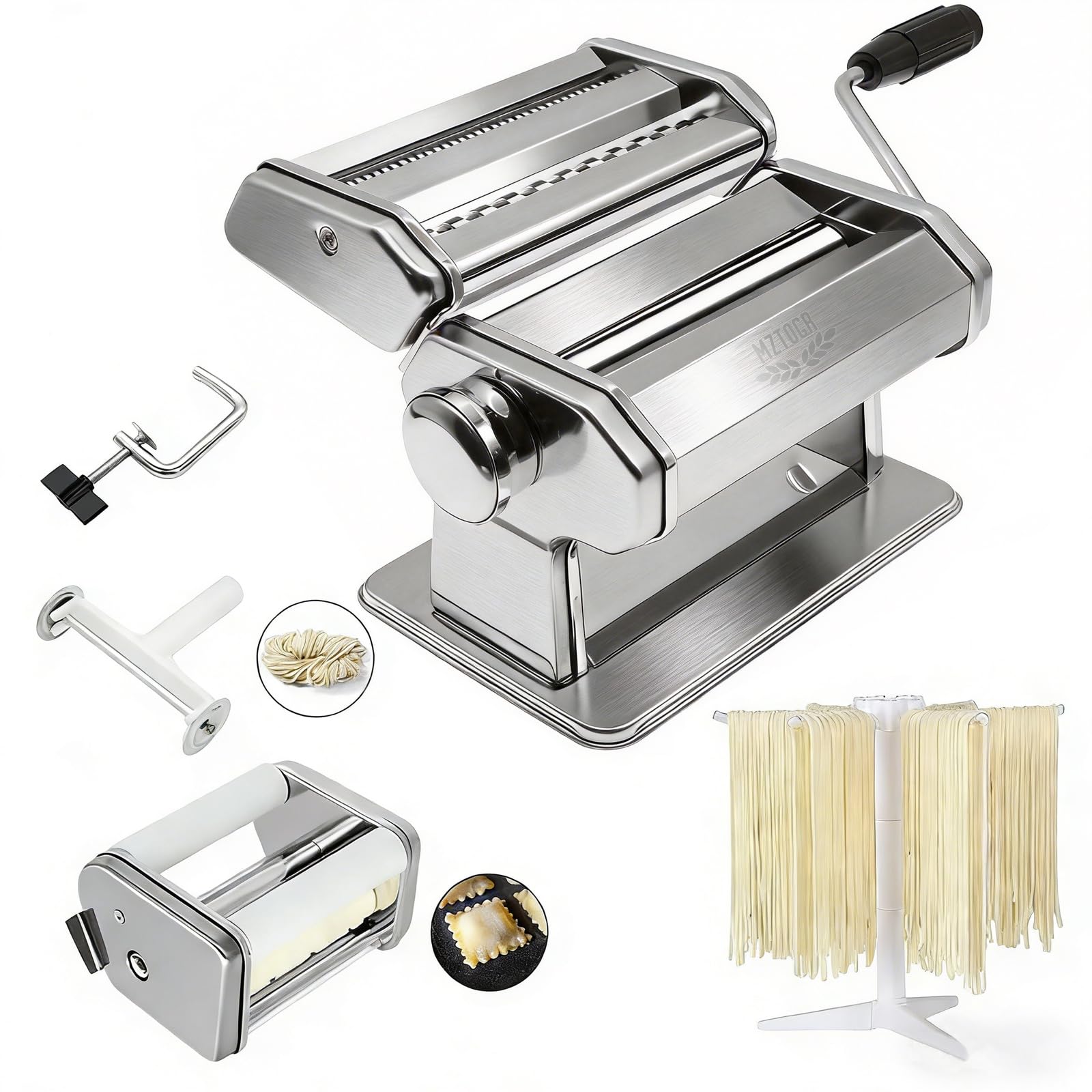
Roll, cut, and hang your noodles on the rack that comes in the box.
This kit adds two things the simpler machines leave out: a ravioli attachment and a drying rack. Roll a sheet, cut spaghetti at 2 millimeters or fettuccine at 7 millimeters, then hang fresh noodles to dry on the included rack. The dial gives 9 settings from 0.5 to 2.5 millimeters, and the easy-lock dial keeps thickness consistent between passes. It is the heaviest of the hand-crank group at 6.5 pounds, which is a fair weight for a machine that carries a carbon steel roller with a plated coating.
The body is stainless steel and the roller runs smoothly through a stiff dough. Owners who try it for the first time find the setup straightforward and the rolling far better than a hand pin — the machine stretches dough thin with less effort. The ravioli attachment is the draw for anyone who wants filled pasta.
That attachment is also the sharpest learning curve in the kit. Filling can ride out with the dough and stick to the rollers, and the instructions do not fully walk you through it, so expect a few test batches. The clamp is the other soft spot — on some counters it grips poorly and the unit tilts, so you hold one side down while cranking. The review record backs patience with this one: the machine turns out even, restaurant-style sheets once you learn its rhythm, but a rough first pass is common.
What Earns It a Spot
- Ravioli attachment and drying rack both included.
- 9 settings from 0.5 to 2.5 millimeters.
- Carbon steel roller with plated coating and stainless body.
- 2-millimeter spaghetti and 7-millimeter fettuccine cutters.
What to Plan Around
- Ravioli attachment takes practice — filling can stick to the rollers.
- Clamp grip varies by counter, so the unit can tilt.
- At 6.5 pounds it is the heaviest hand-crank pick here.
Worth it if: filled pasta and a drying rack matter to you, and you are willing to learn the ravioli attachment.
Skip the ravioli if: you want straight noodles only — a simpler two-cutter machine delivers that with less fuss.
6. Pasta Attachment 3 in 1 Set

Roller and two cutters share one hub, so shapes change without a swap.
Unlike the VEVOR attachment, this one bundles the roller and two cutters into one 3-in-1 unit that connects to the mixer hub. That means you can roll a sheet, cut lasagna, and run spaghetti without pulling parts off and re-seating them. The body is aluminum, which keeps it light enough for a cupboard shelf or a picnic bag. High-precision gears run quiet, so the kitchen stays calm while you work.
The thickness dial adjusts from 0.4 to 2 millimeters, a range that covers lasagna sheets and thin angel-hair styles. Attaching it takes seconds and it fits the stand mixer hub directly. The included manual walks you through angel hair, fettuccine, lasagna and ravioli, and a removable protective cover keeps dough out of the rollers. A cleaning brush reaches inside for the spots a cloth misses.
The cutters are the honest caveat. Spaghetti strands sometimes come out scored rather than cleanly cut, and you pull them apart by hand. Thickness and weight also draw mixed notes — a few owners find the aluminum build lighter than they expected. On the other side, the ease of use is what most owners talk about, and the setup is friendly even for a first batch. One owner’s spaghetti came out thin like ramen; the thicker roller is there for next time.
The useful part: three functions on one hub means no mid-batch part swaps and a quick change from sheets to strands.
The real limit: the cutter scores instead of slicing cleanly, so noodles need a hand-pull.
Good fit for: KitchenAid owners who want spaghetti and lasagna from one attachment without switching cutters.
Less so if: you want perfectly separated strands straight off the cutter.
7. Sailnovo 3-in-1 Pasta Maker
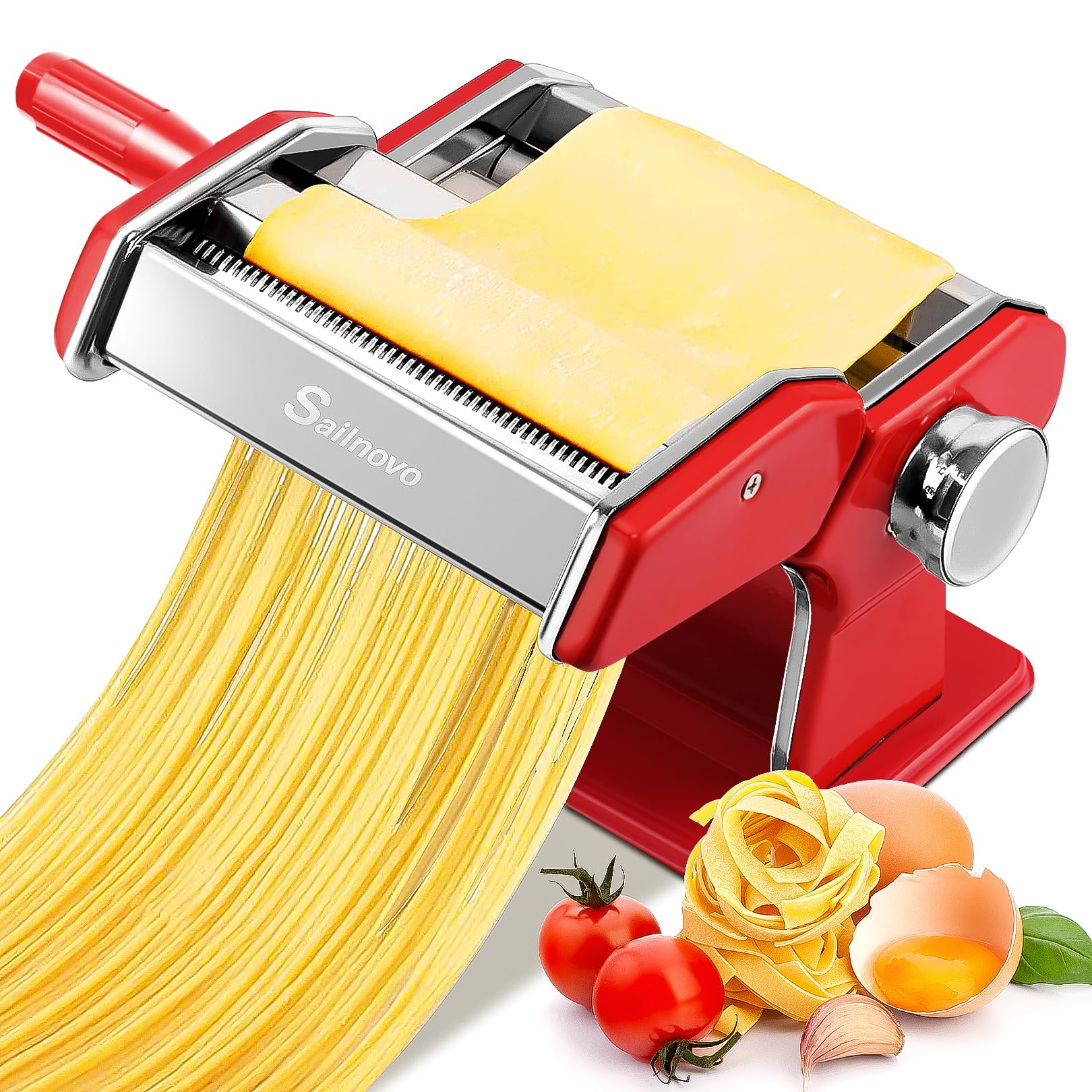
A red hand-crank machine built for kids to help turn the handle.
The draw here is family sessions and craft use. The body is food-grade, and the rollers and cutters are aluminum alloy chosen to resist rust. Little hands can work the crank while you feed dough. It takes dough from 0.3 millimeters at the thinnest up to 3 millimeters, giving you angel-hair-thin sheets or hearty fettuccine. Two cutter widths at 2 and 6.25 millimeters cover spaghetti-style strands and wider noodles.
The machine is solid in the hand, cranks smoothly, and cleans simply — wipe with a dry brush or cloth and pull stuck dough from the rollers with a toothpick. Owners who use it for polymer clay report a heavy metal machine that adjusts thicknesses precisely. For pasta, the draw is the same: a quiet, simple crank that does not need power or a mixer.
The recurring note is the clamp. On some counters it will not stay put, and one owner found the lever scratched a wooden surface, so a cutting board underneath protects both the machine and the counter. The cutter also draws mixed feedback — some strands come out rough and need a hand-pull. Dough quality matters here more than on a powered machine; the cutter handles a well-floured, properly kneaded dough best.
Who it is built for: a family or craft table where one person cranks and another feeds dough, with no power needed.
The honest trade-off: the clamp and cutter are the two places this machine asks you to slow down and work carefully.
A solid match if: you want a cheerful red machine the kids can help turn and a range that reaches 0.3 millimeters for delicate dough.
Pass if: you need a clamp that locks dead-still on a thick stone counter.
Know the Specs
Thickness Range in Millimeters
The dial setting is measured in millimeters — a smaller number means a thinner sheet. Most machines here work between 0.5 and 3 millimeters, with a few reaching thinner. A thin end around 0.3 to 0.5 millimeters lets you roll wonton wrappers and delicate ravioli skins. A thick end around 2.5 to 3 millimeters handles hearty lasagna and thick noodles. Look at both ends of the range, because a machine that only rolls thick dough leaves you finishing thin sheets by hand.
Clamp and Crank
The clamp is the screw or lever that bites the counter edge so the machine stays still while you crank. It needs a counter overhang to grip, so thick ogee-edged granite or thick stone often forces you to mount the machine on a cutting board first. The crank is the handle that slots into the roller shaft. A loose slot means the handle drops out mid-pass, which is why so many owners keep inward pressure on it as they turn. A tight clamp and a snug crank slot are what separate a steady machine from one that fights you.
Stand Mixer Attachments
An attachment uses your stand mixer’s front power hub to drive the rollers instead of a hand crank. That frees both hands for feeding dough and saves cabinet space. Some attachments roll sheets only and leave cutting to a knife; others bundle a roller and two cutters into one unit. All the attachments here connect with a simple hub fit, so check that your model fits the hub before you buy.
Cutter Widths
Cutter width is given in millimeters — a narrow cutter makes spaghetti-style strands and a wider one makes fettuccine. Some machines combine both on a single head so you do not swap parts mid-batch. A few rollers ship with no cutter at all and roll sheets only, which suits lasagna and ravioli but not noodles. Watch for cutters that score the dough instead of cutting through; those strands need a hand-pull to separate.
Common Questions
Will a VEVOR or Coolcook attachment fit my KitchenAid stand mixer?
What thickness setting do I need for dumpling or wonton skins?
Why does my crank handle keep falling out?
Can I wash a pasta roller with water or put it in the dishwasher?
How do I get my machine to stop sliding on the counter?
Do I need a cutter or can I just roll sheets?
What is the difference between a stand-mixer attachment and a hand-crank machine?
Why do my spaghetti strands come out stuck together?
Can these machines handle polymer clay as well as pasta dough?
How long should a pasta roller last with regular home use?
The Bottom Line
If you want one machine that does it all without fuss, the Shule Pasta Maker is the pick — its 4.4-pound cast steel body stays planted, its 0.5 to 3 millimeters of thickness covers thin skins to thick lasagna, and both cutters ship in the box. For a KitchenAid owner who only needs sheets, the VEVOR attachment rolls to 0.3 millimeters and stores in a drawer at 2 pounds. And if dumpling skins and small ravioli batches are your goal, the compact OVENTE PA515R reaches 0.5 millimeters with a dial that is easy to read.
How we choose
We do not accept paid placement. Every pick is matched to a real buyer and a real use-case; we do not hands-on test units.
Sources
Specifications: manufacturer listings and product documentation. Review insights: verified customer reviews, as of October 2026. Pricing: not shown on this page (it changes often); check the current price via the retailer link.
As an Amazon Associate, Aappliancez earns from qualifying purchases. This does not affect which products we feature.