Disclosure: Some links in this post are affiliate links. As an Amazon Associate I earn from qualifying purchases, at no extra cost to you. Learn more
Specs are compiled from manufacturer listings and verified buyer reviews and can change over time — please confirm the key details on the product page before buying.
If your paint keeps sliding into the center of the tray or your colors dry out between sessions, the fix is usually the palette itself, not your technique. A good watercolor palette holds each color in its own well and gives you a flat, roomy mixing surface where paint spreads instead of beading up. The five picks below cover every style of painter, from the studio artist who needs a big ceramic color wheel to the traveler who wants half pans in a pocket-sized box.
This guide is built by comparing the manufacturers’ published specifications and the patterns across verified customer reviews, so you get each pick’s real strengths and trade-offs instead of marketing spin.
We’ll walk through well counts, mixing area, portability, and what each material means for cleanup and stability. By the end you’ll know exactly which watercolor palette fits your studio or your backpack — including how to tell a true airtight seal from a lid that only snaps shut.
Top Picks

How To Choose The Best Palette for Watercolor Painting
Most watercolor palettes that frustrate people fail on one of three things: the surface, the wells, or the seal. Match the material and well layout to how you paint and the palette stops working against you. Here’s what to look at before you buy.
Material decides how paint behaves
A ceramic or porcelain surface is glazed and smooth, so mixed color glides across it — that makes blending easier and lets you wipe it clean with a tissue. Plastic palettes are lighter and cheaper to ship, but they can make some paints bead up in a puddle. Steel with a porcelain enamel coating sits between the two: light in the hand, smooth like ceramic, and easy to clean.
Wells: how many and how deep
Wells are the small cups that hold each unmixed color. A palette with 32 deep wells lets you load a full 5ml tube into each cup, while a 12 half-pan box suits pigments you use in small amounts. Slanted wells tilt the paint toward the front edge, so you can add a drop of water and control it without flooding the cup. If you paint large washes and go through a lot of one color, deep wells save you from refilling mid-session.
Mixing area is where the work happens
The flat central area — often called the mixing tray — is where you blend. A big central mixing area means you can lay down a long gradient without running out of room. Some palettes include a removable tray you can lift out to rinse, which is far easier than washing the whole thing in a sink. If you keep several washes going at once, a tray with divided corners or a partitioned edge keeps them from running together.
Portability and the seal question
A folding case with a latch is not the same as an airtight case. A snap or click tells you the lid is closed; airtight means the seal keeps air out and water in. If you plan to travel with wet paint in the wells, dry it first or expect a spill. Studio palettes are built to stay on the desk and stay put — some sit flat with rubber pads underneath so they don’t skate around while you work.
Side-by-Side Comparison
| Model | Best For | Wells | Material | Mixing Area | Amazon |
|---|---|---|---|---|---|
| MEEDEN Ceramic Watercolor Paint Palette 32-Well★ Best Overall | Home studio color wheel | 32 deep wells | Porcelain (white) | Large central tray plus lid as extra mixing space | Amazon |
| Mijello Fusion 33-Well PaletteMost Wells | Classroom and travel with lots of colors | 33 slanted wells | Plastic, silicone | Large mixing area plus removable mixing tray and lid | Amazon |
| Mijello Fusian 24-Well Palette | Plein air painter carrying color | 24 slanted wells | Plastic, resin | Two mixing wells plus one large removable mixing tray | Amazon |
| Jack Richeson Butcher Tray Palette | Open mixing surface on a desk | No wells — one flat tray | Porcelain on steel | Whole 7 x 11 in surface | Amazon |
| Winsor & Newton Cotman 12 Half Pan Palette Pocket Set | Sketching outdoors and beginners | 12 half pans in 3 removable trays | Plastic box | Two detachable mixing trays | Amazon |
Detailed Reviews
1. MEEDEN Ceramic Watercolor Paint Palette 32-Well
Our pick — 4.5+★ from 600+ verified ratings; the strongest balance of quality and price.
The heavy porcelain color wheel that refuses to slide across your desk.
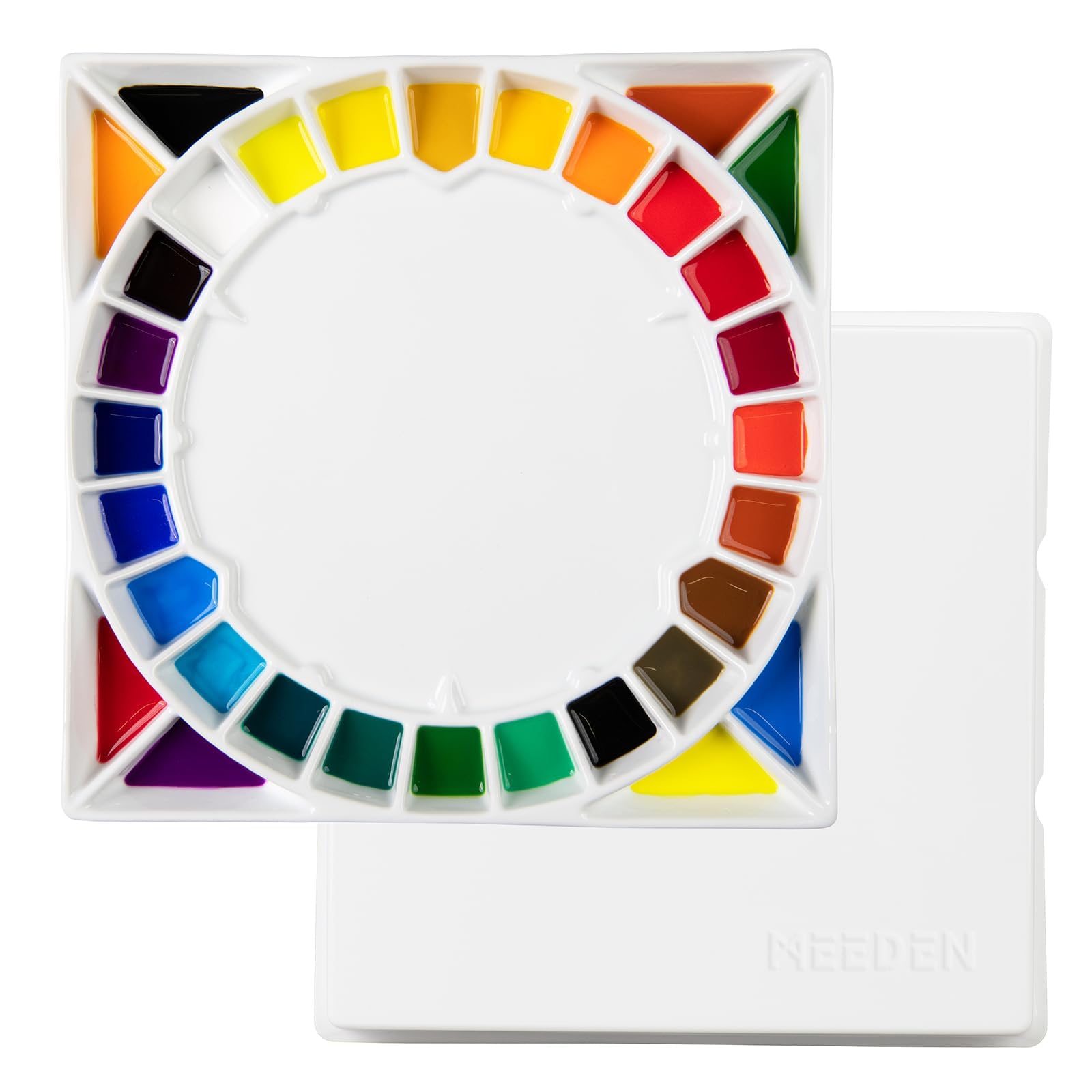
If you paint at a fixed desk and want colors laid out like a color wheel in front of you, this is the one to beat. The 32 deep wells are arranged around a very large central mixing area, so choosing complementary colors across the wheel becomes a visual job instead of a guessing game. The whole thing is 12.6 inches square, which means it owns real estate on your table — the crowd favorite at 4.5+ stars across 600+ owners, and the pick most studio painters will end up keeping.
What wins people over is the material. The white porcelain surface is smooth enough that paint spreads instead of beading, and it wipes clean with a tissue — colors return to pure white after use with no staining left behind. The weight is the other half of the story: buyers report it is “heavy, solid porcelain,” and that heft is exactly why it stays put instead of skating when your brush hand presses down. It’s a studio tool, not a portable one, and the listing is open about that.
The catch is size and weight together. At 12.6 inches square in solid porcelain, this is not something you slip into a tote for a park session — think of it as permanently desk-bound. A few painters also wish the center had sectioned triad dividers for keeping three mixes separate, and the palette is hand wash only, so avoid sudden temperature changes that can stress the glaze. skip it if you need a palette that folds and travels.
What earns its keep on the desk
- Smooth porcelain lets paint spread and blend instead of beading, and wipes clean with a tissue.
- 32 deep wells plus a very large central mixing area give you room for a long gradient.
- The weight and rubber-pad footing keep it from sliding while you press down with a brush.
- The sturdy plastic cover doubles as a large extra mixing area.
Where it asks something of you
- 12.6 inches square and heavy — it is a stay-at-home studio piece, not a travel palette.
- Hand wash only, and avoid sudden temperature changes to protect the glaze.
- Some painters want sectioned triad dividers in the center for separating mixes.
Reach for this if: you paint at a fixed desk and want 32 deep wells laid out as a color wheel with a big central mixing tray.
Look elsewhere if: portability matters more than mixing room — a folding case will serve you better.
2. Mijello Fusion 33-Well Palette
Thirty-three deep wells that swallow whole 5ml tubes — and fold up for the road.
This is the pick for anyone who wants their entire color range loaded at once and still wants to carry it somewhere. The 33 wells are ergonomically slanted, so the paint pools toward the front edge where your brush can reach it, and each one is deep enough to take a full 5ml tube of paint. It holds 33 wells against the 24 on the Martin Fusian below, and owners single out that capacity as the case’s best feature.
The removable mixing tray is the second win. You get a large mixing area on the case plus a tray you can lift out and rinse on its own, and the lid adds yet another flat surface for mixing. The case folds shut with a wide latch and a heavy, audible snap. A lot of painters treat that snap as airtight — the honest read is that the lid closes firmly but a few note it is not a true air seal, so watery paint can still spill if you travel with it wet.
One practical quirk to know: the removable tray can fall out of the lid when you close the case, and stored paint will discolor the tray over time — it does clean, but it takes effort. A strip of foam fixes the loose-fit complaint easily. And at 14 x 11 inches it is roomy enough that some painters find it large for a small art table. That size is the same reason it holds so much.
The capacity story: 33 deep wells and three usable mixing surfaces — the case itself, the removable tray, and the lid — make this the highest-capacity folding option here.
The honest trade-off: the latch snaps firmly but is not a guaranteed air seal, so dry your paint before packing it into a bag.
Best matched to: painters who load a full range of colors and want a folding case with a removable tray.
Think twice if: you need a small footprint — its 14 x 11 inch body wants a real table.
3. Mijello Fusian 24-Well Palette

The folding 24-well case built for the painter who leaves the house with a bag.
Here is the direct head-to-head worth knowing: this Martin case carries 24 slanted wells, while the Mijello Fusion above carries 33 — a 38% more gap in color slots alone. If you want every pigment you own on the road, the Mijello wins on raw capacity. If you want a case that folds, clicks, and tucks into a bag with 24 colors and plenty of mixing room, this is the one to grab.
The 24 wells are slanted so you can add water in controlled drops and wipe your brush clean against the slope. You also get two smaller mixing wells plus one large removable mixing tray, and the tray lifts out for easy cleaning. A buyer who has owned theirs for over 18 months calls it “well made and airtight,” and the folding case carries easily. The clasp is a strong one with a satisfying click, and painters routinely remark that it feels bigger inside than they expected.
Now the honest caveat on the “airtight” label. It is a good seal, but a few painters find a small gap between top and bottom when latched — so if you load wet paint and throw the case in a bag, dry it first or plan for a leak. The same reason makes it a poor match for oil paint, which needs a real seal to stay workable. Owners mention a newer batch with improved hinges and latch over earlier versions.
Where it shines: 24 slanted wells, two smaller mixing wells, and a large removable tray in a case that folds shut and carries.
The follow-up question: “Airtight” is a strong claim — its seal is firm but not perfect, so treat it as leak-resistant rather than spill-proof with wet paint.
Pick this one if: you paint outdoors or in class and want 24 slanted wells in a folding, carryable case.
Pass if: you need every pigment loaded at once — the 33-well Mijello above holds more.
4. Jack Richeson Butcher Tray Palette 7 x 11 in
No wells, no dividers — just a smooth 7 x 11 inch surface and total freedom to mix.
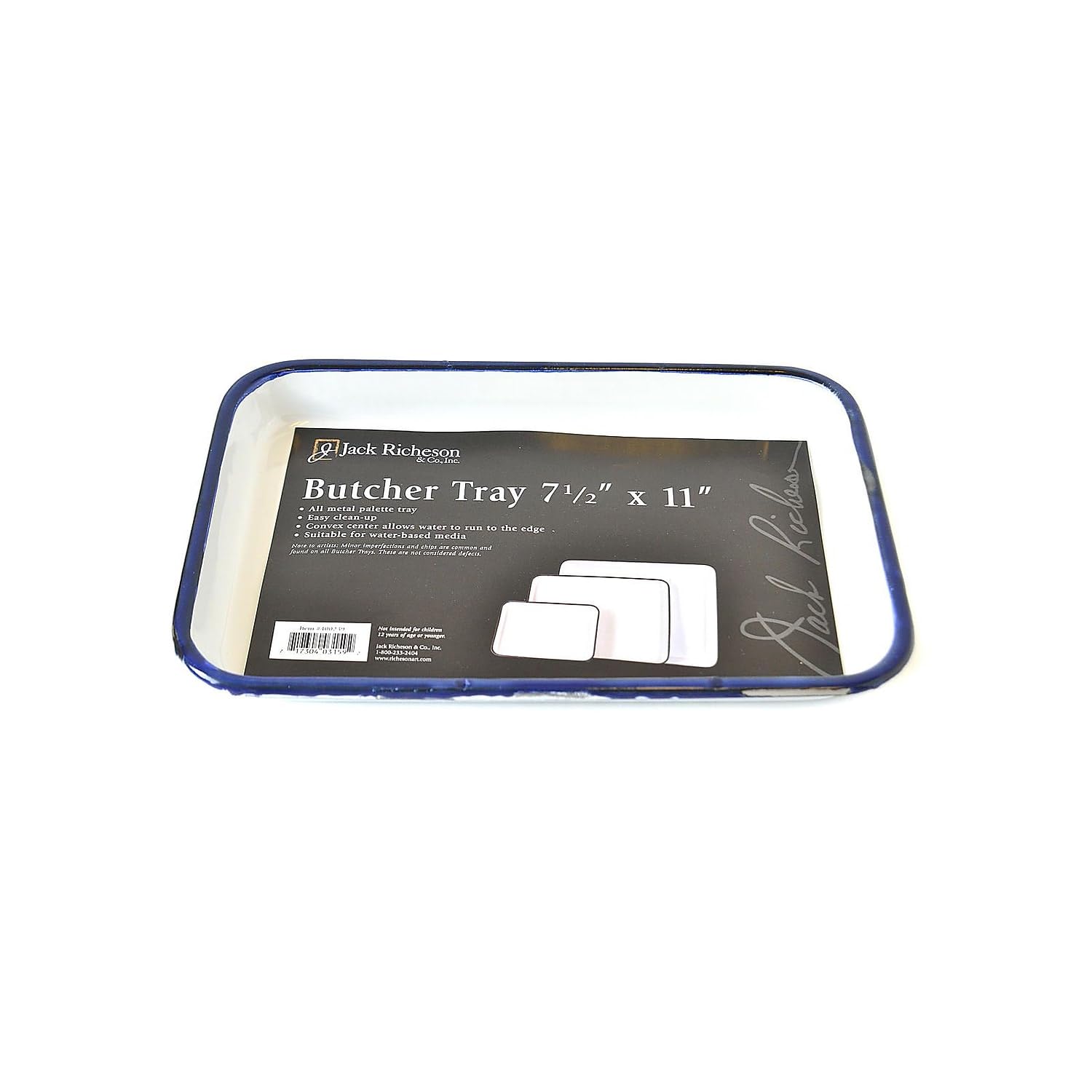
Some painters don’t want 32 little cups. They want one big open plateau and a brush. This butcher tray is exactly that: a 7 x 11 inch porcelain-on-steel surface with a bowed bottom so leftover water runs to the edges instead of pooling under your mix. If you like to lay down a big wash or blend a long gradient by hand, the whole tray is your mixing area.
The material gives it an edge over heavy ceramic. Porcelain on a steel body keeps it light — the listing puts it at 1.6 ounces — while the glossy finish stays smooth and wipes clean. A working illustrator reports the enamel tray is lighter and easier to clean than porcelain or plastic, and that a rim chip didn’t spread or rust through steady use. Rewetting Sennelier, Turner, and Holbein paints left no staining on the surface.
Two things to plan around. The bare steel edges can be rough on the underside, and the coating is the most-mixed point in the feedback — a few trays arrive with enamel that doesn’t fully cover the surface or a small chip on the rim, which the maker calls normal and says won’t touch the working surface. Second, there is no lid, so it isn’t a storage palette; it’s a mixer. pass on it if you need wells to keep colors separate.
The case for the open surface
- A full 7 x 11 inch flat mixing area with a bowed bottom that sends water to the edges.
- Porcelain-on-steel is light at 1.6 ounces and wipes clean easily.
- Handles rewetting of Sennelier, Turner, and Holbein paints without staining.
What to expect going in
- No wells and no lid — it’s a mixer, not a storage palette.
- Some trays arrive with a rim chip or patchy enamel; the maker says it won’t affect the surface.
- The underside edges can be rough to the touch.
Made for: painters who prefer one big open mixing surface over a grid of wells.
Not your tool if: you want colors kept separate in wells or need a lid for transport.
5. Winsor & Newton Cotman 12 Half Pan Palette Pocket Set

A pocket-sized box with paint already in it — the fastest way to start painting anywhere.
This is a different kind of pick: the pans arrive filled. The compact plastic box holds 12 Cotman half pans split into three removable 4-pan trays, plus two detachable mixing palettes and a Cotman Series 111 No.5 brush. It fits into a pocket or a small bag, which makes it the easiest of these five to actually carry outdoors. The 12 colors include Cadmium Yellow Pale Hue, Alizarin Crimson Hue, Ultramarine, Viridian Hue, Sap Green, Burnt Sienna, and Chinese White, among others — a solid working range for sketching on location.
Painters who sketch on the go tend to love how little space it takes while still giving a real mixing surface. The three trays snap back into the box, so you can pull out the pans you need and leave the rest protected. For someone just starting watercolor, having twelve labeled, wrapped pans takes the guesswork out of buying pigments one at a time.
Set your expectations on a couple of points. These are Cotman student-grade colors — the maker keeps the cost down by substituting some of the pricier pigments — so a few hues run close to each other and heavy mixing can muddle them. Some users also miss a true red or a black. Because the pans aren’t glued down, they can slide around until you fix them in place, and the box won’t close if the wells are full of wet paint. Worth knowing before you pack it for a hike.
The all-in-one angle: pans, brush, and two mixing trays in one pocket-sized box make this the lowest-friction way to paint away from home.
The real limit: student-grade pigments and a lid that must wait for the paint to dry — a sketch set, not a studio replacement.
Ideal for: beginners and outdoor sketchers who want a filled, portable set with a brush and mixing trays included.
Choose another route if: you want dense professional pigments or a big open mixing area — the ceramic palettes above deliver both.
Know the Specs
Wells vs. a flat tray
Wells are the small cups that hold each color separately — the MEEDEN packs 32, the Mijello 33, and the Martin 24, all deep enough to hold a good load of paint. Slanted wells push the paint toward the front edge so you can add water in drops and control it. A flat butcher tray has no wells at all; you squeeze color wherever you want and mix across the whole surface. Wells suit painters who work with a fixed set of colors; a flat tray suits painters who like to blend freely.
Material and the mixing surface
Ceramic and porcelain are glazed and smooth, so mixed color glides instead of beading — that’s why the MEEDEN wipes clean with a tissue and the Richeson’s porcelain-on-steel stays easy to clean. Porcelain on a steel body keeps a tray light at 1.6 ounces. Plastic folding cases like the Mijello and Martin are lighter and seal shut with a latch or a click, but the seal is best treated as leak-resistant rather than fully airtight when you carry wet paint.
Common Questions
Is a ceramic or plastic watercolor palette better?
Does an airtight watercolor palette really keep paint fresh?
How many wells do I need for watercolor painting?
Can I carry a watercolor palette with wet paint in it?
Do slanted wells make a difference for brush control?
What is a butcher tray palette used for?
Are the Cotman half pans refillable?
How do I clean a porcelain watercolor palette?
Is a 24-well palette big enough for plein air painting?
Will student-grade paints limit my results?
The Bottom Line
For most painters working at a fixed desk, the winner is the MEEDEN Ceramic 32-Well Palette because its heavy porcelain color wheel gives you 32 deep wells, a big central mixing area, and a smooth surface that wipes clean with a tissue. If you want a folding case with the most wells, grab the Mijello Fusion 33-Well. And for plein air sketching, the Martin 24-Well Fusian case is the one to reach for — it folds shut, carries easily, and holds 24 slanted wells with a large removable mixing tray.
How we choose
We do not accept paid placement. Every pick is matched to a real buyer and a real use-case; we do not hands-on test units.
Sources
Specifications: manufacturer listings and product documentation. Review insights: verified customer reviews, as of October 2026. Pricing: not shown on this page (it changes often); check the current price via the retailer link.
As an Amazon Associate, Aappliancez earns from qualifying purchases. This does not affect which products we feature.