Disclosure: Some links in this post are affiliate links. As an Amazon Associate I earn from qualifying purchases, at no extra cost to you. Learn more
Specs are compiled from manufacturer listings and verified buyer reviews and can change over time — please confirm the key details on the product page before buying.
Mold on a basement wall is not a cleaning problem — it is a water problem. Scrub the black streaks off cinder block and they come back the moment the wall wicks dampness again, because the spores are still fed by moisture behind the surface. The right coating does two jobs at once: it blocks that moisture at the wall face and leaves a film mold has a hard time taking hold on. Below are the seven coatings worth putting on a damp wall, sorted by what each one is actually good at — sealing a weeping foundation, freshening a bathroom ceiling, or wiping out a smell that will not leave.
This guide is built by comparing the manufacturers’ published specifications and the patterns across verified customer reviews, so you get each pick’s real strengths and trade-offs instead of marketing spin.
You will see how coverage per gallon, hydrostatic pressure ratings, and dry times change what a coating can do. By the end you will know which tub suits your wall, your damp level, and your patience. This breakdown of the paint to kill mold lays out each formula’s real job so you stop repainting the same damp corner every spring.
Top Picks


How To Choose The Best Paint to Kill Mold
Start with the honest question: is water coming through the wall, or is the surface just staying damp? Those two situations need two different coatings, and buying the wrong one is why so many people repaint the same wall every year. A masonry waterproofer is built for walls that weep. A mildew-resistant interior paint is built for ceilings and cabinets that collect humid air. Match the coating to the cause before you buy anything.
Sealing a wall that actually leaks
If you can see a damp patch spread after heavy rain, you need a coating rated for water pressure. Look for a hydrostatic pressure figure on the label — that number tells you how much water push the film is built to hold back, so a higher figure means it is meant for wetter concrete. One pick here, the INSL-X WaterBlock, is rated to withstand up to 12 psi of hydrostatic pressure. The Zinsser WaterTite lists resistance up to 20 lbs. of water pressure. Both are waterproof films rather than plain paints.
Handling humidity without a leak
Bathroom ceilings, kitchen walls and cabinet faces deal with steam and splashes, not standing water. Here a moisture-resistant interior paint with a washable finish does the job, and a semi-gloss or gloss surface wipes down without scuffing. Diamond Brite’s kitchen and bath formula covers roughly 300 square feet per gallon with two coats. Just read the maker’s limits — that same can is not intended for bathtubs, showers or sinks.
Coverage and drying time decide your afternoon
Coverage per gallon is the number that tells you whether a single can finishes the job. A rating of 400 square feet per gallon stretches further across a large ceiling than a 75-to-125 square feet per gallon masonry coating spread thick on rough block. Dry time matters just as much when you are working in a lived-in space — a coating that dries to the touch in 25-30 minutes lets you start a second coat the same day, while a 24-hour cure means a project that runs into the next morning.
Side-by-Side Comparison
| Model | Best For | Waterproof | Coverage | Finish | Amazon |
|---|---|---|---|---|---|
| INSL-X WaterBlock Acrylic Masonry Waterproofer★ Best Overall | Weeping basement and foundation walls | Yes — up to 12 psi | 75–125 sq. ft. per gallon | Semi-Gloss | Amazon |
| Diamond Brite Kitchen and Bath Latex PaintBest for Kitchens and Baths | Kitchen and bathroom walls, ceilings, cabinets | No | 300 sq. ft. per gallon | Gloss | Amazon |
| Zinsser WaterTite Mold & Mildew Waterproofing Paint | Basement walls and shower block | Yes — up to 20 lbs. pressure | Up to 100 sq. ft. | Matte | Amazon |
| Rust-Oleum 02711 Mold and Mildew Proof Interior Paint | Interior ceilings and basement walls | No | — | Satin | Amazon |
| Zinsser 305928 Odor Killing Primer | Killing musty and pet odors before topcoat | No | 350–400 sq. ft. per gallon | Flat | Amazon |
| Zinsser 3131 Perma-White Exterior Paint | Exterior and damp-area surfaces | Yes | — | Semi-Gloss | Amazon |
| Rust-Oleum Zinsser Perma-White Semi Gloss (2-Pack) | Whole-bathroom jobs and high-humidity rooms | Yes | 400 sq. ft. | Semi-Gloss | Amazon |
Detailed Reviews
1. INSL-X WaterBlock Acrylic Masonry Waterproofer Paint, 1 Gallon
Our pick — 4.5+★ from 300+ verified ratings; the strongest balance of quality and price.
The wall coating built to hold back water, not just hide the stain.
If your block wall beads up damp after a hard rain, this is the tub that addresses the cause. It is a water-based coating rated to withstand up to 12 psi of hydrostatic pressure — enough for water actively pushing through concrete, not just a humid room. What wins people over is that it genuinely stops the leak: walls that used to seep through heavy storms stay dry once two coats are down. As buyers put it: “No more water leaking in, and we have had a few good long heavy rains since the second coat and everything is dry.”
Two other numbers matter here. It resists alkali up to pH-13, which matters on fresh concrete and mortar because those surfaces are chemically caustic and can eat ordinary paint. And it covers 75 to 125 square feet per gallon, spread thick on rough masonry, so plan your quantity around the low end for porous block. It goes on white in a semi-gloss finish and dries fast enough to keep a basement project moving.
The catch is application, not the formula. This is a heavy, paint-like consistency, and a brush gives poor coverage — a long-nap roller is what the maker and experienced users expect you to use. It is also not a fix for major foundation repair: heavy water at the footer needs structural work, not a coating. Paint only when surface and air temperatures sit between 50 °F and 90 °F, so a cold snap or a heat wave both push the job back.
Where it earns its keep
- Rated to hold back up to 12 psi of water pressure — built for weeping walls
- Alkali resistance up to pH-13 handles fresh concrete and mortar
- Stops leakage on damp basement, foundation and retaining walls
- Bright white semi-gloss finish rolls out clean with a long-nap roller
What to plan around
- Thick, heavy consistency — a brush leaves poor coverage
- Not a cure for major footer or foundation water, only wall seepage
- Must be applied between 50 °F and 90 °F surface and air temperature
Reach for this if: you have a cinder block or poured concrete wall that leaks after rain and want the water stopped at the face.
Look elsewhere if: your problem is a humid bathroom ceiling rather than an actual leak — an interior moisture-resistant paint is the better tool there.
2. Diamond Brite Kitchen and Bath Latex Paint, 1 Gallon
The cabinet and ceiling refresher that fights brown humidity spotting head-on.
A bathroom ceiling that goes brown from steam does not need a waterproofing membrane. It needs a moisture-resistant coating that hides the stain and wipes clean. That is exactly what this formula is for: it is built to help prevent brown spotting caused by humidity in kitchens and bathrooms, and it covers roughly 300 square feet per gallon with two coats. On a nasty stained ceiling, two coats over a skim coat buried every mark, and the semi-gloss surface wiped down without scuffing.
What buyers prize most is the bright white that brings tired surfaces back — laminated vanities and dark wood cabinets come out looking new once an acrylic primer is down and two coats follow. It works on drywall, plaster and wood, so a single can handles the ceiling, the walls and the cabinet faces in the same room. It is made in Cary, Illinois, in a recycled plastic can made in Chicago.
Read the maker’s limit before you buy. This paint is not intended for bathtubs, showers or sinks, so it is a wall-and-cabinet product, not a tub refinisher. The finish also asks for good prep — on the odd surface it can go on sticky or run if it is not stirred hard and applied with patience. Prep it properly and it rewards you; rush it and the texture fights back.
Value read: for a one-room refresh where you need a little bright white and not a whole basement system, this covers ceiling, walls and cabinets from one gallon and asks for two coats.
The line in the sand: it is not waterproof, and the label flatly rules out tubs, showers and sinks — so keep it off the surfaces that actually hold standing water.
Suits you if: the job is a steamy kitchen or bathroom where walls and cabinets need hiding power and a washable finish.
Steer clear if: you are trying to seal a tub surround or a leaking shower — that is outside what this can is built to do.
3. Zinsser WaterTite Mold & Mildew White Waterproofing Paint
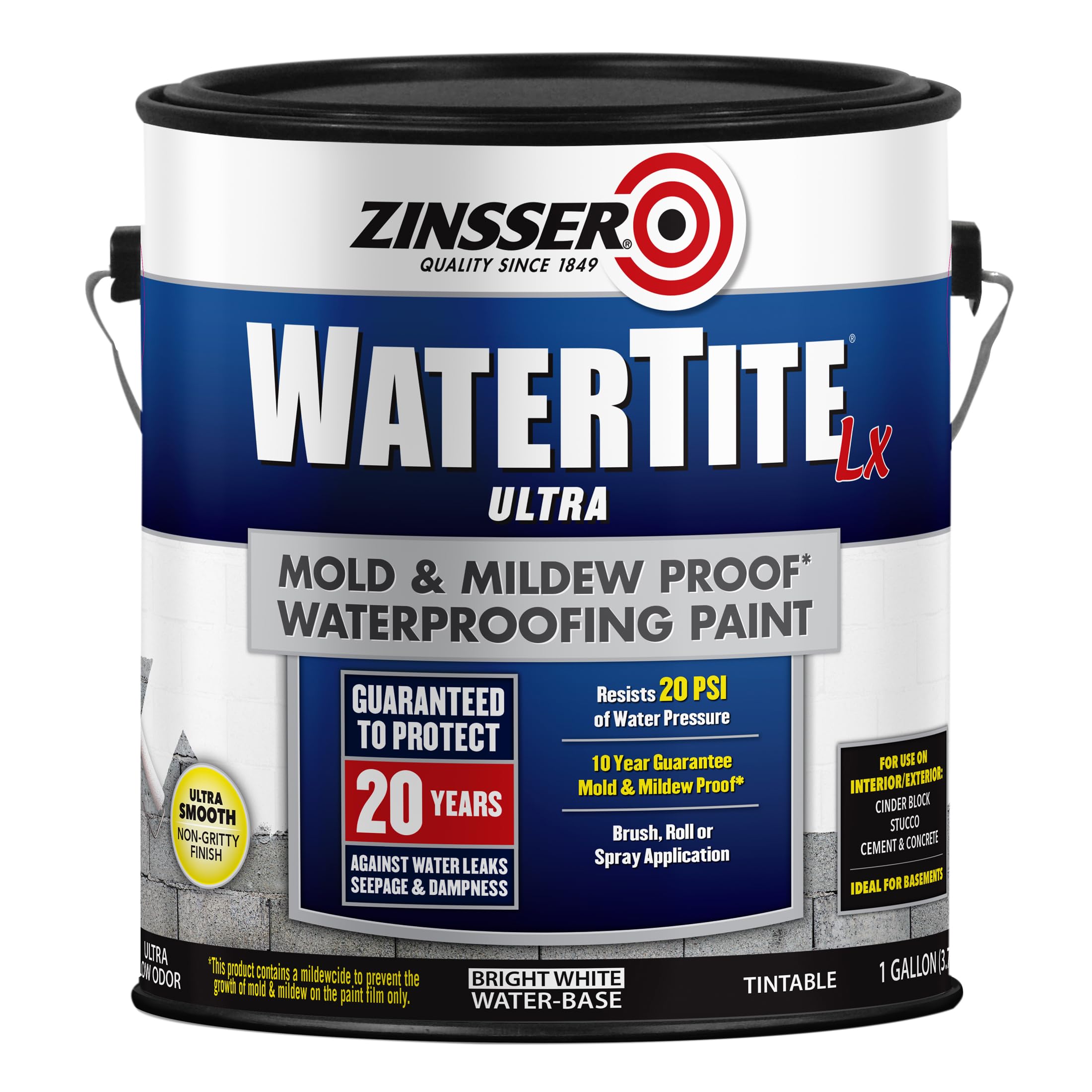
A waterproofing film that leans harder on pressure than the INSL-X, at the cost of some smoothness.
Here is where the numbers split the crowd. This coating is guaranteed to resist up to 20 lbs. of water pressure, against 12 psi for the INSL-X WaterBlock above — the pick for a wall taking a heavier push of water. That extra headroom comes with trade-offs. It weighs 12.3 pounds per gallon, against 11.1 pounds for the INSL-X, and it is a latex-base formula that dries to matte rather than glossy.
On a basement wall that seeps a little when it rains hard, the fix holds. Scrub and bleach the block, apply two coats, and the water stays outside — the same two-coat ritual you will hear repeated across every waterproofing job. It also carries two guarantees: 15 years waterproof and 10 years on the mold and mildew-proof paint film. That is a serious commitment from the maker on paper.
The honest caveat: mildew-proof on a label is not mildew-proof in every wall. A minority of buyers report the film turning green within a day, and it is not the right tool for a wall with ongoing heavy moisture feeding it. It also has a noticeable smell that lingers a week on some jobs. Treat it as a water sealer first — its waterproofing and its bright matte white finish are what it does best.
What it is genuinely good at: shutting off minor-to-medium seepage and resisting a heavier water push than most of the field — that 20 lbs. rating is the headline.
Who should skip it: anyone needing a low-odor finish for an occupied room, or a wall where water keeps coming from behind with no source repair in sight.
Pick this one for: a poured concrete or block basement wall where you want the highest pressure rating on the list and can live with a matte finish and a two-coat job.
Think twice if: strong paint smell and a slow dry in a tight space would run your day — this is not the low-odor option.
4. Rust-Oleum 02711 Mold and Mildew Proof Interior Paint, 1-Gallon
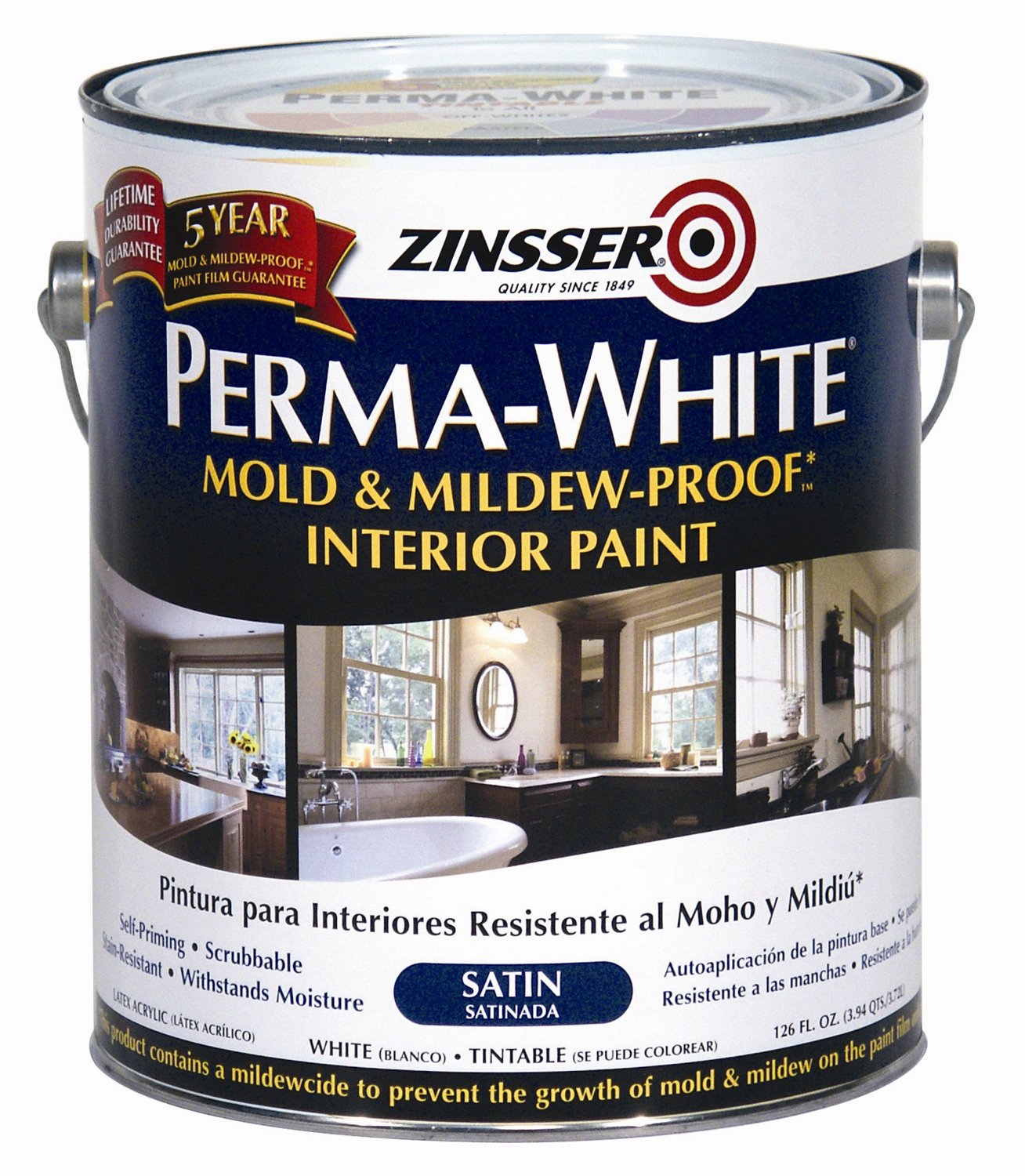
The scrub-it-clean satin that skips the primer step on interior ceilings and block walls.
Basement ceilings and block walls collect grime and need a surface you can actually wash, and that is where this satin interior formula shines. It is self-priming — it sticks to the surface without sanding — and the finish is washable, scrubbable and stain- and moisture-resistant. On stained, dirty cement block basement walls, the coverage is what buyers praise most: it buries discoloration and cleans up easily.
It is also fade resistant and water-based with low odor, which makes it friendlier to a room you are working in. On a kitchen job it went on easily, and on glossy walls it needed a base coat to take hold before it covered cleanly. Two gallons spread across exposed basement ceiling joists in about a 13 x 8 area of unprimed overhead wood.
Be ready to work for the finish. The recurring gripe is consistency — the paint can run thin and drip, and some find it dries hard and chips if the coats are rushed. A minority of cans also arrive dented or leaking in transit. None of that is disqualifying; it just means you treat application as a two-coat job with proper dry time between coats, not a slap-it-on afternoon.
Why it holds a spot on the list
- Self-priming formula sticks without sanding
- Washable, scrubbable, stain- and moisture-resistant satin finish
- Fade resistant and low odor for occupied rooms
- Covers stained cement block and basement ceilings
The reality check
- Can run thin and drip if applied heavy
- Rushing the dry time can lead to chipping
- Occasional can arrives dented in shipping
Good match if: you want a satin interior surface you can scrub, on a ceiling or block wall, without a separate priming step.
Not your pick if: you need the wall to hold back active water — this is an interior moisture-resistant paint, not a waterproofing membrane.
5. Zinsser 305928 Odor Killing Primer, Gallon, Clear
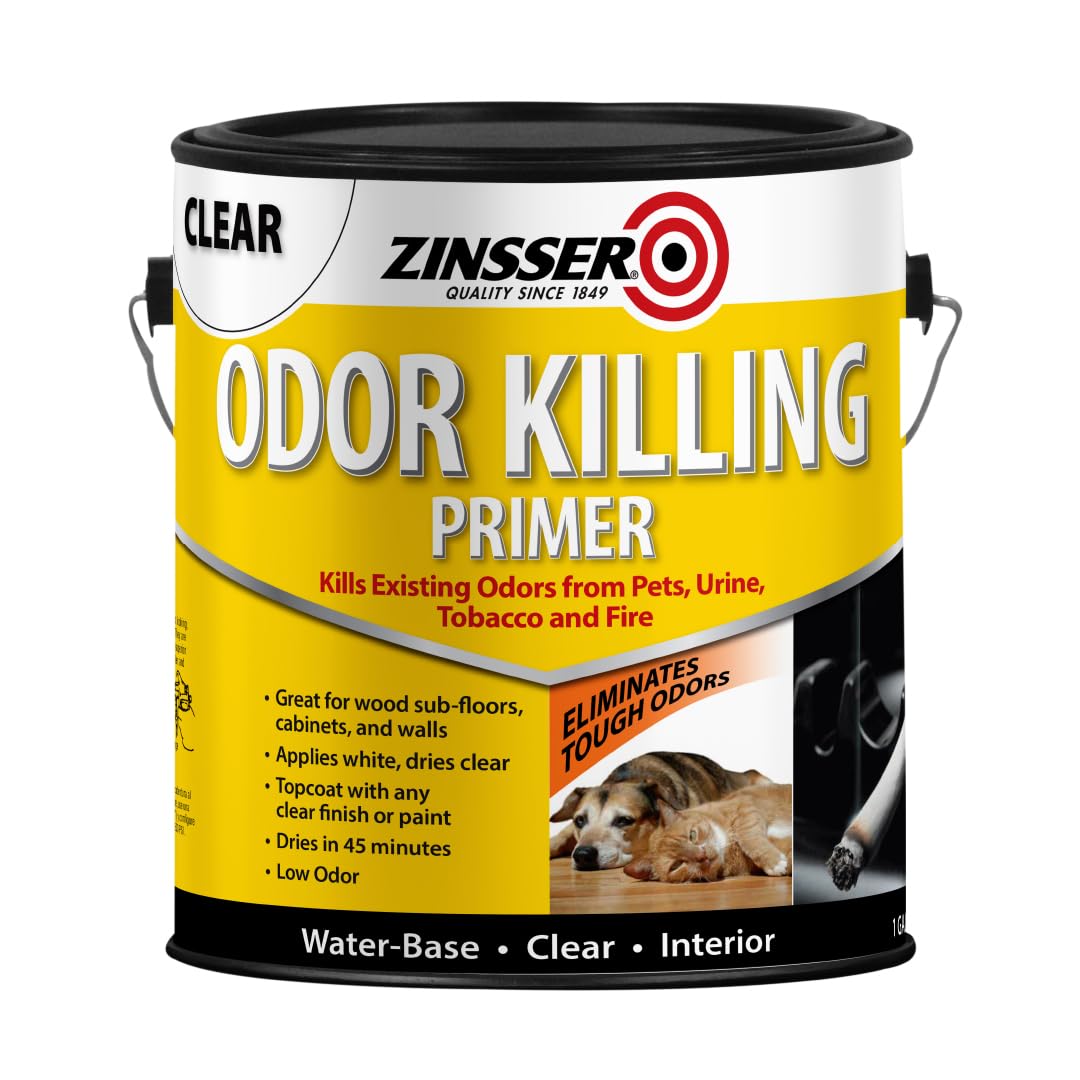
Not a mildew paint at all — the step you do before the mildew paint when the room stinks.
Mold and damp leave a smell that cleaning cannot reach, and that is the gap this primer fills. It is designed to eliminate tough odors — pet urine, food, tobacco, fire and smoke — on painted or unpainted interior surfaces including subfloors, wood floors, cabinets, plaster, drywall, metal, masonry and PVC. What people rave about most is the odor removal itself; it is the reason this primer holds a spot on a mildew list even though it is a deodorizing primer, not a waterproof film.
The numbers make it easy to use well. It covers 350 to 400 square feet per gallon and dries to the touch in 25-30 minutes, so you can seal a subfloor and get a topcoat on the same day. It applies white, turns blue so you can see where you have been, then dries clear — which means it does not discolour the stained wood beneath it. On a musty old oak cabinet, one application cleared the smell without altering the original finish.
Set your expectation on two things. It works on odors on the surface, not on a chronic wall leak — the water still has to be dealt with separately. And the consistency is mixed: some cans go on thin, others are chunky at the bottom until you stir hard. Buy it for the smell, and pair it with a real waterproofing coat when there is active water.
The plain truth: this is the reset button for a room that smells of pets, smoke or damp — one coat to the touch in 25-30 minutes and a clear dry that preserves the wood underneath.
Where it stops: it does nothing to stop water coming through a wall, so it belongs on top of a drainage and sealing fix, never instead of one.
The right call for: subfloors, cabinets and walls where the musty or pet smell is the main enemy and a topcoat will follow.
Wrong tool for: sealing a damp basement wall — that job needs a waterproofing paint, and this primer is a deodorizer.
6. Zinsser 3131 Perma-white Exterior Paint, 1-gal

The outside-the-house version of a mildew-fighting finish, with a four-hour dry and a real humidity test.
Exterior walls take weather that no interior ceiling ever sees, and this acrylic semi-gloss is formulated for that exposure with a mildew-proof claim on the label. It dries in 4 hours, so a siding or trim job can move forward without a full day of waiting, and the maker lists it waterproof. What people like most is the quality of the finish — it covers well and looks great once it lands.
Application is part of why it works. The semi-gloss flows nicely with a brush or roller, so an awkward exterior surface gets an even coat without a struggle, and the coverage hides what it is applied over. On a bathroom ceiling — where humidity is high — one coat was enough for a clean finish with no recoat needed.
The mildew claim is not a lifetime promise. One honest report from a humid-South homeowner says the mildew protection held for one year and then the growth came back. That is a reminder that a coating slows and resists mold, but it does not erase an ongoing moisture source. In a wet climate, expect to maintain the surface periodically and fix the underlying damp, not treat the paint as a one-time shield.
Strongest single fact: it is an exterior-grade acrylic semi-gloss with a mildew-proof label and a 4-hour dry — the practical pick for outside trim and humid rooms alike.
Weigh this before buying: the mildew resistance is not permanent in a constantly wet climate, so budget for touch-ups where moisture never dries out.
The one for you if: you are painting exterior trim or a damp high-humidity surface and want a semi-gloss that dries in 4 hours.
Choose differently if: you expect the mildew protection to last forever in an always-damp climate — several owners find it needs refreshing after a season.
7. Rust-Oleum Zinsser Perma-White 1-gallon Semi Gloss Paint (2-Pack)

Two gallons of the bathroom-ceiling classic for a whole room instead of a touch-up corner.
Some jobs do not fit in one can. This two-pack delivers two gallons of a semi-gloss that is engineered to resist mold and mildew growth in high-humidity areas, with coverage of 400 square feet per gallon and a waterproof claim on the label. It is rated for both indoor and outdoor use, so a bathroom ceiling and an exterior touch-up can come out of the same order.
What earns it a following is the simple, measurable result: in a steamy bathroom where condensation used to drip off the walls, the coated surface now barely collects moisture. Owners mention a bathroom ceiling coated with it stayed mold-free for months on fan-only ventilation. The semi-gloss wipes clean, and it hides existing colour in one pass.
Two things to plan for. The paint needs a thorough stir before use — it settles and will not mix evenly if you skim it. And the full cure reaches 24 hours, so this is a coat-and-come-back job, not a same-afternoon second coat. An occasional shipping problem sees a can open and leak in transit, so check the packaging the moment it lands.
The case for the two-pack
- Mold- and mildew-resistant film for high-humidity areas
- 400 square feet per gallon coverage across both cans
- Waterproof and rated for indoor and outdoor use
- Semi-gloss hides existing colour in one coat
Before you order
- Needs a heavy stir to fully mix before use
- Full cure is 24 hours, so plan the job across days
- Occasional can leaks in shipping — inspect on arrival
Snap it up when: you are doing a whole bathroom or a large humid room and want two cans of a proven mildew-resistant semi-gloss in one order.
Pass if: your job is a small ceiling patch or you need a fast one-day turnaround — the 24-hour cure and the stir requirement slow a short job down.
Know the Specs
Hydrostatic pressure rating
This is the measure of how much water push a coating is built to hold back, written as pounds per square inch (psi) or pounds of water pressure. A higher figure means the film is designed for wetter, more active concrete — so a wall that beads up after rain needs one of these numbers rather than a plain interior paint. The INSL-X WaterBlock is rated to withstand up to 12 psi, and the Zinsser WaterTite resists up to 20 lbs. of water pressure. Pick the higher rating if your wall takes more water, and check the label on any coating that does not print a figure at all.
Coverage per gallon
Coverage tells you how much wall a single can will finish, usually listed as square feet per gallon. A masonry waterproofer that spreads thick on rough block covers less area per gallon than a smooth interior paint, so the same gallon count can mean very different jobs. Rough estimates from this lineup: 75 to 125 square feet per gallon for the INSL-X, 300 square feet per gallon for Diamond Brite, 400 square feet for the Zinsser two-pack, and 350 to 400 square feet per gallon for the Zinsser odor primer. Measure the surface, then round your quantity down at the porous end.
Why “mildew-proof” needs read as “mildew-resistant”
No paint film on a damp wall stops mold permanently if water keeps feeding the spores behind it. What these coatings do is resist mildew growth and block moisture so the surface stays inhospitable. The Zinsser WaterTite, for example, lists a 10-year mold and mildew-proof film guarantee alongside a 15-year waterproof guarantee — strong on paper, but no substitute for stopping an ongoing leak. Treat the coating as the last step after drying the wall and fixing the source.
Dry time and temperature limits
Dry time is what decides whether you finish in a day. The Zinsser odor primer dries to the touch in 25-30 minutes, while Zinsser Perma-White’s two-pack reaches full cure at 24 hours and the exterior 3131 dries in 4 hours. Temperature matters too: the INSL-X WaterBlock must be applied when surface and air temperatures sit between 50 °F and 90 °F. Paint outside that window and the film may not bond or cure correctly, which undoes every other spec on the label.
Common Questions
Will a mold-killing paint work over a damp basement wall, or does it need to be fully dry?
Can I use Diamond Brite kitchen and bath paint on my shower walls?
How many coats does a mold-resistant paint need on a stained ceiling?
Is the Zinsser Odor Killing Primer the same as a mold-killing paint?
Will a mildewed bathroom ceiling stay clean if I use the Zinsser Perma-White two-pack?
Does the anti-mold protection in a waterproofing paint wear out over time?
How do I get the thick waterproofing paint to roll on evenly?
Can I paint a mold-resistant coating over glossy tile or a polished cabinet without sanding?
What dry time should I expect before a second coat?
Is a semi-gloss finish better than matte for a damp room?
The Bottom Line
A leaking wall is the hardest mold problem to solve, and the INSL-X WaterBlock Acrylic Masonry Waterproofer is my top pick because it seals the source — up to 12 psi of hydrostatic pressure, alkali resistance to pH-13, and a proven habit of stopping seepage through heavy storms. That makes it the paint to kill mold that actually fixes the moisture instead of hiding it. If your wall takes a heavier push of water, the Zinsser WaterTite steps up to a 20 lbs. pressure rating and carries a 15-year waterproof guarantee. And for a steamy bathroom ceiling with no leak at all, the Zinsser Perma-White two-pack gives you two cans of a mildew-resistant semi-gloss at 400 square feet per gallon. Whichever you pick, the coating is only as good as the prep — stir hard, apply two coats, and keep the moisture source in check.
How we choose
We do not accept paid placement. Every pick is matched to a real buyer and a real use-case; we do not hands-on test units.
Sources
Specifications: manufacturer listings and product documentation. Review insights: verified customer reviews, as of October 2026. Pricing: not shown on this page (it changes often); check the current price via the retailer link.
As an Amazon Associate, Aappliancez earns from qualifying purchases. This does not affect which products we feature.