Disclosure: Some links in this post are affiliate links. As an Amazon Associate I earn from qualifying purchases, at no extra cost to you. Learn more
Specs are compiled from manufacturer listings and verified buyer reviews and can change over time — please confirm the key details on the product page before buying.
If your exterior wood keeps flaking a season after you paint it, the topcoat is rarely the villain. The primer under it is. A good exterior wood primer is the sticky middle layer that glues your paint to bare timber, weathered boards, or an old coating that will not come off — and picking the wrong one is why fences and deck rails shed paint every year. The picks below cover the real jobs: closing over peeling paint, gripping damp or weathered decks, sealing bare pine before a finish coat, and locking down wood that lives in sun and rain.
This guide is built by comparing the manufacturers’ published specifications and the patterns across verified customer reviews, so you get each pick’s real strengths and trade-offs instead of marketing spin.
Below you will find the drying windows, coverage rates, and bonding chemistry that actually change how a job goes, plus which primer each kind of exterior repaint really calls for. Every pick here has been weighed against the others on the one job it does best, so the list below is a working shortlist of the best paint primer for exterior wood.
Top Picks

How To Choose The Best Paint Primer for Exterior Wood
Exterior wood fails in three predictable places: cracks that let water in, old paint that lifts at the edges, and grain that sucks the topcoat dry before it can cure. A primer is chosen around which of those three you are actually fighting. Chasing “best” without that answer is how people end up with a clear-drying primer when they wanted a white basecoat, or a white undercoat on a deck that needed a binding bridge over flaking paint.
Start with the state of the wood, not the finish you want
Bare, clean timber wants a penetrating or bonding primer that soaks in and gives the topcoat something to grip. Wood that is already coated but flaking wants a flexible binding primer that glues down the loose edges instead of trapping water under a new skin. Weathered grey boards and damp decking want a formula rated to go on damp and to fill and bridge small cracks. Name the condition out loud before you pick a can.
Read the coverage number against the job, not the label
Coverage per gallon is where primer quietly gets expensive. A can rated 150 ft²/gal to 400 ft²/gal and a can rated 204 ft² per gallon for two coats are describing the same square footage very differently. Measure your deck or fence in square feet, multiply for a second coat if the wood is porous or sun-baked, and compare that against the stated coverage rather than the container size. Twice the coverage on one can can mean half the cans at the register.
Decide if you want clear or white before you buy
A clear primer keeps the timber’s natural tone and disappears under a stain or a tinted topcoat. A white undercoat brightens the base so a lighter paint reads true, but it can shift the shade of a dark finish if you go thin. Neither is “better” — they solve different jobs. Pick clear for cedar, redwood, and any finish where you want the grain to stay warm and visible. Pick white where you want a smooth, even foundation for a painted surface and the topcoat will fully cover it.
Drying time is a scheduling decision
Touch-dry times across this category run from 30 minutes to 1 to 2 hours, and recoat windows can stretch to 4 hours. If you have one dry Saturday for a deck, that difference decides whether the job finishes in one day or spills into the week. Check the recoat time, not just the dry-to-touch time, and plan the topcoat window around it.
Side-by-Side Comparison
| Model | Best For | Coverage | Dry Time | Base / Finish | Amazon |
|---|---|---|---|---|---|
| Thompson’s WaterSeal Semi-Transparent Stain & Sealer★ Best Overall | Refinishing decks and fences with a tinted finish | 150–400 ft²/gal | — | Semi-transparent, Chestnut Brown | Amazon |
| Roxil Wood Sealer LiquidBest for Cedar | Keeping cedar and pine looking natural | 204 ft²/gal (two coats) | ~30 min | Clear, natural finish | Amazon |
| Polar Wood Primer White Undercoat | Bare joinery and trim headed for white paint | 10–12 m² per liter | 1–2 hours | Matt White, water-based | Amazon |
| Liquid Rubber Multipurpose Primer | Tricky mixed-material repairs and old porches | — | 2 hours | Clear, matte | Amazon |
| Rust-Oleum RockSolid Deck Start Wood Primer | Weathered or previously coated decks, no sanding | Up to 450 sq. ft. in one coat | 1 hour | Clear, matte | Amazon |
| Rust-Oleum Marine Wood & Fiberglass Primer | Boats, docks, and green pressure-treated lumber | 100 sq ft | 1 hour | Matte | Amazon |
| Zinsser Peel Stop Binding Primer | Glueing down peeling and cracked paint | 50–200 sq. ft. per gallon | 30 min | Clear, flat | Amazon |
Detailed Reviews
1. Thompson’s WaterSeal Semi-Transparent Wood Stain
Our pick — 4.5+★ from 1,000+ verified ratings; the strongest balance of quality and price.
One can that seals a fence and tints it Chestnut in the same pass, no separate primer step.
Most people are actually refinishing a tired deck or fence that needs protection and some color back, and this product is built for exactly that. It lays down a semi-transparent Chestnut finish — you still see the wood texture through it, but the grain is muted rather than bare. That single-step nature is why it takes the top slot: you are waterproofing and finishing at once instead of priming twice over.
The coverage window is the number worth circling — 150 ft²/gal to 400 ft²/gal depending on how porous and sun-baked the boards are. On thirsty old decking you land near the low end; on a tighter, previously sealed surface you can stretch much further. Underneath, fade-resistant polymers and UV resistance are meant to hold the Chestnut tone through a full year of sun rather than chalk out by August. It meets ASTM D-4446 for waterproofing wood, and it goes on damp or dry, so you are not waiting for a week of perfect weather.
The honest catch is that one coat is not enough on anything hot and sun-exposed. The finish arrives thin and the liquid separates, so it needs a real stir before you start, and a second coat is what actually builds the water beading and durability. Buy double what your square footage suggests and budget the second pass. The container condition has also drawn notice — “Only issue was condition of containers when arrived” is a minor recurring shipping note, not a formula problem.
Where this one earns the top slot
- Seals and tints in one step, so a fence or deck job skips a dedicated primer pass.
- Semi-transparent finish keeps wood texture visible under the Chestnut tone.
- Goes on damp or dry wood and meets ASTM D-4446 for waterproofing.
- Fade-resistant polymers resist UV so the color holds through the season.
- Roller, pump sprayer, paint sprayer, or brush — soap-and-water cleanup after.
What to plan around
- One coat falls short on hot, sun-exposed decks — plan on two.
- Liquid separates in the can, so it needs thorough mixing before use.
- Fresh application reads red and chalky until it dries a few shades darker.
- Occasional shipping dents on the container, though the seal holds.
Strongest single-can move: anyone refinishing a fence, deck, or garden structure who wants protection and a Chestnut tint without a separate priming stage.
Pass it by when: you need a true white foundation under a painted surface — a clear or white primer is the right tool there.
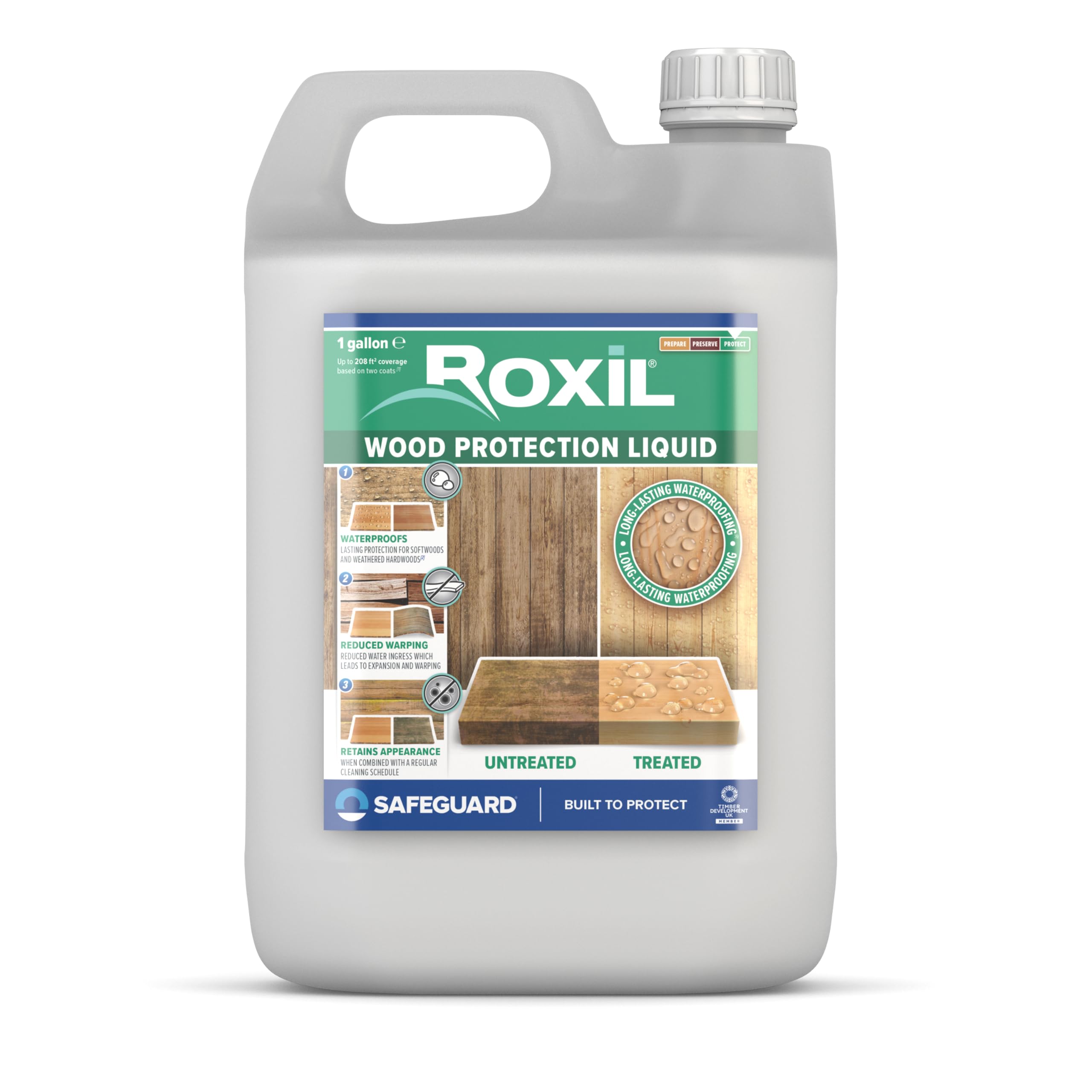
2. Roxil Wood Sealer Liquid 1 Gallon Clear
Cedar stays cedar under this one — clear, matte, and still warm-toned months later.
The defining number here is 204 ft² per gallon for two coats, and the defining property is silicone. That silicone base penetrates softwood timber rather than skinning it, which is why the finish dries clear matte and lets the natural yellow and gold tones of fresh cedar come through instead of hiding them. It also resists warping and improves dimensional stability, which matters most on deck boards that swell and shrink with the seasons.
This is a genuinely heavier pour than the Polar primer above — 3800 g versus 840 g for that can, a 4.5x gap in the weight of the container you are lifting onto the fence line. That weight is the volume of sealer you are getting. Water resistance is the property that wins people over, because it is the one you can watch: after a North Texas summer and repeated rainstorms, treated cedar boards still bead and shed water instead of greying out.
Here is the honest limit. The liquid goes on very thin — closer to milk than to a gel — so a brush application on a vertical surface can feel like you are chasing it. It behaves best sprayed, and while two coats are claimed to last years, water-based sealers of this type are something you refresh rather than forget. Long-term protection is a wait-and-see for anybody who has only had it down a season.
What wins people over: the clear matte read — treated cedar keeps its color and texture instead of turning into a painted plank, and the boards stay looking like raw wood rather than coated lumber.
Go in knowing: it is a sealer, not a paint basecoat. If your plan is to lay a solid color over the timber, this is the wrong layer — reach for a purpose-built white undercoat instead.
Reach for this if: you want a cedar fence, shed, or deck to keep its natural warmth while shrugging off rain.
Look elsewhere if: your project ends in a painted solid color rather than a natural-wood look.
3. Polar Wood Primer White 1L
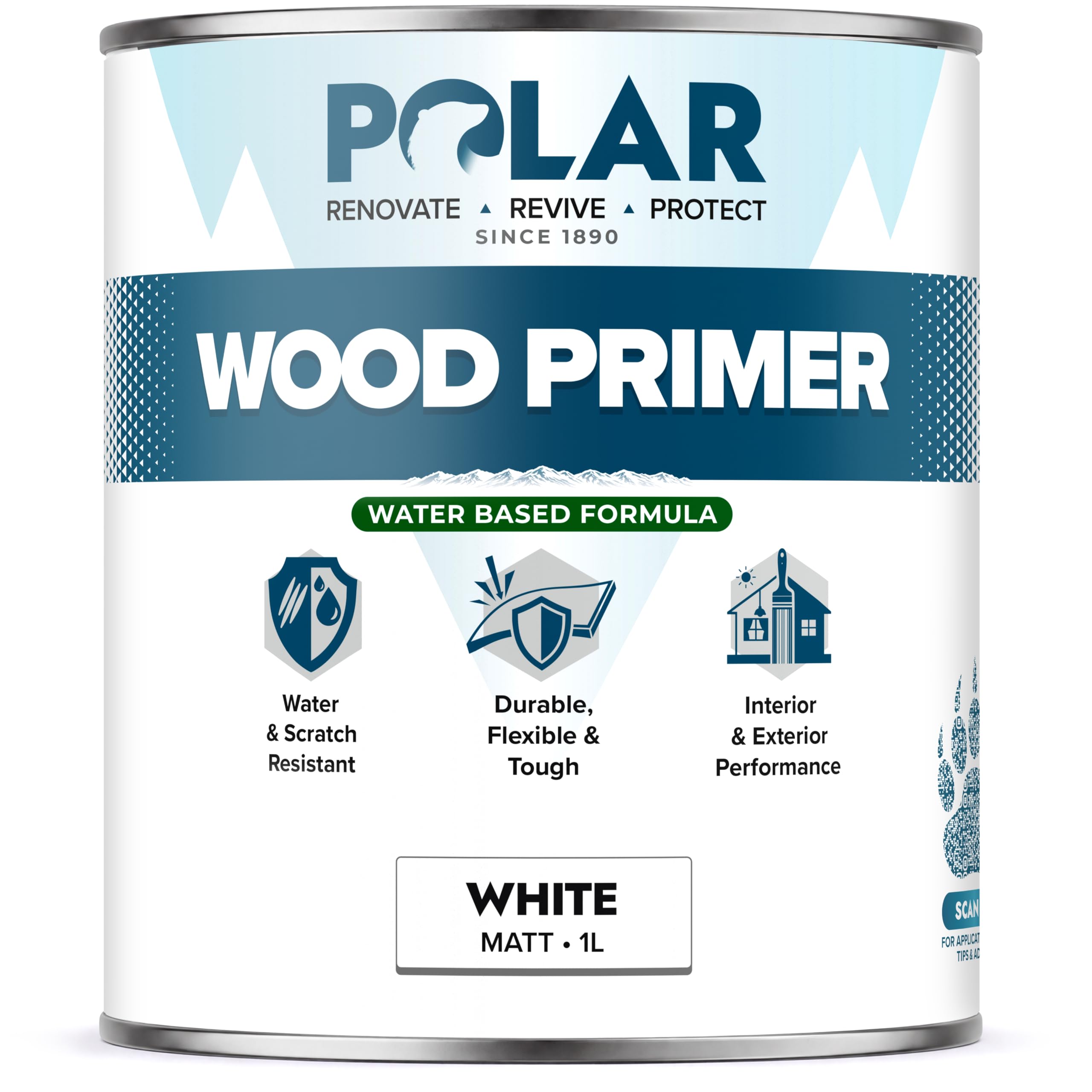
A white basecoat that lets you paint the whole job with noticeably less paint on top.
If your exterior wood is headed for a painted finish rather than a stain, the job is different. This primer’s purpose is to create a smooth, even foundation on bare and unfinished timber so the topcoat grabs and reads consistent. Its low surface tension lets the formula sink into the wood, which is the property that matters on new joinery, door frames, and renovation trim that has never been coated.
The scheduling numbers are friendly. It dries in 1 to 2 hours and can be recoated after 4 hours, so a full exterior door or a run of baseboards can go primer-then-color in an afternoon. Coverage runs 10 to 12 m² per liter, and at 840 g for the container it is easy to carry up a ladder. Outside, the flexible base resists cracking, repels water, and reduces dirt retention, with UV and weather resistance for wood that lives outdoors.
Before you commit, know the adhesion depth. This is a water-based primer, and it is not a dedicated bonding primer for glossy or previously sealed surfaces — on a sun-exposed exterior door, the film holds well under a topcoat, but a true bonding primer for difficult substrates has more bite. Long-term heat and sun durability is the open question, not the initial coverage.
The daily-use benefit: the smooth white base means your finish coat goes on thinner and more evenly — you are not fighting grain texture and dark wood bleed-through at the same time.
Where it falls short: on slick or previously painted surfaces, its grip is softer than a purpose-built bonding primer, so do not lean on it for an old glossy door.
The right fit: bare timber, new door frames, and trim that will finish in white or light paint.
Not the tool for: gluing down peeling paint or bridging a gloss surface — use a binding primer for those.
4. Liquid Rubber Multipurpose Primer 1 Quart

The primer for a porch step that is half wood, half concrete, and half old paint.
Most exterior wood primers assume the whole surface is wood. This one is a bonding agent first, and it works across concrete, wood, high-density polyethylene, and more — which is exactly what you want on a mixed-material repair where you cannot switch products at the seam. Two hours to dry and a matte clear finish make it a practical base layer on a stripped and sanded old porch before a deck paint goes down.
The other half of the pitch is what is not in it: water-based, non-toxic, no solvents, and low VOC (volatile organic compounds — the fumes that off-gas from paint), so you are not gassing out a porch or a workshop while you work. Application is plain — conventional brush or roller, or sprayed with nozzles suited to the material — and you apply 1 to 2 coats depending on surface, then your top coat within 24 hours while it is still tack free.
The trade-off is thinness and the patience it demands. It goes on like milk, so coverage per coat is modest and two coats are the realistic minimum on a porous or uneven surface. The bigger watch-out is durability under a heavy topcoat over years, and this is where the value question splits; the people who rate it highest are using it for demanding spots where the prep was done properly. Prep is not optional here — the surface has to be clean of dirt, oil, silicone, and efflorescence, and you cannot apply it with rain or dew coming.
What it does that wood-only primers cannot
- Bonds to wood, concrete, and high-density polyethylene in one product.
- Water-based and low VOC — no solvents to ventilate around.
- Dries in 2 hours, and you can top coat within 24 hours.
- Dries nearly clear, so it works under a color-matched deck paint without tinting it.
Where it asks more of you
- Very thin out of the can, so 1 to 2 coats is the realistic minimum.
- Demands a fully clean surface — oil, silicone, and efflorescence all interfere.
- Long-term durability under a heavy topcoat is the open question for this formula.
Best for: the mixed-material exterior repair where wood meets concrete and you need one primer to bridge the gap.
Skip if: your job is a single clean wood deck with no tricky seams — a dedicated wood primer gets there with less fuss.
5. Rust-Oleum RockSolid Deck Start Wood Primer

The deck primer that skips the sander entirely — scrape, wash, and go.
The reason this one reaches for the higher tier is the first number: it covers up to 450 square feet in just one coat, on a weathered, worn, or previously coated exterior wood, with no sanding or stripping. It also goes on damp wood, which on an actual deck means you are not blowing a weekend waiting for moisture readings. You apply it under a solid stain, paint, or other solid topcoat — it is the bridge layer, not the finish.
The trick is in the color. It applies milky white, sometimes reading purple or blue as it goes down, and then dries clear in about an hour, so it vanishes under whatever solid color you lay on top. Its adhesion chemistry grips between the existing coating and the new coat rather than relying on fresh, sanded grain. It fills old cracks as it bridges, and it is low-VOC and water-based with minimal odor.
Two honest limits. Drying in the real world can stretch well past the stated hour, and on a cool or shaded deck allow a full day before you paint over it; give yourself three days before top coating if you can. And this is not a paint-in-a-can — used incorrectly you will not get a finish, you will get a clear sealing layer over an existing deck that still needs its color coat.
The time-saving read: skipping sanding and stripping on a weathered deck saves a full day of prep, and the up-to-450-square-feet coverage in one coat means a standard deck takes one container.
The honest trade-off: it bonds to what is already there, so the strength of your finished deck is only as good as the old coating it is gluing to.
Made for: a weathered or previously coated deck where stripping everything back was never realistic.
Not for: bare new lumber or a refinish where you want the topcoat to sit directly on fresh grain.
6. Rust-Oleum Marine Wood & Fiberglass Primer

A corrosive-environment primer that sands easily, for boats, docks, and green fence lumber.
Wood above the waterline takes punishment most deck primers never see, and this is the can built for that job. It goes on wood or fiberglass as a base coat for better topcoat adhesion and a longer-lasting finish, and it is rated corrosion-resistant on bare, lightly rusted, and previously painted surfaces. The finish coat dries to an even gloss over it, which is why people use this primer on a hull or a skiff.
Coverage on the can is 100 sq ft and it dries to the touch in 1 hour, which is where the working rhythm comes from. Performance is what carries it — it holds well over semi-green pressure-treated lumber as well as over a properly prepped boat, so if you are priming a new pressure-treated fence or dock frame, it will grip lumber that still has some moisture in it and give your exterior paint a clean run.
The recurring catch is that it dries too quickly on a warm day — it will start to crust in the can within about 15 minutes, and brush laps can show if you are not moving. The fix is simple and worth planning for: decant what you need into a smaller container, thin your brush with mineral spirits, and work in sections. The smell is also the strongest in this lineup, and this is an outdoor product in practice; if you are using it in an enclosed space, ventilation and a respirator are not optional.
Why it holds its place
- Corrosion-resistant and rated for wood or fiberglass above the waterline.
- Sands easily, so you can smooth it before the finish coat.
- Dries to the touch in 1 hour and covers 100 sq ft.
- Grips semi-green pressure-treated lumber as well as prepped boat surfaces.
What you are signing up for
- Dries fast enough to crust in the can — decant and thin as you work.
- Strong solvent odor, so keep this to outdoor or well-ventilated work.
- Coating can turn rough with visible brush laps if you apply it dry.
Suits the buyer: someone priming a boat, dock, or pressure-treated fence who needs corrosive-environment grip and a sandable base.
Think twice if: you are working indoors or in a tight space — the solvent smell is the loudest in the group.
7. Zinsser Peel Stop Binding Primer, Clear, 1 Gallon
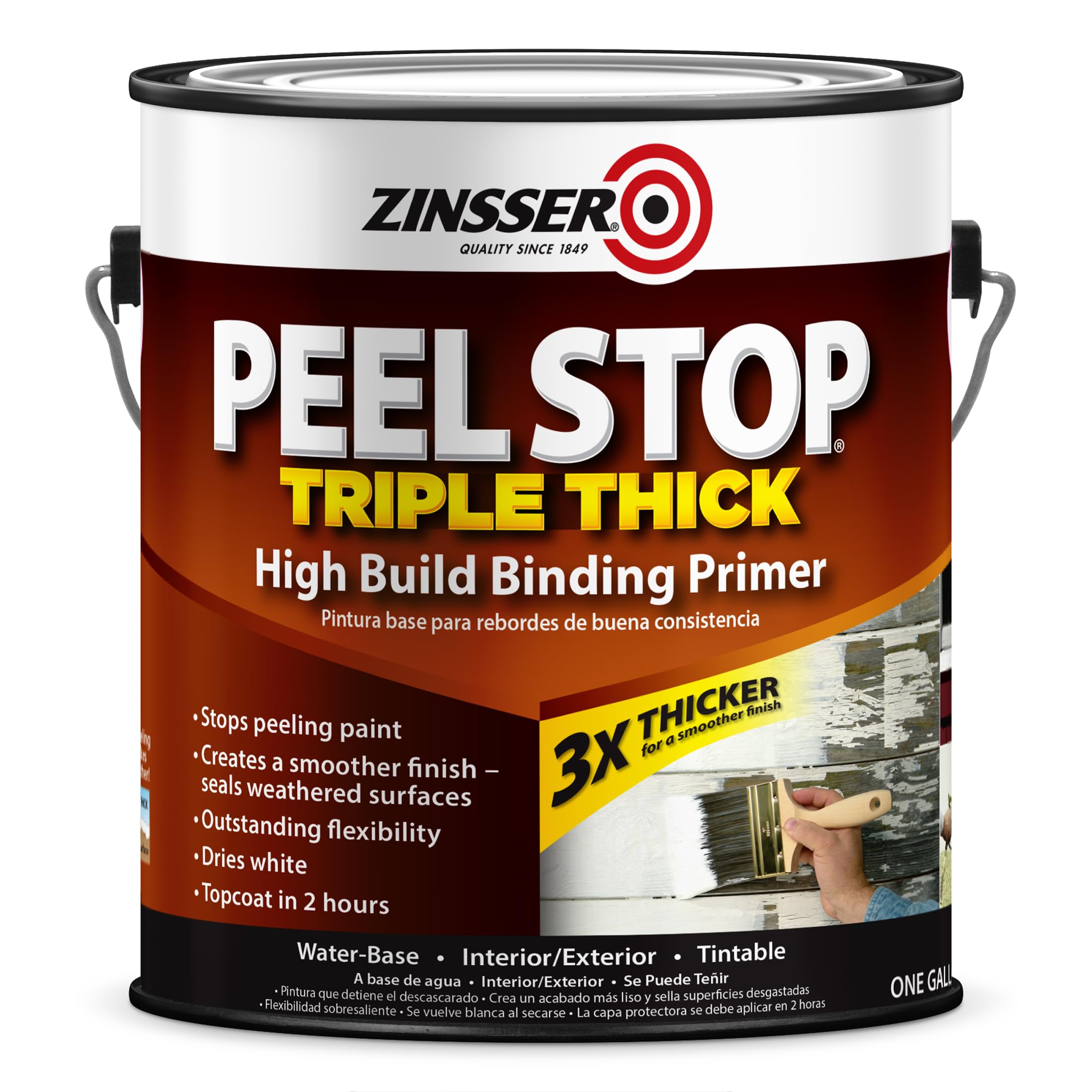
For the door where the old paint has already lost the argument twice.
This is a specialist, not a general undercoat. The whole point is the triple-thick formula designed to penetrate and bond with cracked or peeling surfaces, gluing down the edges of failing paint and filling small gaps so you get a smooth finish without scraping the whole door back to bare wood. On surfaces where the old coating will not come off, it is a way to reload a paint job without starting over.
The working numbers set the pace: touch dry in 30 minutes, coverage between 50 and 200 sq. ft. per gallon depending on how porous the surface is, and it accepts any alkyd or latex topcoat. A clear binding layer also keeps it understated — it is not a color coat and is not trying to be one. It is tintable if you want to nudge the dried base.
Two honest caveats. The texture is the most debated thing about this formula — some find it thick coming out of the can and thin on the surface, and on a neglected surface it can need more than one coat before you would call it a proper prime. It also works best over lightly scraped, loose sections knocked off first; skip that step and it can clog your brush. It is a bridge for old paint edges, not a filler for deep uneven holes.
The real-world payoff: on a door that has peeled twice already, this is the layer that finally gets a paint job to hold, because it is formulated to re-adhere the old edges instead of trapping moisture underneath a new skin.
Where it can disappoint: if the surface is heavily irregular, the film will bridge the cracks but will not level the wood — expect to fill the deep stuff separately.
Worth grabbing for: exterior doors, trim, and siding where old paint is cracked or flaking but a full strip-down is not on the table.
Leave it on the shelf for: new bare timber and smooth, sound surfaces — this primer solves a problem that is not there.
Know the Specs
Coverage per gallon
This is the square footage one container will treat, and it is the single fastest way to compare cans. A range like 150 to 400 ft²/gal means a porous, sun-bleached surface swallows more product than a sealed one, so a deck job can land ten containers apart from the same label. Measure your square footage, then divide by the low end of the stated range to budget, not the high end.
Dry time vs. recoat time
Dry to touch is when you can brush the surface without marking it. Recoat time is when it is safe to add another layer. They are different numbers, and recoat time is the one that decides your schedule — a 30-minute touch dry with a 4-hour recoat window still makes it an afternoon job. Read both before committing to a one-day plan.
Clear vs. white basecoat
A clear primer keeps the natural tone and grain visible and disappears under a stain or tinted topcoat. A white undercoat gives you an even, bright foundation so a lighter paint reads true. Clear suits cedar, redwood, and natural finishes; white suits painted trim, doors, and siding. Neither changes the formula’s strength — only the base color you start from.
Binding primers vs. standard undercoats
A standard exterior wood primer goes on bare or clean wood to give the topcoat a grip surface. A binding primer goes over an existing failing coating to glue down loose edges and bridge cracks. They are not interchangeable. If your wood is bare, use a standard primer. If the old paint is flaking, you need the binding formula or the new coat will lift the old one with it.
Common Questions
Do I need a separate primer if I am using a stain and sealer in one?
Will a clear primer change the color of my topcoat?
Can I apply a primer over damp or slightly green wood?
How do I stop a peeling exterior door from peeling again?
How many coats of exterior primer do I really need?
Can I use a wood primer made for interior wood outside?
What is the difference between a primer and a stain-sealer?
Does a water-based primer work under an oil-based topcoat?
How much primer do I buy for a standard deck?
Is it safe to use an exterior wood primer around pets and plants?
The Bottom Line
For most exterior repaints, the paint primer for exterior wood winner is the Thompson’s WaterSeal Semi-Transparent Stain & Sealer because it waterproofs and tints in one pass across a 150 to 400 ft²/gal coverage window — no separate priming stage. If you want the wood to keep its natural cedar warmth, grab the Roxil Wood Sealer with its 204 ft² per gallon coverage. And when the old paint on a door or trim is already cracking and peeling, the Zinsser Peel Stop is the layer to reach for.
How we choose
We do not accept paid placement. Every pick is matched to a real buyer and a real use-case; we do not hands-on test units.
Sources
Specifications: manufacturer listings and product documentation. Review insights: verified customer reviews, as of October 2026. Pricing: not shown on this page (it changes often); check the current price via the retailer link.
As an Amazon Associate, Aappliancez earns from qualifying purchases. This does not affect which products we feature.