Disclosure: Some links in this post are affiliate links. As an Amazon Associate I earn from qualifying purchases, at no extra cost to you. Learn more
Specs are compiled from manufacturer listings and verified buyer reviews and can change over time — please confirm the key details on the product page before buying.
Thick latex is where most sprayers embarrass themselves. It sits in the cup, spits uneven blobs, and leaves you reaching for a roller anyway — so the machine that actually sprays unthinned wall paint straight from the bucket wins by default. Every pick below sprays unthinned latex, and the InoKraft at the top does it at 3000 PSI with the least fiddling.
This guide is built by comparing the manufacturers’ published specifications and the patterns across verified customer reviews, so you get each pick’s real strengths and trade-offs instead of marketing spin.
Some guns here pull paint from a five-gallon bucket, others need a compressor and a steady hand. That split matters more than any badge on the box, and this breakdown of the best paint gun for latex sorts bucket-drawers from compressor guns fast.
Top Picks


How To Choose The Best Paint Gun for Latex
Latex is a thick, rubbery paint, and that single fact drives every decision here. A gun that sprays thin stain beautifully can stall on wall paint, so you want pressure, flow and a tip size built for the heavy stuff. Think about the job size first — a cabinet door and a whole house exterior want very different machines.
Pressure and flow: the two numbers that decide if latex moves
Airless sprayers push paint with high pressure instead of air, measured in PSI (pounds per square inch). The more pressure a unit holds, the more easily it forces unthinned latex through the tip. Flow rate, given in GPM (gallons per minute), tells you how much paint comes out — higher flow covers a wall faster. A gun with generous PSI and flow handles thick paint without you watering it down first.
Spray tip size: match it to the paint, not the gun
The tip is the small nozzle the paint squirts through, and its number matters. A 515 tip (that is a 0.015 inch opening) is the usual choice for latex, while a 413 tip suits thinner stains. Many airless guns use a reversible tip, which lets you flip it 180 degrees to blast out a clog instead of stopping to dismantle anything — a small feature that saves a lot of swearing mid-wall.
HVLP or airless: pick the right tool for your job size
HVLP (high volume, low pressure) guns use a turbine or compressor to push paint with lots of air at low pressure. They give you more control and less overspray, which is why they suit furniture, cabinets and doors. Airless units spray faster and reach further on big walls and fences. If your project is a whole house or a long fence, lean airless. For a set of cabinet doors, an HVLP gun is gentler and tidier.
Hose, reach and cleanup: the parts that eat your weekend
A longer hose lets you leave the heavy pump on the ground and walk the gun to the far corner. An extension wand adds reach for ceilings and eaves so you are not climbing constantly. And cleanup is the true hidden cost — the faster you can flush the system, the more likely you are to actually use the thing again next year.
Side-by-Side Comparison
| Model | Best For | Max Pressure | Power / Drive | Hose Length | Amazon |
|---|---|---|---|---|---|
| InoKraft MaXpray M1★ Best Overall | Whole-house DIY in one go | 3000 psi | Manual airless | 300 inches | Amazon |
| PHALANX Airless 780WTop Performer | Fast whole-house coating | 3000 psi | 780W AC motor | 300 inches | Amazon |
| VEVOR 750W Stand Airless | Big jobs on a budget | 3000 psi | 750W motor | 7.6 meters | Amazon |
| Wagner Control Pro 130 | Exterior walls, decks, eaves | 1600 psi | HEA airless | 300 inches | Amazon |
| Wagner FLEXiO 570 | Handheld trim and doors | — | X-Boost turbine (HVLP) | — | Amazon |
| BATAVIA 700W HVLP | Smaller projects, cabinets | — | 700W motor (HVLP) | 1.8 meters | Amazon |
| DeVilbiss StartingLine Kit | Auto body and detail work | 30 psi | Compressor-driven HVLP | 1.5 meters | Amazon |
Detailed Reviews
1. InoKraft MaXpray M1 Airless Paint Sprayer, 3000 PSI 0.31 GPM
Our pick — 4.0+★ from 1,000+ verified ratings; the strongest balance of quality and price.
The pump that pulls thick latex straight from a five-gallon bucket and keeps going.
This is the pick for a homeowner staring down walls, ceilings, siding, fences, decks or a garage — the kind of job measured in gallons, not drops. InoKraft rates the M1 at up to 0.31 GPM of paint output and 3000 PSI of pressure, which is exactly the muscle that lets you spray compatible latex and acrylic without thinning it first. You drop the pickup into a 1- or 5-gallon container and the machine draws the paint itself, so there is no pouring and no watering the paint down.
The 25-foot hose and 12-inch extension are the parts your shoulders will thank you for. Ceilings and eaves stop being a ladder-and-neck-craning job, and the 360-degree swivel lets the gun turn through corners instead of fighting you. The system will take up to 75 feet of hose if a job demands more reach. Cleanup runs through the Flush-Ease valve — you connect a garden hose and flush the line without taking the whole pump apart, which is the difference between a five-minute rinse and an evening lost.
The honest catch is the 10.23 kg weight and the pressure dialing-in before your first clean pass. At 10.23 kg the unit is a two-hands-and-a-plan move, and the plastic hose holds a coil memory until you stretch it out in the sun. Expect to spend time dialing in pressure before the first clean pass — as buyers put it about this machine: “The airless sprayer worked great. It took a while to adjust it (air pressure) and a little longer to clean it for next time.” Dial in the pressure on cardboard first and the walls go quickly.
What wins people over
- 3000 PSI and 0.31 GPM handle unthinned latex without a thinning step
- 25 ft hose plus a 12 in extension reach ceilings and eaves with ease
- Flush-Ease valve lets you rinse with a garden hose, no pump teardown
- Reversible AtoMax 515 carbide tip clears clogs by flipping it
- Complete kit: goggles, cleaning kit, two wrenches and guides included
Where it asks for patience
- 10.23 kg makes it a deliberate two-hand carry, not a one-arm grab
- Coil memory in the plastic hose until it is stretched out in the sun
- Pressure and technique take a practice session to dial in
- Rated for jobs up to 10 gallons — bigger than that wants a different class of pump
Reach for this if: you have a whole house, a long fence or a deck to coat and want to skip the thinning step entirely.
Think twice if: a couple of cabinet doors is the whole job — the setup and cleanup will outlast the painting.
2. PHALANX Airless Paint Sprayer 780W
A 780W motor that sprays latex straight from the can, then rinses in about ten minutes.
The PHALANX earns its spot with a 780W motor (a measure of electrical power) that tells you the pump is built for continuous work. It delivers 3000 PSI (pounds per square inch, a measure of spray force) — the same pressure ceiling as the InoKraft above. It sprays unthinned latex and oil-based paints directly from the can, so you skip thinning and extra buckets. The fully adjustable pressure and flow knob lets you shape the fan pattern and cut down on waste — handy when you are learning where the balance sits for your paint.
Reach is where this unit genuinely separates itself from a roller. The 25-foot high-pressure hose draws from a 1- to 5-gallon bucket, so you coat high ceilings and long garden fences without stopping to refill. The reversible spray tip rotates 180 degrees to blow out a clog on the spot, and the integrated quick-rinse system flushes the line in what PHALANX states is under 10 minutes. On a full house exterior, that sub-10-minute flush between coats is the feature you will value most.
At 19.4 pounds it is lighter than the InoKraft’s spec sheet suggests but still a grounded unit. Some buyers do run into paint pushed further than expected — one noted “excessive airflow carries paint 10+ ft causing unwanted overspray” — so mask generously and test the fan on cardboard before you commit to a wall. Others cite occasional leakage, which is worth a careful check of every connection before you prime.
Speed where it counts: the sub-10-minute quick-rinse and 25-foot hose mean you spend your day spraying, not flushing or refilling. For exterior walls, siding, decks and garage doors, this is a genuinely efficient machine.
The trade-off to know: the airflow can carry paint farther than you expect, so proper masking and a cardboard test are not optional. Check connections before you start and the leakage worry mostly disappears.
Built for: the owner who wants whole-house speed and a fast rinse between coats.
Not the one for: fine furniture detail where the airflow would be overkill — reach for the Wagner FLEXiO below instead.
3. VEVOR 750W Stand Airless Paint Sprayer, 3000PSI

A 750W stand pump that covers a two-story barn in four hours and a garage in twenty minutes.
The headline here is throughput. A 750W motor pushing up to 3000 psi with a 1.2 LPM maximum flow rate means the VEVOR moves latex fast enough for medium-to-large jobs. VEVOR states it runs up to 5 times faster than rolling and 12 times faster than brushing, and the real numbers behind that claim show up in the field. One job covered a 44×34 two-story barn in four hours with a lift; another player finished a one-car garage’s three walls and ceiling in 15 to 20 minutes. On a big exterior like that barn, that 1.2 LPM throughput is the whole reason to buy.
The design is built for tired shoulders. The pump body detaches so you can scrub out crevices with the included cleaning brush, and the extension pole handles high or ground-level work without constant bending or climbing. The adjustable motor speed lets you drop to a low gear on wide open areas to stretch paint further. A 7.6-meter hose gives you far more reach than a handheld HVLP gun would ever offer.
The recurring gripe is the plumbing around the pump, not the pump itself. The suction hose can be stubborn about staying submerged, and the stiff hose tugs at your hand while you work. One reviewer noted it “must reverse nozzle every few minutes to spray correctly.” The spray tip is also a wear item — expect to swap in a quality replacement after heavy volumes. Run the included tip until it dulls, then step up.
Why it earns its place
- 750W motor, 3000 psi and 1.2 LPM handle medium-to-large latex jobs
- Pump body detaches for easy cleaning of crevices and corners
- Extension pole reaches high and low without climbing or bending
- Adjustable motor speed lets you run a low gear to stretch paint
- 7.6-meter hose gives serious reach on walls and fences
Friction points to plan around
- Suction hose fights to stay submerged and needs rigging
- Stiff hose tangles and pulls against your hand while spraying
- Tip wears with heavy use and wants a quality replacement
- Occasional clogs with thick or unstrained paint
Good match for: a big exterior or fence job where speed matters and you are willing to rig the suction hose.
Skip over it if: you want a fuss-free hose and tip from the start with zero fiddling.
4. Wagner Spraytech Control Pro 130 Sprayer

The low-overspray exterior specialist with a wand that reaches the eaves without a ladder.
Wagner built the Control Pro 130 around High Efficiency Airless (HEA) technology, which the company states cuts overspray by up to 55% compared with standard airless. That matters on an exterior, where paint drifting onto windows, trim or the neighbour’s fence is a real cleanup problem. The softer HEA spray also gives you more control and a more consistent finish. It is the pick if overspray control is your top concern and your project is a home exterior, a large deck or a fence.
The included 12-inch extension wand is the reason it earns a slot here. It reaches tall walls, ceilings, deck undersides and eave lines without you climbing. It comes with two tips — a 515 for latex and a 413 for stains — so you can change jobs without buying extra parts. The hopper holds up to 1.5 gallons (about 5.7 liters) and the 25-foot hose attaches to a T2 gun with an integrated swivel. It is gravity-fed (paint flows down from the hopper) for fast priming and cleaning, and the built-in filter helps keep nozzle clogs down.
Pressure is the trade-off to understand. At 1600 psi, this is a lower-pressure airless unit than the 3000 psi pumps above, which is fine for stain and most latex but is not the machine for the thickest wall paints at speed. There is also no carry handle, and cleanup takes real time. A single leaking hose connection can also dump paint, so give each connection a firm seat before you prime.
The overspray payoff: HEA technology and the two-tip kit make this the tidiest option for exterior walls, fences and decks. The 12-inch wand keeps your feet on the ground.
The honesty check: 1600 psi is a gentler push than the big airless pumps, and the lack of a carry handle means you will want a cart to move it around the house.
The right tool when: you are coating an exterior, deck or fence and want tight overspray and ladder-free reach.
Look elsewhere if: you need maximum pressure for the thickest latex over a whole house — the 3000 psi pumps are the better fit.
5. Wagner Spraytech FLEXiO 570 Sprayer

The handheld turbine that sprays most unthinned latex without a compressor in sight.
At 16 ounces this is the lightest tool on the list by a wide margin, and that changes what is practical. You can carry it up a ladder, point it at a ceiling, or walk a whole fence line without the arm fatigue a stand pump brings. The X-Boost turbine delivers enough power to spray most unthinned interior and exterior paints and stains, and the iSpray nozzle is designed for a concentrated output that covers faster than a thinner fan gun. Two speed settings let you pick high air power for thick paint and low for thin materials and small areas.
You get adjustable control across the board: power settings, variable paint flow, and changeable pattern size and direction, horizontal and vertical. That flexibility is why it suits trim, doors, ceilings and small exterior jobs really well. The 16-ounce weight is the spec you feel in your wrist by hour two, and it is a big part of why people reach for it on projects that a heavy stand pump would make miserable. One practical note on the reservoir: expect 30 to 60 minutes of spraying before a refill.
The honest caveat is clutter and clogging. Some buyers report the nozzle clogs fairly quickly and that paint can land in places you did not intend. Overspray (paint mist that drifts beyond the target) is a real problem on anything with slats or spindles, so masking and eye protection are requirements, not suggestions. And cleanup, while doable, is a chore best reserved for a job large enough to justify it — one buyer mentioned “only worth it for 4+ gallons.” On a small job, the setup time eats the time you saved.
The case for the FLEXiO
- 16 oz handheld body is easy on the arm on ladders and ceilings
- X-Boost turbine sprays most unthinned latex and stains
- Two speed settings plus variable flow and pattern for real control
- Great for trim, doors, cabinet fronts and small exterior jobs
What to expect going in
- Nozzle clogs can hit quickly and need routine clearing
- Overspray is heavy on spindles and slatted surfaces
- Cleanup is a chore that makes sense only on a larger job
- Reservoir runs 30 to 60 minutes before refilling
Pick it for: trim, doors, ceiling touch-ups and small exterior jobs where a light hand matters most.
Pass if: you need to coat a whole house in one session — a stand airless pump will save your arm.
6. BATAVIA 700W HVLP Spray Paint Gun

A split-body HVLP gun that keeps the motor on the ground and one pound in your hand.
BATAVIA took a different route to arm fatigue: the motor and gun are separate. The 700W high-power motor rides on a shoulder strap or sits on the floor, and the detachable handheld gun weighs just 1 lb, so you are lifting almost nothing as you sweep a cabinet front or a door. The 6.5-foot flexible air hose gives you room to move. For anyone who has held a heavy all-in-one sprayer over their head for an hour, that split is the reason this gun earns its spot.
The nozzle set is built for switching tasks. You get four nozzle sizes at 1mm, 1.5mm, 2mm and 3.0mm — smaller ones for sealers and varnish, larger ones for latex and chalk-type paints. Three spray patterns (horizontal, vertical, circular) cover furniture, doors, cabinets, garden tables and pickup beds. The 360-degree anti-backflow design is there to keep clogs down, and the plastic 40 fluid ounce tank holds a reasonable amount for furniture-scale work. The machine is ETL certified and comes with a 24-month warranty.
The trade-off worth knowing: the 40 fluid ounce tank is small for wall work, and the antics on thicker paint can bite. One buyer found the smaller cap “would not spray at all” on a water-based stain, only to find it sprayed water just fine — a reminder to match the nozzle to the material and test it first. Thinner materials and furniture-scale jobs are where this gun makes the most sense. Save the walls for the airless pumps above.
The split-body advantage: a 700W motor on a strap and a 1 lb gun in your hand makes long sessions far less tiring — especially on cabinets and doors.
The size limit: a 40 fluid ounce tank and fussy behavior on some stains mean this is a furniture and trim tool, not a whole-room weapon.
It suits you if: you are spraying cabinets, doors, furniture or small projects and want low arm fatigue and nozzle flexibility.
Keep looking if: you plan to coat a full room — the small tank and higher-pressure jobs want an airless unit.
7. DeVilbiss StartingLine HVLP Spraying Kit
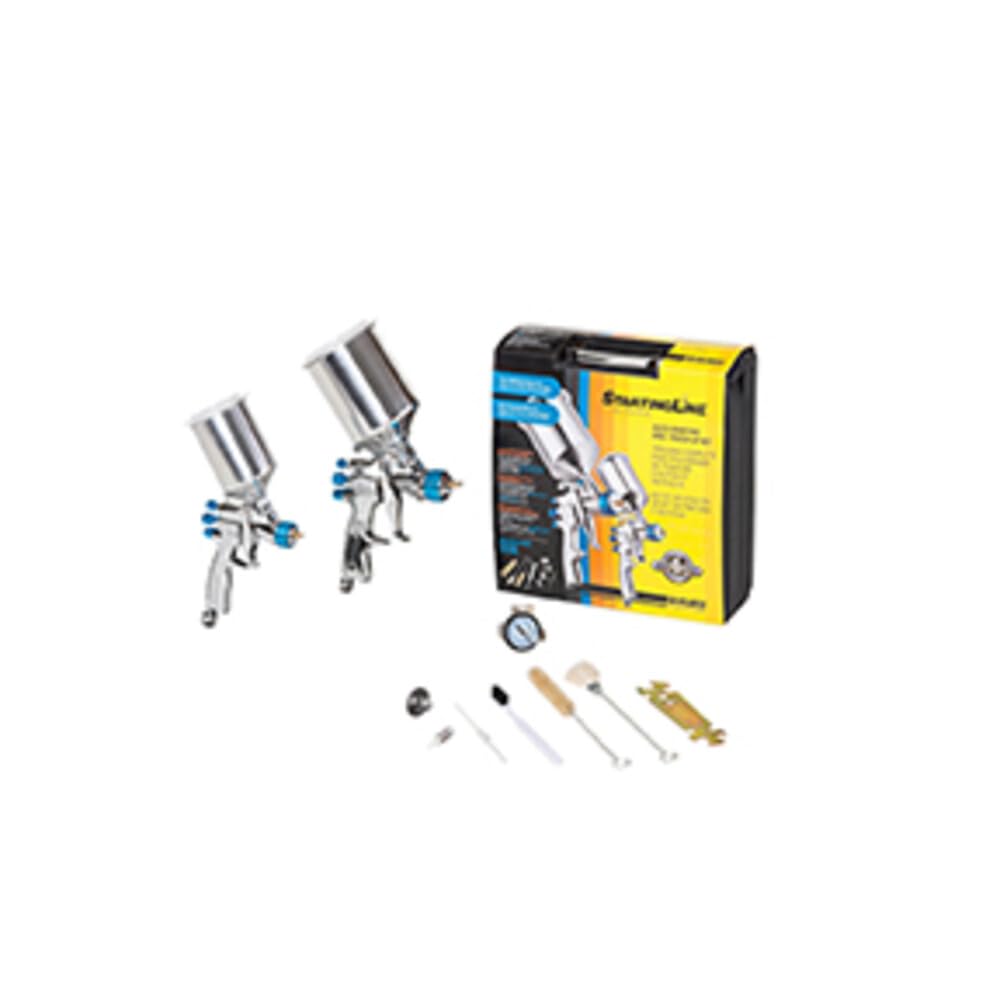
The entry-level compressor gun that lays a smooth coat on cars, bikes and metal.
This one is a different animal from everything above. It is a gravity-feed HVLP gun that runs off your own air compressor, not a self-contained motor, and it is aimed at automotive and detail work rather than house walls. At 6 pounds and with a 1.5-meter hose, it is light and maneuverable. Maximum pressure is 30 psi, so it wants a compressor that can feed it steadily. If you are spraying latex on a wall, this is not your tool. If you are painting a car, a bike, a mower deck or a piece of metal furniture, it is a sharp, affordable way in.
What makes this kit stand out is how forgiving it is on finish. It lays down pearls, color-flake clear and satin clear cleanly, and it performs beyond what its price suggests — good enough that some buyers rate it against far more expensive HVLP guns. The kit arrives ready to start, with the detail and base guns and a case that holds everything well. For someone learning automotive spray work, it takes the fear out of a bad first job.
The build is the part to keep realistic. Some parts feel plastic, tips need careful removal, and the detail-gun needle can leak until you lubricate the spring-needle. None of that is a reason to avoid it at this level — it is simply not built for daily professional use, and the maker does not claim it is. Treat it well, do a couple of bikes or cars a year, and it will serve you happily for years.
Made for: the DIY auto painter or hobbyist who owns a compressor and wants a forgiving first HVLP gun.
Wrong pick for: anyone planning to spray latex on house walls — this gun needs compressed air and is sized for finish work.
Know the Specs
PSI (Maximum Pressure)
PSI stands for pounds per square inch and measures how hard the sprayer pushes paint. Higher PSI forces thick latex through the tip without you thinning it first. An airless pump at 3000 psi handles unthinned wall paint with ease; a lower-pressure unit at 1600 psi is gentler and suits stain and most latex fine, just not at the same speed. A compressor-driven HVLP gun like the DeVilbiss runs far lower — 30 psi — and relies on air volume rather than raw pressure.
GPM and LPM (Paint Flow Rate)
GPM (gallons per minute) and LPM (liters per minute) tell you how much paint the gun puts out over time. A higher flow rate covers a wall faster and is the number to think about when your job is a big exterior. The InoKraft M1 lists up to 0.31 GPM of output, while the VEVOR lists a 1.2 LPM maximum flow rate. Flow and pressure work together — pressure forces the paint, flow decides how quickly it arrives.
Spray Tip Size (515, 413 and Similar)
The tip number encodes the opening size. A 515 tip is a common choice for latex, and a 413 tip suits thinner stains. Getting the tip right matters more than almost anything else — too small and thick paint clogs, too large and it floods. Many airless guns use a reversible tip so you can flip it to blast out a blockage without tearing the gun down. Tips are wear items and dull with heavy volume.
Airless vs HVLP
Airless sprayers push paint at high pressure with no air, which is why they move thick latex fast and draw straight from a bucket. HVLP (high volume, low pressure) guns use a turbine or a compressor to move paint with lots of air at low pressure, giving more control and less overspray. Airless is built for walls, fences and houses. HVLP suits cabinets, trim, furniture and automotive finish work where a smooth, controlled coat matters more than raw speed.
Common Questions
Do I really need to thin latex paint for a spray gun?
What spray tip size should I use for latex paint?
Can an airless sprayer spray latex without a compressor?
How long does it take to clean an airless sprayer after latex?
Will an airless sprayer work for cabinets and furniture?
How much overspray should I expect from a latex spray gun?
Can these sprayers handle oil-based paint as well as latex?
Is an HVLP gun better than an airless sprayer for house painting?
What kind of paint can damage or clog an airless sprayer?
Do I need a special hose or extension for tall ceilings and eaves?
The Bottom Line
For most people painting a house or a long fence with latex, the InoKraft MaXpray M1 is the pick that keeps its promises — 3000 PSI, 0.31 GPM and thinning-free coverage straight from the bucket. If pure speed on a whole exterior is the goal, the PHALANX 780W brings the same pressure plus a quick-rinse system that saves your evenings. For low-overspray exterior work, the Wagner Control Pro 130 with its HEA technology and 12-inch wand is the tidiest choice. And for cabinets, trim and furniture, the Wagner FLEXiO 570 sprays most unthinned latex without dragging a heavy pump up a ladder. Any of these can turn a weekend of roller-and-brush work into an afternoon, provided you match the pump to the job size.
How we choose
We do not accept paid placement. Every pick is matched to a real buyer and a real use-case; we do not hands-on test units.
Sources
Specifications: manufacturer listings and product documentation. Review insights: verified customer reviews, as of October 2026. Pricing: not shown on this page (it changes often); check the current price via the retailer link.
As an Amazon Associate, Aappliancez earns from qualifying purchases. This does not affect which products we feature.