Disclosure: Some links in this post are affiliate links. As an Amazon Associate I earn from qualifying purchases, at no extra cost to you. Learn more
Specs are compiled from manufacturer listings and verified buyer reviews and can change over time — please confirm the key details on the product page before buying.
Painting stainless steel is one of the few paint jobs that punishes you for guessing. Bare stainless has a smooth, low-grip surface, so ordinary enamel and standard rattle-can paint tends to sit on top and flake off later. The two things that actually decide whether a coating survives are what goes into the can and how well you prep the metal before the first pass. Get those right and stainless stays coated through heat, weather, and salt. Get them wrong and you repaint the same part in six months.
This guide is built by comparing the manufacturers’ published specifications and the patterns across verified customer reviews, so you get each pick’s real strengths and trade-offs instead of marketing spin.
Some of the picks here are built to bond straight onto prepared stainless and go on with a brush or spray gun. That distinction is the whole story of the best paint for stainless steel, and it is what separates a coating that lasts from one that peels.
Top Picks

How To Choose The Best Paint For Stainless Steel
The finishing step matters as much as the paint itself, because stainless steel is a low-friction surface that slick, oily or oxidized metal loves to reject. Match the coating to what the part will actually face — heat, road salt, food cleanup, or a chimney cap that sits in the weather — and most of the confusion disappears. Here is what to hold up against each product before you commit to a can.
Match the heat rating to the surface
A fireplace surround, a grill grate, an exhaust manifold, and a barn door all sit in completely different heat zones. If the surface gets hot enough to burn off ordinary paint, you need a coating rated for high heat in degrees Fahrenheit — Stove Bright lists up to 1200°F on both its satin black and New Bronze formulas. KBS Coatings XTC is the pick for exhaust-level heat, used by owners on turbo housings and manifolds. A cold surface like a trailer frame or a car part only needs a tough industrial polyurethane like Steel-It, with no temperature ceiling to chase.
Decide between an aerosol and a brush-on coating
Rattle cans win on even, thin coats over curved or awkward metal. Brush or spray-gun application wins when you want extra build and fewer passes, which is why KBS XTC gets applied with a brush and sprayed with an LPHV gun in owner reports. Watch the spray performance on any aerosol, because clogged nozzles are the single most common complaint across all five products here.
Check coverage before you buy more than one can
Coverage numbers are given in square feet, and they tell you how far one can spreads. Seymour’s Big Rig coating lists 18 square feet, while Stove Bright’s satin black lists 10 square feet — Seymour’s can reach roughly 80% more surface area per can. If your part is large, that gap decides how many cans end up in your cart.
Prep and dry time are non-negotiable
Even the best coating fails on a greasy or glossy stainless surface. Dry time in hours is the wait between coats, and the products here range from a 1-hour re-coat window (Seymour) to a 2-hour window (Steel-It). Plan for the full cure time as well — both of those list a 24-hour full cure before the finish is truly set.
Side-by-Side Comparison
| Model | Best For | Heat Rating | Coverage | Dry Time | Amazon |
|---|---|---|---|---|---|
| Steel-It 1012D Polyurethane★ Best Overall | Trailer frames, cages, food equipment | — | 150 | 2 hours | Amazon |
| Seymour 20-1660 Big Rig Stainless SteelBest Value | Fleet and truck repair | — | 18 square feet | 1 hour | Amazon |
| Stove Bright Satin Black | Fireplaces, stoves, chimneys | Up to 1200°F | 10 square feet | — | Amazon |
| Stove Bright New Bronze | Heat surfaces needing a metallic color | Up to 1200°F | — | — | Amazon |
| KBS Coatings 65123 XTC | Exhaust and high-heat engine parts | — | — | — | Amazon |
Detailed Reviews
1. Steel-It 1012D Polyurethane Black
Our pick — 4.5+★ from 500+ verified ratings; the strongest balance of quality and price.
The industrial polyurethane that stainless fabricators trust when the part has to be welded later or eaten alive by salt.
If your stainless lives on a trailer, a drag-car roll cage, a snow plow, or food processing equipment, this is the can to open first. Steel-It engineers the coating with stainless steel in the formula itself — that is what gives it the corrosion resistance that keeps a welded trailer frame from rusting through. It carries USDA approval for incidental food contact, so it is legal on food processing equipment. Those two credentials are exactly why it takes the top spot here.
What wins people over is the finish quality itself. The matte finish comes out dead flat, and multiple owners describe it as a professional-looking, durable coat that sprays on thick without runs. One buyer summed up the prep routine this way: “Highly chip resistant, I usually sandblast then wash the surface with acetone, let dry, apply 2-3 light coats of paint. Absolutely flawless.” That acetone wash matters — stainless arrives with a machining oil film, and cleaning it off is what lets this polyurethane actually bond.
The honest trade-off is spray performance. A real chunk of the feedback describes cans that either will not spray or stop spraying mid-job, which is the kind of thing you only hit after the can is opened. There is also a practical ceiling: with a 2-hour dry time between coats and a 24-hour full cure, this is a slow, deliberate job — you cannot rush a stainless part back into service the same afternoon. Weldability is the quiet superpower that no competitor here matches. If a frame or cage still needs welding after coating, this is the one that survives the torch.
What earns it the top slot
- Weldable finish — a rare trait when a part still needs torch work after coating
- Engineered with stainless steel for corrosion resistance on frames, cages, and trailers
- USDA-approved for incidental food contact, so it is legal on food processing equipment
- Matte finish sprays thick without running, giving a genuinely professional look
Where it asks patience
- Spray performance is the recurring gripe — cans that fail to spray properly show up repeatedly
- Two hours between coats and 24 hours to full cure makes it a slow job
- Owners who want more of it consistently wish it cost less per can
Reach for this if: you are coating a trailer, roll cage, or food-grade surface that needs to hold up against chips and corrosion over a long stretch.
Look elsewhere if: you are spraying a single small part and cannot afford the wait between coats.
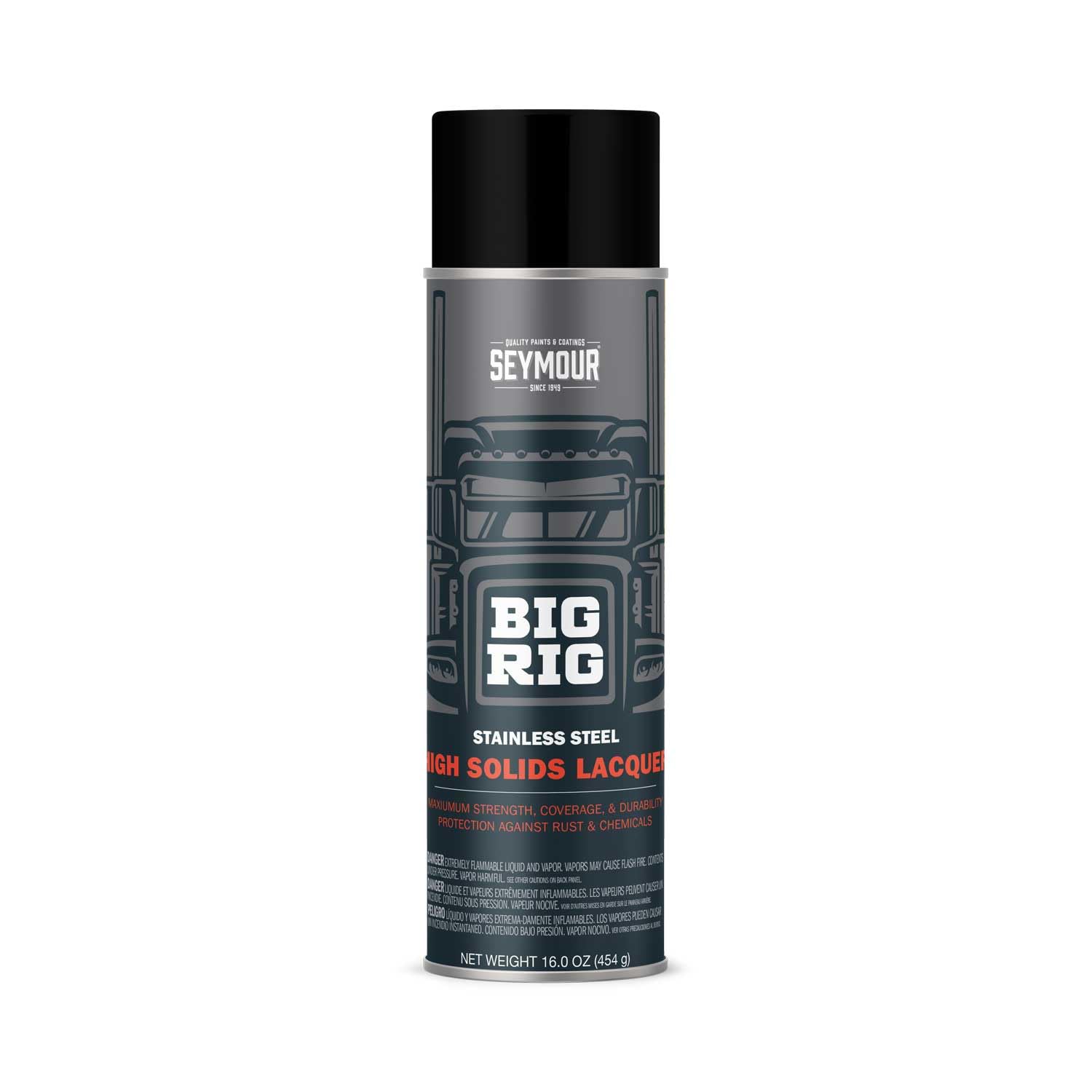
2. Seymour 20-1660 Big Rig Stainless Steel
A fleet-grade stainless spray that goes on fast, covers more metal per can, and refuses to let go of a truck frame.
Fleet mechanics do not have time to rewax a rattle can between passes, and Seymour built this coating for exactly that crowd. It is a lead-free high solids formula, and Seymour states it covers 3-4 times more than standard aerosols. The metal itself goes on as a metallic stainless finish — a bright, reflective silver that stands out on a bumper, a bracket, or a repair patch. This is the can to grab when you want stainless steel color and you want the job done in one long afternoon.
Speed is where it separates from the rest of this list. Seymour’s 1-hour dry time is a full hour faster than Steel-It’s 2-hour window, so you can re-coat sooner. Coverage is measured at 18 square feet. That laps the Stove Bright satin black’s 10 square feet by roughly 80% more surface area per can. On a long frame rail or a set of brackets, that difference is the whole reason to pick it.
Owners keep coming back to one thing: how long the paint sticks. One long-time user put it plainly: “Paint on truck frame (38″ tires, off-road, oil leaks) still intact after 6 years.” That kind of adhesion on a working truck is hard to fake. The recurring grumble is price — some owners feel it costs more than a rattle can should, even with the extra coverage factored in. A few cans have also arrived missing their spray nozzle, which is a shipping quirk rather than a paint problem.
Fleet-grade adhesion: Seymour formulates this for maximum-performance environments and it shows — the finish resists rust, weather, oil, gasoline, and most corrosive chemicals, and it stands up to abrasion and heat. That is a wide net for a single aerosol.
The practical limit: there is no published temperature ceiling here, so treat it as a tough weather-and-chemical coating, not a high-heat one. Save the exhaust manifolds and stove surrounds for the Stove Bright and KBS picks below.
The one-trip pick: if you are coating plenty of stainless in one go and want the metallic finish done fast, the 1-hour dry time and 18 square feet of coverage make this the efficient choice.
Skip only if: your surface runs hot, because this coating is built for weather and chemicals rather than high heat.
3. Stove Bright Fireplace Satin Black Paint

The heat-proof satin black that turns a rusted-out fireplace back into a centerpiece — and holds its color at 1200°F.
For anyone repainting a wood, pellet, or gas stove, a fireplace surround, a grill, or a galvanised chimney cap that needs to go black, this is the pick. Stove Bright rates it for heat up to 1200°F and states it retains color even in extreme heat, which is the exact problem with ordinary paint on a hot stainless surface — it blackens, chalks, or burns off. The satin finish lands between a flat and a gloss, and the black genuinely coats over aged, rusted cast iron and makes it look restored.
One pass covers a lot of ground — that is the win owners repeat most. They describe it covering rust in a single coat, with one noting they only needed two total and that it “restored old cast iron appearance.” It dries fast, so you can work around a still-warm appliance instead of pulling the whole stove out of service for a day. The color holds up too — buyers report rusted outdoor fireplaces looking new again after touch-ups.
The one real warning is the smell. This is a much stronger solvent smell than typical spray paint, and owners are consistent about it — ventilate for several hours or spray outside, full stop. Do that and you get a black that survives the heat. Skip it and the fumes will make you regret the shortcut.
Color retention at heat: the 1200°F rating and the retained-color claim are the reasons this sits ahead of a general-purpose black. On a satin black finish, that is the entire value proposition.
Coverage headroom: at 10 square feet, this can covers less than the Seymour’s 18 square feet, so a large fireplace or a multi-panel job will want more than one can.
Built for: stove, fireplace, and chimney work where the surface gets hot and you want a true satin black that stays black.
Handle with care: budget for heavy ventilation, because the solvent smell is a known part of the deal.
4. Stove Bright High Temp Spray Paint 8107 New Bronze
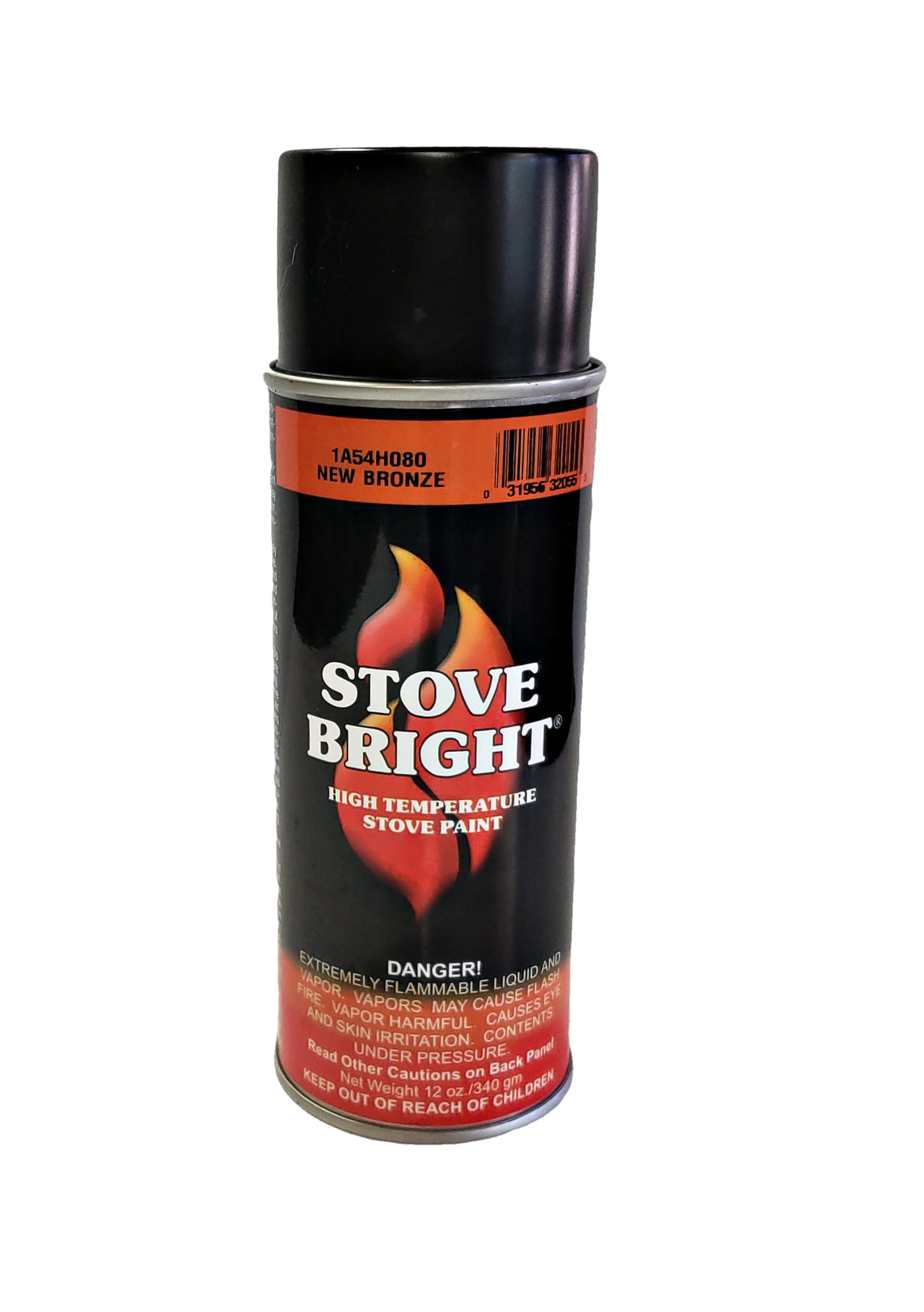
A metallic bronze heat coating for anyone who wants their stove or fireplace to stop looking factory-issued.
Sometimes black is the wrong answer. If you want a heat surface to read as bronze or copper rather than flat black, this metallic aerosol is the option in this lineup that gets you there. It carries the same 1200°F rating as the satin black above and is built for stoves, fireplaces, BBQ grills, flue vent piping, and high-temperature automotive components. The metallic finish is the whole point, and it is the one feature nothing else here offers.
Know how the color behaves before you spray. The paint goes on grey and cures to a metallic blue-bronze, which surprises people who expect the can color. The sharpest finish comes from working it — one owner sanded with 800-1000 grit between coats and finished on the final coat, while another repainted a previously orange gel-insert fireplace and got a “modern and matte finish” they were happy with. Follow the directions and the color lands where you want it.
The risk here is the spray tip. This is the one pick in the list with a hard stop warning in its feedback — the honest version is that some cans clog repeatedly and refuse to spray, and that frustration is real when it happens. When the can behaves, the metallic bronze is genuinely striking. When it does not, you are stuck shaking a can that hates you. It also comes in as one of the pricier cans here, which stings if the nozzle fails.
The metallic payoff
- Metallic New Bronze finish delivers a heat-safe color no other pick on this list offers
- 1200°F rating covers stoves, fireplaces, grills, and flue piping
- Rust-resistant formula built for high-temperature surfaces
- Works on high-temp automotive parts as well as the fireplace at home
The nozzle gamble
- Clogging spray tips are the most-repeated complaint on this can
- The grey-to-blue curing shift surprises buyers expecting the can color
- Sits in the higher price tier, which hurts more when a can misbehaves
Choose this when: a metallic bronze finish is the look you are after and the surface needs to survive real heat.
Think twice when: you want predictable, clog-free spraying, because the tip performance on this can is the recurring complaint.
5. KBS Coatings 65123 Stainless Steel Xtreme Temperature Coating

The exhaust-grade coating owners trust on turbo housings and manifolds where ordinary paint simply burns away.
This is the pick for the hottest stainless surfaces in the game — exhaust headers, intake manifolds, turbo exhaust housings, and anything else where the metal glows hot enough to kill a standard coating. KBS built this as an Xtreme Temperature Coating with a matte finish, and it is applied by brush or spray gun rather than relying on a single aerosol tip. That flexibility is why it appeals to anyone willing to do a little more work for a far more durable heat coating.
The real-world proof is in the extreme use. One owner ran it on a turbo exhaust housing that hits 1100°F with spikes to 1300°F and reported it holding up great, sprayed through an LPHV gun. Another used it on a new exhaust before installation and found it still solid after two winters of heavy road salt and corrosives, with only a few touch-up spots. On engine parts it is also cheaper than the POR-15 alternative while performing equally well according to owner comparisons.
The catch is the drying time, and it is a real one. Reports are split — some say it holds up great, others note flaking within weeks, and the type of complaint usually traces back to prep or the wait. The stated eight-hour gap between coats is the part that trips people up, because rushing that window undermines the whole job. One specific requirement you cannot skip: KBS states this must be used with its XTC Zinc Primer. Buy the primer with the paint or you are setting up for a failure.
Heat ceiling: this is the coating for surfaces that run hotter than a stove top — exhaust, turbo, and manifold level. Fireplace work is well within its range too, as owners confirm.
The commitment: brush-on or spray-gun application, the required KBS XTC Zinc Primer, and an 8-hour wait between coats mean this is the least casual pick here. It rewards the patient user and punishes the impatient one.
The heat-duty answer: exhaust systems, turbo housings, and manifolds that need a coating rated for real extreme heat and a finish that survives road salt.
Not for the fast job: the 8-hour wait between coats and the required KBS XTC Zinc Primer make this a deliberate project, not an afternoon touch-up.
Know the Specs
Heat rating in degrees Fahrenheit
This is the highest temperature a coating is built to survive before it breaks down, chalks, or burns off. Stove Bright lists up to 1200°F on both its satin black and New Bronze formulas, and that rating is the reason those cans belong on a stove, grill, or flue while a general-purpose polyurethane does not. For engine-grade heat above that, KBS XTC is the coating owners reach for. Match the rating to the surface or you will be repainting in a season.
Coverage in square feet
Coverage tells you how much surface one can actually coats. It is listed in square feet, and the smaller the number, the more cans you will need. Seymour’s Big Rig lists 18 square feet while Stove Bright’s satin black lists 10 square feet — roughly 80% more surface area per can. Always compare coverage against the size of the part you are painting, not the size of the can.
Dry time and full cure time
Dry time in hours is the wait before you can apply the next coat. Steel-It lists 2 hours, Seymour lists 1 hour, and KBS XTC asks for an 8-hour gap between coats. Full cure time is the longer wait before the finish is truly hard and durable — Steel-It and Seymour both list 24 hours. Respect both numbers; rushing a coat is the most common reason a stainless paint job fails.
Application method
Aerosol cans spray thin, even coats on awkward shapes but depend on a tip that can clog, which is the top complaint across these products. Brush or spray-gun application — used with KBS XTC — builds thickness faster and holds up better under heat, though it demands more patience and prep. Pick your method based on the shape of the part and how much finish thickness the surface needs.
Common Questions
Does paint actually stick to stainless steel?
Do I need to sand stainless steel before painting it?
What temperature can high heat stainless paint handle?
Do I have to use a primer under KBS XTC?
Is Steel-It better than Seymour for a truck frame?
Why does my spray can stop spraying mid-job?
Can I paint stainless steel without baking it?
How many coats of stainless steel paint should I apply?
Does high heat paint smell while it cures?
Can I use Stove Bright on stainless steel rather than cast iron?
The Bottom Line
For most people, the best paint for stainless steel depends on what the surface does all day. If it gets chipped, corroded, or welded, grab the Steel-It 1012D — the weldable, USDA-approved polyurethane for chipped, corroded, or welded stainless. If you are coating plenty of fleet metal and want it done fast, the Seymour 20-1660 Big Rig gives you 1-hour dry time and 18 square feet of coverage per can. And if the surface runs hot, the Stove Bright Satin Black holds up to 1200°F and keeps its color — that rating is what earns it a spot over the general-purpose cans. Whichever your job needs, match the coating to the heat and the size of the part before you buy, and you will not be repainting next season.
How we choose
We do not accept paid placement. Every pick is matched to a real buyer and a real use-case; we do not hands-on test units.
Sources
Specifications: manufacturer listings and product documentation. Review insights: verified customer reviews, as of October 2026. Pricing: not shown on this page (it changes often); check the current price via the retailer link.
As an Amazon Associate, Aappliancez earns from qualifying purchases. This does not affect which products we feature.