Disclosure: Some links in this post are affiliate links. As an Amazon Associate I earn from qualifying purchases, at no extra cost to you. Learn more
Specs are compiled from manufacturer listings and verified buyer reviews and can change over time — please confirm the key details on the product page before buying.
A metal door needs different paint than a wall does. Metal sweats, it chips, and it rusts from the bottom edge up once moisture gets under the film. The five paints below each handle that in a different way. One is a heavy-duty farm enamel that coats a door in a single pass. One is a thin rust converter that stops corrosion before it spreads. One is a craft set for smaller decorative metal panels.
This guide is built by comparing the manufacturers’ published specifications and the patterns across verified customer reviews, so you get each pick’s real strengths and trade-offs instead of marketing spin.
Each pick below lists coverage per quart, dry-to-touch time, and finish type side by side. You also see how each one behaves on a door that already has rust. Your choice depends on one question: a full repaint, or a spot fix? This breakdown of the paint for metal doors sorts out which one your door needs.
Top Picks


How To Choose The Best Paint for Metal Doors
A metal door gives you one flat panel with edges, hinges, and usually a bottom rail that sits close to splashing rain. That geometry is why coverage and adhesion matter more here than colour choice. A thin film on a door edge wears through first, and once water reaches bare steel the rust spreads under the paint.
Match the paint to the state of the door
If the door is sound and you just want a fresh colour, a gloss enamel or a metallic latex gives you a durable shell. If rust is already showing, you want a converter or encapsulator that neutralises the corrosion before you topcoat. A topcoat over active rust traps moisture, and the corrosion spreads back through the film within a season.
Read the coverage number, not the can size
Coverage is stated in square feet per quart, and that is the number that tells you how far a can goes. A standard exterior door face is roughly the size of a small tabletop, so a quart covers a door and its frame with room to spare. Two thin coats always beat one heavy coat, because a thick coat skins over and traps solvent underneath.
Decide how much shine you want
Gloss finishes are easier to wipe clean and show fewer fingerprints on a door you touch daily. Matte and satin finishes hide dents and dings but show scuffs. Metallic finishes throw light in a way that masks small imperfections, which is why they work well on older doors with a worn surface.
Side-by-Side Comparison
| Model | Best For | Coverage | Dry Time | Finish | Amazon |
|---|---|---|---|---|---|
| Rust-Oleum Farm & Implement Gloss Black★ Best Overall | Full door repaint | 130 sq ft per quart | 2–4 hours | Gloss | Amazon |
| Rust-Oleum Painter’s Touch Metallic Oil-Rubbed BronzeBest Finish | Decorative metal doors | 120 sq ft | 0.5 hours | Metallic | Amazon |
| Shuttle Art 25 Colors Outdoor Acrylic Set | Small metal panels and trim | — | 24 hours | Matte | Amazon |
| Diamond Brite Aluminum Paint | Hot and bare metal surfaces | 15 | 5 hours | Gloss | Amazon |
| Meuvcol 2 in 1 Rust Converter & Metal Primer | Rusted door frames | 50 sq ft | 24 hours | Matte | Amazon |
Detailed Reviews
1. Rust-Oleum Farm & Implement Gloss Black Paint
Our pick — 4.5+★ from 1,000+ verified ratings; the strongest balance of quality and price.
An industrial enamel built for tractors that turns out to be ideal for a battered back door.
You get 130 square feet of coverage from one quart, which is enough to lay down two thin coats on a door plus its frame and still have paint left in the can. For anyone repainting a steel side door that sees weather and scuffing, that coverage-per-quart figure is the reason this one sits at the top. It dries to the touch in 2 to 4 hours, so you can get a second coat down the same afternoon instead of losing the whole day to waiting.
The film is a rust-preventative enamel — a coating designed to sit over prepared steel and keep moisture off it. The enamel film resists chipping and weather damage, which is what a door that gets slammed and rained on needs. The gloss black also matches original equipment manufacturer colours, so a repaired patch blends rather than announcing itself. On raw or rusted metal, buyers report it “goes on easy, almost somewhat self leveling” and that it “still sticks great” even with barely any prep work. It also behaves well on a brush: it levels out on its own so brush marks fade as it cures.
What carries this pick
- 130 sq ft per quart means a door and frame from one can
- Touch-dry in 2 to 4 hours so recoating happens the same day
- Gloss black matches factory equipment colours for invisible repairs
- Durable enough that it holds up on trailers and mower decks
What to know before you buy
- Glossier out of the can than some buyers expected
- Reaching maximum hardness calls for a hardener additive
- Thinning is needed if you plan to spray rather than brush
Reach for this if: you are doing a full repaint on a steel door and want a hard, glossy shell that sheds water and wipes clean.
Look elsewhere if: you want a dead-matte finish — this dries shinier than the can photo suggests, and you would need a flattening agent.
2. Rust-Oleum Painter’s Touch Latex Brush-On Paint
The bronze that makes an old metal door look like a new fixture — and dries in half an hour.
Thirty minutes to touch-dry is the headline here, and it changes how a door project runs. You can paint the panel, close up for the evening, and come back without a tacky surface grabbing dust. That 0.5-hour dry puts it well ahead of the farm enamel’s 2 to 4 hours, which matters if you only have a narrow window between rain showers. The 32 fluid ounces of water-based acrylic reach up to 120 square feet.
Because it is water-based it carries little odour, so a front door in a hallway does not fill the house with solvent fumes. The metallic oil-rubbed bronze finish is the real draw: it lays down a lustrous sheen that reads like brushed bronze rather than flat paint, which flatters a plain steel panel. It also hides well, so a door with old patches under it comes out looking even. Owners mention the rich colour and that it “goes on smoothly and looks lustrous” on patio furniture and metal alike.
The honest catch is drying consistency. Some buyers find it sets much faster than expected, others find it takes a while — humidity and coat thickness both push it around. Prep is also non-negotiable here: sand with 180 or 200 grit and wash with a degreaser, or the metallic sheen will not bond evenly.
The trade-off worth knowing: the metallic film looks its most brilliant under a clear sealer, and a few coats are often needed over a dark existing colour.
Where it shines: a decorative front door or gate where the finish is the point, not just the protection.
Suits you when: you want a door that looks styled rather than utilitarian and you value a fast recoat window.
Not the one for: heavy rust — this is a topcoat, so corrosion needs treating first on a separate step.
3. Shuttle Art 25 Colors Outdoor Acrylic Paint Set
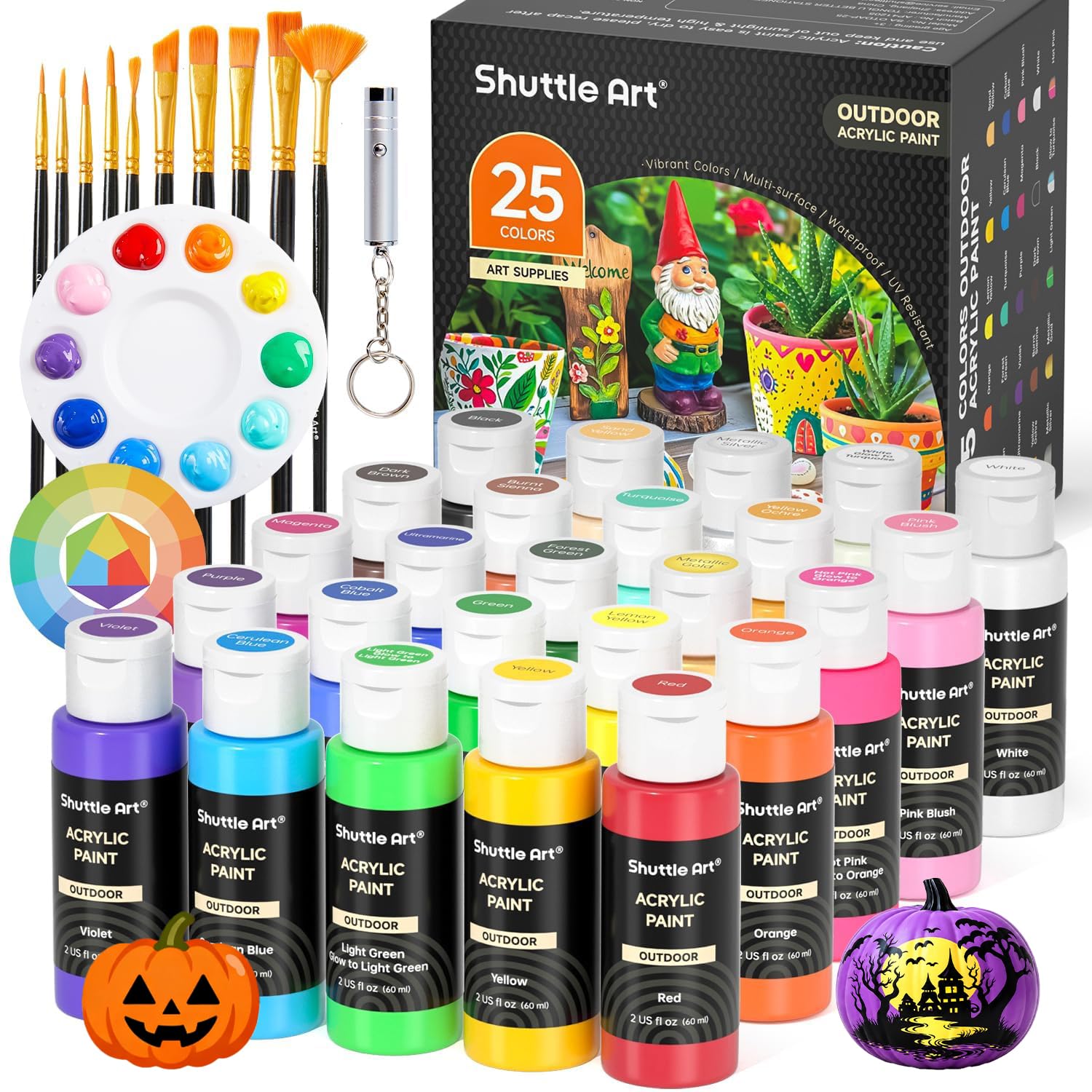
Twenty-five bottles for the door panels you want to decorate, not just repaint.
This is not a one-colour door enamel. It is a 50-fluid-ounce set of 25 outdoor acrylics — 20 classic colours, 3 glow-in-the-dark shades, and 2 metallic finishes — bundled with 10 brushes, a mixing palette, a colour wheel, and a mini UV light. That is a much larger total volume than the metallic latex above, though it arrives split across 25 small bottles rather than one can.
Where it earns a place in a metal-door conversation is stencilling, house numbers, borders, and decorative panels on a steel gate or shed door. The paints are water-resistant and formulated for outdoor exposure, so a design on a sheltered metal surface holds its colour. Coverage is the trade-off: acrylics are thinner-bodied than enamel, and a few shades — yellow especially — need multiple passes over a dark or contrasting base. The kit’s own data lists coverage as variable, which is honest for a multi-colour craft set.
The glow shades are the weak link. The three glow-in-the-dark paints work, but they need charging under the included UV light and several coats before the effect is strong. Customers note “Vibrant colors, easy application, high coverage” on regular shades and note the glow ones are mediocre by comparison. Brushes clean up with soapy water, which is a genuine convenience on a project you finish at the kitchen sink.
Best use on a door: hand-painted motifs, stencilled numbers, and colour-matched touch-ups on a metal garden gate rather than a full respray.
Skip for: a large flat door face — 25 small bottles will not cover a full panel in one colour economically.
Pick this one for: craft work on metal surfaces where you want a rainbow of colours and the brushes thrown in.
Leave it on the shelf if: you need a single durable topcoat across a whole steel door.
4. Diamond Brite Aluminum Paint, Aluminum, 1 Quart
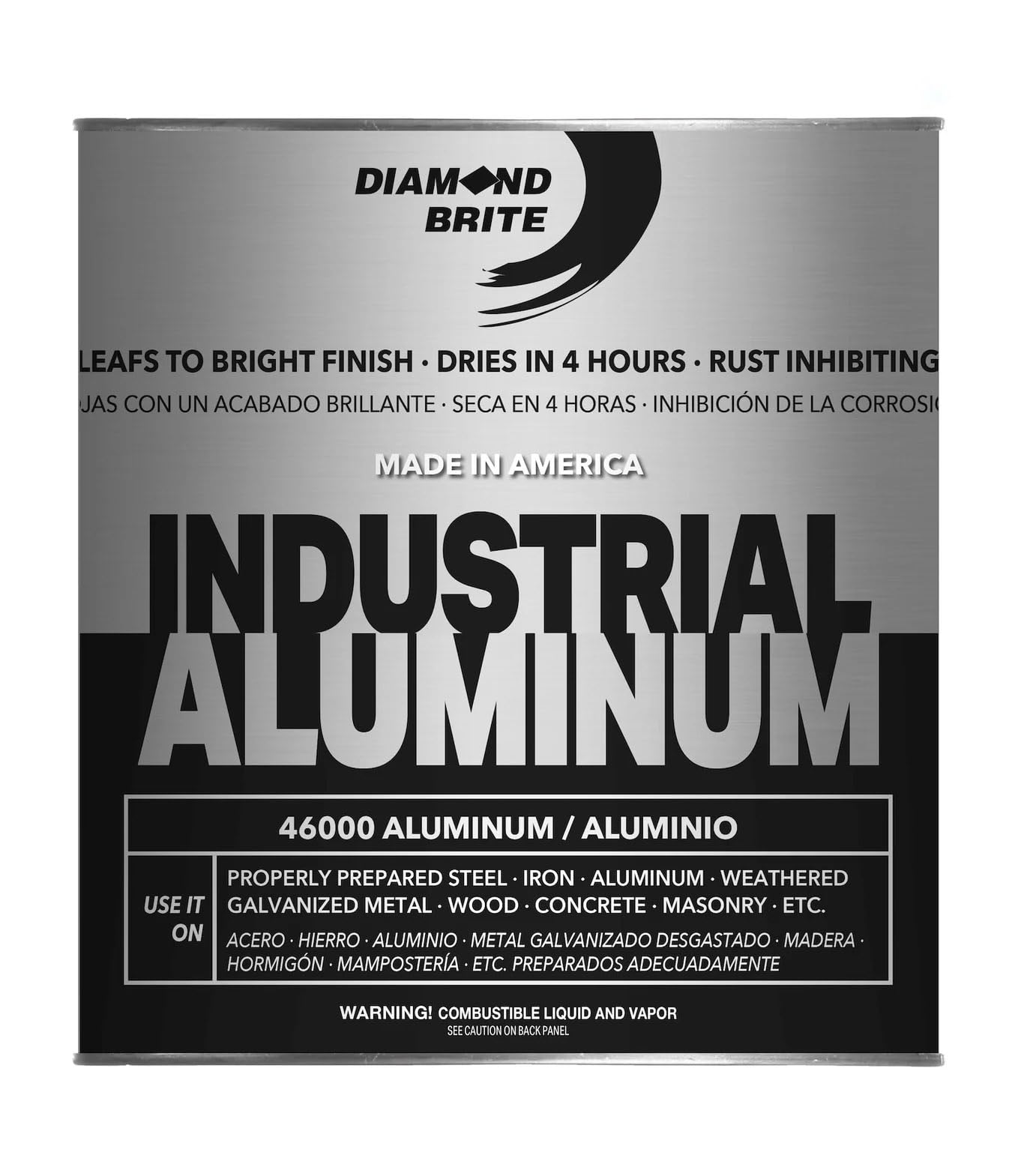
A silver gloss that stays put on hot metal and throws back light like chrome.
Aluminum paint is the old standard for radiators, chainlink fences, and metal cabinets, and it earns that reputation because it copes with heat. If your metal door sits beside a radiator or a hot pipe, this is one of the few paints in this group rated to go straight onto a hot surface. It is waterproof and works indoors or out. You can brush it, roll it, or spray it.
What wins people over is the shine — a mirror-like aluminum gloss that makes tired steel look refinished. Full cure takes 8 hours, after a 5-hour touch-dry window. That slower schedule is a fair trade for a coating built to sit on bare or previously painted metal. Buyers call it “the best paint I could find that had a mirror-like finish,” and it has a loyal following on playhouse frames and gas tanks because “a little paint goes a long way using a roller.”
Here is the honest part: this paint wants a stir stick and a gentle hand. It separates and needs heavy mixing, and overloading a brush or roller leaves marks. Roller strokes can show on the first coat, so plan on a second pass with long, even strokes. Listings do not document longevity past a couple of seasons, and coverage varies with application — brushed thin, a quart reaches much further than you would guess.
Choose it for: a bare or hot metal door panel where you want a bright metallic finish rather than a colour.
Think twice if: you want a simple, single-coat job — this one rewards mixing and two careful coats.
5. Meuvcol 2 in 1 Rust Converter & Metal Primer
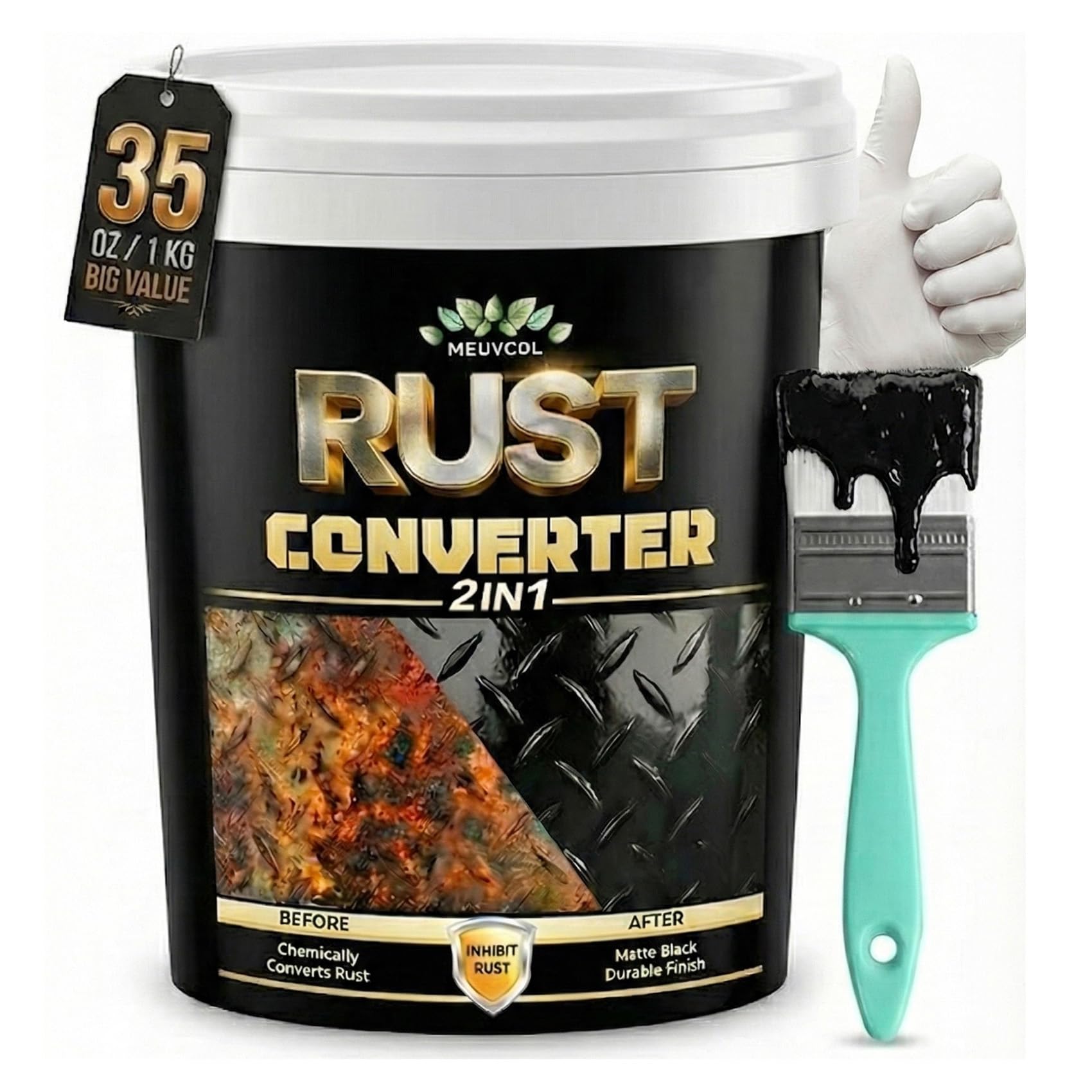
The primer that turns a rusted door frame into a paintable surface instead of a problem.
Not every metal door is sound. Some have a bottom rail full of rust, a hinge-side edge that has bubbled, or a frame that has been fighting corrosion for years. This 35-fluid-ounce converter is built for exactly those cases: it seals rusted metal, locks out water and air, and lays a flat black finish you can paint over or leave as-is. It covers 50 square feet and ships with a brush, gloves, and a manual.
The converter chemistry is what separates it from a topcoat. A rust converter alters the corrosion itself and forms a protective layer on top, so the rust stop happens before you ever reach for a topcoat. Unlike a straight topcoat that needs clean steel underneath, this one tolerates rusted and bare metal both. The finish is a light, paint-like consistency that goes on with a brush and cleans up with water — no solvent fumes to manage on an indoor door. Reviewers point out it lays down smoothly, dries reasonably fast, and leaves the surface looking brand new.
Two things to plan around. First, it needs 24 hours to cure and form its protective film, so a door restored with it is a two-day job once you add the topcoat. Second, coverage of 50 square feet is modest, and the coating wants a minimum of two thin coats to be effective. Some buyers expected a chemical colour-change and instead got a look that resembles flat black paint — the protection is still there, but the mechanical reaction is not always obvious.
Where it wins: a rusted door bottom rail or frame that needs stopping before you paint, not after.
One real limit: the 24-hour cure means you cannot rush the job, and 50 sq ft keeps it to targeted areas rather than a whole door.
For you if: the door has active rust you need to neutralise before any finish goes on.
Step past it if: your door is clean steel — a direct enamel is the simpler route.
Know the Specs
Coverage per quart (square feet)
This is how much surface a can will paint, measured in square feet. A higher number means fewer cans for a large door and its frame. A quart of farm enamel at 130 sq ft covers a door face with spare, while a 50 sq ft converter is sized for targeted rust spots rather than a whole panel. Always apply two thin coats rather than one thick coat — thin coats bond better and cure more evenly.
Dry time vs full cure
Dry-to-touch is when the paint stops being sticky — often as little as half an hour. Full cure is when the film reaches maximum hardness and can take a proper bump, which can run to several hours. You can recoat once touch-dry, but avoid hanging a door or slamming it shut until it has fully cured. A slow cure is not a defect — it usually signals a harder, longer-lasting film.
Finish types
Gloss throws back light and wipes clean, so it suits a door you touch often. Matte and satin hide dents but show smudges. Metallic finishes mask small flaws and give a decorative look. Match the finish to how much traffic and wear the door sees — a back door wants a tough gloss, a decorative front panel can take a metallic or matte.
Rust treatment before the topcoat
Paint over rust and the corrosion keeps spreading under the film. If the door has active rust, use a converter first — it alters the corrosion and forms a barrier — then topcoat. Sound, clean steel skips that step. Sand to the grit the label names and degrease before painting, because adhesion depends on the surface being clean more than on the paint itself.
Common Questions
Can I paint over a metal door that already has rust on it?
How much paint does a standard metal door need?
Do I need to sand a metal door before painting it?
Is a gloss or a matte finish better for a metal door?
How long should I wait between coats on a metal door?
Can I spray paint a metal door instead of brushing it?
Is the Rust-Oleum Painter’s Touch latex suitable for an exterior metal door?
Does the aluminum paint really work on hot surfaces?
Can I paint a metal door with acrylic craft paints?
What prep does a rusted door frame need before the rust converter goes on?
The Bottom Line
For most metal doors, the paint for metal doors that does the most work is the Rust-Oleum Farm & Implement Gloss Black Paint. One quart covers 130 sq ft, enough for a door and frame, and the enamel resists chipping and weather. Want a styled finish that dries fast? Go with the Rust-Oleum Painter’s Touch Metallic Oil-Rubbed Bronze. And if the door has active rust, stop it first with the Meuvcol 2 in 1 Rust Converter & Metal Primer before any topcoat goes near it.
How we choose
We do not accept paid placement. Every pick is matched to a real buyer and a real use-case; we do not hands-on test units.
Sources
Specifications: manufacturer listings and product documentation. Review insights: verified customer reviews, as of October 2026. Pricing: not shown on this page (it changes often); check the current price via the retailer link.
As an Amazon Associate, Aappliancez earns from qualifying purchases. This does not affect which products we feature.