Disclosure: Some links in this post are affiliate links. As an Amazon Associate I earn from qualifying purchases, at no extra cost to you. Learn more
Specs are compiled from manufacturer listings and verified buyer reviews and can change over time — please confirm the key details on the product page before buying.
Painting a mason jar sounds simple until the paint slides off the slick glass, beads up in the middle of your design, or peels away two days later. The fix is a paint formulated to grip non-porous glass, not a steadier hand. That is what separates the five options below. Each one has a real reason to exist, and each one suits a different kind of jar project.
This guide is built by comparing the manufacturers’ published specifications and the patterns across verified customer reviews, so you get each pick’s real strengths and trade-offs instead of marketing spin.
Some of these are dual-tip paint markers, some are bottled enamel that need a cure, and one is a general acrylic set you can press into jar duty. Start with your jar surface, then choose the tool that matches how steady your hand is.
Below you will find the best paint for mason jars sorted by how well each one actually clings to glass, from marker-style pens to oven-cured enamel.
Top Picks

How To Choose The Best Paint for Mason Jars
Mason jars are soda-lime glass, and glass is non-porous — meaning there are no microscopic holes for paint to sink its teeth into. Every pick below is judged on how well it bonds to that slick surface. A paint that feels perfect on canvas can skate right across a jar.
Does it actually bond to glass, or just sit on top?
Look for the words “enamel” or “glass paint” in the listing. Enamel paint is formulated to flow out flat and lock onto slick surfaces instead of beading. A general acrylic may work fine on the jar, but it usually needs a scuff or a primer first.
Dry time vs. cure time — know the difference
Dry time is when the surface stops feeling tacky, measured in hours. Cure time is when the paint reaches full hardness — often longer, and sometimes reached only with heat. If you plan to wash the jar, the cure clock is the one that counts.
Nib size decides your whole project
A fine nib is measured in millimeters and suits lettering and outlines. A round nib covers broad areas without brush marks. Dual-tip pens give you both in one barrel, which matters on a curved jar where switching tools mid-design gets messy.
Side-by-Side Comparison
| Model | Best For | Format | Colors | Dry Time | Amazon |
|---|---|---|---|---|---|
| Betem 36 Colors Dual Tip Acrylic Paint Markers★ Best Overall | Detail work and filling fast | Dual-tip markers | 36 | — | Amazon |
| Colorful Stain Glass Paint SetFastest Dry | Wine glasses and family craft night | 1 oz bottles | 14 | 2 hours | Amazon |
| Bearals Glass Paint | Bottles and full-coverage designs | Tubes (gel) | 12 | 12 hours | Amazon |
| Verdeart Acrylic Paint Set | Mixed jar-and-canvas projects | 2 oz bottles | 24 | — | Amazon |
| Nicpro 18 Colors Stained Glass Paint Set | Washable, long-life jar art | 1 oz bottles | 18 | 24 hours | Amazon |
Detailed Reviews
1. Betem 36 Colors Dual Tip Acrylic Paint Markers
Our pick — 4.5+★ from 21,000+ verified ratings; the strongest balance of quality and price.
Two tips in one barrel means you letter the jar lid and flood the body without swapping tools.
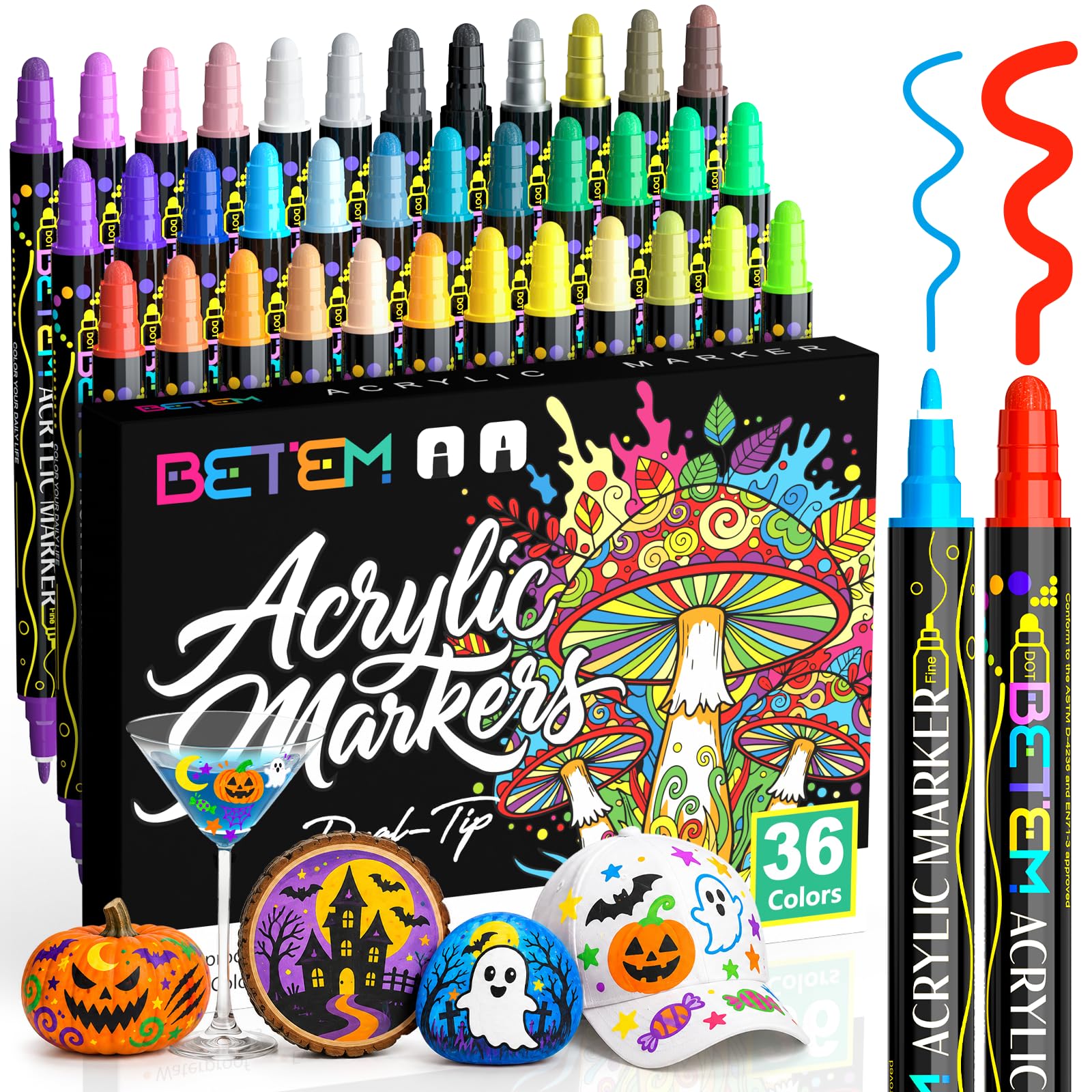
Here is the one most jar painters should start with. Every marker carries a 1mm fine nib for lettering and a 1-5mm round nib for filling — one barrel, two jobs. On a curved mason jar that matters, because you are not juggling a brush and a bottle while the glass rolls under your hand.
These are cotton-nib markers, not push-type pens, so the ink feeds the moment you uncap and dries faster than a squeeze-and-blot pen. The ink is water-based, odorless and acid-free, and Betem lists paper, cardstock, metal, rock, wood, plastic, canvas, fabric and ceramics among the surfaces it handles. Reviewers praise build quality most, with the 36-color range a close second.
An owner who owns the larger set reports buying up, as buyers put it: “Upgraded from 36 to 120 set.” Repeat buying like that says more about the ink than any spec sheet. Practical notes from owner feedback: two thin coats beat one heavy pass on absorbent surfaces, and the caps need to be tightened with pens stored horizontally so the nibs do not dry out.
What earns the top slot
- Two nib sizes in every marker — outline and fill from a single pen
- 36 colors for mixing and shading on one jar
- Cotton nibs start instantly and dry faster than push-type pens
- Water-based, acid-free, odorless ink
Where it asks a little of you
- Drying time splits opinion — go thin rather than heavy
- Store the pens horizontal with caps tight or the nibs stiffen
Go for it: anyone painting lettering, borders or patterned jars who wants control without brushes.
Look elsewhere: if you need a single opaque flood coat in one pass, a bottled enamel does that better.
2. Colorful Stain Glass Paint Set 14 Colors
Fourteen bottles that set in two hours — the craft-night set you can actually finish before bed.
Speed is the whole pitch here. Colorful lists a 2-hour dry time, and that is dramatically quicker than the Bearals set above, which needs 12 hours. If you are painting jars with friends or kids on a Sunday afternoon, those extra hours decide whether the project wraps or sits overnight.
Each bottle holds 1 fluid ounce of liquid acrylic, against 0.85 fluid ounces in the Bearals tubes — more paint per container, which stretches further across multiple jars. The kit lands with 14 colors plus 6 bonus brushes and a palette, so there is nothing else to buy before you start.
The honest catch is opacity. These are transparent paints by design, so a single coat shows the jar behind it — the maker says to let each coat dry and build up until you hit the depth you want. Glass is where they shine; the same product flaked off clear plastic Christmas bulbs while staying permanent on glass jars, so aim it at true glass. Bright color, a 2-hour dry and beginner-friendly layering is the short version.
Why the two-hour clock wins: a fast dry time means fewer smudges, quicker second coats, and a finished jar the same day. The 14 bottles each carry a full fluid ounce, which is generous for small glass projects.
The transparency trade: you cannot get solid coverage in one pass. Plan on two or three thin coats for a bold look, and keep it off plastic.
Reach for this if: you want a complete starter kit with brushes and a palette for glass jars, wine glasses or windows.
Think twice if: you need a fully opaque, one-coat cover or want to decorate plastic surfaces.
3. Bearals Glass Paint

A gel paint built for bottles and windows, forgiving enough to self-level overnight.
Bearals sells this as a 12-tube gel set, and gel is the right word — it holds its position on a vertical jar wall rather than running down it. The tubes hold 0.85 fluid ounces each, and the finish is gloss with a full cure of 24 hours after a 12-hour dry.
Where it genuinely earns its keep is small translucent jobs. It was used to recolor 3mm clear LEDs on a dashboard restoration, where the paint self-leveled into an even coat and gave the right translucence. It is also listed for glass, windows, wine bottles and ceramics, with indoor and outdoor use on the spec sheet.
The catch is real and worth knowing before you buy: on true non-porous glass the coat can slide and a second pass can lift the first, even after curing. It bonds happily to wood and porous stone. Treat it as a gel for decorative bottle work and porous surfaces, and let the long 12-hour dry time do its job without rushing.
The gel advantage: a thick gel means less drip on curved jars and windows, and the 24-hour full cure gives you a durable gloss once it sets.
Best-surface note: porous and textured surfaces hold it far better than perfectly smooth glass, so test a hidden patch first.
Pick it when: you are decorating wine bottles, textured glass or ceramics and want a thick gel that will not run.
Best to pass if: your plan is a flawless, smudge-free finish on perfectly smooth glass with a single coat.
4. Acrylic Paint Set 24 Colors
The set that covers jars today and a canvas next week, with ten brushes in the box.
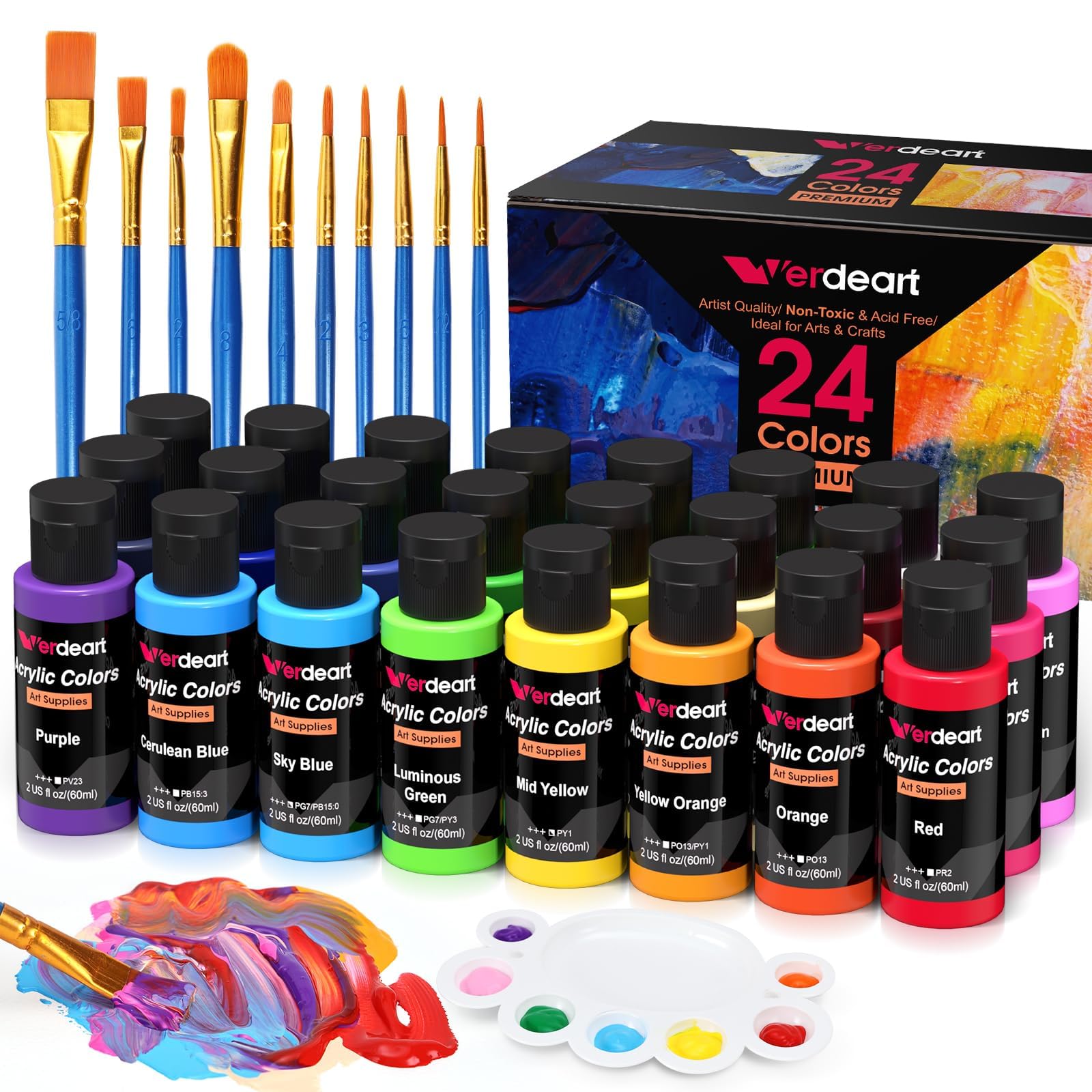
If you want one kit that lives in the craft cupboard and handles jars alongside everything else, this is the one. You get 24 colors in 2 oz bottles — 48 fluid ounces total — plus 10 brushes and a palette, so nothing else needs buying on day one.
The acrylic is water-based, acid-free and certified to ASTM D-4236 and EN71-3, and Verdeart lists glass among the surfaces it covers alongside canvas, stone, wood, paper and ceramic. Reviewers single out the 24-color range most, with overall quality close behind.
What buyers report about thickness is the thing to weigh. Opinions split, and some buyers want a heavier body for opaque jar coats. Painted in a couple of thin layers on glass, it lays down fine. Painted in one thick pass, expect it to behave more like a thin craft acrylic than an enamel.
Why the value reads loud: 10 brushes, a palette and 24 colors in one box means a beginner can finish their first jar without buying anything else.
The honest trade: acrylic flows and spreads well, but heavy coats can look thin on glass. Two light layers outperform one thick one.
Choose this for: a mixed craft shelf — you paint jars this week and a canvas next week and want one box to cover both.
Skip the single thick coat: build thin layers instead, or reach for a true glass enamel for a fully opaque jar.
5. Nicpro 18 Colors Stained Glass Paint Set

Eighteen enamel bottles that go dishwasher safe once you give them the oven.
This is the pick for jars you plan to actually use — a painted candle holder, a decorated mug, a jar that gets washed. Nicpro builds these as acrylic enamel that dries glossy and opaque, and the maker states they become dishwasher safe on the top rack after oven curing. No other pick on this list claims top-rack dishwasher safety.
The kit is complete: 18 colors in 1 oz bottles, 6 bonus brushes, a palette and beginner instructions. Coverage and translucency sit in a workable balance, so you can go bold or sheer depending on how you layer. Owners mention the bright, vibrant color most, with overall effectiveness right beside it.
The trade is the clock. Dry time is listed at 24 hours and the cure comes after — so this is a patient project, not a craft-night sprint. Paint goes on thin and layers well, which means multiple coats for depth, and correction is easy while wet because soap and water lifts it. Once it is cured, though, it is permanent.
Why the durability case is strong: oven curing plus a waterproof, scratch-resistant gloss is the difference between decor and a piece you keep using.
The honest catch: 24 hours to dry before you even discuss curing. Plan the project across days, not hours.
Built for: painted jars and mugs that will be handled, wiped or washed — the oven cure earns its keep here.
Not built for: same-day projects, because the 24-hour dry time will not be rushed.
Know the Specs
Dry Time and Cure Time
Dry time is when the surface stops feeling wet, listed in hours. Cure is when the paint reaches full hardness — often longer, and sometimes reached only with heat. Colorful sets in 2 hours; Bearals needs 12 hours to dry and 24 to cure. If you plan to wash the jar, cure is the clock that counts.
Nib Size in Millimeters
A nib is the tip of a paint pen, measured in millimeters. A 1mm fine nib suits lettering and outlines. A 1-5mm round nib covers larger areas. Betem gives you both in one marker, which is why it works so well on a curved jar where stopping to switch tools is a hassle.
Oven Curing for Glassware
Some glass paints only reach their full waterproof, dishwasher-safe state after a bake in the oven. Nicpro is explicit about this — top-rack dishwasher safe after oven curing. Without the cure, the paint is still waterproof but not built for repeated washing.
Water-Based vs. Enamel
Water-based acrylic cleans up with soap and water while wet, which is friendly for beginners. Enamel is formulated to grip slick surfaces like glass and dry glossy and opaque. Both appear on this list. Match the formula to how permanent and how washable you need the finished jar to be.
Common Questions
Will acrylic paint stay on a mason jar without peeling?
Do I have to bake mason jars in the oven after painting?
How long should I wait before washing a painted jar?
Can I use paint pens instead of a bottle and brush?
Will paint for mason jars work on wine glasses too?
Is stained glass paint actually transparent like real stained glass?
Which paint works best on plastic or vinyl alongside glass?
How many colors do I really need for a mason jar project?
Can kids paint mason jars with these kits?
Why does my glass paint bead up instead of spreading?
The Bottom Line
For most people, the paint for mason jars winner is the Betem 36 Colors Dual Tip Acrylic Paint Markers because one pen handles both the fine lettering and the broad fill, and 36 colors in one set handles any design. If drying speed is your priority, grab the Colorful Stain Glass Paint Set — 2 hours to dry versus 12 for the Bearals gel makes same-day projects realistic. And for jars that will be washed and reused, the Nicpro 18 Colors Stained Glass Paint Set is the one to reach for, since oven curing gets you to top-rack dishwasher safe.
How we choose
We do not accept paid placement. Every pick is matched to a real buyer and a real use-case; we do not hands-on test units.
Sources
Specifications: manufacturer listings and product documentation. Review insights: verified customer reviews, as of October 2026. Pricing: not shown on this page (it changes often); check the current price via the retailer link.
As an Amazon Associate, Aappliancez earns from qualifying purchases. This does not affect which products we feature.