Disclosure: Some links in this post are affiliate links. As an Amazon Associate I earn from qualifying purchases, at no extra cost to you. Learn more
Specs are compiled from manufacturer listings and verified buyer reviews and can change over time — please confirm the key details on the product page before buying.
If your CPAP machine quits at 2 a.m., you wake up gasping — that is the problem these battery packs solve. Backup power for CPAP is not the same as an oxygen concentrator, and the two get mixed up constantly. The listings here are the battery packs and chargers that actually keep a CPAP or BiPAP breathing through a blackout, a campsite, or a long flight. Read what each one really runs, on which machine, and for how many nights.
This guide is built by comparing the manufacturers’ published specifications and the patterns across verified customer reviews, so you get each pick’s real strengths and trade-offs instead of marketing spin.
You will see watt-hours, cable sets, and voltage outputs explained in plain words, plus which machines each pack fits. The goal is simple: pick the right CPAP battery pack on the first try, without paying for watt-hours you never use.
Top Picks


How To Choose The Best Oxygen Concentrator for CPAP Backup Setup
Start with your machine’s model number, not the battery. Every pack here only works with the CPAP models its cables fit, so the model on the bottom of your unit decides your shortlist before anything else matters.
Match the voltage before you match the capacity
CPAP machines run on either 12V or 24V DC power. A 24V ResMed AirSense needs a 24V output cable, and a 12V pack without that cable will not run it. Check the output voltages listed on the pack, then confirm your exact model is named.
Understand what “nights” really means
Manufacturers count nights with the humidifier and heated tube switched off. Turn the humidifier on and the same pack runs a fraction of that time. If you cannot sleep without humidity, plan for fewer nights than the box promises.
Decide whether it flies with you
TSA limits lithium batteries to under 100Wh in carry-on luggage. Packs that clear that limit travel by plane; bigger packs like the 276.48Wh and 297.6Wh units do not. If air travel is part of your routine, that single number settles the choice.
Weigh how you will recharge it
A wall adapter is the fast route. Car adapters and solar panels work too, but they are slower and sometimes sold separately. Look at what comes in the box, not just what the pack can theoretically accept.
Side-by-Side Comparison
| Model | Best For | Capacity | Weight | Machine Fit | Amazon |
|---|---|---|---|---|---|
| Inogen External Battery Charger★ Best Overall | Charging a spare battery off the machine | Charger, not a battery | 0.12 lbs | Inogen One G5, Inogen Rove 6 | Amazon |
| EASYLONGER ES720 PROBest Camper’s Pack | Multi-night camping with a camo shell | 276.48 Wh | 3.4 lbs | ResMed AirSense 11/10, AirCurve 11/10, AirMini, DreamStation, Luna TravelPAP | Amazon |
| BLUETTI X30 | Longest stretch of blackout nights | 297 Wh | 4.1 lbs | ResMed S9, AirSense 11/10, AirCurve 10, AirMini, DreamStation | Amazon |
| EASYLONGER ES960 PRO | Multi-night use with long-life cells | 297.6 Wh | 6.6 lbs | ResMed S9, AirSense 10/11, AirCurve 10/11, AirMini, DreamStation 1/2, Luna TravelPAP | Amazon |
| Pilot-24 Lite | Air travel with a 24V machine | 95 Wh | 1.3 lbs | S9, AirMini, AirSense 10 cables included | Amazon |
| Pilot Flex Navy | Carry-on backup for 12V and 24V machines | 98 Wh | 1.2 lbs | AirMini, AirSense 11 cables included | Amazon |
Detailed Reviews
1. Inogen External Battery Charger for Inogen One G5 / Rove 6
Our pick — 4.5+★ from 600+ verified ratings; the strongest balance of quality and price.
A 0.12-pound charger that tops a spare Inogen battery while you wear the other one.
This is not a CPAP battery at all, and it does not pretend to be. It is the charger that refills an Inogen One G5 or Inogen Rove 6 battery while that battery sits outside the oxygen unit — a 4.5-hour job on its own AC plug. The point is rotation: one battery charges on the AC plug while the other runs the concentrator.
What wins people over is that it simply charges the spare battery, again and again, on the two Inogen models it was built for. It charges, it charges again, and it fits the two Inogen models it was built for. The whole unit weighs 0.12 lbs (a couple of ounces), so it drops into a travel bag beside the spare battery without adding baggage you notice.
The recurring gripe is cost — this is a small accessory with a serious price tag, and there is no third-party shortcut because the connector is proprietary. Plug it in, set the battery on it, and it does its one job. If you already own two G5 or Rove 6 batteries, this turns them into a continuous loop of oxygen on the move. If you run CPAP instead of an Inogen concentrator, look at the packs further down this page instead.
What makes it worth owning
- Charges a spare battery off-unit, so one can top up while the other runs
- 0.12 lbs and narrow enough to live in a travel bag without you noticing it
- Works on a standard AC plug with a 4.5-hour full charge
Before you add it to the cart
- Charger only — no battery in the box
- Fits Inogen One G5 and Rove 6 and nothing else
- Proprietary connector rules out cheaper third-party substitutes
Built for: Inogen One G5 or Rove 6 owners who already carry a second battery and want it full before they leave.
Not the fit: anyone on a ResMed or DreamStation CPAP — this charger has no cable that touches those machines.
2. EASYLONGER ES720 PRO CPAP Battery Pack
Three tent nights on one tank, wrapped in a camo shell no two buyers get alike.
Here is the camper’s math: 276.48Wh of lithium-ion capacity, listed to run your CPAP for at least 2-3 nights with humidification and heating switched off. Comparisons settle fast around this size — the BLUETTI X30 below holds 297 Wh to this pack’s 276.48 Wh, and that extra capacity is why the X30 claims 5-7 nights while this one claims 2-3. Against its own sibling, the ES960 PRO, this unit packs roughly the same watt-hours into a much lighter body: 3.4 lbs here versus 6.6 lbs there.
Where this one earns its keep is tent camping: buyers report a full night of CPAP with 30%+ left for phone charging. A full night of CPAP with 30%+ left for phone charging is the pattern owners describe, and one camper’s line sums up the pitch: it ran “3 nights without having to be recharged.” Four CPAP charging cables come in the box, covering ResMed AirSense 11 and 10, AirCurve 11 and 10, AirMini, Luna TravelPAP, and both DreamStation generations. A 100W USB-C port tops a laptop or phone fast on the side. A full wall recharge takes 4-5 hours, and car or solar input keeps it usable off the grid.
The honest catch is power capacity, which is the most-discussed thing about this pack and splits buyers down the middle. Some units have arrived unable to take a charge at all, and at least one owner found the included DC wall plug dead while the USB-C route worked. Buy from a seller with a clean return path and test every port in the first week. The 276.48Wh rating also puts it over the TSA carry-on limit, so flying with it is out.
Compatibility, plainly: the four blue-and-labeled cables are the real selling point here — most rival packs sell the ResMed lead separately. Match the cable to your machine’s voltage and the startup is one button.
The trade-off to size: at 3.4 lbs it is carryable on a hike but not invisible in a pack. Camp stays win; air travel does not.
Reach for this if: you camp or RV with a ResMed, DreamStation, or Luna machine and want the cables included in one box.
Look elsewhere if: you plan to fly — 276.48Wh exceeds the 100Wh carry-on ceiling, so you will be asked to leave it behind.
3. BLUETTI CPAP Battery Backup X30 297Wh Power Supply

The blackout specialist — 297Wh and a claimed 5-7 nights of quiet CPAP power.
When the power line goes down for a week, the number that counts is 297Wh. BLUETTI lists the X30 as backup for 90% of CPAP and BiPAP devices and claims 5-7 nights from one charge, with the humidifier and heaters off. Owners push that promise hard in the field. One 25-year apnea user ran a ResMed AirSense 10 at 24V for three nights of 7, 9, and 7 hours and still had 52% left. A Philips System One owner on setting 10, humidifier off, got about nine hours a night for five nights at roughly 16% per night.
Three DC output ports cover the voltage spread — 12V/5A, 15V/4A, and 24V/4A — plus a USB-A port at 5V/2.5A for a phone. Five color-coded cables ship with it, matched to System One 50 and 60, AirSense 10 and 11, ResMed S9, Transcend mini, and HDM Z1.
The catch is not capacity but the details: identical round-pin plugs across three voltages invite a misplug. The round-pin cables are all the same size across three voltages, so plugging a 12V cable into a 24V port is a real risk worth double-checking every time. The 24V/4A output also does not match a 3A brick, and the power brick runs warm. Occasional reports of a failing port after months of use exist, so keep the receipt and test early. Design niggles aside, the runtime is the reason this pack takes the top spot.
Why it tops the list
- 297Wh claims 5-7 nights for the majority of CPAP and BiPAP machines
- Five labeled cables mean most buyers never buy an extra lead
- Three DC voltages cover 12V, 15V, and 24V machines in one box
- Built-in handle and accessory bag keep the cable set together
What to watch for
- Identical round-pin plugs across three voltages invite a misplug
- The 4.1 lbs body is heavier than the lightest camp packs here
- A few units have shown port failures after months — test on arrival
Suits you best when: storm season, a rural power line, or a week off-grid is your worry and you want the longest night count here.
The one snag: at 297Wh it stays home — the 100Wh carry-on limit rules it out of any flight.
4. EASYLONGER CPAP Battery Backup ES960 PRO
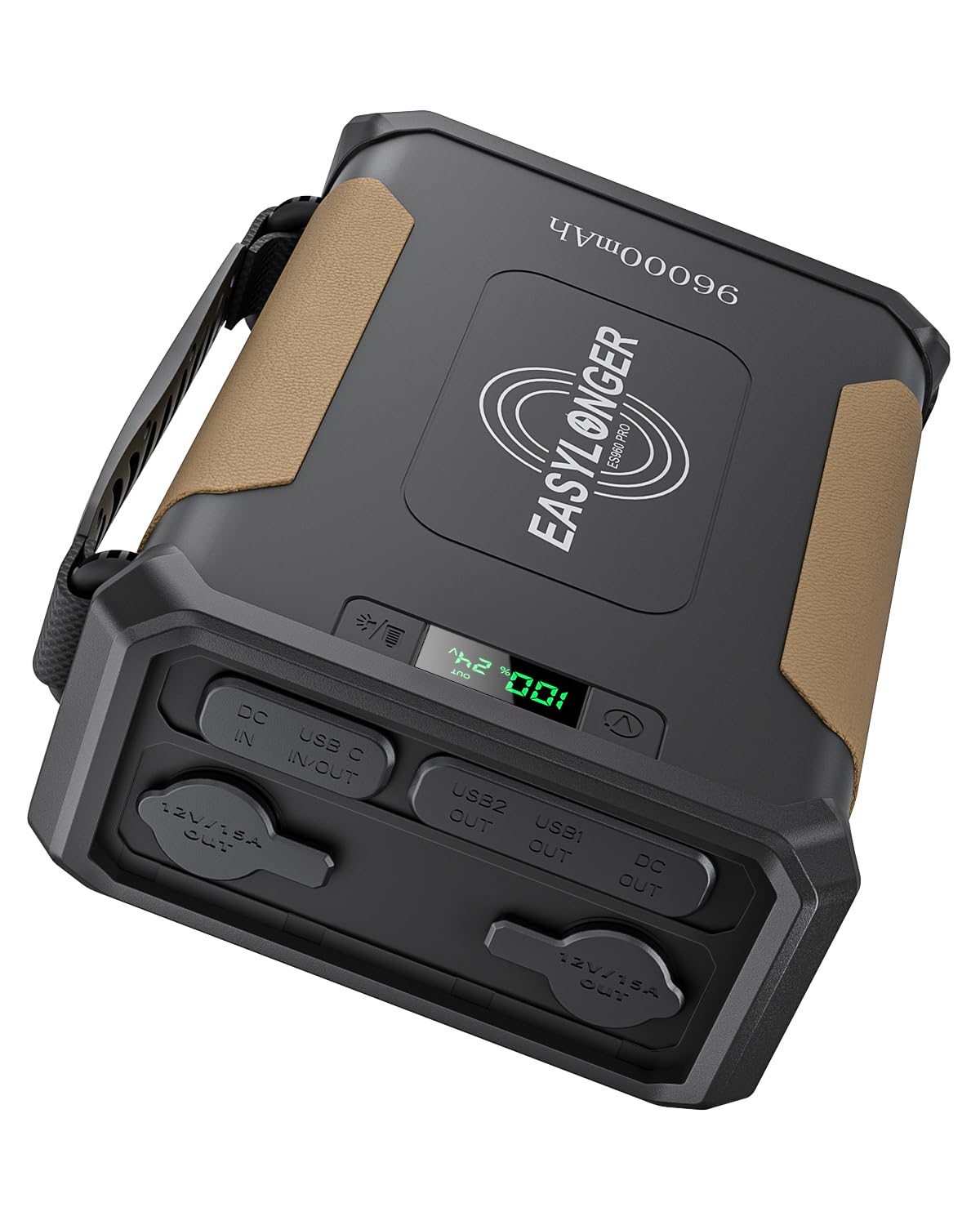
Lithium-iron cells rated for 3000+ cycles, feeding your CPAP for two nights or more.
The headline here is not watt-hours but chemistry: LiFePO4 cells rated for 3000+ cycles. LiFePO4 (lithium iron phosphate, a cell type that holds up through far more charge cycles than ordinary lithium-ion) is rated for 3000+ cycles in this pack. That is a battery you expect to own for years of camping trips and storm seasons rather than a couple of outings. Capacity still matters: 297.6Wh supports 2+ nights of CPAP use without the humidifier or heated tube, and the memory function keeps your voltage setting between uses.
Owners defend that battery life more than anything else. A ResMed AirSense 10 camper ran three nights without a recharge and drained under half the pack. An AirSense 11 user with the humidifier off stretched five nights and still had 1-2 of 4 bars showing. The air’s humidifier crowd does fine too — one AirSense 10 owner with the heated humidifier on got two full nights plus multiple phone charges. Direct 24V DC output skips the AC conversion step, which avoids the losses an AC battery pays on every night.
Six output ports and a 100W USB-C outlet mean the CPAP is not the only thing it can run — laptops, tablets, drones, a car fridge, or a Steam Deck are all within the under-180W range. Compatibility reads like a checklist: ResMed S9, AirSense 10 and 11, AirCurve 10 and 11, AirMini, DreamStation 1 and 2, and Luna TravelPAP, with four cables included. Recharge takes five hours on the wall adapter, about six on a 12-24V car output, or by a 100W-or-better solar panel you bring yourself.
Two costs to plan around. At 6.6 lbs this is the heaviest pack in this lineup by a wide margin — a desk or car trunk battery, not a hiking battery. And 297.6Wh sits over the TSA limit of 160Wh cited for this model, so air travel is out. Charging speed also draws mixed feelings: the five-hour wall charge feels slow next to a fast-charging phone.
Cycle life is the pitch: 3000+ rated cycles on LiFePO4 cells is the single spec that should push this to the front for anyone who uses backup power regularly rather than once a year.
The heft is the price: 6.6 lbs buys you ports and durability you cannot get in a 3.4-pound body.
Right for you if: you want one long-lived pack for home outages, car camping, and RV trips with a ResMed or DreamStation.
Rethink it if: you need to carry it far on foot or take it on a plane — the weight and capacity both push back.
5. Pilot-24 Lite 95Wh CPAP Battery Backup

95Wh, 1.3 lbs, and small enough to clear the TSA carry-on ceiling for in-flight therapy.
Flyers are the target audience here. At 95Wh it slides under the 100Wh carry-on limit, weighs 1.3 lbs, and comes with S9, AirMini, and AirSense 10 cables in the box — three machines, one battery, no extra shopping. Plug it in at home and it works as an automatic UPS: power fails, the pack takes over, and therapy keeps running without you waking to reset anything. Recharge is 2-3 hours on the supplied adapter. AirSense 11, Luna, iCH, Prisma SMART, and DreamStation Go are named as compatible too, but those cables sell separately.
On runtime it is honest about being small. AirSense 10 owners see roughly seven hours with the tube and humidifier heaters off. The 95Wh ceiling is exactly why those numbers look modest: the 297Wh BLUETTI X30 above claims 5-7 nights, while this pack is built for one trip at a time.
The trade-offs are worth knowing before you buy. Cables for AirSense 11 and similar extra models cost extra, and the recharge cable for a depleted pack has been left out of some boxes — check yours arrives complete. Output cords have been the weak point on a small share of units, with intermittent contact and heat reported, so seat the plug firmly and watch it on the first few charges. The bright blue light and low-battery beep are permanent companions on the nightstand. Aluminum casing and industrial-grade cells give it a rugged feel for camping and road trips.
The flying case for it
- 95Wh clears the 100Wh carry-on rule for in-flight CPAP use
- S9, AirMini, and AirSense 10 cables all in the box
- Acts as a UPS — it takes over automatically when the power dies
- 1.3 lbs of aluminum-cased pack for a hotel, campsite, or cabin
The bits that need care
- AirSense 11 and several other machine cables cost extra
- Output cable contact has been flaky on a few units
- Small capacity means one night per charge on most machines
Worth it for: AirMini and AirSense 10 owners who fly or travel to places with unreliable power.
Skip the splurge if: you need multiple nights off-grid — this pack is built for one night, not five.
6. Pilot Flex Navy 98Wh CPAP Battery Backup
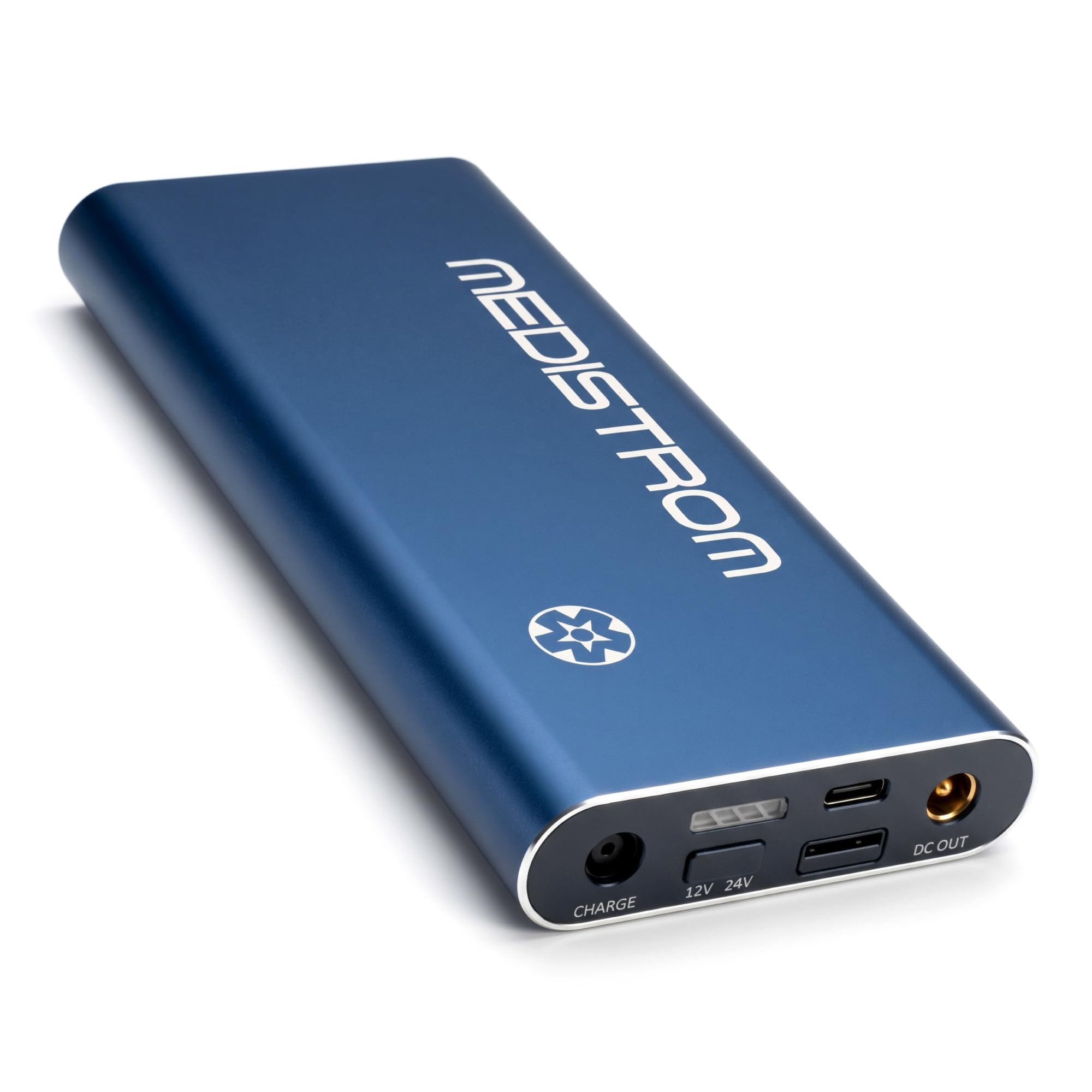
A 98Wh travel pack that charges straight off the AirMini’s own adapter.
This is the flexible sibling of the Pilot-24 Lite. It covers both 12V and 24V machines, which broadens its reach — AirSense 10, DreamStation 1 and 2, System One S60, Apex iCH, Prisma SMART, Luna G3, iBreeze, and S-Box are all named as compatible, though those cables sell separately. AirMini and AirSense 11 leads are in the box. At 98Wh it clears the 100Wh carry-on limit, weighs 1.2 lbs, and recharges in 2-3 hours. Like its sibling, it doubles as an automatic UPS at home, taking over when the wall power drops without interrupting therapy.
What owners like most is the charger design — it uses the ResMed AirMini’s own power adapter to recharge instead of a bulky dedicated brick, which trims the travel kit. Intercontinental flyers report the charge holding two nights. Aluminum casing and industrial-grade lithium cells give it a firm shell for a bag.
Read the mixed signal before you commit. The claimed two full nights on an AirMini does not land for every owner — one gets about 1.5 nights, making it a single-night pack in practice, while another with an AirSense 11 ran 3.5 hours until the humidity and hose heat were switched off, then reached eight hours with one bar left. Adapters also need a firm push or the connection drops.
The real draw: 12V and 24V compatibility in one 1.2-pound body means the same pack covers a camper machine and a home machine as long as you own the right cable.
An honest limit: 98Wh is a single-night budget on most machines, so plan a recharge stop for anything longer.
Best fit: travelers with an AirMini or AirSense 11 who want a light, dual-voltage pack for flights and short trips.
Check first: unplug the humidifier and confirm your charger is in the box, or a night of therapy can turn into a short one.
Know the Specs
Watt-hours (Wh) — the size of the tank
Watt-hours tell you how much energy the battery holds, the way a fuel tank size tells you how far a car goes. A 95Wh pack and a 297Wh pack are not close cousins — the bigger number simply holds more of the same kind of energy. Use it to compare packs against each other, then confirm the machine runs from the pack at all before you count nights.
Voltage (12V / 24V) — the shape of the key
Your CPAP runs at a set voltage, and the pack must output that exact voltage. A 24V ResMed AirSense will not run from a 12V port without a matching cable and voltage setting. Check the output port list against your model before anything else; a big battery that does not match the machine is a paperweight.
Night counts — with the humidifier off
Every “2-3 nights” or “5-7 nights” figure assumes you turned the humidifier and heated tube off. Humidity draws heavily on the pack, so the same battery that runs a week without it can drop to a night or two with it on. Set your own expectation from your own settings.
USB-C output — what it does beside the CPAP
A 100W USB-C port can top a laptop at a useful pace in the same window it runs your CPAP. That range lets one pack cover a work trip, a drone, a tablet, or a phone without adding a second charger to the bag.
TSA limits — the fly/don’t-fly line
Lithium packs under 100Wh are generally allowed in carry-on, which is why 95Wh and 98Wh packs exist. Anything larger — like the 276.48Wh, 297Wh, or 297.6Wh units here — is not approved for air travel. That number decides whether a pack is a travel item or a home-and-camping item.
Cell chemistry — why LiFePO4 lasts longer
LiFePO4 (lithium iron phosphate) cells are rated for more charge cycles than ordinary lithium-ion, and the ES960 PRO quotes 3000+ cycles. More cycles means the pack holds its capacity across more nights of use, which matters most if you rely on backup power regularly rather than once a season.
Common Questions
Can a CPAP battery also run an oxygen concentrator?
How many nights will a 297Wh pack actually run my CPAP?
Why does turning off the humidifier stretch battery life so much?
Can I take a CPAP battery on a plane?
Does the Inogen external charger work on ResMed machines?
What is pass-through charging and why does it matter for CPAP?
How long does it take to recharge these packs?
Is LiFePO4 better than lithium-ion for CPAP backup?
Will the cable from one brand’s pack fit another brand’s CPAP machine?
What should I do if the pack arrives but will not take a charge?
The Bottom Line
For the widest spread of real-world use, the BLUETTI X30 wins on raw staying power — 297Wh, five labeled cables for the most common machines, and a night count that owners push past the box claim. If you want a multi-night pack that also lasts for years, the EASYLONGER ES960 PRO earns it with LiFePO4 cells rated for 3000+ cycles. And if you fly with an AirMini or AirSense 11, the Pilot-24 Lite is the one that clears the 100Wh carry-on line without arguments. Your machine’s voltage and whether you fly, not the biggest watt-hour number, should decide.
How we choose
We do not accept paid placement. Every pick is matched to a real buyer and a real use-case; we do not hands-on test units.
Sources
Specifications: manufacturer listings and product documentation. Review insights: verified customer reviews, as of October 2026. Pricing: not shown on this page (it changes often); check the current price via the retailer link.
As an Amazon Associate, Aappliancez earns from qualifying purchases. This does not affect which products we feature.