Disclosure: Some links in this post are affiliate links. As an Amazon Associate I earn from qualifying purchases, at no extra cost to you. Learn more
Specs are compiled from manufacturer listings and verified buyer reviews and can change over time — please confirm the key details on the product page before buying.
Good bread needs two things from an oven: steady, accurate heat and a way to keep steam around the loaf in the first few minutes. Most countertop ovens give you the heat and skip the steam, which is why home bakers fight pale, thick crusts. The nine machines below are the ones that make real bread baking easier, from steam-injecting combis to big convection boxes that hold a half sheet pan. The top pick is the Breville Smart Oven Air Fryer Pro — 4.5+ stars across 13,000+ owners — because it bakes with even, predictable heat and offers a dedicated proof setting. Here is what each one does well, and where it will make you adapt.
This guide is built by comparing the manufacturers’ published specifications and the patterns across verified customer reviews, so you get each pick’s real strengths and trade-offs instead of marketing spin.
Bread baking punishes an oven that runs hot or blows uneven air, so the picks here are ranked on heat accuracy, steam or proofing support, and how much real capacity you get inside. That is the short version of how to think about the best ovens for baking bread.
Top Picks


How To Choose The Best Ovens for Baking Bread
An oven that bakes bread well has to hold a set temperature and hold it evenly. An oven running 100°F hot browns the crust before the center sets. Without steam, the crust sets early and the loaf stops rising. Judge every candidate on those two jobs first, then look at how many loaves you can fit at once.
Does the oven make steam?
Steam keeps the surface of the dough soft for the first stretch of the bake. That lets the loaf expand fully before the crust hardens, and it is what gives artisan bread its glossy, blistered shell. A steam oven has a water tank and injects moisture on demand. A standard convection oven does not, so you either spritz the loaf or put a pan of water on the rack.
Look at the proof setting, not just the bake mode
Proofing is the final rise before the bake. It wants warmth around 80°F to 90°F and gentle, even humidity. An oven with a proof setting gives you a closed box with none of the drafts that stall dough on a kitchen counter. The Breville has a Proof function, and the two steam combis here keep dough from drying out while it rises.
Check the interior before the wattage
Wattage tells you how fast an oven heats. Interior dimensions tell you whether your loaf pan or Dutch oven actually fits. A 1 cubic foot oven fits most 9 x 13 pans. A 0.6 cubic foot steam oven will not fit a quarter sheet pan, which limits you to boules and smaller loaves.
Side-by-Side Comparison
| Model | Best For | Capacity | Steam | Max Temp | Amazon |
|---|---|---|---|---|---|
| Breville BOV900BSS Smart Oven Air Fryer Pro★ Best Overall | All-round bread and daily cooking | 1 cubic foot | — | — | Amazon |
| Cuisinart CSO-300N Convection Steam OvenSteam Specialist | Steam proofing and crust | 0.6 cubic feet | Yes | — | Amazon |
| Elite Gourmet ETO4510MX French DoorBatch Baker | Large batches on a budget | 45 liters | — | 450°F | Amazon |
| Elite Gourmet ETO4524 French Door | Counter-space-friendly French doors | 45 liters | — | 450°F | Amazon |
| VEVOR Commercial Convection Oven 66L | Four trays at once | 60 quarts | — | 500°F | Amazon |
| Nuwave Bravo Pro Convection Air Fryer Toaster Oven | Zone control for pizza and bread | 21 quarts | — | 450°F | Amazon |
| CIARRA 12-in-1 Countertop Steam Oven | Steam bake plus ferment | 25.4 quarts | Yes | 430°F | Amazon |
| Nuwave Combi Steam Oven | Moisture control and sous vide | 16 quarts | Yes | 450°F | Amazon |
| Multifunction Air Fryer Steam Oven Convection | Compact steam combo | 23 liters | Yes | 446°F | Amazon |
Detailed Reviews
1. Breville BOV900BSS Smart Oven Air Fryer Pro
Our pick — 4.5+★ from 13,000+ verified ratings; the strongest balance of quality and price.
The one oven that bakes like a full-size range without eating your whole countertop.
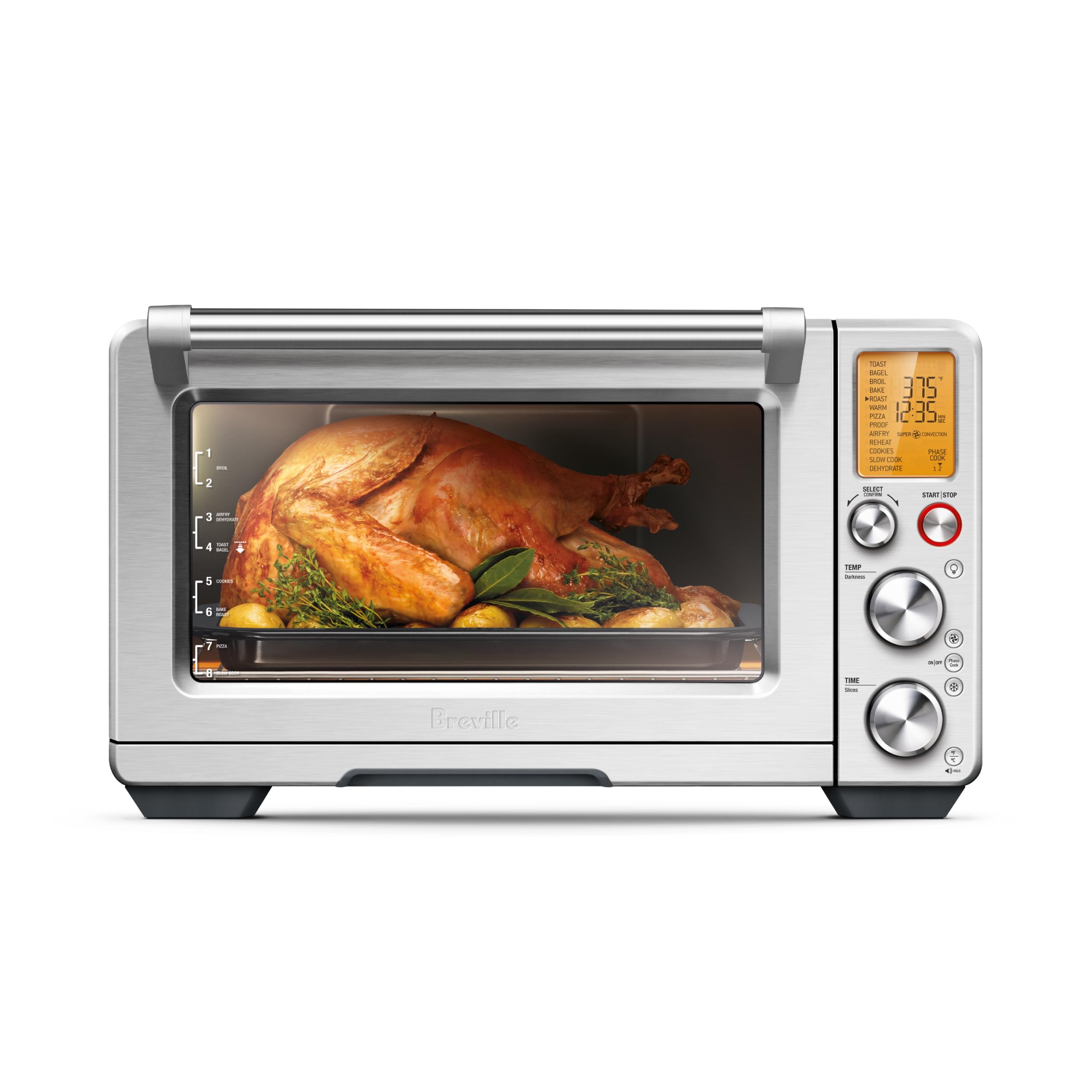
What makes this one worth owning for bread is the Element iQ System — five independent quartz elements that a set of smart algorithms steer to wherever heat is needed. Paired with digital PID temperature control (a feedback loop that keeps the actual temperature locked to the one you dialed in), it works to kill cold spots in the corners where a loaf pan sits. That matters because uneven heat browns the top before the center sets. It carries a 1 cubic foot interior, which is large enough for most 9 x 13 pans and a proofing bowl, and it lists a Proof setting among its 13 functions alongside Bake, Roast, Pizza and Dehydrate.
You get a whole baking setup in one countertop box, not just a bake cycle. It preheats fast, and one owner measured accurate temperatures with an even interior, flagging only a hot spot at the front right. Another reviewer fit a half sheet pan and said it baked as well as a large oven, then used the freed-up full-size oven for storage. It keeps the ambient kitchen heat down, so summer baking does not overrun your AC. Against the Cuisinart below it is the bigger box — 1 cubic foot versus 0.6 cubic feet — and heavier at 30.2 pounds versus 23.4 pounds, the price of all that steel and glass. You also get a 2-year limited warranty and 1800 watts on a standard 120-volt outlet.
The catch is heat on the outside. Buyers report “After 15min at 450°F: top front 215°F, glass 235°F, sides 140°F, cabinet above 90°F,” so keep a cutting board or a heat shield between it and the underside of your cabinets. It is also a serious footprint at 17.5″D x 21.5″W x 12.7″H, so measure your counter before you commit. And because it has no water tank, you will get your steam from a spritz or a water pan rather than an injected burst. Toast is slower than a dedicated slot toaster, but for bread that is not the point.
What earns it first place
- Element iQ System with 5 quartz elements steers heat where each bake needs it — fewer cold corners under a loaf pan.
- 1 cubic foot interior fits most 9 x 13 pans and a half sheet pan, so you can bake two boules or a tray of rolls.
- Proof function handles the final rise in the same box, with no drafts to stall the dough.
- 13 cooking functions replace a toaster, pizza oven and slow cooker in one machine.
- Interior oven light auto-turns-on at the end of a cycle, so you can check browning without opening the door.
- 2 year limited product warranty and 1800 watts on a standard 120-volt outlet.
The honest trade-offs
- Top and front glass run hot in use — heat shield or clearance under the cabinet is a must.
- 17.5″D x 21.5″W x 12.7″H needs dedicated counter space and won’t slide under a low shelf.
- No steam injection, so crust shine is on you with a spritz or a water pan.
- At 30.2 pounds it is a two-hand lift if you ever move it.
Go with this one if: you want one countertop oven that bakes bread, proofs dough, and cooks dinner on the nights you are not baking.
Measure first: the 21.5-inch width and the hot top surface mean you need counter depth and overhead clearance sorted before it lands.
2. Cuisinart CSO-300N Convection Steam Oven, Stainless Steel
The narrow steel box that puts real steam into the bake instead of hoping you spritz enough.
If crust is your obsession, the bread proofing technology here is the whole reason this oven exists. It runs 120 minutes of steady, uninterrupted steam from a 47 oz removable water reservoir, and it has a dedicated Bread setting alongside Steam Bake and Super Steam. Steam in the first minutes keeps dough soft so it springs in the oven before the surface sets, and it also stops baked-on residue from crusting so the interior wipes clean. The whole box is just 0.6 cubic feet — smaller than the Breville’s 1 cubic foot — and lighter at 23.4 pounds versus 30.2 pounds, which makes it easy to lift onto a shelf. Once you learn its steam timing, it delivers a thin, blistered crust the fan-only ovens here cannot match.
The cooking performance is what wins people over here, especially roast chicken and baked bread. Owners mention “steam-broil browns while keeping food moist (e.g., potatoes at 350°F for 30 min),” which is exactly the moist-heat-plus-browning trick that makes a good loaf crust. Near-instant preheat is a real bonus when you are baking on a weeknight. There are 9 functions, a side water reservoir, an interior light and a Steam Clean cycle. The trade-off beyond crust is capacity: it fits a 2-quart casserole and a 12-inch pizza, but not a quarter sheet pan, so tall sandwich loaves and big batards are cramped.
Two quirks to plan around. Temperature increments are coarse — 25°F for bake and broil, 10°F for steam — so you fine-tune by time rather than dial. And that door glass and vent bar reach 245°F in use, so mind your knuckles when you pull a loaf. The stainless interior has no nonstick coating, which means no coating to flake into your bread.
Why it earns its place: you get a genuine steam-injection bake from a 47 oz water tank that runs 120 minutes of steam, in a machine 13 percent smaller in footprint than the Breville at 15.5″D x 18″W x 10.75″H — so it tucks into tighter kitchens.
What you give up: 0.6 cubic feet caps your loaf size and racks, and the 25°F baking steps mean you dial in by feel.
Reach for this if: you want a real steam bake for crust and proofing without a built-in combi price tag.
Look elsewhere if: you need to bake two full loaves at once or fit a quarter sheet pan — the 0.6 cubic foot box will not take it.
3. Elite Gourmet ETO4510MX French Door Convection Oven
Two swinging doors and 45 liters of room to bake a whole batch without swinging a wide handle.
You save counter clearance because of the French dual door. Each side opens on its own, so you can slide in a loaf pan without a full-width drop-down door knocking your coffee maker. The 45L capacity gives you four rack positions and room for 2 x 14-inch pizza racks. The convection fan (a rear fan that circulates hot air) is what turns out flakier crusts and more even browning across a tray of rolls. Independent top and bottom element knobs go up to 450°F, so you can run bottom heat only for a loaf that needs oven spring before the top browns. A 60-minute timer shuts it off automatically.
Bread is what people cook in it, and lots of it — performance is the standout, and one owner who uses it mainly for bread found it “generally good,” while another says it takes a whole meal with room left over. The 20-pound turkey rating signals the interior volume: two loaves side by side or a full sheet of buns. For a home baker working in batches, that means two loaves side by side or a sheet of buns without a second oven. The four rack positions let you bake on two levels at once, which is where a bigger box pays off.
Know the temperature story before you buy. Heat output gets mixed feedback, with the recurring note being that the dial runs hot by 100-140°F against what the thermometer reads. Hang an oven thermometer inside and trust it over the knob, especially for a loaf where a 50°F overshoot can brown the crust early. The doors can also bounce until you level the unit, and the interior light is adequate rather than bright.
Where it delivers
- 45L interior with four rack positions fits 2 x 14-inch pizzas and large batches.
- French dual doors save counter clearance and let you peek without a wide swing.
- Top and bottom elements adjust independently up to 450°F for crust control.
- Convection fan circulates air for more even browning.
Where it needs care
- Knob temperature runs hot — confirm with an oven thermometer before a bake.
- Doors can bounce until the unit sits level.
- Analog knobs give no digital readout to dial a precise number.
Pick it when: you bake in volume and want a wide box with doors that save your counter space.
Bring a thermometer: this one asks you to trust a separate gauge over its dial.
4. Elite Gourmet ETO4524 Convection Oven

Same French-door idea as its sibling, aimed at smaller loaves and a lighter bird.
The 45L capacity here fits up to 12 slices of toast or a 14-inch pizza on the wire rack and roasts up to a 7 lb turkey. That 7 lb figure is the honest tell: this is a smaller bird than the 20 lb the ETO4510MX claims, so treat this as the modest version of the French-door design. The convection fan circulates super-heated air 360° for flakier crusts — the exact quality you want on the outside of a loaf — and the rotisserie spit rotates food inside for even browning. Two knobs run the temperature up to 450°F and the 60-minute timer, and you control the top and bottom elements separately.
You get a French-door oven for shorter bread and everyday baking in a slightly smaller frame — 17″D x 14″W x 21″H — with the same tempered safety glass and a slide-out crumb and grease tray that makes cleanup quick. The rotisserie is the fun extra for chicken, and the dual door still saves your counter clearance. The performance consensus lines up with the sibling: people lean toward it for bread and get generally good results.
The same temperature caveat applies. Expect the dial to read hotter than the real interior, and use an external thermometer as your source of truth so a loaf does not catch. Doors can bounce if the unit is not level. And with only a 7 lb turkey capacity, this is not the oven for the biggest Thanksgiving bird.
Best fit: a smaller kitchen where French doors matter more than a wide body, and where most bread is a boule or a daily sandwich loaf.
Worth knowing: the 7 lb turkey ceiling signals the size — check your loaf pan against the 16″ W x 13.25″ D x 8″ H interior before you buy.
Choose it if: you want French doors and rotisserie in a slightly smaller footprint for everyday bread.
skip it if: you need maximum batch size — the smaller turkey rating points to less interior room than the sibling above.
5. VEVOR Commercial Convection Oven 66L
Four wire racks, one box, and enough room to fire a bread batch all at once.
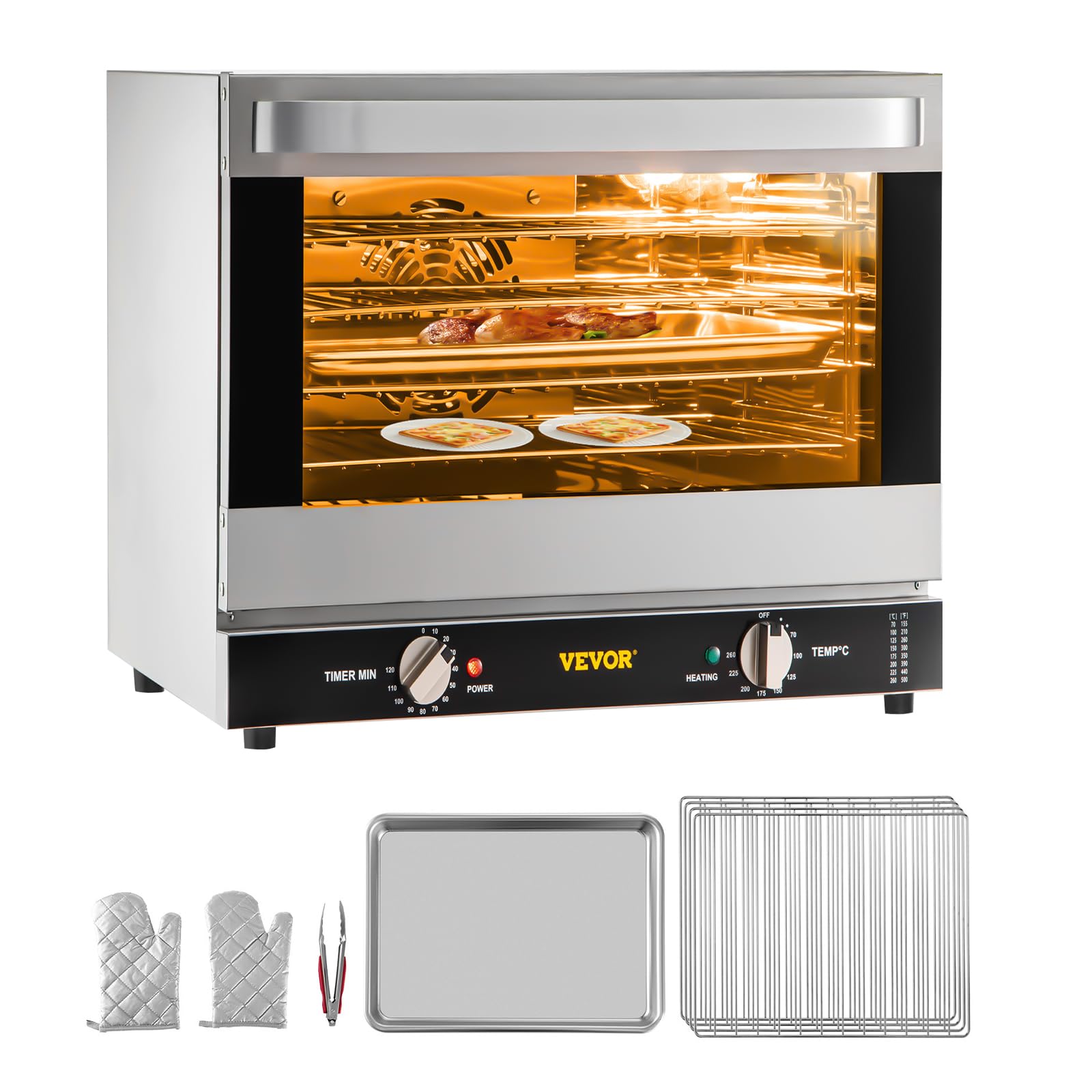
This is the closest thing here to a small production bakery oven. The 66L capacity comes with a 4-tier interior measuring 18.5″ x 15.4″ x 14.2″, and it ships with four wire racks at 18.1″ x 13.0″ plus a food tray. The 1800W power drives an efficient fan to spread heat evenly, and two knobs control temperature from 150°F to 500°F and time from 0 to 120 minutes. That 500°F top end is higher than most countertop ovens reach, and a hot, well-circulated box gives you the oven spring and browned crust that make a loaf look bakery-made. The stainless steel interior and exterior resist rust and clean easily, and the dual-wall tempered glass door keeps heat in.
The baking performance is the reason to buy it. One owner reports it “bakes cakes and cookies perfectly and does not add heat to the kitchen,” and bread and pizza come out excellent on stable, predictable temperatures. Being a 4-tier box, you can put a loaf on the top rack and rolls below, which is a different game from the smaller single-layer ovens. A magnetic sealing strip holds the temperature inside and dense vents keep airflow moving. If you bake sourdough or bakes for a farmer’s market, the ability to run a full tray batch in one session is the whole pitch.
Check your outlet before ordering. The 66L unit needs a T-blade plug (a 20-amp outlet) — do not use adapters or alter the plug, and the manufacturer specifically warns against it. The top gets very hot in use, so keep it clear of anything that can rest on it. And the supplied bread clip aside, there are no bread-specific presets: you manage bake by hand with the two knobs.
Why bakers shortlist it
- 66L over four tiers fits full baking trays, so you can batch a day’s bakes.
- 1800W fan spreads even heat with knobs for 150°F to 500°F and 0 to 120 minutes.
- Stainless steel and dual-wall tempered glass resist rust and hold heat.
- Includes 4 wire racks, a food tray and heat-resistant gloves.
Set these up before you bake
- The 66L model needs a T-blade plug outlet — check that first or it will not power up.
- No digital readout or bread presets; you drive bake and time with two knobs.
- The top surface gets very hot during use and needs clear space.
The pick for: anyone baking in trays who wants multiple racks running at once.
Check first: that T-blade outlet on your wall, because this 66L unit will not run on a standard plug or an adapter.
6. Nuwave Bravo Pro Convection Air Fryer Toaster Oven Combo

Split the top and bottom heat yourself and dial in how a loaf browns.
Most countertop ovens give you a temperature and little else. The Bravo Pro hands you the heat distribution: you can shift the ratio of top to bottom heaters anywhere from 0 to 100% and adjust the convection fan speed at any time. For a loaf, running the bottom heater hard gives you oven spring off the stone, while cutting the top back stops the crust from setting early. Nuwave’s example is a thick pizza with bottom at 70% and top at 30%, and the same logic maps straight onto bread. The 21-quart capacity fits a 9 x 13 pan, the new fan is rated 100% faster than the prior design, and the convection system holds a 0-1°F difference between layers for even multi-level bakes.
Owners bake, toast and reheat in it daily, and the three convection settings (high, mid, low or off) give real control at the touch of a button. There is a small learning curve, but once you know it toasts evenly and bakes well, it becomes the machine you leave on the counter. The digital display is easy to read, you get 10 presets including Bake and Pizza, and included trays cover the basics. It is PFAS-free and lighter than most of the competition at 16 pounds.
One thing to know: the new-smell burn-off at 425°F makes the exterior very hot to touch on the first run, and it can dislodge a plastic light cover close to the unit — so do that first burn-off with the oven well clear of cabinets and under a window. Normal reheating at 350°F leaves it only warm. A few owners also felt the air fry mode is weaker than they hoped, though for baking that is beside the point.
what separates it: you get crust control most combis cannot match from the top/bottom heater ratio — you are not locked to whatever the bake preset decides.
Do this first: run the 425°F burn-off outside or with clearance, because the exterior runs hot on those early cycles.
Great for: bakers who want to tweak top and bottom heat for a specific loaf instead of accepting a preset.
Not for: someone who wants to press Bake and walk away — the zone control is only worth it if you will use the dials.
7. CIARRA 12-in-1 Countertop Steam Oven

Steam for the bake, a ferment mode for the rise — one box for the whole loaf.
Bread baking is a two-stage job, and this oven covers both stages in one slot on the counter. Rapid steam and steam convection lock moisture in during the bake, which is what gives a loaf a thin, glossy crust. The Ferment mode gives you a warm, draft-free box for the bulk rise or the final proof, so the dough does not stall on a cold kitchen counter. The 25.4-quart interior runs from 85°F to 430°F, and a 33.8 oz water tank means you are not refilling mid-cook. The rapid-steam function heats faster than a traditional oven, so preheat time shrinks. Everything you need is in the box: an air fryer basket, baking pan, oven rack, water tank and oven mitt.
The versatility is what keeps people using it daily. Owners fit a 9 x 3 pan inside and have baked bread, cookies and a whole Thanksgiving meal in the same week. The steam function is the reason it beats a plain countertop oven for this job, because an injected burst of moisture does what a spritz bottle cannot do consistently. It also has a sterilize mode and a 33.8 oz tank long enough for a full bake plus a proof.
The honest friction is the controls and the documentation. Presets are handy once you learn them, but early days are trial and error, and the machine ships with limited printed guidance. Opening the door to check the loaf will pause or stop the cycle on some settings, so use the light and trust the timer. It is also a large footprint at 14″D x 16″W x 17″H, and some owners note the water tank needs refilling for longer steam sessions.
The bread-baking wins
- Rapid steam and steam convection for a thin, glossy crust instead of a tough shell.
- Ferment mode handles the rise in the same box, no cold-counter stall.
- 33.8 oz tank and 85°F to 430°F range cover a full proof-to-bake session.
- Timer and preset menus mean less babysitting once you know the controls.
What to plan for
- Preset logic takes trial and error before it feels natural.
- Opening the door to check the loaf can interrupt the cycle.
- 14″D x 16″W x 17″H is a large footprint and the tank needs refills for long steam runs.
Take this route: if you want proof and bake handled by one steam oven with a ferment setting.
Know going in: you will spend the first few bakes learning the presets, and the door check will cost you a cycle pause.
8. Nuwave Combi Steam Oven

The moisture dial goes from 10 to 90%, so you tune the steam to the bread you are baking.
This is a combi oven at a countertop scale, and the spec that matters for bread is moisture control measured from 10-90% alongside a temperature range of 50°F to 450°F with 1°F precision increments. That is not a fixed steam burst — it is moisture you set as a percentage, so you can hold back steam for a lean baguette and run it higher for a soft sandwich loaf. Add the Combo mode that steams the interior while air frying the outside, and the Toast function designed to brown bread to bakery-fresh color, and it is built around the two jobs bread wants. The 16-quart capacity fits 4 slices of toast or a 5 lb roast, and there are 120 presets in the box.
The steam performance is what people come back to. Owners say the steam cooks quickly and evenly, letting them run several items at once, and reheating beats a microwave because the box has no turntable and does not dry food out. There is a 51-recipe book and a 120-preset guide for a starting point. If you are new to combi baking, the preset logic gives you a warm-up while you learn the moisture settings.
Two things to weigh honestly. The interior is on the tighter side at 16 quarts, which suits a small household but not a double batch of loaves. And the sous vide function is unreliable — there are reports of chicken still raw after about two hours at 160°F — so treat this as a steam and bake oven, not a sous vide machine. A thermal gasket issue has been reported on some units, and the recipe chart can confuse rather than help.
Its smartest spec: the 10-90% moisture range gives you the closest thing to a dial-in steamer here, and 1°F increments keep the bake stable.
Stay realistic: the sous vide mode is the weak spot — buy this for the steam and bake, and use the 120 presets as a guide.
Worth it for: a smaller kitchen where moisture percentage matters more than raw capacity.
Don’t buy it for: sous vide — the function has reliability reports, so lean on the steam and bake modes instead.
9. Multifunction Air Fryer Steam Oven

A small steam combo with a proof-friendly 104°F floor and a bake tray included.
The 104°F to 446°F temperature range is the bread-relevant part here. That low end covers proofing and gentle steam, and the top end is hot enough for a crust-setting bake. A 0.8 liter (27.05 oz) water tank runs the long steam program, and the one-touch panel steams, steam-and-bakes, convection bakes and air fries without a menu maze. The 23 liter capacity comes with 5 shelf positions, so you can proof a bowl of dough on one level and finish loaves on another. The included perforated steam tray, bake tray, wire rack and drip tray means you can start baking without buying anything else.
For a compact unit, the versatility is the reason to look at it — it can steam, bake, proof and air fry, so it replaces a steamer and an air fryer on a small counter. The touch interface keeps the front panel clean and easy to wipe. The 5 shelf positions give you more stacking flexibility than most boxes this size.
Weigh the durability record before you buy. There are reports of the door interior coating bubbling and rust setting in after about two years, and a unit that blew fuses after a damaged power cord arrived in the box. Before you open the packaging, film the unboxing — a crushed cord is hard to prove later. Treat it as a compact entry into steam baking rather than a long-term workhorse, and you will judge it fairly.
The appeal: the 104°F floor makes it one of the few compact options here that can proof dough and steam-bake a loaf in the same box.
The caution: door coating and cord-damage reports mean it asks for careful handling and an unboxing video.
Good match for: small kitchens that need proof, steam and bake from one compact machine with a usable 104°F to 446°F range.
Pause if: you want a long-term daily driver — the coating and rust reports make it better suited to lighter use.
Know the Specs
Steam injection vs. a water pan
A steam oven has a built-in tank and injects moisture on demand. That is more consistent than spritzing a loaf or setting a pan of water in a standard convection oven. Steam keeps the crust soft in the first stretch of the bake, so the loaf can rise fully before the surface hardens. It also stops burned-on residue from sticking, which makes the interior easier to wipe down.
Capacity in quarts, liters and cubic feet
Capacity tells you how much dough you can bake at once. A 0.6 cubic foot box fits a boule or a small sandwich loaf. A 1 cubic foot box fits a half sheet pan. A 60 quart commercial box with four tiers fits trays of rolls and multiple loaves in one run. Match the number to the size of your typical bake, not to the biggest batch you might make once a year.
Common Questions
Can a countertop steam oven really bake a loaf with a crusty crust?
What does a proof setting do and do I need one?
Why does my loaf brown too fast on top?
Does the VEVOR 66L work on a normal wall outlet?
Is a steam oven better than a convection oven for bread?
Can I fit a 9×13 pan or a half sheet pan inside these ovens?
How long can a steam oven run before I have to refill the tank?
Will a steam cycle leave my oven wet or hard to clean?
Should I pick a French door oven over a drop-down door for bread?
Do I need a dedicated oven thermometer if the oven has a digital display?
The Bottom Line
For most people baking bread at home, the best ovens for baking bread winner is the Breville Smart Oven Air Fryer Pro because its five quartz elements and PID temperature control (a chip that holds the heat steady) keep the bake even, and its Proof function covers the rise. If crust is your single priority and you bake smaller loaves, the Cuisinart CSO-300N gives you real steam injection that the fan-only ovens cannot match. And for tray batches or market baking, the VEVOR 66L puts four racks in one box. The Breville has the most owners of the three, and every pick here earns its place on heat accuracy, steam or proofing support, and usable capacity.
How we choose
We do not accept paid placement. Every pick is matched to a real buyer and a real use-case; we do not hands-on test units.
Sources
Specifications: manufacturer listings and product documentation. Review insights: verified customer reviews, as of October 2026. Pricing: not shown on this page (it changes often); check the current price via the retailer link.
As an Amazon Associate, Aappliancez earns from qualifying purchases. This does not affect which products we feature.