Disclosure: Some links in this post are affiliate links. As an Amazon Associate I earn from qualifying purchases, at no extra cost to you. Learn more
Specs are compiled from manufacturer listings and verified buyer reviews and can change over time — please confirm the key details on the product page before buying.
You have one wall socket and four things that need it, so you need an outlet extender that turns that single socket into a small power station without taking over the wall. The five picks below cover the range: the crowd favorite (4.5+ stars across 1,100+ owners) that keeps a rare half-star edge, a night-light model, a huge-review workhorse, a slim two-pack for behind furniture, and a rotating six-outlet for cramped corners. Every pick plugs straight into the wall, no cord to trip over.
This guide is built by comparing the manufacturers’ published specifications and the patterns across verified customer reviews, so you get each pick’s real strengths and trade-offs instead of marketing spin.
Here is what actually separates these picks — outlet count, USB-C output, surge-joule rating, and whether the body stays put when you pull a charger out of it. Read on to find the one that fits your wall and your drawer of adapters.
Top Picks

How To Choose The Best Outlet Extender
Four specs decide whether an outlet extender works on your wall: outlet count, outlet spacing, surge joules, and how it anchors.
Count the plugs you actually need
An extender with three AC outlets and three USB ports powers six devices at once, which handles a nightstand or a desk. If you have a kitchen counter stacked with a coffee pot, a blender, and a Roomba charger, reach for the six-outlet models. USB ports on the front save you from hunting for a charging block, so a unit with four USB ports frees up every AC outlet for the things that actually need a plug.
Check the outlet spacing before you buy
Standard wall sockets sit about 1.5 inches apart, and that gap is where bulky adapters collide. Extenders built with 2.1 inches between outlets give each plug its own elbow room, so a chunky power brick does not block the socket next to it. If you have a mix of laptop chargers and small adapters, wider spacing is worth more than one extra outlet.
Match the surge rating to what you plug in
Surge protection is measured in joules — the energy the unit can absorb in a spike. An extender rated at 1440J or 1680J absorbs a big surge and shuts it down before it reaches your electronics. That matters for a laptop, a TV, or a desktop PC. If you only charge phones, the joule rating is a bonus, not the deciding spec.
Decide whether it needs to stay put
Pulling a plug out can drag the whole extender out of the wall if nothing anchors it. A center screw that threads into a duplex outlet’s faceplate holds it firmly. A white plastic stability prong does the same job on some models. Either way, you want some anchor, otherwise the extender will loosen every time you unplug.
Side-by-Side Comparison
| Model | Best For | AC Outlets | USB Ports | Surge Rating | Amazon |
|---|---|---|---|---|---|
| TESSAN Surge Protector Wall Outlet Extender★ Best Overall | Small spaces and everyday charging | 4 | 3 (1 USB-C, 2 USB-A) | — | Amazon |
| POWSAF 5 Outlet ExtenderNight-Light Pick | Bedrooms and hallways with a night light | 5 | 4 (2 USB-C, 2 USB-A) | 1680J | Amazon |
| QINLIANF 5 Outlet Extender | Whole-home outfitting on a budget | 5 | 4 (1 USB-C, 3 USB-A) | 1680J | Amazon |
| TROND Outlet Extender Surge Protector | Tight corners and horizontal outlets | 6 | — | 1440J | Amazon |
| BN-LINK Multi Plug Outlet Extender 2 Pack | Behind the bed or a travel bag | 3 per unit | 3 (1 USB-C, 2 USB-A) per unit | — | Amazon |
Detailed Reviews
1. TESSAN Surge Protector Wall Outlet Extender
Our pick — 4.5+★ from 1,000+ verified ratings; the strongest balance of quality and price.
The compact seven-device extender that turns one socket into a whole charging station
The TESSAN earns the top spot because it does the most with the least wall space. It gives you four AC outlets (rated 1875W max), plus one USB-C port and two USB-A ports, for seven devices charging at once. That 7-in-1 count is the single number to remember: it beats the TROND six-outlet design on USB, and it beats the BN-LINK two-pack on outright outlet count.
The USB-C port outputs up to 15W and the USB-A ports output 2.4A each, so a phone, tablet, and earbuds can sit on the same extender without a single charging block. Buyers put it plainly: “I no longer have to have charging blocks for everything and I can plug in 3 items.” What wins people over most, though, is the physical quality — a dense, well-finished body that feels like it belongs on the wall rather than stuck in it. Quality leads every aspect by a wide margin.
The 3-side layout matters as much as the ports. One AC outlet faces front, so four larger adapters can sit side by side without blocking each other. At 5.43 ounces it stays light enough not to sag out of a loose socket. The trade-off is one to know about: some buyers report the USB-C port does not fast-charge every phone. The 15W max will keep up with a tablet or a routine top-up, but it is not the 20W PD that the POWSAF offers. If you need a quick full charge from a USB-C port on the wall, that is the real reason to step up.
Why it wins the top slot
- Seven devices from one socket — four AC, one USB-C, two USB-A
- Compact 2.32 x 3.15 x 1.5-inch body that does not cover the bottom socket
- Front outlet lets four large adapters sit side by side
- Surge protection on the AC side with a red indicator light
What to weigh first
- USB-C tops out at 15W — not the full-speed PD some phones want
- No night light, unlike the POWSAF and BN-LINK picks
Reach for this if: you want the most outlets and USB ports in the smallest footprint — a nightstand, desk, or dorm wall.
Look elsewhere if: a high-wattage USB-C fast charge is your main need; the POWSAF’s 20W PD port fits better.
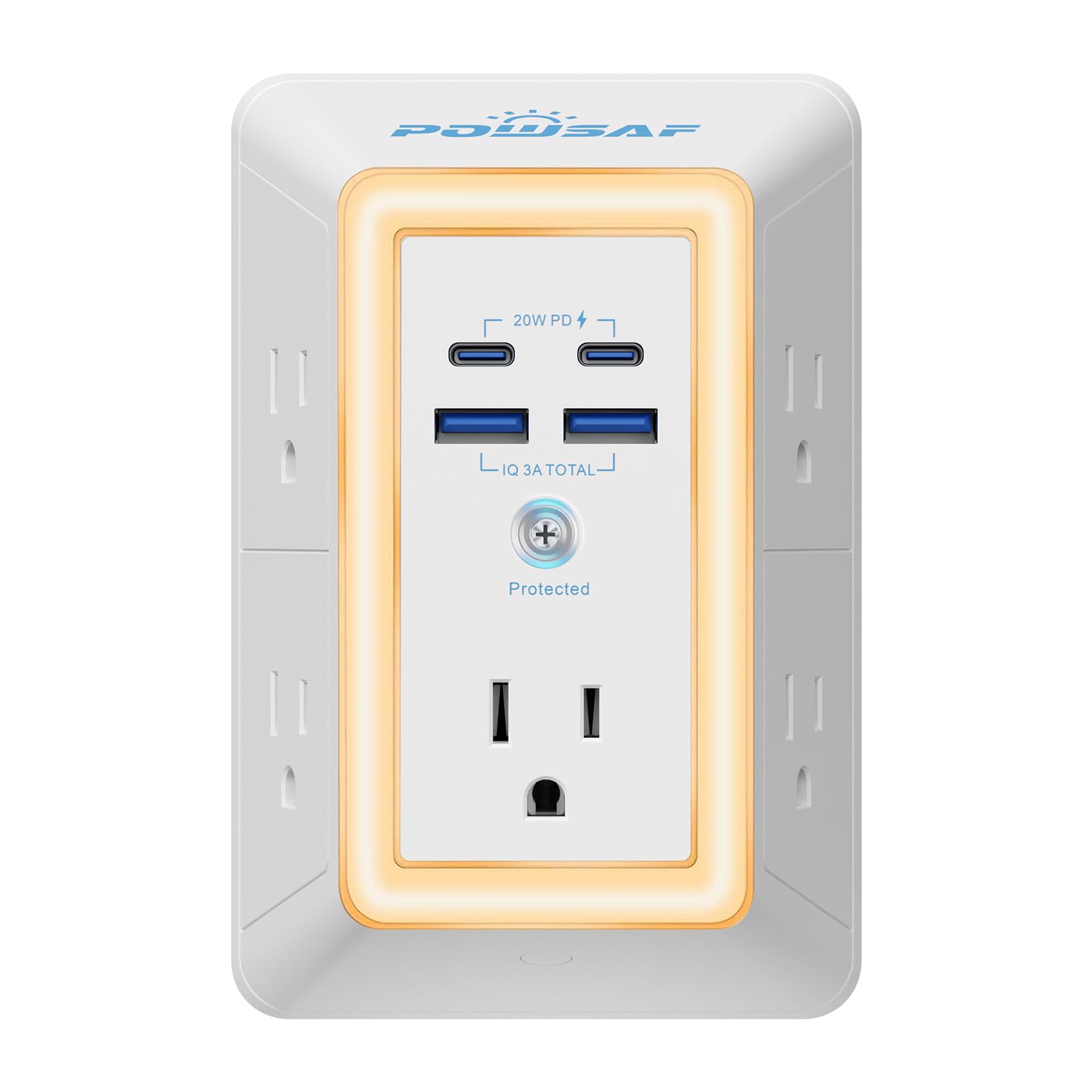
2. POWSAF 5 Outlet Extender with Night Light
Five outlets, four USB ports, and a light that turns itself on when the room goes dark
For a hallway or a kid’s room, the POWSAF does a job no plain extender can: the LED ring around its edge fades on at dusk and off at dawn. A light sensor handles the timing automatically, and a touch control gives you three adjustable brightness levels, plus a manual on/off if you want it dark. The light itself is warm and soft, so it works as a night-light rather than a spotlight.
Underneath the light is a serious surge protector. It carries a 1680J rating built from a three-level circuit — TVS, MOV, and GDT components that absorb and divert a spike. Compared with the TROND at 1440J, the POWSAF gives you more absorbable surge energy for the same kind of wall socket. Five AC outlets sit 2.1 inches apart, wider than the standard 1.5-inch gap, so a chunky adapter clears its neighbor. Four USB ports — two USB-A and two USB-C — give you 20W PD fast charging on the USB-C side, and that 20W port is the edge it holds over the TESSAN’s 15W.
One practical note before you buy: this unit is not compatible with GFCI outlets, so check what is on your wall. It is also heftier than the TESSAN at 0.3 kg, and it extends farther out from the plate. Buyers like the center screw that anchors it to a duplex outlet — “easy to install,” as the page puts it, and it stays put. What everyone notices first is the night-light ring; the AC outlets and the sturdy build come right after. Set against the QINLIANF’s 5 outlets and 4 USB ports, the POWSAF matches the count but adds the light and the 20W PD edge.
Best for the hallway: the dusk-to-dawn ring and three brightness levels make this the extender you buy when the plug itself can double as a night-light.
The catch: skip it on a GFCI outlet, and be ready for a body that sticks out farther than the TESSAN’s.
The best fit: bedrooms, hallways, and nurseries where you want charging and a soft glow from the same wall plate.
The one snag: it will not seat on a GFCI outlet — check your wall type first.
3. QINLIANF 5 Outlet Extender with 4 USB Ports

The one people buy in twos and threes once the first one goes in
There is a pattern in the reviews that tells you everything: owners keep coming back for a second and third unit. The QINLIANF gives you five AC outlets across a 3-sided layout, plus four USB ports (one USB-C, three USB-A), with 2.1 inches between the AC sockets. That extra spacing is wider than the standard 1.5-inch gap, so a power brick on one side does not crowd the next. The 3-sided shape also means plugs do not stack up in one plane, which is why people stick one in nearly every room where two sockets were never going to be enough.
The surge rating is 1680J, the same as the POWSAF, high enough to protect a laptop or TV from a spike. A center screw threads into a duplex outlet faceplate and anchors the whole unit to the wall, so it does not come out when you pull a charger. There is no cord, so nothing loops across the counter or behind the desk — the wall plate stays clean. Functionality and build quality are the two things owners talk about most, and both land as solid, well-made, and easy to live with. A green indicator light confirms the protection is active.
Two things are worth flagging. The USB-C port is a 5V/3A output and is not a Quick Charge port, so a fast-charge phone will not get its top speed here — the same limit you get from the TESSAN, and behind the POWSAF’s 20W PD. Some owners also find the body bulkier than they pictured. And a few report the screw mount is fussy on outlets that are not a standard duplex. Set against the TESSAN, the QINLIANF gives you one more AC outlet (five to four) and one more USB port (four to three), which is why it suits the person buying for a whole apartment rather than one desk.
The whole-home play: five AC outlets and four USB ports per unit make this the extender to buy in multiples — one for each room where two sockets fall short.
Worth knowing: the USB-C port will not quick-charge a fast-charge phone, and the body is chunkier than the photos suggest.
Buy it for: a fix-it-everywhere approach — one wall extender per room without breaking the budget.
Pass on it for: a super-slim frame behind a dresser or a fast-charge-first USB-C setup.
4. TROND Outlet Extender Surge Protector
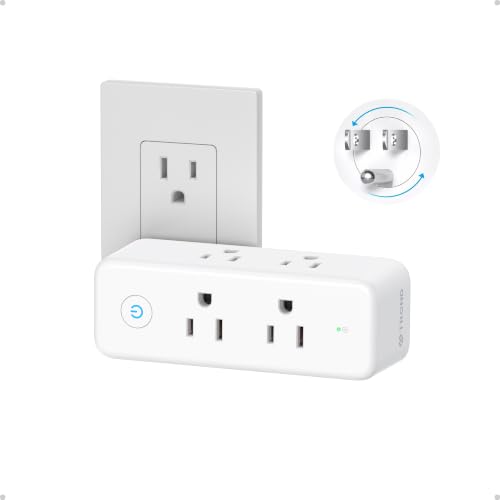
The one that swivels a full 360 degrees so it clears a horizontal outlet and a countertop
Most extenders are built for a vertical wall plate, and they wedge against a countertop when the outlet runs sideways. The TROND solves that with a plug that rotates a full 360° while it is plugged in. On a kitchen counter or behind a low cabinet, you turn it until it clears the surface or the neighboring switch plate. You get six AC outlets, rated 1875W/125V/15A, with a built-in on/off switch to cut power to all six at once — handy if you are leaving for a trip and want nothing live. The 1440J surge rating sits a little below the POWSAF and QINLIANF at 1680J but still gives real protection.
What wins people over here is the tight-space fit. Owners mention it slides into cramped horizontal outlets and handles a coffee pot, a blender, and a Roomba charger from one socket — “works great on my bathroom counter,” as the page reads, where four outlets was all the wall offered. The 3-sided design adds real clearance, too: 1.6 inches between AC sockets means larger adapters do not block each other. The body is 4.96 ounces, small enough to toss in a bag, and the shell is UL94 V-0 flame-retardant PC+ABS.
The catch is stiffer socket contacts. Owners describe having to push hard to seat a plug, and a chunky adapter can nudge the swivel into the counter — “doesn’t fit fat plugs together” is the harshest take. Some owners also find the swivel tight while it is in the wall. None of it is a dealbreaker, but this is the pick where you want to set the swivel correctly first, then push the plugs home. If your outlet is a standard vertical wall plate, the POWSAF’s 20W USB-C port is the better fit.
The right tool for: a horizontal outlet in a kitchen or bathroom where straight extenders scrape the counter.
The honest snag: sockets are tight, so a fat adapter can be a two-handed job.
5. BN-LINK Multi Plug Outlet Extender 2 Pack

Two slim extenders for the cost of one, built to disappear behind a bed
The pitch here is quantity and a thin profile. You get two extenders, each with three AC outlets and three USB ports (one USB-C, two USB-A), so a pair covers two rooms for the cost of a single full-size unit. Each one weighs 0.55 pounds and measures 3.94 x 1.1 inches, narrow enough to sit behind a bed where a full-size power strip would not fit. Owners single out the slim frame as the reason they bought the pack — “I bought this pack because it was slim to fit behind the bed,” as the page sums it up.
The USB situation is basic but workable. The USB-C port charges at up to 5V/2.4A, and the USB-A ports output 5V/2.4A, so a phone tops up without a charging block. A 5V/2.4A port charges a 3000mAh phone in about 2 hours, fast enough for overnight and desk duty. A white plastic stability prong braces the extender against the wall so it does not pull loose — though on some outlets that prong has to be cut off before it will seat. Build quality is what earns the most praise, with value a close second: the 2-pack leans on giving you more units, not more ports per unit.
The honest caveat is the light. If you plug this in near a bed, a blue indicator light stays on, and the night-light versions are noted as too bright for a bedroom and better for a bathroom or hallway. There is also no surge-joule rating listed, so if you are plugging in a laptop or a TV, the 1680J POWSAF or QINLIANF is the safer bet. For bedside phone charging and travel, this pack is the practical pick: three AC and three USB ports, doubled, without the bulk.
Worth grabbing if: you want two small extenders for two spots — bedside and a travel bag — without buying twice.
Think twice if: a dark bedroom matters, since the indicator light stays lit, or you need a published surge rating for expensive gear.
Know the Specs
Surge Protection in Joules
Joules measure how much energy an extender can absorb from a spike before it reaches your devices. A 1440J unit (the TROND) and a 1680J unit (the POWSAF and QINLIANF) both absorb a meaningful surge; the higher number gives you more headroom. This matters for laptops, TVs, and desktops. If you only charge phones, the joule count is a bonus, not the deciding spec.
USB-C Output and Fast Charge
A USB-C port that outputs 20W (the POWSAF) charges a modern phone faster than a 15W port (the TESSAN) or a 5V/3A port (the QINLIANF). A 20W PD port charges a modern phone faster than a 15W or 5V/3A port. Check the wattage on the USB-C port before you buy if phone charging speed matters to you.
Outlet Spacing
AC sockets set 2.1 inches apart (the TESSAN, POWSAF, and QINLIANF) clear bulky adapters better than the standard 1.5-inch gap. The TROND sits at 1.6 inches. Wider spacing is the single most useful spec if you have mixed plugs — laptop bricks and small chargers — sharing one wall plate.
Wall Anchoring
A center screw (the POWSAF and QINLIANF) threads into a duplex outlet and holds the extender in place. A plastic stability prong (the BN-LINK) does the same job and may need trimming on some outlets. Without an anchor, every charger you unplug pulls the extender loose from the wall.
Common Questions
Will an outlet extender work on a GFCI outlet?
Does a 1680J surge rating protect a laptop?
Why does my extender pull out of the wall when I unplug something?
How many devices can these extenders charge at once?
Can I plug two big adapters side by side?
Does the night light on the POWSAF stay on all day?
Is a USB-C port on an extender as fast as my phone charger?
Can I use an outlet extender behind furniture?
Do I need a surge rating if I only charge phones?
What is the difference between the TESSAN and the POWSAF?
The Bottom Line
The winner among the best outlet extenders is the TESSAN Surge Protector Wall Outlet Extender because it fits seven devices — four AC and three USB — into one compact wall plate with the highest owner score of the group. If you want a night light and a faster USB-C port, the POWSAF adds 20W PD and a dusk-to-dawn ring. For outfitting a whole apartment on a budget, the QINLIANF gives you five outlets and four USB ports to buy in multiples. And if your problem is a sideways outlet behind a counter, the swiveling TROND is the one to reach for.
One last nudge: the TESSAN’s 4.5+ stars across a growing base of owners is the highest score on this list, and it costs no more than the models around it. Start there, and step up to the POWSAF only if the night light and 20W USB-C are worth the extra bulk on your wall.
How we choose
We do not accept paid placement. Every pick is matched to a real buyer and a real use-case; we do not hands-on test units.
Sources
Specifications: manufacturer listings and product documentation. Review insights: verified customer reviews, as of October 2026. Pricing: not shown on this page (it changes often); check the current price via the retailer link.
As an Amazon Associate, Aappliancez earns from qualifying purchases. This does not affect which products we feature.