Disclosure: Some links in this post are affiliate links. As an Amazon Associate I earn from qualifying purchases, at no extra cost to you. Learn more
Specs are compiled from manufacturer listings and verified buyer reviews and can change over time — please confirm the key details on the product page before buying.
If you live far from the broadcast towers, the noise you see on screen is not a broken TV — it is an antenna that cannot pull a weak signal out of the air. The picks below are built for exactly that: long-distance, fringe reception where the transmitter is 40, 60 or even 100 miles away and every bit of gain counts.
This guide is built by comparing the manufacturers’ published specifications and the patterns across verified customer reviews, so you get each pick’s real strengths and trade-offs instead of marketing spin.
A snowy screen and a locked-in picture usually come down to three things: gain (how strongly the antenna pulls in weak signals), front-to-back ratio (how well it ignores signals from behind it) and how well it rejects cell and FM interference. Here is what actually works when you need the best outdoor TV antenna for rural areas.
Top Picks

How To Choose The Best Outdoor TV Antenna for Rural Areas
Out in the country, the towers are far away and the signal arrives weak. That single fact drives every decision you make here. The antenna has to squeeze a usable picture out of a faint transmission, and it has to do it without amplifying the noise around it.
Gain and front-to-back ratio beat the mileage claim
Gain, measured in dBi, is how much the antenna boosts a signal before it reaches your TV. A directional design with a high front-to-back ratio (the gap between signal picked up from the front versus the back) focuses on the towers and ignores interference from behind. That ratio is what keeps a distant channel from breaking up.
How far are your transmitters really
Before you buy anything, look up the actual distance and bearing to your local towers. The FCC’s digital TV maps let you enter your address and see the stations and their direction. Aim the antenna at that bearing with a compass, and re-scan channels on the TV after every adjustment.
Filtering and amplification for weak signals
A preamplifier boosts a faint signal at the antenna, before it travels down the coax and loses strength. Built-in FM and LTE/5G filtering cuts interference from nearby cell towers and radio stations. Both features matter more in rural spots, where one strong local interferer can drown out a distant channel you actually want.
Side-by-Side Comparison
| Model | Best For | Max Range | Channels | Directional | Amazon |
|---|---|---|---|---|---|
| Televes DAT BOSS Mix LR 149884★ Best Overall | Fringe reception | 80 miles | 29 | Yes, stacked triple-boom | Amazon |
| GE Outdoor HD Digital TV AntennaBest Value | Budget installs | 80 miles | 200 | Yes, Yagi style | Amazon |
| PIBIDI Outdoor TV Antenna | Long UHF haul | 200 miles | 100 | Yes, extended elements | Amazon |
| Five Star Outdoor HDTV Antenna | Multi-directional use | 200 miles | 100 | No, multi-directional | Amazon |
| Five Star 200 Miles Yagi Antenna | One-tower targeting | 200 miles | 100 | Yes, high-band VHF/UHF | Amazon |
| Televes Ellipse Mix 148883 | Attic or roof | 75 miles | 29 | Yes, triple-boom | Amazon |
Detailed Reviews
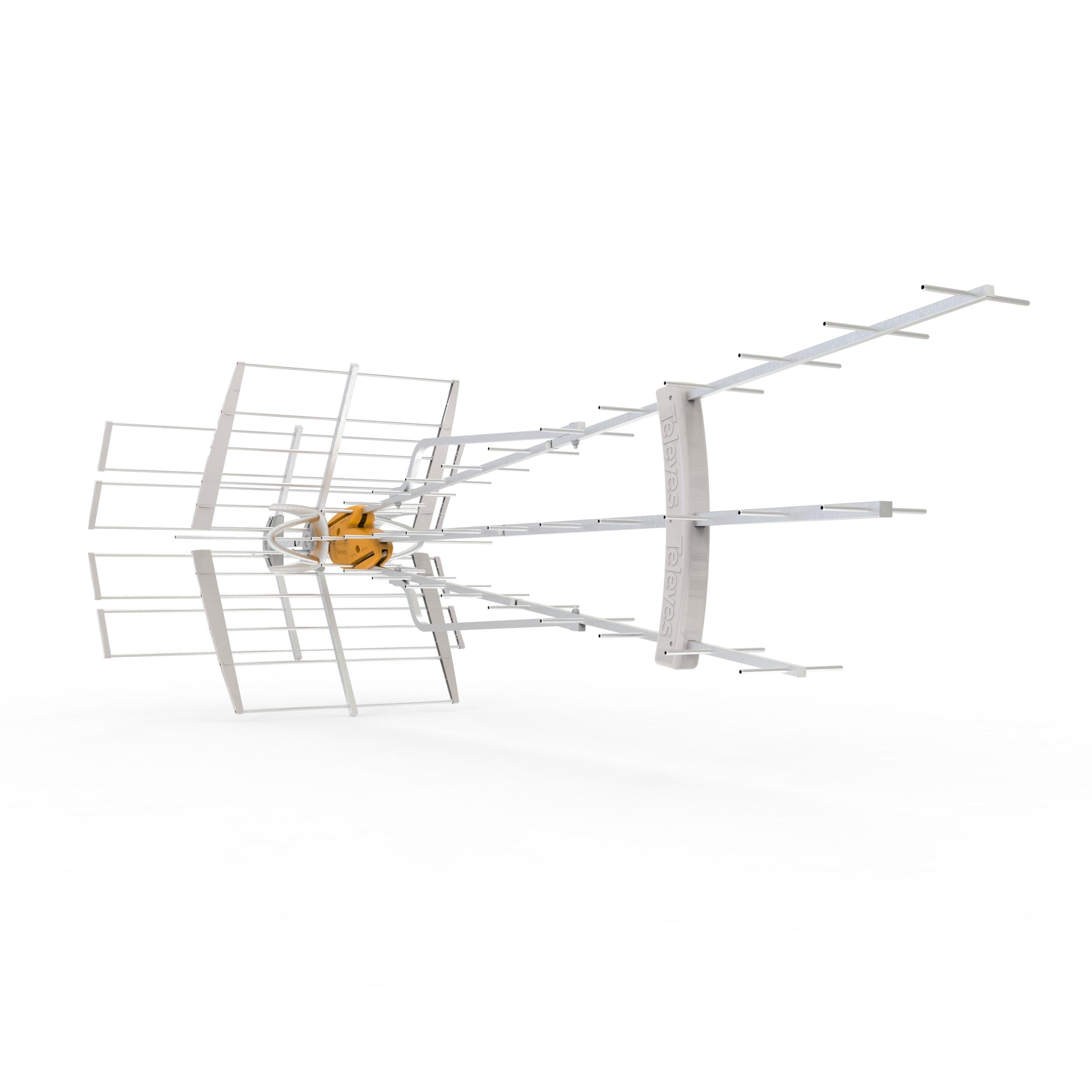
1. Televes DAT BOSS Mix LR 149884 HDTV Antenna
Our pick — 4.5+★ from 450+ verified ratings; the strongest balance of quality and price.
Built for the toughest fringe zones, this antenna boosts weak distant signals by band.
This is the pick for a rural property where the towers are far and the signal is anything but clean. The Televes DAT BOSS Mix LR arrives ready for exactly that fight, with a built-in TForce preamplifier that independently adjusts gain by band: 38 dBi on High VHF and 46 dBi on UHF. In plain terms, those are high gain figures that push a weak transmission up to a level your TV can lock onto, and it does so per band so one can’t swamp the other.
The intelligent gain control is the real story. It monitors signal conditions and corrects automatically, so you avoid both the frozen-picture “too weak” problem and the overloaded “too hot” problem that plagues fixed amplifiers. Toss in built-in FM and LTE/4G/5G filtering and you get clean separation from the cell and radio traffic that crowds the air in the country. The directional stacked triple-boom layout concentrates the reception toward your towers, and the 12 dB High VHF / 25 dB UHF front-to-back ratio is what keeps a distant channel from getting pushed around by interference from the sides.
Compared to the GE over in the budget list, the Televes packs far more raw gain and filtering, though the Geo numbers the other way — the GE lists 200 channels against this antenna’s 29. Buyers consistently call this one the best they’ve ever owned, and it pairs well with Starlink setups for streaming plus over-the-air locals. Assembly is the one honest sticking point: the hardware and directions take patience, and a full install is not a five-minute job.
Where the DAT BOSS earns its keep
- Per-band gain control at 38 dBi High VHF and 46 dBi UHF boosts weak distant channels.
- Front-to-back ratios of 12 dB High VHF and 25 dB UHF cut multipath interference.
- Built-in FM, LTE, 4G and 5G filtering rejects nearby cell and radio noise.
- Keeps passing signal passively if the power supply drops out.
The parts worth knowing about upfront
- Shows a list of 29 channels, well below antennae that list 200.
- Assembly takes care and time; directions are the weakest part of the package.
- A large directional frame that needs a clear aim at your towers.
Best for: rural homes with distant, weak transmitters where signal quality trumps channel count.
The catch: it demands careful aiming and a little patience on the roof.
2. GE Outdoor HD Digital TV Antenna
The budget-friendly Yagi that turns a distant signal into dozens of free stations.
If you want a no-nonsense antenna without a lavish bill, the GE is the one to look at first. It lists a 200-channel capacity and a range of up to 80 miles, which is a huge jump over the Televes above on paper. In practice the Yagi-style design aims at your nearby towers and pulls in high-definition VHF and UHF channels, and it is 4K Ultra HD-ready as well. Buyers routinely report picking up over 100 channels with no pixelation.
What wins people over is raw channel reception — it is what this model is talked about most in reviews. The included weather-resistant mounting bracket, mast clamp and J-mount make a wall, roof or mast install straightforward, and the low profile fits an attic or sits outside out of sight. It is also NextGen TV (ATSC 3.0) compatible, so it is ready for the newer broadcast standard when your area turns it on.
Fit the GE into your plan if your towers are within roughly 40 miles and budget drives the decision. The build quality is a touch lightweight — a few owners find the frame on the flimsy side, and the instructions can take a second read to sort out. But for a very distant tower, you’ll want the higher-gain Televes instead.
Channel haul: 200 listed channels and clear 1080p reception from towers up to 80 miles away.
Honest note: the frame is light, and it deserves a careful mount on a windy roof.
Reach for this if: your transmitters sit within 40 miles and you want a proven, affordable workhorse.
Look elsewhere if: your towers are pushing 80-plus miles — you’ll want more gain.
3. PIBIDI Outdoor TV Antenna

A 200-mile range claim and long elements give this one real reach for the money.
Distance is the headline here: the PIBIDI lists a maximum range of 200 miles, which is a much bigger number than the 80 miles the Televes DAT BOSS and the GE quote. Those long receiving elements are the reason. The specs run VHF 170–230MHz and UHF 470–790MHz, so it covers both bands for 1080p and 4K reception from your local transmitters, and the extended length is built for a more stable, stronger signal on distant stations.
Functionality is what owners praise most here, and it does that job without a lot of fuss. The antenna arrives mostly preassembled, with only a few elements to click together and no tools in the box. It is also lightning-protected and grounding-ready so it can take the weather. One rural buyer reports that replacing a motorized 150-mile unit in a windy Ohio valley 120 miles from the Columbus transmitters led to a stronger picture in bad weather, with no motor to re-adjust after high winds.
Here is the trade-off: the 200-mile figure assumes an optional power signal booster. The 200-mile figure assumes an optional power signal booster that the paperwork mentions but the box does not include. Without it, the same owner got just 28 channels and only 3 of those locked in. Add a booster and the picture strengthens, so budget for that in your plan if you are truly at the far edge of the range.
Best for edge-of-fringe: rural homes where the towers are 100-plus miles out and long elements boost reach.
The clarifying question: will you add the optional booster that the full range claim assumes?
Your move: go for the PIBIDI if you want long-range reach and are ready to add a booster for the last mile.
4. Five Star Outdoor HDTV Antenna

The multi-directional frame that grabs towers from several directions at once.
If your towers are spread around you rather than clustered in one spot, this is the Five Star to consider. It is a multi-directional design, so it pulls from more than one angle without a rotator, and its 40 ft. RG6 coaxial cable is in the box so you can start running coax the day it arrives. It supports 1080p and 4K reception and covers both VHF and UHF, with a range of up to 200 miles on the listing.
On channel count, it delivered for owners: several report 50-plus channels, and one got 72 without an amplifier. Assembly is the part people like — one buyer describes it as “super easy to assemble,” while a cottage owner found that a new included cable brought a great signal where the old chewed cable gave none. The multi-directional layout means you can skip the precise compass aiming that a Yagi needs, which is a real time-saver on a roof.
The honest caveat is the 200-mile range claim. Several owners say it doesn’t actually reach anywhere near the advertised 200 miles, which is the one spot where the specs and reality part ways. On a normal-to-moderate distance install it’s a solid value. Just don’t count on the full 200-mile figure in a deep fringe location — the Televes above is the safer bet there.
What actually works well here
- Multi-directional reception grabs towers from several angles with no rotator.
- Comes with a 40 ft. RG6 coax cable, J-pole and mounting bracket.
- Owners get 50-plus channels, and one got 72 without an amp.
- ATSC 3.0 and 4K-ready for current and newer broadcasts.
Where it falls short of the pitch
- The 200-mile listing outruns what several owners actually receive.
- Built a little delicate; handle the frame with care on install.
- Not the pick to choose for deep-fringe, single-direction reception.
Good fit for: homes with towers spread across a range of directions.
Better to skip if: you have one distant tower and want the strongest possible single-direction pull.
5. Five Star 200 Miles Long Range Yagi Outdoor TV Antenna
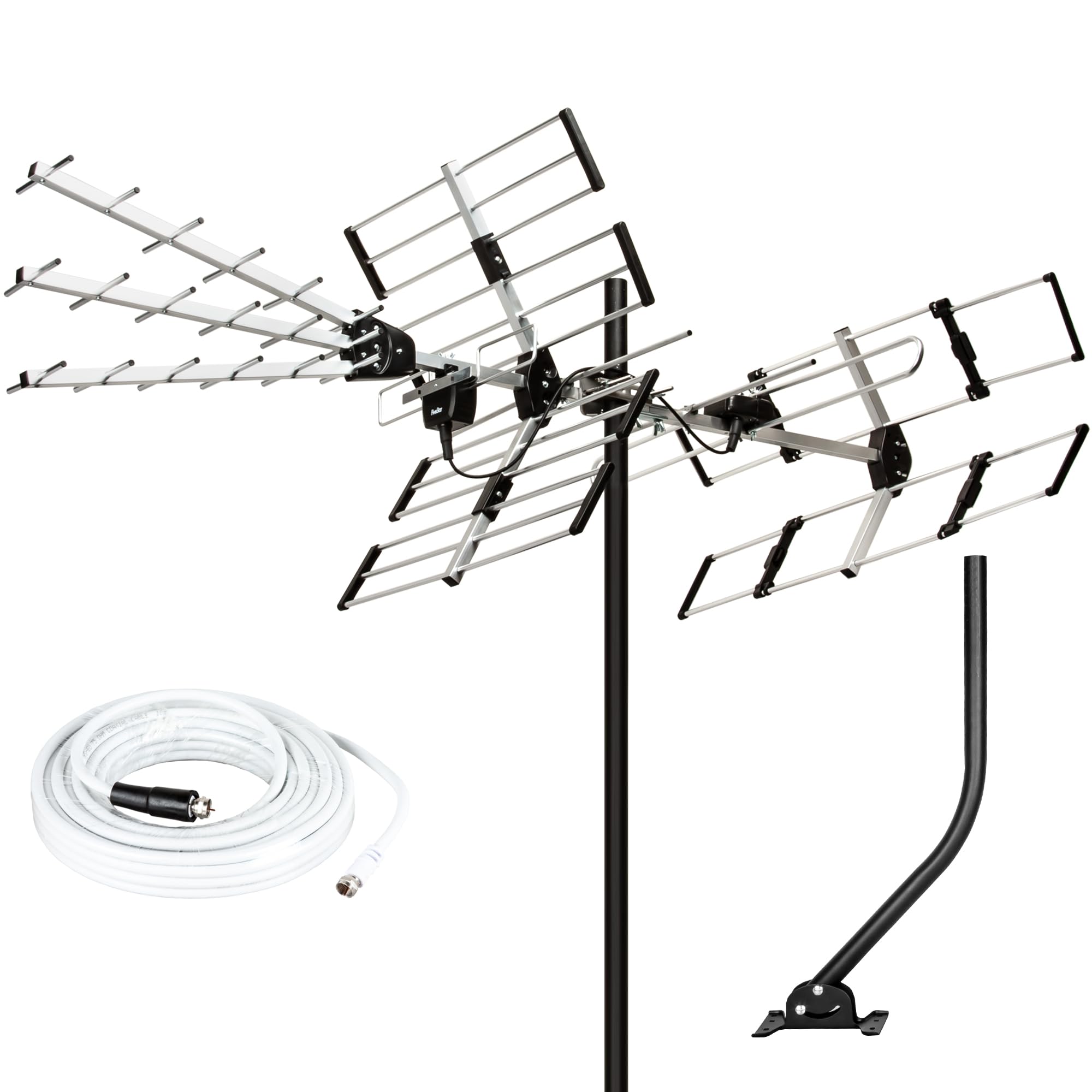
A directional Yagi that snaps together tool-free and targets one tower at a time.
This Five Star Yagi takes the opposite approach to the multi-directional unit just above it. It is a directional design on purpose — it focuses reception hard on one transmitter and suppresses interference from everywhere else. The listing quotes high-band VHF and UHF coverage up to 200 miles, and the multi-element Yagi layout with an upgraded smart chip is built to boost that pull. It is ATSC 3.0 and 4K Ultra HD-ready, so it will keep up with the newer broadcast standard.
The install is where this one separates from the pack: a click-and-lock design snaps together with no tools. A click-and-lock design means the parts snap together with no tools at all, and the folding structure breaks down into a compact footprint for storage or transport. It ships with a 20-inch extra-long J-pole for roof, attic, eave, chimney or mast mounting. Signal quality is the angle owners talk about most, with several noting it picks up a lot of channels and stations up to 65 miles out.
What you should weigh before you commit is that the real-world reception is a split. Some rural buyers find it excellent, while a few feel the long-range figure overpromises — one owner describes it as “not a long range unit” but notes 30-mile stations still come in well. The manual turning mechanism on the mount isn’t great either. It’s a strong choice when your towers sit at moderate distance and you want an easy tool-free build.
Pick this one if: your target tower is within a moderate distance and you want no-tool assembly.
Think twice if: you are genuinely at the far edge and need reach the listing implies.
6. Televes Ellipse Mix 148883 HDTV Antenna
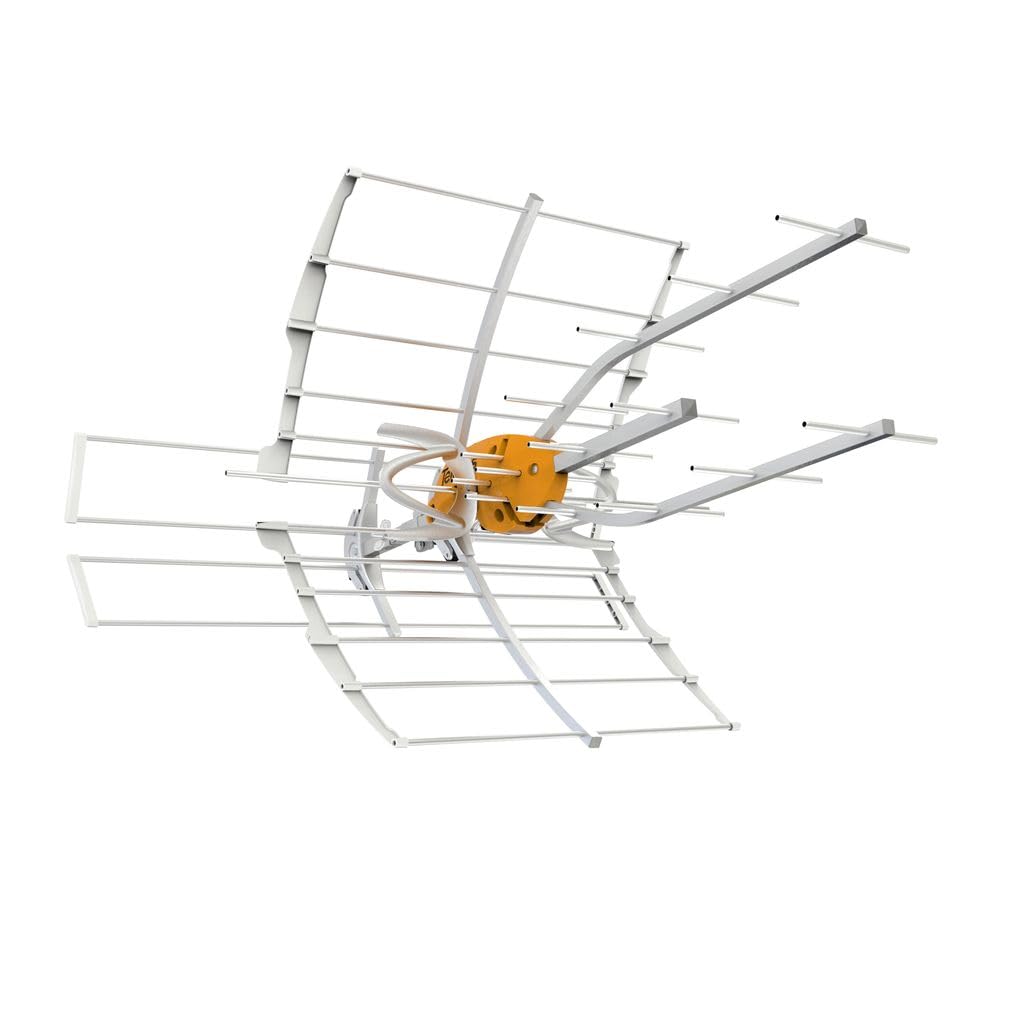
The compact triple-boom that hides in an attic and still locks onto weak signals.
For the rural home where a big rooftop frame is not an option, the Televes Ellipse Mix is the answer. It has a compact 38.8″ x 34″ x 27″ footprint, so it fits an attic, balcony, wall or roof without a monster spread. Inside that frame sits a built-in TForce preamplifier that boosts gain independently by band: 36.5 dBi High VHF and 40 dBi UHF. It’s a little lower than the DAT BOSS above, but on a 75-mile range the trade-off is a much more manageable size.
What makes it worth the premium is the build and the smarts. The intelligent gain control corrects signal on the fly, and the FM, LTE, 4G and 5G filtering cuts outside interference. Corrosion-resistant aluminum elements and stainless hardware take rain, humidity and UV. Owners find it performs better than expected, with one noting it survived a hurricane. Assembly is tool-free and takes well under a minute.
Set your sights here if you want professional-grade reception but can’t afford the footprint of a full Yagi array. The range tops out at 75 miles, so it is not the pick for the deepest fringe. But if your towers land inside 75 miles, it delivers a rock-solid picture in a frame that fits almost anywhere.
Why it earns the premium: 36.5 dBi High VHF and 40 dBi UHF gain in a compact weather-resistant frame.
What you give up: 75 miles of range versus the higher number on the DAT BOSS.
Best for compact installs: attics, balconies and roofs where a compact, weather-tough antenna matters most.
Know the Specs
Raw gain (dBi)
Gain is how much the antenna boosts a signal, measured in dBi. A higher figure means a weak distant channel arrives at your TV strong enough to lock in. Directional designs naturally run higher gain than multi-directional ones. The trade-off is that a high-gain model must be aimed carefully at your towers, while a multi-directional unit trades some gain for forgiving placement.
Front-to-back ratio
This is the gap between signal picked up from the front and interference from behind. A high ratio means the antenna rejects noise coming from the sides and back, so your desired channel arrives clean instead of breaking up into blocks. It’s the number that separates a stable picture on a distant channel from one that drops out every few minutes.
Built-in preamplifier
A preamplifier boosts the faint signal right at the antenna, before it travels down the coax and loses strength. Doing it at the antenna is better than boosting at the TV, because every foot of cable leaks a little signal. Intelligent gain control then keeps the boosted signal at a stable level so it never overloads. A model with a built-in preamp can often skip a separate inline amplifier.
FM, LTE and 5G filtering
Cell towers and FM stations push strong radio waves that can swamp a weak broadcast signal. Built-in filtering cuts those frequencies before they enter the antenna’s output. In a rural spot with one nearby cell mast, that filtering is what keeps a distant channel from being buried under interference. Look for a listing that names LTE, 4G and 5G filtering explicitly.
Common Questions
Will an outdoor TV antenna work if I live 60 miles from the nearest towers?
Do I need a preamplifier or signal booster for rural reception?
Can I install an outdoor antenna in my attic instead of the roof?
How high should I mount my rural outdoor antenna?
Will a splitter weaken the signal from my antenna?
Is a directional antenna better than a multi-directional one for rural areas?
What does ATSC 3.0 mean and do I need it?
Can I use my existing cable TV coaxial cable for an antenna?
How do I aim my antenna at the towers if I’m not sure where they are?
Does the range claim on the box really mean I’ll get those channels?
The Bottom Line
The rural winner is the Televes DAT BOSS Mix LR 149884, because its 38 dBi High VHF and 46 dBi UHF gain plus automatic per-band control keeps a distant signal stable without overload. If your towers sit within roughly 40 miles and budget matters, the GE Outdoor HD Digital TV Antenna is the proven value pick, with a huge channel list. And for a compact attic or balcony install, the Televes Ellipse Mix 148883 hides under a 75-mile range without giving up build quality.
How we choose
We do not accept paid placement. Every pick is matched to a real buyer and a real use-case; we do not hands-on test units.
Sources
Specifications: manufacturer listings and product documentation. Review insights: verified customer reviews, as of October 2026. Pricing: not shown on this page (it changes often); check the current price via the retailer link.
As an Amazon Associate, Aappliancez earns from qualifying purchases. This does not affect which products we feature.