Disclosure: Some links in this post are affiliate links. As an Amazon Associate I earn from qualifying purchases, at no extra cost to you. Learn more
Specs are compiled from manufacturer listings and verified buyer reviews and can change over time — please confirm the key details on the product page before buying.
Winter is where solar path lights usually fall apart. Short days, low sun, frost on the panel — and by January your walkway is a dark strip of dead plastic. The lights that survive are the ones with a genuinely sealed body, a panel that keeps taking a charge through grey weather, and a battery that still has something left at dawn. That is the whole test, and it is what this shortlist is built around.
This guide is built by comparing the manufacturers’ published specifications and the patterns across verified customer reviews, so you get each pick’s real strengths and trade-offs instead of marketing spin.
Below you will find seven sets ranked by how they actually behave in cold, wet, low-sun conditions, from a bright four-pack spot light to a stainless steel walkway set. Every pick here is a legitimate option for outdoor solar lights for winter — the differences come down to how much light you want and how much weather you expect.
Top Picks
How To Choose The Best Outdoor Solar Lights for Winter
Cold weather does three things to a solar light at once. It cuts the hours of usable sunlight, it slows the chemistry inside the battery, and it puts the housing through repeated freeze-and-thaw. A set that looks great in July can be a dead row of stakes by February. Choose on these four points and you cut most of that risk out before you buy.
Water and dust sealing comes first
An IP rating is a two-digit seal score: the first digit covers dust and the second covers water. IP65 means the housing is sealed against dust and against water sprayed from a nozzle. IP67 means it can shrug off brief immersion as well. For a light standing in a snowy bed through a thaw, that second number is the one that keeps the circuit board dry.
Runtime in high mode tells you the honest story
Every set here quotes a long low-mode runtime and a much shorter high-mode one. High mode is the number that matters in winter, because on a short grey day your panel simply will not refill a big tank. A set that claims 6 hours on high will light your path to the door for a full winter evening. A set that only quotes a big low-mode figure is telling you less.
Fixed versus adjustable panels
If the solar panel is moulded into the head, you aim the whole light at the sun and live with wherever the beam lands. If the panel tilts separately, you can point it at the low winter arc while the beam still hits your walkway. It is a small design detail that decides whether the light charges properly from November through February.
Match the light to the job
A spotlight throws a narrow beam at a shrub or a sign. A pathway light spreads a warm pool at ground level. Buying the wrong one for the spot you have in mind is the most common winter disappointment — a narrow spot aimed at a path lights three feet of it, while a wide path light aimed at a tree lights nothing useful.
Side-by-Side Comparison
| Model | Best For | Brightness | Waterproof Rating | Pack Size | Amazon |
|---|---|---|---|---|---|
| GKGG 76 LED Solar Spot Lights★ Best Overall | Bright accent lighting on a budget | 400 lm | IP65 | 4 Pack | Amazon |
| HGGH 60 LED Solar Spot LightsBrightest Output | Maximum brightness and winter weather sealing | 800 lm | IP67 | 4 Pack | Amazon |
| Eyrosa Solar Pathway Lights | Whole-driveway coverage that looks good | 1200 lm | Waterproof | 12 Pack | Amazon |
| DERAYSION Stainless Steel Pathway Lights | Metal and glass construction that ages well | 15 lm | Waterproof | 8 Pack | Amazon |
| Amzarp Solar Garden Lights | Soft dusk-to-dawn glow along a path | 22 Lumen | IP65 | 8 Pack | Amazon |
| RAVICEN Solar Pathway Lights | All-night warm lantern light | — | IP65 | 8 Pack | Amazon |
| 16-Pack Solar Lights Outdoor | Lining a long fence or driveway on a budget | — | IP65 | 16 Pack | Amazon |
Detailed Reviews
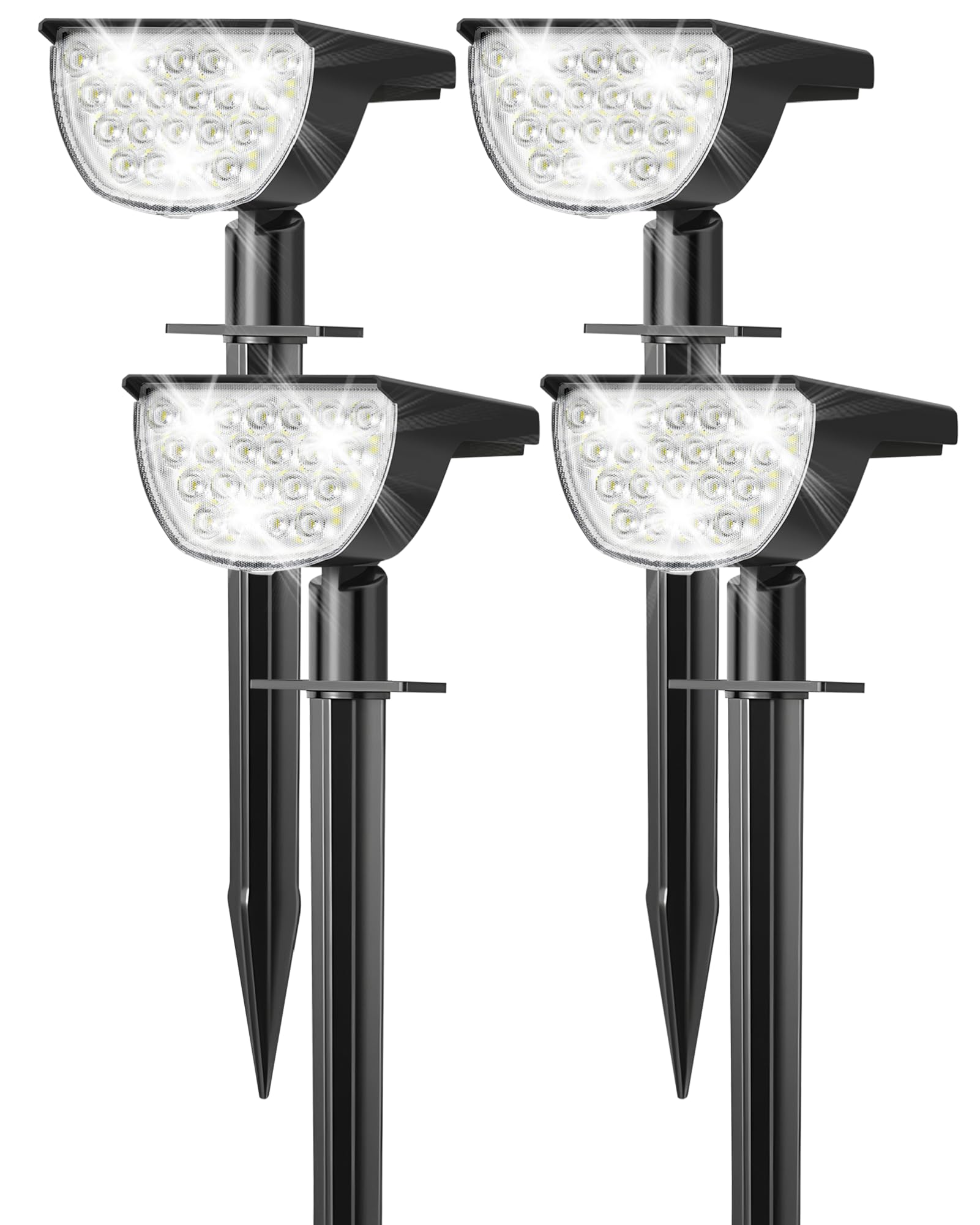
1. GKGG Solar Lights 76 LED 4 Pack
Our pick — 4.5+★ from 1,500+ verified ratings; the strongest balance of quality and price.
A four-pack spot light that still has charge left when the sun has barely shown up.
Here is the thing that makes this set the pick for a cold-climate garden: it was built to keep going after a bad stretch of weather. The housing is sealed to an IP65 rating — dust-tight and protected against water sprayed from any direction — and the manufacturer lists an operating range of -4°F to 140°F. So a hard freeze does not take it off the board. Inside, a shutdown leakage current under 50uA keeps the battery from quietly draining itself while the light sits idle in a dark week.
The numbers are 76 LEDs at 400 lm delivered from a polysilicon panel running 5.5V and 1.1W. You get three modes on a single button: low for 20 hrs, medium for 10 hrs, and high for 6 hrs. That spread matters most in winter, because high mode is what you actually want on a dark evening and 6 hours covers the walk to the door and back. Compare it to the HGGH set below and the trade is clear — the HGGH doubles output to 800 lm and brings an IP67 seal, but runs 6 hrs on high and costs more. If your path needs a bright pool of light rather than a decorative glow, the HGGH wins that argument; if you simply want a lot of light for the money, this one keeps its place.
What wins people over here is how much light you get for the outlay, and the build does not feel flimsy in the hand. One genuine limitation: the solar panel is fixed inside the housing, so you cannot tilt it toward a low winter sun separately from the beam. You aim the whole lamp and hope the angle works for both. In a shaded bed that means careful placement rather than a quick stake-in. A cool white 7500 Kelvin output also reads crisp and blue rather than cosy, which suits a driveway and looks severe against a warm porch light.
What earns it the top spot
- IP65 sealing plus a -4°F to 140°F operating range keeps it working through a freeze
- 76 LEDs at 400 lm give real usable brightness for a garden or driveway
- Three modes spread from 6 hrs on high to 20 hrs on low
- Under 50uA shutdown leakage means the battery is not wasted on standby
- Stake or wall mount from the same box, so it covers two jobs
Where it asks you to compromise
- The solar panel is fixed in the housing, so you cannot angle it at a low winter sun
- Effective reach is short — you need the light close to what you want lit
- Cool white 7500 Kelvin reads cold beside a warm porch lamp
Buy this if: you want a bright, sealed spot light for a path, hedge or fence and you are happy to place it thoughtfully for winter sun.
Think twice if: your garden is shaded most of the day — the fixed panel will leave you hunting for a spot that charges.
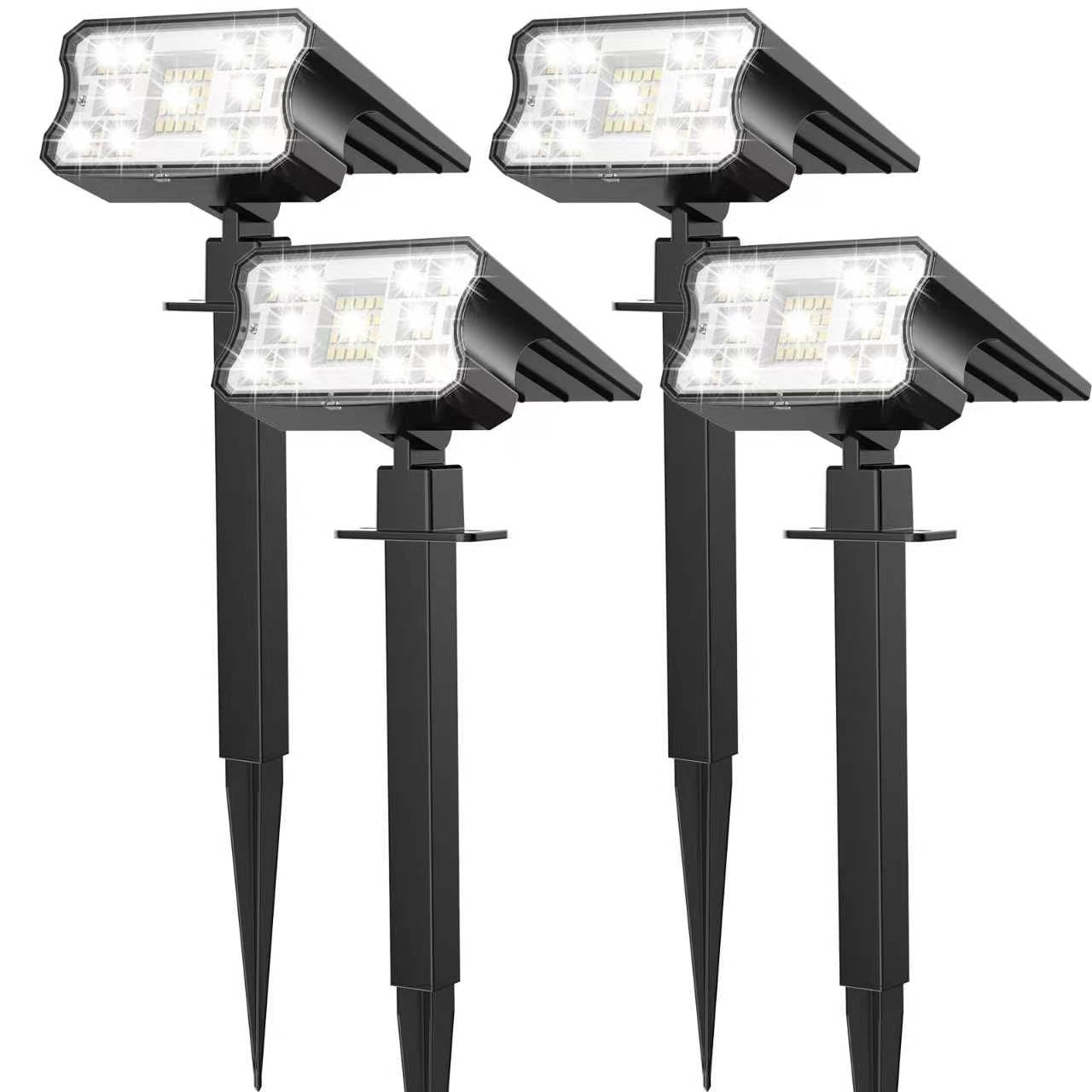
2. HGGH Solar Lights 60 LED 4 Pack
The one that throws double the light of the top pick and survives being buried in snow.
If your winter problem is light rather than budget, start here. Sixty LEDs push 800 lm at an 8500 Kelvin cool white — double the 400 lm of the GKGG above — and that is a visible difference on a dark path. The housing carries an IP67 rating, which is a step past IP65: dust-tight and rated to survive brief immersion. For a stake light sitting in a snowdrift that melts and refreezes, that extra half-step is the whole point. The manufacturer also lists a -4°F to 140°F working range and triple circuit protection.
Runtime runs the other way from the count. You get 9 hrs on high, 13 hrs on medium and 24 hrs on low, charged by 6-8 hours of daylight. Compare that with the GKGG’s 6 hrs on high and 10 on medium and this one holds on longer at a brighter setting — which is the combination that matters when a short winter day has to carry a long winter night. Set to medium, 13 hrs will take you from dusk well past midnight.
The honest caveat is that brightness claims and real winter nights do not always agree. The light is genuinely intense — owners describe an intense white output — but the staying power is uneven in practice, with some nights running to dawn and others cutting out much earlier. That is the nature of solar in low sun, and it is why mode choice is on you: high mode on confidence, medium when the forecast is grey. One owner puts it plainly: “They work sooo good and they last so much time, i just love how it transforms my garden at night.”
The winter case: IP67 sealing, an -4°F to 140°F range and 800 lm from 60 LEDs make this the toughest and brightest set here for genuinely foul weather.
The trade: 9 hrs on high is a shorter high-mode run than some, and a few owners see the lights fade well before dawn after a run of overcast days.
Choose it when: you want the strongest, most weather-sealed beam and you will actually use the medium setting on overcast weeks.
Pass it over if: you need a guaranteed all-night burn — the low mode at 24 hrs is the setting built for that.
3. Eyrosa Solar Pathway Lights 12 Pack

Twelve warm stakes that turn a whole driveway into a lit line without a single wire.
Coverage is the reason this set exists. Twelve stakes at 1200 lm total means you can line a full driveway or the whole front walk rather than dotting four lights around a flowerbed. The 360° clear lampshade throws light in every direction at a 3000 Kelvin warm white, so it reads as a soft golden pool rather than a spotlight. It is the difference between lighting a path and decorating one, and it is the look most people actually want at the front of the house.
Charging matches the season realistically. The polycrystalline panel takes 6-8 hours of daylight and gives back 8-10 hours of glow, and the auto on/off sensor handles dusk and dawn for you. Buyers report the lights still coming on after cloudy days, and appearance is the top praise — a twelve-piece run along a fence or bed visibly lifts the front of a house. Brightness and value run a close second and third in owner feedback.
The catch worth knowing before you commit to twelve of anything: the poles and stakes are ABS plastic, and the transition from a long service life to a frustrating one is often about how those get handled. Treat the stakes gently going into hard or frozen ground and you get years out of them. Frost-heave and heavy boots are what shorten that. The 60 lm-per-stake average also means this is ambience lighting, not security lighting — one of these will not light a face at ten paces.
Why it earns its place
- 12 stakes cover a real driveway rather than a corner of one
- 360° clear lampshade spreads an even warm 3000 Kelvin glow
- 6-8 hours of charge returns 8-10 hours of light
- No switch and no wiring — assemble, stake, done
What to plan around
- ABS poles and stakes need care going into hard or frozen ground
- Warm ambience light, not a bright beam for safety
- Battery fade is the usual end-of-life point on solar path lights
Made for: the front-of-house buyer who wants the whole walkway glowing warm and even, not a hot spot on a hedge.
Not for: anyone who needs to actually see across a dark yard — go for the HGGH above and accept a narrower pool.
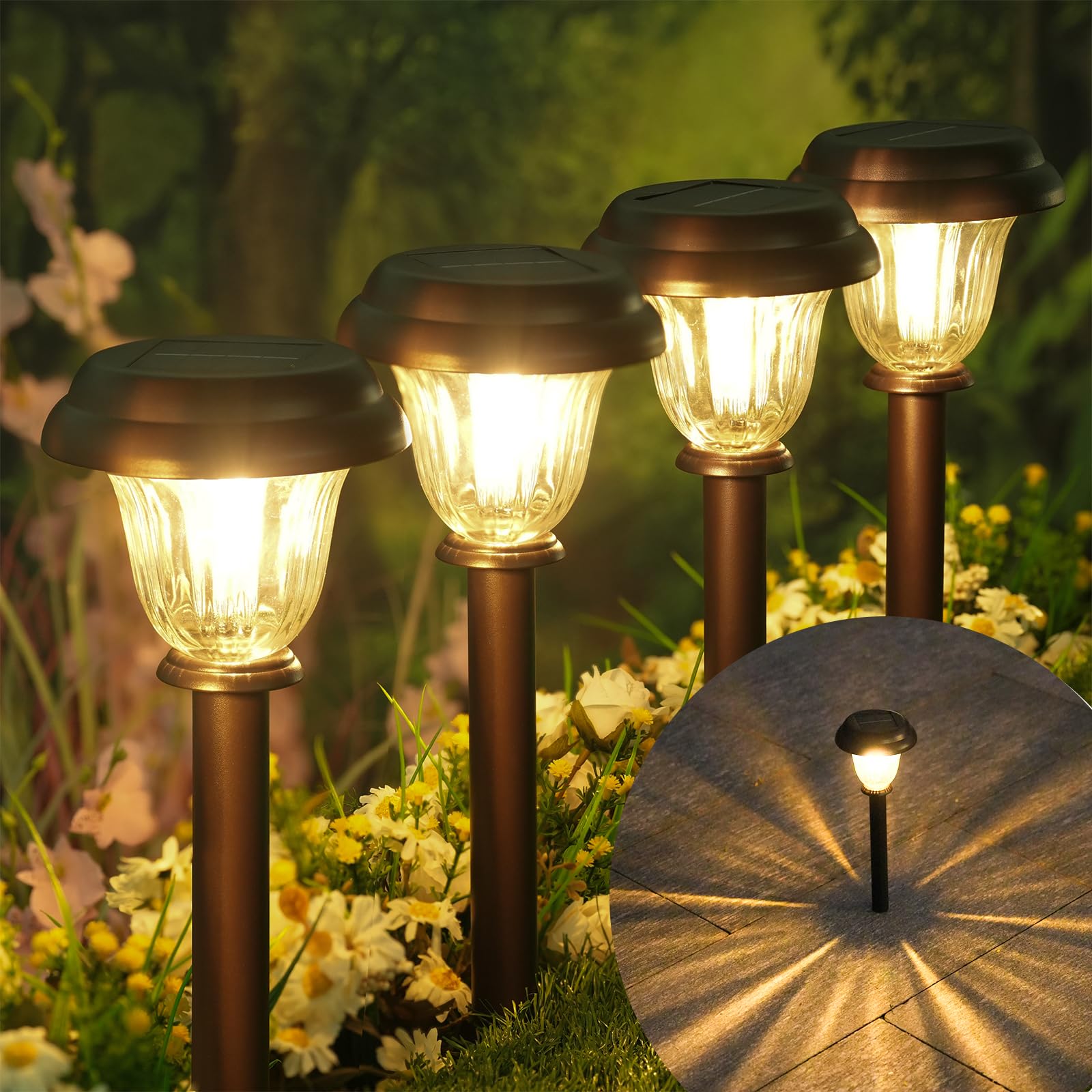
4. DERAYSION Stainless Steel Solar Pathway Lights 8 Pack
Metal and glass instead of plastic, so winter weather has less to crack.
Most solar path lights are ABS plastic, and plastic is what winter punishes — it goes brittle, it crazes, it splits at the joint. This set uses stainless steel and glass, which is why the quality of the build is what owners talk about more than anything else. A 1000mAh battery backs up the higher-quality solar panels, and the manufacturer rates the run at 8-12 hours, up to a full night. On a January evening that is a real claim, not a summer one.
It is also the most decorative set here. The starlight-pattern shade throws a scattered pattern across the ground rather than a flat pool of light, which is a look you either love or find fussy. At a listed 15 lm per light it is firmly ambience, and there is no pretending otherwise — this is the set that makes a garden look considered, not the set that lights a driveway for reversing. The 3000 Kelvin warm white pitch suits a cottage garden, a front bed, or a heritage look where a plastic lantern would stand out badly.
The one honest grievance is the metal tubing, which is thinner than the look suggests. That makes the stakes harder to drive into packed or frozen ground, and the ground spikes below the tubing are on the short side. A rubber mallet and a little patience gets around it; brute force does not. Once staked, they hold up — owners mention this set surviving a storm that strips branches off nearby trees.
Why buyers pick it: stainless steel and glass hold their finish where plastic fades and cracks, and customers note a bright, warm wash that holds up through snow and heavy rain.
The snag: thin tubing and short ground spikes make frozen or compacted soil a wrestling match, and the ambience-level output will not light a wide area.
Reach for these: if you want a garden that still looks smart in February and you care about materials that age honestly.
Look elsewhere: if you are staking into rock-hard winter ground or you need a beam rather than a pattern.
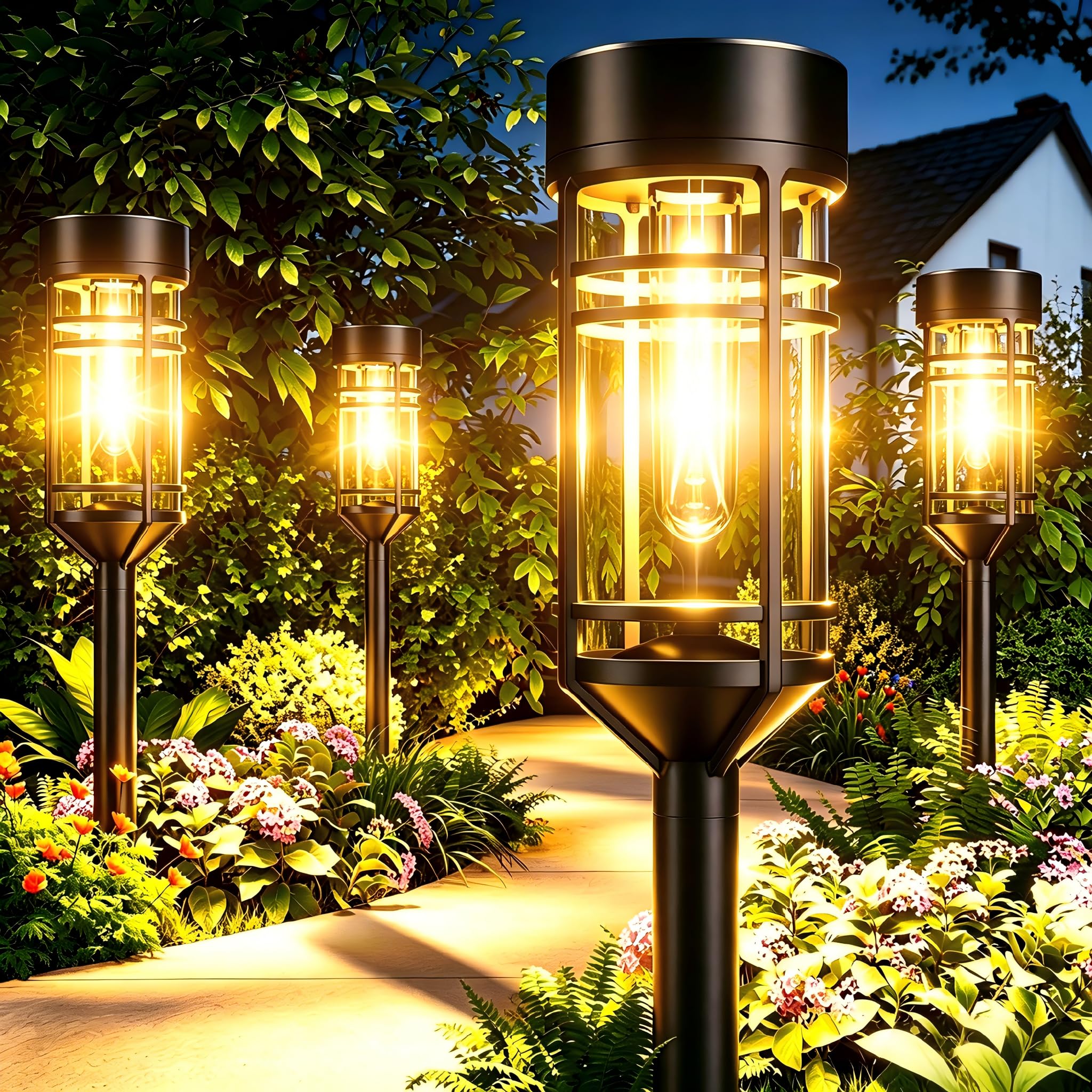
5. RAVICEN Solar Pathway Lights 8 Pack

A modern lantern that gives you the long burn — up to 14 hours of warm white light.
Fourteen hours is the number to hold onto here. That is past the longest winter night in most of the country, which means a full charge on a clear day takes you all the way to dawn without a gap. The manufacturer gets there with advanced solar panels and high-capacity batteries, and pairs it with an IP65 waterproof housing rated to handle rain, snow and frost. The lantern-style head with a filament-effect LED gives it a warm, traditional look that sits well against brick and timber.
Setup is the part that makes it easy to live with. You push the stake into the ground, no wire and no tools, and the built-in light sensor takes over from there — on at dusk, off at dawn, no switch and no maintenance. Owners consistently report charging well through the day and staying lit for most of the night, and the warm glow makes a patio somewhere you would actually sit.
Two things to keep in mind, neither of them fatal. The published spec sheet lists the light source as tungsten and the lighting method as incandescent rather than LED, which is worth knowing if you were expecting pure LED efficiency — the warm look comes from a filament-style source. And like every solar path light here, it lives or dies by where you put it. A shaded spot or a lamp too close to a security light will leave it half-charged. Give it four to six hours of direct sun and it does what the box says.
What you are buying
- Up to 14 hours of warm white light per charge
- IP65 housing rated for rain, snow and frost
- Dusk-to-dawn sensor with no switch and no wiring
- Lantern styling that suits brick, timber and stone
- 8-pack covers a good stretch of walkway
Read before you buy
- Spec sheet lists a tungsten, incandescent-style light source rather than pure LED
- Needs direct sun to hit that 14-hour figure
This is your set: if the goal is a walkway that is still lit when you let the dog out at 4am in January.
skip it if: your planting spot is shaded most of the day — no solar light rewards a dark corner.
6. Amzarp Solar Garden Lights 8 Pack
A soft, glare-free warm light that is easier on the eye than a spotlight beam.
Not everyone wants their garden lit like a car park. This set runs 3000 Kelvin through an upgraded LED plated filament behind a high-transparency cover, tuned for ample brightness without glare. The result is a warm, even wash that flatters plants and stone rather than picking out hard shadows. At 22 Lumen per light it is deliberately modest, and the manufacturer says so — enough for daily use along a path, not enough to flood a lawn.
The charge side is smarter than the price point suggests. Monocrystalline silicon panels with PET lamination are rated at 20+% conversion, and a full 4-8 hour charge returns dusk-to-dawn warm light from a built-in high-capacity battery. The housing is IP65 against rain and dust, ABS shelled with an explosion-proof pole, and the maker states the lamp cover does not yellow or corrode over time. Reviewers point out the shorter spike sets straight with no lean, and the lights still burning at dawn after an evening install.
Reliability is the mixed note, honestly stated. Some units in a set can fail while the rest keep going, which is typical of solar garden lights at this level and worth knowing if you are buying eight. Buy the pack rather than replacing one at a time and the odds work in your favour. The other thing to plan for is placement — the maker warns off shade during the day and streetlights at night, and both will quietly kill your runtime.
What sells it: a 3000 Kelvin warm white output designed to be bright without glare, with a short spike that sets straight and looks properly installed.
What to weigh: 22 Lumen per light is ambience-only, and a failing unit inside a pack is the reliability caveat to accept going in.
Pick it for: a patio or garden bed where you want warmth and softness rather than a hard beam on the shrubs.
Walk on by: if you need real coverage or a security-grade pool of light on a driveway.
7. Solar Lights 16-Pack
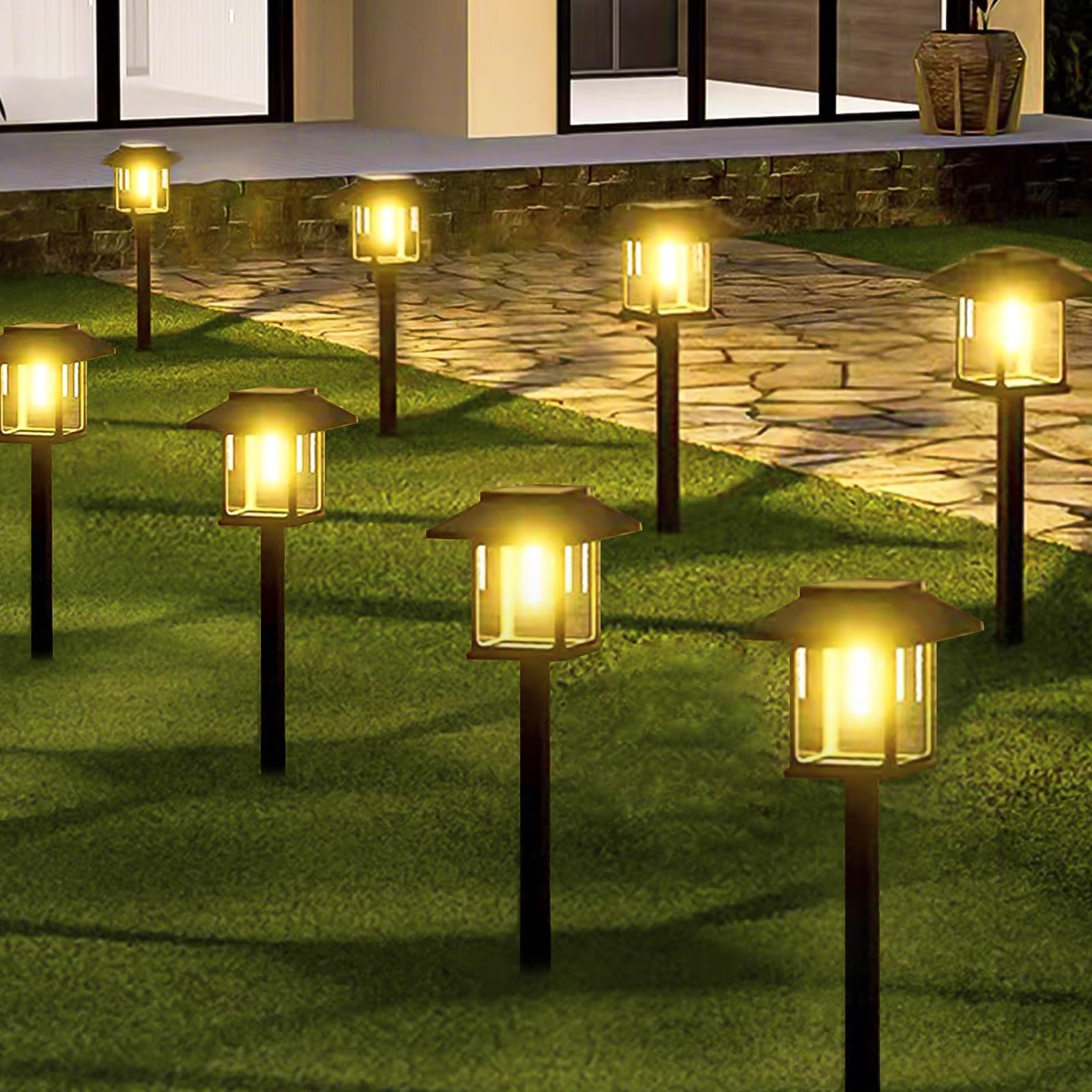
Sixteen stakes in one box — the fastest way to line a long fence line at once.
If your winter job is “light the whole back fence before the clocks change”, this is the set that gets you there in one order. Sixteen stakes is four times the count of the GKGG four-pack at the top of this list, which is why it suits a long driveway, a run of vinyl fence, or a big garden boundary. The stakes press into the ground with no tools and no wiring, and the intelligent light sensor takes over at dusk. Warm white output, powder-coated finish, IP65 waterproof sealing against rain, snow and dust.
The honest part is the build. The posts are plastic, and the maker’s own spec sheet lists no manufacturer warranty — which tells you what level of durability expectation to set. Owners praise the golden glow and the look, and the set is genuinely easy to place along a fence in minutes. But the long-term story on a sixteen-pack like this is a mixed one: some sets hold up, others thin out within a season. That is the real cost of buying volume at this level, and you should buy it knowing that.
There is one more practical note. A switch sits under the top — you twist off the cap and flip it on before the first night, or nothing happens. Owners have been caught by that more than once. Do that during setup, in daylight, before you stake them into frozen ground and lose the chance.
Where it wins: 16 stakes in one order covers a fence line or driveway edge in one go, with push-in install and dusk-to-dawn sensing.
What you accept: plastic posts, no listed manufacturer warranty, and a durability record that varies from set to set.
Best for: a big boundary or long drive where the count matters more than the individual build.
Not the one: for a small front garden or a spot where you want one light to last a decade.
Know the Specs
IP65 and IP67 waterproof ratings
An IP rating is a two-digit seal score: the first digit covers dust and the second covers water. IP65 means a housing sealed against dust and against water sprayed from a nozzle. IP67 goes further and covers brief immersion. In winter, the practical difference shows up when a stake light sits in a snowdrift that melts and refreezes around it — a higher second digit is what keeps the circuit board dry through that cycle.
Lumen output versus runtime
A lumen is a measure of visible light output. More lumens means a brighter light, but brightness and runtime pull against each other on the same battery. A set rated at 400 lm might run 6 hours on its high setting and 20 hours on low, while a 15 lm decorative set can stretch further because it is drawing far less. Winter makes this trade real, because a short grey day cannot refill a big draw overnight.
Battery capacity in mAh
Milliamp-hours, or mAh, measure how much charge a battery can store. A 1000mAh cell holds more than a smaller one, which is what lets a set claim a full night rather than a few hours. The figure is only half the story though — the panel has to put that charge back, and in low winter sun it may take longer than a summer day to top up a high-capacity battery.
Colour temperature in Kelvin
Kelvin describes the colour of the light rather than how bright it is. Around 3000 Kelvin is a warm, golden white that suits gardens and porches. A 7500 Kelvin or 8500 Kelvin output is far cooler and reads crisp and blue, which suits a driveway or a security look. Neither is better — they set a different mood, and mixing them on one path looks unsettled.
Common Questions
Will solar path lights still charge on a cloudy winter day?
Is IP67 worth choosing over IP65 for snowy winters?
How many hours of light should I expect on a winter night?
Why do some solar lights stop working in freezing weather?
Can I leave solar pathway lights out all winter?
Do I need to switch a solar light on before first use?
Will a fixed solar panel struggle in winter?
Is a spotlight or a pathway light better for winter use?
Do solar lights cost anything to run once installed?
The Bottom Line
For most people buying outdoor solar lights for winter, the GKGG 76 LED 4-Pack is the pick that fits — an IP65 sealed housing rated down to -4°F, 400 lm from 76 LEDs, and a three-mode spread that puts 6 hours of real high-mode light on your path. It balances brightness, weather sealing and price better than anything else here. If your winters are genuinely harsh and you want the strongest, most sealed beam, the HGGH IP67 4-Pack doubles output to 800 lm and survives a snowdrift better. And if the goal is a whole driveway glowing warm until dawn, the RAVICEN 8-Pack claims up to 14 hours and is the set built for the longest night of the year.
How we choose
We do not accept paid placement. Every pick is matched to a real buyer and a real use-case; we do not hands-on test units.
Sources
Specifications: manufacturer listings and product documentation. Review insights: verified customer reviews, as of October 2026. Pricing: not shown on this page (it changes often); check the current price via the retailer link.
As an Amazon Associate, Aappliancez earns from qualifying purchases. This does not affect which products we feature.