Disclosure: Some links in this post are affiliate links. As an Amazon Associate I earn from qualifying purchases, at no extra cost to you. Learn more
Specs are compiled from manufacturer listings and verified buyer reviews and can change over time — please confirm the key details on the product page before buying.
If your property sits past the reach of a router — a rural lot, a job site, a barn, a vacation cabin — a camera that leans on WiFi is a paperweight, because the moment the signal drops, so does your recording. The cameras worth buying here run on cellular data or their own local base station, keep footage on a memory card or a built-in drive instead of a monthly cloud bill, and lean on a solar panel so you are not climbing a ladder every few weeks. This guide sorts the strongest current options by how they actually behave once the truck leaves the driveway.
This guide is built by comparing the manufacturers’ published specifications and the patterns across verified customer reviews, so you get each pick’s real strengths and trade-offs instead of marketing spin.
The picks below split into two camps — cellular models that need a data plan, and self-contained kits that store everything locally. The best outdoor security cameras without WiFi keep recording when your router is nowhere in sight.
Top Picks
How To Choose The Best Outdoor Security Cameras Without WiFi
Buying a camera that ignores WiFi sounds backwards until you own one. Once you unplug from the router, three things decide whether the setup works: how the camera gets its signal, how it gets its power, and where the footage lands.
Pick your signal first — cellular or a local base station
A 4G LTE camera carries a pre-installed SIM card and talks straight to a cell tower, so it works on a ranch, a construction site, or a vacation home where no internet line exists. The catch is the data plan. A camera like the GLEEMALL charges for unlimited data after a free trial, and each camera needs its own subscription. The alternative is a base-station kit — the camera talks to a small hub wired to your router, and the hub does the recording. That hub route still needs a router somewhere, but it keeps all your footage in your own house.
Match the power source to your sun and your seasons
Every camera here is battery powered, and most ship with a solar panel to top the battery up during daylight. A detachable panel with a long cable lets you chase the sun even when the camera itself faces shade. If you live somewhere with heavy cloud cover or brutal cold, factor that in: battery performance outdoors is the single most argued-about trait in the review data, and no panel fully fixes a short winter day.
Decide where your recordings live
Local storage is the whole point of skipping the cloud. Some kits hide a built-in drive inside a base station — the ANSQUE packs 32GB that expands to 512GB, and the SOLIOM ships 32GB in its base. Others slot a microSD card up to a set ceiling, usually 128GB or 512GB. Read the fine print, because a few cameras hand you a free cloud trial that quietly converts to a paid plan after it ends.
Know what resolution you actually need
More pixels mean more detail when you zoom in to read a plate or a face. A 2K camera gives you a sharp everyday picture, while a 4K model like the REOLINK doubles the detail and stretches the view wider with a dual-lens setup. Match the number to your goal: clear identification up close, or wide coverage of a big lot.
Side-by-Side Comparison
| Model | Best For | Resolution | Cameras Included | Storage | Amazon |
|---|---|---|---|---|---|
| ANSQUE 4-Cam Solar System★ Best Overall | Full-property coverage with no fees | 2K HD | 4 cameras | 32GB built-in, expandable to 512GB | Amazon |
| GLEEMALL 4G LTE CellularBest for Off-Grid | Off-grid sites with no internet line | 2K color | 2 cameras | microSD up to 128GB | Amazon |
| Septekon 4-Pack Solar Camera | Budget multi-corner coverage | 2K 3MP | 4 cameras | microSD up to 128GB | Amazon |
| GMK 4-Cam System | No-drill indoor and outdoor flexibility | 2K 3MP | 4 cameras | microSD + cloud option | Amazon |
| REOLINK Argus 4 Pro | Wide 4K coverage on a tight budget | 4K 8MP | 1 camera | microSD up to 512GB | Amazon |
| SOLIOM 5MP 4-Cam Kit | Auto-tracking with zero fees | 5MP Ultra HD | 4 cameras | 32GB built-in base | Amazon |
Detailed Reviews
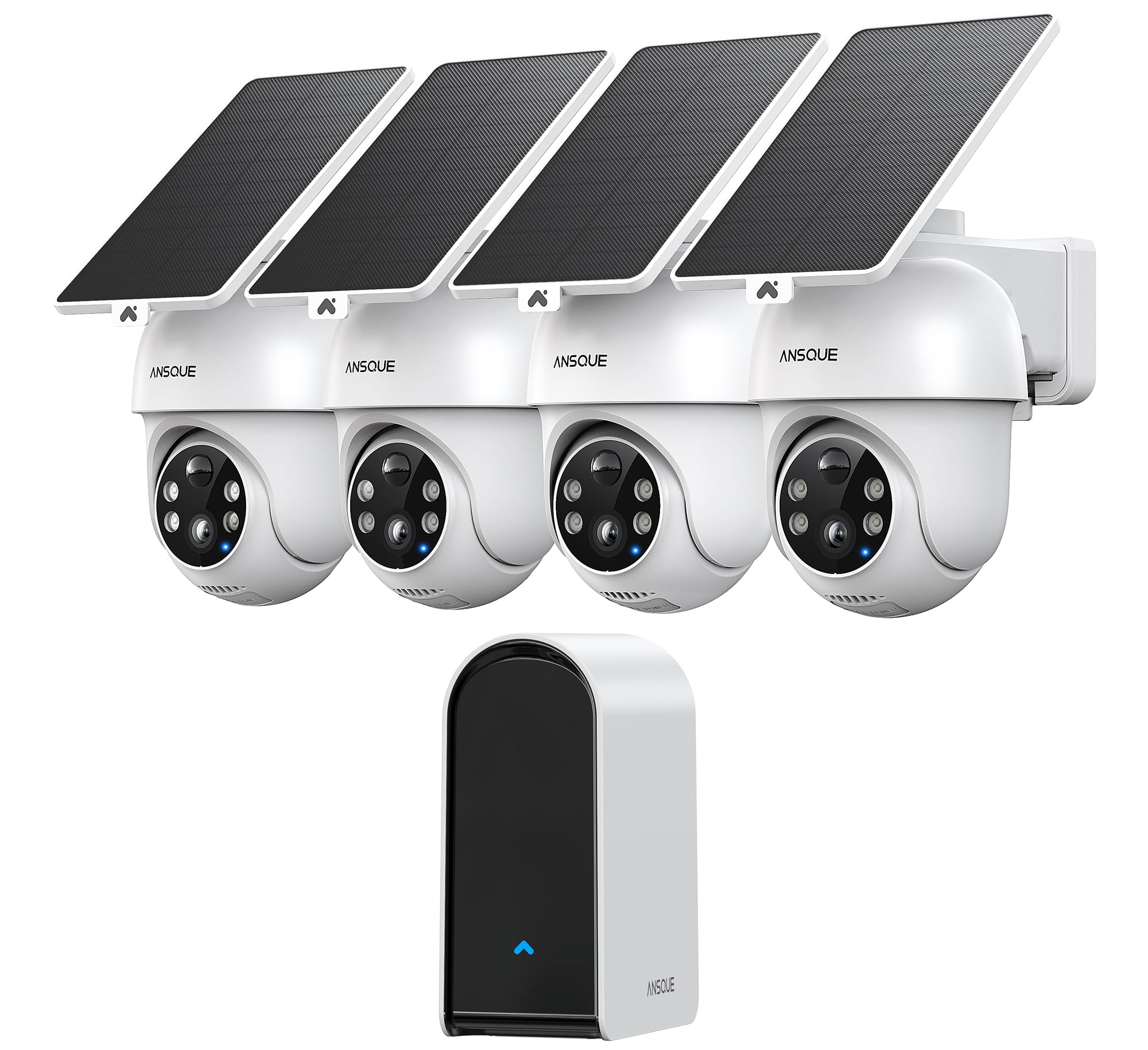
1. ANSQUE Home Security Cameras
Our pick — 4.0+★ from 1,000+ verified ratings; the strongest balance of quality and price.
Four cameras, one base station, and not a single monthly bill in sight.
If you want one system to cover a whole house — driveway, porch, pool, side gate — this four-camera kit does the most work for the least ongoing fuss. Each camera mounts with a detachable solar panel on a 4-hole reinforced bracket, and the package includes everything you need to be running in about five minutes per camera. The 360° panoramic PTZ camera pans and tilts to follow anyone walking through the frame, and AI tracking sends a live view of the movement straight to your phone.
Your recordings stay private and cost nothing to keep: footage lands on a base station with 32GB of built-in storage that expands to 512GB, protected by AES-128 encryption (a scrambling standard that keeps the video unreadable if a unit is swiped off the wall). That all-local setup cuts the recurring cloud fee entirely. For sharp pictures, a 7-layer glass lens captures 2K video, and four LED lights paired to a PIR motion sensor — a passive infrared detector that spots body heat — pick up activity up to 40 ft (12 m) away after dark, so a person crossing your driveway at midnight still shows up. Tap the 8× digital zoom and a license plate or a shipping label enlarges on demand.
What wins people over here is how painless the whole thing feels — the buyer consensus lands heavily on build quality and a setup the app walks you through. The recurring gripe is motion detection, which can be inconsistent, so budget a few minutes to dial in your detection zones and sensitivity. Battery life draws mixed notes too; for most homes the panel keeps things topped up, but a stretch of deep shade will ask more of the battery. At 4.0+ stars, this is the pick to beat.
What works in its favor
- No subscription, no hidden fees, and recordings stored privately on the base
- 360° PTZ camera with AI person-tracking and cross-camera clip linking
- 32GB built-in storage expandable to 512GB, with AES-128 encryption
- Detachable solar panel and bracket put it on the wall in around five minutes
Where it asks a little patience
- Motion detection can miss or misfire until the zones are tuned
- Battery life struggles in constant shade or heavy cloud cover
Best fit: Anyone covering a full property who refuses to pay a monthly cloud bill — the local base storage alone justifies the choice.
Think twice if: Your mounting spots sit in deep permanent shade, where battery charging will lag behind use.
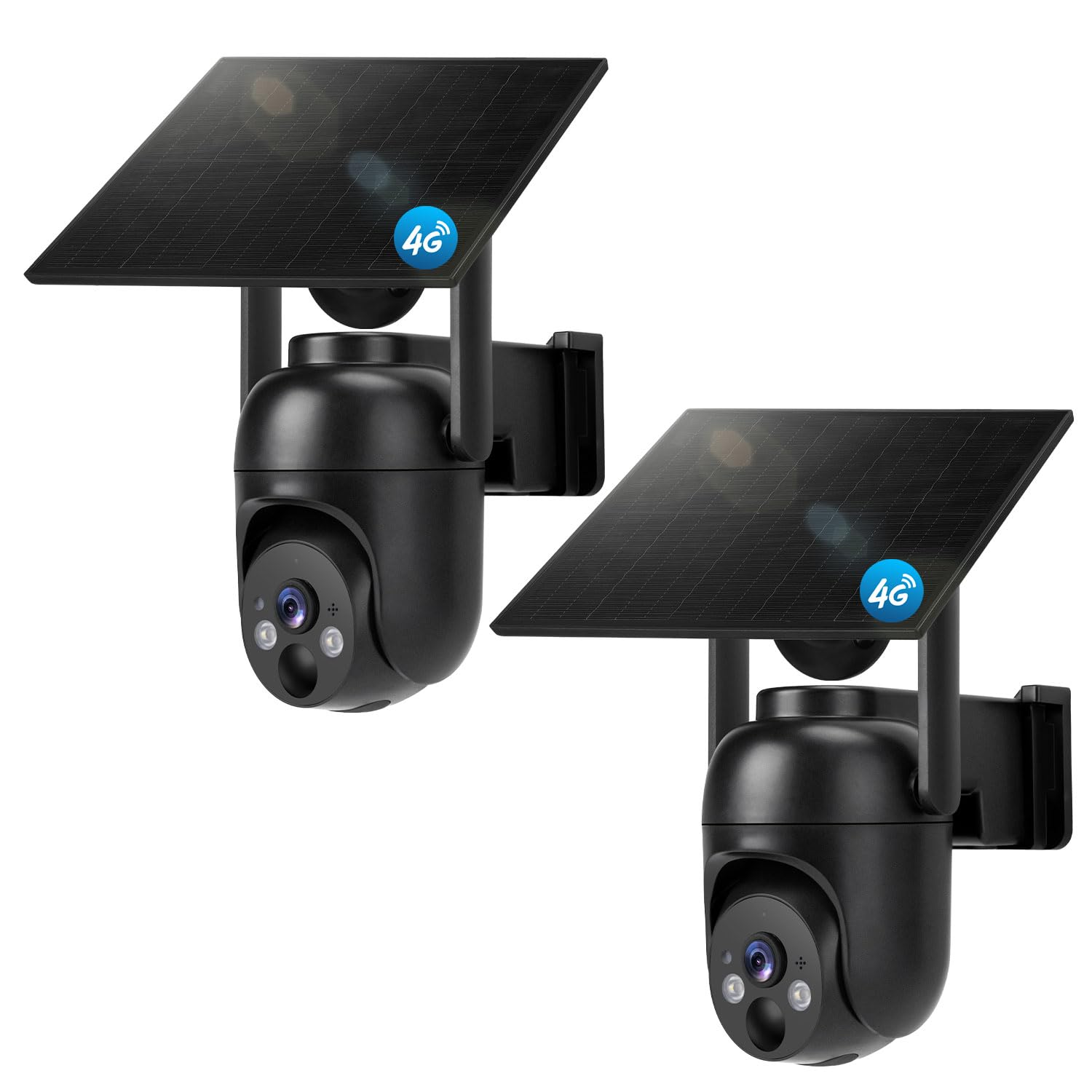
2. 4G LTE Cellular Security Cameras 2 Packs
No router, no wires, no internet line — just a cell tower and a solar panel.
For a ranch, a job site, or a cabin where no internet connection exists at all, this GLEEMALL twin-pack is the true no-WiFi route. Each camera ships with a pre-installed SIM card and a 7-day unlimited data trial, then auto-connects to the strongest U.S. network. When the trial ends, you keep remote access through the UBox app on a data plan — and here is the honest catch: every camera needs its own subscription, so a two-camera setup doubles that line item, and the SIM card itself is non-replaceable.
You should not have to climb a ladder to swap batteries: power comes from a rechargeable battery paired with a 6W solar panel, which together promise year-round operation. The IP65 weatherproof rating (a standard that means rain, dust, heat, and cold are all accounted for) keeps it running through bad weather. On the video side you get 2K color night vision at up to 65 ft, so a face at the far end of your driveway stays visible in the dark. The camera pans 355° and tilts 100° for a 360° sweep — plenty for scanning a wide lot, though note it does not auto-track movement on its own.
The smart PIR sensor fires alerts to your phone the moment a person or animal crosses the frame, and the built-in speaker lets you talk back or trip the siren and white-light alarm. Storage gives you a 30-day free cloud trial plus a microSD slot up to 128GB. There is a real split in the feedback: several buyers report the 4G LTE and solar combo works surprisingly well far off-grid, while others hit connection dropouts and subscription friction. Know the data cost going in and this becomes a dependable remote sentry.
The remote-property angle: This is the pick that does not care whether WiFi exists anywhere near it. The 4G LTE connection and solar power make it the option for construction sites, vacation homes, or any spot a router will never reach.
Budget for the plan: Owners mention a roughly monthly subscription and card-replacement headaches after a 4G plan renewal, so the ongoing data cost belongs in your math from day one.
Reach for this if: Your cameras have to work somewhere the internet simply is not — and you are fine paying for cellular data to make that happen.
Look elsewhere if: You want zero ongoing costs, since each camera here needs its own paid data plan to stay online.
3. Septekon 2K Security Cameras 4 Pack
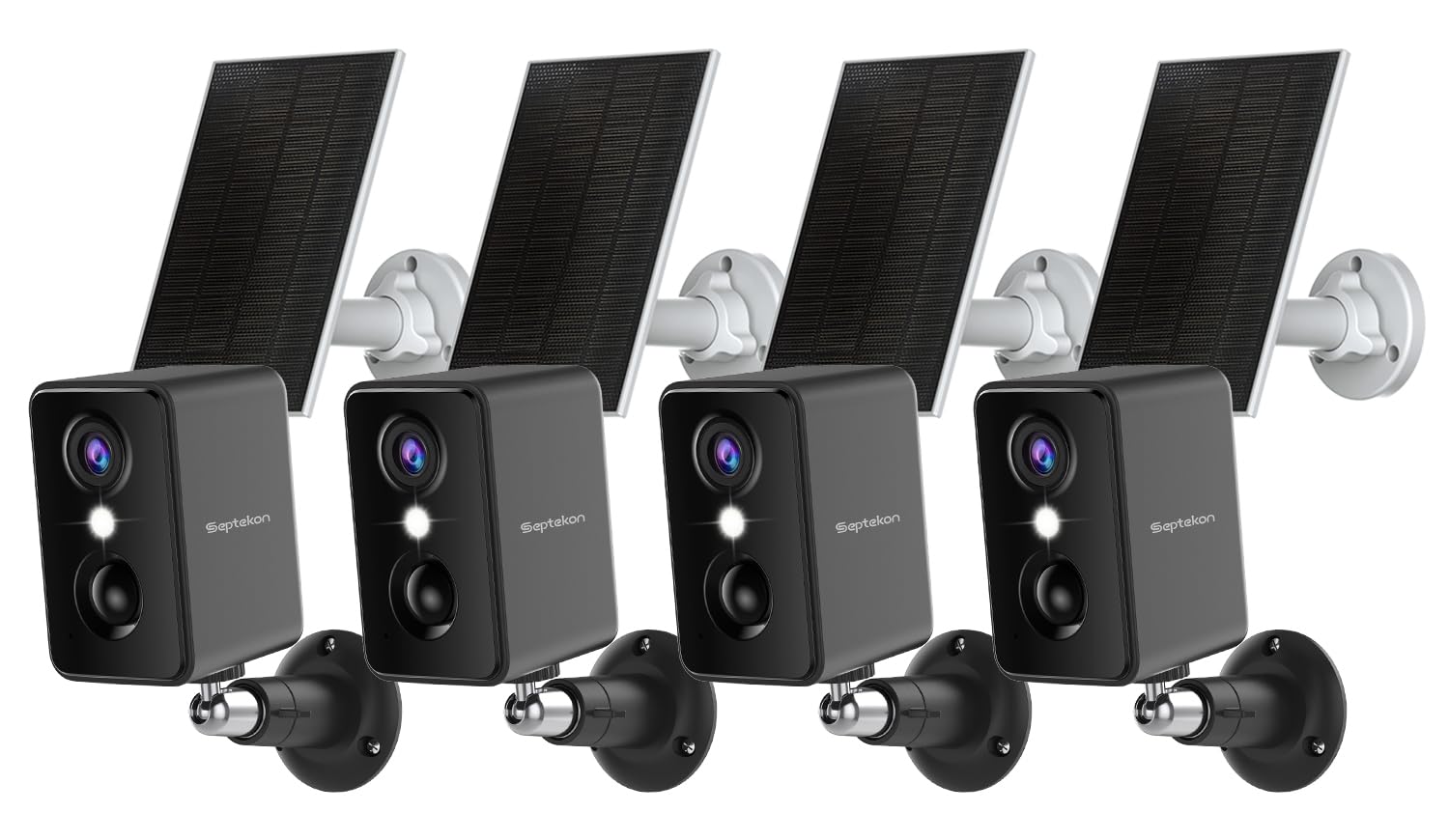
Four cameras, two spotlights each, and a price that lets you blanket every corner.
Covering all four sides of a house usually means choosing between going broke and going partial. This Septekon four-pack is the entry-level answer, and it does not skimp on the basics: full 2K 3MP video, two floodlights plus six IR lights (infrared lamps that light up the scene invisibly) for color images in pitch darkness, and a 5200 mAh battery that a solar panel recharges day and night. AI and PIR detection together sort people, pets, packages, and cars, which cuts down the false alarms that wake a quiet night.
Two-way audio lets you greet a friend at the door or warn off a stranger from your phone, and the feed is protected with AES256 encryption (a stronger scrambling standard) plus cloud or microSD storage up to 128GB. One buyer summed up the appeal plainly: “I am not good with technology at all these were fairly simple to operate easy to mount and the night vision is just as clear as day visionAnd the price you can’t beat the price.” Mount it through an old exterior spotlight housing like one owner did to shield it from harsh sun, and it will happily run a farm’s perimeter.
The honest trade-off here is connectivity — this is the one pick where the signal reliability draws real pushback, with disconnections being the loudest complaint in the feedback. Some also report a camera that stopped charging within the first month, though the warranty replaced it. Motion recording and battery charging each get a mix of good and bad notes. If your WiFi reaches your whole property cleanly, this is a lot of coverage for the money; if the signal is already shaky, look at the base-station picks instead.
The value equation: Quality and video sharpness carry the strongest praise, and for a four-camera system the coverage-per-camera math is the reason budget shoppers land here.
Know your signal: Where the Septekon separates itself from the GMK below is price point; where it falls short is WiFi stability, which several owners fight with dropouts.
Choose it if: You want four corners covered for as little as possible and your WiFi already reaches the far side of the house.
Skip the gamble if: Your property is large enough that connectivity is already a problem — this is the weakest link in the set on that front.
4. GMK 4 Pack Cameras System

Wall mount it or stand it on a shelf — this four-pack is built to move.
Most outdoor cameras punish you the second you want to reposition one. This GMK set does the opposite. Every camera has a stable upright base, so it can sit on any flat surface indoors with no drilling, or bolt to a bracket outside for permanent coverage. That flexibility, plus a rechargeable battery rated for 1–6 months of standby and 3,000+ motion triggers per charge, makes it unusually portable across a property — move a camera from the hallway to the warehouse without rewiring anything. Charging takes 6–8 hours when the battery finally runs down.
The picture is 2K 3MP through a 3.3mm wide-angle lens, with color night vision and infrared modes for after-dark detail. This model also supports a constant plug-in power option alongside the battery, letting you go cord-free in the garden and permanently powered at a busy entryway in the same system. A 110-degree field of view keeps the frame wide without stretching the image.
Motion is handled by PIR detection with AI cloud analysis, firing instant alerts to your phone. You can quiet the whole system with a one-tap privacy sleep mode or schedule it to hibernate while the family is home and wake for late nights and vacation. Family members can be added as view-only users while you keep admin control. The catch worth knowing upfront: this kit is 2.4GHz WiFi only, with no 5GHz support, so a crowded 2.4GHz band may slow things down — a point that shows up in the feedback alongside the need to recharge batteries in heavy-use spots.
Where the coverage shines: Quality and picture clarity are the traits owners lean on hardest, with the wide-angle lens spreading that sharp 2K frame over porches, drives, and yards, plus reliable color night vision and quick two-way talk. With app, the whole four-camera set runs from one dashboard.
The 2.4GHz reality: Unlike the SOLIOM’s dual-band base below, this one lives entirely on 2.4GHz, so a cluttered band can bottleneck your live view.
Pick this for: Renters or anyone who wants no-drill indoor placement plus outdoor coverage from the same cameras, without running cables.
Pass it over if: You need a second Wi-Fi band to keep all four feeds smooth on a busy network.
5. REOLINK Argus 4 Pro
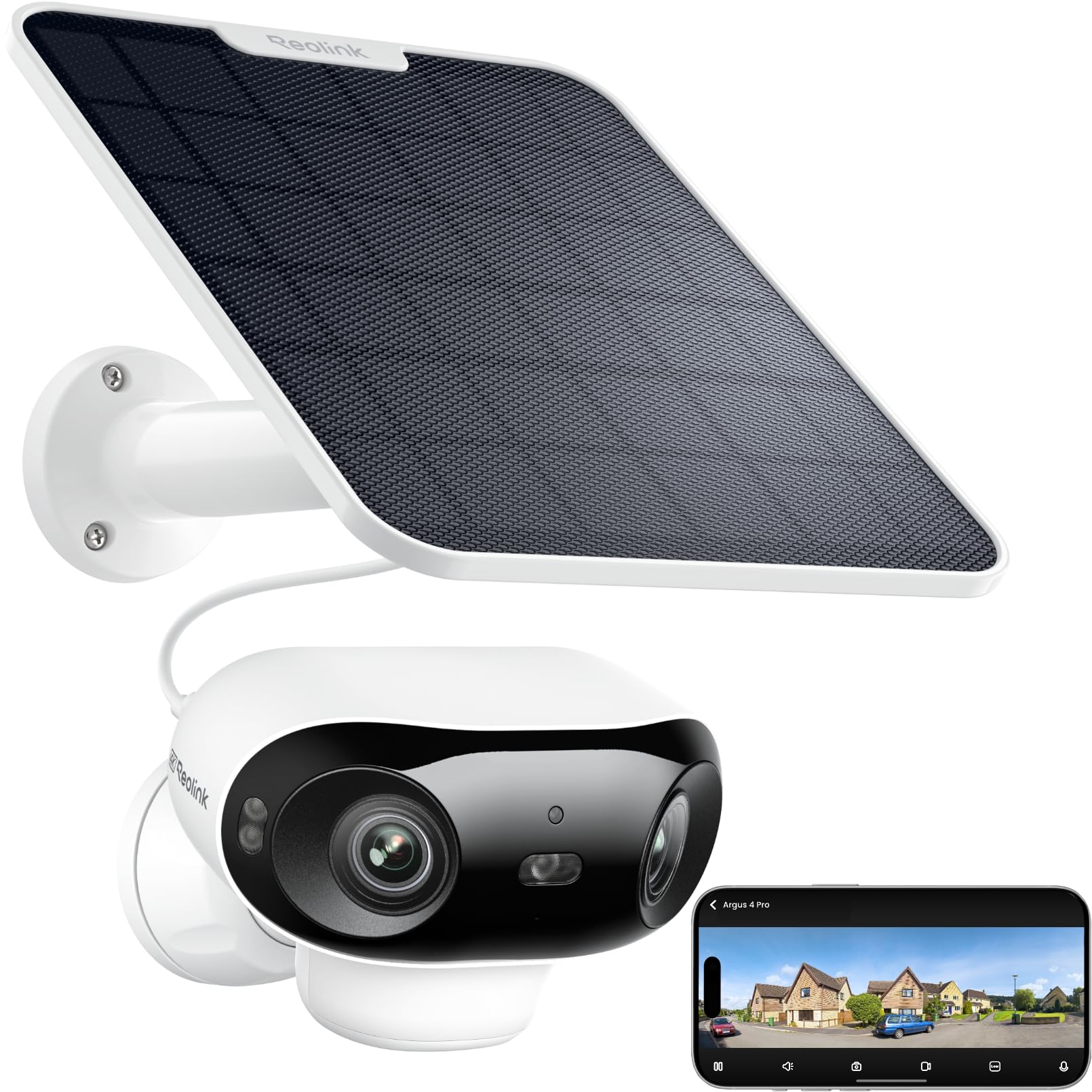
Two lenses stitched into one 180-degree window on your whole yard.
If detail is the whole point, this REOLINK single camera out-resolves everything else on this list. Its dual lenses stitch into a smooth 4K 8MP perspective covering 180 degrees, so one unit watches a span that would normally take two or three to cover without blind spots. Add ColorX full-color night vision — delivered through an F/1.0 aperture and a 1/1.8 sensor (a wide lens opening and a large image sensor that together pull in far more light than a standard lens) — and the after-dark picture stays usable without leaning on spotlights or infrared.
The detection is genuinely smart, sorting people, vehicles, and pets from everyday motion so you are not pinging on every passing cat. Power comes from a 16.2-watt-hour battery topped up by an included solar panel, and storage is fully local: a microSD card up to 512GB or a Reolink Home Hub that takes up to two 1TB cards, with RTSP and NAS support (streaming and network-drive standards that let you record to your own hardware) once paired to a hub. That means no mandatory cloud account.
Here is the real caution, and it matters more here than anywhere else in this article. The feedback runs sharply two ways: some owners describe flawless setups with excellent motion detection at distance, while others report the camera dropping its WiFi signal around 40–50 ft and a few units failing within the first week. Wired PoE is praised as rock-solid while WiFi is the weak spot, so mount it close to a strong access point. At 3.5+ stars this is the lowest-rated pick of the group — a lot of camera, but the connection is the thing to babysit.
Why it earns its spot
- 4K 8MP dual-lens covers 180° in one smooth frame
- ColorX full-color night vision with an F/1.0 aperture and 1/1.8 sensor
- Smart human, vehicle, and animal detection
- Local storage up to 512GB microSD or a Home Hub with 2x1TB
Where it can disappoint
- WiFi signal weakens notably beyond roughly 40–50 ft
- Some units reported failing within a week; wired PoE is the more praised route
- Only one camera in the box
Ideal for: Buyers who prize the sharpest possible day-and-night image and a wide field of view, and can mount the camera near a strong signal.
Look past it if: You need multi-camera coverage from the start or your mounting spot sits far from your access point.
6. SOLIOM 5MP Security Cameras 4-Cam Kit

Four cameras that rotate to follow movement across your whole property.
This is the pick for a large lot where a fixed lens keeps losing the action. Every camera in the SOLIOM four-cam kit pans, tilts, and rotates through a full 360°, and with one Soliom Base wired to your router, the cameras work together to hand off tracking between zones as someone walks the perimeter. Add the Magnifier Zoom — tap the screen to enlarge a spot and follow the detail as it moves, out to 30 ft — and reading a face or a plate is a tap away. The 5MP sensor delivers crisp video day and night.
Storage is the reason to love this one: the Soliom Base holds 32GB built in, encrypted so footage cannot be pulled off it even if a camera goes missing, and there is no subscription and no hidden cost. Power comes from detachable solar panels with a 10 ft cable for flexible placement, and the dual-band 2.4G and 5G WiFi connection means the system grabs the cleaner band automatically. Setup is as simple as plugging the base into your router with the included Ethernet cable and powering it on — the cameras come pre-paired.
Watch for two things. Live view is capped at 15 minutes per session, and recordings run in fixed 20-or-60-second clips, so you review events in chunks rather than one continuous stream. Alerts also open to the home screen rather than the live feed, and the motion sensor picks up bugs at night — a small price for the tracking. Customers note the SOLIOM running flawlessly for about a year with the batteries still holding charge.
Tracking that closes the gap: What separates the SOLIOM from the ANSQUE above is the cross-camera handoff — multiple units coordinate to follow one subject across separate areas, a step beyond single-camera tracking.
Mind the clip limits: A 15-minute live-view ceiling and fixed 20-or-60-second recordings mean you trade continuous footage for fee-free local storage.
Made for: Big properties with multiple zones where you want the cameras to track movement from one area to the next, with no recurring bill.
Not the one if: You need to watch long uninterrupted live sessions or record continuous video over extended stretches.
Know the Specs
Resolution: 2K, 5MP, and 4K explained
Resolution is the number of pixels in the picture, and more of them mean a sharper zoom when you are trying to identify a face or read a plate. A 2K camera is the everyday standard and plenty for most yards. 5MP pushes a bit more detail than 2K. 4K 8MP, the REOLINK’s spec, is the highest here and stretches a wider view without losing clarity. Pick based on if you need broad coverage or fine identification.
Weatherproof ratings: IP65, IP66, and IP67
The “IP” number tells you how well a camera keeps out dust and water. The first digit covers dust, the second covers water. An IP65 rating handles rain and dust comfortably, IP66 adds resistance to stronger water jets, and IP67 survives brief immersion. For a camera mounted under an eave in a wet climate, an IP66 or higher rating gives you more margin against driving rain and runoff.
Local storage versus cloud subscription
Cameras that store footage locally write video to a microSD card or a built-in base station instead of a remote server. That is what lets a kit like the ANSQUE or SOLIOM skip a monthly fee, since your recordings never leave your property. Cloud storage adds off-site backup but usually comes with a recurring charge once a free trial ends. If avoiding fees is the goal, check whether any included cloud trial converts to a paid plan.
Solar power and battery behavior outdoors
Each camera here runs on a rechargeable battery, and a solar panel tops it up during daylight. How much charge you can count on depends on how much sun your mounting spot sees — a panel on a shaded wall produces far less than one on a sunny roof. Expect longer battery life in summer and shorter in heavy overcast or cold. Detachable panels with long cables give you the most freedom to chase the sun.
Common Questions
Do these cameras work if I have no internet at all?
How much does a cellular camera plan cost each month?
Will these cameras record at night in full color?
Do I need a subscription to view my recordings?
What does IP65 or IP66 actually protect against?
How long do the batteries last before I need to charge them?
Can these cameras share footage with my family?
Will one camera cover a large yard or do I need several?
Does WiFi range limit these cameras even without a router involved?
What do I need to set up a no-WiFi camera system on a remote property?
Are the recordings private if the camera is stolen?
The Bottom Line
For most people, the standout best outdoor security cameras without wifi choice is the ANSQUE 4-Cam System, because it bundles four cameras, private 32GB local storage, and a truly subscription-free setup into one kit — the one to grab if you want full coverage without a monthly bill. If your property has no internet line at all, the GLEEMALL 4G LTE twin-pack runs purely on a cell signal with no router needed. And if you want cameras that chase movement across a large lot, the SOLIOM 5MP Kit and its 360° auto-tracking are the ones to reach for. Whichever you choose, make sure the storage model and power source line up with your sun and your signal before you mount a single bracket.
How we choose
We do not accept paid placement. Every pick is matched to a real buyer and a real use-case; we do not hands-on test units.
Sources
Specifications: manufacturer listings and product documentation. Review insights: verified customer reviews, as of October 2026. Pricing: not shown on this page (it changes often); check the current price via the retailer link.
As an Amazon Associate, Aappliancez earns from qualifying purchases. This does not affect which products we feature.