Disclosure: Some links in this post are affiliate links. As an Amazon Associate I earn from qualifying purchases, at no extra cost to you. Learn more
Specs are compiled from manufacturer listings and verified buyer reviews and can change over time — please confirm the key details on the product page before buying.
Pick the wrong shed paint and you will be back on the ladder within a season, scraping flakes off damp boards. The right one depends on one thing: what your shed is actually made of. A timber shed needs a coating that flexes with the wood as it swells and dries. A concrete or block shed needs something that seals water out rather than sitting on top of it. Match the coating to the wall material and the finish will hold through a wet winter.
This guide is built by comparing the manufacturers’ published specifications and the patterns across verified customer reviews, so you get each pick’s real strengths and trade-offs instead of marketing spin.
Below you will find the coverage figures, dry times and finish types that decide how a shed coat behaves through a wet winter, so you can choose the Best Outdoor Paint for Shed without wasting a weekend on the wrong can.
Top Picks


How To Choose The Best Outdoor Paint for Shed
Start with the material under the brush, not the colour on the lid. A shed is a small building with more exposed edges than a house wall, so every joint, sill and board end takes the weather first. The paint has to move with those boards or seal against that block.
Match the coating to timber or masonry
Timber cladding, feather-edge boards and fence panels want a latex or acrylic barn paint designed to flex. Masonry, block and rendered walls want a waterproofing coating that soaks in and blocks water movement instead of forming a skin. Using a timber paint on damp block, or a waterproofer on a wooden shed, is the most common reason a shed repaint fails inside a year.
Check the coverage figure against your shed’s square footage
Coverage tells you how far one can stretches. A can rated at 400 sq ft per gallon will cover a small shed’s walls in a single pass. A can rated at 250 sq ft may need a second gallon for the same building. Always buy for two coats, because almost every shed coating performs better with a second pass over bare or weathered boards.
Respect the temperature window
Most exterior paints need the surface and the air to sit above a stated minimum before they will cure. Some formulations allow application down to 35 degrees Fahrenheit, while others state 50 degrees. Painting below the stated range is how you end up with a tacky film that never hardens properly.
Side-by-Side Comparison
| Model | Best For | Coverage | Finish | Dry / Cure Time | Amazon |
|---|---|---|---|---|---|
| INSL-X WaterBlock Acrylic Masonry Waterproofer★ Best Overall | Damp concrete and block sheds | 75 to 125 sq ft per gallon | Semi-Gloss | — | Amazon |
| INSL-X Tough Shield Floor and Patio PaintToughest Finish | Shed floors and thresholds | 350 to 450 sq ft per gallon | Satin | 24 hours dry / 1 hour full cure | Amazon |
| Majic Paints Latex Flat Barn & Fence Paint | Budget black boarding | 250 sq ft per gallon | Matte | 0.5 hours dry / 4 hours full cure | Amazon |
| Glidden Total Exterior Paint & Primer | One-coat colour change | Up to 400 sq ft | Semi-Gloss | 4 hours full cure | Amazon |
| Valspar Barn & Fence Latex Paint, White | Large white timber walls | 400 sq ft per gallon | Matte | 1 hour dry | Amazon |
| EVOLVE Barn & Fence Paint, Flat Black | High-contact boards and fences | 300-400 sq ft per gallon | Flat | — | Amazon |
| Diamond Brite Oil-Based Enamel | Metal and hard-wearing trim | 300 sq ft per gallon | High-Gloss | 24 hours full cure | Amazon |
Detailed Reviews
1. INSL-X WaterBlock Acrylic Masonry Waterproofer Paint, 1 Gallon
Our pick — 4.5+★ from 300+ verified ratings; the strongest balance of quality and price.
For a concrete or block shed that weeps after rain, this is the coating that keeps the inside dry.
Most sheds that go damp are not timber sheds at all — they are rendered block or concrete, and the water walks straight through the wall rather than sitting on it. That is the problem this INSL-X can is built for. It is a water-based coating for sealing vertical interior and exterior concrete walls, and it handles masonry, cinder blocks, stucco and brick rather than timber.
The number that decides its job is coverage: 75 to 125 square feet per gallon. That is a small figure next to the INSL-X Tough Shield below, which spreads across 350 to 450 square feet per gallon — a waterproofer soaks in and builds a barrier, so it does not stretch like a surface paint. It also stands up to 12 psi hydrostatic pressure, which is the push of water sitting against a wall from the soil outside. Practically speaking, it can hold back real groundwater rather than just damp air. High alkali resistance up to pH-13 matters for fresh concrete and block, which stay chemically aggressive long after they look dry.
Buyers report it sealing leaks that popular brands failed to stop. As buyers put it: “This stuff worked where the popular brands failed.” The main caveat is preparation and temperature. The surface and the air both need to sit between 50 and 90 degrees Fahrenheit, and it needs to go on in two coats rather than one to be reliable. It is not a cosmetic paint either — it is a white sealer for stopping water, not a colour change for bare boards.
What it genuinely solves
- Seals damp block and concrete walls rather than just covering them
- Withstands up to 12 psi hydrostatic pressure from soil-side water
- High alkali resistance up to pH-13 for fresh masonry
- Rolls on over cinder block, stucco and brick
Where it stops short
- Only 75 to 125 square feet per gallon, so larger sheds need several cans
- Needs surface and air between 50 and 90 degrees Fahrenheit
- Won’t fix a heavy footer leak or a structural foundation problem
Right for you: a block, brick or rendered shed with visible damp patches or water tracking on the inside wall.
Look elsewhere: if your shed is timber boarded — this sealer is built for masonry, so a latex barn paint suits those walls better.
2. INSL-X Tough Shield Floor and Patio Paint, 1 Gallon
The shed floor is the part everyone forgets, and this is the can built to take the boots and the shovels.
Quantities alone set this one apart. One can stretches across 350 to 450 square feet, against 75 to 125 square feet from the WaterBlock above — roughly a four-and-a-half-fold spread advantage per gallon. On a standard shed floor that difference decides whether you buy one can or three. The finish is a waterborne acrylic enamel with a satin surface, and the maker lists resistance to detergents, oils, greases and scrubbing, plus ponding water.
Technically, this is a coating for interior and exterior floors rather than walls — masonry, concrete and wood, with a clear warning not to use it on garage floors or car parking surfaces. If your shed sits on a concrete pad that takes wet boots, lawn equipment or drips from a mower, this is the layer that protects the slab. Edge it up the first few inches of the wall and you seal the joint where water collects. Full cure comes in 1 hour and dry time is 24 hours, though two coats 24 hours apart is the application that gets the best result.
Reviewers report the film surviving 2 feet of snow on a porch and still looking fresh a year later. Porches survive 2 feet of snow and still look fresh the following year, and the satin finish leaves a non-slip texture that feels fine underfoot. The honest catch is traffic timing: another coat needs a full cure between passes, and rushing it means footprints that stick. There is also one real limit on this specific finish — aging peeling can appear in high-traffic spots if the surface was not completely clean before painting, so a proper wash-down is not optional.
Coverage advantage: 350 to 450 square feet per gallon is the most generous floor coverage on this list, so a single can handles a typical shed footprint with room to spare.
The timing discipline: plan the job around two coats a day apart and keep feet off it until the cure is set, or the non-slip finish will pick up marks.
Pick this one if your shed has a concrete or wooden floor that sees boots, tools and weather.
Give it a miss if you are painting vertical cladding — this is formulated for flat surfaces you walk on.
3. Majic Paints Latex Flat Barn & Fence Paint, 1-Gallon
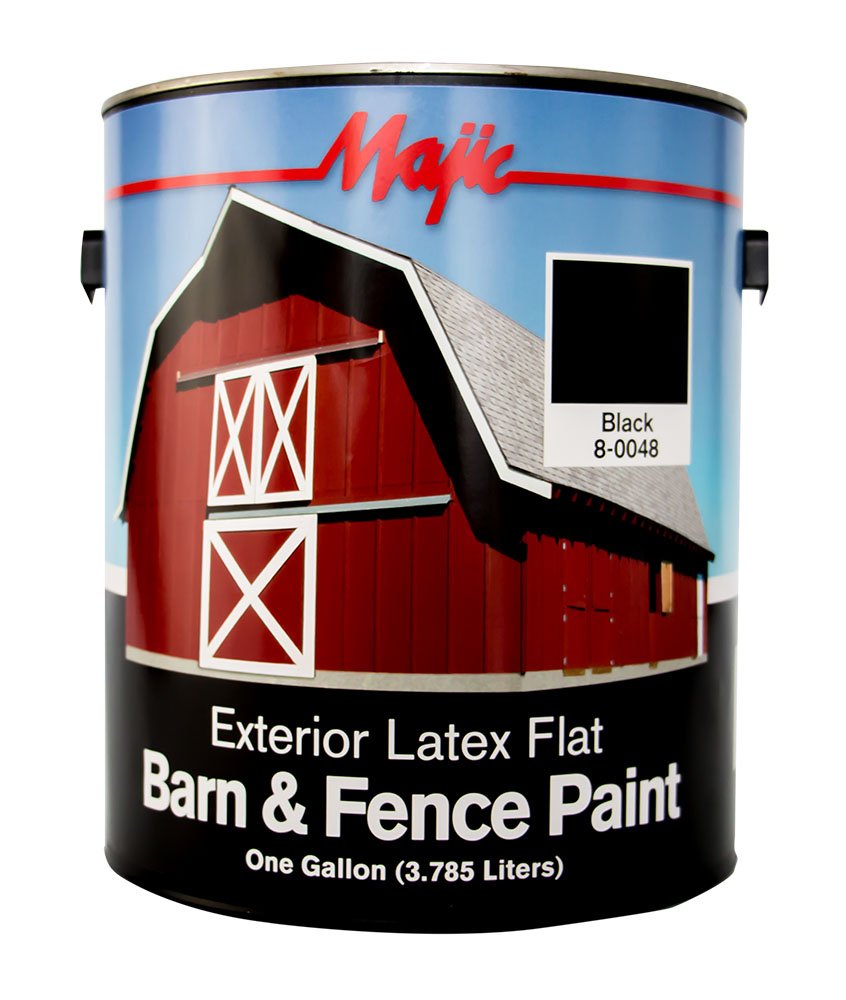
Half an hour to a touch-dry surface is the fastest turnaround in this whole lineup.
If you are painting a shed in one weekend and the weather forecast is closing in, dry time matters more than almost anything else. This Majic can reaches a dry time of 0.5 hours — 30 minutes — against 24 hours for the Tough Shield above. Full cure arrives in 4 hours. That is a formula designed for exterior wood, masonry, brick and metal, with the maker claiming weather, UV and fade resistance and a tough but flexible bond.
Coverage sits at up to 250 square feet per gallon, the leanest figure among the timber paints here. The maker’s own instruction is to plan the work so you finish at least 4 hours before nightfall, which tells you the formula wants warm drying conditions. One feature worth noting: this paint is not stated as waterproof, so it protects by covering and flexing rather than by forming a water barrier. On vertical barn boards that is normal and fine; on a surface that puddles it is not the right choice.
The recurring advice from people who have used it is almost always about stirring. The pigments settle hard in the can, and people who lay the can on its side for a day or two and then mix with a drill stirrer get very good, deep coverage that penetrates the wood. Skip that step and you can end up with patchy, streaky results in a flat black that shows every missed patch. Colour drift is a smaller issue — a couple of buyers found the “classic red” leaning orange under certain light, so check the shade against a real sample if the exact tone matters.
Best-case use: two coats on a timber shed’s exterior boarding on a warm, dry day, with a full stir before the first dip of the brush.
Who should pass: anyone who wants a one-and-done can or who cannot get a proper mix into the pigment at the bottom.
Go for this when speed and a deep flat black on timber are what the job needs.
Consider the Valspar instead if you want more coverage per can on large walls — 400 square feet per gallon against 250 here.
4. Glidden Total Exterior Paint & Primer, 1 Gallon
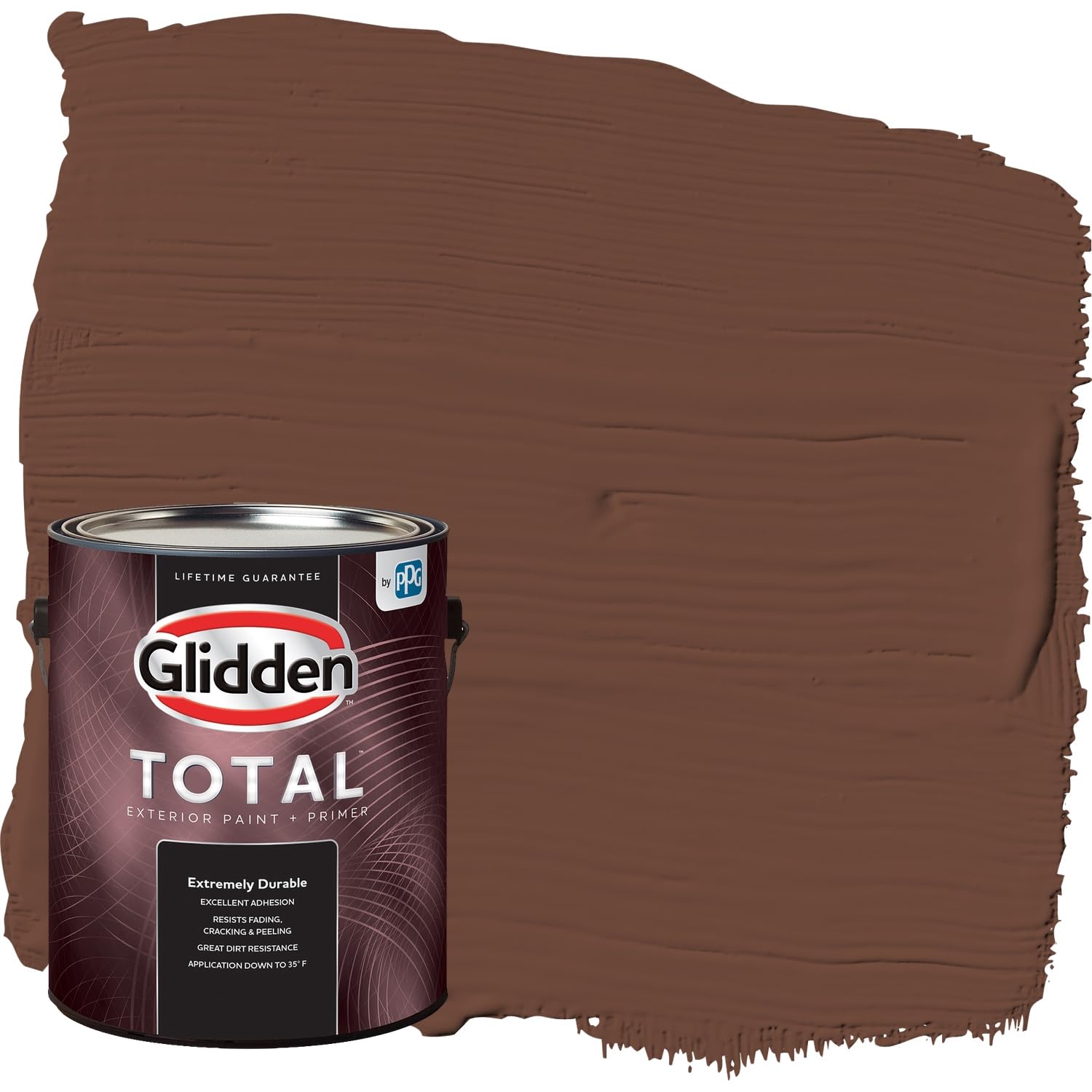
One coat over prepared boards is what this can promises, and the shed test results back it up.
Repainting a shed in a deeper colour usually means a primer coat first, because light timber shows through. This Glidden formula combines the two, and it covers up to 400 square feet with a semi-gloss finish that resists fading, cracking and peeling. It goes on exterior wood, brick, masonry, concrete, weathered aluminium, weathered vinyl siding and primed metal, and the maker lists application down to 35 degrees Fahrenheit — a lower working temperature than the 50 degrees that the WaterBlock and Tough Shield both require.
What that temperature flexibility means in practice is a longer painting season. If you are squeezing a shed repaint into a cool autumn weekend, this can will still cure where a warmer-weather formula would stay tacky. Full cure comes in 4 hours, and the semi-gloss surface wipes down more easily than a flat finish when the shed picks up green algae or road grime. Great dirt resistance is listed as a feature, which suits a shed near a driveway or under trees.
Coverage earns the most praise, and it is genuinely one-coat on prepared wood. Buyers who painted a wooden shed deck and animal shelters reported full coverage with minimal dripping and a finish that appeared abrasion resistant. The colour is where opinions split — the Bird House Brown can read a touch different from the swatch on screen, and one purchaser who ordered a dark brown got a reddish-orange leaning result instead. Order a tester pot or check the label code before committing to a whole shed.
Why it earns a place
- Paint and primer in one saves a whole extra pass over bare boards
- Applies down to 35 degrees Fahrenheit, extending your painting window
- Up to 400 square feet of coverage with strong hide
- Semi-gloss resists dirt and wipes clean
What to keep in mind
- Colour can drift from the on-screen swatch, especially deeper browns
- Not stated as waterproof, so it protects the surface rather than blocking water
- Needs thorough stirring and proper surface prep for the one-coat result
The right call for a shed that needs a fresh colour and a protective skin in a single pass.
Think twice about the deep browns without checking a sample first, since the shade is the one thing buyers disagree on.
5. White Exterior Barn & Fence Latex Paint, 1 Gallon

One gallon, four hundred square feet of white boarding — the arithmetic that makes big sheds affordable.
Large timber sheds eat paint, and this Valspar can spreads across 400 square feet per gallon, a full 150 square feet more per can than the Majic formula above. It flows on smoothly, dries in 1 hour to a matte finish, and the maker lists fade and weather resistance across exterior wood, masonry, primed metal, weathered steel and aluminium siding. A gallon goes a long way on cladding, so a single-can job is realistic for a compact garden shed.
Where a lot of exterior paints fall apart is in the film. This one is described by buyers as a paint that covers well and lays down evenly, drying fast with no stickiness once set. The flip side is thickness — some find it thick and others find it thin, and flaking has been reported on surfaces that were not prepared properly. Two coats is the reliable approach, with a single coat looking patchy on darker timber.
Its 400 square feet per gallon makes it the cheapest way to cover large white timber walls. For a shed with large pale walls and a budget mindset, the coverage is the selling point and the matte finish gives a clean, traditional look that suits a garden building. It is not a waterproofing product though. If your shed has moisture coming through the walls from outside, this paint covers rather than seals, so deal with the damp first.
Spread per can: 400 square feet per gallon is the best coverage on this list, so an average timber shed walls can be done with one can and a second coat on a second.
Honest limit: thickness and long-term flaking divide opinion, so surface prep and two coats are what decide how long the finish holds.
Choose this for a large white-walled timber shed where coverage per can is the main thing you are buying.
Leave it if the shed has a damp issue coming through masonry — reach for the WaterBlock instead.
6. EVOLVE Barn & Fence Paint, Flat (Black), 1 Gallon
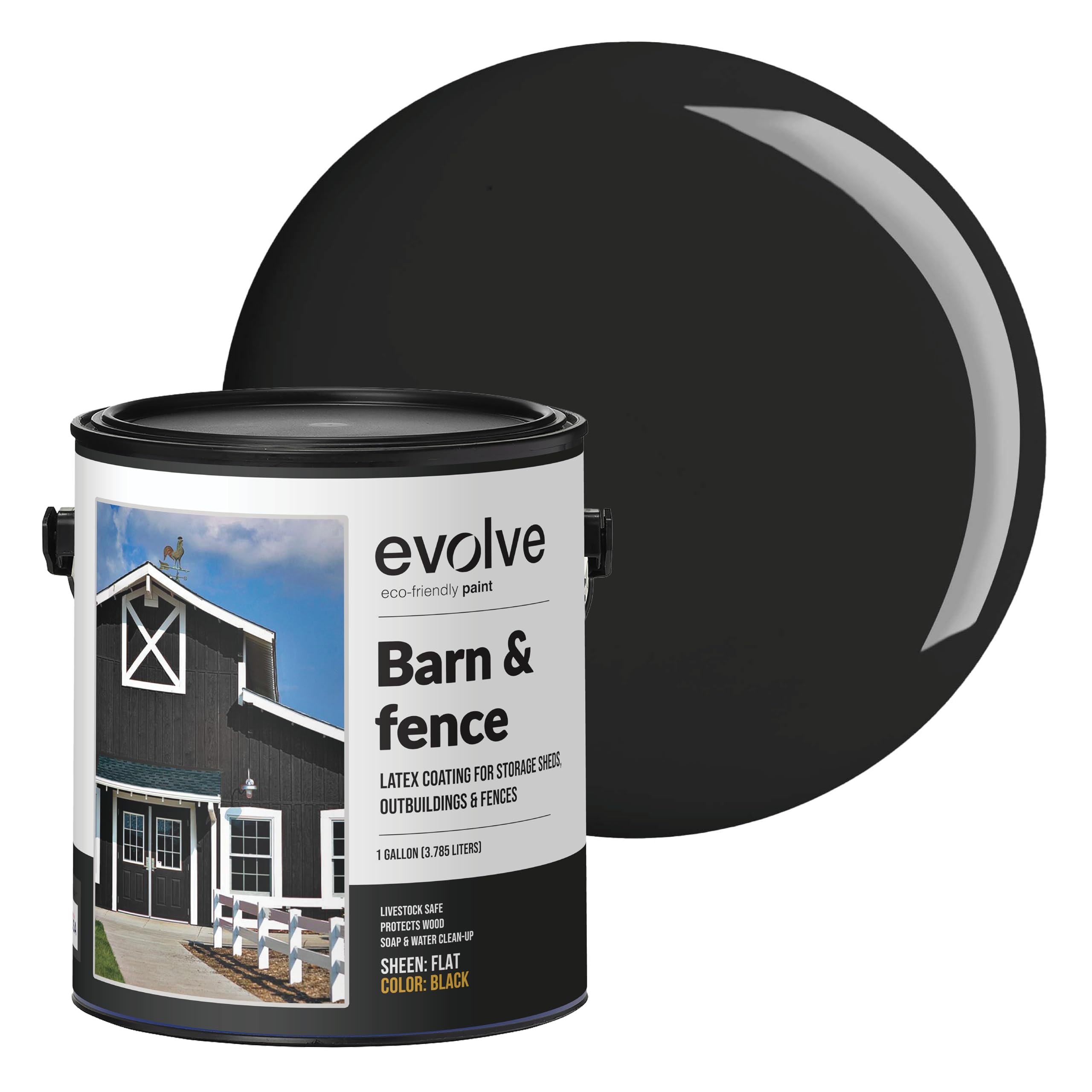
A flat black that resists scuffs and wipes clean sounds like a contradiction, but this one is built for it.
Sheds take a beating — bikes wheeled past, tools leaned on walls, mud splashed up from the lawn. This EVOLVE paint is a water-based acrylic latex with a scratch-resistant finish that keeps a clean, uniform look in high-contact areas. It covers 300 to 400 square feet per gallon, goes on as a flat finish in a farmhouse-style black, and the maker lists resistance to sun, rain and temperature changes to hold off peeling, cracking and fading.
The fast-drying technology is a genuine benefit on a shed project, because you can recoat within the same working day and close up faster. Clean-up is with water, which makes brushes and rollers a quick wash rather than a solvent soak. The paint is also stated as waterproof, so the film itself resists water rather than just covering the boards. For exposed shed boarding on a rainy site, that is the difference between a coat that beads water and one that simply looks painted.
Owners spraying thinned coats report smooth, even coverage across fences and garage fronts. Owners who thinned it for a paint sprayer found it sprayed flawlessly and stayed smooth across window screens, and people painting fences and garage fronts report it brings tired timber back without fuss. The catch is that the coverage is honest rather than generous — 300 to 400 square feet sounds big, but real job reports say expect to buy a second can for a larger project. A flat paint also shows every flaw in old boards, so expect a second coat on previously weathered timber.
What the spec gives you: a scratch-resistant, waterproof flat finish that can be sprayed, brushed or rolled, and dries fast enough for same-day recoats.
The trade: this is a paint that rewards good prep and a second can, and the flat finish has little forgiveness for rough, repaired boarding.
Ideal for a black-boarded shed with plenty of foot traffic past it and clean-up on the priority list.
Skip if you need wall-sealing rather than a surface coat, or if rough timber needs a flatter, creamier product to sit over it.
7. Diamond Brite Oil-Based Enamel Paint, 1 Gallon

For metal doors and hard-worn shed trim, this oil enamel gives the toughest shell on the list.
Not every part of a shed wants a latex barn paint. The metal door frame, the hinges, the edging and the old steel brackets want a finish that resists rust, scuffs, fading, cracking and peeling — and that is what this oil-based enamel is designed for. It works on wood, concrete, plaster, masonry, hardboard, drywall, metal, brick, stucco, aluminium and cinder block, so it is the flexible can in a shed project rather than the specialist one.
Coverage is listed at approximately 300 square feet per gallon using two light coats. It has a high-gloss finish that stands up to household chemicals and can be brushed, rolled or sprayed without thinning. Full cure is 24 hours — the longest on this list alongside the Tough Shield — and the high-gloss surface wipes clean easily once set, which is the right quality for a shed door that takes constant contact. It is also stated as waterproof and moisture resistant, which makes it suitable for a metal shed or one with a hard-wearing entry panel.
Owners describe the cured high-gloss film as hard and durable, with rust and scuffs easy to spot and fix. Owners describe it as durable and hard once cured, and the high gloss makes rust and scuffs easier to spot and easier to fix. What to know before you start: the instructions are more involved than a latex can’s, and curing takes real time. Colder, humid conditions stretch that out further, and one report noted it can feel tacky for days in cooler weather. The coverage claim of 300 square feet per gallon is also generous against real job results — 585 square feet used 6 gallons in one account, so buy more than you think you need for a larger job.
The case for it
- Resists rust, scuffs, fading and peeling on metal and timber
- High-gloss surface wipes clean once set
- Works on an unusually wide list of surfaces for a shed project
- Can be brushed, rolled or sprayed without thinning
The honest caveats
- 24-hour full cure is slow, and cool weather can stretch it out
- Coverage can run short of the stated 300 square feet per gallon on rough surfaces
- Oil-based formula needs careful clean-up and decent ventilation
Reach for this when the shed has metal components, a door that takes a daily beating, or you simply want the hardest film available.
Look elsewhere if you need to paint a whole shed in a single day — the 24-hour cure will not allow it.
Know the Specs
Coverage per gallon
This is the square footage one can will coat in a single pass. It is listed as “sq ft per gallon” or as a range like 350 to 450. A higher number means fewer cans for the same shed, but it also means a thinner film per coat, which is why most exterior paints ask for two coats. On a shed with lots of edges and trim, plan on the low end of the stated range, because edges and rough boards absorb more.
Finish type
The finish is the surface texture the paint leaves behind — flat, matte, satin, semi-gloss or high-gloss. Flat hides flaws in old timber but shows dirt and marks. Semi-gloss and high-gloss wipe clean easily and reflect light, which makes them better on doors, trim and anything that gets touched. A satin finish sits between the two and suits floors where you need both grip and wipeability.
Dry time and full cure
Dry time is how long before the surface is touch-safe or ready for a second coat. Full cure is when the film has fully hardened and reached its resistance. These are not the same number: a paint can be dry to the touch in 30 minutes while curing fully over hours or a day. Plan recoats around the dry time and keep heavy traffic off until the cure is complete.
Waterproof versus water-resistant
A waterproof coating is stated by the maker as blocking or withstanding water — sometimes listed with a hydrostatic pressure figure. Water-resistant means it repels water without that seal. A shed in a wet spot wants the first; a shed in a sheltered, dry spot can survive on the second. Always check which term the can uses before trusting it with a damp wall.
Common Questions
Can I use masonry waterproofer on a wooden shed?
How many gallons of paint do I need for a shed?
Can I paint a shed in cold weather?
What is the difference between barn paint and floor paint?
Do I need a primer before painting a shed?
How long does shed paint take to fully cure?
Why is my shed paint peeling after one season?
Can I use exterior floor paint on shed walls?
Is oil-based enamel better than latex paint for a shed?
How do I stop water coming through a concrete shed wall?
The Bottom Line
A shed stays dry when the coating matches the wall: masonry waterproofer on block, latex barn paint on timber. For a block, concrete or rendered shed with visible damp, the INSL-X WaterBlock Acrylic Masonry Waterproofer is the pick that actually seals water out, which is why it takes the top slot. If your shed has a concrete or wooden floor taking boots and tools, the INSL-X Tough Shield Floor and Patio Paint handles the flat surfaces with the widest coverage in this lineup. And for large timber walls that need a fresh colour with one can doing real work, the Valspar White Exterior Barn & Fence Paint gives you 400 square feet per gallon.
Before you buy anything, spend ten minutes on preparation: wash the surface, let it dry fully, and check the can’s stated temperature range before you open it. Washing the surface, letting it dry fully and checking the can’s temperature range will outlast any brand choice on this list.
How we choose
We do not accept paid placement. Every pick is matched to a real buyer and a real use-case; we do not hands-on test units.
Sources
Specifications: manufacturer listings and product documentation. Review insights: verified customer reviews, as of October 2026. Pricing: not shown on this page (it changes often); check the current price via the retailer link.
As an Amazon Associate, Aappliancez earns from qualifying purchases. This does not affect which products we feature.