Disclosure: Some links in this post are affiliate links. As an Amazon Associate I earn from qualifying purchases, at no extra cost to you. Learn more
Specs are compiled from manufacturer listings and verified buyer reviews and can change over time — please confirm the key details on the product page before buying.
You want to train at home without a gym membership, and the thing that decides whether that actually works is how much steel sits under the bar and how stable it feels at rep ten. A rack that sways at rep ten, a bench that slides under a dumbbell press, or a pulley that binds mid-row will end more home workouts than lost motivation does. The picks below run from a 2000-pound Smith machine cage down to a 53.4-pound power tower and a folding bench on wheels.
This guide is built by comparing the manufacturers’ published specifications and the patterns across verified customer reviews, so you get each pick’s real strengths and trade-offs instead of marketing spin.
What follows is a comparison table, a plain-English specs section, and nine write-ups covering frame weight, footprint depth and ceiling clearance for each rig. Read on for outdoor gym equipment picks rated from 165 to 2000 pounds, each measured against ceiling height and floor depth.
Top Picks

How To Choose The Best Outdoor Gym Equipment
Most buyers compare price tags first and discover the ceiling height problem after delivery. The two numbers that decide whether a rig stays usable for years are the maximum weight recommendation (the ceiling the maker says the frame will safely hold) and your available ceiling height. Miss either one and the attachments, the pulley ratio and the price tag stop mattering.
Start with your ceiling, not the picture on the listing
A rack that stands 82.6″H will not fit under a low basement joist no matter how good the reviews are. Measure the actual gap from floor padding to the lowest obstruction before you buy. A few of the rigs here let you skip the rear uprights or rear plate holders, which buys you depth and lets the frame sit close to a wall.
Match the weight recommendation to the lifter, not the marketing
Weight recommendations here run from 300 pounds up to 2000 pounds. If you squat heavy or share the rack with a partner, the higher figure gives you real headroom. If you train with bodyweight and light dumbbells, a tower rated at 300 pounds covers you fine. Remember the recommendation is the maker’s stated frame limit — your bar, plates, and rigging are separate.
Understand what “all-in-one” actually buys you
An all-in-one cage bundles a squat rack, cable pulleys, a landmine, and a pull-up bar into one footprint. One 59.6″ x 59.6″ footprint replaces a squat rack, a cable station and a landmine you would otherwise buy and store separately. The trade-off is that bundled attachments are usually functional rather than commercial-grade, so factor in replacing a handle or J-hook you dislike rather than replacing the whole frame.
Weight stacks versus plate-loaded pulleys
A stack gives you instant weight changes with a pin; a plate-loaded pulley makes you walk to the weight tree mid-set. Stacks are faster for circuit training. Plate-loaded pulleys let you add a 5 pound adder plate for half-step jumps. Pick based on whether you train in quick circuits or slow, heavy sets.
Side-by-Side Comparison
| Model | Best For | Max Weight Rec. | Item Weight | Footprint (D x W x H) | Amazon |
|---|---|---|---|---|---|
| SPORTSROYALS Power Rack★ Best Overall | Full home gym on one frame | 1200 lb | 150 lb | 59.6″D x 59.6″W x 82.6″H | Amazon |
| Sunny Health & Fitness Power TowerBest Value | Dips and pull-ups with no rack | 300 lb | 53.4 lb | 39.2″L x 40.9″W x 83.7″H | Amazon |
| Sunny Row-N-Ride Squat AssistMost Approachable | Joint-gentle squats and rows | 220 lb | 39.3 lb | 46.9″D x 26.8″W x 40.6″H | Amazon |
| REP FID Foldable Bench | Compact pressing and core work | 1000 lb | 89.3 lb | 55.6″D x 25.8″W x 17.1″H | Amazon |
| Mikolo Home Gym Station | Small spaces, low ceilings | 300 lb | 300 lb | 75″D x 36.3″W x 80″H | Amazon |
| MAJOR FITNESS F22 Power Rack | Partner training in small footprint | 1600 lb | 243 lb | 68.9″D x 55.5″W x 82.5″H | Amazon |
| pooboo P43 Power Cage | Smith machine heavy lifters | 2000 lb | 417 lb | 62.9″D x 43.3″W x 82.6″H | Amazon |
| Marcy Smith Machine Cage | All-station garage machine | 300 lb | — | 86″D x 70″W x 84″H | Amazon |
| Inspire Fitness FTX Trainer | Cable training in tight rooms | 165 lb | 544 lb | 54″D x 40″W x 82″H | Amazon |
Detailed Reviews
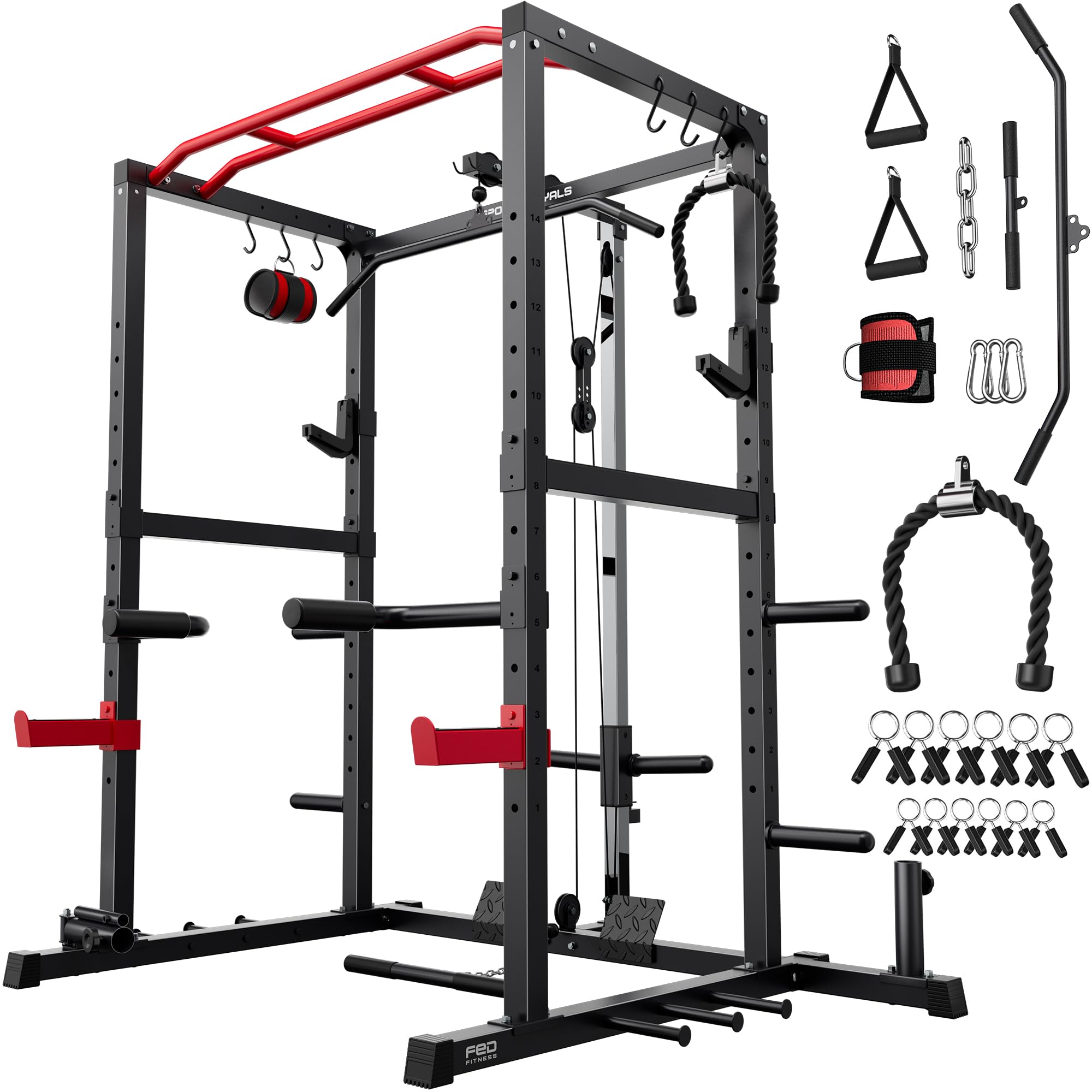
1. SPORTSROYALS Power Rack
Our pick — 4.5+★ from 700+ verified ratings; the strongest balance of quality and price.
One cage that does squat, bench, lat pull-down and landmine — and holds four figures.
If you are turning half a garage into a permanent training corner, this is the frame that squeezes the most work out of one footprint. The steel is square tube measuring 50 X 50mm at 1.5mm thick, and the maker rates the whole thing to 1200 pounds — a genuinely high ceiling for a home cage. That rating matters because it means you are not nervously watching the uprights when you load up a heavy squat.
Where it separates from a bare rack is the attachments. You get a rowing bar, four weight plate storage posts, six band pegs, safety arms and bars, two J-hooks, dip stands, a tricep rope, an ankle strap, cable handles and a 360° landmine. That is a complete gym in the crate. The plate storage fits both 2″ Olympic and 1″ standard plates, so you are not locked into one plate type. The 150-pound frame weight and the two reinforcing tabs are what keep it planted during compound lifts.
The honest catch is stability design. The most-discussed aspect in the review pages is build quality, and the recurring note is a slight side-to-side wobble from a frame that is not anchored to the floor. The safety bridge is also awkward to move between settings, and taller lifters notice the lat pulldown pulley sits close to the face. None of that stops the work — it just means you plan your bar storage so accessories do not block the bar path.
Where the steel earns it
- Rated to 1200 pounds, so heavy squats and deadlifts have real headroom over the Sunny tower’s 300-pound figure
- Weighs 150 pounds versus the 53.4-pound Sunny tower — the mass is what keeps it steady under load
- Full attachment set covers bench, landmine, rows, dips, pull-ups and cable work without extra buying
- 2″ Olympic and 1″ standard plates both fit the storage posts
What you live with
- Unanchored frame shifts slightly side to side at the base
- Safety bridge takes effort to reposition mid-session
- Lat pulldown pulley position crowds tall users
Built for the garage lifter: buy this if you want squat, bench, lat and landmine all in one frame and you train heavy compound lifts.
Know before you commit: budget for a bench and plan your plate storage, because the included accessories compete for the same bar space.
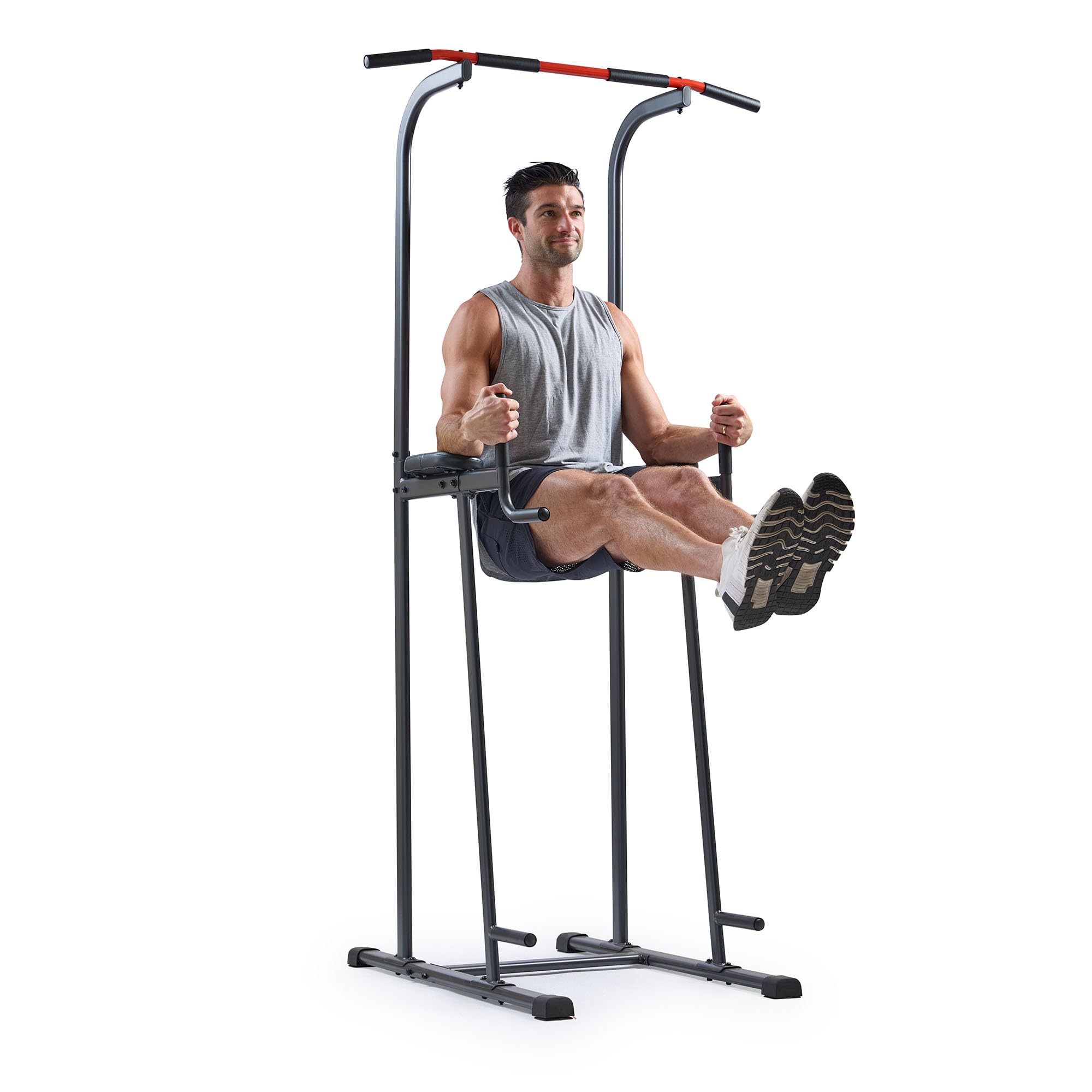
2. Sunny Health & Fitness Power Tower
Bodyweight training on a stand that tucks into a corner and takes an hour to build.
Not everyone needs a squat cage. If your training is pull-ups, dips, push-ups and leg raises, this tower covers all four in a footprint of 39.2″L x 40.9″W and a 53.4-pound frame you can shift single-handed. Value is the thing that wins people over here — the review pages treat it as a bargain dip station above all else.
The climb grip handlebar adds a second hand position, which is genuinely useful for changing your pull-up width without bolting on anything extra. The captain’s chair section handles leg raises, and the foam padding on the grips keeps longer sets comfortable. A buyer measuring 6’1” and 195 lbs reports: “Plenty tall and stable plus climbing grip adds versatility.”
Two honest fits to weigh up. First, the included hardware is basic — the nuts are sized awkwardly and the front holes are known to need some persuasion, so plan on watching the instructional video before you start turning bolts. Second, the stated 300-pound recommendation is the relevant limit; heavier users who kip will notice the frame rocking. Lighter users will find it planted.
What lands on day one: Assembly is a one-evening job for two people and the climbing grip is the feature that keeps sessions varied for pull-up work.
The fit test: If you are well past 5’8″ and want a full dip range, check the working height before ordering — the top of the stand runs to 83.7″H but the dip position is set lower.
Reach for this if: your routine is bodyweight-first and you want a rack-free way into dips and pull-ups.
Look elsewhere if: you are near the stated weight limit and train with explosive kipping reps.
3. Sunny Health & Fitness Row-N-Ride
Squats with a seat under you, so the depth is set by the machine instead of your knees.
This is the pick for someone who wants the squat and row pattern without loading a barbell. The single handlebar splits into two independent rower bars, so you can row with one arm at a time or wide. Three machine angles let you pick shallow, parallel, or deep — a 30-to-90-degree spread that takes the guesswork out of how low you go.
Quality and workout performance are what earn the most goodwill in the reviews, and the pattern holds up: the glide motion makes reps feel easy for out-of-shape beginners, and the arms get work at the same time as the legs because the handles double as a pulling station. The LCD tracks your time, and a device holder keeps a show or a training video in view. The 220-pound weight recommendation sets a clear limit on the seated frame.
Where it shines: Set the seat and handlebar, pick your angle, and the machine walks you through the motion — a good entry point for anyone restarting after a long break.
The honest limit: Resistance is the point buyers disagree on most. Some find it plenty; others find it lighter than a cable stack and better suited to high-rep aerobic work than heavy strength.
Best fit: a beginner or returning exerciser who wants a guided squat-and-row session at home.
Think twice if: you already train heavy and want a machine that can scale resistance with you.
4. REP FID Foldable Weight Bench, AB-3000

A 1000-pound bench that folds flat and rolls away when the session ends.
Every cage on this list needs a bench, and this one is built to survive being used. The frame is rated to 1000 pounds and weighs 89.3 pounds, which is the mass that stops it skating during a dumbbell press. Flat, incline, and decline positions give you chest, shoulder, core and arm work off one platform. Integrated wheels let you push it aside between sessions.
Construction is the aspect owners bring up most, and the pattern is consistent — this bench is compared to fitness club equipment by people who have bought several benches before. One buyer sums it up: “This is a great bench for your home gym! Easy set up. Very sturdy.” Assembly runs about 45 minutes, and the high-density padding holds shape through repeated pressing.
There is a height fit to consider before you order. Taller lifters with long legs report the improve position works well; shorter users may find their feet want a plate underneath for a grounded press. The fold mechanism is a genuine space saver, but it is still an 89.3-pound object to move, so give yourself a clear path when you roll it out.
The build that sells it
- 1000-pound rating sits far above the 300-pound figure on the Sunny tower
- Flat, incline and decline in one platform
- Wheels and a fold mechanism handle storage
- 89.3 pounds of frame keeps it from drifting under load
Details worth knowing
- Short-legged lifters may want foot support under the press position
- 89.3 pounds is a two-hand move even with wheels
- Assembly takes about 45 minutes
The call: this is the bench that lets one cage serve pressing, flyes, sit-ups and incline work without a second purchase.
One thing to check: measure your leg length against the 17.1″H deck before committing to the press position.
5. Mikolo Home Gym, Workout Station with 150LBS Weight Stack
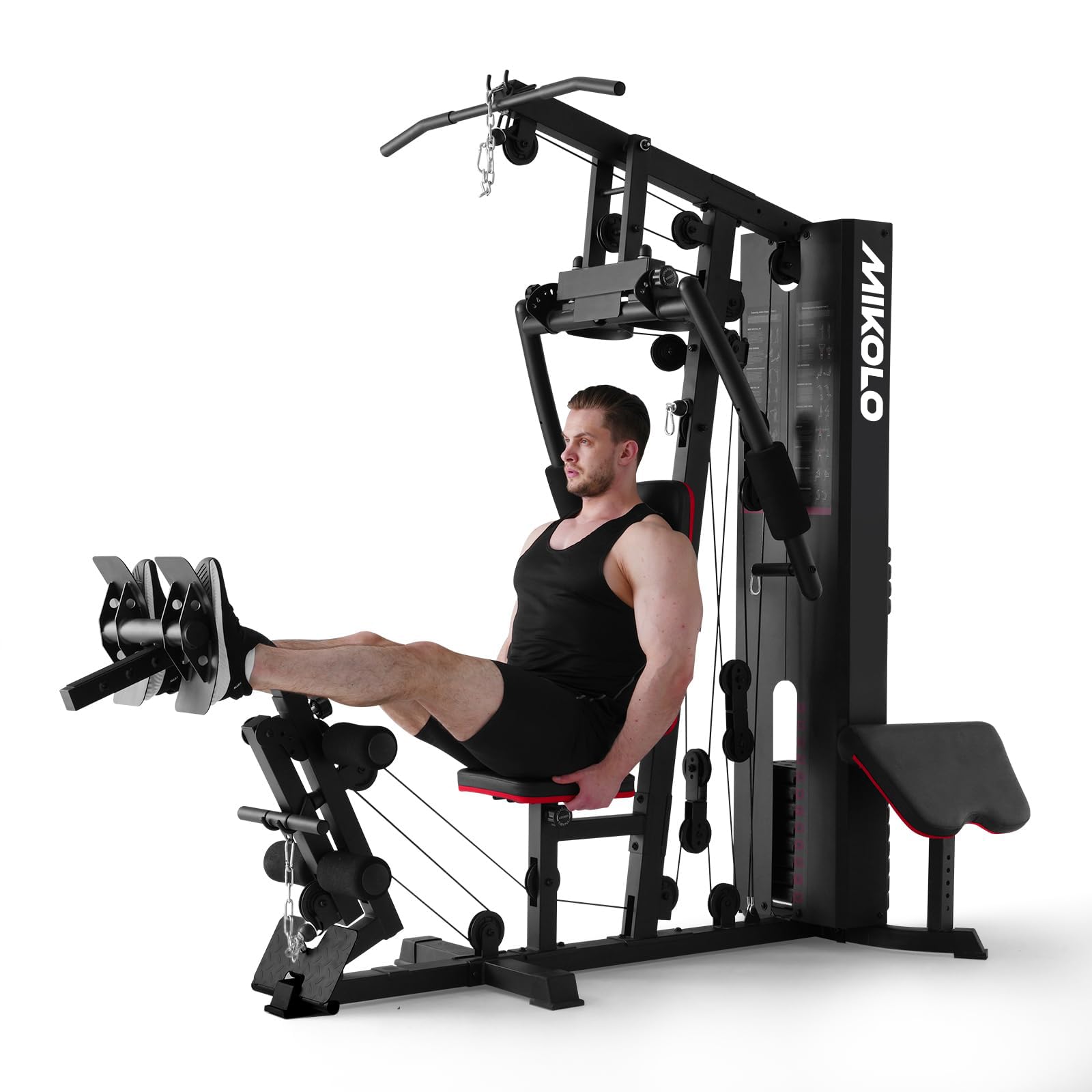
A full selectorized gym that slides into a low-ceiling room without eating the floor.
Here is the option for someone who wants cable work, chest press, leg extension and preacher curls but has no room for a cage and a plate tree. The frame is 14-gauge steel and stands 80″H, which clears most basements. The 152-pound weight stack changes with a pin, so you skip walking to a weight tree between sets. The maker lists more than 90 exercises, backed by a high, mid and low pulley system plus chest press and chest fly stations.
Build quality is what owners talk about most, and the consensus is that it feels close to a commercial cable machine once assembled. One long-term owner puts it simply: “2 years near-daily use by user and two teens.” The preacher curl pad and leg press accessories come off when you need them out of the way, and the professional bearing in the cable bar reduces wrist stress on pulling movements.
The real caveat is height fit. Reviewers under 5’5″ fit comfortably; a 6’2″ partner could not reach full range of motion on most exercises without shortening the chain. Seat adjustment moves up and down, not forward and back, which limits the tweaking taller users can do. Assembly is a long afternoon — four to five hours with a helper.
What you gain: Nine-plus stations and a 152-pound stack in a 36.3″W footprint, versus a cage that needs a bench, a bar and a plate tree beside it.
The height question: Measure your tallest lifter against the fixed seat position — this machine rewards average height and frustrates tall users on lat pulldowns.
Made for: a low-ceiling room and a lifter who wants pin-selectable weight changes in a quick circuit.
Not the pick if: anyone over 6’2″ will be doing full-range lat pulldowns on the same machine.
6. MAJOR FITNESS F22 Power Rack
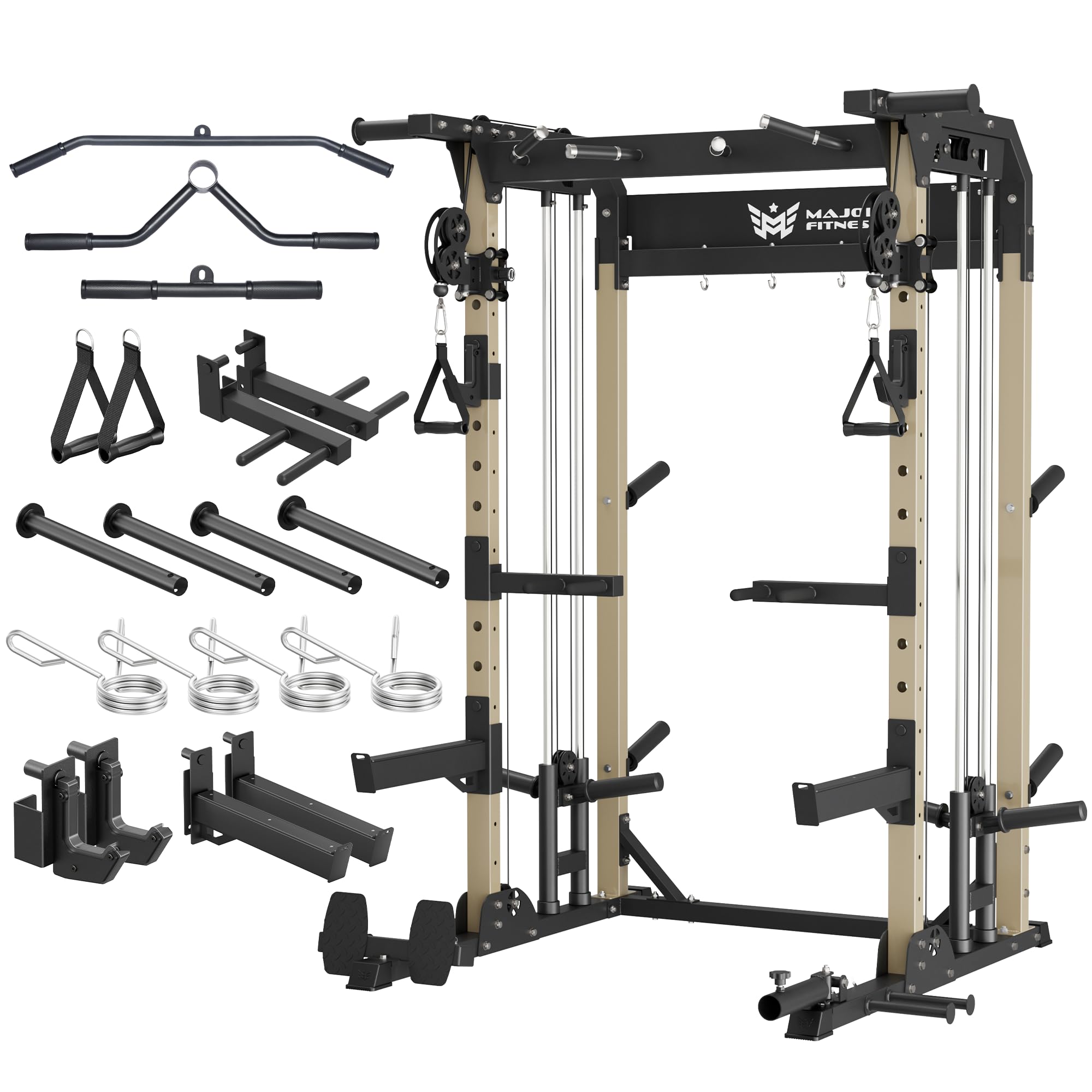
Two people can train at the same time on this rack — that is the whole pitch.
Most home cages assume one lifter. This one runs independent dual pulleys on a 2:1 ratio, so you and a partner can work opposite sides without the cables fighting each other. The steel is 2″x3″ commercial-grade 14-gauge at 0.08″ thick, rated to a 1600-pound static capacity. That figure sits above the SPORTSROYALS cage’s 1200-pound rating, so if you squat near the top of your game this is the sturdier spec.
The dual-triangle base is designed to spread load across the floor, and the maker says no bolting is required for standard stability. Owners back the feel and the value — one reports months of near-daily use with no regrets about the frame. Assembly is a manageable job for two people with mechanical sense at about three to four hours, and skipping the rear plate holders buys back roughly 8″ of depth so the rack can sit near a wall.
The fit note is the pulley changeover. It uses standard circular plates rather than a selectorized stack, so switching weight mid-set means walking to the plate pins. A weight-stack conversion exists but costs close to the rack itself. Dip bar width is narrow at about 1″ steel, which pinches larger hands.
Why it earns a premium slot: A 1600-pound rating and 243 pounds of frame deliver a planted feel at 82.5″H — tall enough for a 6’4″ lifter to stand inside.
The trade-off: Plate-loaded pulleys demand a walk to the pins between sets, and the add-on stack conversion is a real cost if quick changes matter to you.
Suits you if: two lifters share one garage and you want the highest weight rating short of a full Smith machine.
Check this first: whether you can reach the plate pins comfortably, since pulleys run on plates rather than a pin stack.
7. pooboo Power Cage Smith Machine P43
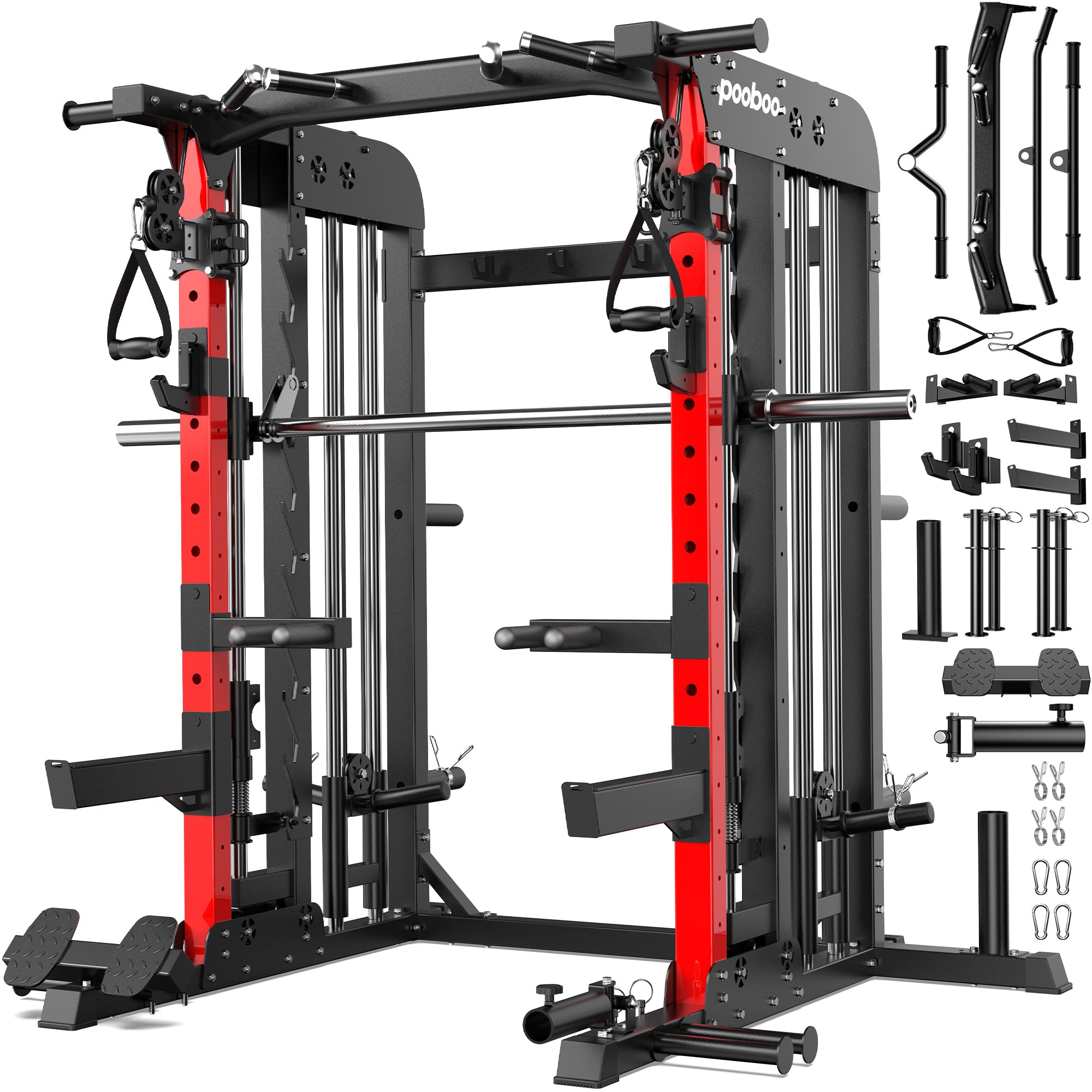
A 417-pound frame rated to two thousand pounds, with a Smith machine on board.
This is the cage for someone who wants the Smith machine barbell path plus cables plus a landmine all on the same frame. The rating is 2000 pounds — the highest on this list, sitting above the MAJOR F22’s 1600-pound figure and well above the SPORTSROYALS cage’s 1200-pound rating. The 417-pound frame is the weight that makes that number feel real under a bar.
You get over 20 attachments in the crate: two J-hooks, two safety spotter arms, two dip bars, two cable grip handles, a lat pulldown bar, a row bar, a row low foot board, a 360° landmine, four plate storage pins, four weight holders and four band pegs. The pulley runs on bearing pulleys and PU wire rope, and each metal part is sandblasted and topped with rust-proof paint for a burr-free finish. Quality is the aspect that earns the most praise in the pages, and the pattern is that it reads closer to commercial equipment than the price suggests.
The honest part: it ships in multiple boxes, assembly is a long job — several buyers report spending a full weekend on it — and the slide bars want grease after a couple of weeks to keep the motion silent. The rear pull-up cross member realistically needs a second pair of hands. The 2000-pound figure is the maker’s stated capacity, not a tested commercial rating.
Why the numbers matter
- 2000-pound rating outranks every other cage here, including the MAJOR F22’s 1600 pounds
- 417-pound frame — more than double the SPORTSROYALS cage’s 150 pounds
- Smith machine, dual pulley cable crossover and landmine in one footprint
- Over 20 attachments ship in the box
What the weekend costs you
- Assembly is a full-weekend job for one person
- Slide bars squeak without added grease after about two weeks
- Arrives across many boxes, so confirm receipt against the packing list
Built for the heavy lifter: if the bar is loaded often and you want the Smith path plus cables, this frame carries the highest stated capacity on the page.
The fair warning: clear a weekend for the build, and buy a tube of grease before the first session.
8. Marcy Smith Machine Cage System Home Gym Multifunction Rack

The largest footprint here, and the one that turns an empty garage bay into a full station.
At 86″D x 70″W x 84″H this is the biggest rig on the list, so measure the room before anything else. What you get for that space is a Smith machine, an adjustable weight bench, pull-up and dip bars, weight plate storage and a dual pulley system in one steel frame. The 300-pound maximum user weight is the number to check against the heaviest person who will use it.
Owners who commit to the build come away satisfied. The trade-off is time and patience — the assembly is the largest job here, with parts arriving across five heavy boxes and no sorting by assembly order. Several owners mention six to twelve hours of work over multiple days. One advises laying every part out first and using ratcheting wrenches. Once built, the machine is described as solid, stable and smooth, with a sequence that lets you move quickly between exercises.
The catch worth naming is fit on two fronts. The bench sits high relative to the Smith bar, and there is no lat pulldown attachment in the base configuration. There are also reports of mismatched frame parts arriving, which can add a wait for a replacement. Those are rare enough that the machine still earns its place here, but a buyer going in should know the build is the real project.
The upside you are buying: one footprint that holds the Smith machine, a bench, pull-up and dip bars and plate storage — no second purchase for stations.
The part to size honestly: the 300-pound user limit and the lack of a lat pulldown attachment mean this is a beginner-to-intermediate machine, not a powerlifter’s cage.
An honest fit for: someone with a spare garage bay, patience for a long build, and a training style that mixes Smith machine work with bench and bodyweight moves.
Skip the wait if: you want a lat pulldown in the base machine or you are pressing past 300 pounds of user weight.
9. Inspire Fitness FTX Functional Trainer

Two independent 165-pound stacks, sliding pulleys, and a footprint smaller than most cages.
If cable exercises are the core of your training, this is the machine built for that job specifically rather than as a bonus station on a cage. Two 165-pound weight stacks sit on sliding pulleys that move without friction, so the resistance stays constant through the whole arc of a movement. The maker calls it one of the smallest footprints in a full functional trainer, at 54″D x 40″W x 82″H — noticeably shallower than the Marcy cage’s 86″ depth.
Build quality is what buyers highlight most, and the pattern is gym-grade: solid, no squeaks or rattles, cables that feel well-balanced. Assembly is called simpler than expected, though the towers are heavy enough to want two people for the lifting stages. The accessory kit is real rather than token — a tricep rope, two deluxe D handles, a dual hook curl bar and a chin/dip belt all ship with it.
Two limits to size up. The weight stacks are not upgradeable, so 165 pounds per side is your ceiling and buyers who outgrow it are told to look at the larger Inspire models. And the station height tops out low enough that taller users lose range of motion on some exercises — a 5’6″ lifter thinks it is ideal. The 544-pound machine needs a solid floor and a plan for getting it there.
Why cable-first lifters choose it
- Two independent 165-pound stacks with friction-free sliding pulleys
- 54″D footprint against the Marcy cage’s 86″D
- Accessory kit includes a curl bar, dip belt and two D handles
- Smooth, constant-tension resistance across the arc
Where it stops short
- Stacks are fixed at 165 pounds per side with no upgrade path
- Taller lifters lose full range on upper stations
- 544 pounds needs a helper and a sturdy floor to set up
The verdict: pick this if cable flys, crossovers and rows are your main lifts and you want commercial feel in a compact footprint.
The one ceiling: 165 pounds per stack, so anyone pressing or rowing beyond that needs the larger Inspire models.
Know the Specs
Maximum weight recommendation
This is the maker’s stated load ceiling for the frame — the safety number you check before you load a bar. It ranges from 300 pounds on the Sunny tower and Marcy cage to 2000 pounds on the pooboo P43. Match it to the heaviest lifter and the heaviest load, then give yourself headroom. A cage rated at 1200 pounds or 1600 pounds leaves more room for a partner or for progress before you approach the limit. Treat it as the frame’s stated rating rather than a lab-tested figure.
Steel gauge and frame weight
Gauge describes how thick the steel tube is — a lower gauge number means thicker, heavier steel. The pooboo and MAJOR FITNESS rigs use 14-gauge steel. Frame weight is the practical readout: a 150-pound cage and a 417-pound cage are built differently, and the heavier one resists sway under a loaded bar. Lighter stands, like the 53.4-pound Sunny tower, are easier to move but rely more on a wide stable base than on mass.
Weight stack versus plate-loaded pulley
A weight stack is a column of plates with a selector pin — pull the pin, change weight in a second. The Mikolo runs a 152-pound stack and the Inspire FTX two 165-pound stacks. Plate-loaded pulleys, like the MAJOR F22 and SPORTSROYALS cage, use your own plates and require a walk between sets. Stacks suit fast circuits; plates suit lifters who want half-step adders and already own a plate tree.
Pulley ratio and cable rating
The ratio sets how the felt weight compares to the actual load on the cable. The MAJOR F22 runs a 2:1 ratio for smoother cable travel. The SPORTSROYALS PU-coated cable is rated to hold up to 500 pounds. Both numbers matter, but so does how smoothly the pulleys roll — bearing pulleys move cleaner than simple bushings, and that difference shows up the moment you start a heavy cable row.
Common Questions
Will a power cage fit under a low basement ceiling?
What does a 1200-pound or 2000-pound rating actually mean?
Is a weight stack better than a plate-loaded pulley?
Can two people train on the same rack at once?
How long does it take to assemble a home power cage?
Do I need a bench if I buy a power cage?
Will a functional trainer work for a tall lifter?
How much floor space does one of these machines take up?
Why do cables squeak, and is that a fault?
Is a Smith machine cage a good first home gym purchase?
The Bottom Line
For most people building a permanent training corner, the strongest pick for outdoor gym equipment is the SPORTSROYALS Power Rack. It rates to 1200 pounds and ships with the rowing bar, landmine, dip stands and J-hooks that would otherwise be separate purchases. If you want a partner training on the same rack and a taller weight rating, the MAJOR FITNESS F22 leads with its independent dual pulleys. And if you are working in a low basement with cable-first training in mind, the Mikolo Home Gym Station packs a 152-pound stack into the narrowest of these frames.
How we choose
We do not accept paid placement. Every pick is matched to a real buyer and a real use-case; we do not hands-on test units.
Sources
Specifications: manufacturer listings and product documentation. Review insights: verified customer reviews, as of October 2026. Pricing: not shown on this page (it changes often); check the current price via the retailer link.
As an Amazon Associate, Aappliancez earns from qualifying purchases. This does not affect which products we feature.