Disclosure: Some links in this post are affiliate links. As an Amazon Associate I earn from qualifying purchases, at no extra cost to you. Learn more
Specs are compiled from manufacturer listings and verified buyer reviews and can change over time — please confirm the key details on the product page before buying.
Your kitchen bucket fills up faster than the pile outside can break it down, and that is exactly what an outdoor compost bin is meant to fix. The short answer: pick a bin that matches how much waste you actually make each week. A 37-gallon tumbler suits a two-person kitchen; a 50-liter worm tray suits someone who wants finished castings without turning anything; a 173-gallon cedar bay suits a big yard with leaves to burn through. This guide breaks down seven real options across those jobs, with the numbers that decide each one.
This guide is built by comparing the manufacturers’ published specifications and the patterns across verified customer reviews, so you get each pick’s real strengths and trade-offs instead of marketing spin.
Start with how much waste your yard produces, then decide if you want to tumble, stack, or just let a static heap do the work. Here is how the leading options stack up for anyone shopping for the outdoor compost bin that actually fits their yard and waste volume.
Top Picks
How To Choose The Best Outdoor Compost Bin
The mistake most first-time buyers make is choosing a bin by how it looks rather than how they will load and empty it. A waterfall of small decisions follows from that one, so start with the amount of waste your household generates in a week. Everything else — turning method, footprint, lid style — comes after.
Match the bin’s capacity to your actual waste volume
A 37-gallon dual tumbler like the Hotfrog is built around a two-person kitchen’s worth of scraps and can finish a batch in about two months when the mix is right. A 50-liter worm tray is a different animal entirely — it handles food waste but produces castings rather than bulk compost, so it suits a gardener who wants a concentrated soil amendment. A 173.92-gallon cedar bay swallows leaves and yard waste by the cartload. Sizing too small means you fill the bin before the first batch is done; sizing too large means you never build enough mass to heat a pile.
Decide whether you will turn the pile or not
Tumblers exist to save your back. You rotate the drum five or six times every few days and the aeration holes and internal fins do the mixing. Static bins and worm trays need no spinning at all — the trade-off is slower breakdown and, for a worm bin, a narrower list of what you can safely feed it. A wooden bay sits in the middle: no turning mechanism, but plenty of drainage and airflow through the gaps between slats.
Check the build materials against your winters
Polypropylene and high-density polyethylene bins resist UV fading and cracking, but thin panels can feel flimsy and lids can lift in wind. Cedar boards breathe and drain better than plastic, at the cost of some splintering on cut ends. Whichever you pick, look for a lid that seats firmly and a frame or base that will not tip when the drum is full and heavy.
Side-by-Side Comparison
| Model | Best For | Capacity | Type | Footprint (L x W x H) | Amazon |
|---|---|---|---|---|---|
| Original Vermihut 5 Worm Composter★ Best Overall | Small-space vermicomposting | 50 liters | Tray worm bin | 16″L x 16″W x 15″H | Amazon |
| FCMP Outdoor HOTFROG Dual Body TumblerBest for Small Yards | Two-person kitchens | 37 gallons | Dual-chamber tumbler | 30″L x 28″W x 36″H | Amazon |
| EJWOX 80 Gallon Static Compost Bin | Bulk leaves and clippings | 80 gallons | Static open-bottom bin | 24″L x 24″W x 30″H | Amazon |
| Nova Microdermabrasion 43 Gallon Tumbler | Small yards on a budget | 43 gallons | Dual-chamber tumbler | 28.5″L x 25″W x 37″H | Amazon |
| Marcytop 45 Gallon Dual Chamber Tumbler | Beginners who want two batches going | 45 gallons | Dual-chamber tumbler | 29.5″L x 26.7″W x 23.4″H | Amazon |
| Greenes Fence Cedar Wood Composter | Big yards and leaf volume | 173.92 gallons | Cedar slat bay | 36″L x 36″W x 31″H | Amazon |
| Compost Wizard Jr. Tumbler | No-assembly backyard tumbling | 7 cubic feet (50 gallons) | Single-chamber tumbler | 22″ x 23.5″ x 30″ | Amazon |
Detailed Reviews
1. Original Vermihut 5 Tray Worm Composter
Our pick — 4.5+★ from 800+ verified ratings; the strongest balance of quality and price.
The bin that turns your food scraps into worm castings and never asks you to spin a drum.
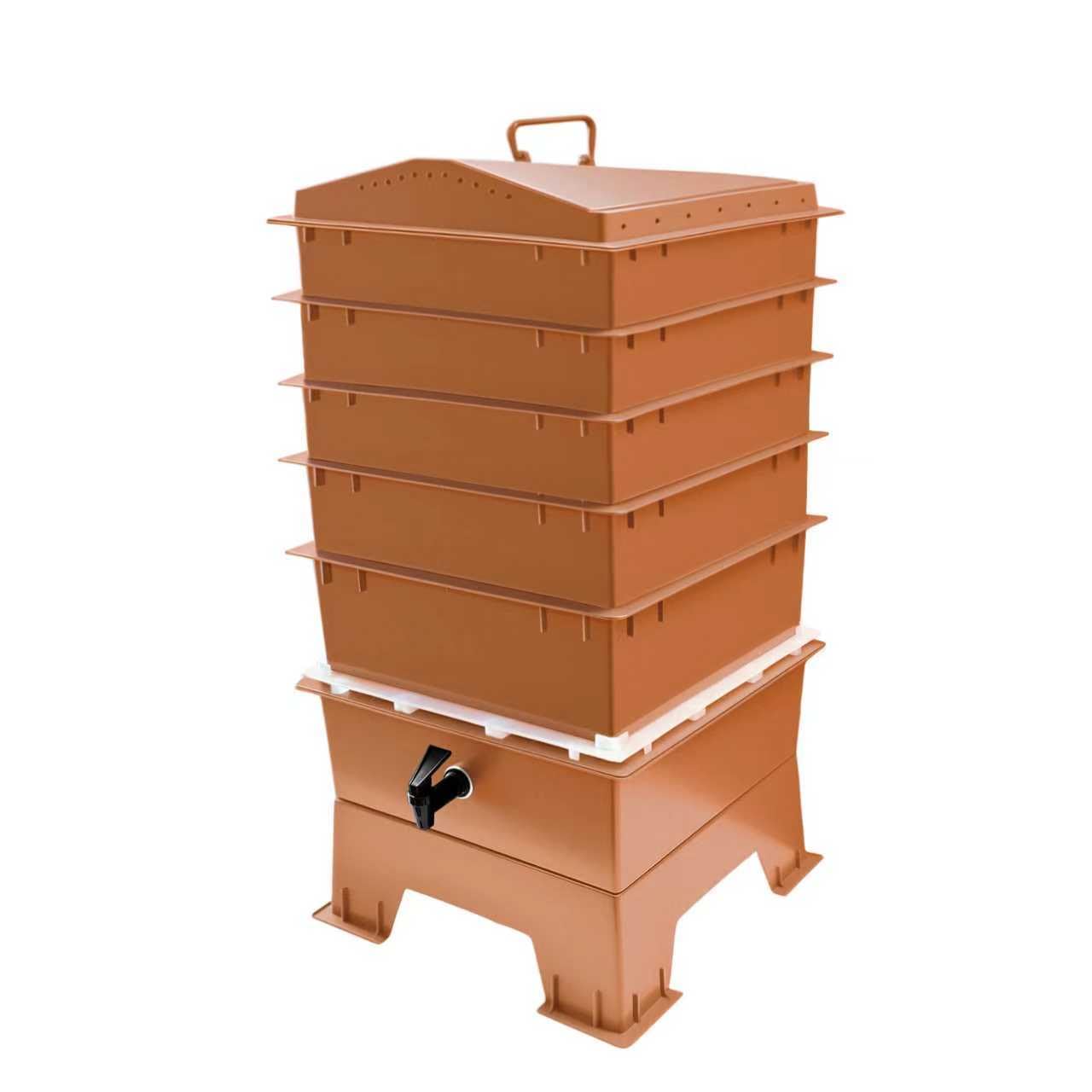
If your kitchen throws off more vegetable peelings than your yard throws off leaves, a tray worm bin does the job a tumbler cannot. The Vermihut 5 holds 50 liters across stacking trays, so worms migrate upward into fresh food while the bottom tray finishes. That bottom tray also catches worm tea — the liquid runoff — through a spigot, and a worm saver tray keeps the colony from dropping into the liquid.
The footprint is the real story here. At 16″L x 16″W x 15″H it tucks onto a porch or beside a garage, and next to the FCMP Hotfrog tumbler’s 30″L x 28″W x 36″H frame it takes up a fraction of the floor space. HDPE plastic holds up outdoors, and the whole thing arrives with bedding, a cup, a rake, a spigot, and a worm blanket so you are not hunting for accessories before you start.
The worms do the heavy lifting: they breed in the trays and leave castings you harvest straight into the garden. Assembly is the other thing buyers keep coming back to: the illustrated instructions make it a same-afternoon job. The honest catch is the thin instruction sheet, and the fix is a corner trick owners pass around: drop 2-3″ PVC spacers (short plastic tubes) into the corners so the trays do not compact under weight and the bedding keeps breathing. Fruit flies also show up if you feed carelessly; covering scraps with damp paper or dry peat shuts that down.
What earns its keep
- 50-liter tray capacity in a 16″L x 16″W x 15″H footprint that fits a porch or balcony
- Worm tea spigot plus a worm saver tray that keeps the colony out of the liquid
- Ships with bedding, rake, cup, and worm blanket — nothing extra to buy
- HDPE construction that shrugs off outdoor conditions
Where it asks more of you
- The instruction sheet is the weakest link — plan on a little trial and error
- Trays compact under weight without corner spacers, which cuts airflow
- Fruit flies appear fast if scraps go in uncovered
Made for: apartment and small-yard gardeners who want finished castings from kitchen scraps and will never touch a turning handle.
Think twice if: you generate mostly grass clippings and leaves — this bin is sized for food waste, not bulk yard debris.
2. FCMP Outdoor HOTFROG Dual Body Tumbling Composter
Two independent drums, not one split barrel — the Hotfrog lets you cure a finished batch while you keep feeding the other side.
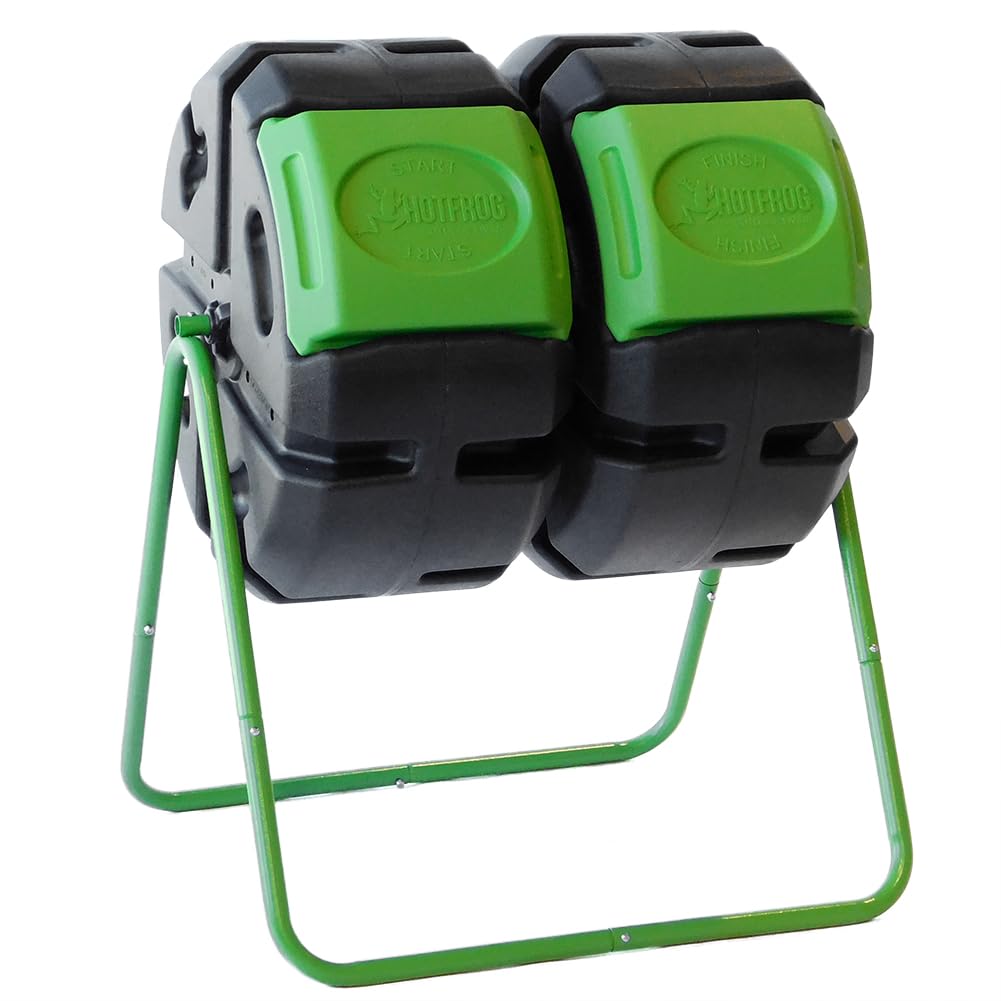
Most dual-chamber tumblers are a single barrel with a divider down the middle. This one is two fully assembled containers on one frame, which sidesteps the imbalance problem that plagues divided drums when one side is heavy. Total capacity is 37 gallons, split across the two, and the whole unit sits in a compact 30″L x 28″W x 36″H envelope that fits a back porch or a tight garden corner.
Close the doors, give the drum five or six turns every two or three days, and the aeration holes feed oxygen to the pile. Buyers report usable compost in about two months from a two-person household feeding it kitchen scraps, coffee grounds, tea bags, and egg shells. Assembly runs roughly 15 minutes with eight screws, and swapping the “Start” and “Finish” doors is the trick for keeping the two sides straight.
The trade-off shows up in the air holes. They are generous enough that black soldier flies (a type of fly that lays eggs in compost) can find their way in, and rain gets into the drum unless you rig a tarp over it — a few owners drill small drains in the doors for the water that collects. Package handling also is not gentle; legs have arrived scraped, though the one-year limited warranty covers manufacturing defects and the factory replaces broken parts at their expense.
The reason to spend more: Two separate drums instead of one divided barrel. You cure one batch while adding to the other, and the frame stays balanced because neither container is fighting a heavier opposite side.
What you accept: The 37-gallon total is modest — a few owners note it feels small alongside bigger tumblers — and the wide air holes invite flies and rainwater. Tape the holes down to a smaller grid and the fly problem quiets considerably.
Worth it when: you want continuous compost from a small household and prefer two clean drums over one fiddly divider.
Pass if: your household piles up more than 37 gallons of material per cycle or you refuse to babysit a tarp in wet weather.
3. EJWOX 80 Gallon Static Compost Bin

Eighty gallons that go together in about five minutes flat — no screws, no drum, no turning.
Here is the capacity comparison that matters: this bin swallows 80 gallons against the Hotfrog tumbler’s 37, so you are managing roughly twice the volume — the 300L (about 80 gallons) measurement is the reason leaf-heavy yards pick it over any drum. It stands 24″L x 24″W x 30″H, weighs 12 pounds, and the six-piece snap design means you are composting the same afternoon you unbox it. Forest green polypropylene (a sturdy plastic) blends into a hedge line rather than shouting at the neighbors.
The open-bottom design is the part buyers praise most, and with good reason — a static bin that sits on bare soil lets worms and microbes in from below and drains freely, which means it tolerates a lazier mix of browns and greens than a sealed tumbler. Air vents on every side keep the pile aerobic (meaning it gets oxygen, so it breaks down without smelling). It handles dog waste with sawdust and a starter in hot sun just as readily as it handles kitchen scraps.
Now the honest part: durability is the weak spot, with thin panels that flex and lid tabs that give out over time. Most owners work around it by staking the bottom through the existing holes or weighting the lid with a brick through winter. The other real consideration is wind — in an exposed spot, a light bin like this can tip, so pick a sheltered corner.
Why it earns a garden spot
- 80 gallons of capacity — enough for leaves, clippings, and kitchen scraps at once
- Six-piece snap assembly with no tools required
- Open bottom drains freely and lets soil life in from below
- Vented on every side to keep the pile aerobic
What you will end up fixing
- Panels flex and lid tabs are the first thing to go — a brick on top solves it
- Light enough to tip in an exposed spot; stake the base if your yard is windy
- No bottom or internal tray, so a determined animal can get at the contents
Reach for this if: your compost problem is volume — bags of leaves, piles of grass, a full kitchen — and you want a dark green box that disappears into the landscaping.
Look elsewhere if: you need something that will take a beating for a decade without cable ties and a brick.
4. Nova Microdermabrasion 43 Gallon Compost Tumbler

A hexagonal drum that spins smoothly on deep fins and gets a yard’s worth of waste moving without a pitchfork.
Two separate chambers split across 43 gallons means you fill one side while the other cures, so finished compost keeps coming. The body is BPA-free polypropylene with the black finish that absorbs UV light and holds heat — that warmth is what speeds the pile along. A corrosion-resistant alloy steel frame holds the drum steady at 28.5″L x 25″W x 37″H, and the whole unit weighs 24.3 pounds, so you can reposition it before it fills.
Deep baffles on each of the eight panels do the mixing as the drum rotates through 360 degrees. You skip the digging entirely — add scraps, give it a spin, walk away. In a small yard this is the whole pitch: no pile to fork, no pitchfork to buy. Assembly is quoted at 15 minutes with coded parts and detailed instructions.
The one thing to weigh before you buy is the screw count. Assembly gets mixed reviews because there are a lot of fasteners going in, and if you are doing it solo on a hot afternoon that quota adds up fast. Set aside proper time and an extra pair of hands and it goes in fine. Everything else about the bin — the sturdy frame, the smooth rotation, the honest price-to-capacity ratio — holds up.
The rotation verdict: Eight baffled panels and a 360-degree drum mean thorough mixing with one push. Nothing about this tumbler demands a strong back.
Best fit for: a small yard that wants a heat-absorbing black drum and two chambers without paying premium money.
skip it if: you dread putting together furniture — the screw count here is the one thing you will notice.
5. Marcytop 45 Gallon Dual Chamber Tumbler
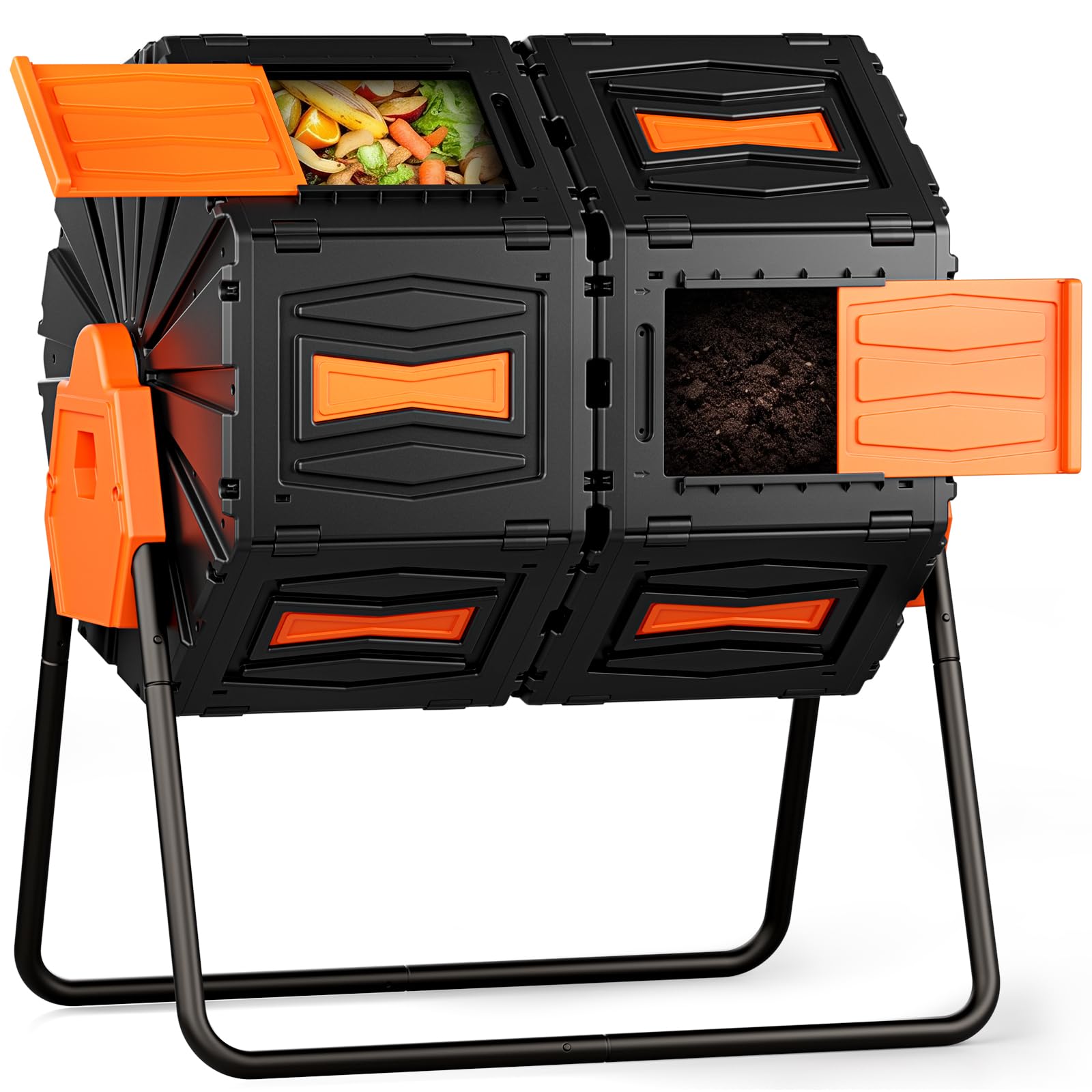
Two 22.5-gallon chambers that clip together with buckles instead of a hundred screws — and an orange door you can find in the dark.
If assembly is the thing that stopped you buying a tumbler, this is the one that flips that. Marcytop connects the frame with buckles and far fewer screws than most competitors, which brings setup time down to roughly 30 minutes even for a first-timer. The payoff is a 45-gallon bin split into two 22.5-gallon chambers — you can start a fresh batch while the other side finishes curing.
The drum itself is extra-thick new polypropylene on a powder-coated steel frame, and it does not rock when you spin it. Aeration holes and deep fins on each panel break up clumps as the drum turns, mixing oxygen through the pile. Rotate five or six times every few days and you are done with the work. Removable doors and wide openings make loading and unloading straightforward, which is why it lands as a sensible first compost bin.
Opinions on turning are mixed — some owners find it spins easily, others say it takes real effort once the chamber is heavy. That is the honest reality of any dual-chamber tumbler loaded with wet scraps, so keep the mix balanced rather than soupy. The 45-gallon split also caps how much you can load per side; if you generate a lot in a week, you will fill both chambers quickly.
The strong case
- Buckle-based assembly cuts screw-driving to a minimum — setup in about 30 minutes
- Two 22.5-gallon chambers let you cure and add at the same time
- Extra-thick PP drum and powder-coated steel frame stay steady when rotating
- Wide openings and removable doors make loading and emptying easy
The caveats worth knowing
- Rotation gets laborious when a chamber is packed full and wet
- 45 gallons split two ways fills faster than the number suggests
- Deep fins can catch long, stringy material
Pick this one for: your first compost bin, when you want two chambers and a gentle assembly curve.
Only if not: you already know you will overload it — a larger single drum suits a busy kitchen better.
6. Greenes Fence Premium Cedar Wood Composter

Four times the capacity of a 37-gallon drum, built from real cedar and put up with a mallet and a morning.
This is the bin for the yard with a leaf problem, not a scrap problem. At 173.92 gallons it dwarfs the tumbling options here — the Hotfrog’s 37 gallons is not even in the same league, and you would need a stack of them to match one Greenes bay. The 36″L x 36″W x 31″H square footprint takes up real ground, but that is the trade for the volume.
Construction is 3/4″-thick sanded North American cedar, made in the USA and supplied as four posts, 24 boards, and 40 spacers. Assembly is what people talk about most favorably — a rubber mallet is your only tool, and owners mention getting it up in under 30 minutes, with one happy owner calling it “exactly what I was looking for.” The gaps between slats drain excess moisture far better than a sealed tumbler, so the pile does not turn to sludge.
Cedar’s natural oils are what protect the wood outside, and the material is genuinely pleasant — it smells good and looks like garden furniture rather than plastic tub. The honest caveat is the slats, thin enough to splinter at the ends if you strike them wrong. Use a rubber mallet, hit near the posts, and slide the spacers fully into the dovetail grooves. Treat it gently and you get a bay you can grow: Greenes sells add-on kits that turn it into a two- or three-bin system.
Build quality read: Real 3/4″ North American cedar, made in the USA, with a natural oil content that lets it face the weather. The finish is smooth enough that you can skip sanding.
Where it demands care: Slats and spacers are delicate to join — tap gently, and the reward is a sturdy, breathing bay. Greenes also replaced a cracked post for one buyer without argument, which is worth knowing.
Go cedar if: you have a big yard, want a bin that looks like it belongs in a garden, and are happy to swing a mallet instead of a turning handle.
Not your pick if: you want a sealed, animal-proof container — this is an open bay with gaps between boards.
7. Compost Wizard Jr. Tumbler
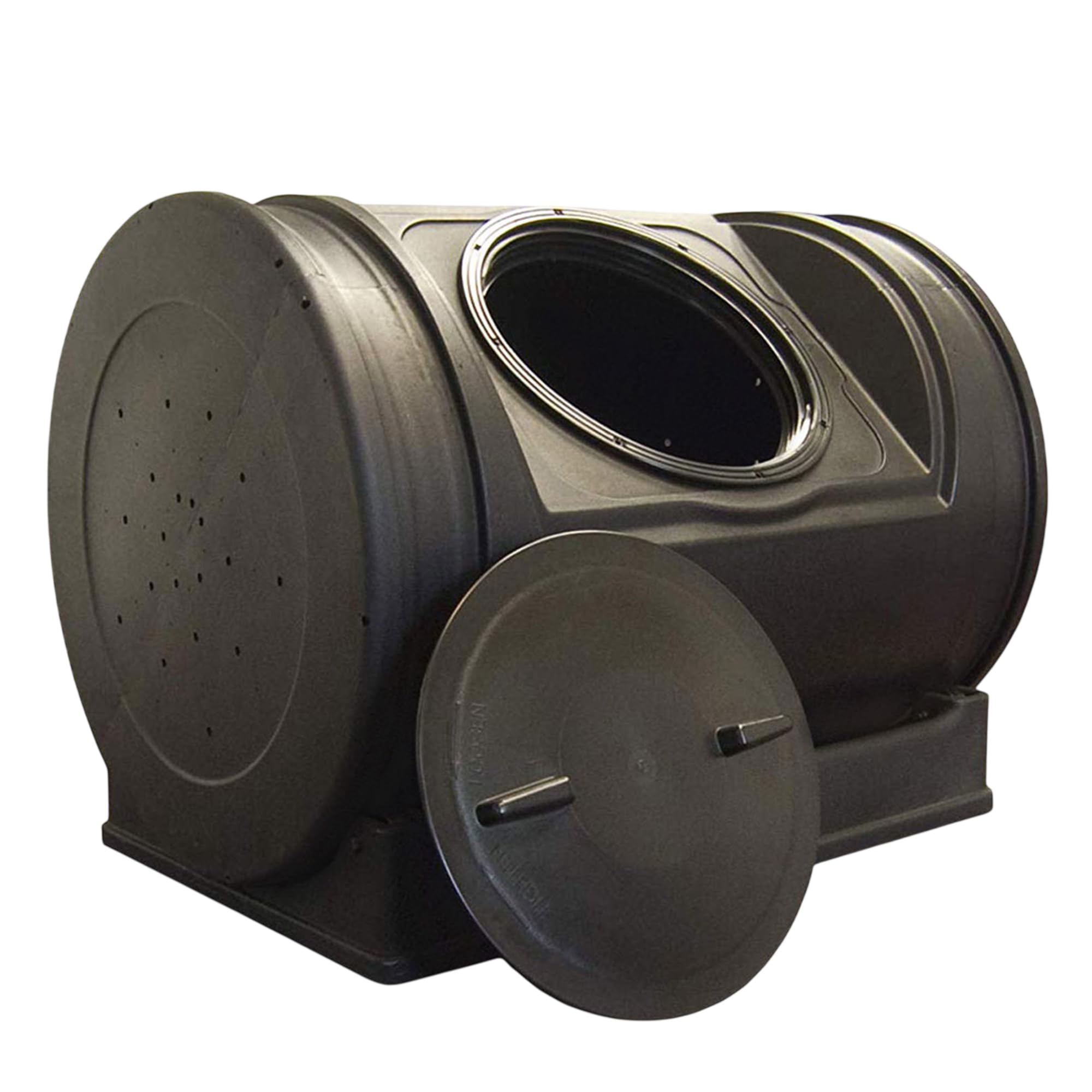
Shows up fully assembled on a wheeled base — roll it to the sunny spot and start composting today.
No screws, no mallet, no 30-minute build. The Compost Wizard Jr. arrives ready to fill, which is a real advantage over every tumbler on this list. The single 50-gallon chamber (listed as 7 cubic feet) holds a batch in a compact footprint, and molded handholds do double duty as agitators when you turn the drum.
Twelve-inch twist lids seal in heat and moisture to keep the pile cooking, and the black drum absorbs sunlight to speed the process from outside. A wheeled base lets you reposition the whole bin around the yard without lifting. It is the easiest tumbler here to live with: it arrives assembled, so there is nothing to build and nothing to adjust.
The trade-off is the drum’s own weight. Once it is full and wet, turning takes real effort, and the single chamber means you have to stop adding on one end while the batch cures. There is no second drum to alternate into, so plan for a pause between batches. Otherwise, the design holds up as a low-maintenance backyard unit that is safe for pets and kids once the lid is twisted shut.
The no-setup win: Ships fully assembled on wheels. That is the entire advantage over every flat-pack drum in this guide — you save an afternoon.
The honest limit: One chamber, 50 gallons, and a heavy drum to spin once it fills. Great for a steady single batch, awkward if you want nonstop throughput.
Perfect for: a gardener who wants a tumbler that works from the start and moves around the yard on a wheeled base.
Better choose a dual chamber if: you want to keep adding waste while a batch cures — this one makes you wait.
Know the Specs
Capacity in gallons vs. liters
Capacity tells you how much raw material the bin holds before it is full. A 37-gallon tumbler suits a two-person kitchen; an 80-gallon static bin handles bulk leaves and clippings; a 50-liter worm tray is measured differently because it processes food into castings rather than holding a bulk pile. Bigger is not always better — an oversized bin never builds enough mass to heat, and an undersized one fills before the first batch finishes.
Aeration holes and internal fins
Compost needs oxygen to break down without going anaerobic (the smelly state). Aeration holes let air in from outside, and deep fins inside the drum break up clumps so oxygen reaches the center. That is why tumblers with internal baffles mix faster than a static pile. The trade-off: large holes also let in rain and black soldier flies, so smaller or taped-down holes keep airflow without the pests.
Tumbler vs. static vs. worm bin
A tumbler saves your back — rotate it and the mixing is done. A static bin relies on airflow from vents and an open bottom, needs no turning, but breaks down slower. A worm tray uses worms to convert food scraps into castings and produces liquid worm tea through a spigot. Pick by waste type and effort: a tumbler for mixed kitchen scraps you will turn, a static bin or cedar bay for bulk yard waste, a worm tray for food scraps with no turning.
Material and weather resistance
Polypropylene and HDPE resist UV fading and cracking, but thin panels can flex and lids can lift in wind. Cedar boards breathe and drain far better than plastic, at the cost of some splintering on cut ends. Any bin outdoors needs a lid that seats firmly and a base or frame that holds steady when full and heavy. Check whether the base can be staked down before windy season.
Common Questions
Will a compost tumbler work in winter?
Can I put meat and dairy scraps in an outdoor compost bin?
How long does it take to get finished compost?
Do I need to add worms to a worm composter?
Why does my compost bin smell bad?
Will an outdoor compost bin attract rats or raccoons?
How much space does a compost bin need?
Can I compost grass clippings in a tumbler?
Do I need two compost bins running at once?
What is worm tea and how do I collect it?
The Bottom Line
For most people, the winning outdoor compost bin is the Original Vermihut 5 — it runs quietly on food scraps, needs no turning, and tucks into a porch corner at 16″L x 16″W x 15″H, with worms that thrive in it. If you want a tumbler that alternates batches, grab the FCMP Hotfrog with its two separate 37-gallon drums. And for sheer volume — leaves, clippings, and yard waste — the Greenes cedar bay at 173.92 gallons is the one to reach for. The Vermihut 5 backs that up with 4.5+ stars across 750+ owners — the kind of loyalty that means a bin actually gets used all year.
How we choose
We do not accept paid placement. Every pick is matched to a real buyer and a real use-case; we do not hands-on test units.
Sources
Specifications: manufacturer listings and product documentation. Review insights: verified customer reviews, as of October 2026. Pricing: not shown on this page (it changes often); check the current price via the retailer link.
As an Amazon Associate, Aappliancez earns from qualifying purchases. This does not affect which products we feature.