Disclosure: Some links in this post are affiliate links. As an Amazon Associate I earn from qualifying purchases, at no extra cost to you. Learn more
Specs are compiled from manufacturer listings and verified buyer reviews and can change over time — please confirm the key details on the product page before buying.
If your eyes feel gritty and tired by mid-afternoon, the problem usually isn’t a lack of water — it’s a lack of oil. Meibomian gland dysfunction (MGD) means the tiny glands along your eyelid rims stop releasing enough oil, so the watery layer of your tears dries out too fast. The drops that help most are lipid-based or thick lubricants, preservative-free, and dosed in single-use vials. Below you’ll find five that fit that brief.
This guide is built by comparing the manufacturers’ published specifications and the patterns across verified customer reviews, so you get each pick’s real strengths and trade-offs instead of marketing spin.
You’ll see which formula ingredients actually matter for oil-deficient tears, which picks suit post-surgery or contact-lens eyes, and which bottles fight back when you squeeze. Here is the shortlist of the best OTC eye drops for meibomian gland dysfunction you can order today.
Top Picks

How To Choose OTC Eye Drops for Meibomian Gland Dysfunction
MGD dry eye is not the same as ordinary tired eyes. When your oil glands underperform, your tears evaporate too quickly, which leaves a gritty, burning, sandy feeling even when your eyes are technically wet. So the drops you choose need to do one of two things: add oil back, or coat the surface thick enough that the water stays put. Here are the four decisions that matter.
Look for a lipid layer, not just water
The thin oil film on the surface of your tear is what stops moisture from evaporating between blinks. A drop built around castor oil, a lipid nano-emulsion, or flax seed oil can reinforce that film, whereas plain saline just flushes the eye and disappears. Check the ingredient list for hyaluronic acid, castor oil, or a named lipid ingredient before buying.
Preservative-free or nothing
Preservatives like benzalkonium chloride keep a bottle stable over weeks, but they also irritate a tear film that is already fragile — which is why most MGD-friendly formulas skip them entirely. Preservative-free means single-use vials or a special bottle that seals out air. If you dose more than four times a day, this is the one line item you should not compromise on.
Vial or bottle — the daily rhythm
A single-use vial is sterile until you open it, and you throw the rest away. A multi-dose bottle is cheaper per drop but loses sterility every time you touch the tip to your eye or eyelid. For MGD eyes that need drops at your desk, in your car, and by the bed, a mix of both works: carry vials, keep a bottle at home for multiple doses.
Check the label for post-surgery and contact-lens suitability
If you have had LASIK, cataract surgery, or you wear contacts, look for preservative-free and minimal-ingredient formulas. A drop with hyaluronic acid and simple electrolyte inactives (sodium chloride, potassium chloride, calcium and magnesium chloride) is gentler for a healing or contact-wearing eye than one loaded with extra additives.
Side-by-Side Comparison
| Model | Best For | Rating | Format | Key Ingredient | Amazon |
|---|---|---|---|---|---|
| Refresh Optive Mega-3 (3 Pack, 30 ea)★ Best Overall | Everyday MGD relief | 4.5+ | Single-use vials | Flax seed oil + CMC | Amazon |
| TheraTears Dry & Tired VialsBest for Screen Eyes | Screen fatigue & post-LASIK eyes | 4.5+ | 30 single-use vials | Carboxymethylcellulose + electrolytes | Amazon |
| Blink Triple Care | All-day moisture with one drop | 4.0+ | 0.34 fl oz bottle | Hyaluronic acid + castor oil | Amazon |
| Complete Preservative Free Dry Eye Drops (2 Pack) | Value two-pack for daily use | 4.5+ | 0.33 fl oz, 2 bottles | Preservative-free lubricant | Amazon |
| Refresh Optive Mega-3 Vials (2 Pack) | Severe, chronic dry eye | 4.5+ | 30 vials, 2-pack | HydroCell lipid formula | Amazon |
Detailed Reviews
1. Refresh Optive Mega-3 Eye Drops Pack of 3
Our pick — 4.5+★ from 27,000+ verified ratings; the strongest balance of quality and price.
If your dry eye is the evaporative kind, this flax seed oil formula is the one to reach for first.
Refresh Optive Mega-3 is built for eyes that lose moisture because the oil layer is thin — the exact problem MGD creates. Its flax seed oil and carboxymethylcellulose sodium (a thickener that holds water against the eye) work together so the drop stays resident longer instead of vanishing in seconds. You get 30 single-use sterile containers in each box, and this listing is a pack of three, so 90 doses in total. That is the whole reason this pick sits at the top.
What earns the most gratitude in the review pages is straightforward relief — the drop calms gritty, burning, tired eyes and keeps them comfortable through a workday. Blurred vision clears quickly after instillation, and the preservative-free formula means you can dose several times a day without the sting of a bottle preservative. It also works as a rinse: if a fleck of debris gets in, a vial flushes it cleanly.
Now the honest part. This is the most expensive format you can buy, and the review pages will tell you so — the value gripes are real and consistent. Several buyers also mention a stinging sensation on first drop, especially if their eyes are already irritated. If you are on a budget or need a bottle you can leave on the desk indefinitely, drop down to the Complete two-pack. But for eyes that need a lipid boost and the sterility of single-use, this is the formula to anchor your routine around — the crowd favourite at 4.5+ stars across 27,000+ reviews.
Why it leads this shortlist
- Flax seed oil plus carboxymethylcellulose delivers a genuine lipid layer, not just water
- 90 sterile single-use doses across the three boxes — nothing to contaminate
- Quick relief from gritty, burning, tired eyes that lasts through the workday
- Doubles as a gentle rinse for debris in the eye
What to weigh before you click
- Priciest per-dose format on this list, and buyers consistently flag it
- A minority report stinging on first instillation
- Each container is one-use only — no capping and reusing
Go for it if: your dryness flares with screen time, air conditioning, or contact-lens wear and you want the best lipid formula available.
Think twice if: you need a bottle for the bedside table and dislike paying per-vial — the Complete two-pack below is the budget-friendly answer.
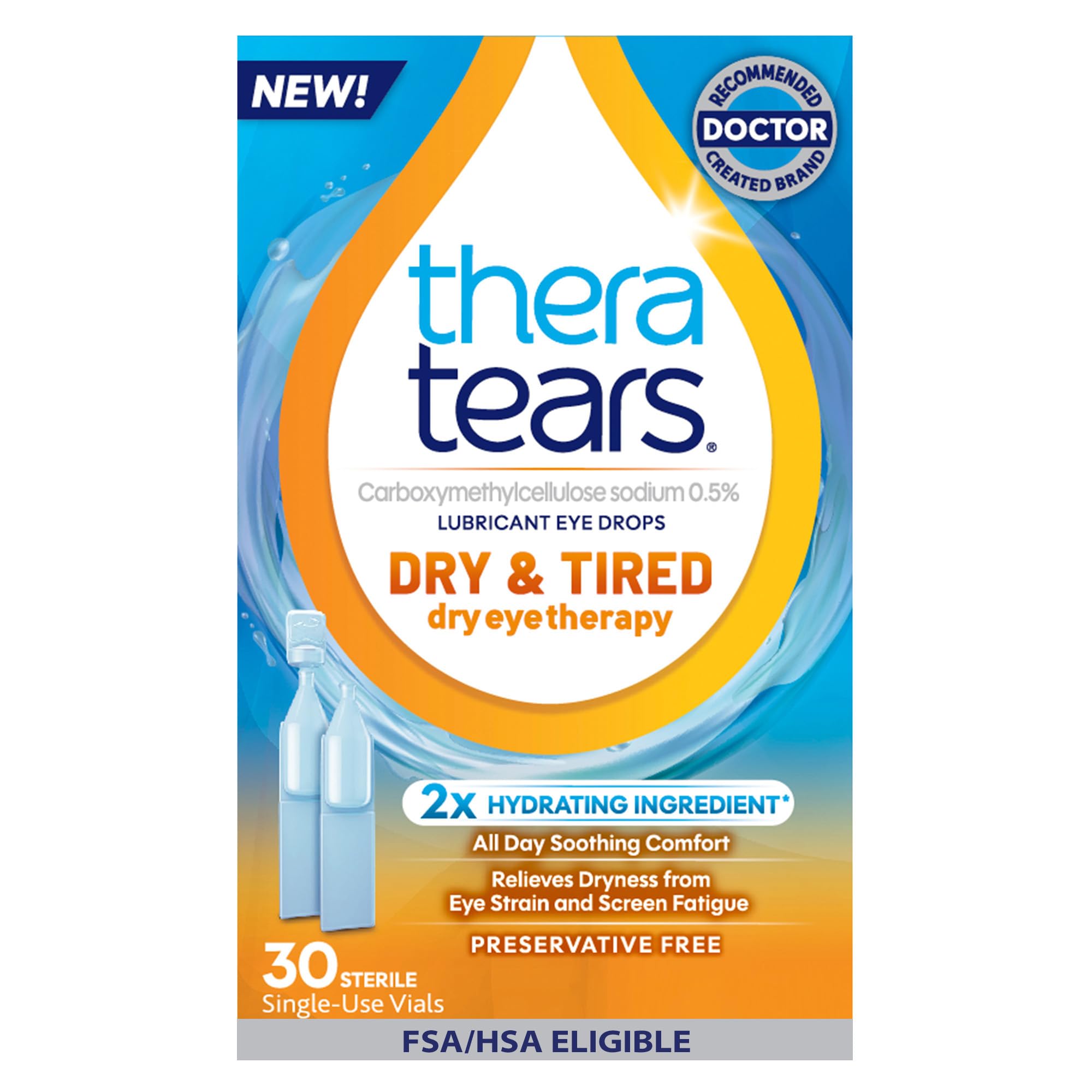
2. TheraTears Dry & Tired Eye Drops 30 Ct
Twice the hydrating ingredient of the original formula, packed into a vial the size of your thumb.
If you stare at a monitor for eight hours, the gritty end-of-day feeling you get is classic screen fatigue — your blink rate drops and the tear film thins. TheraTears Dry & Tired is designed for exactly that. It carries twice the hydrating ingredient of TheraTears’ original formula, so each drop holds more water against the surface. The vial is genuinely portable: 2.13 inches long and 2.08 ounces for the whole box, small enough to sleep in a jacket pocket. Compare that to the Refresh three-pack at 4.75 inches and 2.08 ounces per box — the TheraTears box is far more upright and easier to slip into a bag.
The formula itself is a simple carboxymethylcellulose base with minimal electrolyte inactives — sodium chloride, potassium chloride, calcium and magnesium chloride. That is about as short an ingredient list as you will find, and it makes the drop gentle on sensitive eyes. Post-LASIK buyers report each vial coats both eyes with a bit left over, and it hydrates without the blurry-aftermath that thicker gels can leave. People who work under blue light report the same: relief that arrives almost immediately and doesn’t fade in an hour.
Where does it fall short? The box holds 30 vials — half the dose count of the Refresh three-pack — and the per-dose cost is higher than a multi-dose bottle. Some owners mention a stinging sensation, usually when the eye is very dry at the start. It is also a thinner drop than the lipid-heavy formulas, so for evaporative MGD you may find yourself re-dosing more often than with the Refresh Optive Mega-3. The trade-off is a cleaner, more portable formula with a shorter ingredient list.
Best-fit profile: This one suits you if you sit at a desk all day and want a small, sterile vial (a sealed single-use container) that slips into a pocket or purse without a second thought.
The honest catch: 30 doses per box and a water-based formula means more frequent re-dosing for serious MGD — the Refresh pack gives you three times the vial count at a similar format.
Reach for this if: screens are the main trigger and you want a minimal-ingredient drop you can carry anywhere.
Look elsewhere if: you need a lipid layer for evaporative dryness or you want the lowest cost per dose.
3. Blink Triple Care Eye Drops
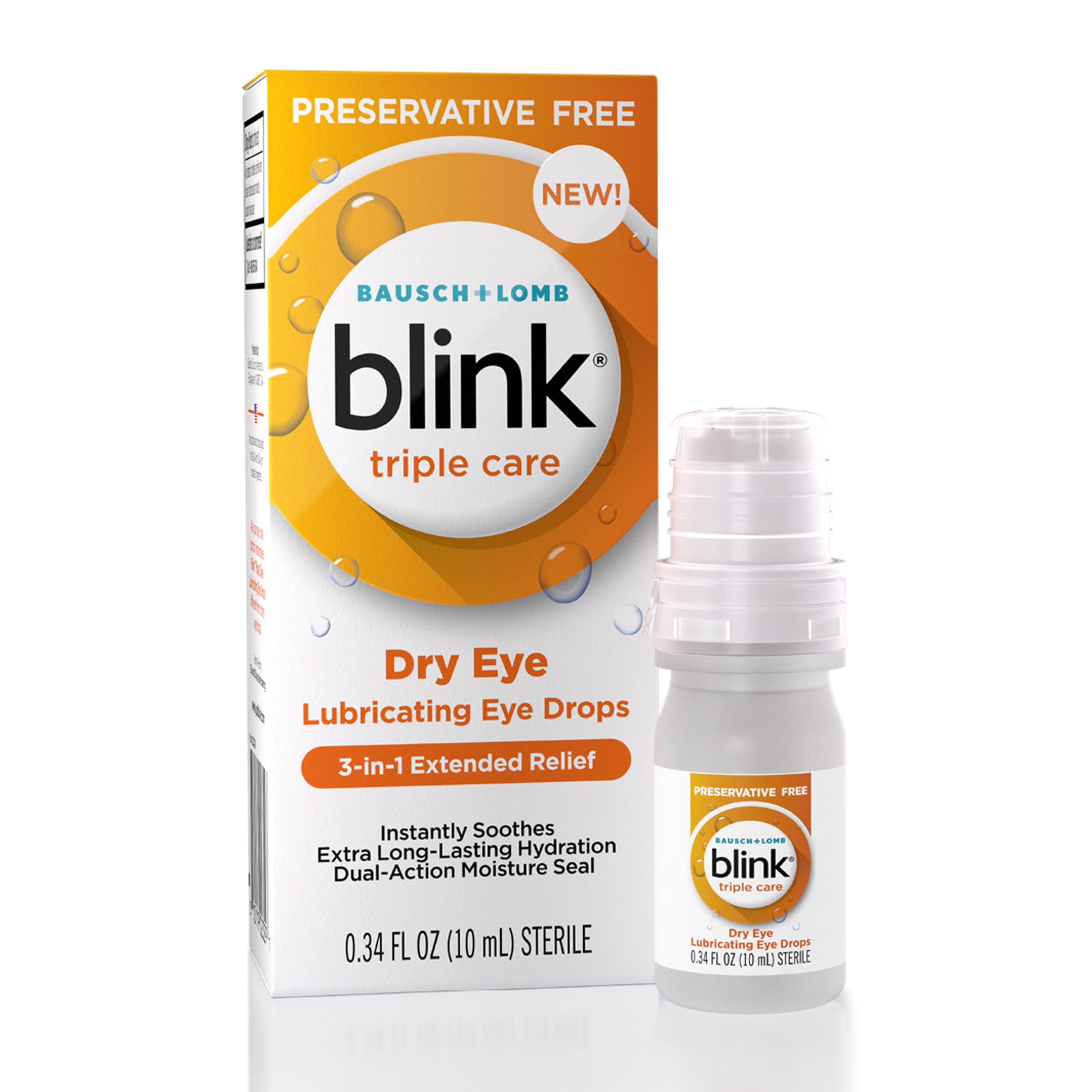
One drop in the morning, and the manufacturer claims up to 10 hours of relief.
Blink Triple Care works differently from the vials above: it comes in a multi-dose bottle with a visco-elastic formula (a drop that thins when you blink and thickens between blinks to steady the tear film). Two active ingredients do the work. Hyaluronic acid holds a large amount of water, and natural castor oil sits on the surface and slows evaporation. Together they form a dual-action moisture seal. The maker claims 93% of users in an in-home study reported feeling better, with relief lasting up to 10 hours.
Owners who size this up against other drops often say the same thing: it lasts longer than anything else they have tried. The single-drop dose suits eyes that hate a flood of liquid, and the formula is gentle on very sensitive eyes — a common comment is that it works without the burn. At 0.34 fl oz the bottle is small, 4.13 inches long and 0.64 ounces, so it slides into a pocket or glovebox without a second thought.
Know this before you buy: the bottle is the recurring problem. Several customers note it is genuinely hard to squeeze. Once the collapsible reservoir is pressed in, it does not reinflate, so you can get as few as 10 uses before the bottle stops delivering, even with three-quarters of the fluid still inside. That wastes product, and at this price it stings. The drops themselves are effective and long-lasting; the container is what will test your patience.
What wins people over: the longevity. A morning drop that carries you to evening is a genuine upgrade over drops you reapply every two hours.
The real trade-off: the squeeze bottle. Treat it gently, don’t crush it, and you’ll get more out of each fill.
This one is for you if: you want fewer applications per day and a bottle you can stash anywhere.
skip it if: hand strength or bottle mechanics are a frustration — the single-use vials here avoid that problem entirely.
4. Complete Preservative Free Dry Eye Drops, 0.33 Fl Oz, 2 Pack
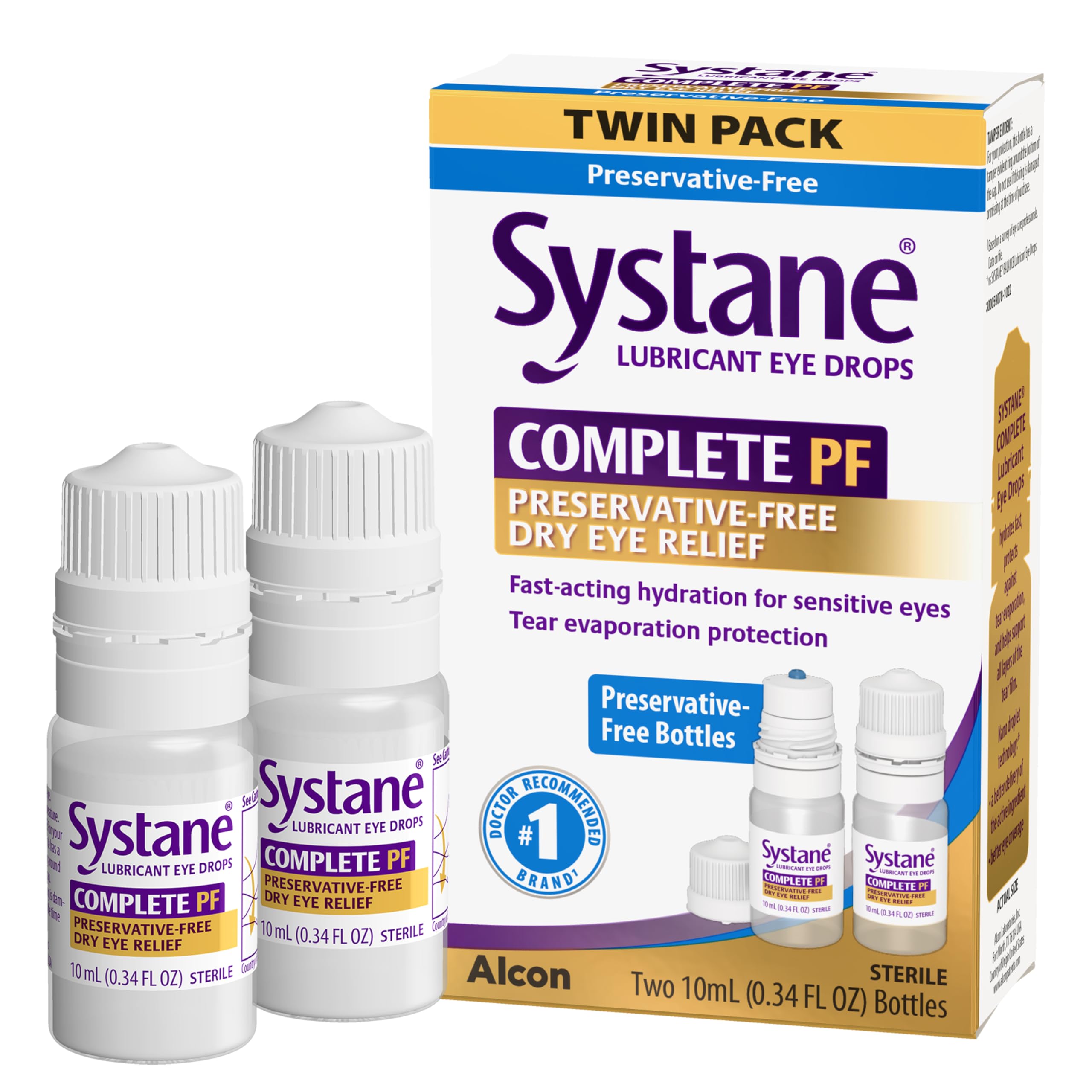
The two-bottle workhorse for people who dose all day long and don’t want to count vials.
Complete takes the opposite approach to the single-use picks: two 0.33 fl oz bottles, preservative-free, meant to live on your desk and your nightstand. If you go through drops four or five times a day because of air conditioning, allergies, or plain old screen fatigue, this is the format that won’t have you rationing. The drops are slightly oily and very lubricating, and buyers who use them through allergy season report waking up without the morning grit.
What stands out in owner feedback is the sheer consistency of relief — this formula keeps eyes from drying out through the day, and people who have tried several brands often land here and stay. It is also a popular choice after cataract surgery, where the gentle preservative-free formula suits a healing eye. One post-LASIK buyer describes the drops as milky-white, refreshing, and helpful through recovery, dosing twice a day plus as needed.
Now the dropper. The bottle design gets mixed reactions — some buyers love the nipple-tip delivery and find it easy, while others find the flat-top bottle messy, with drops running down the face. It can take a week or two to master the angle. There is also a subset of buyers who find the formula slightly irritating, though that is far outweighed by the people who use it daily without issue. Shake before each use, because the preservative-free formula separates.
The value read: two full bottles beats a box of vials if you dose constantly — no per-use ceiling, and you can leave one at home and one at work.
What to expect on day one: a learning curve with the dropper. Aim for the inner corner and squeeze gently.
Pick this one when: you need drops multiple times a day and a two-pack at home makes more sense than a pocketful of vials.
Look at the vials if: you want sterile, pre-measured doses and can’t be bothered mastering a bottle angle.
5. Refresh Optive Mega-3 Eye Drops Pack of 2

HydroCell lipid technology in a 60-vial two-pack, built specifically for MGD eyes.
The maker actually names the problem on the box here: this is formulated for people with meibomian gland dysfunction. The HydroCell technology is designed to hydrate the ocular surface and support all three layers of the tear film, which is the exact structure that MGD breaks down. The formula carries carboxymethylcellulose sodium, glycerin, and polysorbate 80 — a lubricant, a moisture-holder, and an emulsifier that helps the oil and water mix. No shaking required, and no preservatives. You get 30 vials per box, two boxes per order, so 60 doses total.
This pick separates itself from the single-box version above by how it handles chronic cases. For eyes that are severely dry, the note that keeps coming back is staying power — these drops do not evaporate right after you put them in, which is the exact failure point of thinner formulas. For people whose eyes fight back against everything else, that difference is the whole game. Buyers also like that the single-use tubes travel easily, so a dose is always within reach in a bag or a drawer.
The trade-off is the same one every lipid vial shares: cost. This is the premium-tier box on this list, and some buyers find it steep compared to a bottle they can use for weeks. It’s also a 0.01 fluid ounce vial — small, and one dose per container with no reuse. If those constraints fit your budget and your routine, the formula itself is as targeted as OTC drops come for MGD. For severe, stubborn dryness, this is the pick worth building your day around.
Where it pulls ahead
- Explicitly designed for MGD, per the manufacturer’s own labeling
- HydroCell lipid formula supports all three tear film layers, not just the water layer
- Stays on the eye instead of evaporating quickly — the difference chronic-dry-eye buyers notice most
- 60 preservative-free vials, no shaking needed, easy to carry
What you should know
- Premium-tier pricing per dose compared with a multi-dose bottle
- Small 0.01 fl oz vials mean one dose per container, no topping off
- MGD-specific formula is a strength, but it doesn’t suit every eye style — try a box before committing to a bulk order
Built for: severe or chronic dry eye where the oil layer needs real reinforcement and you’ll pay for a formula targeted at MGD.
Not the right fit: budget-first buyers, or people who want a bottle they can leave open and reuse across weeks.
Know the Specs
Lipid vs. water-based formulas
A “lipid-enhanced” drop carries oil — castor oil, flax seed oil, or a nano-emulsion — that reinforces the outer oil layer of your tear. That layer is exactly what MGD weakens, which is why lipid formulas matter more for this condition than plain water-based tears. Water-based drops like TheraTears hydrate the middle layer well but do not replace the missing oil, so you may re-dose more often.
Preservative-free
Preservatives keep multi-dose bottles stable but can irritate an already-fragile tear film, especially when used more than four times a day. Preservative-free formats — single-use vials or sealed no-preservative bottles — keep the formula clean without that additive. If your eyes are post-surgery or contact-lens sensitive, this is the spec to check first.
Common Questions
Are these eye drops safe to use with contact lenses?
How is MGD dry eye different from regular dry eye?
How many times a day can I use preservative-free drops?
Is it better to use single-use vials or a multi-dose bottle?
Do lipid eye drops actually stop my tears evaporating?
Can I use these after cataract or LASIK surgery?
Why does the Blink bottle stop working before it’s empty?
Do these drops blur your vision after applying?
How long does a box of single-use vials actually last?
Should I choose the flax seed oil or the castor oil formula?
The Bottom Line
For most people dealing with MGD, the otc eye drops for meibomian gland dysfunction winner is the Refresh Optive Mega-3 three-pack. Its flax seed oil and carboxymethylcellulose formula (a lubricant that holds water on the eye) reinforces the lipid layer (the oily top layer of your tears) that MGD strips away. You also get 90 sterile single-use doses, so each application stays clean. If screen time is your main trigger and you want a minimal-ingredient drop that slips into a pocket, the TheraTears Dry & Tired vials are the sharper fit. For severe, chronic dryness where staying power matters most, the Refresh Optive Mega-3 two-pack is the one explicitly built for MGD. One honest nudge: both Refresh formulas hold the highest rating in this group, 4.5+ stars across tens of thousands of reviews.
How we choose
We do not accept paid placement. Every pick is matched to a real buyer and a real use-case; we do not hands-on test units.
Sources
Specifications: manufacturer listings and product documentation. Review insights: verified customer reviews, as of October 2026. Pricing: not shown on this page (it changes often); check the current price via the retailer link.
As an Amazon Associate, Aappliancez earns from qualifying purchases. This does not affect which products we feature.