Disclosure: Some links in this post are affiliate links. As an Amazon Associate I earn from qualifying purchases, at no extra cost to you. Learn more
Specs are compiled from manufacturer listings and verified buyer reviews and can change over time — please confirm the key details on the product page before buying.
If you’re buying your first pair of hearing aids, the one that’s worth your money is the one that stops whistling before it starts and lets you hear a conversation instead of the fridge hum. Feedback control and speech clarity are what decide whether they stay in your ears. The picks below split into two rough groups: tiny in-canal aids that disappear in your ear, and receiver-in-canal models that sit behind it. Which one you want depends almost entirely on how much fiddling you can tolerate on day one.
This guide is built by comparing the manufacturers’ published specifications and the patterns across verified customer reviews, so you get each pick’s real strengths and trade-offs instead of marketing spin.
You’ll see how many hours each pair runs on a charge, how the feedback control behaves in real rooms, and where the honest limits sit. By the end you’ll know which of these OTC CIC hearing aids actually suits your ear shape and your daily routine.
Top Picks
How To Choose The Best OTC CIC Hearing Aids
Forget the box copy for a second. Three things decide whether a pair of hearing aids ends up in your ears every morning or in a drawer by week two: how well it seals your canal, how fast it charges, and whether you can change the volume without a struggle. Seal, charge speed, and volume control outweigh every other spec on the box.
Seal beats specs every time
A hearing aid that doesn’t seal your ear canal will whistle, no matter how good the chip inside is. That squeal is feedback — sound leaking out of your ear and bouncing straight back into the microphone. The fix is almost always a different dome size, not a different device. Look for a set that ships with several dome options, and expect to try more than one before it feels right.
Charge time versus runtime
These are two different numbers and buyers mix them up constantly. Charge time is how long the aids sit in the case before they’re full. Runtime is how many hours you actually get in your ear. A pair that fills in an hour but only runs a short day is a different tool from one that takes longer to top up but carries you to bedtime. Check both before you decide.
Self-fitting versus in-office tuning
Some models run a hearing test through a phone app and build your profile from there, so you never book an appointment. Others ask you to adjust volume and tone by hand until it sounds right. Both approaches work; the choice depends on how you like to set things up. Self-fitting suits anyone who wants to set it up on a Sunday afternoon; manual control suits anyone who likes tweaking as they go.
Where Bluetooth earns its keep
Streaming phone calls and TV audio straight into your ears is genuinely useful if you’re on the phone all day or struggle with dialogue on screen. It’s dead weight if you mainly need help across a dinner table. Be honest about which person you are — that single question removes half the models on this list.
Side-by-Side Comparison
| Model | Best For | Fit Style | Runtime Per Charge | Bluetooth | Amazon |
|---|---|---|---|---|---|
| Nova Hearing Aids (iBstone)★ Best Overall | First-time wearers | Completely in canal | 20 hours | — | Amazon |
| Flaygo ProFeatherweight Pick | Ultra-small discreet wear | In-ear, 2 grams | Case holds 7 days of charges | — | Amazon |
| Lexie B3 Powered by BoseBest For Streaming | Streaming calls and TV | Receiver-in-canal | Up to 32 hours | Yes, iOS & Android | Amazon |
| Eargo SE | Nearly invisible fit | Completely in canal | Up to 16 hours | No | Amazon |
| MDHearing NEO XS | Small ear canals | In-ear, nearly invisible | Full day; case adds 6 charges | — | Amazon |
| ELEHEAR Beyond | App control and calls | Receiver-in-canal | Up to 20 hours | Yes, iOS & Android | Amazon |
| Vivtone Xpure | Bluetooth on a budget | Receiver-in-canal | Up to 24 hours | Yes, iOS 12 & Android 11+ | Amazon |
| AuraLink (iBstone) | Active, sweaty days | Receiver-in-canal | — | Yes, Bluetooth 5.4 | Amazon |
| Sennheiser All-Day Clear | All-day comfort and calls | Receiver-in-canal | Up to 24 hours | Yes, iOS & Android | Amazon |
Detailed Reviews
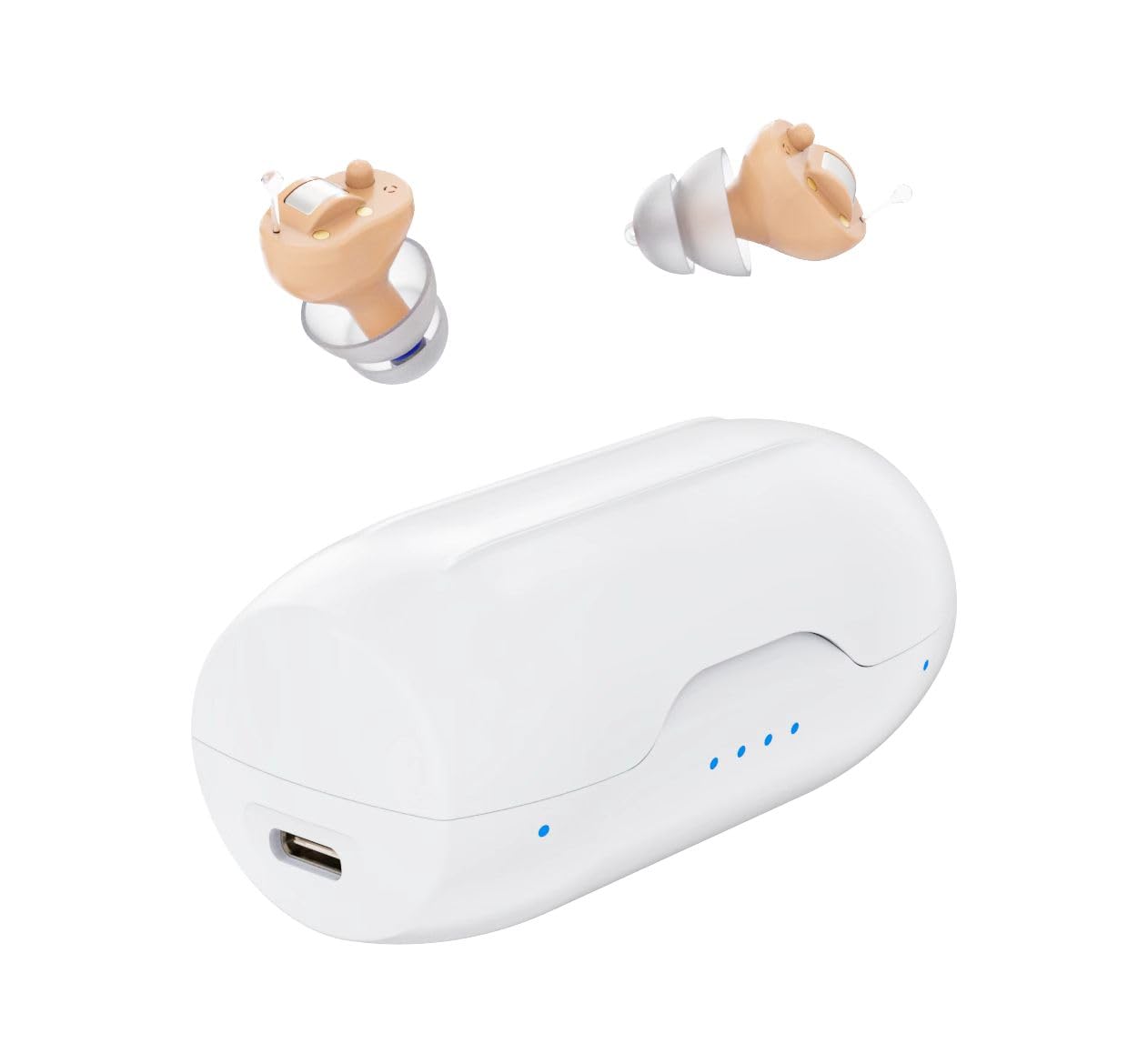
1. Nova Hearing Aids for Seniors Adults (iBstone)
A completely-in-canal aid for first-time wearers that reaches a full charge in 1.5 hours.
Start with the number that shapes your whole week: 1.5 hours to a full charge, and 100 hours of working time from the set. That’s the aid plus its drying case doing the heavy lifting, so a Sunday top-up carries you through to the following weekend. Compare that with the Flaygo Pro, which fills in 1 hour — the Nova asks for half an hour more at the plug. In practice that’s the difference between charging over breakfast and charging over breakfast plus a coffee.
On sound, the maker claims 80% background-noise reduction from its chip. Hearing-aid marketing leans on that kind of figure, so treat it as the design goal rather than a lab result. What holds up is the feedback story: the case doubles as a dryer that pulls moisture out of the aids overnight, and dry aids whistle less. Owners lean on that. The praise that stacks up highest is build quality, followed by clarity of speech — the recurring line is that these hold their own against far dearer clinic pairs. As one buyer put it, “I’ve had ones from an audiologist and these comparatively are much better performing with less feedback!”
Where it wobbles is the controls. Changing volume means cycling through settings one press at a time, and you can’t power them off while they’re still in your ears. A few owners also found the drying case fussy. Fit is the real wildcard — nine pairs of soft tips come in the box, and the honest truth is that a good seal matters more than any chip. Insert them firmly with the right dome and the whistle stops; get the dome wrong and it won’t.
What earns its place
- 1.5-hour charge for 100 hours of total working time with the case
- Completely-in-canal design that sits out of sight
- Drying case pulls moisture out overnight, which helps keep feedback down
- Nine pairs of soft tips included for dialing in a seal
- 30-day home trial and 12-month service window
What to weigh first
- Volume steps cycle one press at a time rather than jumping straight to your level
- Can’t be switched off while still in your ear
- Case drew mixed notes from some buyers
Reach for this if: you want a discreet in-canal pair, you’re new to hearing aids, and a quick charge matters more than app features.
Look elsewhere if: you expect to fine-tune volume and modes constantly through a phone app.
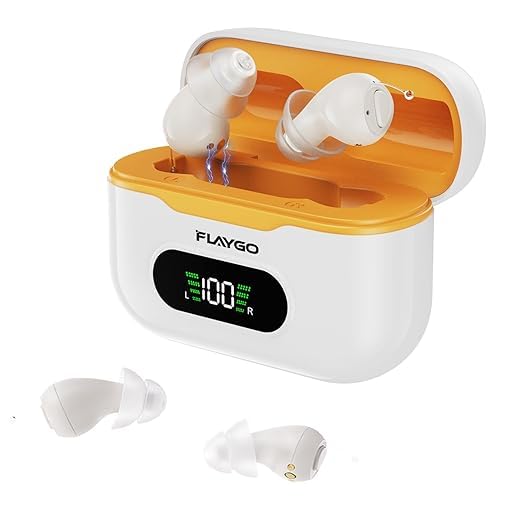
2. Flaygo Pro Hearing Aids with Smart Noise Reduction
Two grams per aid and a case that keeps going for a week between wall sockets.
If you’ve ever taken a hearing aid out at lunch because it felt like a pebble, the Flaygo Pro is aimed at you. Each aid weighs 2 grams, and there’s no left-right distinction — you just put them in. The 32-channel digital chip is the technical heart here, splitting sound into 32 bands so speech and background get handled separately. The practical upshot is that the aids power on with a button press rather than sitting live in your ear, which is how the feedback problem gets killed at the source.
What wins people over most is the sound. Clarity in conversation and in front of the TV is the thing buyers keep coming back to, with noise cancellation close behind. Setup is deliberately plain: no app, no pairing, charge them and wear them. The case shows the exact battery percentage on a display, and when 10% is left the aids announce “00” out loud so you’re never caught out mid-conversation.
The catch is how much sound the seal blocks. Wearing both at once can create a closed-in, tunnel-like feeling because the noise filtering adjusts itself continuously — one buyer only wears a single aid at a time for that reason. A few also pushed back on the “not an amplifier” claim. Fit with the correct ear tip is what separates a comfortable day from a frustrating one.
The hygiene angle: the charging case runs UV cleaning while the aids sit inside, which is a practical touch for anyone who dislikes handling tiny components every night.
Sound-first, app-last: 32 channels and 4 volume levels with voice announcements mean you can check the setting with your eyes closed — genuinely useful for older users.
Best fit: anyone who wants near-weightless aids, a week of case power, and zero smartphone setup.
Think twice if: you dislike the plugged-ear sensation of a full seal, or you want app-based tuning.
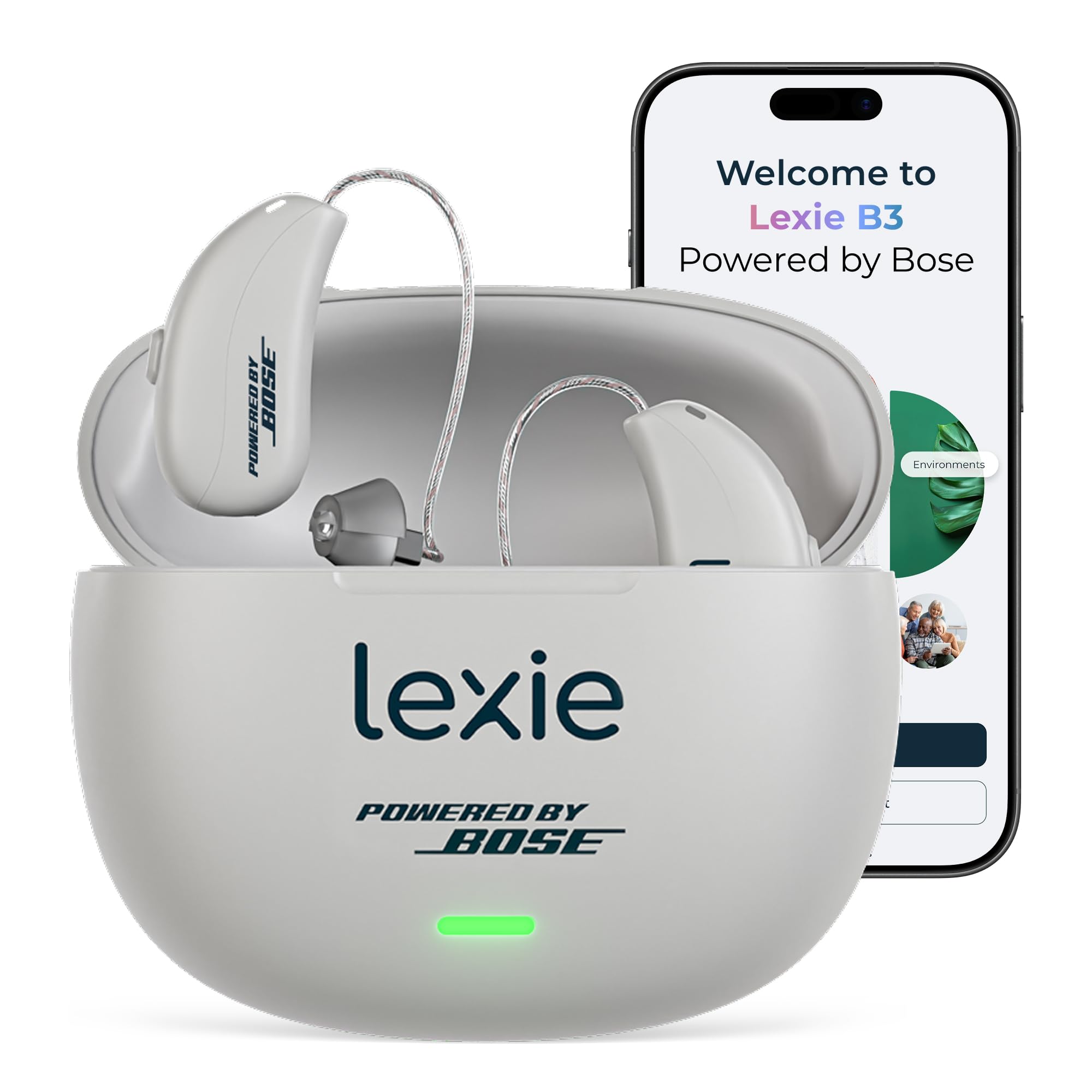
3. Lexie B3 OTC Hearing Aids Powered by Bose
Bose-tuned processing and a case that stretches power across more than five days.
The battery math here is the headline. You get up to 32 hours on a single charge, and the portable case holds 3 extra charges — a total of up to 128 hours, or over 5 days of power before you hunt for a cable. That’s the longest total runtime on this list, which buys slack for anyone who forgets to plug in the case.
The sound side is Bose-engineered, with Automatic Sound Focus steering dual microphones toward whoever’s speaking and cutting the room around them. Six listening programs — 4 environments plus 2 streaming — cover home, outdoors, and phone audio. Self-fitting runs through an in-app hearing test that builds your profile per ear, and separate left-right tone control (bass, mid, treble) lets you balance a lopsided loss. Transparency mode has four levels, so you can blend streaming audio with the room instead of pausing your podcast.
Here’s the honest part, and it’s bigger than a fit note: the company has announced it is winding down US operations. The devices keep working and the app keeps running for now, but warranty and support commitments past that point are unclear. That uncertainty is why the score sits where it does despite genuinely strong hearing performance. Bluetooth is the other split — flawless for some, unreliable for others.
What the hardware delivers: 32 hours per charge, 128 hours with the case, and directional microphones that follow speech instead of amplifying everything.
The long-term question: buying into a product whose maker is exiting the US market means accepting support risk that no spec sheet can offset.
Worth it for: streamers who want Bose tuning, the biggest battery buffer here, and fine per-ear control — and who are comfortable with the support picture.
Not for: anyone who needs a guaranteed warranty and service line for years ahead.
4. Eargo SE Self-Fitting OTC Hearing Aids

So small it vanishes in your canal — and it takes a hearing test to tune it.
Eargo’s whole identity is discretion, and the SE earns it. This is a completely-in-canal aid, meaning it tucks fully inside your ear canal rather than looping behind it. Owners consistently describe it as near-invisible, and the one-gram weight backs that up. The trade you make for that hiding act is simple: no Bluetooth. The SE does not stream music or take phone calls. If calls matter, look at the Lexie B3 or the Sennheiser instead.
Setup runs through the Eargo app’s Sound Match feature, which builds a separate profile for each ear without a clinic visit. Three sizes of Trumpet eartips come in the box, and getting the right one is what makes the invisibility work. Runtime is up to 16 hours on a charge, with the case holding up to 5 full charge cycles on top — enough that you’re not docking them every single night.
Comfort and build quality are what people notice first, and the value read is warm too: buyers regularly compare it favorably against far pricier clinic models. The recurring caveat is sound character — some find it clear and natural, others call it tinny. There’s also a small quirk worth knowing: the charger needs careful seating, and occasionally one aid won’t catch the contact until you reseat it. An honest note on the charger itself — it’s the part most likely to need attention over time.
Why it holds its spot
- Completely-in-canal fit at 1 gram per aid — genuinely hard to spot
- Up to 16 hours per charge plus 5 extra cycles in the case
- Sound Match builds a per-ear profile from your phone
- Three Trumpet eartip sizes for dialing in the seal
- One-year warranty with a support team buyers speak well of
Know before you order
- No Bluetooth — no calls, no music streaming
- Sound splits buyers: clear to some, tinny to others
- Charger seating takes a careful hand
Pick this one if: invisibility is your top priority and you don’t need phone audio in your ears.
Pass if: streaming calls or TV audio is part of why you’re buying.
5. MDHearing NEO XS OTC In-Ear Hearing Aids
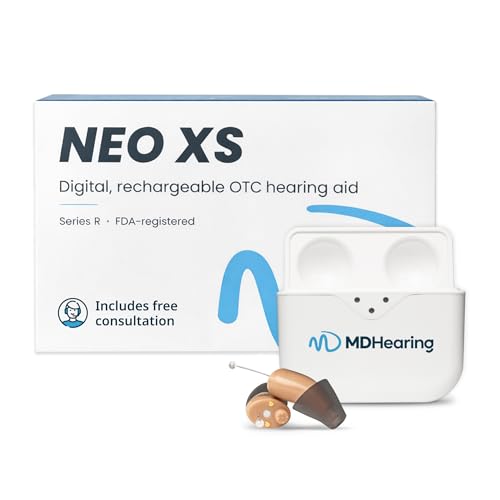
Built narrow for tight canals, with a charger that keeps going after you unplug it.
Narrow canals are the reason a lot of first pairs get returned, and the NEO XS is sized for exactly that problem. The aids measure 0.6 inches long by 0.43 inches wide — small enough to sit inside the canal and stay put. Comfort and small size are the two things buyers bring up most, and owners with tight ears specifically call out that the included small domes make the difference (medium comes pre-fitted, so budget time to swap).
Charging is well thought out. You get a full day on a single charge, and the case itself can refill the aids up to 6 times before it needs a wall socket — handy for a weekend away. The digital processing filters feedback and background noise through several preset audio settings, and a compact button on the aid handles both volume and program changes.
Now the candid part. There’s a known workaround: step up to a larger dome and insert deeper, then give a slight pull so the seal sets. Owners who found that combination report running at higher volume without squeal. Reliability over the long run is the other question mark, so treat the warranty as part of the purchase.
The fit-first design: 0.6 by 0.43 inches is deliberately narrow, and multiple dome sizes ship in the box for anyone whose canal has been a problem before.
The honest caution: if you can’t get a consistent seal, the whistle will follow you — this is a pair that rewards a little patience on day one.
Suits you when: your ear canals are narrow, you want a nearly invisible aid, and you’re willing to experiment with dome sizes to kill feedback.
Skip when: you want a set-and-forget seal with no trial and error.
6. ELEHEAR Beyond OTC Hearing Aids

The app-heavy option with a gain ceiling and a tinnitus toolkit built in.
Two numbers frame this one: a maximum gain of up to 50 dB and up to 24 dB of noise attenuation, aimed at mild to moderate loss. In plain terms, gain is how much louder the aid can push sound into your ear, and attenuation is how much of the room it can turn down. Add the VocClear AI processing and you get the pitch: bring up voices, push back the clatter. Runtime stacks up at up to 20 hours per charge, with the case adding 4 more cycles for a total of up to 100 hours.
The app is where this model separates itself. Volume, per-ear tone, telephone speech enhancement, and a serene sound relief setting all live there, alongside a tinnitus masking feature that plays background sounds to cover the constant hiss some people hear. Whether that matters to you is the whole buying question — if you want granular control in your pocket, this delivers it.
The fair warning is noise handling. Open-plan restaurants are the recurring weak spot; some owners find speech gets buried under cutlery and room echo. Music reproduction is also uneven for a subset of buyers, and Bluetooth calls occasionally drop to one side until you reboot.
The one-line case: 50 dB of gain, 24 dB of attenuation, and 100 hours of total battery make this the most configurable pair here at a mid-tier position.
Where it stumbles: reflective, noisy rooms are its weak spot — the very place a hearing aid is supposed to prove itself.
Choose it for: app-based fine-tuning, phone calls, and a tinnitus masking option in one device.
Look past it if: crowded restaurants are where you most need help.
7. Vivtone Xpure Bluetooth Hearing Aids

Streaming that costs less than most — with a two-and-a-half-hour charge to full.
Want calls and music in your ears without paying top-tier money? The Xpure is the pair to look at. It’s a receiver-in-canal design, so a thin wire runs from the aid behind your ear to the receiver in your canal — that layout is what keeps distortion and feedback down. Bluetooth handles phone calls and audio, and it works with iOS 12 or Android 11.0 and newer, so check your phone’s software before you buy. Full charge takes 2.5 hours for both the aids and the case, which yields up to 24 hours of hearing aid use, or 3 hours of Bluetooth streaming. The case adds about a week of standby power.
There’s a free companion app for fine-tuning volume and frequency, plus onboard buttons if you’d rather skip the phone. Multiple preset modes cover quiet conversation, noisy restaurants, and outdoor settings, and you can switch between them on the device itself. Real-human phone support is a genuine plus for anyone setting these up alone.
Set expectations honestly here. These are aimed at mild to moderate loss, and the output ceiling is capped to avoid distortion, so a severe loss will feel underpowered. Larger canals may struggle to get a solid fit, and the Bluetooth connection has quirks that take some trial and error. Battery duration has drawn mixed notes. When it all lines up — a Galaxy S24 Ultra user reported easy pairing for calls, apps, and video — the value reads clearly.
Value read: 24 hours per charge, a week of case standby, and Bluetooth streaming at the lower end of the mid-range — 24 hours per charge plus Bluetooth streaming at this price is the best streaming value on this list.
Fit note: the same generosity doesn’t extend to large canals, where the fit gets loose. This is a mild-to-moderate tool, not a heavy-loss solution.
Right call if: you want Bluetooth calls and music on a mid-range budget and your loss is mild to moderate.
Wrong call if: your loss is on the severe side, or your canals run wide.
8. AuraLink Bluetooth Hearing Aids by iBstone
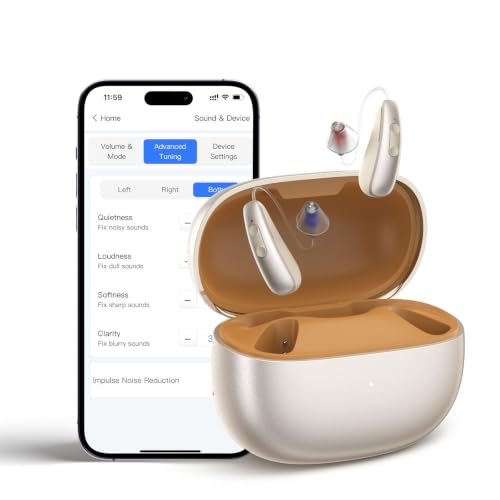
An IP68 rating on a hearing aid — built for sweat, rain, and being dropped.
Most aids on this list are indoor creatures. The AuraLink is rated IP68, which means it’s sealed against dust and survives being submerged in water — a real difference if you garden, golf, or live somewhere humid. It’s also drop-tested to an SGS certification, and it ships with a UV-sanitizing charging case. Bluetooth runs on version 5.4, the newest standard here, which brings lower power draw and a steadier connection than older versions. It’s a receiver-in-canal shape that sits behind the ear, and multiple dome shapes and sizes are in the box.
Sound comes through adaptive AI processing that retunes itself as your surroundings change, aimed at adults with mild to moderate loss (stated as 25-85 dB HL). The free AuraFit app runs a hearing check, builds a precise fitting, and includes tinnitus masking — no clinic appointment needed.
Temper the enthusiasm with the maturity of the listing. Review traffic is thin compared with the other picks, and the notes skew binary: some find the clarity superb for crowds and calls, others find the sound sharp or piercing and return them. One buyer’s spouse with extensive loss found them no help at all, which tracks with the mild-to-moderate target. The case and packaging get consistent praise; the noise handling under pressure is the piece still earning its evidence.
Built for: active wearers who need sweat and rain protection, plus the newest Bluetooth standard for calls and music.
Hold back if: your loss is beyond mild to moderate, or you want a long track record before committing.
9. Sennheiser All-Day Clear Bluetooth Hearing Aids

A familiar audio name brings a receiver-in-canal aid that survives a full day of streaming.
The headline figure is up to 24 hours of continuous use from the rechargeable battery, and buyers report never dropping below 30% across a 17-hour day with streaming on. For anyone who’s worn out a cheaper pair by mid-afternoon, that headroom is the argument. The receiver-in-canal shape is the classic design, with a discreet fit and eight ear tips in sizes S, M, and L tucked in the box alongside wax guards and a cleaning brush.
Setup takes a few minutes through the app, with personalization options and automatic adjustment to whatever sound environment you walk into. Bluetooth handles hands-free calls, podcasts, and audiobooks with a tap on your phone. The package includes a 30-day risk-free trial, and the reliability read is the strongest positive signal here — effectiveness and reliability are what owners keep coming back to.
Now the compromises. You get two sound profiles — auto and music — and nothing that specifically sharpens a voice in front of you in a loud restaurant, which is the classic complaint. Background hiss in quiet rooms shows up in some reports. The charging case has no internal battery of its own, so it needs a wall socket, and the port is micro-USB rather than USB-C. Replacement ear tips have been hard to source at times, so buy spares early.
Strengths worth the money
- Up to 24 hours of continuous use, with battery to spare on long days
- Eight ear tips across three sizes plus wax guards in the box
- Self-fitting through the app with no clinic appointment
- Bluetooth streaming for calls, podcasts, and audiobooks
- 30-day risk-free trial
Where it asks you to compromise
- Only 2 sound profiles, with no dedicated speech-in-noise mode
- Charging case has no internal battery and needs a socket
- Micro-USB charging port rather than USB-C
- Replacement ear tips can be hard to find in stock
The honest verdict: a well-built, genuinely all-day pair from a name you recognize, best suited to phone and media use at home or outdoors.
skip it if: crowded restaurants are your main battleground — you’ll want a model with a dedicated speech-focus mode.
Know the Specs
Runtime Versus Case Capacity
Runtime is the hours you get from one charge in your ear. Case capacity is how many extra full charges the case holds before it needs a wall socket. A pair with up to 16 hours and 5 case cycles is a different proposition from one with up to 32 hours and 3 cycles, even though both are “rechargeable.” Check both figures, because the one you’ll actually live with is the total across a week.
Fit Style: CIC Versus RIC
Completely-in-canal (CIC) means the aid tucks fully inside your ear canal, so nothing shows. Receiver-in-canal (RIC) means a small unit sits behind your ear with a wire running in to a receiver in the canal. CIC hides better; RIC typically leaves room for Bluetooth and directional microphones. CIC wins on discretion; RIC wins on room for Bluetooth and directional microphones.
Feedback And Why It Happens
That squeal is sound escaping your ear, hitting the microphone, and looping back. It’s a seal problem first and a chip problem second. Larger or better-shaped domes, deeper insertion, and a slight outward pull to seat the tip are the standard fixes. A drying case helps too, because moisture degrades the seal and the electronics.
Gain, Attenuation, And Channel Count
Gain is how much louder the aid can make sound, measured in decibels (dB). Attenuation is how much background it can turn down, also in dB. Channel count is how many frequency slices the chip processes separately — more channels can mean finer shaping of speech versus noise. A model listing up to 50 dB gain and 24 dB attenuation is stating its working range, not a guarantee of how it will sound in your ear.
Common Questions
What does CIC actually mean on a hearing aid listing?
Will these hearing aids whistle when I hug someone?
Can I wear these hearing aids while exercising or in the rain?
Do OTC hearing aids work for severe hearing loss?
How long does the battery last on a single charge?
Do I need a smartphone to set these up?
Will a hearing aid that blocks my ear make my own voice sound strange?
Can I stream phone calls and music through these hearing aids?
What happens if the hearing aid company stops supporting the product?
How often should I replace the domes or ear tips?
The Bottom Line
For most people buying their first pair, the otc cic hearing aids winner is the Nova Hearing Aids by iBstone — a completely-in-canal fit you can hide, a 1.5-hour charge, and 100 hours of total working time with the drying case that keeps feedback down. It’s the sensible starting point if you want discretion without app overhead.
If phone calls and TV audio matter more than hiding the aid, the Lexie B3 Powered by Bose gives you up to 32 hours per charge and directional microphones — worth it if you accept the support uncertainty. And for anyone whose ear canals have made every other pair uncomfortable, the narrow-fit MDHearing NEO XS is the one to reach for, provided you’re willing to spend an afternoon getting the dome right.
How we choose
We do not accept paid placement. Every pick is matched to a real buyer and a real use-case; we do not hands-on test units.
Sources
Specifications: manufacturer listings and product documentation. Review insights: verified customer reviews, as of October 2026. Pricing: not shown on this page (it changes often); check the current price via the retailer link.
As an Amazon Associate, Aappliancez earns from qualifying purchases. This does not affect which products we feature.