Disclosure: Some links in this post are affiliate links. As an Amazon Associate I earn from qualifying purchases, at no extra cost to you. Learn more
Specs are compiled from manufacturer listings and verified buyer reviews and can change over time — please confirm the key details on the product page before buying.
If your shoes wear down on the outer edge and your ankles keep rolling toward the outside, you supinate — and the wrong insole makes it worse, not better. The fix is not more cushioning under a collapsed arch. It is a firmer, higher arch plus a heel wedge that tilts your foot back toward centre. On this page you get eleven orthotics that real buyers with outward-rolling feet actually keep wearing, sorted by what each one is genuinely good at.
This guide is built by comparing the manufacturers’ published specifications and the patterns across verified customer reviews, so you get each pick’s real strengths and trade-offs instead of marketing spin.
Supination correction is about arch height and heel tilt, not just softness. This breakdown of the best Orthotics for Supination covers firmness, heel-cup depth and shoe fit so you can choose with confidence.
Top Picks

How To Choose The Best Orthotics for Supination
Supination means your foot rolls onto its outer edge with every step, so the outside of your sole wears faster than the inside. That outward roll changes the angle your ankle, knee and hip sit at, which is why many people feel it in the knees and lower back long before they feel it in the foot. A corrective insert works in two separate ways: it puts a firm, high arch under the middle of your foot, and it tilts your heel back toward the middle with a wedge.
Arch height matters more than cushioning
A soft, squishy insole lets your arch collapse into it, which keeps the foot rolling the same way. What you want is a firm shell that holds the arch up so the foot cannot dip. Several picks here use a hard TPU or firm EVA arch — the same family of material a lot of custom orthotics use — so the arch stays put instead of flattening under your weight.
Heel wedges are the second half of the fix
A heel wedge is a small tapered pad that sits under your heel and lifts one side more than the other. Worn one way it tilts the foot inward to counterpronation; flipped the other way it counters supination, the outward roll. A wedge is thin and low-profile, so it slips under almost any shoe liner without stealing toe room. If your main complaint is shoes wearing unevenly on the outside heel, a wedge alone is often the simplest place to start.
Side-by-Side Comparison
| Model | Best For | Support Type | Heel Wedge | Length | Amazon |
|---|---|---|---|---|---|
| PowerStep Pinnacle Maxx★ Best Overall | All-day stability in any shoe | Firm shell, 2-degree medial post | No | Full-length | Amazon |
| Spenco Total Support MaxTop Performer | High arches with pronation control | Multi-density support pod | No | Full-length | Amazon |
| Superfeet All-Purpose High Arch (Green)Most Adjustable | Roomiest boots and running shoes | High-density closed-cell foam | No | Trim-to-fit | Amazon |
| PowerStep Pinnacle High Arch | High-arched feet wanting tried-and-true support | Podiatrist-shaped firm arch | No | Full-length | Amazon |
| VALSOLE Heavy Duty | Heavier users on their feet all day | Rigid TPU arch, deep heel cup | No | Full-length | Amazon |
| PCSsole Professional | Stiff support under a heavy build | Hard arch, deep heel pocket | No | Full-length | Amazon |
| pedag Correct | Simple heel-only realignment | Natural latex wedge | Yes, reversible | Heel wedge | Amazon |
| WalkHero Arch Support | Plantar-fasciitis shoppers in wide shoes | Deep heel cup, EVA cushion | No | Full-length | Amazon |
| PCSsole 3/4 Orthotics | Toe room in tight sneakers | 3.5cm firm EVA high arch | No | 3/4-length | Amazon |
| FitFeet Arch Support Inserts | Work shoes and boots | Rigid arch, deep heel cup | No | 3/4-length | Amazon |
| Dr. Foot’s Supination & Over-Pronation Inserts | Trying a wedge before committing | Self-adhesive foam wedge | Yes, medial and lateral | Heel wedge | Amazon |
Detailed Reviews
1. PowerStep Pinnacle Maxx Orthotic Insoles
Our pick — 4.5+★ from 19,500+ verified ratings; the strongest balance of quality and price.
The firmer-shell pickup that holds a rolling foot steady all day long.
A 2-degree medial post is a small built-in tilt at the back of the insole that angles your heel just slightly inward. It is the single most useful feature here if your foot insists on rolling outward. The squared heel design keeps the back of the insole sitting flat in your shoe instead of curling to one side, so the tilt goes where it should. PowerStep calls it a step above the original Pinnacle, and the firmer arch shell is exactly the difference a supinating foot notices.
Where this pick separates itself from the lighter, softer options is substance. It comes in at 5.29 ounces, while the heel-wedge-only Dr. Foot’s inserts weigh just 1.13 ounces. That weight is the tell — there is a real shell inside holding your arch up rather than foam compressing flat under it. The packaging runs 14.25 x 4.45 x 1.77 inches, so it ships as a proper full-length pair, not a folded wedge.
Owners single out the build quality above everything, and the fit is right behind it. The top fabric is 100-percent polyester, which is there to cut friction and heat so your feet stay dry through a long shift. The practical catch is the break-in: a shell this firm takes a few days before it stops feeling like a foreign object under your arch. The recurring gripe is durability — some say the foam base compresses over months of hard use, so this is a replace-when-worn item, not a forever pair.
Why It Holds The Top Spot
- 2-degree medial post actively counters the outward roll your supination causes
- Squared heel sits flat and refuses to roll sideways in the shoe
- Firm shell gives real support where flimsier insoles collapse
- No trimming needed — transfers between casual, athletic and work shoes
What To Expect
- A few days of break-in before the firm shell feels normal under your arch
- Heaviest pick on this list, and the foam base can compress with heavy daily wear
Grab this one if: you want maximum stability that survives a long workday with a hint of inward tilt built right in.
Think twice if: you need to trim an insole to a tiny shoe — this ships full-length and is meant to stay that way.
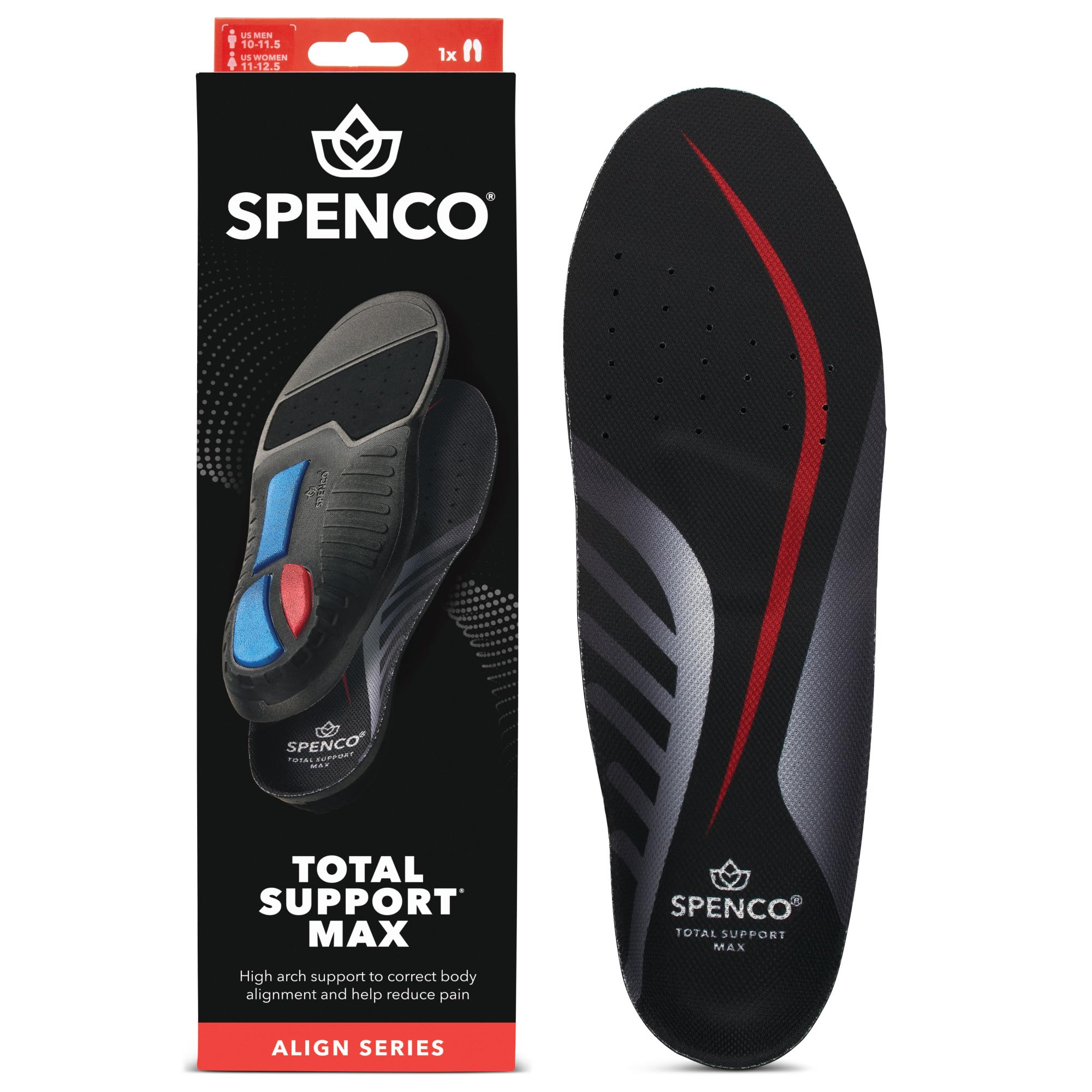
2. Spenco Total Support Max Shoe Insoles
A multi-density build that fights the roll with a stiff pod instead of soft foam.
The idea behind the Total Support Max is simple: a stiffer support pod sits under the arch to slow the outward roll, while softer cushioning pods take the impact at the moment your foot lands. That split is what a supinating foot needs — firmness where the arch is collapsing, softness where you want shock soaked up. A deep heel cup keeps your foot centered instead of sliding to the outside edge, and a metatarsal pad eases pressure on the ball of the foot for long standing days.
Owners who tried firmer overpronation insoles say this one gives rigid arch support without squishing flat, which keeps an ankle from rolling. It carries the APMA Seal of Acceptance, and the big-toe cutout is a small detail that lets your arch engage naturally rather than sitting on a flat wall of foam. It is sized to fit rather than trim-to-fit, so you order your size and skip the scissors.
The honest catch is the break-in and the fit quirks. A rigid arch takes a few days to feel neutral, and the fit is not universal — a narrow shoe may feel tight once you slot this full-foot insole in. There is a break-in squeak that fades as it settles, and taller-arched feet can find the arch sitting slightly low for their preference. None of that stops it being a favourite for overpronation, but it does mean trying it before you commit to a second pair.
The support logic: a firm arch pod that holds shape is the whole point — soften that and a supinating foot rolls the same way it always did.
Fit honesty: sized rather than trimmable, so a roomy shoe earns its keep and a snug one may not.
Built for: high arches that need firm, unyielding support rather than plush cushioning.
Skip if: your shoe already runs narrow — the full-foot footprint leaves little margin.
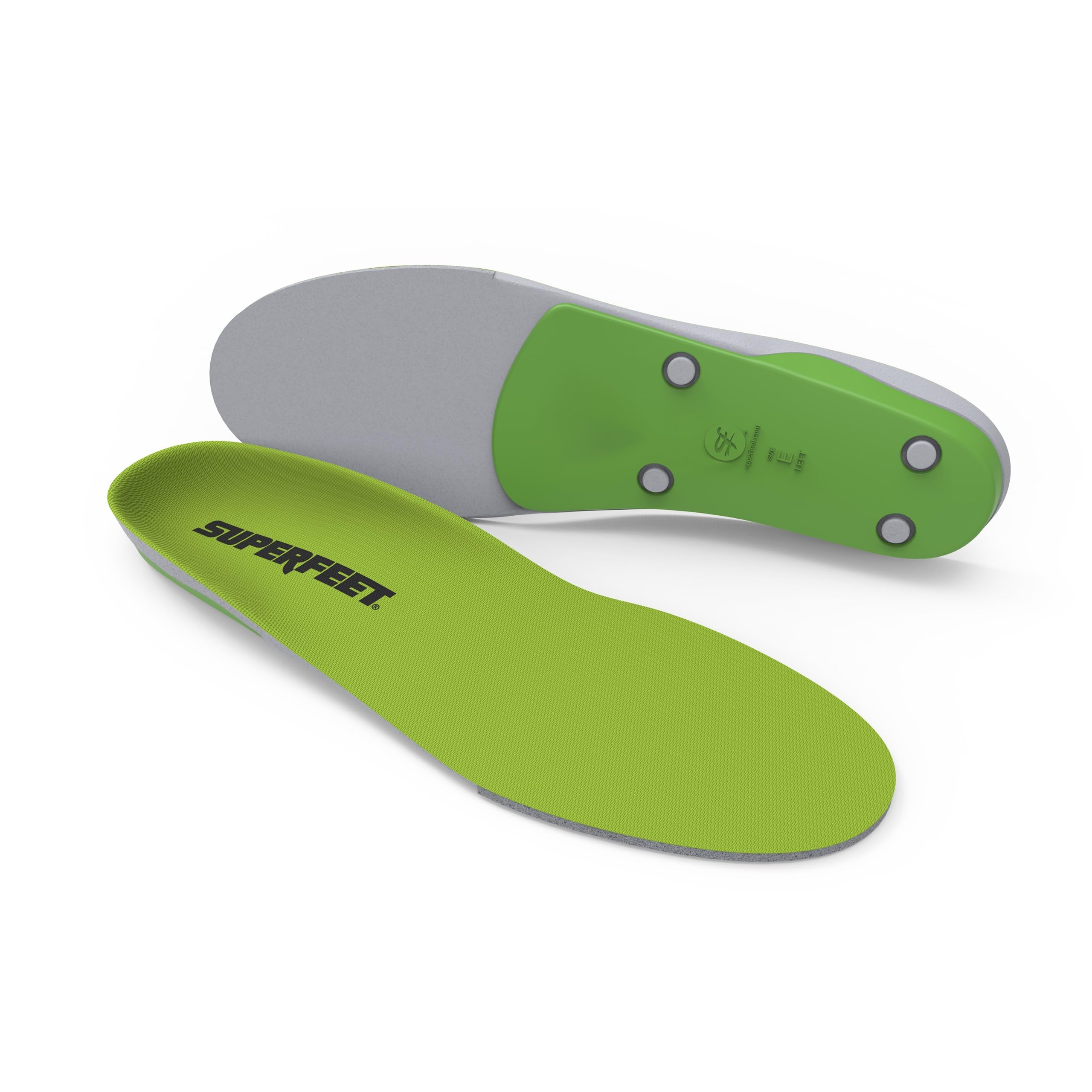
3. Superfeet All-Purpose High Arch Support Insoles
The trim-to-fit workhorse that brings a high arch to almost any boot or sneaker.
Superfeet built this one to be cut down to your shoe, and that flexibility is why it fits so many roomy boots and running shoes where a fixed-size insole would fight you. If you land between sizes, the method is to size up and trim down, so you never come up short at the heel. A sculpted heel cup cradles the heel and helps the foot absorb shock naturally, while the high-density closed-cell foam holds the whole foot instead of squashing under your weight.
The arch here is high and firm, which is what supinating feet need to stop rolling outward. A moisture-wicking top cover helps keep odours in check through long days. This is the model formerly sold as Superfeet GREEN, and it now carries the All-Purpose name with the same arch-support design. Because it goes under the full foot, it suits roomy footwear rather than tight dress shoes.
What people notice first is the arch height — and it is also the reason some send it back. A high, deep arch can feel like too much for a low or medium foot, and a few find the shape too narrow for their shoe. There is a genuine break-in: the firm foam softens into place over a week, and it dulls the springiness of a cushioned sneaker as a side effect. Once adjusted, owners keep it in seven pairs at a time because it stays consistent from one set to the next.
Why the trim matters: cutting to your own shoe is what lets one insole suit a steel-toe boot and a running shoe without coming up short.
The real trade-off: a high, deep arch is the feature and the fit question at once — some low-foot users just never bond with it.
Reach for this if: you have genuinely high arches and want one insole you can cut to fit a whole rotation of shoes.
Look elsewhere if: you need metatarsal padding up front — this one puts its focus on the arch.
4. PowerStep Pinnacle High Arch Orthotics Insoles

The higher, firmer sibling to the Pinnacle Maxx — shaped for a foot that needs more arch.
Everything here turns on the arch shape. PowerStep designs that specific curve to sit reliably under the foot for supination, overpronation and flat feet, and the High Arch version pushes it higher than the Maxx. If your outer-edge wear comes with a genuinely tall arch that never feels supported, this is the model aimed straight at you. It is made in the USA and calibrated for flexibility so the shell bends with your stride rather than fighting it.
Owners with high arches call this the best orthotic they have bought, citing real arch support and an easy slip-in fit in running shoes. It is a straight alternative to custom-made orthotics for a lot of people — you get the arch without the moulding appointment. Against the far cheaper WalkHero below, this leans firmer and carries a bigger arch, which suits a high foot better than a flatter one.
The friction point is value. Treat it as a replace-and-rotate item rather than a once-a-decade pair. The trade-off you keep hearing is durability creeping down over long continuous wear, so rotate it across shoes instead of leaving it in one boot forever.
The high-arch bet: a taller podiatrist-designed arch than the Maxx, and that difference is exactly what a tall foot needs to stop rolling outward.
Worth knowing: firm foam still ages, so rotate it across shoes rather than hammering it in a single boot.
It suits: high-arched feet that want a firm, ready-made alternative to a custom pair without the moulding step.
Pass on it if: your arch is low or flat — the extra height here is more than a flat foot usually wants.
5. VALSOLE Heavy Duty Support Pain Relief Orthotics

A rigid-arch build made for the weight that flattens softer insoles fast.
VALSOLE builds these specifically for people over 220 pounds, and the material choice makes sense of that: a hard TPU arch (a stiff plastic shell, not foam) supports the arch and wraps the heel to give side-to-side stability. A PU heel pad soaks up impact so the ankle and knee joints take less of a beating with each step. The deep heel cup cradles the foot bone so it stays vertical, which is a direct answer to the outward roll that supination throws at you.
Bigger users report the boot pain went away, and the firm arch held up through a full day on their feet. This is the pick that keeps working after cheaper insoles have gone flat. It ships in 10 sizes to fit most people, and The rigid TPU arch holds its shape for up to 6 months of heavy wear before it starts to give.
The two honest notes are rigidness and shoe fit. The arch is hard, and some feet read that as too much at first — the maker suggests breaking in with 2–3 hours a day before you go all day. It is also not built for tight, strongly-wrapped formal or leather shoes, so leave those alone. A small number find the arch sits lower than they would like, which is the usual gap between a stock size and a custom shape.
Why Heavy Users Keep Buying It
- Hard TPU arch holds its shape where soft insoles flatten out
- Deep heel cup keeps the foot vertical to counter outward roll
- PU heel pad absorbs impact so ankles and knees feel less of it
- 10 sizes fit most feet with no trimming on many pairs
Know Before You Buy
- The hard arch needs a 2–3 hour a day ramp-up before all-day wear
- Not made for tight formal or leather shoes with strong wrapping
Made for: heavier walkers who have flattened softer insoles and want a rigid arch that survives a full shift.
Best avoided if: you want to slip in an insert and wear it eight hours on day one — the rigid shell wants a slower warm-up.
6. PCSsole Professional Plantar Fasciitis Insoles

Hard-shell support for the heaviest, longest days on your feet.
This is the stiffest option in the line-up, built for users at 240 pounds and up who need an arch that will not budge. The deep heel pocket is the standout feature — it locks your heel in place so it stops shifting side to side, which is the motion that keeps driving a supinating foot off course. A hard, non-gel arch gives firm, deliberate support rather than the soft forgiving feel most drugstore insoles lead with.
People on their feet 8–10 hours a day find the firm arch holds alignment and eases the pain that travels up into the knee. One 46-year-old with arthritis and plantar fasciitis said the hard arch finally gave support that resolved the ache. It fits a size 12 work boot, and A separate user with a pulled tendon said the firm arch let them forget the condition for a full day.
The trade-off is that the arch height is fixed, so a foot that wants a taller curve will find it slightly short — that is the most common note, alongside the odd pair that simply does not fit a bulky shoe. A few find it wears quicker than they expect under heavy use. The other thing to plan for is room: the deep heel pocket and firm body want a work boot or a roomy sneaker, not a tight slip-on.
Where it wins: that deep heel pocket is what stops the side-to-side slide a rolling foot fights against all day.
The honest limit: the arch curve is fixed and some want it taller — and durability under constant heavy wear is the weak spot.
Pick it if: you are a heavy build spending long hours in work boots and want maximum heel lock and stiffness.
Look past it if: you use tight slip-on shoes — the deep heel pocket needs room to seat properly.
7. pedag Correct German Made Wedge Heel Straightener

A small, reversible German wedge that tilts the heel without a full insole.
If you only need the heel angle corrected, this is the cleanest way to do it. The wedge sits in the heel of your shoe and tilts the foot back toward the middle — reverse the placement and it counters the other direction, so the same insert handles supination and pronation. It is handmade in Germany from vegetable-tanned leather (leather tanned with plant extracts rather than heavy chemicals) with a firm natural latex rubber base that holds its tilt instead of softening into nothing.
Because it is leather and rubber and only covers the heel, it keeps a low profile — a flat 0.25 inches thin and just 1.45 ounces — so it slides under almost any shoe without stealing space. The result is far less disruption than a full-length insole, and it is meant for exactly the daily standing and walking that wears the outer heel unevenly.
The recurring complaint is movement: the adhesive backing is weak, so the wedge can shift around inside the shoe. A couple of users also find the foam rubber layer tears when removed, which means handle it gently when you pull it out. Where this earns its keep is durability — longtime owners say the quality holds up year after year, and one buyer sums it up by noting they bought these ages ago and they are the same quality now. That consistency is rare for a low-profile wedge.
What earns its keep: handmade German leather and rubber that keeps its tilt instead of flattening, and it reverses to cover either direction of roll.
The weak spot: the adhesive is light and the foam layer is easy to tear on removal, so treat it as a fit-in-and-leave-it item.
Ideal for: anyone who wants heel-only correction with a low profile and no loss of toe room.
Not the pick if: you need strong adhesion or a strong arch — this handles the heel angle and nothing above it.
8. WalkHero Arch Support Inserts for Women & Men
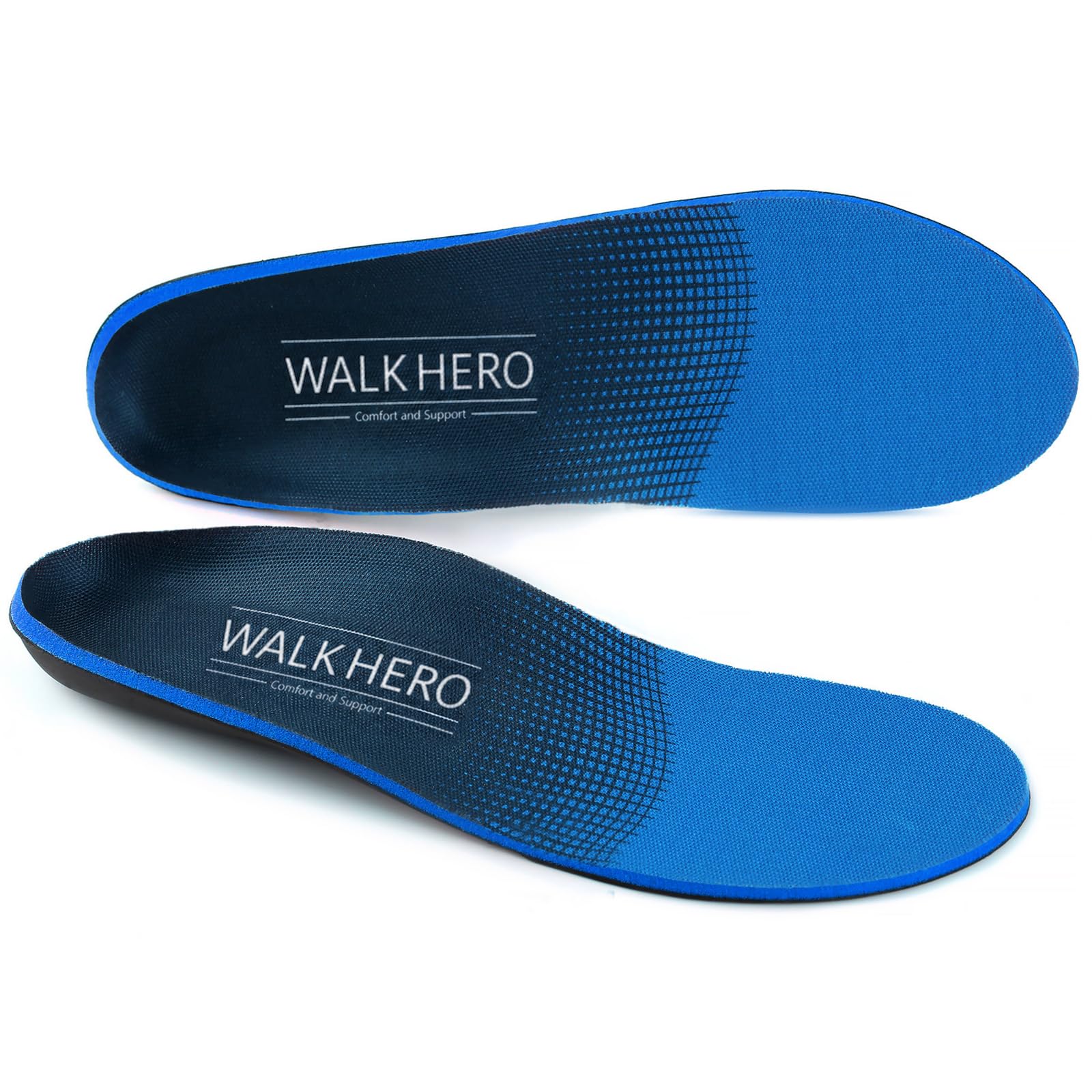
The deep-heel-cup favourite that calms sore feet in roomy everyday shoes.
WalkHero’s EVA foam (a springy, shock-absorbing cushioning material) is what a lot of people reach for when the priority is comfort with real arch support underneath. The deep heel cup keeps your foot positioned correctly and protects the heel through the impact of each landing, while the moderate arch support is aimed at wide, high-volume shoes — work boots, basketball shoes and roomy sneakers. It is built for everyday use rather than hardcore correction, and the arch here is taller and firmer than the flexy arch on a Dr. Scholl’s plantar-fasciitis insole.
Two aspects carry this pick: pain relief and arch support get the most mentions, and both come back to the deep heel cup and the rigid arch that keeps the foot seated instead of rolling. Owners say it replaces insoles that cost many times more, and a size 10.5 wears snug in Merrells with no trimming needed. For a supinating foot, the deep cup plus a fixed arch is the combination that stops the outer edge from driving down hard.
The most common gripe is firmness — several describe the arch as too hard, which is exactly what you want for support but takes getting used to. It is also a firmer, taller insole, so it can feel too thick for slim dress shoes. That is a fit decision, not a defect: put it where it has room and it stays comfortable.
Why it leads: deep heel cup plus a tall, rigid arch is the pair of features that keeps a rolling foot seated instead of tipping outward.
Watch the thickness: the firm body is a poor match for tight dress shoes — save it for the roomier pairs.
Best in: roomy athletic and work shoes where the deep heel cup and firm arch can do their work.
Not ideal for: slim dress shoes or anyone who wants a soft, pillowy feel under the arch.
9. PCSsole 3/4 Orthotics Shoe Insert

A three-quarter-length insert that supports the arch without crowding your toes.
The design choice that defines this one is length: it stops short of your toes, so a snug sneaker gets arch and heel support without the toe pinch that a full-length insert can cause. A 3.5-centimetre firm EVA high arch sits under the middle of your foot, and a structured deep heel cup wraps the heel to stabilise it in the right position. For a supinating foot, the deep cup and the firm arch work together to keep the foot from tipping onto its outer edge.
This is the pick for high arches and plantar-fasciitis feet that need support in every shoe. The hard arch is deliberately firm — the same level of support a custom orthotic gives — and around a week is the usual adjustment window. Owners who wear it in several pairs a week buy more than one, and the toe-free design is what lets it drop into a range of shoes without tightening the fit.
Two caveats. The firmness is real, so a soft-feet person may need a gradual ramp-up, and the same rigid body can feel snug on a narrow foot even though the toe box stays clear. Then there is the height question — a few want it a touch thicker under the arch, so if you like a lot of cushioning, set expectations accordingly. Otherwise the arch and the deep heel cup are exactly what a rolling foot wants.
The main case: three-quarter length frees up toe room while the firm EVA arch and deep heel cup keep a supinating foot upright.
The caveat: a hard, low-volume body wants a gradual break-in and a shoe with a little width to spare.
Well suited to: high-arched feet that need support but hate the toe squeeze of a full-length insole.
Poor match for: open-toed sandals or anyone who cannot tolerate a hard arch against a bare foot.
10. FitFeet Arch Support Inserts for Women & Men, 3/4 Insoles

A rigid three-quarter insert built to hold up in work shoes and boots.
FitFeet’s selling point is that the arch does not collapse — a rigid support shell holds the centre of your foot up so the foot stays in alignment instead of rolling outward. The same 3.5-centimetre firm EVA arch you see elsewhere in the three-quarter category lives here, paired with a deep heel cup for shock absorption and cushioning under the heel bone. The anti-slip velvet top layer is there to keep the insert steady and keep your foot cool on a hot shift.
Where this earns its spot is work shoes and boots. The insert is sturdy enough to last a long time, and it is one of the more durable three-quarter options here. Owners say it holds up through hard workouts and long shifts without going mushy. The arch support is the top mention, with the build quality right behind it.
The honest notes are firmness and fit. The arch is firm to hard, and a couple of people find it a touch much at first — a gradual ramp-up of 1–3 hours a day smooths that out. And because it is a full three-quarter body, a very narrow shoe can make it feel tight. The material is the real strength: firm EVA is deliberately firmer than plush memory foam, which is exactly why it keeps the arch from sinking.
Where it earns its place: a rigid arch that stays put, a deep heel cup for stability, and an anti-slip top layer that keeps the whole thing centred.
The honest catch: the hard arch is deliberate, so it wants a slow ramp-up and a shoe with a little width.
Fits the bill for: work boots and heavy-duty shoes where durability matters more than plushness.
Reconsider if: you want a soft, cushion-forward feel rather than a firm support wall under the arch.
11. Dr. Foot’s Corrective Shoe Inserts

The simple foam wedge kit that lets you test the whole idea cheaply.
This is the entry point if you have never tried a corrective insert and want to see whether a heel wedge alone helps your outward roll before spending more. The kit comes as three pairs of medial and lateral wedges — medial to counterpronation, lateral to countersupination — made from a flexible foam with a sweat-wicking top layer and a strong self-adhesive backing so they stay put while you reposition or trim them to fit. Because they are wedges and not full insoles, you place one under the heel and leave the rest of your shoe alone.
At 1.13 ounces for the pair, they add essentially nothing to shoe weight, and the flat 5.91 x 4.33 x 0.87-inch pack slips into any shoe. They fit most shoe types, from running shoes and sneakers to dress shoes, boots and work shoes. Owners who wear them for gait alignment say the wedges helped, particularly with the geometry of the roll.
The honest limitation is durability. The foam is soft, and the most-repeated note is that it flattens after a few weeks of wear and stops making a difference. One buyer put it plainly: “These worked well for a few weeks then were too flat to make a difference.” Adhesion is also mixed — some find the backing strong, others find the wedge shifts. Treat these as the low-cost way to test whether heel wedges help you at all, then step up to a leather wedge like the pedag if they do.
The smart use: a cheap way to find out whether a heel wedge changes your roll before you commit to a firmer pair.
Set expectations on durability: the foam softens over a few weeks — this is a trial-and-learn insert, not a long-haul one.
Start here if: you are new to supination inserts and want to test heel wedges without spending much.
Move on if: you want a wedge that keeps its shape for the long haul — the foam here flattens over time.
Know the Specs
Arch Height and Firmness
The arch of an insole is the raised section that sits under the middle of your foot, and its height and firmness decide whether it supports a rolling foot or surrenders to it. A firm, high arch (firm EVA or hard TPU) holds the foot in position; a soft memory-foam arch lets the foot sink, which keeps the outward roll going. That is why the supination-focused picks here all lean firm, and why comfort-first foam insoles tend to disappoint for this specific problem. Expect a break-in of a few days to a week as your foot adapts to the firmer support.
Heel Wedges and Heel Cups
A heel wedge is a tapered heel insert that tilts the foot to one side, and it is the most direct tool for supination — placed laterally it counters the outward roll on its own. A heel cup is different: it is a raised rim that holds the back of the foot in place, and a deep cup (found in several of these picks) keeps the heel from sliding side to side while you walk. The two work together, which is why a firm full insole with a deep cup often beats a standalone wedge for all-day wear.
Length and Fit
The length you choose decides how the insert sits in your shoe. A full-length insole covers the whole footbed and gives maximum support but takes up more room; a 3/4-length insole stops before the toes and leaves the toe box free, which suits snug sneakers and work shoes. A heel wedge is the smallest of all, covering just the heel. Match the length to how much room your shoe has — a tight shoe wants a shorter insert, a roomy boot can take a full one.
Material and Break-In
EVA (ethylene-vinyl acetate, a foam used in most insoles), firm EVA and hard TPU are the main materials you will see, and each behaves differently. Soft EVA cushions but flattens fast; firm EVA holds an arch for longer; TPU is the hardest and is used for the heaviest users. Natural materials like leather and latex, used in the pedag wedge, keep a tilt without the foam-squash problem. Almost all of these inserts want a short break-in period of a few days to a week before they feel neutral underfoot.
Common Questions
What is the difference between supination and pronation?
Do orthotics for supination actually fix the problem?
Should I pick a heel wedge or a full-length insole for supination?
How long does a firm orthotic insole last?
Will a supination insole fit in my work boots?
Do I need to trim a supination orthotic to fit my shoe?
How long does it take to get used to a firm orthotic?
Can I wear a supination insole all day every day?
Is a higher arch always better for supination?
Can I move the same insole between different pairs of shoes?
The Bottom Line
For most people fighting an outward roll, the winner among these orthotics for supination is the PowerStep Pinnacle Maxx — it brings the two things that actually matter, a firm arch and a 2-degree medial post, and it holds up to a full workday. If your main issue is heel angle alone and you want the smallest possible fix, the pedag Correct handles that with a leather-and-latex wedge you can reverse for either direction. And for a heavy build on long shifts, the VALSOLE Heavy Duty gives you a rigid TPU arch built to survive the weight that flattens softer insoles.
How we choose
We do not accept paid placement. Every pick is matched to a real buyer and a real use-case; we do not hands-on test units.
Sources
Specifications: manufacturer listings and product documentation. Review insights: verified customer reviews, as of October 2026. Pricing: not shown on this page (it changes often); check the current price via the retailer link.
As an Amazon Associate, Aappliancez earns from qualifying purchases. This does not affect which products we feature.