Disclosure: Some links in this post are affiliate links. As an Amazon Associate I earn from qualifying purchases, at no extra cost to you. Learn more
Specs are compiled from manufacturer listings and verified buyer reviews and can change over time — please confirm the key details on the product page before buying.
If your whole wheat loaves keep coming out squat, dense, and slightly bitter, the flour is usually the culprit — not your technique. The fix is a bag milled from heritage wheat with enough protein to build a proper crumb, and every pick below clears that bar. What separates the winners is protein strength, how recently the grain was milled, and whether the wheat has been stripped of its bran and germ.
This guide is built by comparing the manufacturers’ published specifications and the patterns across verified customer reviews, so you get each pick’s real strengths and trade-offs instead of marketing spin.
Some bags are stone-ground heritage wheat that behaves beautifully in a bread machine, while others are ancient grains that need a gentler hand. Below you’ll find the organic flour for bread that matches how you actually bake.
Top Picks

How To Choose The Best Organic Flour for Bread
Buying flour for bread is a different job than buying flour for cakes. Bread needs protein to form gluten — the stretchy network that traps gas and lifts the loaf. Cake flour is deliberately weak so it stays tender. Pick the wrong bag and you will fight your dough all afternoon.
Start with protein strength, not the label
Higher protein means more gluten potential, and more gluten potential means better rise. A high-protein bread flour gives you a loaf with structure instead of a crumbly brick. If your store-bought whole wheat has been failing to rise, the protein level is the first thing to suspect.
Understand what whole wheat actually costs you
Whole wheat keeps the bran and germ, so you get the fiber and nutrients — but the bran is sharp and slices through gluten strands. That is why whole wheat dough often looks sticky and slack. Expect to add extra water and give it a longer rest before shaping.
Heritage versus modern wheat
Heritage wheat comes from pre-hybridized varieties that were grown before intensive plant breeding took over. Bakers reach for it for its deeper, nuttier flavor and, often, easier digestion. It hydrates and proofs differently from supermarket wheat, so bake one test loaf before committing a whole bag.
Milling freshness and how the grain was grown
Flour is perishable, not shelf-stable. A bag milled recently tastes sweeter and less bitter than one that has sat around. Look for a grind or mill date printed on the packaging. On the farming side, certified organic means the wheat was grown without the chemicals and herbicides that some buyers are actively trying to avoid.
Side-by-Side Comparison
| Model | Best For | Grain Type | Bag Size | Protein Strength | Amazon |
|---|---|---|---|---|---|
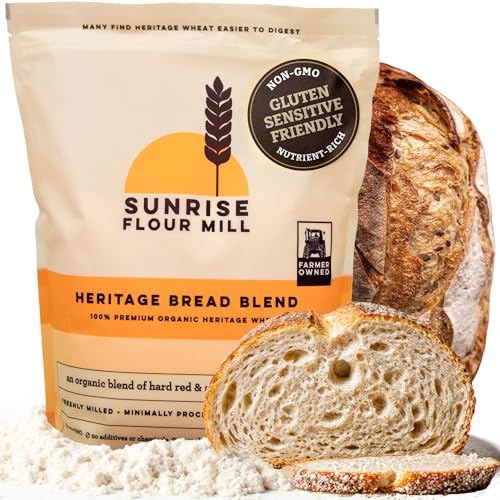
| Sunrise Flour Mill Heritage Organic Bread Flour Blend★ Best Overall | Sourdough and bread machines | Turkey Red & White Sonora heritage wheat | 5 lbs (80 oz) | High | Amazon |
| Palouse Brand Glyphosate Residue Free Bread FlourGlyphosate Tested | Lower-hydration sandwich loaves | Whole wheat, Hard Red Spring | 3 lbs (48 oz) | — | Amazon |
| Sunrise Flour Mill Heritage Organic Whole Wheat Flour | Everyday whole wheat baking | Red hard wheat, pre-hybridized | 5 lbs (80 oz) | — | Amazon |
| Grain Brain Organic White Spelt Flour | Wheat-sensitive bakers | White spelt (ancient grain) | 5 lbs (80 oz) | High by nature | Amazon |
| Jovial Organic Einkorn Whole Wheat Flour, 3 Pack | Flavor-first ancient grain baking | Einkorn (original wheat) | 3 × 32 oz | Weaker gluten | Amazon |
Detailed Reviews
1. Sunrise Flour Mill Heritage Organic Bread Flour Blend – 5 lbs
Our pick — 4.5+★ from 1,000+ verified ratings; the strongest balance of quality and price.
A heritage blend built to lift soft, airy loaves without the bitter edge whole wheat usually brings.
This bag is milled from Turkey Red and White Sonora heritage wheat — two pre-hybridized varieties — and it is the only flour here that pairs a high protein bread blend with a stated digestibility angle. That combination is what earns it the top slot: it holds structure for a proper rise while staying smooth and creamy-gold in the bowl. The 5-pound (80-ounce) bag is the largest format alongside the other Sunrise bag, so you get a real run of test loaves before you need a reorder.
What wins people over is how it performs in a bread machine. Owners run it at 66% hydration in a Zojirushi for sandwich bread and French toast and report no bloating afterward — a concrete hydration figure note if your machine loaves have been coming out gummy. The single-pass unifine milling (a 1930s technique that grinds fine in one pass) produces super-fine, fluffy flour, which is why doughs feel silky rather than gritty. And the flavor lands clean: as buyers put it, “Used in Zojirushi bread machine at 66% hydration for sandwich bread and French toast; no gut issues or bloating, outstanding flavor.”
Sourdough bakers get the same result outside the machine — sandwich breads, dinner rolls, and open-crumb artisan loaves all come out with a golden crust. The honest trade-off is cost: this is a premium-priced bag, and one person’s own note is that it is “a bit pricey” compared with supermarket flour. That is the price of heritage grain and single-pass milling. It is still the crowd favorite at 4.5+ stars across 1,000+ owners, and for anyone chasing a repeatable weekly loaf, that track record is the argument.
What Bakers Are Getting
- High protein blend that holds rise in machines and by hand
- Turkey Red and White Sonora heritage wheat, 100% USDA Organic
- Unifine single-pass milling for a super-fine, fluffy grind
- Nutty flavor that reads smooth, not bitter
Where It Costs You
- Premium-priced for a 5-pound bag
- Needs a hydration adjustment if you normally bake modern wheat at the same water level
The confident verdict: If you want one bag that handles sourdough and machine loaves equally well, this is the one to buy.
The real catch: It sits at the top of the premium range, so budget bakers should weigh the cost against how fast they go through flour.
2. Palouse Brand Bread Flour | 3 LBS
The farm-to-table bag with a residue test behind it, sized small enough to try before you commit.
If residue on your wheat is the reason you’re buying organic in the first place, this is the pick that puts the answer on the packaging. Palouse Brand certifies its flour glyphosate residue free through the Detox Project, and the whole chain happens on the family’s 125+ year old Washington State farm — grown, harvested, triple cleaned, stone ground, and packaged. That triple cleaning takes place in an HACCP Certified facility, a documented food-safety standard.
Quality is what earns the most praise from owners, with a nutty taste close behind. It behaves best in lower-hydration dough, which makes it a strong match for sandwich bread. For a no-knead artisan loaf you’ll want to blend it with a finer flour or a sprouted spelt for structure. In a bread machine it rises where store-bought whole wheat failed — the Hard Red Spring variety carries enough gluten to lift a cranberry wheat loaf with the same recipe and yeast. “This is the best non-GMO whole wheat bread flour that I have ever used,” is how one baker sums it up.
Watch the size and texture before you order. At 3 pounds (48 ounces) this is the smallest bag among the whole-wheat picks here, so a serious weekly baker will burn through it fast. The grind runs coarser than some shoppers expect, which is a matter of taste rather than a flaw — the same coarseness is what brings that old-school homemade texture. The other practical note is the packaging: the newer bag won’t stand upright on the counter, which makes scooping more fiddly than the old version. It is a small annoyance, not a reason to pass on a bag this carefully traced.
Traceability you can name: A 125+ year old family farm, a named miller and mill date on the label, and a third-party glyphosate residue certification — a level of documentation most flour bags never offer.
Texture reality check: The grind is coarser than refined flour and splits opinion. Blend it for no-knead dough rather than expecting it to behave like a fine white flour.
Reach for this if: you want documented glyphosate-free wheat and bake lower-hydration sandwich loaves in a machine or by hand.
Look elsewhere if: you need a big bag for a busy bakery-style schedule or prefer a fine, uniform grind.
3. Sunrise Flour Mill Heritage Organic Whole Wheat Flour – 5 lbs
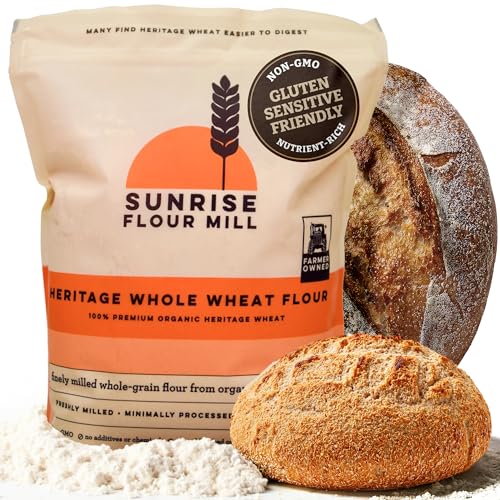
Milled from red hard wheat within ten days, so the bag reaches your kitchen close to its freshest.
Freshness is the story here. This bag is milled from red hard wheat within 10 days, which is the shortest stated grain-to-bag window in this lineup. Flour is a perishable ingredient, and fresher milling means a sweeter, less stale flavor in the finished loaf. The grain itself is pre-hybridized heritage wheat, milled on the same unifine single-pass system as the top pick, giving you a super-fine grind with smoother bran integration and loftier, higher-volume results.
Owners lean hardest on overall quality, with taste the clear second. It handles sandwich buns beautifully — one home baker’s body “handles this wheat flour very well” and the wholesome flavor keeps them coming back. It also works as a straight stand-in for whole spelt flour without spelt’s fussy handling, and it brings a slightly sour note that suits baked goods. Watch the water: the same baker found it too sticky for a basic flatbread. This bag runs 5 pounds (80 ounces) at 10 x 3 x 13 inches, versus the Palouse 3-pound bag at 8.5 x 8 x 4 inches — a meaningfully bigger format for the pantry shelf.
The one contested ground is value. Some bakers call it worth the money and others find it overpriced, which roughly tracks with what heritage organic wheat costs to grow and mill. Twenty-seven owners flag it as a value question, and that is the fair caveat here — you are paying for the ten-day milling window. If you bake often, the quality-per-loaf math works out; if you bake a loaf a month, the bag may outlast its freshness.
The freshness edge: A ten-day mill-to-bag window and an ultra-fine grind give you lighter, higher-volume whole wheat loaves than coarse supermarket bags produce.
Texture honesty: This flour can run sticky in lean doughs like flatbread. It rewards you in enriched breads and buns, where that extra body becomes a soft chew.
The standout spec: ten-day fresh milling in a full 5-pound bag — hard to match when freshness is your priority.
Think twice if: you bake rarely enough that a large bag could stale before you finish it, or you need a firm dough for flatbread.
4. Grain Brain Organic White Spelt Flour (5 LB)

An ancient grain for bakers who react to modern wheat but still want a soft, workable loaf.
Spelt is an ancient grain (Triticum Speltum) that was widely cultivated across Europe for centuries before wheat largely replaced it. This is the white spelt version, which means the flour contains no bran and no germ — a lighter, more refined bake than a whole spelt bag. Spelt’s gluten is more fragile than modern wheat’s, and many wheat-sensitive bakers report handling it without trouble. This one is USDA certified organic, unbleached, and free of potassium bromate and other chemicals or preservatives. Cool milling keeps the minerals, vitamins, and protein intact.
Overall quality is the aspect owners praise most, with flavor right behind. It subs cleanly into most recipes calling for modern wheat flour, which makes it a low-risk swap. Sourdough bakers report good performance in particular, and the fine grind means it comes out of the bag light and fluffy with a fresh smell. It is also kosher parve. For anyone rotating between grain types, this is the most painless transition in the lineup — as one baker describes it, “This is a high protein flour by nature, less refined and the easily digested.”
Two things to plan around. Because the bran and germ are removed, you give up some of the fiber and nutrient density that the whole-grain bags deliver — that is the trade for a lighter crumb. And there is an occasional shipping complaint, where the reusable white closure slips off in transit; that is a handling issue rather than a flour issue. At 5 pounds (80 ounces) and 4.5+ stars across 700+ owners, this is a solid value for a specialty ancient grain.
Why It Swaps In Easily
- White spelt carries no bran or germ, so the crumb stays light
- Substitutes into most modern wheat recipes without reworking ratios
- USDA certified organic and kosher parve
- Cool milling preserves vitamins, minerals, and protein
The Trade-Offs To Know
- Removing bran and germ trims the fiber and nutrient load versus whole grains
- The resealable closure can loosen during shipping
Who it beats: this outlasts a whole-grain bag on crumb lightness and swap-in convenience, so wheat-sensitive bakers get a familiar bake.
Who it’s not for: anyone buying flour specifically for maximum fiber and whole-grain nutrition.
5. Jovial Organic Einkorn Whole Wheat Flour, 32 Oz, 3 Pack
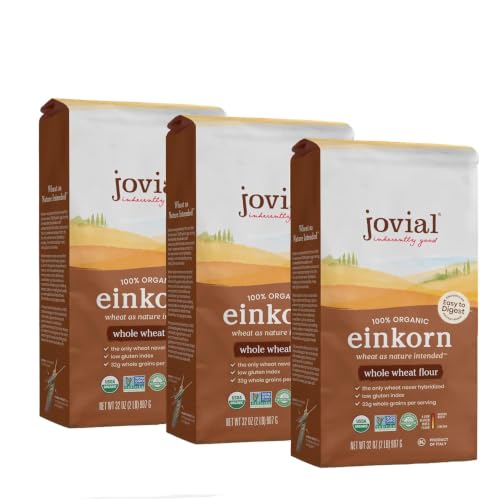
The original wheat, in a three-bag pack, with a gluten so delicate it handles almost like a pastry flour.
Einkorn is the original wheat — the only wheat that has never been hybridized — and that lineage is the whole reason to buy this bag. Its gluten is weaker than modern wheat’s, which some wheat-sensitive bakers find easier to digest, though Jovial states plainly that it should not be consumed by celiacs. The 3-pack of 32-ounce bags totals 96 ounces, so you get a substantial supply across three sealed bags. It is USDA Certified Organic, Non-GMO Project Verified, and never bromated, bleached, or enriched.
Flavor is the headline, and it delivers a nutty, silky, buttery-yellow bake. Flavor is the second-most-praised quality after overall quality, and everyone from pancake makers to pizza-crust bakers comes back to it. Whole wheat einkorn carries more fiber than regular whole wheat by many bakers’ reckoning, and it browns faster in the oven. The much-discussed weave: bakers mix it 50/50 with a standard whole-grain flour to get the best-tasting, healthiest rolls. “Makes baking and nourishment for all most rewarding and delicious,” is one way the review pages put it.
Here is the honest catch: weaker gluten cuts both ways. It will not give you a tall, elastic sandwich loaf the way the Sunrise bread blend does — one baker found einkorn crumbled where a stronger flour held together. It also lands at the premium end of this list. If you want a flavor-led artisan bake and don’t mind a denser, more delicate crumb, this is a rewarding bag. If you need a workhorse loaf with maximum oven spring, choose the top pick instead.
Where the flavor lives: you get a nutty, buttery-yellow einkorn (an ancient wheat with a fine, silk-like texture) that bakes into a rich-tasting loaf. Each bag carries USDA organic certification (grown without synthetic pesticides) and Non-GMO verification (no genetically engineered ingredients), and you get three sealed bags.
Where the gluten bites back: einkorn’s weaker gluten will not build a tall sandwich loaf on its own. Blend it or bake it as a rustic, denser style.
Your move: buy this for pancakes, pizza crust, and rustic loaves where flavor wins over height.
Skip the einkorn route if: your weekly goal is a high-rising sandwich bread, which a stronger heritage blend serves better.
Know the Specs
Protein Strength and Gluten
Protein is what forms gluten, the elastic web that traps gas and lifts your bread. A high-protein flour builds a taller, springier loaf. A weaker protein, like the gluten in einkorn, gives a more delicate, crumblier result — lovely for rustic bakes, harder to shape into a tall sandwich loaf. When a whole wheat loaf fails to rise, protein is the first number to check.
Whole Grain vs. White varieties
Whole grain flour keeps the bran and germ, delivering more fiber and nutrients. The cost is a coarser, thirstier dough, because the bran interrupts the gluten strands. White flour — including white spelt — removes the bran and germ, so the crumb comes out lighter but you give up some of that nutrition. Decide which trade you want before you pick a bag.
Milling Method and Freshness
Unifine single-pass milling grinds flour fine in one pass, producing a super-fine, fluffy texture. Cool milling, used by Grain Brain, keeps the minerals, vitamins, and protein intact by avoiding heat. Freshly milled flour simply tastes sweeter and less stale. A grind or mill date on the bag tells you how close to freshly milled your flour actually is.
Glyphosate and Organic Certification
Certified organic means the wheat was grown without the chemicals, pesticides, and herbicides that some buyers avoid. Glyphosate residue free certification tests specifically for that herbicide, using a third-party standard. When you see both on a bag, you are getting a documented growing method and a documented residue result rather than a marketing claim.
Common Questions
Can I substitute organic bread flour straight into my regular white-flour recipe?
Why did my whole wheat bread come out dense and heavy?
Is einkorn flour safe for someone with celiac disease?
What does glyphosate residue free certification actually mean on a flour bag?
How long does opened flour stay fresh?
Is spelt flour better than whole wheat for bread?
Will heritage wheat flour work in a bread machine?
Does a big bag save money over time, or is a small bag smarter?
Can I mix whole wheat and white flour to lighten my loaf?
Why is my dough sticky when I work with organic whole wheat flour?
The Bottom Line
For most bakers, the winner is the Sunrise Flour Mill Heritage Organic Bread Flour Blend because its high-protein Turkey Red and White Sonora heritage wheat holds a proper rise in both a sourdough bowl and a bread machine. If you want documented glyphosate residue testing and bake lower-hydration sandwich loaves, grab the Palouse Brand Bread Flour. And when modern wheat is the problem but you still want a soft, workable loaf, the Grain Brain White Spelt is the one to reach for.
The honest nudge: the top pick earns its spot on both rating and a deep bench of owners who bake weekly, so if you want one bag to build your whole routine around, start there.
How we choose
We do not accept paid placement. Every pick is matched to a real buyer and a real use-case; we do not hands-on test units.
Sources
Specifications: manufacturer listings and product documentation. Review insights: verified customer reviews, as of October 2026. Pricing: not shown on this page (it changes often); check the current price via the retailer link.
As an Amazon Associate, Aappliancez earns from qualifying purchases. This does not affect which products we feature.