Disclosure: Some links in this post are affiliate links. As an Amazon Associate I earn from qualifying purchases, at no extra cost to you. Learn more
Specs are compiled from manufacturer listings and verified buyer reviews and can change over time — please confirm the key details on the product page before buying.
You want to hear conversations clearly without paying used-car money for prescription hearing aids. The good news: over-the-counter open fit hearing aids now include real, self-fitting options. Your main decision depends on one thing. Do you only need clearer conversation, or do you also want to stream phone calls and music straight into your ears?
This guide is built by comparing the manufacturers’ published specifications and the patterns across verified customer reviews, so you get each pick’s real strengths and trade-offs instead of marketing spin.
You will see how self-fitting apps, receiver-in-canal comfort and rechargeable batteries change daily life, all explained without the jargon. Below is a straight comparison to help you choose among the best open fit hearing aids.
Top Picks


How To Choose The Best Open Fit Hearing Aids
The single biggest decision is how the device sits in your ear. Open fit means the sound flows through a soft dome that leaves your ear canal partly open, so your own voice does not boom inside your head. Get that shape wrong and no amount of app tuning fixes it. Get it right and a mid-range aid can feel more natural than a premium one.
Start With Your Level Of Hearing Loss
Every product here is built for mild to moderate hearing loss, which is the range these over-the-counter devices are made for. If your loss is severe in one or both ears, the honest answer is that none of these are the right tool — you need a prescription fitting. Check a product’s stated gain ceiling against your needs. The ELEHEAR Beyond lists a maximum gain of up to 50 dB, while the Vivtone Lucid508 lists peak sound gains up to 41dB — both are real figures you can compare rather than guess at.
Self-Fitting Apps Versus Preset Programs
A self-fitting app runs a short hearing check through your phone and shapes the sound to each ear separately. That matters because most people hear differently on the left and right. Not everyone wants to fiddle with a phone, though. Some aids ship with preset programs that work straight from the box, which suits anyone who just wants to pop them in and go.
Battery And Charging Reality
Rechargeable aids have replaced tiny button batteries for most buyers, and the case usually doubles as a power bank. Look at whether the case carries its own battery. A case with its own battery keeps charging your aids when you travel, while a case that needs a wall outlet will strand you without a socket.
Water And Dust Protection
Look for an IP rating — a two-digit score where the first number covers dust and the second covers water. IP68 means the maker rates the device against dust and water at a high level, though no aid survives a swim. If you garden, golf or live somewhere humid, a higher rating is worth prioritizing.
Side-by-Side Comparison
| Model | Best For | Style | Battery | Bluetooth | Amazon |
|---|---|---|---|---|---|
| EARGO 8★ Best Overall | Discreet all-day wear | CIC, IP68 | Up to 16 hours | No | Amazon |
| Vivtone Xpure 2.0Best Value | Budget Bluetooth streaming | RIC | Up to 24 hours | Yes | Amazon |
| Sennheiser All-Day ClearBest for a First Try | Known audio brand | RIC | Up to 24 hours | Yes | Amazon |
| Nova iB-N-br04 | Lowest-cost trial | Behind ear | — | No | Amazon |
| Vivtone Lucid508 | Simple for elderly users | BTE | 25 hours per charge | No | Amazon |
| ELEHEAR Beyond | Speech clarity plus streaming | RIC | Up to 20 hours | Yes | Amazon |
| ELEHEAR Beyond Pro | Fast-charge premium | RIC | Up to 20 hours | Yes | Amazon |
| AuraLink | App fitting on a budget | RIC, IP68 | — | 5.4 | Amazon |
| Jabra Enhance Select 500 | Clinic-grade support | RIC, micro | — | Yes, LE Audio | Amazon |
Detailed Reviews
1. EARGO 8 CIC Hearing Aids
An aid that all but disappears in your ear canal, then gets out of your way for sixteen hours.
If you want people to look at your face and not your ear, this is the pair that does it. The EARGO 8 sits in the ear canal itself — a CIC, or completely-in-canal, shape — so there is no wire looping over your ear and no box behind it. That is the defining spec here, and it is why the device earns the top slot. It carries an IP68 rating, which means it is rated against dust and water at the highest level the maker lists, so sweat from a walk or a rainy dash to the car is not an emergency.
This pair earns its place on stubborn, everyday hearing. Sound Match runs a self-fitting routine that shapes output to each ear separately, so your left and right ears get their own settings. Smart Sound Adjust reads the room and shifts the settings for you as it changes. Fans of the lineup describe the Restaurant mode as the thing that finally cuts through a noisy room. And you may never open the app at all — four preset programs are ready from the start. Battery is a “low-maintenance” story: up to 16 hours of listening on one charge. The extended-life charger carries up to 14 full recharges, which covers roughly two weeks away from a wall socket.
Here is the part nobody tells you up front: these are not Bluetooth earbuds. They do not stream music and they do not take phone calls, so if that is your wish list, look elsewhere. The fit is also the most-debated point about this pair. Some ears grab the included Trumpet eartips snugly and never think about it again. A smaller share find the dome works loose and needs a re-seat during the day. There are three eartip sizes in the box, so try each before deciding.
Why buyers pick this pair
- Completely-in-canal shape hides inside the ear with no visible hardware
- Self-fitting Sound Match plus 4 ready-made preset programs
- Up to 16 hours per charge; charger adds up to 14 full recharges
- IP68 dust and water rating for sweat and weather
- 2-year warranty with unlimited repairs and one-time loss or damage coverage
Where it falls short
- No Bluetooth — no music streaming and no phone calls
- Fit is the recurring complaint; some ears need a different dome size
- One-sided battery drain reported on a rare unit
Reach for this if: you want the hearing to disappear into your ear and you never plan to take calls through it.
Think twice if: a phone-call stream into your ears is a must-have, or your ear canal has never held an in-ear tip comfortably.
2. Vivtone Xpure Bluetooth Hearing Aids
The entry point into hearing aids that also play your phone calls and music.
Buyers who want the full earbud experience without a prescription price tag gravitate here. The Vivtone Xpure connects over Bluetooth to iOS 12 and Android 11.0 or newer devices, so calls and music route straight into your ears. Its receiver-in-canal design — the speaker sits closer to your eardrum — is built to keep distortion and feedback low, and the free companion app plus onboard buttons let you tune volume and frequency by hand. The published working time is up to 24 hours on a single charge, or 3 hours of Bluetooth streaming. For context, that 24-hour figure runs longer than the EARGO 8’s stated 16 hours — though those two numbers describe very different jobs.
The physical footprint is friendly, too. At 6.74 ounces it travels lighter than the Nova iB-N-br04 at 10.86 ounces, and its 6.61 x 4.17 x 1.73-inch package is easier to tuck into a bag. The recycle charging case carries enough standby power for about a week, and both the aids and the case top up in 2.5 hours. There is also real-human phone support, which a lot of first-time users value more than they expect.
Now the honest part. This is the most split-down-the-middle product in the guide on sound. Some owners hear crisp conversation and clean calls. Others describe a thin, noisy quality and a charge that fizzles well short of the headline figure. As buyers put it: “They made squealing sounds and only lasted about 5 hrs on a charge.” The domes also run small for larger ear canals, so a loose fit is a real risk worth planning for before you order.
What works: Bluetooth calls and streaming in a lightweight body, a charging case with about a week of backup, and phone support run by real people rather than a bot.
What to weigh: the sound is genuinely love-it-or-leave-it, and the fit leans toward smaller ear canals — order knowing you may need to return it if your ears run large.
Best for: the buyer who wants calls and music in the same device and can live with tuning it by hand.
Look elsewhere if: you need a device that nails sound on the first try with zero fiddling.
3. Sennheiser All-Day Clear Bluetooth Hearing Aids
A familiar audio name brings headphone-grade streaming intent to a self-fitting hearing aid.
Sennheiser is the name most people already trust for headphones, and the All-Day Clear leans on that. It uses a receiver-in-canal shape — the classic behind-the-ear body with a thin wire feeding sound into your canal — for a discreet fit. Setup takes a few minutes through the app, with no audiologist appointment required, and it is FDA cleared for adults with mild to moderate hearing loss. The rechargeable battery is listed at up to 24 hours of continuous use, dependent on how you use it.
The package is genuinely complete: a pair of aids, a charging case, a USB cable, a wall plug, eight ear tips in small, medium and large, wax guards, a cleaning brush and a manual. Bluetooth connects to iOS or Android for hands-free calls, music, podcasts and audiobooks. One balanced review sums it up: these rival prescription ReSound and Starkey models on sound and streaming for a fraction of the price, with a three-step app setup and automatic noise reduction. A 74-year-old with asymmetric loss singled out the independent per-ear volume and discreet all-day comfort as the wins.
The weak spot is noise in busy rooms. The only listening profiles are auto and music, so there is no dedicated restaurant mode to flip to when a loud table drowns out the person beside you. Some describe a background hiss in quiet, and the larger dome can cause a plugged-up feeling (occlusion) in smaller canals. The charging case has no battery of its own, so it needs a wall socket to work — the one design miss on an otherwise tidy package.
The audio-brand edge: familiar tuning and headphones-grade Bluetooth intent, with the full accessory kit in the box and a 30-day risk-free trial.
The trade-off to know: two profiles only, no restaurant mode, and a case that must stay plugged in to charge your aids.
Good match for: someone who wants a recognized audio brand and a complete accessory kit from day one.
Less ideal if: your daily life is loud restaurants and busy tables where a dedicated speech-in-noise mode matters most.
4. ELEHEAR Beyond OTC Hearing Aids

Built for people who want their conversations sharpened and their music streamed from the same pair.
This is the pick for the buyer who wants one device that handles both the spoken word and the phone. The ELEHEAR Beyond runs VocClear AI technology with a maximum gain of up to 50 dB — a real number you can hold against the Vivtone Lucid508’s 41dB peak gain — plus 24 dB of noise attenuation. That is a measure of how much it pushes down competing sound, and it is why the noise cancelling and feedback control are the headline. It is built for mild to moderate loss, sits in the ear as a receiver-in-canal shape, and automatically turns on when you lift it out of the case and off when it goes back in.
Battery is a genuine strength across a whole trip, not just a day. The rechargeable aids run up to 20 hours on a single charge, and the case adds four more charging cycles for up to 100 hours in total. The app carries more than most: per-ear compensation, volume control, a telephone speech setting and tinnitus masking that some call the best part of the device. One comparison that stopped us: this pair does the job of a prescription setup costing many times more, and the people across the table notice the difference in conversation.
The catch is the noisy-room experience. Sound that is crisp in a quiet kitchen can go hard and harsh in a room with clattering plates, and noise cancelling does not rescue every level. Music also splits opinion — some call it clean, others find it buzzy on higher notes. There is no severe-loss option here, so anyone with significant loss in one ear should be looking at a different tool.
What it brings to the table
- 50 dB max gain with 24 dB of noise attenuation
- Up to 20 hours per charge and 100 hours total with the case
- Bluetooth streaming for calls and media on iOS and Android
- Tinnitus masking and per-ear tuning in the app
- Auto on/off when you lift it from or drop it into the case
Where it gives ground
- Loud, echoey rooms can turn harsh
- Music playback splits opinion on the higher notes
- Not built for severe hearing loss
Pick this when: you want clarity in conversation and streaming in a single pair, with a case that keeps going through a whole weekend.
Pass if: your worst listening happens in crowded rooms with hard surfaces — that is where it works hardest and wins least.
5. ELEHEAR Beyond Pro Bluetooth Hearing Aids for Seniors
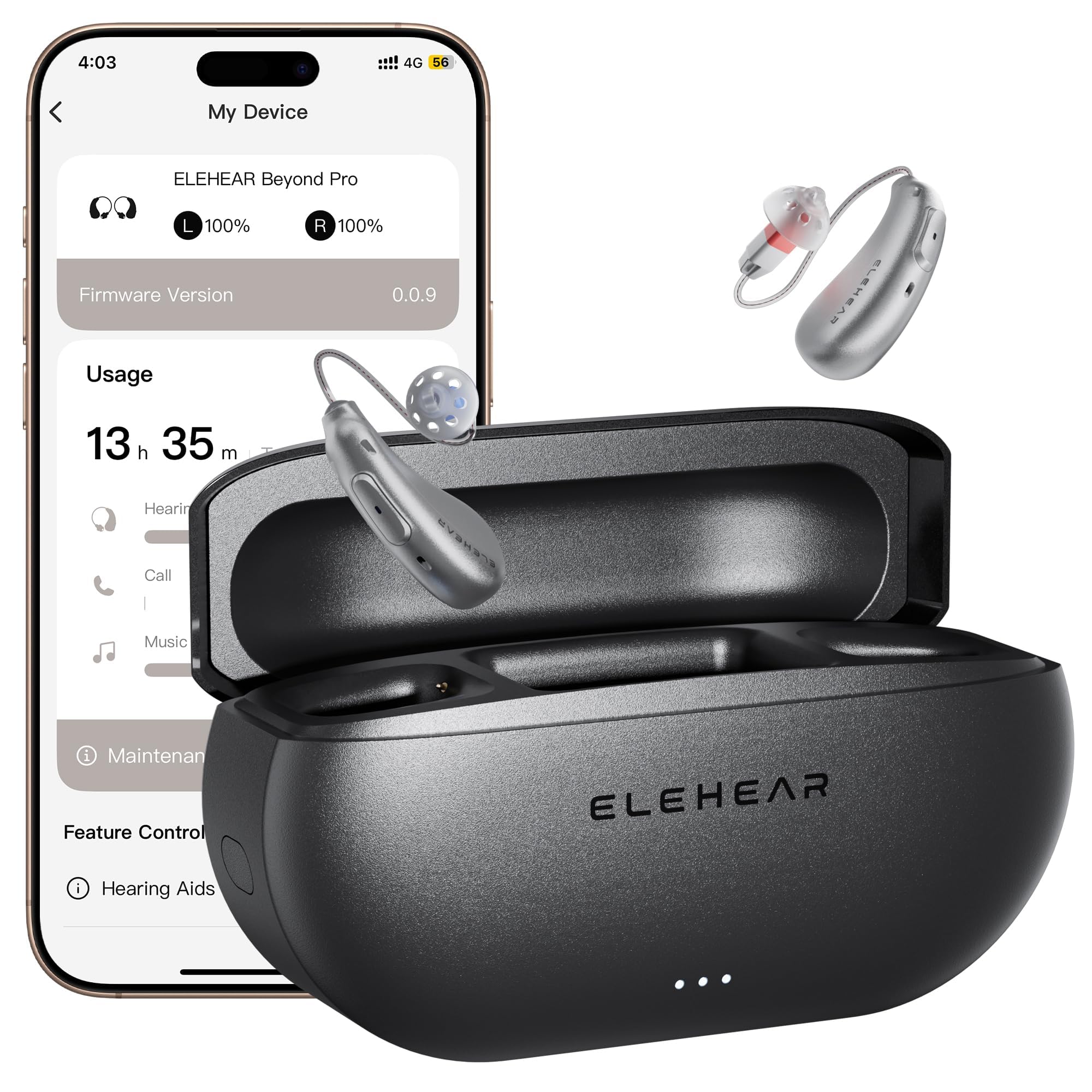
Fifteen minutes on the charger buys you six hours of listening — that is the pitch that stops people.
Fast charging is the headline here, and it is a genuine quality-of-life feature. Plug the Beyond Pro in for 15 minutes and you get up to 6 hours of use — a top-up that covers a forgotten overnight charge. A full charge runs up to 20 hours, and the case adds four more cycles on top. VocClear 2.0 drives the sound, with a claimed 30% clearer speech, high-frequency detail up to 8500Hz and just 8ms of latency — the lag between a sound and what you hear. Low lag keeps voices synced with moving lips on a screen.
The app is where this one spends its money. Beyond the usual tone and volume controls, it carries 20 ambient soundscapes — rain, breeze, vinyl crackle — plus real-time AI translation across 20 languages including Spanish, French, Italian, Japanese and Chinese. A 72-year-old who had worn prescription aids for seven years rated this above warehouse-club and other OTC options, citing the in-app hearing test, tinnitus masking and environment modes as real customization rather than decoration.
Long-term wear tells a more complicated story. A fourth-pair owner praised the crisp upper frequencies and the one-hour charge, but watched the left aid fail after seven months and had feedback trouble when coats collar against the ear. The presets in the app feel thin, and the fit can need locking in place. In noisy rooms it is not the star of the show.
What earns the premium: 15-minute fast charge, 20 ambient soundscapes, and AI translation across 20 languages built into a hearing aid.
The long view: durability over many months is the open question — a hardware failure has happened, and the fit can need extra securing in active use.
Suits you if: you travel, translate, or tend to forget the charger — the top-up speed alone changes how you use it.
Not your pick if: you want a device you can set once and forget for years with zero hardware drama.
6. AuraLink Bluetooth Hearing Aids
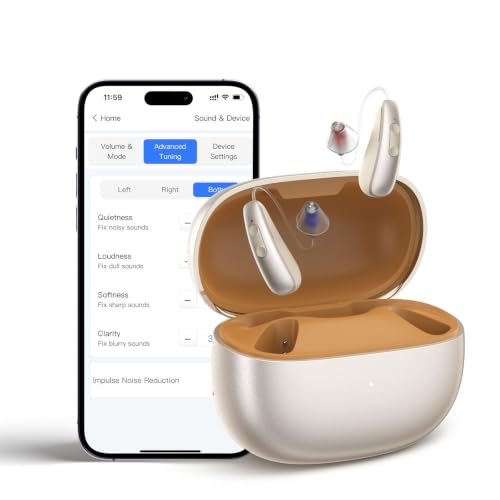
A hearing aid that treats the phone app as the control panel and the sanitizing case as part of the deal.
If you have ever wished you could fine-tune your hearing like an equalizer, the AuraLink is pointed straight at you. The free AuraFit app runs a hearing check, shapes a precise fit, and adds tinnitus masking — no clinic visit. It connects on Bluetooth 5.4, the current version of the wireless standard, which brings lower power draw and steadier connections for calls and music. It is built for adults with mild to moderate loss in the 25-85 dB HL range. An IP68 rating covers sweat, rain and dust, and the charging case adds a UV sanitizing step between uses.
Comfort and discretion are handled with a lightweight receiver-in-canal body that sits behind the ear, with several dome shapes and sizes to get a secure fit. The feature list also names echo cancellation, high-fidelity audio and noise cancellation, with a dynamic driver inside. The maker lists voluntary clinician support and use in a physician-led study — claims we cannot verify independently.
The sound is the split point. Owners of a senior parent describe background noise dropping away in crowds, with Bluetooth music and calls working cleanly. Others find the tone sharp or piercing, which a sensitive ear can read as uncomfortable, and some simply cannot get on with it for a more significant loss. The app is also newer than the big-brand rivals, so expect fewer preset shortcuts and more manual tuning. It is a smaller-track record, so the early feedback carries more weight than the settled verdicts on the older models.
The draw: Bluetooth 5.4, IP68 protection, a UV sanitizing case and deep app-based fitting for the app-inclined.
The caution: the tone reads sharp to some ears, and the early track record is thinner than the big names.
Worth a look if: you like the idea of dialing in your own sound and want the UV case for daily hygiene.
Pick another if: your hearing loss is on the heavier side or you prefer a long, proven track record.
7. Vivtone Rechargeable Hearing Aids for Seniors, Lucid508
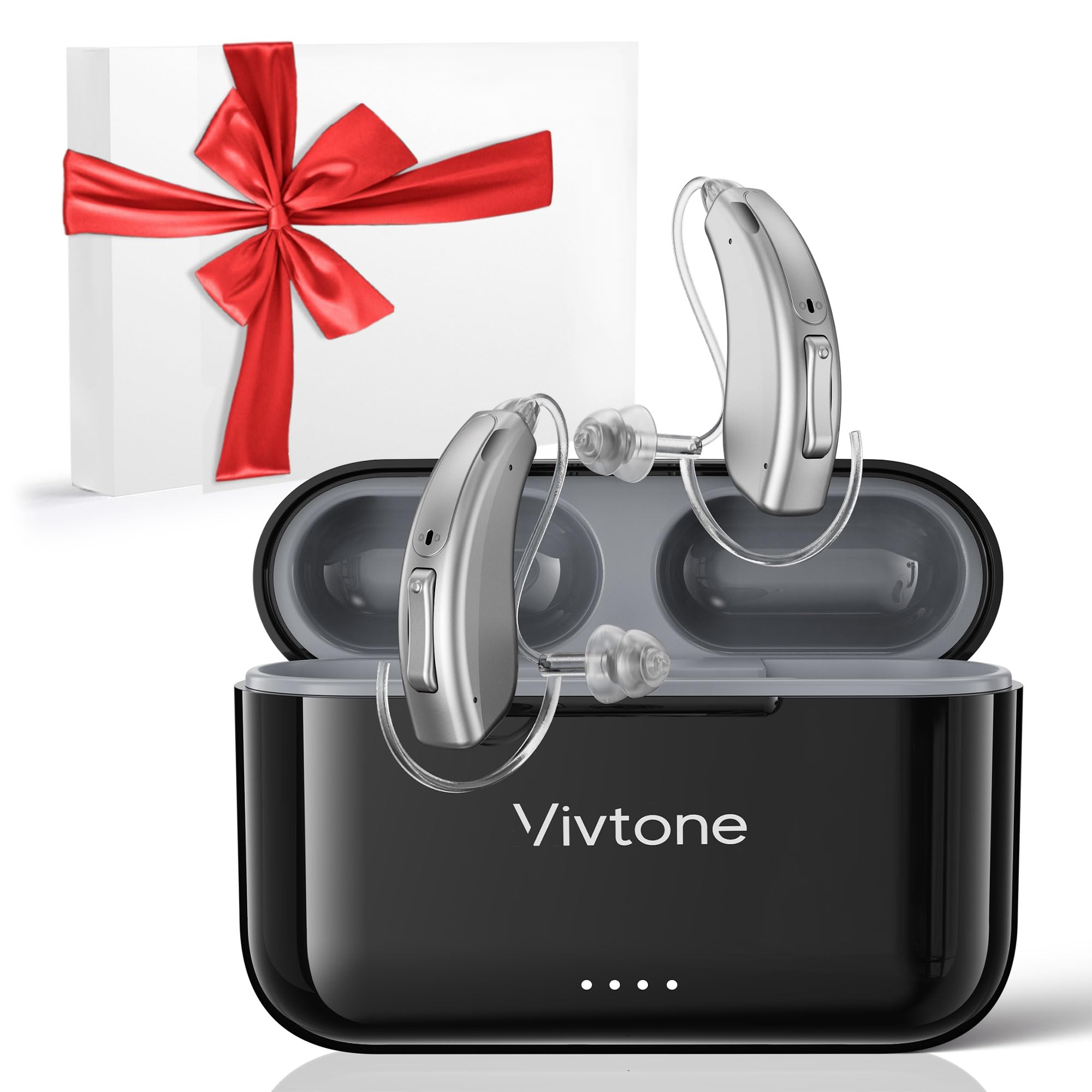
The one you hand to a parent who does not want to learn an app first.
No app, no Bluetooth, no learning curve — the Lucid508 works the way a simple device should. It is a behind-the-ear (BTE) design, with the body resting behind your ear and sound piped in through a tube. It turns on when you lift it from the case and off when you drop it back in, which removes the button hunt that trips up a lot of first-time users. Peak sound gains reach up to 41dB, aimed at mild to significant loss. There are three modes: quiet for normal rooms, noisy for background reduction that focuses on a human voice, and a tinnitus masking mode.
Charging is the quiet win. Two hours to full charge, then 25 hours of use — and the case holds enough to charge both aids four times over, for 125 hours of backup power. For an elderly parent who forgets the charger, that headroom matters more than any app feature. It comes with a three-year warranty noted by owners, and a free anti-lost lanyard and clip are available with your purchase when you click the Promotion section.
The realistic expectation is simple amplification, not audiologist-grade shaping. A repeat buyer loved the auto on/off and called the sound excellent; another would recommend it only if what you need is simple magnification, because an audiologist-adjusted pair can tailor individual frequencies around your exact loss. There is one reliability note worth knowing: a unit has quit charging after the 30-day return window, and the fix came through the company’s warranty line rather than a quick replacement.
Why it earns the value crown
- Auto on/off through the case — zero buttons to learn
- 25 hours per charge; 125 hours of backup in the case
- Three listening modes including tinnitus masking
- Nearly invisible behind the ear with medical-grade materials
What to expect honestly
- No app and no Bluetooth — amplification only
- Not the same as per-frequency audiologist tuning
- A rare unit has stopped charging past the return window
Hands down the choice for: the parent or grandparent who wants one button-free device and a case that outlasts a week.
Skip the upgrade if: you need app tuning, streaming, or a clinician’s per-ear shaping — this is deliberately the simple tool.
8. Jabra Enhance Select 500 Clinic-Quality OTC Hearing Aids

The one that brings a real audiology team and a streaming-specced chip into the over-the-counter crowd.
This is the pick for the buyer who wants professional support without the clinic drive. The Select 500 ships with audiology services included, and the maker positions it at half the price of in-person clinics. The hardware is its smallest “micro” shape, nearly invisible and ergonomically curved for all-day wear. Bluetooth covers calls, music and media on Apple or Android, and the chip also supports Bluetooth LE Audio and Auracast — the newer low-energy audio standard and the broadcast feature that lets one source reach many listeners. TapControl means a double-tap on your ear or the aid answers a call.
Jabra’s own battery spec stacks up well: the aid’s battery weighs 4.26 g and the device itself 2.12 g, so there is very little hanging on your ear. The audio engineering targets the hardest rooms — multiple speakers at a loud party — exactly where most OTC aids struggle. Where the sound is right, owners describe hearing clearly again and praise the simple app install and the adjustable settings. For one wearer, the over-ear fit stayed put and did not fight with glasses, and the charging case ended the button-battery routine entirely.
Two things to decide before you buy. First, Bluetooth on these can collide with car or office headsets, and some calls have come through poorly until streaming was switched off in the phone’s accessibility menu. Second, the long 100-day trial and free audiologist consults apply to direct Jabra purchases, not the Amazon listing — here you are inside the standard 30-day window. A fitting adjustment plus a replacement wire can eat most of that time, so know going in that your evaluation window is tight.
Standout value: clinic-quality tuning with audiology support included, the smallest body in this lineup, and Auracast-ready Bluetooth LE Audio.
The catch: Bluetooth can conflict with other headsets, and the generous Jabra trial and consult program does not carry over to Amazon purchases.
Made for: the buyer who wants a professional fitting path and the newest Bluetooth audio standards in one device.
Choose differently if: you need a long trial window to decide — that benefit belongs to the maker’s direct channel, not this listing.
9. Nova Hearing Aids for Seniors Adults, iB-N-br04
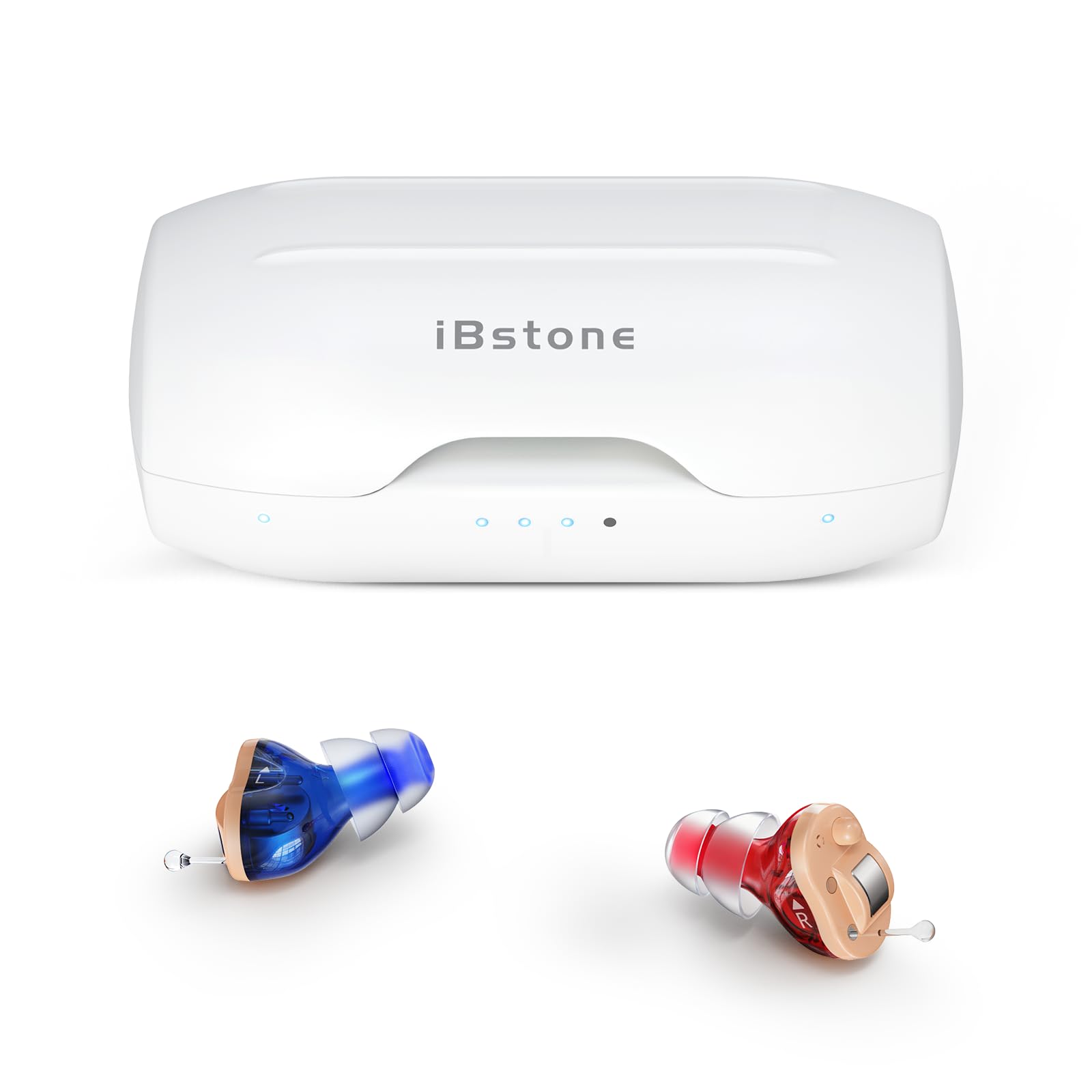
The cheapest way to find out whether any hearing aid belongs in your daily routine.
Buying a hearing aid blind is a leap. The Nova iB-N-br04 is the lowest-stakes test drive in the group, and that is its honest purpose. It is a basic behind-the-ear pair with manual adjustment dials rather than app control — you turn a wheel to change the volume. It arrives in a 6.57 x 4.17 x 2.13-inch package, and at 10.86 ounces it is the heaviest box here, travelling noticeably heavier than the Vivtone Xpure’s 6.74 ounces. If you want to try amplification before committing to an app-driven device, this is the entry rung.
The trade-off shows up in the sound. The tone runs thin and bright, and the dial can be finicky. One complaint is that it is too sensitive to small nudges when you seat the aid in your ear. Another is that background traffic cuts in more sharply than an indoor conversation. For some that is a deal with themselves: a couple of days of trial, then back it goes. The controls are the thing to master before you judge it, since the dial changes how the aid behaves both ways.
There is also very little track record to lean on. This model is newer than most on the list, so the body of feedback is small, and what exists is split. It works — with a dial to keep playing with — and it is not the device we would point a first-time buyer toward for long-term use. But for someone who wants to find out whether a hearing aid in general is worth the money, the lower commitment speaks for itself.
Lowest commitment: a simple behind-the-ear pair with a manual volume dial and no app to learn.
Small track record: the tone runs bright, the dial is easy to bump, and feedback is limited because the model is young.
Try this if: you want a cheap, no-frills way to test whether an aid fits your life before spending more.
Move up if: you already know you want an aid and care about sound quality and a proven history.
Know the Specs
What IP68 Actually Means
An IP rating is a two-digit score, and IP68 is the highest tier a maker typically lists. The “6” covers solids — full protection from dust. The “8” covers water — rated to survive being submerged under set conditions. In real life this means sweat and rain are not a threat, but a shower or a swim still is. It is the spec that matters most if you garden, golf, walk the dog, or live somewhere humid.
Gain In dB, Explained Plainly
Your hearing aid has to push the sound up to a level your ear can use. That push is measured in dB, a unit of loudness. The ELEHEAR Beyond lists a maximum of up to 50 dB; the Vivtone Lucid508 lists peaks up to 41dB. Higher gain can serve more significant loss, but the number is a ceiling — what your ear hears is set by how the device shapes gain across frequencies, not the single top figure.
Receiver-In-Canal Versus Behind-The-Ear
A receiver-in-canal (RIC) design pulls the speaker out of the body and places it closer to your eardrum, which typically sounds more natural and keeps the aid smaller. A behind-the-ear (BTE) design carries sound through a tube instead. RIC tends to suit small canals and first-time listeners; BTE is the old reliable when button simplicity tops the list.
Battery Hours And Case Backup
Two figures matter. The first is hours per charge — 16, 20, 24 or 25 depending on the model. The second is case backup: how many full recharges the case holds before you need a wall socket. The Vivtone Lucid508 case extends to 125 hours, the EARGO 8 charger holds up to 14 full recharges, and the ELEHEAR Beyond case adds four cycles for up to 100 hours altogether.
Common Questions
Will an open fit hearing aid work for severe hearing loss?
Do I need an audiologist appointment to set these up?
Can I stream music and phone calls through a hearing aid?
What is the difference between CIC, RIC and BTE designs?
How long does a hearing aid battery last on a charge?
Can a hearing aid take the place of my prescription pair?
Is an IP68 rating enough for sweat and rain?
What is tinnitus masking and which aids include it?
Do these pair with both iPhone and Android?
What happens if my hearing aid breaks after the return window?
The Bottom Line
For most people hunting the best open fit hearing aids, the top pick is the EARGO 8. It hides completely in your canal, so people see you, not the device. It carries an IP68 rating (a dust and water-resistance rating) and a 2-year warranty. Its 16-hour charge with 14 case recharges makes the maintenance almost invisible. If you also want to stream calls and music in the same device, the ELEHEAR Beyond is the one to reach for, with up to 100 hours of total battery life and 50 dB of gain (how much it boosts quiet sounds). And for the parent or grandparent who wants to skip the app entirely, the Vivtone Lucid508 delivers 125 hours of backup in a case and an auto on/off routine that needs no instruction manual. If you already know you want full streaming and professional tuning support, the Jabra Enhance Select 500 brings audiology services and Bluetooth LE Audio (a low-energy wireless audio standard) into the same device — just double-check that 30-day window before you commit.
How we choose
We do not accept paid placement. Every pick is matched to a real buyer and a real use-case; we do not hands-on test units.
Sources
Specifications: manufacturer listings and product documentation. Review insights: verified customer reviews, as of October 2026. Pricing: not shown on this page (it changes often); check the current price via the retailer link.
As an Amazon Associate, Aappliancez earns from qualifying purchases. This does not affect which products we feature.