Disclosure: Some links in this post are affiliate links. As an Amazon Associate I earn from qualifying purchases, at no extra cost to you. Learn more
Specs are compiled from manufacturer listings and verified buyer reviews and can change over time — please confirm the key details on the product page before buying.
You want one pair that reads a phone, handles a laptop, and still lets you look up at the TV — without three pairs scattered around the house. The problem is that a lot of so-called progressives sold online are really just plain reading glasses with a clever name. This guide separates the genuine no-line multifocal lenses from the ones that only magnify up close, so you know exactly which pair is worth your money.
This guide is built by comparing the manufacturers’ published specifications and the patterns across verified customer reviews, so you get each pick’s real strengths and trade-offs instead of marketing spin.
Progressive lenses blend near, mid, and distance vision into one lens with no visible line. That blend is what makes or breaks a pair, and the picks below differ sharply on how well it is done. These online trifocal glasses cover every budget and face shape so you can pick the pair that actually fits your day.
Top Picks
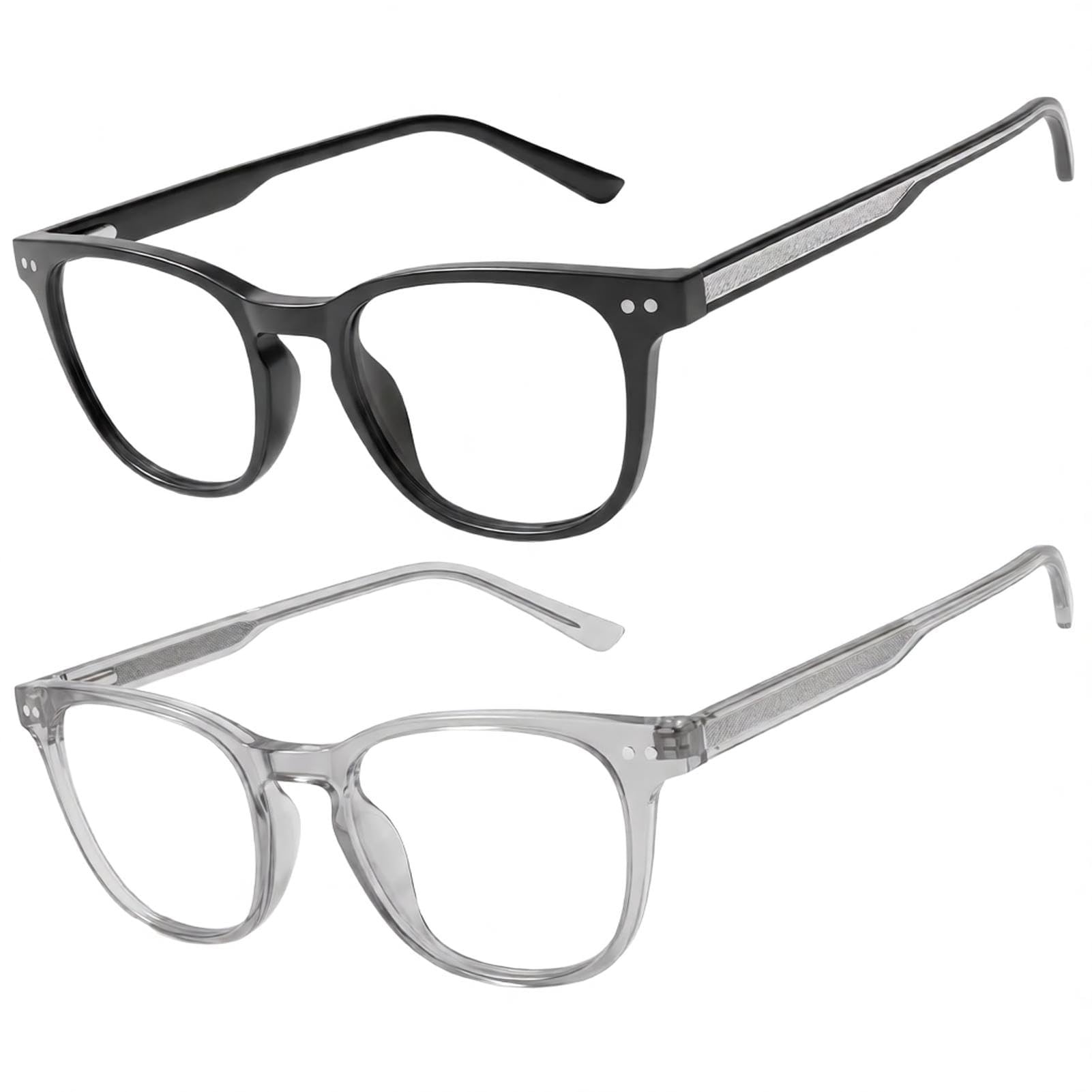

How To Choose The Best Online Trifocal Glasses
The single most important thing to understand before you buy is that “progressive” and “trifocal” both describe a lens with more than one power in it. A true one lets you read a label, work at a laptop, and glance across a room without changing pairs. A fake one just magnifies everything and turns the top of the lens blurry for distance. Learn to spot that difference and you will avoid the most common disappointment in this category.
Check what the top of the lens actually does
The top zone is your distance zone, and it should be clear — no magnification. If a lens magnifies the top area too, you cannot look up and see a road sign or a television sharply. Look for wording that spells out three distinct powers: an up-degree for distance, a middle degree for computer work, and a down-degree for close reading. When a listing only promises “magnification,” assume the top zone is not clear.
Pick your magnification one step lighter than you think
Buyers routinely order a strength that is too strong, then find the print swims. If drugstore readers at a given power feel slightly aggressive, go one step down in a progressive. A lighter power still handles a menu or a phone screen but leaves the mid zone more usable for a monitor at arm’s length.
Decide between full progressive and mid-near range
A full progressive covers distance, mid, and near. A mid-near range lens skips the far distance zone and concentrates on the space between your screen and your book. That makes mid-near a strong pick for desk and reading work. If you also want to drive or watch TV in the same pair, you need the full version.
Weigh the frame, not just the lens
These glasses live on and off your face all day, so the frame takes real abuse. Metal core wire inside the temple adds rigidity where it matters. A metal spring hinge lets the arm flex outward instead of snapping. Acetate and flexible plastic frames survive more handling than stiff, brittle plastic — and adjustable nose pads keep a heavier lens from sliding down.
Side-by-Side Comparison
| Model | Best For | Lens Type | Frame Build | Magnification Focus | Amazon |
|---|---|---|---|---|---|
| DEHOTRE Progressive Multifocus (Metal Core Wire)★ Best Overall | All-day computer and reading use | Progressive multifocus, no line | Acetate frame, metal core wire, metal spring hinge | Transition readers (multiple powers) | Amazon |
| Eyekepper 4-Pack Progressive ReadersBest for Spares | Having a spare pair in every room | Progressive multifocus, 3 levels in one lens | Spring-leg design, swingable temples | +1.50 | Amazon |
| DEHOTRE 2 Pack Half Frame | Long work sessions at a desk | Progressive multifocus, no line | Acetate half frame, metal core wire, adjustable nose pad | Subtle progressive transition | Amazon |
| Computer Reading Glasses Blue Light Blocking | Screen-heavy days and mild magnification | Single-power reader with blue light blocking | Light grey elastic frame, anti-reflective coating | 0.25 magnification | Amazon |
| DEHOTRE Metal Half Frame (Mid-Near) | Desk, book, and screen work in one pair | Progressive multifocal, no line, mid-near range | Half metal frame, metal patterned arm, bended temple | Mid-near range | Amazon |
| DEHOTRE Metal Half Frame (Nose Pad) | Slipping glasses on a heavier lens | Progressive multifocal, no line, mid-near range | Half metal frame, comfortable nose pad, metal patterned arm | Mid-near range | Amazon |
| Peepers Progressives for Women | Style-first buyers wanting real progressive lenses | Progressive, no line | Hinged temples, sturdy build | Progressive (near to far) | Amazon |
Detailed Reviews
1. DEHOTRE Progressive Multifocus Reading Glasses Metal Core Wire
Our pick — 4.0+★ from 100+ verified ratings; the strongest balance of quality and price.
The clear-frame progressive that buyers keep reordering — and the strongest all-rounder on this list.
What wins people over here is the lens itself. Lens quality is the most-praised thing about this pair by a wide margin — roughly twenty separate mentions land on the glass, well ahead of fit. Owners describe it as clearer than the drugstore readers they were using before, and one repeat buyer said it plainly: “Definitely see clearer than other pairs we have purchased. Second time purchasing because my husband loves them.” For a pair that has to carry you from a keyboard to a paperback, that clarity is the whole point.
Then there is the frame, built around a metal core wire that runs inside the acetate temple. In plain terms, that stiff wire keeps the arm from flopping and adds structure where cheap frames fail first. The metal spring hinge lets each arm flex outward when you push the glasses on one-handed. Buyers describe the weight and fit as solid and the hinges as firm, which matters when you are taking these off twenty times a day. Compared with the Peepers pair further down, you are trading a little brand polish for a steadier arm and a quieter, more masculine look.
Here is the honest catch, and it comes straight from the top of the lens. A handful of owners find the distance zone carries some magnification, which undercuts the “look up and see far” promise. As one put it: “the biggest shortcoming is the top part of the lens is not clear.” A few also note the acetate frame feels less sturdy than they hoped. Neither complaint is widespread, but if clear distance vision is your main reason for buying a progressive, read the reviews closely and consider the mid-near DEHOTRE models below instead.
What earns the top spot
- Lens quality is the standout — owners repeatedly call it clearer than drugstore readers.
- Metal core wire and spring hinge give the acetate frame real structure and flex.
- Look more expensive than the price tier, with a distinctive clear frame.
- Multiple magnification strengths let you dial in the reading power you need.
Where it can disappoint
- The distance zone at the top can carry slight magnification, which can muddy far vision.
- A few owners find the acetate frame less durable than the hinges suggest.
- If you want truly clear distance viewing, a mid-near model suits desk work better.
Reach for this if: you want one pair for reading, computer work, and everyday wear with the clearest lens on this list.
Look elsewhere if: clear distance vision is essential — the mid-near DEHOTRE pair below skips the far zone on purpose.
2. Eyekepper 4-Pack Progressive Readers Women +1.50
Four progressive pairs, one flat buy — the set that solves the “where did my glasses go” problem.
Start with the number that defines this pick: four pairs in one box. That is the entire argument. Instead of hunting for the one progressive pair you own, you leave a set on the desk, one by the bed, one in the car, and one wherever you read. Each costs a fraction of a single pair from the premium tier, so losing one is an annoyance rather than a disaster.
The lens itself is a genuine three-level multifocal — up-degree for distance, mid for computer, and down for close work — with a 5-layer anti-reflective coating to cut glare from screens and fluorescent lights. Buyers describe the lenses as delivering clear vision at all depths, and the very light weight is a real asset. At 0.7 ounces, this pair is the heavier of the two weighed here, above the 0.5-ounce blue-light Computer Reading pair — a little more presence on your nose, but not enough to notice by the end of a workday.
The frame engineering is worth a line too. A spring-leg design that swings on the arm reduces the squeeze on the sides of your head, so it settles on larger and smaller faces alike. The blue-light tint is intentionally light, and buyers call out that it produces fewer of the blue “ghost spots” you can see at night with heavier tinted lenses. A small caveat: the tint is subtle, so it is easy to forget these are doing any filtering at all.
The value math: four pairs for one purchase, each with three vision zones and a glare-cutting coating, is the most practical option for someone who reads in four different rooms.
What to expect on strength: the set is fixed at +1.50, so if your reading power lands a step either side, the fit will feel off — check your usual reader strength before committing.
Suits you if: you want a spare pair in every room without paying premium prices for each one.
Won’t suit you if: you need a very specific magnification — this set is locked at +1.50.
3. DEHOTRE 2 Pack Progressive Multifocus Reading Glasses Acetate
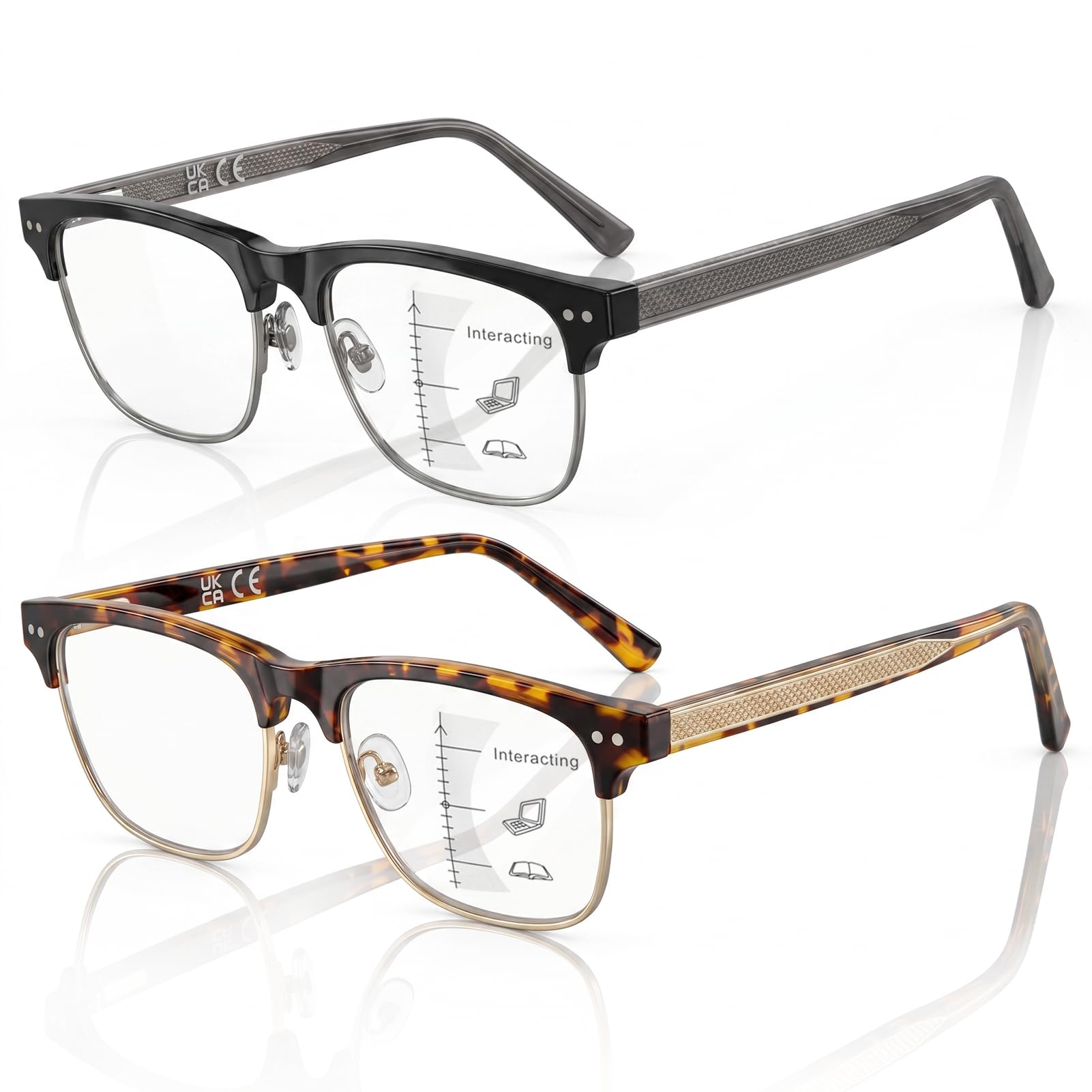
The half-frame pair built for eight-hour desk sessions — flexible, light, and styled like sport eyewear.
This is the pair you leave on the monitor until lunch. The acetate half frame keeps the rim line low so you are not looking through a thick bar of frame when you glance at the screen, and the adjustable nose pad lets you fine-tune the height so the mid zone lands right on your line of sight. The progressive transition is deliberately smooth and subtle, which is exactly what you want on a lens you wear while your eyes travel between a document and a keyboard.
The build leans on a metal core wire inside the temple, the same structural trick as the Best Overall pair. Flexible plastic outlasts the stiffer acetate frames here, and buyers report the frames hold up through daily handling. The look is distinct — a slightly sporty orange read that calls to mind athletic eyewear rather than a clinical reader. You also get two pairs in the box, which pairs well with its long-session purpose if one pair stays desk-bound.
The long-session read: smooth, subtle progression plus an adjustable nose pad means fewer head tilts during a full workday.
Bear in mind: half-frame lenses suit desk and reading work; if you need sharp distance vision for driving, this is not the pair.
Best matched to: anyone who lives at a monitor and wants comfortable, flexible progressives for the workday.
Not the pair for: driving or TV viewing at a distance — the half-frame design is built for near and mid work.
4. Computer Reading Glasses Blue Light Blocking

A single-power reader with the lightest build here and a minimal 0.25 magnification for slight help.
Not everyone needs a progressive lens. If your eyes are fine for distance and you only need a nudge on tiny print, this reader is the sensible buy. The 0.25 magnification is the lightest on this list — low enough that it barely changes your view, high enough to lift a phone screen or a paper label into focus. Value is what buyers prize most about this pair, and the box backs it up: aspheric scratch-resistant lenses, an anti-reflective coating, a hard case, a cleaning cloth, and a tool.
The frame is where this pair stands apart physically. A clear light-grey elastic frame keeps the whole thing at 0.5 ounces — the lightest on this list — so it barely registers on your face. Owners mention they forget they are wearing them by the end of day one. The plastic build is light and thin rather than rigid, and it flexes rather than cracking when you push it on one-handed. Men and women both wear it comfortably.
The honest part: some buyers do not find the blue-light tint strong enough to trust the marketing. As a few put it: “no noticeable blue light reduction (blues still look blue).” The anti-reflective coating still helps with screen glare and overhead lights, and the mild magnification is where the real value sits. A rare unit also has the bridge give way after a few months of normal use. Treat that as a fragile-plastic caveat rather than a reason to pass — this is a light, affordable single-power reader, not a rugged frame.
Makes sense for: anyone who wants the lightest possible pair with a gentle 0.25 magnification and a hard case included.
Think twice if: you need strong blue-light filtering — the tint on this pair is intentionally light and subtle.
5. DEHOTRE Progressive Multifocal Reading Glasses Women Nose Pad
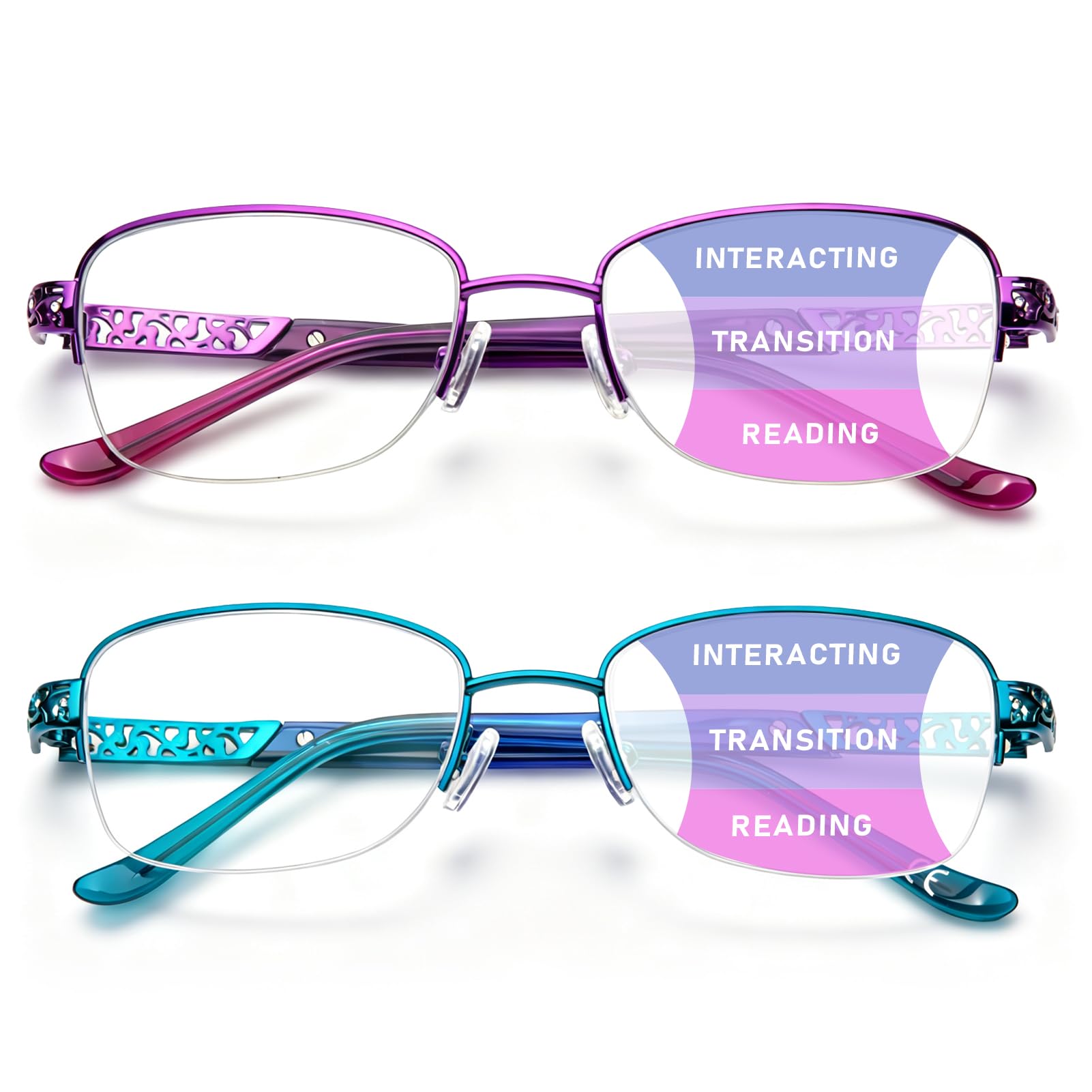
A mid-near half-frame built for the desk-to-book hop, with a metal arm and a bended temple.
This pair goes after a specific job: the middle ground. Mid-near range means the lens concentrates on the space between your monitor and your paperback, skipping the far-distance zone entirely. If your day is a laptop, a spreadsheet, and a novel at lunch, that focus is more useful than a full progressive. The half metal frame keeps the weight low on your nose, and the bended temple curves around behind your ear so the pair stays put when you lean into a screen.
The metal arm carries a patterned finish that lifts the look above a plain reader, and the comfortable nose pad sits the lens at a consistent height — which matters more on a mid-near lens, where the sweet band of clear vision is narrower. As with the other DEHOTRE pair above, the build leans on metal where it counts rather than all-plastic arms that loosen over time.
The one-job specialist: if you work close and mid, this concentrated mid-near lens puts the clear band where your eyes live.
Be clear on the limit: mid-near skips the distance zone, so this is not a pair for driving or crossing a room.
Built for: desk workers and readers who want a focused mid-near lens on a light metal half frame.
Steer clear if: you expect to look up and see distance clearly — the mid-near design leaves the far zone out.
6. DEHOTRE Progressive Multifocal Reading Glasses Women Metal Half Frame
The same mid-near half frame, priced and built around a lighter, more comfortable nose fit.
Nearly identical to the pair above, this model’s case is the nose. A comfortable nose pad carries the lens without clamping, and the bended temple hooks around the ear so a heavier progressive lens stays centered. On a mid-near lens, where the clear band of vision is narrow, a stable fit does real work — a pair that slides down your nose drops your reading zone out from under your line of sight.
The lens story is the one buyers actually talk about. It goes progressive cleanly, from a clear distance zone at the top to a near zone at the bottom, and the light tint is mild enough that colors stay close to true. A buyer at 2.75x called this the best progressive they had found: “The lens were not super heavy and the clear portion allows me to not have to put glasses on and off.” That is the exact promise of a real progressive — no more swapping pairs to read and to look up.
What you should know before you commit: this pair has very few reviews so far, and the handful that exist split. Some find the temples tight and stiff, and one noted that the top zone carried some magnification, pushing them to look above the rim. Both are fixed with a careful fit — bend the temple gently, and set the nose pad so the mid zone lands on your line of sight. The build is metal and half-frame, the weight is slight, and the price sits in the mid tier.
What it gets right
- Genuine progressive lens with a clear top and a near bottom, so you stop swapping pairs.
- Metal half frame with a bended temple keeps the lens centered on your face.
- Light tint keeps colors close to true instead of casting a heavy hue.
- Comfortable nose pad eases pressure over a long reading session.
What to plan for
- Temples can arrive tight and stiff; give them a gentle bend for head comfort.
- Very few reviews so far, so buyer feedback is still building.
- The top zone can carry slight magnification, which some find muddies distance viewing.
The right pick for: a reader who works near and mid and wants a metal half frame that stays centered.
Pass if: your daily wear leans on distance viewing — a full progressive suits that better than mid-near.
7. Peepers Progressives for Women, To the Max Progressives

The style-first progressive — plenty of compliments, with a genuine near-to-far lens behind the design.
Peepers built its name on looks, and this pair leads with exactly that. Style is the most-praised thing here by a wide margin, and owners say the compliments come constantly. Under the design sits a real progressive lens, not a magnified reader dressed up — the pair transitions from a near reading zone at the bottom to a clear distance zone at the top, so you can read a menu and then look up at the room. Hinged temples help it fit a range of face shapes.
Where the Peepers pair asks for patience is the lens fit. The clarity of the top zone is the most consistent complaint, and several buyers find the progressive bands do not line up with their eyes — the near-to-far transition takes some getting used to, and you may find yourself tilting your head to find the clear spot. A handful also feel the glossy black frame looks less premium in person, and one reviewer with a larger head found the fit ran slightly small. The build gets called sturdy, so the frame itself is not the weak link.
Style is the headline: this is the pair you reach for when glasses are part of the outfit, and the progressive lens is genuinely there behind the design.
The clear catch: the top distance zone can be fuzzy for some wearers — if you need sharp distance viewing, expect a break-in period.
Designed for: women who want a stylish progressive pair with a real near-to-far lens and a sturdy frame.
Skip if: you need crisp distance vision from the first wear — the top zone can be soft.
Know the Specs
Progressive vs Trifocal Lens
A trifocal has three distinct powers; a progressive blends those powers gradually with no visible line. In practice a progressive is smoother to wear because there is no hard edge to cross between zones. The cost is that the clear band for each distance is narrower, so the fit of the frame has to be right to keep the right zone over your pupil.
Magnification Strength
The +1.50, +2.75, or 0.25 figures are the reading power. A lower figure like 0.25 is a nudge for tiny print; a higher figure like 2.75 is for heavier reading. Pick one step lighter than your usual reader on a progressive, because the mid zone already helps and a too-strong lens makes the print swim.
Mid-Near Range Explained
Mid-near range concentrates the clear band on the space between your screen and your book, skipping the far distance zone. This suits desk and reading work but is not designed for driving or looking across a room. A full progressive covers near, mid, and far in the same lens.
Frame and Hinge Build
Metal core wire inside the temple adds rigidity so the arm holds its shape. A metal spring hinge lets the arm flex outward when you push the glasses on. Acetate and flexible plastic outlast brittle plastic, and adjustable nose pads keep a heavier lens from sliding down your nose.
Common Questions
What is the difference between progressive and trifocal glasses?
Will these progressive glasses work for driving?
How do I pick the right magnification for online trifocal glasses?
Do I need a prescription to buy progressive readers online?
How long do progressive reading glasses last?
Are blue light blocking lenses worth it on reading glasses?
How do I stop progressive glasses from sliding down my nose?
Can I wear online trifocal glasses for computer work all day?
What does no line bifocal mean on these listings?
The Bottom Line
For most people, the strongest of these online trifocal glasses is the DEHOTRE Progressive Multifocus with Metal Core Wire, because its lens is the clearest on this list and its acetate frame with a metal core wire and spring hinge holds its shape through daily on-and-off use. If you want a spare in every room, the Eyekepper 4-Pack solves that in one buy. And for the days spent entirely between a screen and a book, the DEHOTRE Mid-Near Half Frame puts the clear band exactly where your eyes live. The honest nudge: pick one step lighter on magnification than your usual reader, and set the nose pad so the mid zone lands on your line of sight — that single fit step does more for a progressive than any spec label.
How we choose
We do not accept paid placement. Every pick is matched to a real buyer and a real use-case; we do not hands-on test units.
Sources
Specifications: manufacturer listings and product documentation. Review insights: verified customer reviews, as of October 2026. Pricing: not shown on this page (it changes often); check the current price via the retailer link.
As an Amazon Associate, Aappliancez earns from qualifying purchases. This does not affect which products we feature.