Disclosure: Some links in this post are affiliate links. As an Amazon Associate I earn from qualifying purchases, at no extra cost to you. Learn more
Specs are compiled from manufacturer listings and verified buyer reviews and can change over time — please confirm the key details on the product page before buying.
If you are tired of running out of hot water mid-shower, the fix is not a bigger tank — it is matching a tankless unit’s heating power to your home’s electrical service. Most buyers get this wrong in one of two directions: they buy a unit that cannot heat water fast enough, or they buy one that needs an electrical service their house simply does not have. This guide walks through seven electric tankless water heaters, from compact point-of-use models to whole-home units, so you can pick the one that actually fits your plumbing, your breaker panel, and how many people shower before 8 a.m.
This guide is built by comparing the manufacturers’ published specifications and the patterns across verified customer reviews, so you get each pick’s real strengths and trade-offs instead of marketing spin.
You do not need to be an electrician to shop this category, but you do need to know your home’s service size and how many fixtures you want running at once. That single number decides almost everything, and it is the first thing this on-demand electric water heater guide uses to separate the picks worth considering.
Top Picks

How To Choose The Best On-Demand Electric Water Heater
Shopping for a tankless electric heater is really an electrical question wearing a plumbing costume. The unit heats water by pulling a large amount of electricity through heating elements as water flows past them. If your home cannot deliver that power, the heater will either trip breakers or produce lukewarm water no matter what the display says. Get the electrical side right first, then pick the unit that matches your fixture count.
Start with your home’s electrical service
Your home’s electrical service, measured in amps, is the ceiling on everything. The Stiebel Eltron Tempra 29 Plus, for example, requires a minimum of 200 amp total service to the residence and three separate dedicated 40 amp breakers. Smaller homes often carry 100 amp or 150 amp service, and older houses can be lower still. If you are unsure what you have, check the main breaker at your panel or ask an electrician. This one check saves you from the most common and most expensive mistake in this category.
Match kilowatts to how many fixtures run at once
Kilowatts, the unit’s heating power, set how much hot water you can draw at the same time. A whole-home unit in the 24kW to 28.8kW range can heat water for multiple showers and a running appliance. A point-of-use unit in the 3.5kW range is designed for a single sink. Buy more power than your service supports and it is wasted money; buy too little and you will be the person waiting for the shower to warm back up.
Check flow rate and inlet water temperature
Flow rate, measured in gallons per minute, tells you how fast water moves through the unit. The temperature your unit can deliver depends on both the flow rate and how cold the incoming water is. Homes in cold regions need more power to reach the same output temperature as homes in warm ones. If you live somewhere with genuinely cold winters, size up rather than down.
Side-by-Side Comparison
| Model | Best For | Heat Output | Flow Rate | Capacity | Amazon |
|---|---|---|---|---|---|
| Stiebel Eltron Tempra 29 Plus★ Best Overall | Whole-home use in larger houses | 28800 watts | 3 gpm | 0.39 gallons | Amazon |
| ECOTOUCH ECO270STop Performer | Whole-home use with multiple bathrooms | 27 KW | — | 6.5 gallons | Amazon |
| CAMPLUX TE04N2 | A single sink in a tight space | 3.5 KW | 2.5 liters per minute | 0.66 gallons | Amazon |
| EcoSmart ECO 8 | Small apartments and single-bath homes | 8 KW | 2 gpm | 2 gallons | Amazon |
| AIRTHEREAL EVT-27K | Three simultaneous showers | 27 KW | 0.48 gpm | 240 gallons | Amazon |
| ThermoMate ET180 | Whole-home use on a mid-size panel | 18 KW | 4.4 gpm | — | Amazon |
| Stiebel Eltron Tempra 24 Trend | Two-bath homes wanting quiet operation | 24 KW | 0.03 gpm | — | Amazon |
Detailed Reviews
1. Stiebel Eltron Tempra 29 Plus Electric Tankless Water Heater
Our pick — 4.0+★ from 450+ verified ratings; the strongest balance of quality and price.
The heavyweight that keeps two showers running at once without blinking.
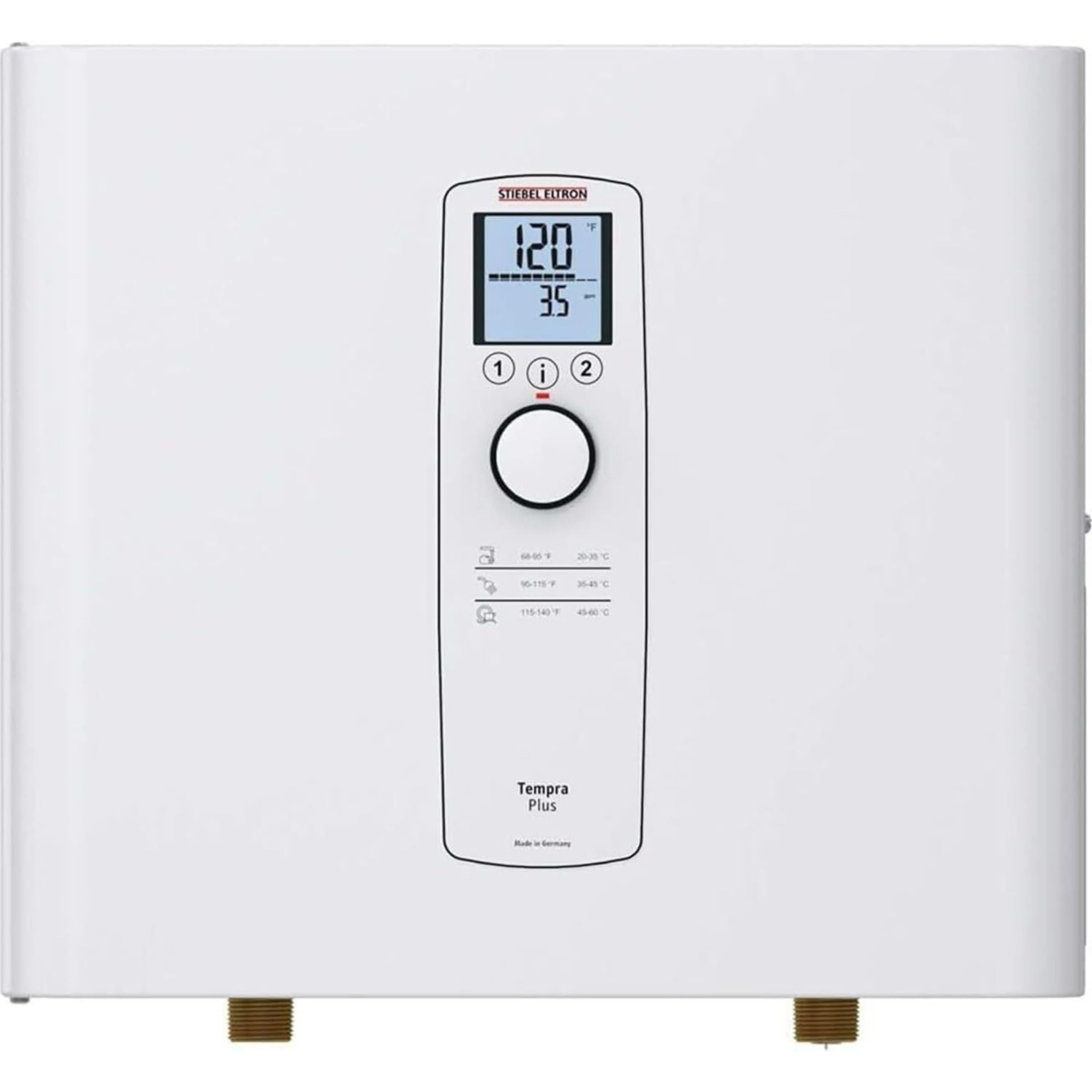
The Tempra 29 Plus is the pick for a busy household where the hot water never seems to stop. It delivers hot water on demand with a continuous and unlimited supply, so the last person in line gets the same shower as the first. The unit puts out 28800 watts of heat, the highest in this group. For anybody upgrading from a tank that runs cold, that number is the whole point.
What wins people over is how precisely you can set your temperature. Two different temperature memory presets make it easy to switch between, say, a shower setting and a tub-filling setting without fiddling. Owners describe precise temp presets for tub filling and two simultaneous showers as the reasons they moved off gas tanks in the first place. The design is also sleek and needs no venting, which means you can relocate it near the point of use and skip the flue work entirely.
Know the catch before you buy. This unit draws a maximum of 28,800 watts at 240 volts or 21,600 watts at 208 volts, and it requires three separate dedicated 40 amp breakers with 8 gauge copper wiring. It also wants a minimum of 200 amp total service to the residence. On top of all that, it will not switch on at very low flow, so a trickle at a tap does nothing. If your panel is 100 or 150 amps, this is not the one for you.
Why it earns the top spot
- 28800 watts of output, the highest heat capacity in this lineup, so two showers can run together
- Two temperature memory presets make daily switching painless
- Made in Germany with a copper heating system and no venting required
- Buyers report consistent hot water with two bathrooms in use and the Tempra 29 Plus still going strong after four to five years
What you need to plan for
- Needs three 40 amp breakers, 8 gauge copper wiring, and at least 200 amp service
- The front cover hinges and will not fully open in a tight closet
- No hot water during a power outage, since there is no tank to fall back on
Reach for this if: your home has the electrical capacity for a whole-house draw and you want the most heating power on this list.
Look elsewhere if: your main panel tops out at 150 amps, because the 200 amp service requirement is a hard floor, not a suggestion.
2. ECOTOUCH 27kW Water Heater Electric
A whole-house heater that handles a 120°F shower with no temperature dips.
If you have a house with several bathrooms and a full house every morning, this is your pick. The ECO270S runs on 27 KW of heat output and can deliver a flow rate of up to 6.5 gallons per minute, so it handles two showers at once or four small sink fixtures in a small home or apartment. One owner replaced a pair of 40-gallon electric tanks with this single unit and reports back-to-back showers at 120°F with no errors.
The self-modulating system is what keeps the temperature steady. A smart chip inside monitors conditions 20,000 times per second and adjusts the exact power input to match your flow rate in real time, so you do not get the hot-cold-hot cycle that plagues cheaper units. Pushing the flow down at a tap also drops the power draw, which keeps the draw steady rather than scalding. Owners describe it heating up extremely fast in a house with multiple bathrooms and high water usage.
The trade-off is electrical, and you have to plan for it. This unit works only on 240V, not 120V, and it draws up to 113 amps, so it needs a 200 amp breaker panel plus three 40 amp double-pole breakers and three sets of 8 gauge wire with grounding. The safety coverage is thorough — leakage protection, over-temp protection, high voltage protection, and dry-heating protection all come standard, with ETL certification and UL qualification for extra reassurance. It also has a 131°F max temperature and a built-in water filter, which helps cut down on the scale that plagues units without one.
Where it wins: the combination of 27 kW output and that 6.5-gallon-per-minute ceiling is what lets it keep up with real back-to-back morning traffic in a busy house.
The one snag: assembly quality can vary on arrival. An occasional unit ships with a missing grounding screw, though the brand is quick to respond when contacted through Amazon.
Best for: larger homes with a 200 amp panel and more than one hot-water fixture fighting for attention at once.
Not for: a home running 120V service or a panel below 200 amps, because this unit cannot operate on either.
3. CAMPLUX Tankless Water Heater Electric 120V
A tiny single-sink heater for spaces where a full unit will never fit.
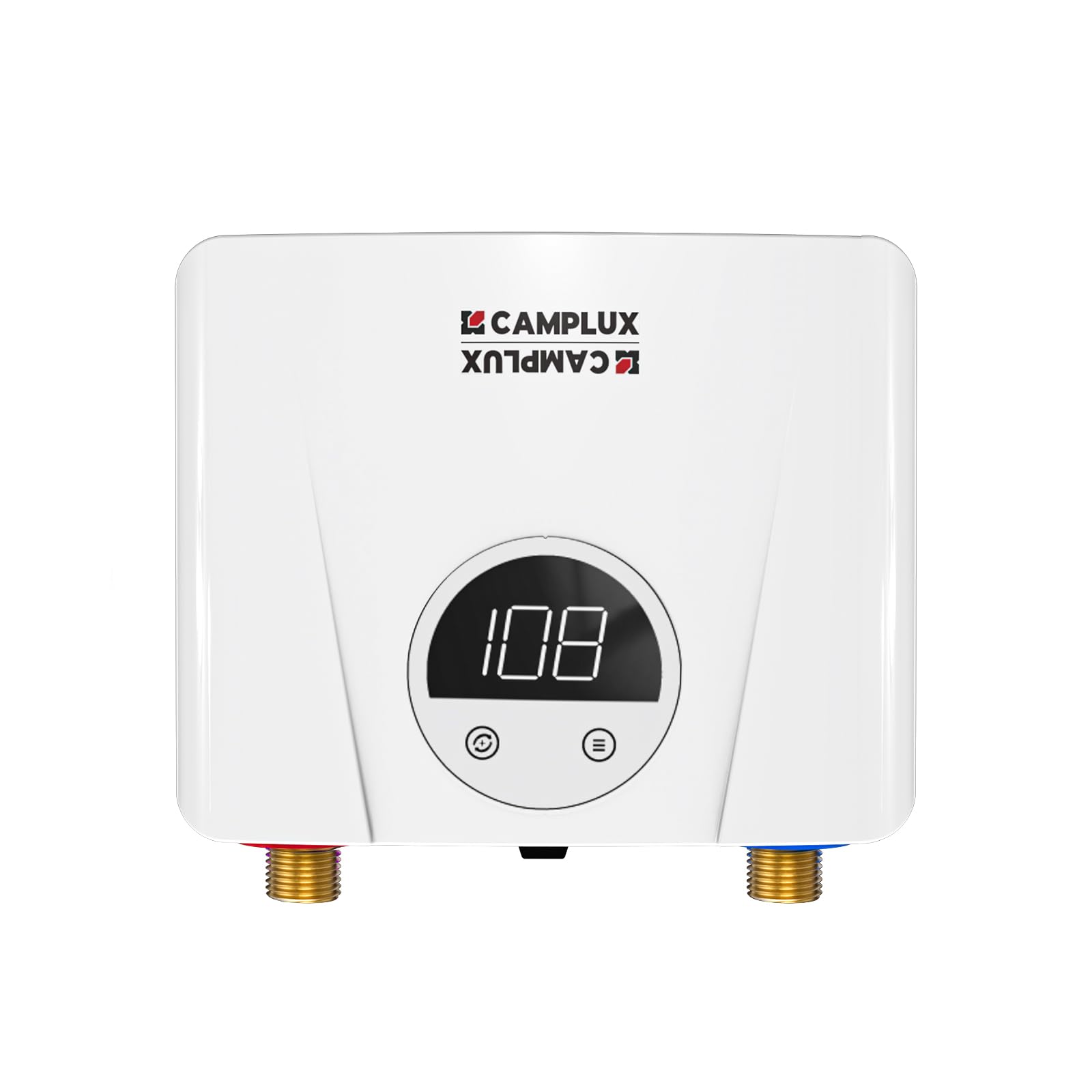
This is the point-of-use unit, built for one sink and nothing else. It draws 3.5 KW at 120V and can raise the temperature of water moving at 1.0 GPM by 22°F, giving you hot water at 73°F or higher within seconds. The manufacturer is explicit about that scope — one sink only. So if you are hoping to run a shower, a washing machine, or an RV from this, this is not the unit for the job.
Where it earns its place is in tight quarters. The body measures 7.8W by 6.3H by 3.9D inches and weighs just 3 pounds, so it can mount multi-angled under a small kitchen sink, a wet bar, or a salon station. That makes it the lightest unit in this lineup by a wide margin — the Stiebel Eltron Tempra 29 Plus weighs 19 pounds, and this one is 3. You also get a touch control panel with a digital temperature display and a 131°F max, plus a minimum flow for activation between 0.4 GPM and 0.66 GPM.
Be honest about the limits before you order. It must be hardwired with no plug, and it needs a 32A circuit breaker, 10 gauge wire, and a 1/2″ NPT water connection. Owner feedback here is genuinely mixed, and it is worth knowing: some units arrive used with scratches and debris in the inlet, and even a fresh unit only heats well at very low flow rates. That is not a defect — it is a hard limit of running at 120V.
The real verdict: buy it for a single low-flow tap and nothing more, and it does that job in spaces where nothing bigger fits.
Worth it for: a wet bar, salon sink, or boat galley where one small fixture is all that matters.
Skip it for: any application at higher flow, because the slight trickle it needs to heat water properly will frustrate you everywhere else.
4. EcoSmart ECO 8 Tankless Water Heater

The modest-power unit that fits where bigger draws simply are not an option.
This is the entry point to tankless heating, and it is the one for a small space with modest hot-water needs. The ECO 8 puts out 8 KW at a 2 gallon-per-minute flow rate and is rated 99.8% efficient. At 4.8 pounds, it is the second lightest unit here. For a studio, a single-bath apartment, or a cottage with one or two fixtures, that combination is entirely workable.
What buyers tend to comment on is how easy it is to install and how precisely you can dial in a temperature. Being able to set the exact temperature you want is the recurring theme in the feedback, and that is the counterintuitive advantage of going electric over a tank — a dial, not a guess. It is also durable in service, which is why this design keeps reappearing across the various models on this list.
Here is the honest caveat on the heat. Buyer feedback on the heat output itself is split — while some note it warms up very fast, others find it struggles to hold water hot once you start pushing flow through it. In a colder climate or a home with heavy simultaneous demand, it will fall short. In a mild climate with one fixture running at a time, it does the job without the wiring headache of a bigger unit.
Where it shines
- Precise temperature setting lets you dial in exactly the heat you want
- Only 8 kW means far less wiring and breaker work than whole-house units
- 4.8 pounds, so a single person can mount it without help
- 99.8% efficiency rating means essentially no standby energy loss
Where it stops short
- At 8 kW it cannot feed multiple fixtures at once
- Some owners find it struggles to keep water hot at higher flow
- Limited output matters most in cold-climate installations
Pick it if: you want the smallest, simplest possible draw and only ever heat one fixture at a time.
Pass if: two showers run in your house at the same hour — this output will not carry both.
5. AIRTHEREAL Electric TANKLESS Water Heater 27KW

Big power for the money, with a stainless build and the simplest install story in the group.
Airthereal’s EVT-27K promises hot water for three showers from a 27 KW heating element, and it self-modulates its power to keep energy use down. The case is stainless steel, it takes up a shallow footprint, and at 19 pounds it is built to sit on a wall and be forgotten. The performance is the standout positive — buyers describe water so hot that it far outperforms the 18 kW unit they replaced, and the flow stays hot with no trouble.
The caveat worth knowing is about the electrical work, not the heater. A 27 kW draw needs a serious circuit, and buyers consistently flag that the higher power complicates installation and that a professional is recommended for the wiring. Many report the wiring itself costs almost as much as the unit, but they also say the result is worth it. If you already have the panel capacity, this is a lot of heating power for a mainstream price. If you do not, you will be pricing a sub-panel upgrade alongside the heater.
The other honest note is about support over time. This is a unit with no user-replaceable parts, so if something fails in service, the fix is a new heater, not a repair. Owner reviews on reliability and long-term value are genuinely split for that reason. The upside of that design choice is a simpler machine with fewer things to go wrong in daily use.
My read: the self-modulating element and stainless casing are the real value here, delivering genuine whole-home output at a price that undercuts the flagship pick.
The catch: it is not a user-serviceable unit. If a component fails, replacement is the path, not a repair, so factor that into how long you plan to keep it.
Choose it if: you want three-shower capability and are prepared to invest in the wiring to run it.
Think twice if: you expect to repair rather than replace a heater down the road — there are no parts to swap here.
6. ThermoMate 18kW Tankless Water Heater Electric
Whole-home hot water from a modest panel, with a temperature dial that moves in single degrees.
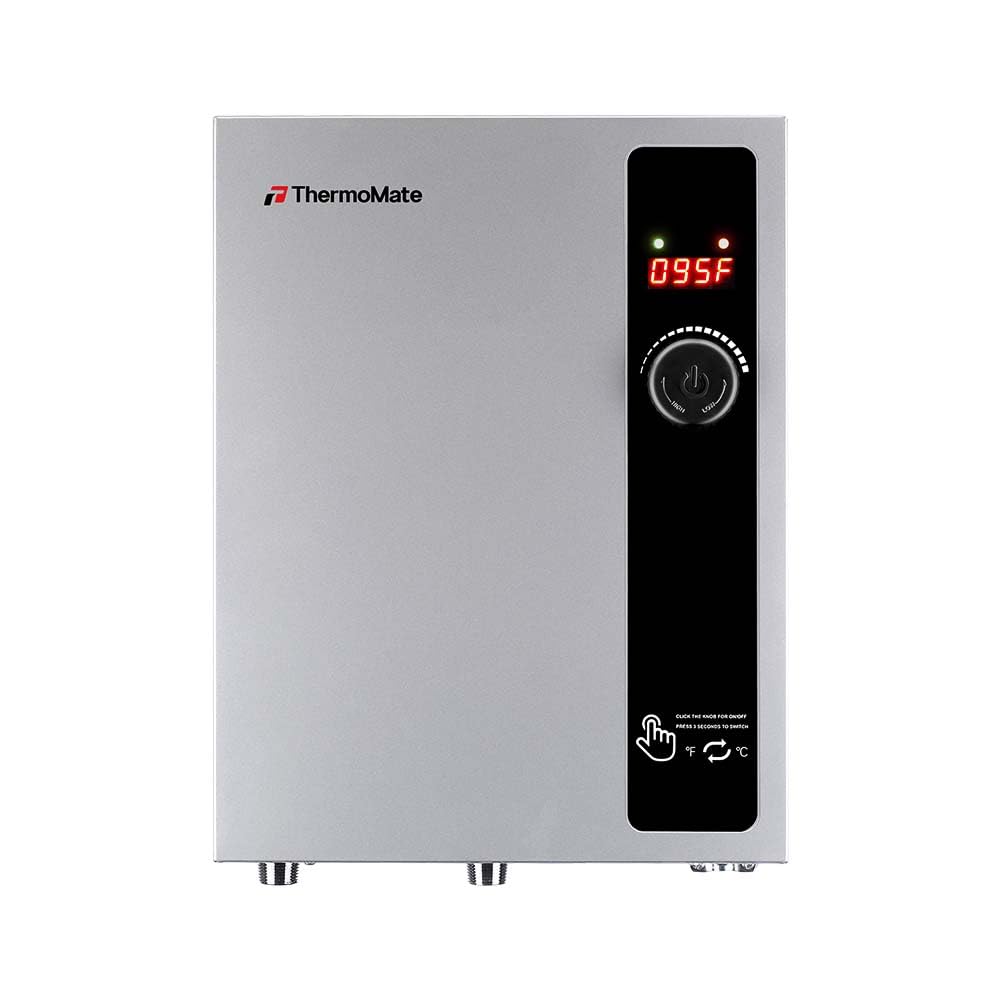
ThermoMate’s ET180 is the middle-power whole-house option, and it is the one to look at if your panel sits between the small point-of-use units and the 27 to 28.8 kW flagships. It puts out 18 KW, delivers water at a flow rate up to 4.4 gallons per minute, and runs on a max draw of 76 amps. Owners mention the electric bill dropping noticeably after install and the ET180 handling a two-bath home, laundry, and a dishwasher on a 100 amp sub-panel.
Where it pulls ahead of cheaper models is the temperature control. The digital display lets you adjust in 1° increments all the way from 80°F to 140°F, and the heating element is deliberately separated from the water tube to cut down on the scale and mineral buildup that shortens the life of cheaper units.
Now for the number that will decide if this unit works for you. The 4.4 gpm flow rate is a headline spec, but real-world output is lower on a cold or demanding install. Customers note that at 2.5 gpm the ET180 tops out near 105°F, not the 127°F the marketing suggests, and only one outlet gets full heat at a time. In a 650 square foot cottage, that means one tap at a time, and some owners add an under-sink heater to cover the gap. Size it against your actual usage, not the spec sheet alone.
What earns it a place
- 18 kW can run a whole home with 2 baths, laundry, and a dishwasher on the right panel
- 1° temperature increments from 80°F to 140°F give you real control over the dial
- Separated heating element resists scale and mineral buildup, which helps in hard-water areas
- Reviewers point out electric bills dropping after installation
Where it asks for patience
- Actual flow is lower than the 4.4 gpm headline once the water is cold and the draw is heavy
- Cold climates may need more power than 18 kW provides
- Only one outlet delivers full heat at a time
Made for: a mid-size home with a panel too small for a 27 kW unit but too much demand for a point-of-use model.
Watch out if: you plan to run two hot fixtures at the same time, because the second outlet will not see the same temperature as the first.
7. Stiebel Eltron Tempra 24 Trend Electric Tankless Water Heater
The silent one — a copper-core heater that runs without a peep and never interrupts a shower.
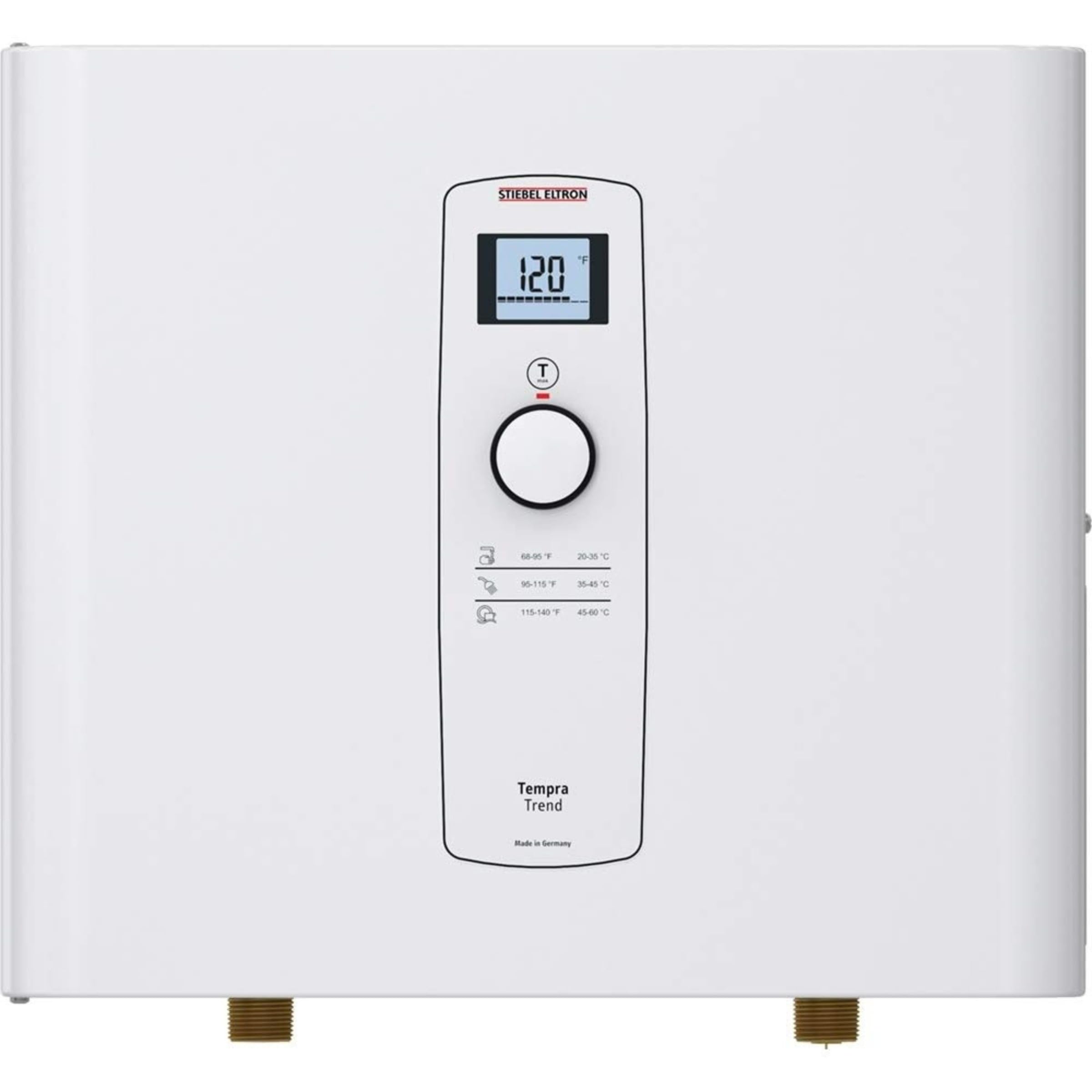
If noise is the thing that bothers you most about a water heater, this is the pick. The Tempra 24 Trend runs on a single electronic switch and is noise-free while in use, with a digital temperature display that is easy to read from across the room. It puts out 24 KW and gives an output water temperature range of 68° to 140°F. Buyers list quiet operation and reliability as the two things they value most, with the Tempra 24 Trend still going strong after years of use.
The whole design is built around continuous flow. Hot showers are never interrupted, and the supply is unlimited when you need it, with no energy wasted while the tap is off. It is compact and wall-mounted with no venting required, and it saves energy with auto-modulation, which means the elements scale their draw to match demand rather than running flat out. The copper heating system does the heavy work. Measured against RVs and point-of-use units, this is a serious whole-home machine that happens to run quietly.
Two limits to weigh. First, it requires a minimum recommended electric service of 150 A, and it wants two 50A breakers and a 100A draw, so budget for the electrical work. Second, pressure can dip when a major appliance like a washing machine kicks on during a shower. Stiebel Eltron backs the Tempra 24 Trend with a 7-year leakage and 3-year parts warranty, and shoppers say positive experiences with the brand’s warranty support.
What you are paying for: a German-built copper system, a 7-year leakage warranty, and genuinely silent operation that only matters once you have lived with a noisy unit.
The honest note: placement matters. Put it near the breaker panel, because running heavy-gauge wire across a long distance is expensive and adds install cost quickly.
Right for: a two-bath home with 150 A service that wants a near-silent, whole-house heater from a brand known for making them.
Not right for: homes with limited panel capacity, since it needs a 150 A service minimum and a pair of 50A breakers.
Know the Specs
Kilowatts (Heating Power)
Kilowatts tell you how much electricity the unit uses to heat water per second, and that number sets how many fixtures can run at once. A 3.5 kW point-of-use unit is designed for one sink, while 18 kW can support a whole home with moderate demand, and 27 to 28.8 kW handles two bathrooms and a laundry running together. Choosing the wrong kW is the number one reason people end up disappointed with a tankless unit.
Flow Rate (Gallons Per Minute)
Flow rate is how fast water moves through the heater. The higher the flow, the more energy it takes to heat each pass. A unit rated at 0.39 gallons of stored capacity can deliver a continuous 3 gpm flow because tankless heaters make hot water on demand rather than storing it. Pick a flow rate that matches your fixtures — one sink draws far less than a shower head.
Amperage and Service Size
Every electric tankless unit has an amperage draw, and your home’s main breaker panel must be able to cover it. A 28.8 kW unit needs three 40 amp breakers and 200 amp service, while a 3.5 kW unit runs on a single 32A breaker. If your panel is smaller than the unit requires, you will be paying for a sub-panel upgrade before you even install the heater.
Temperature Range and Presets
A wider temperature range gives you more control, and some units let you save presets for different uses. The Stiebel Eltron Tempra 29 Plus offers two memory presets, the Tempra 24 Trend covers 68° to 140°F, and the ThermoMate adjusts in 1° increments. A unit that holds a steady temperature matters more than one that hits a very high number briefly.
Common Questions
How many amps does an on-demand electric water heater need?
Can a tankless electric water heater run two showers at once?
Do I need 200 amp service for a whole-house tankless heater?
What is the difference between a point-of-use and a whole-house tankless heater?
Why does my tankless heater only warm water at very low flow?
How cold does incoming water affect a tankless electric heater?
Can I install an electric tankless water heater myself?
Do tankless electric water heaters scale up and need cleaning?
Do I get hot water if the power goes out?
Will an electric tankless water heater actually lower my electric bill?
The Bottom Line
For most homes with the electrical service to support it, the on-demand electric water heater winner is the Stiebel Eltron Tempra 29 Plus, because it pairs the highest heat output in this group with two temperature presets and a German build that buyers report running reliably for years. If you want a more mainstream whole-house unit with a smaller panel footprint, the ECOTOUCH ECO270S delivers 27 kW and up to 6.5 gallons per minute for a busy household. And for a single fixture in a tight space, the CAMPLUX point-of-use unit is the one to reach for. One last nudge worth noting: the Stiebel Eltron name carries a 7-year leakage warranty on the Tempra 24 Trend, so if longevity is your priority, that is the model to look at closely.
How we choose
We do not accept paid placement. Every pick is matched to a real buyer and a real use-case; we do not hands-on test units.
Sources
Specifications: manufacturer listings and product documentation. Review insights: verified customer reviews, as of October 2026. Pricing: not shown on this page (it changes often); check the current price via the retailer link.
As an Amazon Associate, Aappliancez earns from qualifying purchases. This does not affect which products we feature.