Disclosure: Some links in this post are affiliate links. As an Amazon Associate I earn from qualifying purchases, at no extra cost to you. Learn more
Specs are compiled from manufacturer listings and verified buyer reviews and can change over time — please confirm the key details on the product page before buying.
If you want power that keeps running when the grid goes down, the BLUETTI Elite 300 is the pick most people should start with — it stores 3014Wh of usable energy, fits in a corner, and recharges to 80% in as little as 78 minutes. The rest of this guide sorts the genuinely capable off-grid setups from the ones that only look good on a spec sheet, so you can match capacity, output, and panel count to how you actually live.
This guide is built by comparing the manufacturers’ published specifications and the patterns across verified customer reviews, so you get each pick’s real strengths and trade-offs instead of marketing spin.
Capacity, inverter size, and whether the panels are bifacial (they capture light on both faces) decide almost everything about how a kit performs in real weather. That is the lens I use throughout this comparison of the best off-grid solar and wind power kits. Keep reading before you commit your money.
Top Picks
How To Choose The Best Off-Grid Solar and Wind Power Kits
Off-grid power buying goes wrong in one of two directions: people buy a battery too small to run what they own, or they buy panels that never deliver their rated watts in real weather. Fix those two numbers and everything else falls into place.
Start with storage, not with panels
Storage is measured in watt-hours (Wh) — the total energy a battery bank can hold and release. A 3014Wh unit holds roughly three kilowatt-hours, enough to run a fridge overnight plus lights, a router, and phone charging. Panels only refill that tank; the tank size decides how long you last after sunset.
Match the inverter to your biggest surge load
The inverter turns stored DC power into the AC power your appliances expect. Continuous output is the steady rating; surge is the brief burst needed to start a compressor or motor. A fridge compressor can pull several times its running watts for a second, so a 2400W inverter with 4800W surge behaves very differently from a 2400W inverter without one.
Panel type and mounting decide real output
Bifacial panels collect light on both faces, so reflected light off a roof or snow adds to the total. Cell efficiency and a proper MPPT controller (maximum power point tracking, which squeezes the most watts out of changing sunlight) matter more than the headline panel wattage in shading or cloud.
Wind is a supplement, not a plan
A wind turbine can fill in during cloudy stretches and overnight, but mounting height, pole stability, and local wind patterns govern whether it produces anything useful. Treat wind as a bonus layer on top of a solar foundation, never as the primary source.
Side-by-Side Comparison
| Model | Best For | Storage | Output | Power Source | Amazon |
|---|---|---|---|---|---|
| BLUETTI Elite 300★ Best Overall | Whole-home outage backup | 3014Wh | 2400W (4800W surge) | Solar, AC, car | Amazon |
| Jackery Explorer 2000 v2Top Performer | Portable home + camping | 2042Wh | 2200W | Solar, AC, car | Amazon |
| BLUETTI Elite 400Most Versatile | Wheeled whole-home backup | 3840Wh | 2600W (3900W surge) | Solar, AC, car | Amazon |
| ECO-WORTHY 1.6KWH Kit | RV and shed starter system | 200Ah (2×100Ah) | 2000W inverter | Solar, AC | Amazon |
| EcoFlow Delta 3 Ultra | Silent overnight backup | 3072Wh | 3600W (7200W surge) | Solar, AC, car | Amazon |
| PowerMax 6000 | Split-phase 240V loads | 3600Wh | 6000W (9000W surge) | Solar, AC, car | Amazon |
| Nature’s Generator 1800W | Solar plus wind tinkerers | AGM sealed lead acid | 1800W | Solar, wind, AC | Amazon |
| ECO-WORTHY 7.168KWH Kit | Full RV off-grid install | 7.168kWh (12.8V 280Ah ×2) | 3000W inverter | Solar, AC | Amazon |
| ECO-WORTHY 1200W 24V Kit | Larger cabin and trailer builds | 7168Wh (12.8V 280Ah ×2) | 3000W inverter | Solar, AC | Amazon |
Detailed Reviews
1. BLUETTI Elite 300 Portable Power Station
Our pick — over 4.5★ from 200+ verified ratings; the strongest balance of quality and price.
Three kilowatt-hours that squeeze into a footprint a wheeled station can only dream about.
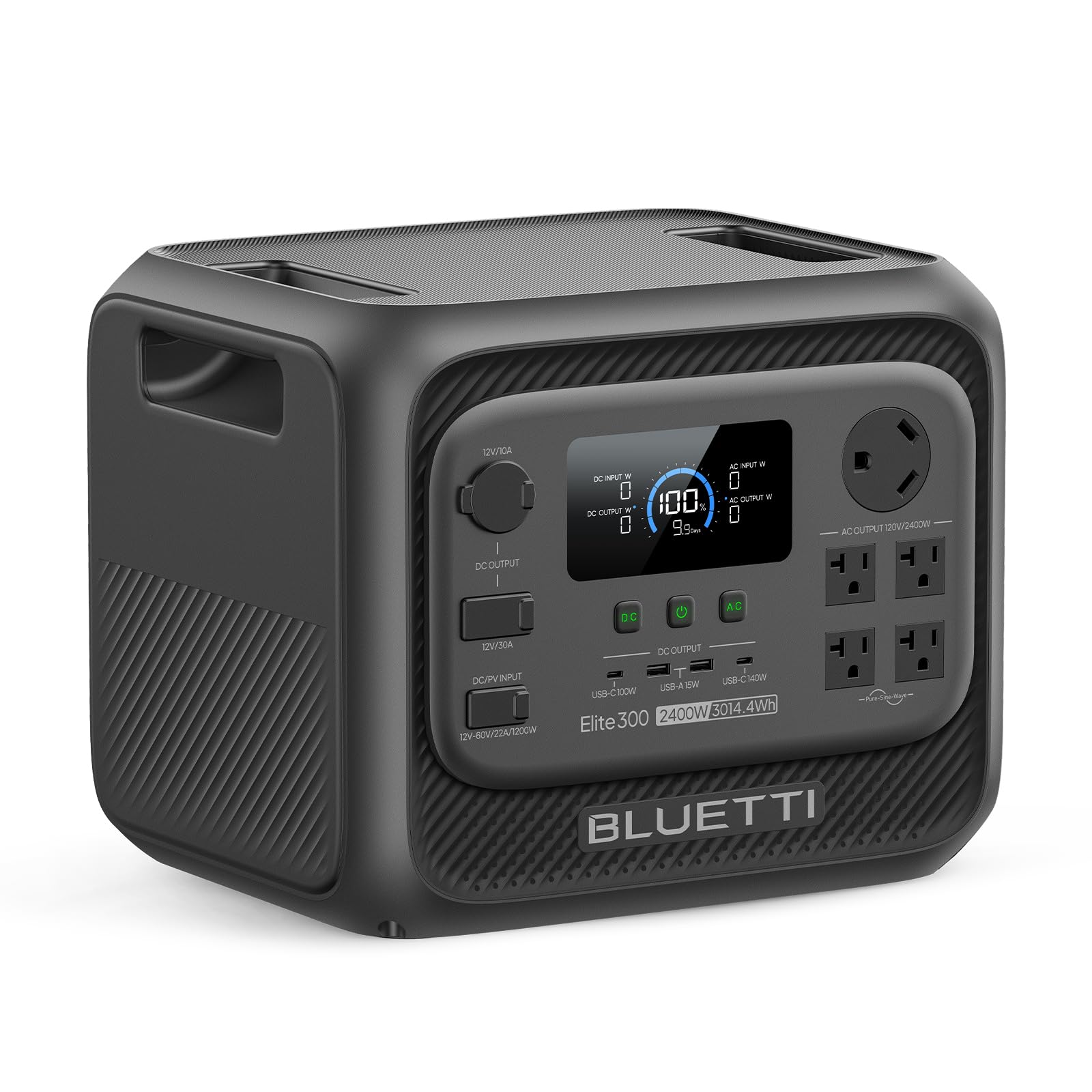
For anyone who wants serious stored energy without giving up half a garage, this is the one to beat. It holds 3014Wh — about three kilowatt-hours — in a body measuring 14.4 inches long, 12 inches wide, and 11.7 inches tall. Compare that to the Nature’s Generator 1800W further down this list at 28 by 18 by 19 inches, and you are looking at roughly a third of the physical volume for a battery bank that does far more. It backs that up with a 2400W continuous output and a 4800W surge, so kettles and other resistive loads start without tripping anything.
The RV crowd gets a dedicated TT-30 outlet and a 12V/30A DC output, which means camper fridges, water pumps, and diesel heaters run straight off the battery without adapters or inverters. Homeowners get a 10ms UPS switch — the station detects a blackout and takes over faster than most devices can notice — keeping computers, routers, and a CPAP machine alive through a storm. Recharging is genuinely fast: AC, solar, or a car charger all work, and it reaches 80% in as little as 78 minutes.
One owner reports running a 15,000 BTU Coleman RV air conditioner for two hours on it. Charging from dead to full lands around two hours in normal use. The honest trade-off is weight — it tips the scales at 58 pounds, and the review pages are candid about that — plus solar input capped at a narrow voltage window, so check your panel’s open-circuit voltage before you buy or you risk the controller and the warranty. Battery expansion is not an option here either; what you buy is what you get.
What earns it first place
- 3014Wh in a 14.4″ x 12″ x 11.7″ body — far smaller than the Nature’s Generator 1800W at 28″ x 18″ x 19″H
- Dedicated TT-30 RV port plus 12V/30A DC for camper appliances and diesel heaters
- 2400W steady, 4800W surge for starting kettles and compressors
- 10ms UPS switch keeps routers, computers, and CPAP machines running
- 80% charge in as little as 78 minutes; LiFePO4 rated for 6000+ cycles
What to plan around
- 58 pounds — heavy enough that placement matters before a storm, not during one
- Solar voltage window is tight; exceeding the open-circuit limit can damage the MPPT controller
- No battery expansion, so three kilowatt-hours is the ceiling
Made for: apartment and suburban households that want real outage coverage without a gas generator.
Think twice if: you need to run a central AC or a welder all afternoon — the surge is brief, not sustained.
2. Jackery Explorer 2000 v2 Solar Panels
Thirty-nine and a half pounds of battery with two panels already in the box.
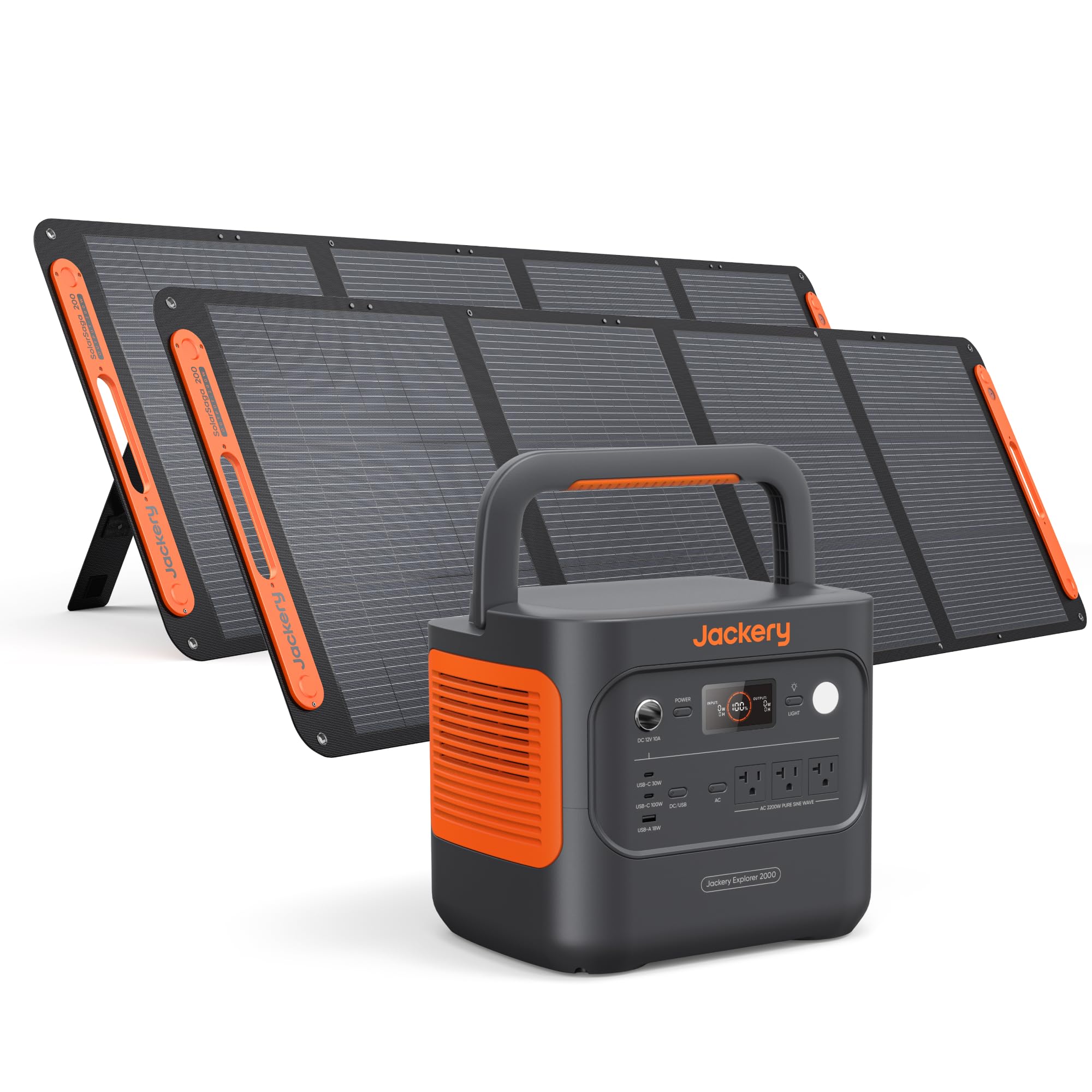
If you plan to carry your power between a garage, a campsite, and a job site, this is the kit that travels well. It stores 2042Wh, puts out 2200W across three AC ports, and includes a USB-C PD 100W port so laptops charge without a brick. At 39.5 pounds, it is built to be lifted and moved, and the CTB (Cell-to-Body) construction borrows the pack-mounted approach used in EVs to keep the frame compact. Against the BLUETTI Elite 300 above, it gives up about a kilowatt-hour of capacity in exchange for a much easier carry.
Charging is the headline. AC input takes it to 80% in 66 minutes, an app-activated Emergency Super Charging mode fills it in 102 minutes, and a Silent Charging mode completes a full charge in 5 hours at just 30dB — quiet enough to run overnight in a bedroom. Solar charging with the included 400W of panels takes about 6 hours. It also carries a 20ms UPS switch (the transfer time from grid to battery) and holds UL1778 certification for uninterruptible power systems, so sensitive gear keeps running through a trip.
What buyers gravitate to is how quickly it refills — climbing from 29% to 100% in under two hours gets mentioned repeatedly, and the panels pull in real watts, roughly 200W in full sun and around 30W through cloud. The recurring niggle is port selection: there are only a handful of AC outlets, and the panel connector needs the straight DC8020 plug rather than the L-shaped DC7909, which catches people out on first assembly. The LiFePO4 battery is rated for up to 10 years of performance.
Where it wins: the 66-minute AC charge to 80% and the bundled 400W of solar make this the least fussy kit on the list for someone who wants panels included and no shopping around.
Where it compromises: 2200W continuous means central AC and big shop tools are out of reach — plan on fridges, freezers, lights, and electronics instead.
The right buyer: renters, campers, and small-business owners who move their power around and want solar in the same box.
The wrong buyer: anyone trying to power a whole house through a multi-day outage — 2042Wh will not stretch that far.
3. BLUETTI Elite 400 Portable Power Station
Nearly four kilowatt-hours on wheels, for people who want a whole-home tank without the forklift.
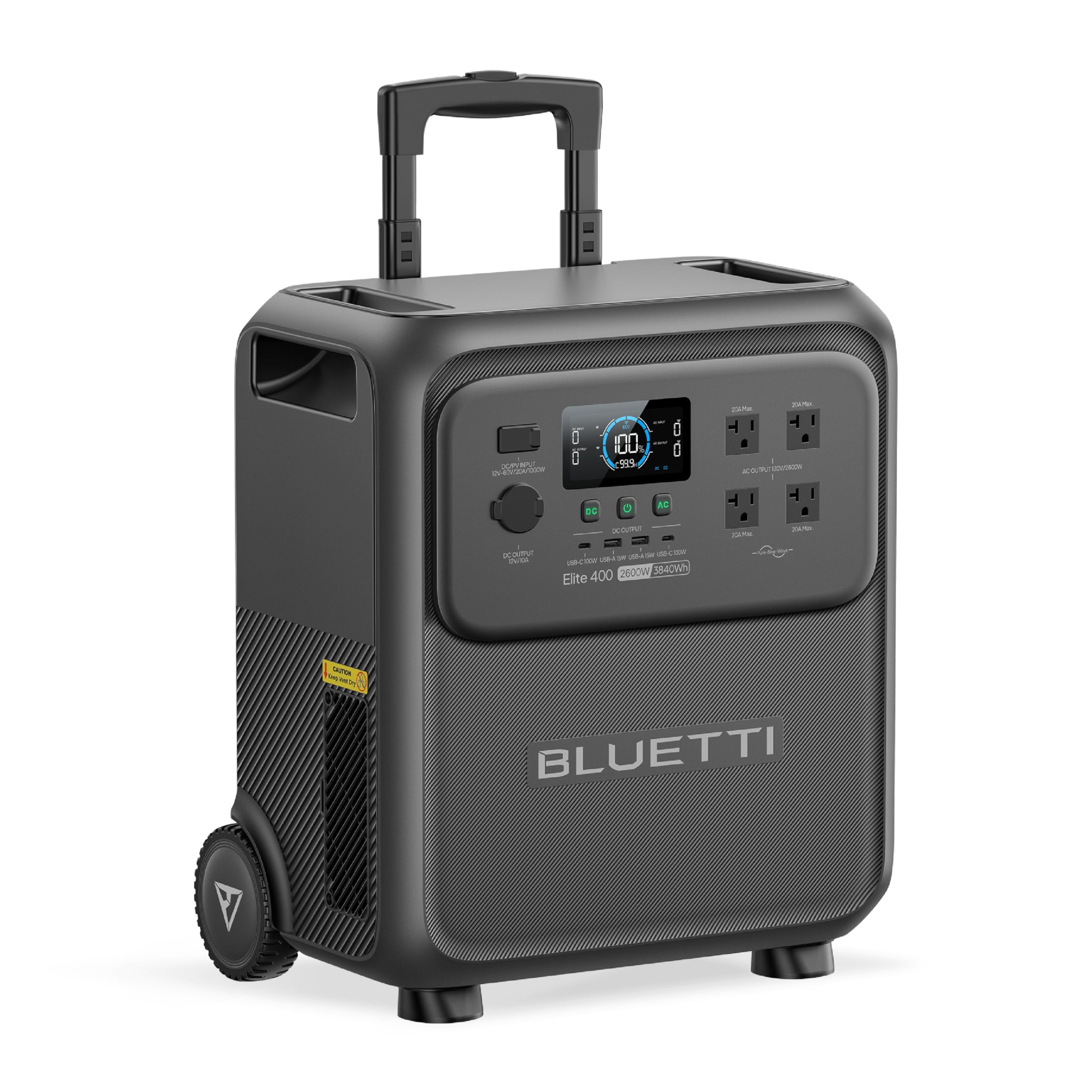
When your backup plan has to cover a fridge, a freezer, and a mini split, this is the capacity tier to shop in. The Elite 400 stores 3840Wh and delivers 2600W continuous with a 3900W surge across nine ports. It rolls on a trolley system with an integrated handle, which solves the problem that bigger batteries normally create — you can park it in a basement and still move it to the kitchen when a storm rolls in. The rating describes this as a step up in both capacity and output over its smaller sibling above, and that is exactly how it behaves.
Charging is quick for a unit this size: 2800W of combined AC and solar input takes it to 80% in 70 minutes, a standard 1800W outlet fills it in about 2.5 hours, and 1000W of panels do the job in roughly 6 hours. DC-DC alternator charging means it can top up from a vehicle while you drive. A 15ms switchover keeps Wi-Fi, security cameras, and a pet feeder alive through an outage without a flicker, and the LiFePO4 pack is rated for 3000+ cycles.
Owners describe it as dependable and quiet under light loads, and the strongest recurring theme is sheer capability — one buyer ran a mini split for two hours, and another covered a full two-day camping trip with LED lights, two heated blankets, phones, tablets, and a Starlink Mini while still finishing at 4%. Solar panels and app monitoring round out the package. The catch is genuinely the weight: 86 pounds, and the solar panels that pair with it are heavy too. A portion of its features live behind the app, which is worth knowing if you want to operate it in a dead-signal emergency.
Best-fit scenario: a house that loses power a few times a year and needs to keep a fridge, freezer, and a small AC running for hours at a stretch.
The honest limit: 2600W continuous will not start a central air conditioner or a large well pump — those need split-phase output, which the PowerMax 6000 below is built to deliver.
Go here if: you want maximum stored energy in a rolling cabinet and can live with the heft.
Look elsewhere if: you need something one person can carry up stairs.
4. ECO-WORTHY 1.6KWH Solar Panel Kit
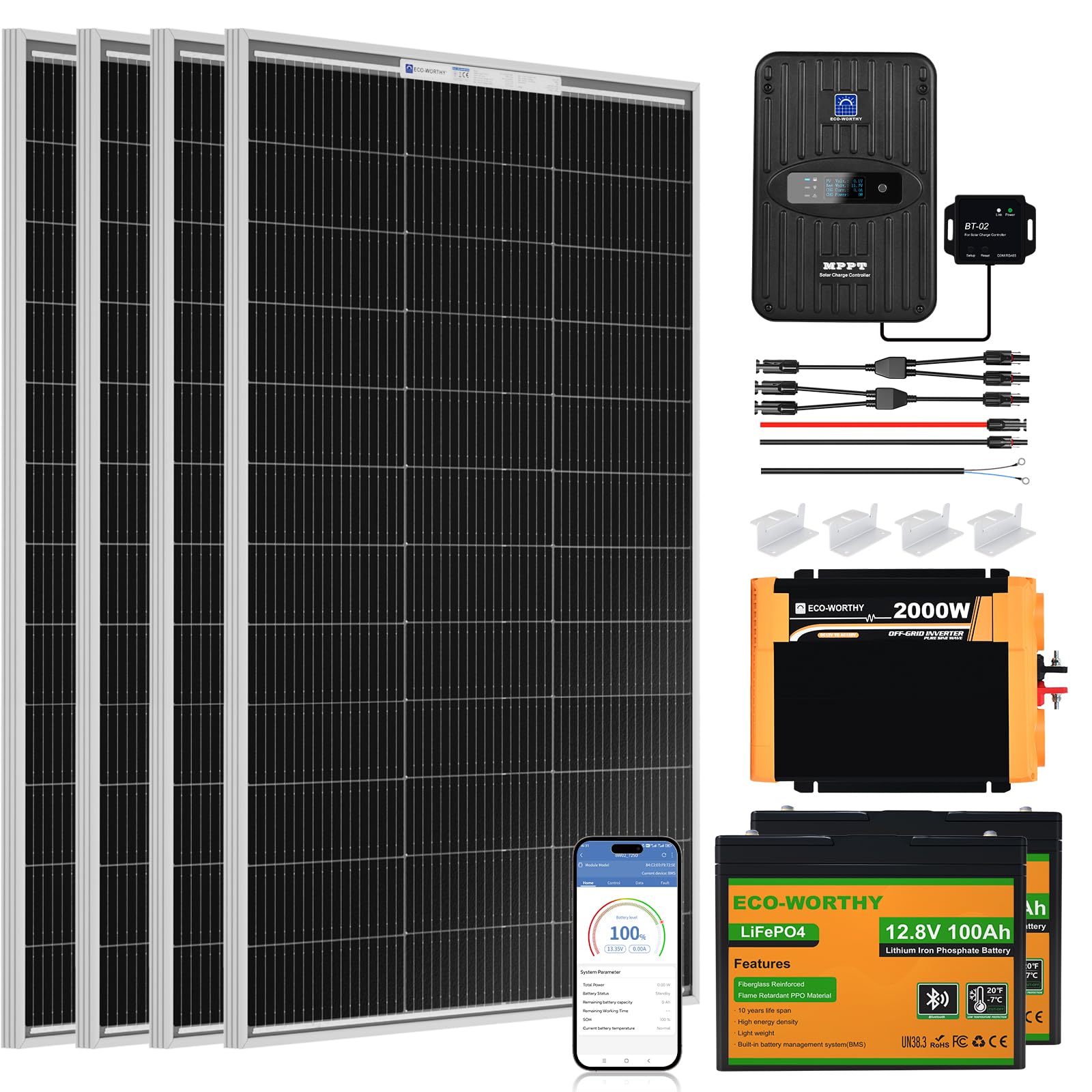
A box of real components — panels, controller, batteries, and inverter — for a small trailer or shed.
This is the entry point into building an actual system rather than buying a sealed box. You get four 100W bifacial panels rated at 23% conversion efficiency, a 40A MPPT charge controller, a 2000W pure sine wave inverter, and two 12V 100Ah lithium batteries with a built-in BMS (battery management system, which guards against overcharge and over-discharge). Ideal daily output is stated at 1.6kWh under 4 hours of sunlight, enough to run a TV, a fridge, and AC devices under 2000W.
The controller side is where this kit quietly outperforms its price class — up to 99% tracking efficiency and a stated 98% peak conversion efficiency keep waste low. The panels connect with standard MC4 connectors, the cells use a 12BB design, and the composite back panel is built for durability. There is also a Bluetooth module 5.0 for monitoring. If you later want more output, ECO-WORTHY states that a dual-axis tracker can add 40% production and adjustable multi-piece mounting brackets can add 20%.
What lands with owners is how approachable the build is — several describe it as almost intuitive to wire up, all parts arriving separately but complete. The honest caveat is that it is a starter system, not a whole-home solution. Performance is the most-discussed theme in the feedback, and it splits: some are surprised how well it works, while others report reliability trouble and panels that underperform in anything but direct sun. As a primary power source you will also need more battery capacity, and the manual is thin enough that most people lean on YouTube videos to finish the install.
Why it earns a place
- Four 100W bifacial panels, 2000W pure sine wave inverter, and two 100Ah lithium batteries in one kit
- 40A MPPT controller with up to 99% tracking efficiency
- Lithium batteries rated for more than 3000 deep cycles with built-in BMS protection
- Bluetooth module 5.0 for remote monitoring
What to expect
- Ideal output of 1.6kWh assumes 4 hours of good sun — shade and winter cut that hard
- Treat it as a starting point; running larger loads means adding batteries
- The included manual is basic, so budget an afternoon and some video research
Pick this if: you want to learn a real solar build and run a trailer fridge, lights, and small electronics.
Pass if: you expect to run an air conditioner straight from the start.
5. EF ECOFLOW Delta 3 Ultra Solar Generator
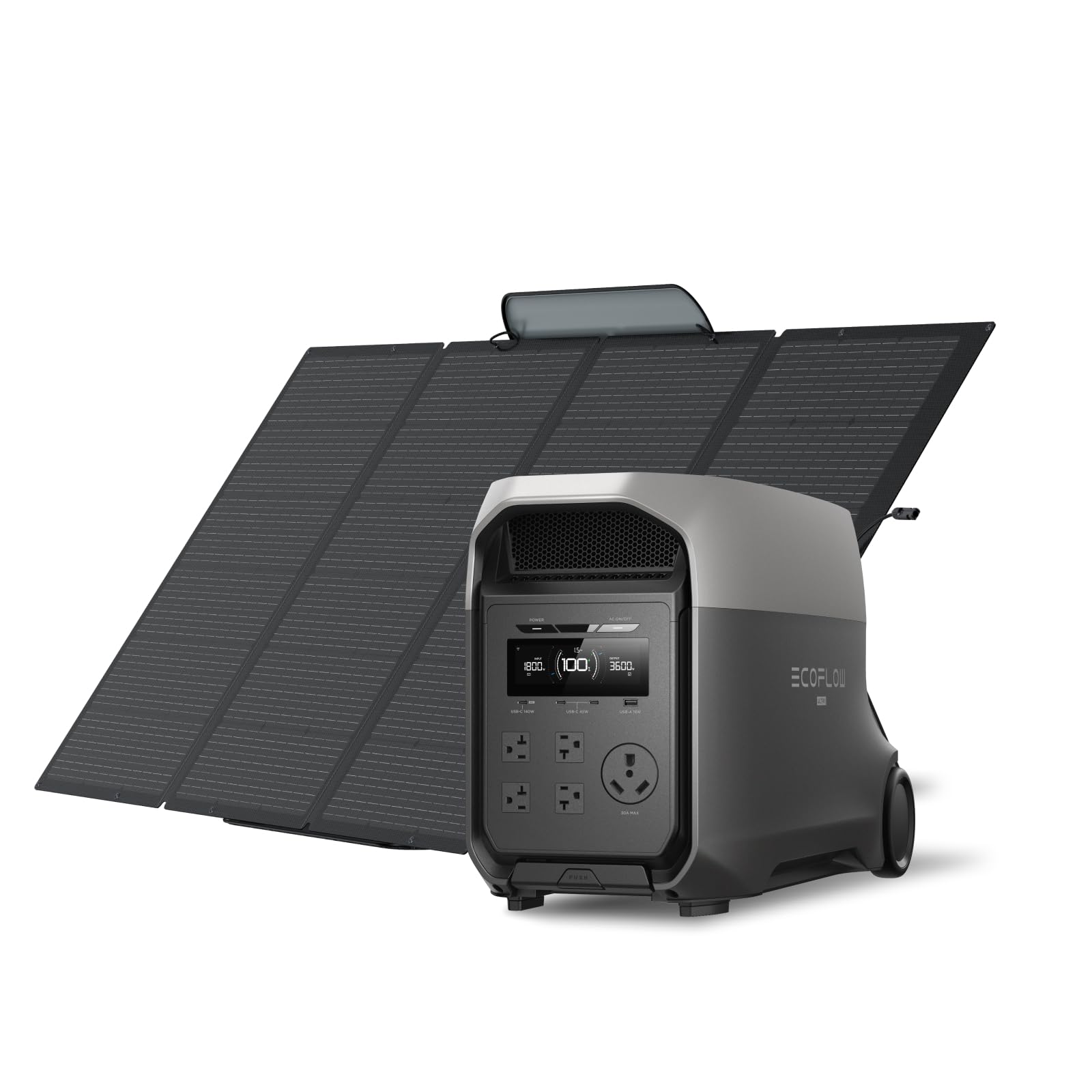
A three-kilowatt battery that runs at 25 decibels — quieter than a whisper in a small apartment.
For studio flats, RVs, and bedrooms, noise is the spec nobody thinks about until the power goes out at 2 a.m. and a fan kicks on. This one runs at just 25dB under load thanks to its cooling design, while pushing 3600W continuous and 7200W surge through three outlets. That surge figure is the highest in this comparison at the same capacity tier, which matters if you want to start a well pump or a compressor motor that trips lesser units. It stores 3072Wh on a LiFePO4 battery rated for 10 years of daily use.
Backup switching happens in under 10 milliseconds with no manual setup, which keeps PCs, routers, and sensitive equipment alive through a grid drop. Charging is flexible — wall outlet, solar panels, car input, or an EcoFlow Smart Generator — and the included 400W solar panel arrives in a separate box, so plan for two deliveries. Against the Jackery above, this one leads on both output and capacity, 3600W and 3072Wh versus 2200W and 2042Wh.
The pattern in owner feedback is that it simply keeps essential appliances running when the grid quits, and battery life surprises people in a good way — one report describes powering a 24-cubic-foot side-by-side fridge for 34 hours, which is a realistic picture of how far 3072Wh stretches on a modern fridge. Quality is the trait that gets mentioned most in reviews. On value, opinions genuinely split, so weigh that against the output ceiling rather than assuming it is a bargain.
The standout spec: 25dB at load means you can sleep next to it, something the PowerMax 6000 below cannot claim with its larger inverter and heavier chassis.
Where it lands: 3600W of steady output covers fridges, microwaves, heaters, and power tools — but whole-home wiring still needs a transfer setup this unit does not include.
Choose it if: silence and high surge matter more to you than maximum stored kilowatt-hours.
Reconsider if: you need the extra surge headroom of a 6000W split-phase unit.
6. PowerMax 6000 Portable Power Station
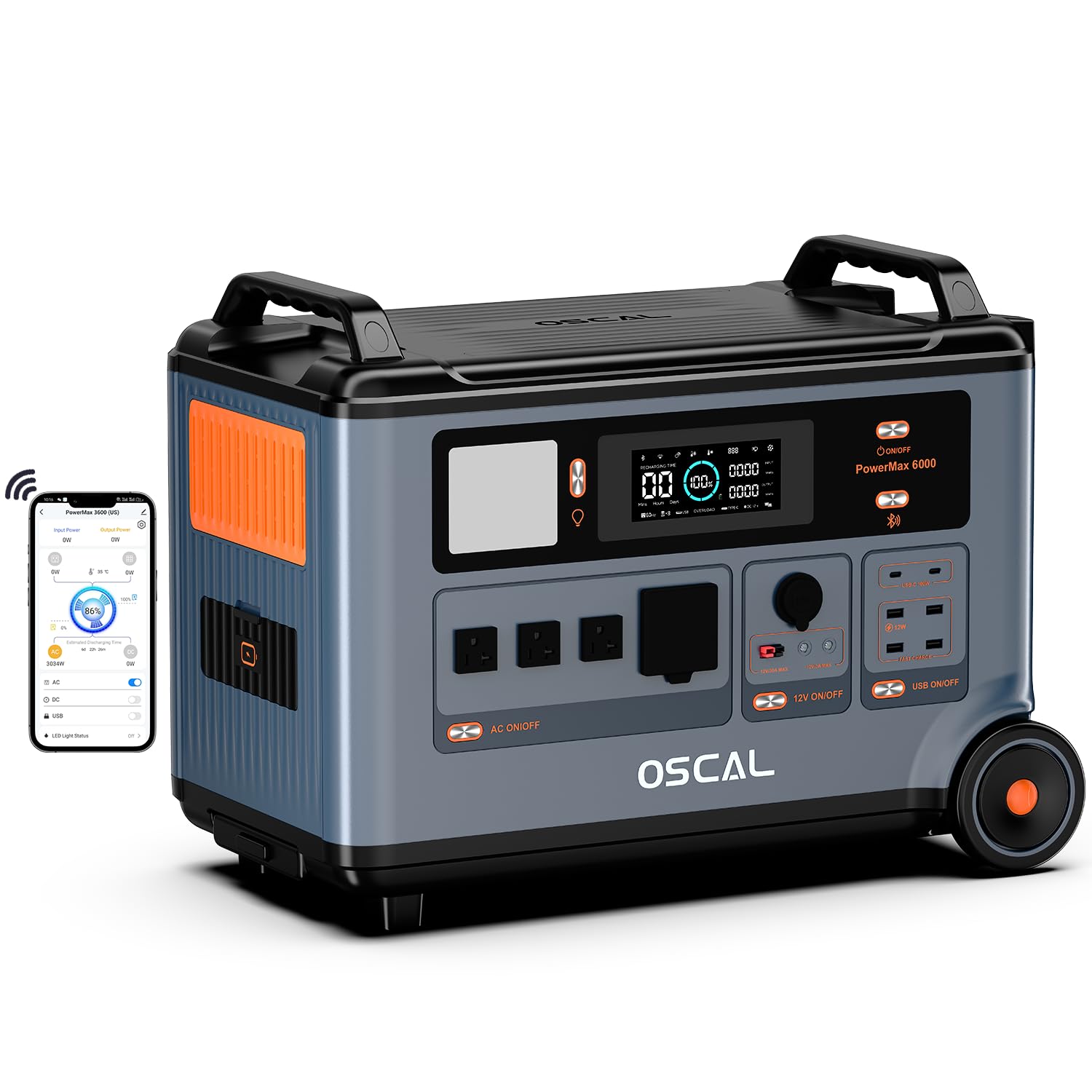
The only kit here that hands you 240 volts — for well pumps, dryers, and anything else a 120V outlet cannot touch.
Dual voltage output is the reason to read this entry at all. Most portable stations in this class stop at 120V and simply cannot start a well pump or feed a subpanel. The PowerMax 6000 supports DC/AC bi-directional inverter output at both 120V and 240V, delivering 6000W across four AC outlets with a 9000W surge, from a 3600Wh capacity. Fourteen outlet sources in total mean you are unlikely to run out of places to plug something in. It is also expandable, and the listing states capacity can grow to 57.6kWh.
Charging is aggressive: 2200W of AC input takes it from empty to full in 1.44 hours, and combined AC and solar reach 2400W. The LiFePO4 battery sits behind an eight-layer safety BMS covering overcharge, over-discharge, over-voltage, over-current, short-circuit, and temperature swings, and is rated for up to 3500 cycles. An EPS uninterruptible supply switches to battery in 5 to 8 milliseconds, and the OSCAL app handles monitoring and remote commands. A 2-year warranty backs the whole unit.
The honest trade-off, and this shows up in the feedback, is transportability — this is a heavy machine and it is not meant to be carried. There is also a documentation gap: one buyer could not find guidance on tying it into existing roof solar panels, which is worth sorting out with the seller before purchase. On the upside, owners who already run one describe it as a rock-solid backup addition. This is a fixed-installation tool, not a campsite accessory.
The reason to buy it: 240V split-phase output at 6000W continuous is a capability none of the 120V stations here can match, and it is what makes well pumps and subpanel feed possible.
The compromise: it is heavy, and integrating it with an existing rooftop array needs a clear wiring plan before you commit.
Right for: rural homes with 240V well pumps, or anyone wanting to feed a subpanel rather than individual appliances.
Wrong for: anyone who needs their backup power to be portable between locations.
7. Nature’s Generator 1800W Generator (GXNGPT)
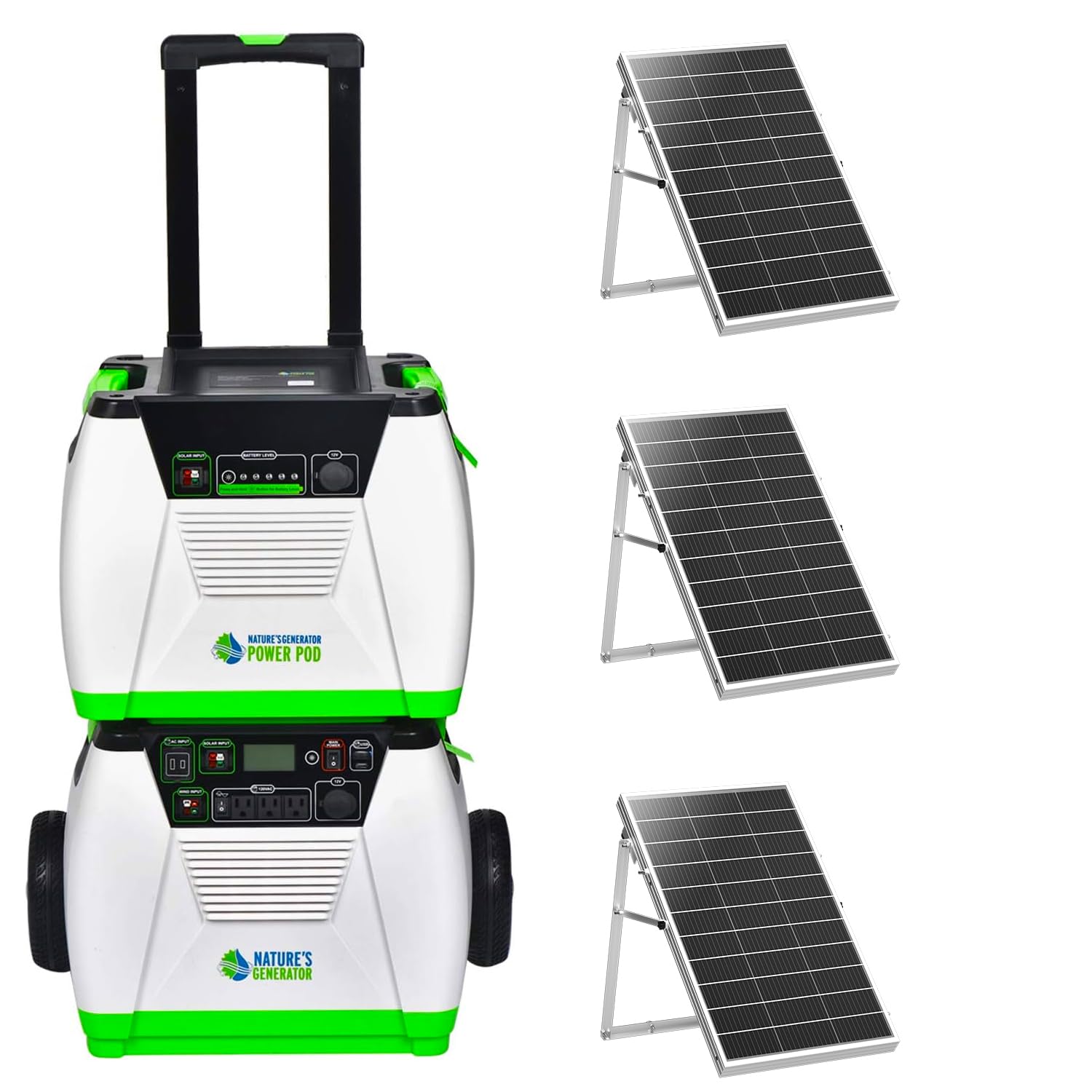
A fume-free generator that takes solar, wind, and shore power — with a mounting caveat you must read first.
The design premise is smart: a 4-stroke unit that runs on solar, wind, or AC instead of gasoline, so there are no fumes and no pull-cord frustration. It puts out 1800W at 60Hz, stores energy in AGM sealed lead acid batteries, and pairs with monocrystalline panels. For anyone with chemical sensitivities or an indoor-adjacent setup, a non-gas generator solves a problem the fuel-burning alternatives simply do not address. One owner used it to power an electric recliner during an outage after a stroke left a family member unable to get out of the chair — a real demonstration of what backup power means beyond convenience.
The wind component deserves a straight warning. The turbine is serious machinery, and getting useful output from it means mounting the pole 20 to 30 feet up — a requirement that is not obvious from the product description and has caught buyers out. The turbine also lacks a pole, and the cord exits through the pole collar in a way that requires drilling. If you are not prepared to engineer a proper mast, budget for solar-only operation. Physically, the unit is 28 inches long, 18 inches wide, and 19 inches tall, which is a substantial footprint compared with the compact BLUETTI above.
Owner experience is genuinely divided, and honesty matters here. The lead acid battery degrades over time — one long-term report describes it no longer holding a full charge after four outages, with a 70W continuous load draining it in 4 to 5 hours and only around 280 to 350Wh retained when fully charged. Build quality complaints also appear, including panels not properly seated and a bent telescope handle leg. On the other side, the control panel is widely described as clear and easy to understand, and the unit works from the start for many buyers.
What makes it different
- Runs on solar, wind, or AC power with no fuel and no fumes
- 1800W at 60Hz output from AGM sealed lead acid storage
- Control panel described as clear and simple to operate
- Real capability for medical-adjacent loads like power recliners during outages
Read before buying
- The wind turbine needs a 20-30 foot mast — not stated clearly in the listing
- No pole included; the cord exits through the pole collar and requires drilling
- Older units show battery capacity loss over time, so plan on eventual battery replacement
Best for: tinkerers who genuinely want wind in the mix and will build a proper mast.
Skip if: you want plug-in simplicity — the solar-only stations above need zero assembly.
8. ECO-WORTHY 7.168KWH Solar Panel Kit
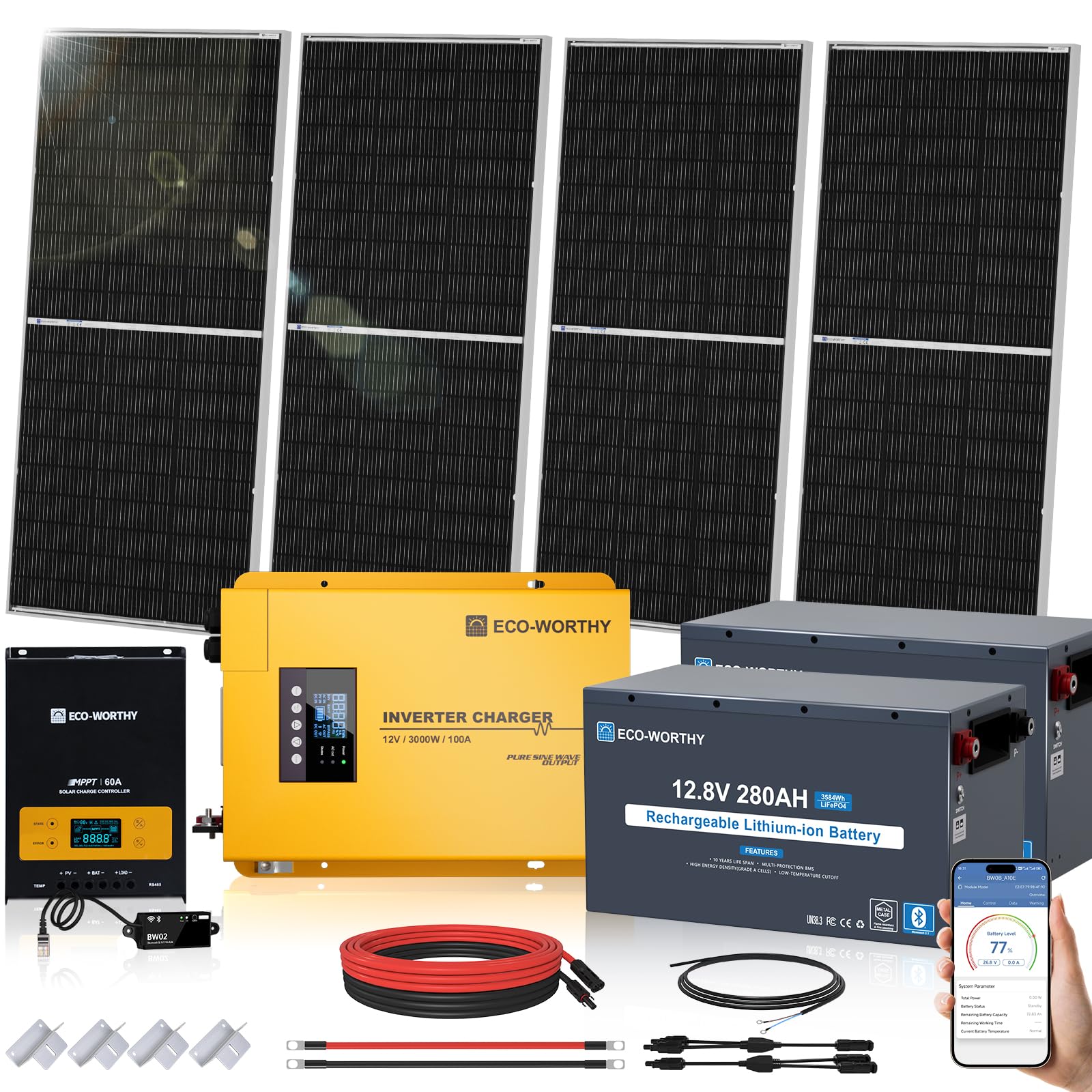
A full trailer build in a crate — 780W of panels and over seven kilowatt-hours of storage.
This is the step up from the 1.6kWh kit above, and the jump is substantial. You get four 195W bifacial panels with a 25.2% cell efficiency rating, a 12V 3000W inverter charger, two 12.8V 280Ah lithium batteries storing 7.168kWh combined, a 60A MPPT controller, a Bluetooth module, and the cables to tie it together. The panels are all-black for a cleaner roofline. On paper, 4 hours of sun produces 3.2kWh of generation, and the battery bank holds more than twice that.
The intended application is clear: powering 99% of RV appliances, including refrigerators, air conditioners, microwaves, TVs, fans, coffee machines, LED lights, and water heaters. The inverter charger uses a UPS function to switch between solar and mains power, so you keep running when you plug in at a campground or when the sun disappears. ECO-WORTHY frames it as a novice-friendly four-step installation with technical support and damaged-part replacement.
Owner results skew positive on the build itself — the recurring theme is that assembly is simple, with one report noting it runs a camper down to 40% even on cloudy days, and another confirming it handles everything including A/C. The friction point is packaging and documentation: parts ship in multiple parcels, and the angriest feedback describes missing components, unlabeled parts, and no installation directions. Novices will want to photograph every box on arrival and keep the parts list handy. Some buyers also found certain cable leads too short and had to buy extensions.
Where it delivers: 780W of bifacial panels feeding a 7.168kWh bank is enough headroom for a trailer that runs a fridge, lights, and an air conditioner through real use.
Where it stumbles: multi-parcel shipping and sparse instructions mean you should inventory everything before starting the install.
Ideal for: RV and travel-trailer owners ready to commit to a permanent roof install with real storage behind it.
Not for: anyone wanting a single box that arrives ready to plug in.
9. ECO-WORTHY 1200W Lithium Battery Solar System
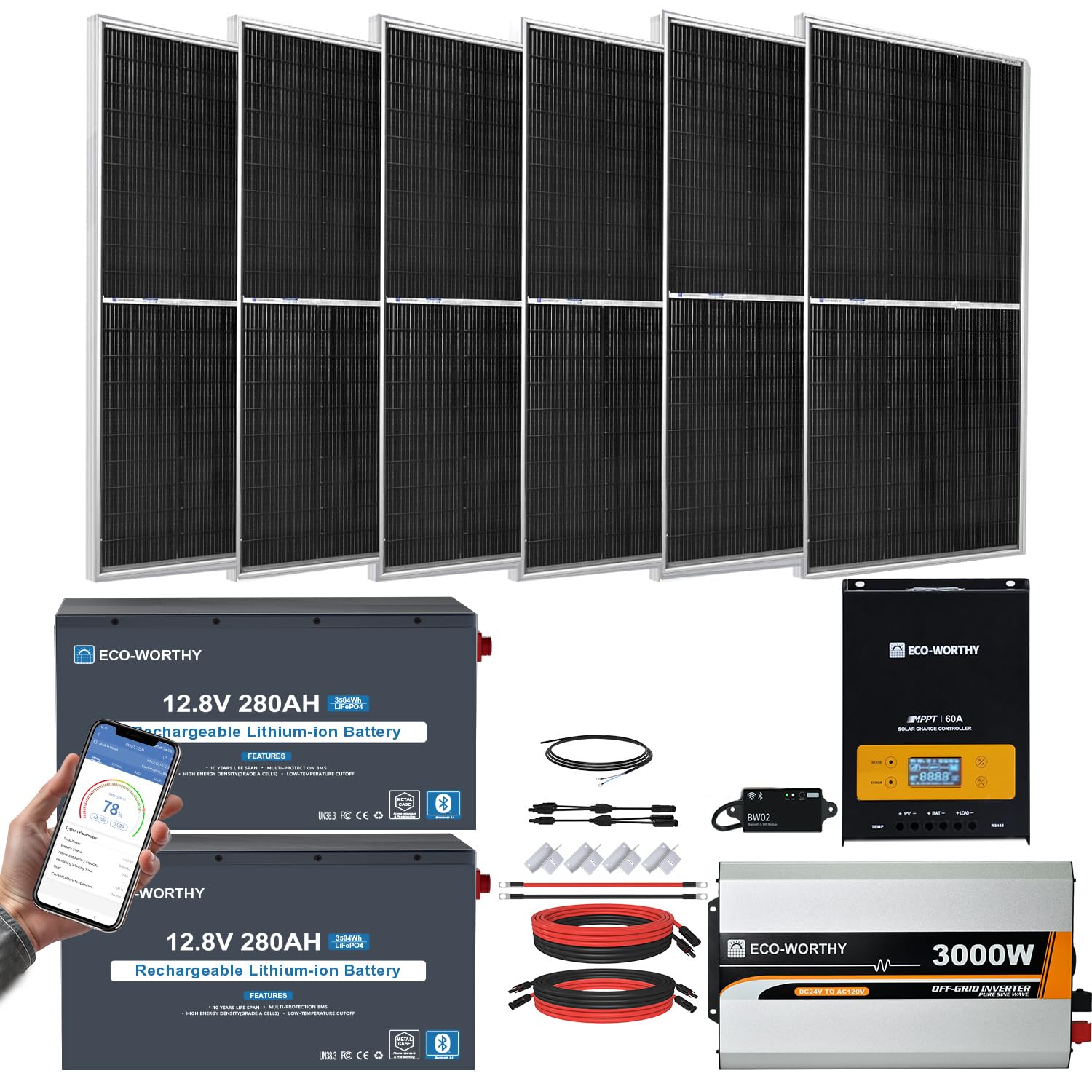
Six panels, a 24-volt architecture, and the highest daily yield in this roundup.
Step into the 24V tier and the whole system scales. This kit pairs six 195W bifacial panels with two 12.8V 280Ah lithium batteries, a 60A MPPT controller, and a 3000W pure sine wave inverter. The panels use 12BB cells with a transparent backing and 91.5% light transmittance, at a 25% conversion rate. Stated daily generation is 858Wh per panel under ideal conditions, and the ideal daily output for the system is 4.68kWh under 4 hours of sun — the biggest listed yield figure on this page.
Storage sits at 7168Wh across the dual battery pack, with more than 6000 deep cycles claimed versus lead acid. The MPPT controller tracks at up to 99% efficiency with a stated 98% peak conversion, which ECO-WORTHY puts at 40% higher than traditional PWM controllers. A Bluetooth monitoring function reaches up to 82 feet, so you can check the system from inside the house.
Power output is the trait owners talk about most, and the everyday proof is convincing — a small fridge and a wine fridge running continuously, a 6000 BTU air conditioner handled on the 3000W inverter, and even heavy kitchen appliances backed by 30+ days of use in one report. The recurring frustration is documentation: instructions are frequently reported missing from the package, and set-up is described as manageable only for someone with basic wiring familiarity. Panels also benefit from reflective surfaces underneath, which several buyers report noticeably lifts output.
The case for it: 4.68kWh of ideal daily generation on a 24V architecture is a genuine step beyond the 12V kits here, and the 82-foot Bluetooth range covers a whole house.
The case against: missing instruction manuals feature repeatedly in feedback, so allow time to source a wiring guide before the boxes arrive.
Serious buyers only: cabins and trailers that need a 24V system with real generation capacity and 3000W of inverter headroom.
Hold off if: you are new to wiring and want a system that walks you through step one.
Know the Specs
Watt-hours versus watts
Watt-hours (Wh) measure stored energy — how long you can run something. Watts measure the rate of flow — how much can run at once. A 3014Wh battery with a 2400W inverter runs a 200W fridge far longer than it runs a 2000W kettle, because the kettle empties the tank much faster. Size the Wh to your overnight load and the watts to your biggest surge.
Why inverter surge matters
Anything with a motor or compressor pulls a brief spike on startup, often several times its running watts. A station rated 2400W continuous and 4800W surge starts appliances a 2400W-only unit cannot. That is why the output column in the table shows two numbers.
Bifacial panels and MPPT
Bifacial panels capture light on both faces, so reflected light from a roof, water, or snow adds to production. An MPPT controller then tracks the best operating point as sunlight shifts, which recovers power that a simpler controller wastes. Together they raise real output above the raw panel rating in good conditions.
UPS switchover speed
The millisecond figure tells you how fast a station takes over when grid power drops. A 10ms switch is invisible to routers and computers; longer gaps can reboot sensitive gear. If you are backing up a home office or network equipment, treat this number as a hard requirement.
Common Questions
How much battery capacity do I need to run a fridge overnight?
Can a 120V portable station run a 240V well pump?
Do I really need a wind turbine or is solar enough?
What is the difference between the ECO-WORTHY 1.6KWH kit and the 7.168KWH kit?
How long do LiFePO4 batteries last compared with lead acid?
Will the included solar panels charge the battery on a cloudy day?
Can I expand these systems later with more batteries or panels?
What size inverter do I need to start an air conditioner?
Do I need to buy extra breakers or fuses for an off-grid kit?
Should I choose a 12V or 24V solar system for a camper?
The Bottom Line
For most people, the strongest choice among the best off-grid solar and wind power kits is the BLUETTI Elite 300, because it packs 3014Wh and a 2400W inverter into a compact frame you can actually store. If you want a split-phase unit that handles 240V well pumps and subpanels, the PowerMax 6000 is the one to reach for. And if you are building a full trailer system with panels, batteries, and an inverter in one crate, the ECO-WORTHY 7.168KWH kit is worth the wiring weekend.
How we choose
We do not accept paid placement. Every pick is matched to a real buyer and a real use-case; we do not hands-on test units.
Sources
Specifications: manufacturer listings and product documentation. Review insights: verified customer reviews, as of October 2026. Pricing: not shown on this page (it changes often); check the current price via the retailer link.
As an Amazon Associate, Aappliancez earns from qualifying purchases. This does not affect which products we feature.