Disclosure: Some links in this post are affiliate links. As an Amazon Associate I earn from qualifying purchases, at no extra cost to you. Learn more
Specs are compiled from manufacturer listings and verified buyer reviews and can change over time — please confirm the key details on the product page before buying.
Off-grid cooling is not one product, it is two different jobs. If you are pulling cold air out of a battery bank on a van or a camper, you want a 12V DC rooftop unit that sips power. If you are cooling a cabin or a house with no power pole, you want a high-efficiency mini split inverter that runs on very little electricity. This guide separates those two worlds so you buy the right machine instead of the wrong one.
This guide is built by comparing the manufacturers’ published specifications and the patterns across verified customer reviews, so you get each pick’s real strengths and trade-offs instead of marketing spin.
Off-grid cooling only works when the power draw, the BTU output, and the size of the room you are trying to chill actually line up. Below are the picks that hold up best in real off-grid use for an off-grid air conditioner setup.
Top Picks

How To Choose The Best Off-Grid Air Conditioner
Two numbers decide almost everything here: the cooling power in BTU and the wattage the unit pulls while it runs. BTU (British thermal units) is a measure of how much heat the unit removes. The wattage (annual energy consumption, the average draw over a year) is what drains your battery bank or solar setup. Mismatch those two and you either freeze slowly or flatten your batteries by nightfall.
Match BTU to the space, not to the sticker
A unit rated for 1,050 square feet is wasted on a 150-square-foot van bedroom. It will short-cycle, and short cycling means wasted power. Look at the floor-area rating listed for each unit and treat it as an honest ceiling, not a sales promise. For a small camper van, 10,000 BTU with a low draw is the practical target.
Power draw is the real off-grid spec
A standard household AC pulls far more watts than a battery bank can supply for long. That is why the picks here lean on inverter compressors, which modulate speed instead of banging on and off at full power. A unit that averages a lower watt draw will run longer on the same battery capacity. If your source is a 12V LiFePO4 bank, the 12V DC rooftop units are the safer match; if you have mains power and want efficiency, the mini splits win.
Do you need heating too?
Many of these units are heat pumps, meaning they reverse the cycle to warm a room. A heat pump handles mild cold, but a heat pump with a supplementary PTC heater (a small electric heater element) is a different tool. Check the heating rating honestly — a modest supplementary heater is fine for a mild evening, not a hard freeze.
Side-by-Side Comparison
| Model | Best For | Cooling Power | Floor Area | Power / Draw | Amazon |
|---|---|---|---|---|---|
| Senville AURA 24000 BTU Mini Split★ Best Overall | Cabin or whole-home off-grid cooling | 24000 BTU | 1250 sq ft | 3973 kWh/year | Amazon |
| ZAFRO Smart Inverter Portable 16000 BTUMost Flexible | Portable dual-hose cooling in a large room | 16000 BTU | 800 sq ft | 1158 kWh/year | Amazon |
| BAYKUL Portable Camping AC 6800/7500 BTUTent Specialist | Tent and truck-cab cooling | 6800 BTU | — | Avg 550 watts | Amazon |
| Outequip 12V 10000 BTU Rooftop (no heater) | Van and Class B off-grid cooling | 10000 BTU | — | 12V DC | Amazon |
| 12V DC RV Air Conditioner 10000 BTU (APP) | Boondocking with app control | 10000 BTU | 529 cu ft | 0.3 kWh/hr | Amazon |
| Outequip 12V 10000 BTU Rooftop (with heater) | Off-grid cooling plus mild heating | 10000 BTU | — | 12V DC | Amazon |
| Daikin 18,000 BTU Entra R32 Mini Split | Whole-room efficiency on modest power | 18000 BTU | 1000 sq ft | 18 SEER2 | Amazon |
| TOSOT 24,000 BTU Aoraki Mini Split | Cold-climate, large-area mini split | 22000 BTU | 1500 sq ft | 24 SEER2 | Amazon |
| MRCOOL 24000 BTU Ductless Mini Split | Big-shop cooling on a ductless split | 24000 BTU | 1050 sq ft | — | Amazon |
Detailed Reviews
1. Senville AURA Mini Split 24000 BTU
Our pick — 4.5+★ from 550+ verified ratings; the strongest balance of quality and price.
The 24000 BTU inverter that cools a 1000 sq ft cabin on a modest power draw, off-grid.
This is the unit for the buyer with a cabin, a workshop, or a house with no grid feed who needs serious cooling and can feed it from solar and a battery bank. The headline is 24000 BTU (British thermal units, a measure of cooling power) across a rated floor area of 1250 square feet. It runs on an inverter compressor, which varies its speed instead of switching hard on and off, and an efficiency rating of 21.5 SEER (Seasonal Energy Efficiency Ratio, how much cooling you get per unit of electricity).
This is the biggest cooler on the list, and that is why it earns the top spot. Its 24000 BTU (British thermal units, the standard measure of cooling power) beats the Daikin’s 18000 BTU by a clear margin. Its 24000 BTU out-cools the TOSOT’s 22000 BTU, though the TOSOT’s 1500 sq ft rating covers more floor. Compare it with the ZAFRO portable and the efficiency story reads plainly: the Senville lists 3973 kilowatt hours per year against the ZAFRO’s 1158, because a whole-home heat pump offsets far more heating load over a year of use. Off-grid buyers report it averaging under 600W, the draw that decides whether your battery bank can carry it.
Control is where the Senville earns its everyday keep: Alexa voice and app control let you adjust the temperature from anywhere, which matters when you are cooling a place you are not standing in. The heat pump handles cold down to -22°F/-30°C per the spec sheet, and it is certified Energy Star, UL Listed, and AHRI. What the spec sheet does not tell a first-time buyer: professional installation is required, and this is not a DIY unit. The line set included is 16 ft, and one buyer found it 2 ft short for their run and had to buy a longer one.
The case for one unit
- 24000 BTU across a rated 1250 sq ft, enough for a whole cabin or studio.
- Inverter compressor with 21.5 SEER efficiency keeps running cost down over a season.
- Alexa and app control let you cool a remote cabin before you arrive.
- Works down to -22°F/-30°C as a heat pump, so one unit handles cold too.
Where it asks more of you
- Professional install required; it is not a DIY kit.
- The included 16 ft line set runs short on some longer installs.
- At 2 tons and 3973 kWh/year, it wants a real solar-and-battery bank to feed it.
Reach for this if: you are cooling a cabin or house off-grid and can support a 2-ton unit with solar and storage.
Think twice if: you want a weekend DIY install — this one needs a pro on the lineset and charge.
2. ZAFRO Portable Air Conditioners 16000 BTU
A dual-hose portable that moves with you — the answer when you cannot cut a roof.
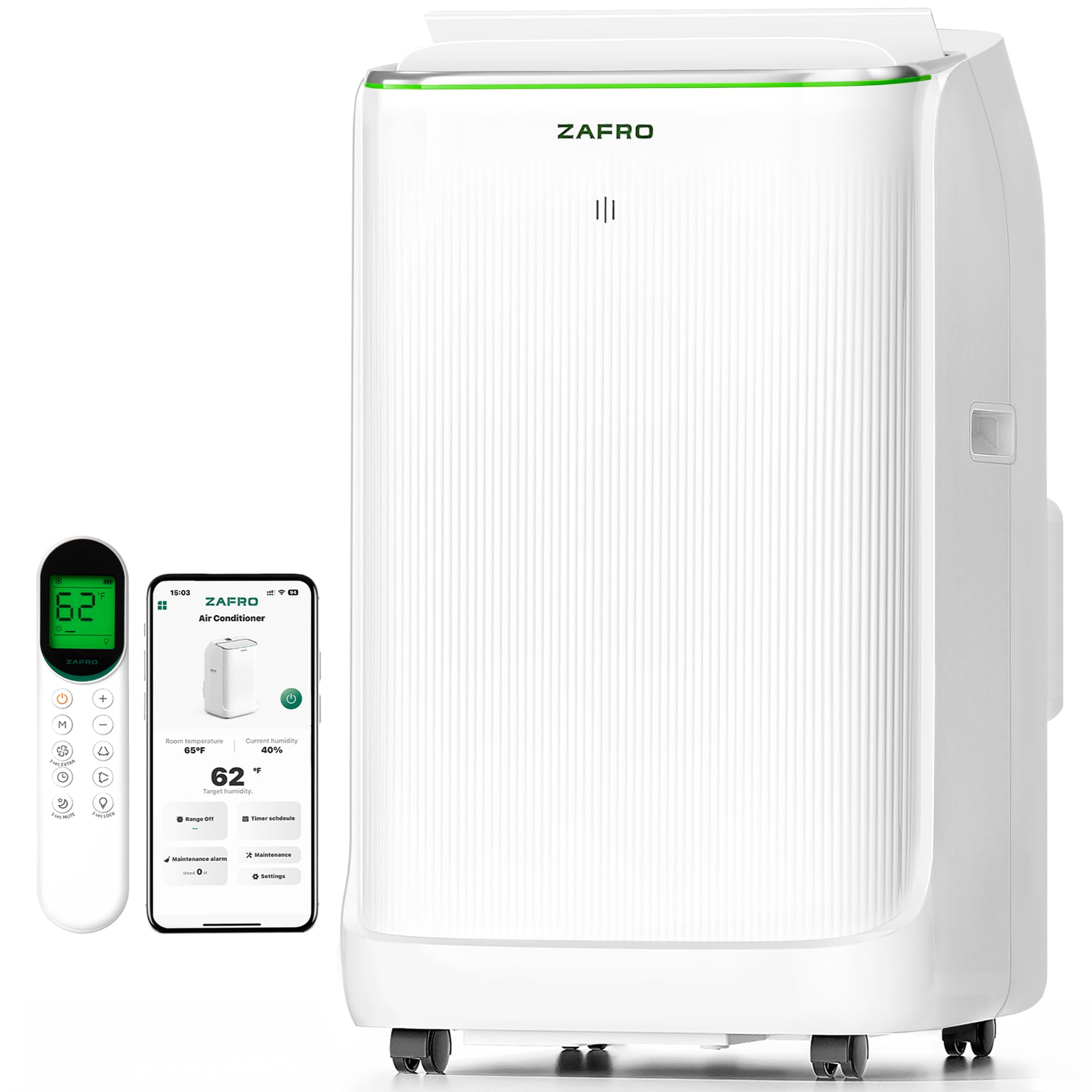
Not every off-grid setup allows a permanent split. If you rent, move the unit between rooms, or want cooling you can roll into a bedroom at night, this ZAFRO portable is the practical pick. It runs on a dual-hose system (two hoses that pull outside air in and push hot air out) so it does not starve the room of air the way single-hose units tend to. Its cooling power is 16000 BTU across a rated 800 square feet, with an inverter compressor and a CEER (Combined Energy Efficiency Ratio) of 12.8.
The efficiency comparison here is the interesting one. It lists 1158 kilowatt hours per year against the Senville’s 3973, and while the two units serve very different jobs, the ZAFRO is doing its cooling with a lower annual draw. That is why it fits a battery-plus-solar setup that cannot carry a whole-home heat pump. The 72-hour drainage-free self-evaporating system means the condensate gets slung back into the condenser and evaporated, so you are not emptying a tank on a schedule in normal humidity.
You can sleep right next to it, because it runs as low as 42 decibels (dB, a measure of sound) in sleep mode — quieter than a normal conversation. Six modes — Cool, Dry, Fan, Sleep, Extra, and Eco — let you dial in the draw to match your power budget. The 24-hour timer lets a remote setup pre-cool before you arrive. The honest catch: in a 14×20 living area during a real heat wave above 100°F outside, it can struggle to hold below 72°F. In the high 80s and mid 90s it handles 66-68°F without complaint.
What owners love: the dual-hose setup does the heavy lifting. Owners mention it keeps a large bedroom at 70°F easily, with three ways to control it (manual, remote, and app), and it runs quieter than a window fan.
What to plan around: that same dual-hose design needs two windows or one wide panel, and the exhaust hose runs hot enough that insulating it helps.
Best for: renters, RVers, and anyone cooling a room they cannot cut a hole in.
Skip the hose blanket and you pay for it: insulate the exhaust hose or the heat bleeds back into the room.
3. BAYKUL Portable Camping Air Conditioners 6800/7500 BTU
The one that lives in a tent, a truck cab, or a van corner and cools a small pocket of air fast.
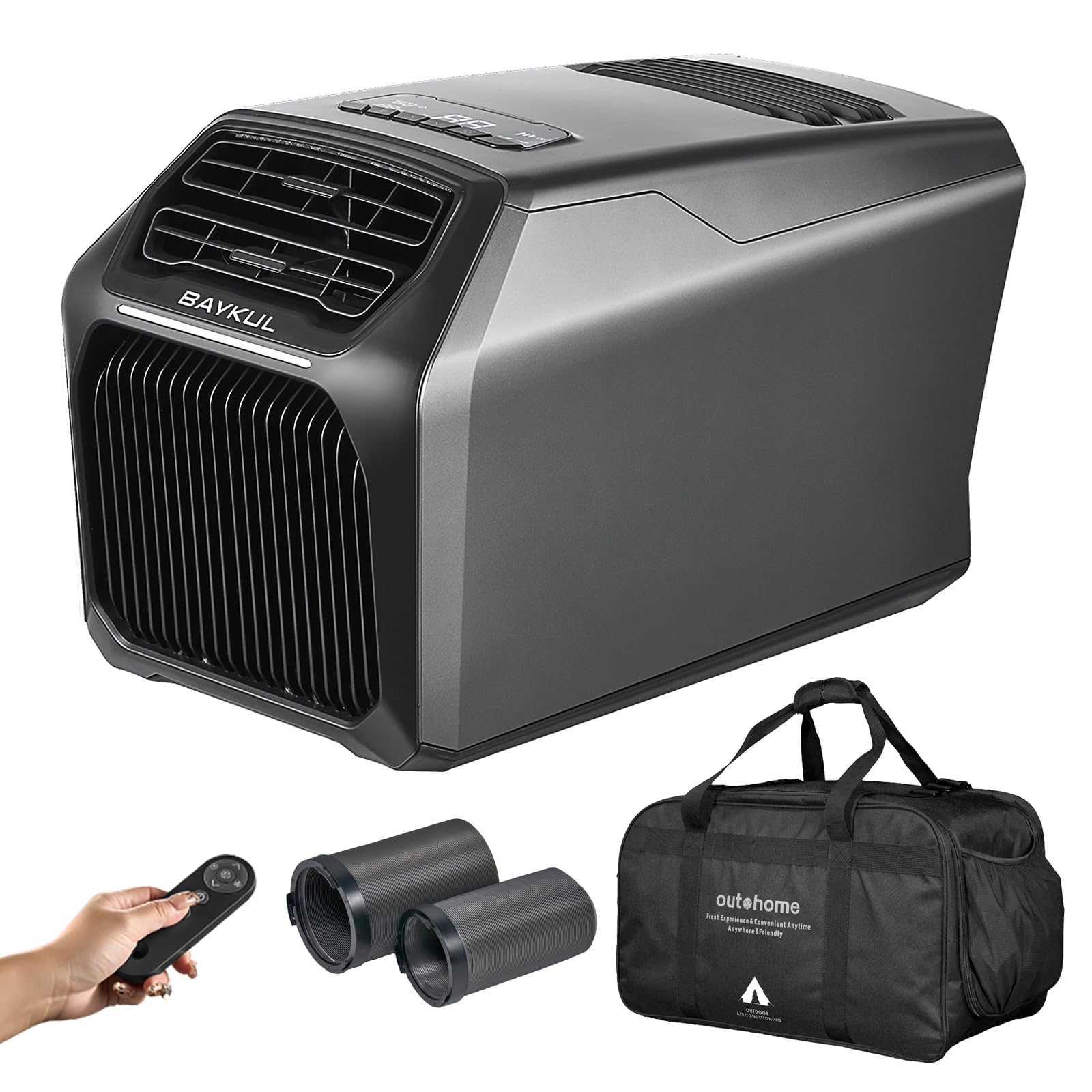
This is a niche tool aimed at the smallest spaces: a tent, a truck cab, a van berth, a picnic setup. It delivers 6800 BTU of cooling and 7500 BTU of heating from a compact body, and the 5-in-1 build covers cooling, heating, fan, dehumidifier, sleep mode, and a timer in one box. It runs on a standard 110V AC outlet or a car inverter, and the average power consumption is listed at 550 watts. The carry bag and the RF remote that works through walls are thoughtful touches for something you pack up each trip.
This one shines outdoors. For a tent, the strongest move is to set the unit outside and blow the cold air in through its hose, rather than dumping its own heat into the space you are trying to cool. A buyer who ran it that way reported it working very efficiently and running all night off a 12V 300Ah LiFePO4 battery (a lithium battery rated at 300 amp-hours of capacity) and an inverter. That trick, plus a thermal blanket or duct cover over the hot vent hose, is what turns an okay result into a genuinely useful one.
The honest trade-off is consistency. The durability track record is thinner than the bigger brands here, with reports of a water-tank sensor fault and a failing pump over a short period. If you want a truck-cab cooler for weekends and go in expecting to treat it gently, this delivers. If you need something to run hard and trouble-free for years, spend more and buy a 12V rooftop unit or a mini split. The compact form factor and the affordable price tag are exactly why it is worth a look for light-duty use.
Strongest for the small stuff
- 6800 BTU cooling from a compact body with a carry bag for one-handed portability.
- 5-in-1 build adds heating, fan, dehumidifier, sleep, and timer modes.
- Average 550 watts lets it run from a standard outlet or a car inverter.
- RF remote works from behind walls, handy inside a tent.
What to keep in perspective
- Durability is the weaker point; some units have shown early sensor and pump faults.
- It works best when placed outside the space and ducted in, which is a setup step.
- The compact size limits it to small pockets of air, not whole rooms.
Good match if: you want a portable weekend cooler for a tent or truck cap and are willing to duct it smartly.
Not your tool if: you need hard, long-term reliability in a permanent off-grid build.
4. Outequip RV Air Conditioner 12V 10000 BTU
A low-profile 12V rooftop that runs on your van’s battery bank and is barely audible outside.
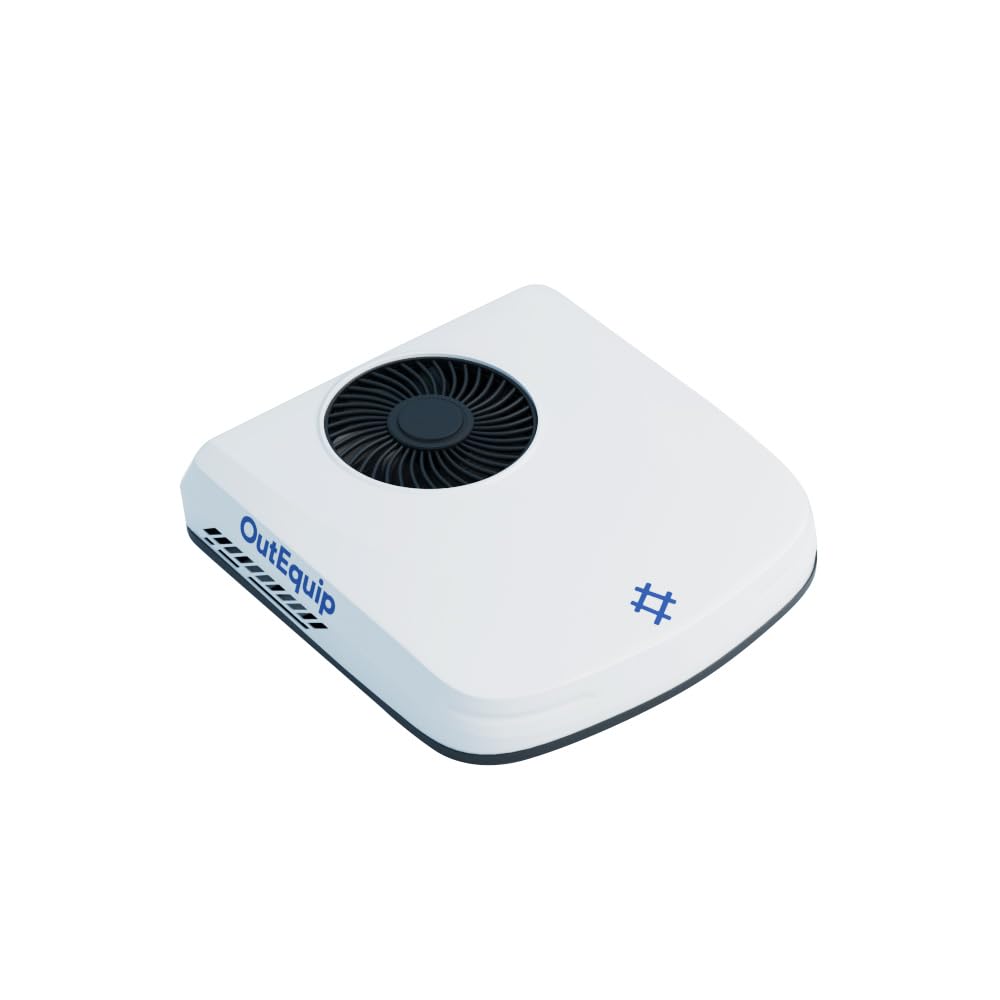
For the van builder, this is the sensible ceiling choice. It runs directly off your vehicle’s 12V electrical system, which means no inverter losses and no AC shore power needed. The cooling power is 10000 BTU, and the maker claims it cools an RV in 15 minutes. It is rated for 8 hours of cooling on a 480Ah bank and 10 hours on a 600Ah bank when parked. Those are the numbers that decide whether your battery bank can actually support it.
Where it earns its place in the van world is the low profile and the quiet. The compact 28×28 footprint fits a leaner roof line, and the brushless copper motor fans paired with spring-supported mounts keep the noise down. It is built with UV-stabilized ABS (a plastic that resists sun damage), an EPDM foam gasket (a weatherproof rubber seal), and a zinc-coated condenser to hold up outdoors. The install kit is complete, and the low rise means it hides behind solar panels on many vans.
Fit is the recurring complaint: the mounting gasket and torque instructions read as unclear, and some units sit a fraction of an inch high on the roof. One buyer with a narrower opening had to shoehorn it into a 14.1″ cutout. Set against the similar Countrymod 12V, both are 10000 BTU rooftop units running 12V DC (direct current, the 12-volt power your van or battery bank supplies), so the choice often depends on fit and finish on your exact roof. Quiet operation is the standout: it stays around 54dB at the rear on max, which is conversation-level, and the low ECO draw hovers in that modest range customers note.
The quiet rooftop argument: brushless copper fans, spring mounts, and a directional duct keep it close to background noise, and it barely registers from outside the van.
The install caveat: the gasket and torque steps need care, and the unit can sit slightly proud of the roof on some builds.
Pick this one for: a Class B van or camper where a 12V battery bank and a low profile matter most.
Check your cutout first: a snug 14-inch opening may need some working, and the roof seal deserves patience.
5. 12V DC RV Air Conditioner 10000 BTU Rooftop with APP Remote
A 12V rooftop that dials its compressor speed to match the load, with an app for the rest.
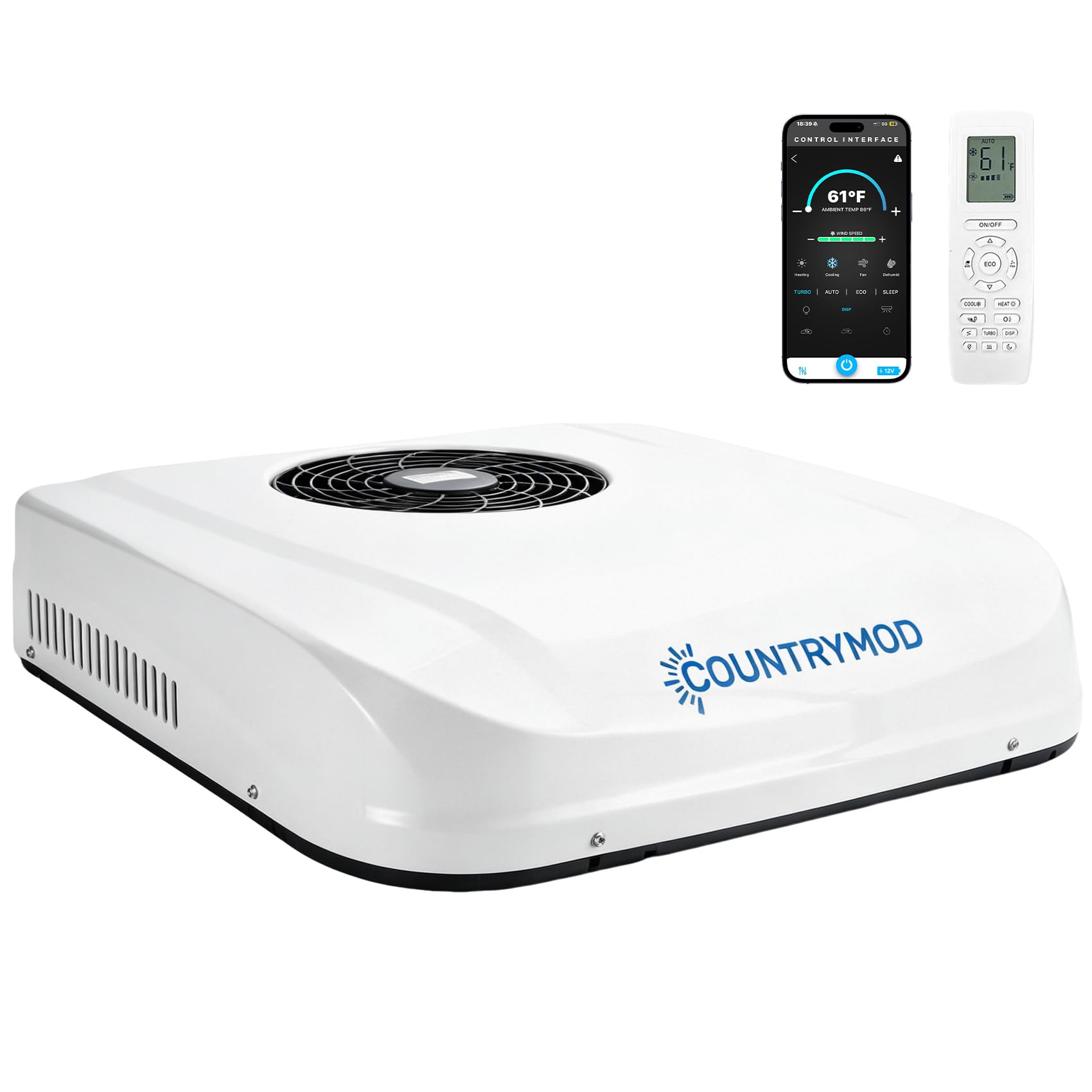
The variable-frequency design is the story here. Instead of banging the compressor on and off, this unit adjusts its speed to the demand, and the maker rates it at 0.3 kWh (kilowatt hours, a unit of electricity use) per hour. That figure is what makes it a serious boondocking tool: it is drawn from a power budget that a modest solar-and-battery setup can feed. The cooling power is 10000 BTU, and the floor area listed is 529 cubic feet, which keeps expectations honest for a small-to-mid camper.
The horizontal compressor layout is a genuine engineering detail worth understanding. It puts the center of gravity lower and cuts vibration compared with a vertical design, which means less road shock and a longer service life on the roof. It fits a standard 14″ x 14″ roof vent, and because it is ductless, you are not tearing up the interior to run ductwork. It comes with remote, touch, and app control, and the 45-55 decibel range is low enough to sleep under.
The mixed signal here is the instructions — several reviewers point out they could be more detailed, and the install takes planning with the wiring and overcurrent protection. A few units showed early failures, including a ruptured pressure hose and a compressor lockup, though the seller has replaced defective units and drawn praise for responsiveness. Set against the Outequip 12V, both are 10000 BTU, but this one leads on app control and the lower quoted draw while the Outequip leans on its build and quiet. Treat the installation plan as a real step, and this is a strong off-grid rooftop.
Why it fits off-grid
- Rated 0.3 kWh/hour, a genuine low-draw spec for a 12V rooftop.
- Variable-frequency compressor adjusts output to demand instead of hammering on and off.
- Fits a standard 14″ x 14″ vent with no ductwork needed.
- App, remote, and touch control give three ways to run it.
Read before you buy
- Instructions are thin, so plan the wiring and protection carefully.
- Mounting hardware can run short on thicker roofs.
- A minority of units have shown early failures, though the seller has replaced them.
Choose this for: boondocking where the draw matters more than the depth of the manual.
Bring a wiring plan: the install rewards a careful setup and a dedicated heavy-gauge run.
6. RV Air Conditioner, 12V 10000 BTU Rooftop (with heater)
The heater version of the 12V rooftop, for the camper who wants a warm evening as well as cold air.
This is the same 10000 BTU rooftop cooling package as the Outequip above, with a 4500 BTU PTC heater (a small electric heating element) added in. The heater is described clearly: it provides supplementary warmth ideal for mild temperatures and small spaces, and it is not suitable as a primary heat source in extreme cold or very large spaces. That framing is honest and worth respecting. It is a shoulder-season and chill-morning aid, not a furnace replacement.
The weatherproofing is the same rugged combination — UV-stabilized ABS, EPDM foam gasket, and zinc-coated condenser — and the brushless copper motor fans and spring mounts keep it quiet. It comes with remote control, temperature monitoring, and eco, sleep, and turbo modes. The cooling performance is where shoppers say the most satisfaction, and it runs on a modest draw in normal cooling use. The heated version is the one to pick when you camp into cold mornings and want to take the bite off the inside.
One honest contrast against the base Outequip: the heater is only useful if you plan around it. One buyer got roughly 8 hours of cooling on two 100Ah batteries but only about 2 hours of heating on the same bank. If you are off-grid in real cold, that ratio is worth respecting. The refrigeration side is what carries the unit, and it handles that with the same low profile and quiet operation as its sibling.
The value of the heater: it takes the chill off a camper morning and runs off the same 12V system, so you are not packing a second heater.
The catch is runtime: heating drains a battery bank faster than cooling, so it is a mild-weather tool, not a winter survival device.
Get this if: you camp into cool mornings and want a heater that shares the 12V system.
Keep the base unit if: you never camp cold — the extra heater is weight you will not use.
7. Daikin Entra R32 Heat Pump Mini Split

The 18 SEER2 workhorse for a small house that runs off solar and needs quality over sheer size.
If your off-grid home is smaller than a big cabin and you want a name-brand heat pump that sips power, the Daikin Entra is the one. It delivers 18000 BTU cooling with a range from a minimum 6900 BTU up to a maximum 20000 BTU, and 18000 BTU heating from 5800 up to 22500 BTU. The efficiency figures are 18 SEER2, 9 HSPF2 (Heating Seasonal Performance Factor, heating efficiency), 10.5 EER2, and a 3.30 COP (Coefficient of Performance). The rated floor area is up to 1000 sq ft, and it runs on R-32 refrigerant.
Its operating window is the reason it belongs here: it cools from 50°F to 115°F outdoors and heats from 5°F to 65°F. That wide band makes it usable through more of the year than a simple cooling unit. The R-32 refrigerant and DC inverter let it hit that 18 SEER2 number while running quietly. A titanium apatite photocatalytic filter (a screen that traps particles and breaks down odors) helps keep the air cleaner. In the real world, it is quiet enough that a buyer comparing it to a window unit said it is very quiet compared with what they had before.
How does it stack up against the Senville? The Senville leads on raw cooling and floor area at 24000 BTU and 1250 sq ft. The Daikin pulls back on capacity but gives a higher efficiency claim at 18 SEER2 with a lower maximum, which suits a smaller solar setup that cannot feed a 2-ton unit. If your battery bank or panel array is modest, this is the smarter size. The remote alone controls it, with no smart app in the spec, so plan control around the included remote.
Where it leads
- 18 SEER2 and 3.30 COP efficiency in a smaller, easier-to-power package.
- Wide range from 6900 to 20000 BTU cooling modulates fully with the load.
- Cools to 50°F and heats down to 5°F, so it covers more of the year.
- R-32 refrigerant and an air-purifying filter in one unit.
Where it gives ground
- 18000 BTU cools less space than the 24000 BTU Senville.
- No smart app in the spec; control is by remote.
- Runs on 50-115°F for cooling, so it is not a desert-extreme machine.
The right size for: a small off-grid home that wants a name-brand heat pump on a manageable power draw.
Not the biggest shot: for a 1200-plus sq ft cabin, the Senville carries more cooling.
8. TOSOT 24,000 BTU Mini-Split A/C
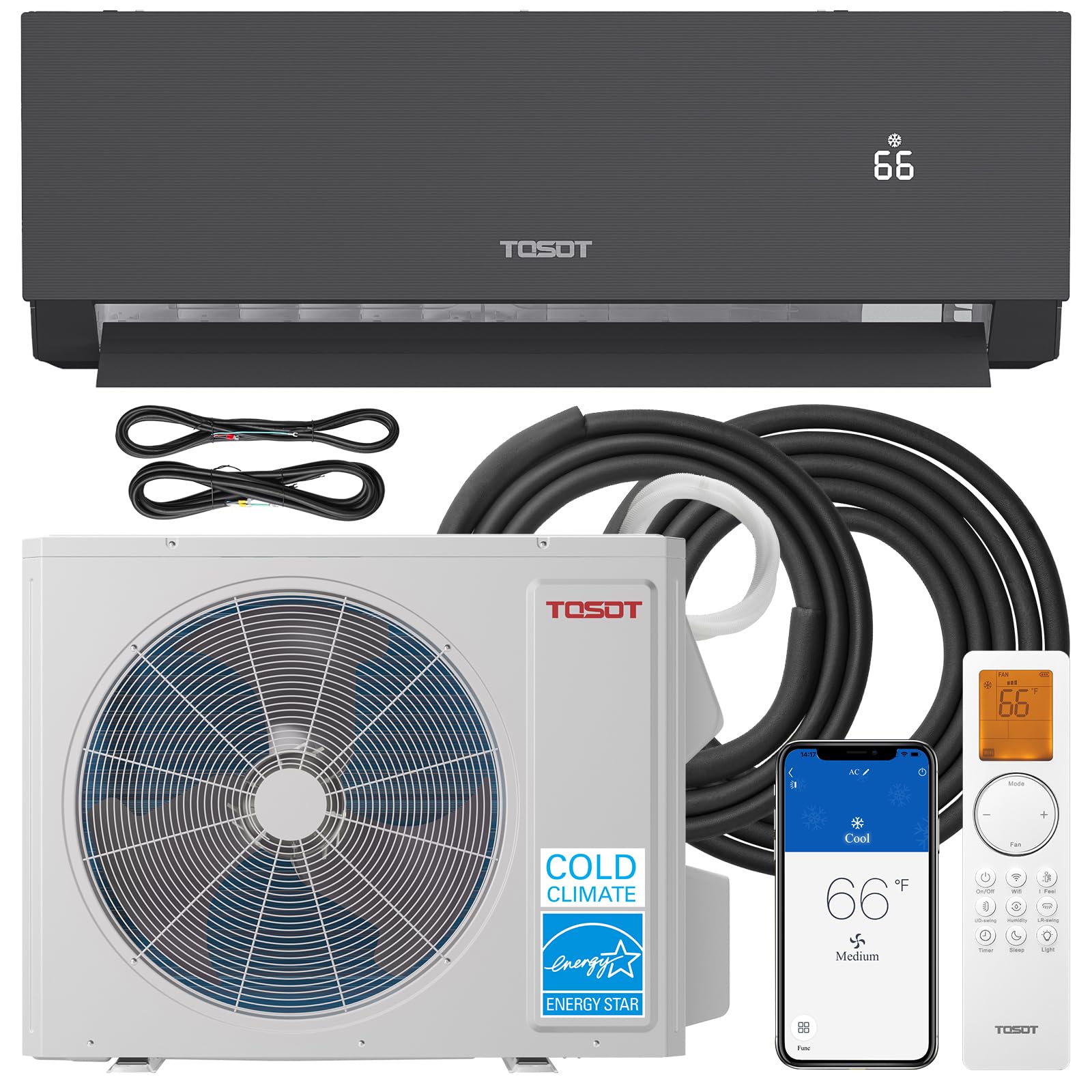
A 24 SEER2 cold-climate split that heats down to -22°F and tops the efficiency ladder.
Cold matters more than hot for a lot of off-grid homes, and this TOSOT is built for it. It ranks at 24 SEER2, the highest efficiency rating on this list, with a cooling power of 22000 BTU and a heating capacity of 24000 BTU. The floor area is up to 1500 sq ft, and the operating range is the standout: -22 to 122°F, with a dual electric heating belt to handle the extreme end. That means it keeps working in a climate where a fair-weather unit would simply stop.
The optional ERV integration is a genuinely different feature. ERV stands for energy recovery ventilation, a system that pulls stale air out and brings fresh air in while recycling the energy between them. TOSOT is described as the first in the US to offer a ductless mini split with optional ERV pairing, which matters in a tight off-grid cabin where fresh air and humidity balance are a real concern. The indoor noise level drops as low as 30dB, and the night mode quiets the outdoor unit to 61dB. It is WiFi-enabled and runs on 208-230V, and the Aoraki series is ENERGY STAR and AHRI certified.
The honest snag is shipping. The outdoor unit on some orders arrived dented or with crushed fins because the packaging is thin on a 90lb component. The hardware itself earns high marks, and one buyer cooled a 24×40 garage shop from 94°F to 70°F in two hours once it was installed. The ERV accessory is sold separately and needs extra wall vents, so plan that into the build from the start rather than retrofitting it later.
The cold-climate ace: a -22°F heating floor with a dual electric heating belt is the spec that separates it from the fair-weather splits.
The packaging risk: protect the delivery — some outdoor units arrived battered, so inspect on arrival and flag it fast.
Ideal for: a large off-grid home in a cold climate that wants max efficiency and future ERV options.
Weigh the extras: the ERV is a separate purchase, and the outdoor unit needs careful delivery handling.
9. MRCOOL 24000 BTU Mini Split Air Conditioner
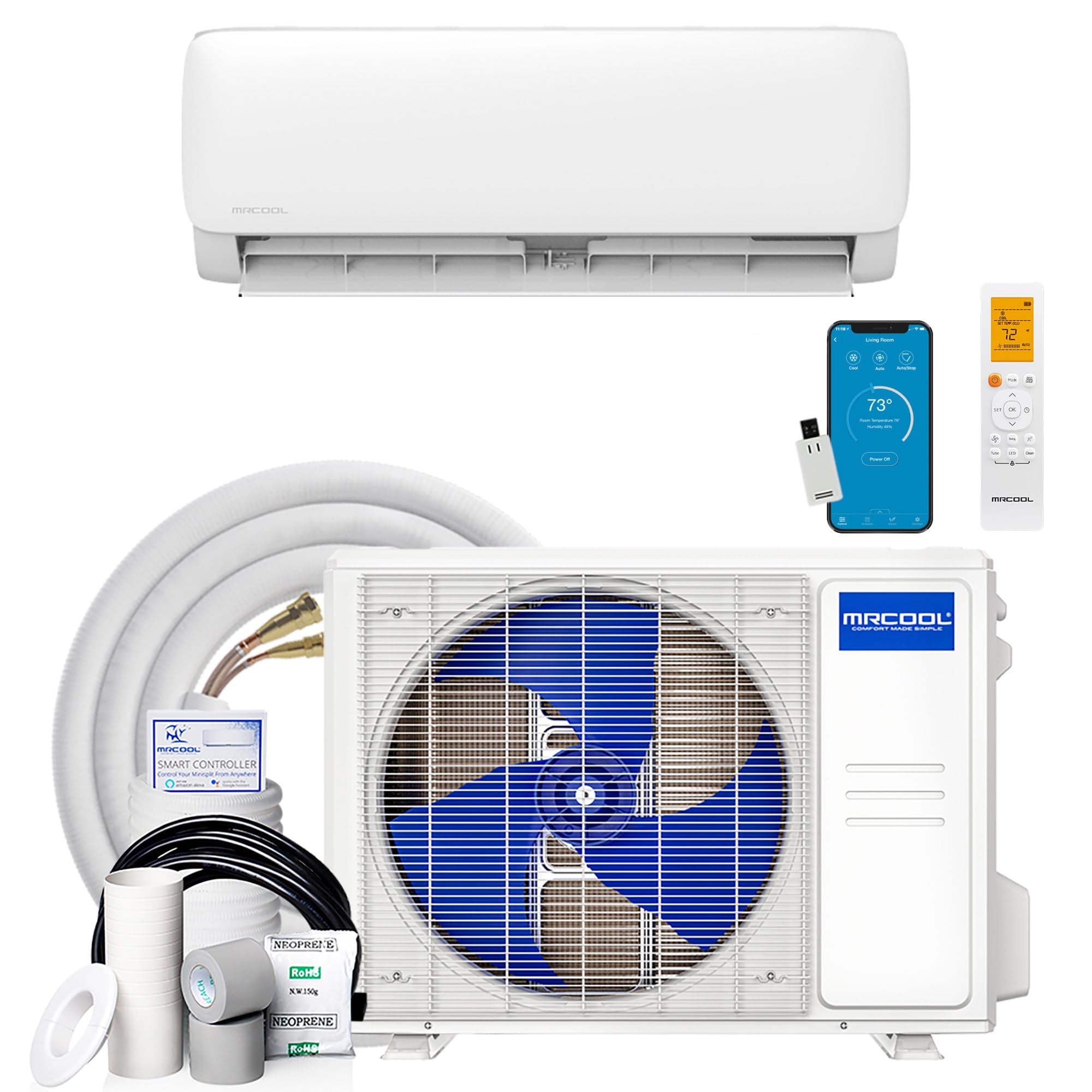
A 24000 BTU DIY split aimed at the big shop or garage that needs serious volume cooling.
For a large garage or workshop, the number that matters is cooling volume, and this MRCOOL brings 24000 BTU across a rated 1050 square feet. It is a ductless inverter system (an inverter varies compressor speed to hold temperature instead of switching on and off) with both heating and cooling. The DIY framing is central to the pitch: the manufacturer positions it as a streamlined install with less mess and reduced cost compared with a traditional split. Control is by remote and voice, and the finish is a clean white wall-mount design.
Inside a real 1k square foot shop in Florida heat, it holds its own, and a buyer who installed one in an 11-foot-ceiling garage reported it cooling roughly 1050 sq ft well and running quietly. The DIY installation is reported as straightforward with adequate directions. That is the whole point of this unit: cutting the contractor cost out of a mini-split install and letting a confident DIYer do the work with minimal tools.
The risk to know about is support and reliability at the edges. A minority have had units that arrived damaged and still ran, while one report describes a unit running only in heat mode and poor support follow-through. The install being DIY also means a mistake in the lineset or charge is on you, so either be confident or have a technician commission it. Against the Daikin, the MRCOOL matches it on nothing but volume — it wins on sheer BTU and big-space reach, while the Daikin wins on efficiency and a documented 18 SEER2 rating.
What it brings to a big space
- 24000 BTU across 1050 sq ft covers a serious garage or workshop.
- DIY framing cuts the traditional install cost and mess.
- Quiet operation holds up even in a big open room.
- Heating and cooling in one wall-mounted split.
What to weigh up
- No efficiency rating (SEER2) given in the published spec to compare directly.
- Some units arrived damaged; a few had function issues.
- DIY install means commissioning and lineset mistakes are on you.
The call for: a big shop or garage where volume cooling matters more than a trophy efficiency number.
Make sure you will commission it: a DIY split rewards confidence — if you are unsure, budget a technician to finish the job.
Know the Specs
BTU and floor area
BTU (British thermal units) is the measure of how much heat the unit moves out of a room. The bigger the space, the more BTU you need, and the floor-area rating on each spec sheet is the practical ceiling. A 10000 BTU unit suits a small van or camper, while 24000 BTU units are built for a cabin, a big workshop, or a whole-home space. Oversizing wastes power, undersizing runs the compressor flat out and never gets comfortable.
Power draw and inverter control
The draw, in watts or kWh (kilowatt hours), is the number that decides whether your battery bank can carry the load. An inverter compressor modulates its speed to the demand instead of hammering on and off, which smooths the draw and cuts waste. That is why a variable-frequency unit with a low average draw is the right match for a solar-and-battery setup. Always check the listed consumption before you buy, and match it to the capacity of your bank.
Common Questions
What is the difference between a 12V DC rooftop and a mini split for off-grid use?
How many BTU do I need for a small off-grid cabin?
Can a 12V air conditioner really run all night on a battery bank?
Is a mini split or a portable unit better for an off-grid setup?
Do off-grid air conditioners heat as well as cool?
What SEER2 rating should I look for on an off-grid mini split?
How loud are these units in an off-grid bedroom?
Can I install an off-grid mini split myself?
What does the ERV option on the TOSOT actually do?
How long does an off-grid air conditioner last?
The Bottom Line
For most people chasing an off-grid air conditioner, the Senville AURA 24000 BTU is the one to beat — 24000 BTU across a rated 1250 sq ft, inverter efficiency at 21.5 SEER (Seasonal Energy Efficiency Ratio, a higher number means less power per unit of cooling), and Alexa control so you can pre-cool a cabin you are hours away from. It asks for a professional install and a real solar-and-battery bank, but no other pick on this list covers that much space that efficiently. If a van build is your project, the Outequip 12V 10000 BTU Rooftop is the quiet, low-profile ceiling unit that runs straight off your 12V system — and if cold mornings are your concern, the heater version shares the same 12V wiring with a 4500 BTU PTC heater (a self-regulating ceramic heater) on board. On a tighter power budget, the Daikin 18 SEER2 split cools a smaller home with a lower maximum draw, backed by 4.5+ stars across 50+ owners, so it is the safest efficiency-first pick when your panel array is modest.
How we choose
We do not accept paid placement. Every pick is matched to a real buyer and a real use-case; we do not hands-on test units.
Sources
Specifications: manufacturer listings and product documentation. Review insights: verified customer reviews, as of October 2026. Pricing: not shown on this page (it changes often); check the current price via the retailer link.
As an Amazon Associate, Aappliancez earns from qualifying purchases. This does not affect which products we feature.