Disclosure: Some links in this post are affiliate links. As an Amazon Associate I earn from qualifying purchases, at no extra cost to you. Learn more
Specs are compiled from manufacturer listings and verified buyer reviews and can change over time — please confirm the key details on the product page before buying.
If you want the short answer: buy the SonoHealth Pulse Oximeter if you want a fingertip clip that reads your blood oxygen and pulse and beams the numbers to your phone. Buy the WearO2 ring instead if your real goal is watching your oxygen hour after hour while you sleep. Those two cover most people. The rest of this list handles specific jobs, like spotting a low-oxygen room or checking yourself at altitude.
This guide is built by comparing the manufacturers’ published specifications and the patterns across verified customer reviews, so you get each pick’s real strengths and trade-offs instead of marketing spin.
An O2 saturation monitor is a small device that shines light through your fingertip or skin to estimate how much oxygen your blood is carrying. Below you get six picks, the specs that actually matter, and the trade-offs nobody puts on the box for the o2 saturation monitor buyer.
Top Picks


How To Choose The Best O2 Saturation Monitor
Oxygen monitors look almost identical on a shelf, yet they do very different jobs. Some clip to a finger for a ten-second snapshot. Some wear like a ring for a full night. At least one on this list does not track your body at all — it checks the oxygen level in the air around you. Decide which job you actually have before you compare a single spec.
Decide between a spot check and a continuous watch
A fingertip clip gives you a number in seconds, which suits a quick check after a workout or at altitude. A continuous monitor logs readings over hours, so you can see whether your oxygen dips while you sleep. If you only need a snapshot, a clip is simpler and cheaper to own. If your interest is overnight trends, look for a device with a rechargeable battery and built-in memory.
Check the measuring range before you buy
The measuring range is the span of oxygen percentages a device reports. A body oximeter with a range of 95% to 100% covers normal readings but tells you little if levels drop far below that. One pick here covers 70% to 100%, which reaches much lower. Match the range to how low you expect to track.
Battery hours decide how you actually use it
A replaceable-battery monitor holds its charge for months in a drawer, so it works on the first press. A rechargeable monitor trades that for overnight sessions, where it needs enough hours per charge — look for 12 hours or more — to last a full sleep. Both styles appear on this list, so pick the one that matches how often you actually check.
Side-by-Side Comparison
| Model | Best For | Style | Measuring Range | Battery | Amazon |
|---|---|---|---|---|---|
| SonoHealth Pulse Oximeter★ Best Overall | Quick checks with phone tracking | Fingertip clip | 95% – 100% | 2 AAA (included) | Amazon |
| WearO2 Ring OximeterContinuous Tracker | Overnight continuous tracking | Wearable ring | — | 12 hours | Amazon |
| Pepultech Fingertip Oximeter | Sports and outdoor use | Fingertip clip | — | 15 hours continuous | Amazon |
| ZYKYCX Portable Oxygen Detector | Checking oxygen in the air | Handheld detector | 0% – 30% | 2500mAh, 16 hours | Amazon |
| Medline Soft-Touch Oximeter | Long battery life and app sharing | Fingertip clip | 70% – 100% | 300 hours | Amazon |
| JKS50F Pulse Oximeter | Multi-user and print-out needs | Fingertip clip | — | 4 AAAA (included) | Amazon |
Detailed Reviews
1. Pulse Oximeter by SonoHealth
Our pick — 4.0+★ from 350+ verified ratings; the strongest balance of quality and price.
A fingertip clip that turns your phone into the record book.
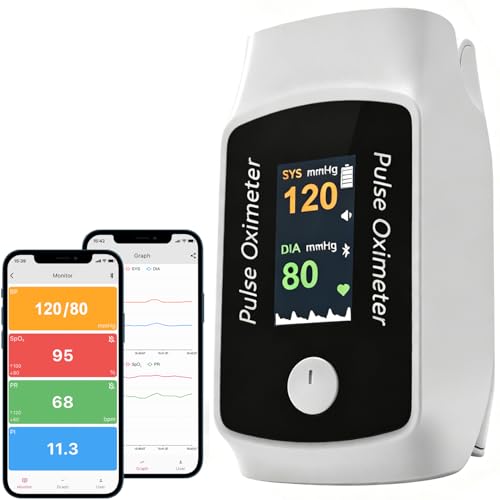
The SonoHealth clip is the pick most people should start with because it does the everyday job well. You slip your finger in, it reads your blood oxygen saturation (SpO2 — the percentage of oxygen your red blood cells are carrying) and your pulse rate, and you see the result on an OLED screen (a display that lights each pixel itself, so it stays bright and easy to read in the dark). What wins people over is plain reliability — getting the reading to appear and behave — which is the thing this device is known for.
The reason it earns this spot is the combination of that easy reading and the phone handoff. Two AA batteries come in the box, plus a travel case and lanyard, so it is ready to use the day it arrives. The screen rotates and offers six layout options, which means you can read it at an odd angle without tipping the whole device toward your face. Bluetooth sends your numbers to the SonoHealth app so you can look back over trends instead of trusting memory.
The catch is the app side. Some owners say the Bluetooth handoff to the phone can be inconsistent, and a few report trouble pairing or seeing results show up. The device itself still reads on its own screen, so a failed app connection does not leave you empty-handed — it just means the tracking feature is the weaker half. Treat the app as a bonus and you will be satisfied.
SonoHealth build quality
- Clear OLED readings with six screen layouts and a rotation feature
- Two AA batteries, a travel case and a lanyard all included
- Bluetooth app access for looking back at trend data
- Comfortable, familiar fingertip shape that most people pick up instantly
needs steady finger
- The phone app can be hit or miss at displaying a saved result
- Measuring range stops at 95%–100%, so deep dips are outside its zone
- At 6.4 ounces it is a little heavier in the hand than a bare-bones clip
daily home checks: you want a dependable clip that reads instantly and can share numbers to your phone when it cooperates.
fussy finger placement: your goal is logging oxygen all night — that is a job for the ring below.
2. WearO2 Bluetooth Ring Oxygen Monitor
The soft silicone ring that logs your oxygen while you sleep.
Most oximeters expect you to hold still for a few seconds. The WearO2 takes the opposite approach — you wear it on a finger, and it keeps tracking blood oxygen saturation, heart rate and motion for hours, up to 12–16 hours per charge on a rechargeable lithium-ion battery. The soft silicone ring sensor is shaped to sit on your finger without making it feel sore or numb, which is the whole point for long-term use.
For anyone watching overnight trends, the built-in memory is the real star. It holds four sessions of up to 10 hours each before the oldest gets overwritten, and it works without a phone at all. The free Vihealth app then turns those sessions into graphs and a PDF report you can share, and it feeds into Apple Health. There is also an adjustable vibration alert that nudges you when oxygen falls below a threshold you set yourself.
Here is the honest part. This is not a medical device — the maker states it is for sports and aviation use, and you should read it just before or after exercise with a calm body. A few buyers report a unit that would not power on after charging.
ring overnight comfort: it stays on through the night and the app is easy to follow, which is what you want from a wearable you forget about. Just expect the band to loosen over time, and gentle catching on covers can make the light blink now and then.
sleep tracking nights: it is the pick for tracking dips across a full night of sleep, hands-free.
quick spot checks: readings run lower than a fingertip clip for some wearers, so use it for trends rather than a single absolute number.
3. Pepultech Fingertip Pulse Oximeter
Built for a backpack, not a bedside table.
At 63 grams including the battery, this clip is light enough to ride in a jacket pocket on a climb and never register as weight. That lightness is the point for the buyers this targets — hikers, mountain climbers, altitude trainers and cyclists. It reads SpO2, pulse rate and blood pressure in seconds and shows the numbers on a large OLED display you can flip direction on with the buttons, so it reads right-side-up whether you hold it upright or sideways.
Two battery details decide how it behaves on a trip. It runs 15 hours of continuous operation, and it shuts itself off after 8 seconds of inactivity, which stretches that further between changes. Note that the two AAA batteries are not included, so pack your own. The Berry Health app lets you see live readings on your phone while the device records, which helps when you want a second pair of eyes on the number.
The recurring gripe is accuracy — the readings are not always as reliable as the price suggests, and a handful of buyers call the value into question. Against that, most buyers praise its simple, dependable operation, which suits casual altitude checks rather than serious tracking. This one is for sports and aviation use only, not medical use — the maker says so plainly.
travel bag staple: altitude checks and workout snapshots where low weight matters more than lab-level precision.
advanced data needs: you want a number you can lean on for a health decision — this is a sports tool.
4. ZYKYCX Portable Oxygen Detector
It measures the oxygen in the room, not in your blood.
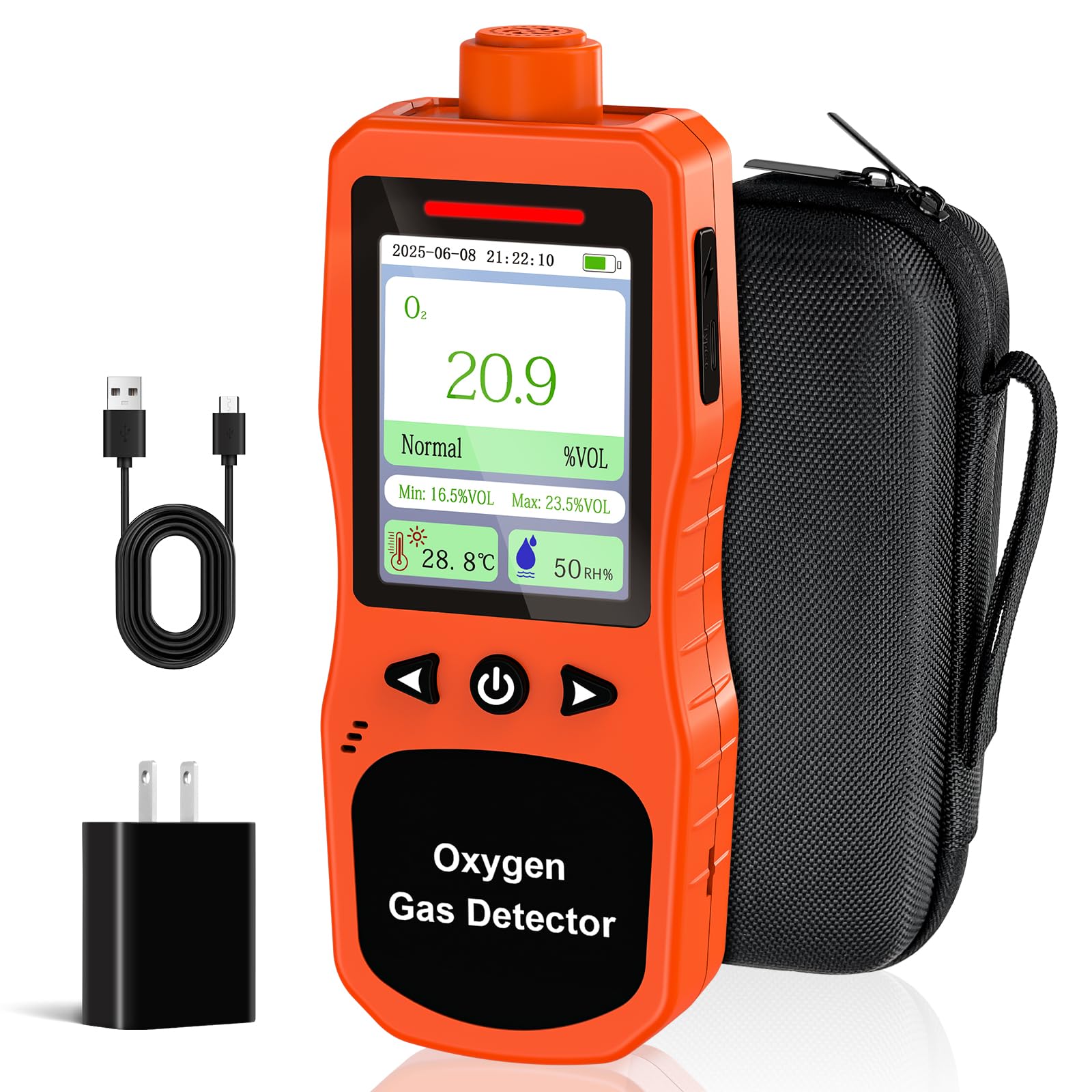
Do not confuse this with the finger clips above. This is an air-quality meter — it samples the oxygen content of the space around you from 0% to 30%, with 0.1% resolution and a claimed response time of 0.5 seconds. In normal fresh air it should settle around 20.9%, which is the number a user reports seeing light up on delivery. If your concern is a workshop, basement, mine or lab where the air itself could go oxygen-poor, this is the tool for that job.
The safety layer is where it earns its place. A triple-alarm system — sound, light and vibration — fires automatically when oxygen drifts outside a default 19.5% to 23.5% threshold band, and you can adjust the alarm yourself to catch a drop early. A 2500mAh built-in battery gives up to 16 hours per charge over Type-C, and it keeps up to 180 alarm logs. The 2.8-inch LCD shows real-time oxygen plus max/min values, temperature and humidity, and the clip-on back lets you wear it hands-free.
Calibration is the sore point. The maker says to recalibrate in fresh air and includes a menu password for it, but a few buyers found the process hard to complete or that the unit drifted out of spec. Owners find the core detection and alarm functions solid. Buy it if you need to monitor air oxygen, not if you want a personal health reading.
oxygen-only checks: anyone needing an early warning when the oxygen in a work space drops.
full vitals tracking: checking your own blood oxygen — that requires a finger clip.
5. Medline Soft-Touch Bluetooth Fingertip Pulse Oximeter

A finger clip that simply refuses to run out of power.
The headline here is endurance. Medline rates this clip at 300 hours of battery life on the two included AAA batteries — which means you can check your oxygen daily for a long stretch without ever swapping cells. That combination of longevity and a soft finger pad for comfort makes it an easy pick for anyone who wants a monitor to just live by the bedside and work whenever it is needed.
The measuring range is wider than most on this list. It reads 70% to 100% SpO2, so it keeps reporting well below the normal 95% zone rather than dropping out. The bright OLED screen offers seven direction viewing modes, which is handy when someone else is reading it from across the room. Bluetooth pairs it with the Medline Health app, and the maker notes you can document, track and share your SpO2 and pulse rate without a prescription to buy.
What you give up is data logging you can dig into later without the phone. The app is the record keeper, so if you want paper-thin portability with zero app fuss, this is not that device. If battery life matters more to you than extra features, that trade is a small one.
clinic-style logging: the set-and-forget owner who wants a clip that never needs a battery run.
no-phone users: you would rather not rely on a phone app to store your readings.
6. JKS50F Pulse Oximeter

One clip, ten profiles, and a printed report at the end.
Most oximeters track one person. The JKS50F is built for a household or a care setting, with a 10-user mode that lets ten different people record and store their oxygen readings on the same device — each user storing up to 300 data sets with a date and time stamp. A reading comes up in as little as 5 seconds with a single button press, and you can run it in either a point-test mode for a quick check or a trend-test mode across time.
The alert system suits overnight watching. When SpO2 falls below 90 or the heart rate drops below 50, the unit sounds an alarm and the display number flashes. The Bluetooth connection lets you share or print your data through your phone. What people praise most is the overall build quality — the interface stays simple and the finger clip stays comfortable — and the adjustable display reads clearly in low light.
Know the limits before you commit. The rechargeable cell runs for hours, not hundreds, so it wants a top-up between uses. The finger probe cord is short for some setups, and the controls and charger base take a little figuring out. This is a sports and aviation device, not a medical one, and it is the pick here if you need many users on one device.
single-user routine: families or caregivers who want several people tracked on one clip with alarms that fire loudly.
multi-user sharing: budget a charging routine and expect a fiddlier control layout than the simpler clips.
Know the Specs
SpO2 and measuring range
SpO2 is the label for your blood oxygen saturation — the percentage your device estimates by shining light through your fingertip or skin. A normal range sits high, so a measuring range like 95% to 100% covers everyday checks. A wider range like 70% to 100% keeps reporting when levels fall below normal. Pick the range to match how low you expect to monitor.
Battery hours versus rechargeable
Battery life is quoted either in hours of continuous use or total hours of operation. A 300-hour rating means many casual checks before a swap, while a 12-hour rating means a single overnight session per charge. Rechargeable cells suit continuous tracking; replaceable cells suit a device sitting idle in a drawer.
Air oxygen versus blood oxygen
An air oxygen detector measures the oxygen content of the surrounding atmosphere — fresh air near 20.9% — not your blood. It is a safety tool for rooms and work spaces, while a fingertip clip or wearable ring measures your body. They are not substitutes for one another, and the wrong one for your job will disappoint.
Apps, memory and sharing
An app or built-in memory is what turns a spot reading into a trend you can look back on. Continuous monitors store sessions internally, while fingertip devices hand data to a phone app. If you want records for a family member or a print-out, check whether the device stores readings on its own or needs a phone present.
Common Questions
What is SpO2 and what does a normal reading look like?
Do I need a fingertip clip or a continuous wearable?
Can a fingertip oximeter check the oxygen in my room instead of my body?
How long do the batteries last and what type do these monitors take?
Will a Bluetooth oximeter share readings with my phone?
Is a wearable ring oximeter as accurate as a fingertip clip?
What does the oxygen alarm on these devices do?
Can several people use the same oximeter?
Is a home oximeter a medical device?
Why do some units read lower than others?
The Bottom Line
For most buyers, the best O2 saturation monitor is the SonoHealth Pulse Oximeter — it reads your blood oxygen in seconds, rotates its OLED screen to any angle, and hands your numbers to a phone app when you want the history. If tracking overnight is the whole reason you are shopping, reach for the WearO2 Ring, whose rechargeable battery and internal memory are built for a full night of logging. And for anyone checking the oxygen in a room rather than their own blood, the ZYKYCX Oxygen Detector is the one to grab.
Match the tool to the job. A fingertip clip reads your blood oxygen; an air detector reads the oxygen in a room — same word on the box, different jobs.
How we choose
We do not accept paid placement. Every pick is matched to a real buyer and a real use-case; we do not hands-on test units.
Sources
Specifications: manufacturer listings and product documentation. Review insights: verified customer reviews, as of October 2026. Pricing: not shown on this page (it changes often); check the current price via the retailer link.
As an Amazon Associate, Aappliancez earns from qualifying purchases. This does not affect which products we feature.