Disclosure: Some links in this post are affiliate links. As an Amazon Associate I earn from qualifying purchases, at no extra cost to you. Learn more
Specs are compiled from manufacturer listings and verified buyer reviews and can change over time — please confirm the key details on the product page before buying.
Nutsedge does not play by normal weed rules. Pulling it snaps the stem and leaves the little underground tubers — the “nuts” it is named for — sitting in your soil, ready to send up new shoots. So the straight answer is this: buy a hose-attached ready-to-use killer for a quick patch job, or a concentrate you mix in a sprayer if you have a whole lawn to cover. Below are the five products worth your money, sorted by what job each one actually does best.
This guide is built by comparing the manufacturers’ published specifications and the patterns across verified customer reviews, so you get each pick’s real strengths and trade-offs instead of marketing spin.
Each pick below lists its active ingredient, container size and the turf types its label clears. Every pick below is a real product with real label data, so you can match one to your grass type and your patience level with the best nutsedge weed killer for your own yard.
Top Picks

How To Choose The Best Nutsedge Weed Killer
The first fork in the road is simple: do you want to attach a bottle to a garden hose and spray, or do you want to mix a concentrate yourself? Ready-to-use saves you the measuring. Concentrate saves you money per square foot and lets you dose a big lawn precisely. Pick ready-to-use for a patch and no measuring; pick concentrate for acreage and a lower cost per square foot.
Match the bottle to your grass, not to the weed
Most nutsedge killers are selective, meaning they are built to knock out the weed while leaving your lawn standing. But “selective” is a label claim tied to specific turf types. Labels list grasses such as fescue, bluegrass, Bermudagrass, zoysia and St. Augustine, and they also list grasses to avoid. Find your grass name on that product’s label list before you spray.
Speed versus depth of kill
Fast products show yellowing in a matter of days, which feels satisfying but does not always mean the tubers are finished. Slower systemic products take weeks to work down to the root system, and they often need a follow-up pass. Either way, plan a second application two to four weeks out to catch regrowth from surviving tubers.
Rainproof timing and temperature
Several of these products become rainproof once the spray has dried, which is why the label wording matters: apply with enough dry hours ahead of the forecast. Heat matters too, since one label explicitly tells you to avoid spraying above 90°F. Spray in the cooler morning hours and let the leaf dry before the heat builds.
Side-by-Side Comparison
| Model | Best For | Format | Active Ingredient | Container Size | Amazon |
|---|---|---|---|---|---|
| Ortho Max Nutsedge Killer Rtu, 24 fl.oz. (2 Pack)★ Best Overall | Fast, no-mixing patch treatment | Ready-to-use liquid | — | 24 fl oz (2 pack) | Amazon |
| Fertilome 11254 Weed-Out Nutsedge Control ConcentrateBig-Lawn Value | Big lawns on a mixed-weed budget | Liquid concentrate | Halosulfuron | 16 fl oz | Amazon |
| Atticus Empero Q-Pak Nutsedge Killer (2 Pack) | Measured sprayer dosing, no guesswork | Water dispersible granular packets | Halosulfuron-methyl | 13.5 g packets | Amazon |
| Liquid Harvest Mesotrione – 8oz | Cool-season lawns and crabgrass too | Liquid concentrate | Mesotrione | 8 fl oz | Amazon |
| Bonide Sedge Ender, 16 oz | Hose-end spraying over large ground | Ready-to-spray liquid | Sulfentrazone | 16 fl oz | Amazon |
Detailed Reviews
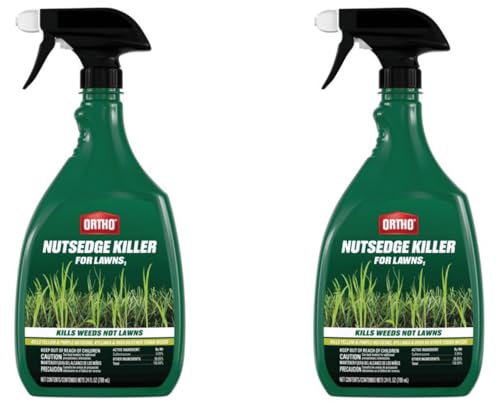
1. Ortho Max Nutsedge Killer Rtu, 24 fl.oz. (2 Pack)
Our pick — 4.0+★ from 8,500+ verified ratings; the strongest balance of quality and price.
The hose-and-go bottle that treats your first bad patch in a single evening.
For a yard with a few ugly clusters along the driveway, this is the one to start with. You screw the bottle onto a hose, flip the control, and spray — no measuring cup, no tank, no mixing math. The bottle is labelled for yellow and purple nutsedge plus kyllinga and a long list of other tough weeds, so it doubles as a general cleanup spray on dandelion, spurge and broadleaf plantain.
What wins people over here is the speed and the simplicity. As buyers report, it “killed invasive nutsedge in flower beds without harming flowers” with easy hose attachment and on/off control, results in about four days, and the grass hadn’t returned. The rainproof claim is the practical bit: once the spray has dried on the leaf, a shower two hours later will not wash your work away. Compare that with the Fertilome concentrate below, which is 16 ounces in a single bottle you have to dilute — the Ortho comes as two 24-fluid-ounce bottles and starts working in days rather than weeks.
The trade-off is real but narrow. Two 24-fluid-ounce bottles cover a patch, not an entire acre, and heavier infestations often need a second pass a couple of weeks later. Some lawns do yellow slightly where the spray lands. Both are normal, and neither is a reason to skip a product that handles the job this cleanly for most first-time buyers.
What earns the top spot
- Ready to spray — no mixing, no tank, no measuring
- Labelled for yellow and purple nutsedge, kyllinga and more than 50 tough weeds
- Rainproof two hours after application
- Two 24-fluid-ounce bottles in the pack
Where it runs out of room
- Best suited to patches and beds rather than whole-lawn coverage
- Some lawns show yellowing where the spray lands
- Heavier stands usually need a second application
Reach for this if: you want the least fussy first strike on nutsedge along a driveway, bed edge or small lawn — it holds 4.0+ stars across 8,000+ ratings for exactly that job.
Think again if: you are treating a large acreage and need concentrate that goes further per bottle.
2. Fertilome 11254 Weed-Out Nutsedge Control Concentrate
One pint, up to 5,800 square feet — the maths that makes concentrate worth the mixing.
Do the coverage maths before you judge the bottle size. This pint of concentrate is labelled to treat up to 5,800 square feet of lawn or turfgrass, which is a whole lot of ground from one small jug. It is a selective pre- and post-emergent herbicide, so it goes after broadleaf weeds, annual grasses and sedges while leaving your turf standing, and it is cleared for both warm and cool season grasses including bluegrass, Bahia, Bermuda and fescue.
Here is the honest part: effectiveness is genuinely mixed across the review pages. Some buyers call it “the best I have ever used,” with the nutsedge taken care of and most of it not returning the next year. Others applied it exactly as instructed and found the kill barely noticeable. That split tells you more about soil, timing and grass type than about the jug itself — the halosulfuron inside is the same family of active ingredient the Atticus packets use. Note for anyone with flowers nearby: one buyer would not recommend it for nutsedge sitting in the middle of flower-type vegetation.
You are also mixing this one yourself, so a sprayer is part of the deal. If you want zero measuring, the ready-to-use Ortho above saves that step, and the pre-measured Atticus packets below split the difference. If you would rather buy once for a large yard, this is the volume play.
The coverage case: a single 16-ounce pint reaching up to 5,800 square feet makes this the cheapest ground-per-dollar route among the concentrates here.
The honest caveat: results are genuinely split in reviews — some lawns come back clean a year later, others see barely any kill, and flower beds are a no-go per one buyer.
Pick this for: a big lawn, a sprayer you already own, and a willingness to follow the label mix rate exactly.
Pass if: you want a guaranteed single-bottle answer or you are spraying nutsedge among ornamental flowers.
3. Atticus Empero Q-Pak Nutsedge Killer (2 Pack) Turf Herbicide

One packet, one gallon of water, one sprayed yard along the road — done.
The pitch here is that you never measure powder again. Each Q-Pak is pre-measured for a sprayer and already carries a surfactant — the additive that helps the spray cling to a waxy sedge leaf instead of beading off. Tear one open, drop it in a gallon of water, and you have a batch ready. The active ingredient is 5% halosulfuron-methyl, and the label says it travels down to the root system tubers for a top-to-bottom kill.
That tuber detail is the whole point with nutsedge. As owners mention, “my yard always has nutsedge along the road and driveway. 1 treatment and it’s totally gone!” Others describe a severe St. Augustine invasion in Florida turning yellow and dying several weeks in. And that is the recurring note across the reviews: patience required. Roughly three weeks is the realistic window before you can judge a pass, not three days like the Ortho.
The label is broad on turf — bluegrass, fescue, Bermudagrass, zoysia and more — and pets and people can re-enter the treated area once the spray has dried. Coverage is listed at 2,000, and two packets come in the pack. If you have a small yard and a sprayer, the cost per gallon is harder to swallow than a big concentrate; if you hate ratios, it is easily the least error-prone option here.
What earns its keep: pre-measured sachets with surfactant already included remove the single most common spraying mistake — a wrong mix rate.
Set expectations on timing: this is a slow, root-deep killer, not a same-week visual fix, and one packet is sized for a gallon-sized batch rather than a whole acre.
Who it suits: the sprayer owner who wants no guesswork and does not mind waiting a few weeks for the yellowing.
Who should look on: anyone wanting a visible change in days, or a big yard that would burn through packets fast.
4. Liquid Harvest Mesotrione – 8oz – Mesotrione Concentrate

The crabgrass blocker that also handles sedge — but it turns weeds white doing it.
If your yard has more than just nutsedge going on, this is the pick with the widest net. The label lists 46 broadleaf species and grasses, including crabgrass, clover, chickweed, dandelion and barnyard grass, and it works both before weeds sprout and after. Effectiveness is the thing owners praise most about this bottle, and the crabgrass results in St. Augustine lawns are the standout story: blanched weeds in about a week, no hand-pulling by late summer.
The white-bleach look is what trips people up. Mesotrione works by blocking photosynthesis, so treated weeds go ghost-white before they die. Owners are split on whether that is satisfying or alarming, and it can take two to three weeks for the full kill. The label adds a water rule: if no rain falls within 10 days, apply 0.15 inches of water to activate it. This 8-fluid-ounce bottle is also the smallest liquid container here — against the Bonide’s 16 fluid ounces it is half the volume, so check your area before assuming it goes as far.
Turf compatibility is the deal-maker or deal-breaker. It is labelled for Kentucky bluegrass, centipede, buffalo grass, tall fescue, perennial ryegrass and fine fescue, plus St. Augustine sod only. It is explicitly not for bentgrass, Poa annua, kikuyugrass, zoysiagrass, seashore paspalum or bermudagrass, though you can apply it on dormant bermudagrass. Read that list against your own lawn before you mix.
Why it earns a slot
- Targets 46 broadleaf species and grasses — crabgrass included
- Works as both a pre-emergent and a post-emergent
- Cleared for a long list of cool-season turf, plus St. Augustine sod only
Read this before you buy
- Turns weeds white, which some owners dislike
- Full kill can take 2-3 weeks
- Not for bermudagrass, zoysiagrass or bentgrass lawns
Best match: a cool-season lawn fighting crabgrass and sedge together, where you accept white weeds as part of the show.
Wrong tool for: a bermudagrass or zoysiagrass yard, or anyone who wants greened-down weeds rather than bleached ones.
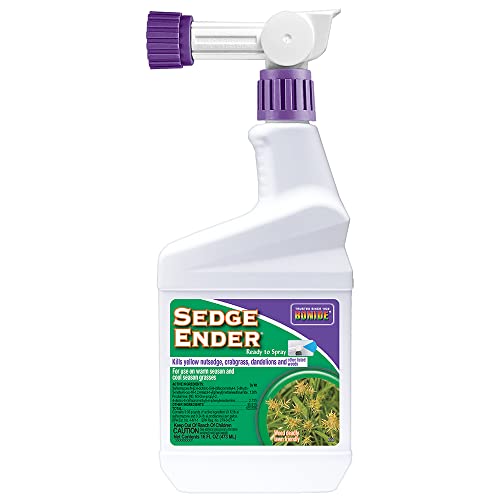
5. Bonide Sedge Ender, 16 oz Ready-to-Spray Weed Killer
Hose-end convenience for the biggest patch of ground — once you get the dial to turn.
Bonide’s selling point is straightforward: one pint of this ready-to-spray bottle can cover 2,000 to 8,700 square feet, and you just hook it to a garden hose and go. The active ingredient is sulfentrazone, and the label covers yellow nutsedge, crabgrass, goosegrass and other grassy weeds down to the roots, on both warm and cool season grasses such as bluegrass, ryegrass, fescue, Bermuda and carpetgrass. It also works pre- and post-emergent, so you can hit weeds that are already up and block seedlings behind them.
Results are genuinely mixed, and the timing is the reason. One owner applying to hybrid Bermuda in Central Texas found it effective with two passes three to four weeks apart and no grass damage, and noted less yellowing than Certainty. Another said it took care of their sedge spots and that sedge is simply hard to get rid of. The recurring gripe is the on/off dial — on the review pages the words “the locking mechanism had to be forced open with pliers” are not far off the mark, and Bonide’s fix was replacement spray parts. If you have hand strength issues, this is worth knowing.
The rainproof claim also has fine print: it is rainproof once it has dried, and you should apply with enough hours ahead of a shower. Avoid spraying in temps above 90°F per the label guidance owners cite. Against the Ortho’s two 24-fluid-ounce bottles, this single 16-fluid-ounce bottle claims more square footage in one unit, which is its real argument for larger yards.
Strong points
- Treats 2,000 to 8,700 square feet from one 16-fluid-ounce bottle
- Hose-end spray bottle, no mixing cup needed
- Kills down to the roots on yellow nutsedge and grassy weeds
Where the friction sits
- The on/off dial can be stiff enough to need tools
- Stubborn infestations typically need two passes weeks apart
- Results are genuinely mixed, so timing and temperature matter a lot
Fits best when: you have a broad stretch of lawn, a hose nearby, and a firm grip for the dial.
Think twice if: you have limited hand strength, or you expect a single pass to clear a heavy infestation.
Know the Specs
Ready-to-use versus concentrate
A ready-to-use bottle is already mixed at spray strength, so you attach a hose and go — the Ortho and the Bonide both work this way. A concentrate is a stronger liquid you dilute into water yourself, which costs less per square foot but adds a sprayer and a mix ratio to the job. The Fertilome pint is a concentrate; the Atticus packets are granular sachets you dissolve in a gallon of water.
Active ingredients and how they act
Halosulfuron and halosulfuron-methyl are the sedge-focused actives in the Fertilome and Atticus products, and they travel down toward the tubers. Mesotrione blocks photosynthesis, which is why treated weeds go white. Sulfentrazone in the Bonide works on contact and down into the roots. Different actives explain the different wait times — days for some, weeks for others.
Coverage in square feet
Bottle size alone tells you nothing. The Fertilome pint lists up to 5,800 square feet, the Bonide range is 2,000 to 8,700 square feet, and Atticus lists 2,000. Measure your lawn’s square footage and compare it to the coverage figure on that product’s label.
Selectivity and turf safety
Every product here is selective, meaning it is built to spare certain grasses. But that safety list is specific. Mesotrione is cleared for St. Augustine sod only and not for bermudagrass, zoysiagrass, bentgrass or Poa annua. The others are broader across warm and cool season grasses. Check your grass type against the label’s cleared-turf list before you buy.
Common Questions
Why does nutsedge keep coming back after I pull it?
Can I spray nutsedge killer on my whole lawn or just the patches?
How long until the nutsedge actually dies?
What does rainproof actually mean on these labels?
Is the Mesotrione safe on St. Augustine grass?
When can pets and kids go back on the treated lawn?
Do I need a surfactant with the Liquid Harvest Mesotrione?
What temperature should I avoid spraying nutsedge killer in?
Will one bottle of ready-to-use cover my whole yard?
The Bottom Line
For most yards, the nutsedge weed killer worth starting with is the Ortho Max Nutsedge Killer Rtu — screw it onto a hose, spray the bad patches, and measure the result in days rather than weeks. If you would rather buy one pint that reaches up to 5,800 square feet and you already own a sprayer, the Fertilome concentrate is the volume play. And for a cool-season lawn fighting crabgrass and sedge together, the Liquid Harvest Mesotrione covers the widest list of targets, whites and all. Whichever you pick, plan a second pass two to four weeks later to hit regrowth from the tubers.
How we choose
We do not accept paid placement. Every pick is matched to a real buyer and a real use-case; we do not hands-on test units.
Sources
Specifications: manufacturer listings and product documentation. Review insights: verified customer reviews, as of October 2026. Pricing: not shown on this page (it changes often); check the current price via the retailer link.
As an Amazon Associate, Aappliancez earns from qualifying purchases. This does not affect which products we feature.