Disclosure: Some links in this post are affiliate links. As an Amazon Associate I earn from qualifying purchases, at no extra cost to you. Learn more
Specs are compiled from manufacturer listings and verified buyer reviews and can change over time — please confirm the key details on the product page before buying.
If you write notes by hand, you already know the difference a good card makes — a flimsy sheet that feathers your pen and shows the ink through to the other side ruins the whole gesture. The five picks below all use 65 lb cardstock or heavier and ship with envelopes, so pick the one that matches how you actually send notes.
This guide is built by comparing the manufacturers’ published specifications and the patterns across verified customer reviews, so you get each pick’s real strengths and trade-offs instead of marketing spin.
This breakdown of the best note cards covers stock weight, card size, and envelope quality so you buy once.
Top Picks


How To Choose The Best Note Cards
A note card is a small, flat piece of heavy paper you write a short message on, and it usually comes with a matching envelope. The three things that decide whether you enjoy using a set are the weight of the paper, the finish on the surface, and the size of the card itself. Get those three right and the cover design matters far less.
Paper weight decides whether your pen shows through
Cardstock weight is written in pounds, like 65 lb or 90 lb, and it measures how heavy and dense the sheet is. A heavier sheet — say 90 lb over 65 lb — soaks up fountain pen and marker ink without it bleeding through to the back. If you write with anything thicker than a ballpoint, check the lb number first.
Smooth or textured changes how your pen feels
Uncoated, smooth paper lets a pen glide and dries fast, which suits everyday handwriting and printing. A textured sheet gives cards a more premium, letterpress-style feel but can make fine pen strokes wobble and tends to soak up printer ink unevenly. Match the finish to your method: smooth uncoated for handwriting, textured for printed designs.
Card size sets how much you can actually say
A flat 4 x 6 inch card gives you real room for a paragraph; a 3.5 x 5.5 inch card suits a few lines and a signature. If you mostly send quick thank-yous, a 3.5 x 5.5 inch card holds a few lines and a signature. If you write letters or recipe cards, go bigger — a 5 x 8 inch card fits a full recipe or a paragraph with room to spare.
Side-by-Side Comparison
| Model | Best For | Card Size | Card Count | Envelopes | Amazon |
|---|---|---|---|---|---|
| Better Office Products 50-Pack All Occasion★ Best Overall | Photographic all-occasion notes | 4″ x 6″ | 50 | 50 included | Amazon |
| American Greetings 100-Count EarthtoneBiggest Set | Bulk sets and small businesses | 4″ x 5.24″ | 100 | 100 included | Amazon |
| Avery Textured Cardstock Note Cards | Printing your own designs | 4.25″ x 5.5″ | 50 | Included | Amazon |
| Home Advantage 5×8 Blank Index Cards | Heavy stock and study notes | 5″ x 8″ | 50 | — | Amazon |
| Graphique Mint and Gold Flat Notes | Gifting and display | 3.5″ x 5.5″ | 50 | 50 included | Amazon |
Detailed Reviews
1. Better Office Products 50-Pack Greeting Cards
Our pick — over 4.5★ from 800+ verified ratings; the strongest balance of quality and price.
Six photographic Americana covers on genuinely thick stock — the set most people should just buy.
You get 50 blank cards and 50 white 32 lb. offset envelopes, all in a sturdy full-color box that keeps the cards flat until you use them. Each card is printed on 90 lb cover stock (a paper weight that equals 250 gsm), heavy enough that the paper feels substantial in your hand and doesn’t flop when you hold it up to write. That weight is why it lands first: among the five sets here, 90 lb cardstock outclasses the 65 lb sheet used on the Avery cards, so your handwriting sits on top of the paper rather than sinking into it.
At 4 x 6 inches, these are the sort of cards you can actually fill. Buyers report “Beautiful pictures, great to write short letter to friends,” and the six nature photographs — all Americana landscapes — give you variety without straying into novelty. The cover stock is dense enough that one buyer’s experience of cards that “don’t easily bend or tear” tracks with the 90 lb spec, which is the number that matters most when envelopes get handled by the postal service. The set fits standard gift cards too, so it doubles as a holder when you’re mailing one.
Here is the honest catch: the photo set is fixed at six designs, so if you want a beach or tropical scene you won’t find one in this box. There’s no lined or guided interior either — every card is blank inside, which is the point but also means no helping hand if you freeze up on what to write. And the envelopes are functional white offset rather than anything fancy, so this is a workhorse set, not a display piece for your desk.
What earns it the top spot
- 90 lb / 250 gsm cover stock, the heaviest cardstock among the everyday sets here
- 50 cards plus 50 envelopes, both packed in a rigid storage box
- Six distinct Americana photo designs keep a bulk set from feeling repetitive
- 4 x 6 inch surface leaves room for a real paragraph or a gift-card enclosure
The trade-offs worth knowing
- Designs are fixed — no tropical or beach scene in the lineup
- Blank inside with no guiding lines for undecided writers
- Plain white envelopes rather than a colored or patterned match
Buy it if: you want one box that covers birthdays, thank-yous, and just-because notes with paper that feels expensive.
Second-guess it if: you specifically want to choose your own artwork or need a colored envelope to match a themed card.
2. American Greetings 100-Count Note Cards
Twice the cards of most sets, in warm earthtones you can mix and match across envelopes.
The number that decides this one is 100 — you get 100 blank notecards and 100 coordinating colored envelopes, double the 50-card count of the Better Office Products set. Each card carries the same blank face and blank interior, so the entire stack is yours to fill with thank-yous, invitations, or quick messages. The palette runs through warm reds, oranges, yellows, lime greens, teal, and kraft neutrals, and because the cards and envelopes come in coordinating colors rather than a single matched pair, you can deliberately mismatch a teal card with a kraft envelope if that’s your look.
The paper is smooth and uncoated, which is the practical choice for handwriting: ballpoints and gel pens glide, and printed labels take cleanly. Owners lean into exactly that freedom. As one buyer put it, “I really like these cards. The quality is there, and the size is good enough for a smaller note. I also like the way you can mix and match colors (envelopes/cards).” That sentiment lines up with what buyers care about most here — quality and color are the two things that come up again and again in the reviews, far ahead of anything else, and the color story is strong enough that people notice it first.
The catch is size. At 4 x 5.24 inches, these are noticeably smaller than the Better Office Products cards, and that difference shows up in the feedback, where opinions on the size split. If your notes run to a full paragraph, the smaller face will feel tight. The envelope paper is also on the thin side — it doesn’t tear in normal use, but it won’t feel like heavy stationery either. For a bulk sender, though, that’s a fair trade for getting 100 of everything.
The earthtone palette is broad enough that no two notes look alike even when you send several in a row.
Where it sits versus the top pick: The American Greetings set wins on quantity and color choice, while the Better Office Products box wins on cardstock weight and card size. Neither is the wrong buy — they just serve different volumes.
Pick this one if: you burn through cards fast and want a color for every mood without paying for heavy stock you don’t need.
Keep looking if: you write longer messages and need the extra inch of writing space the top pick offers.
3. Avery Textured Cardstock Note Cards, 4.25″ x 5.5″, 50 Cards
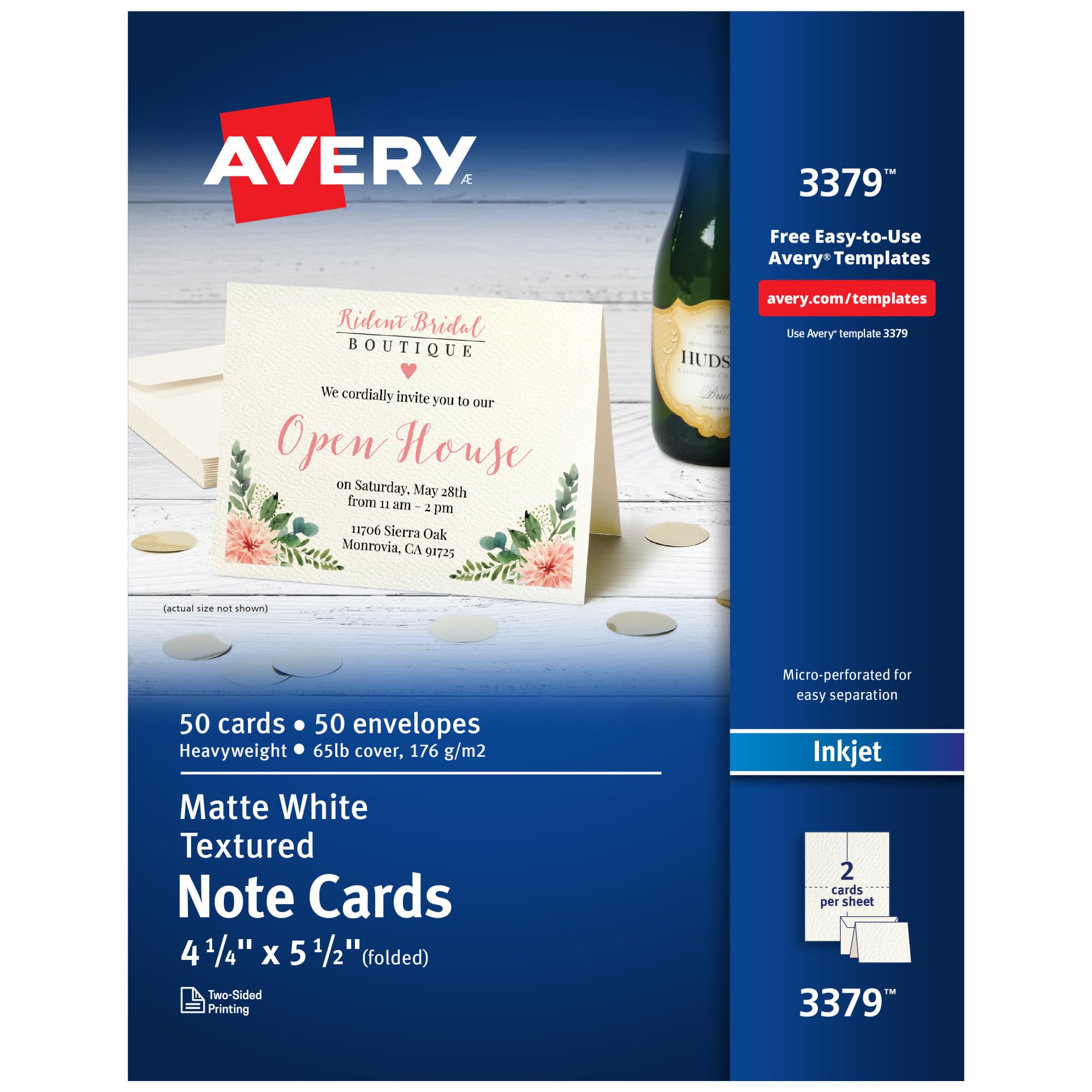
Feed a sheet, print a batch, snap them apart — the only set here built around your desktop printer.
Avery’s angle is that you make the cards yourself. Each sheet holds two 4.25 x 5.5 inch note cards on 65 lb / 176 gsm textured white cardstock, pre-scored so they fold neatly, with micro-perforations that let each card detach with a clean edge. The paper is engineered for inkjet printers, and Avery’s free Design & Print templates line up double-sided artwork on the inside and outside of every card. Printability is the thing people rave about most with this set — the feed is reliable and the ink doesn’t smear — which is exactly what you want when you’re running a stack through in one sitting.
If you already own an inkjet, the worked-like-it-should factor is real. Owners mention “I tried them on Canon TR7020 and it worked like it should,” and a separate reviewer notes the paper took both ink and pen without the ink bleeding through or feathering. That double duty — print a design, then hand-write a personal line on top — is what separates a printable card from a plain blank one. Smaller than the Better Office Products 4 x 6 card, the Avery’s 4.25 x 5.5 face still leaves room for a short printed greeting plus a handwritten sign-off.
The honest limits are specific. This is inkjet-only stock, so don’t expect it to perform in a laser printer. The texture divides opinion — some love the tactile finish, others find it only lightly textured — and the 65 lb sheet is lighter than the 90 lb of the Better Office Products set, so very wet markers can show through. If your printer settings are wrong, results suffer, which is a real learning curve for a first bulk print job.
The subtle edge it holds: Nothing else here lets you design a card, print a run of them from your desk, and then sign each one by hand. If personalization is the point, this is the only tool in the lineup that plays in both modes.
Feed it right: Set your printer for cardstock weight and textured media before the first sheet, and the perforations tear clean with no ragged edge left on the card.
Lands best with: small-business owners branding their thank-yous, crafters with an inkjet, and anyone who wants custom artwork without ordering a print run.
Think twice if: you own a laser printer, or you’d rather pull a finished card straight from a box instead of managing print jobs.
4. Home Advantage 5×8 Blank Index Cards, 50 Pack

The jumbo card you can hold up to the light and still not see your own writing through.
This is the set for people whose note cards pull double duty as study tools, recipe cards, or place cards. Each of the 50 unruled white cards measures 5 x 8 inches on 14PT thick printable cardstock — that thickness is the headline spec, and it’s the direct reason marauding Sharpie ink stops at the surface instead of ghosting through to the back. On a list where the others run 65 lb and 90 lb, this is the sheet you can feel is different the second you pick it up, and the crisp white color keeps handwriting legible from across a desk.
The extra real estate changes what you can do. At 5 x 8 inches these cards comfortably hold a recipe, a full agenda item, or a study card with room to spare, and they work vertically or horizontally when you sort them on a table. Owners find they’re thicker than typical index cards — closer to card stock than the flimsy pads you’d grab at a discount store — and the sturdy build handles a thumb-pressed “snap” without buckling. A buyer sums up the reliability well: they print beautifully for wedding invitations, and Sharpies and markers don’t bleed through.
The one trade is what you give up for that thickness: no envelopes come in the box, so if you plan to mail these you’ll need to buy them separately. They’re also unruled, meaning no faint guide line down either card, which suits freeform note-takers but offers nothing for someone who writes in crooked rows. And 5 x 8 is a big card — it won’t slide into a standard mailing envelope without an upgrade, so think tabletop tool before you think letter.
What these are actually for: Research notes, flashcards, recipe cards, place cards, and wedding signage. Any job where paper flimsiness would ruin the result, these handle. The unruled surface stays out of your way and the thick sheet takes printed designs as cleanly as it takes thick markers.
The companion purchase: Budget for envelopes separately if this is going in the mail. The cards themselves are stout enough that a cheaper envelope would be the weak link anyway.
Suits writers who: want the thickest sheet on the list and a big surface for recipes, study cards, or tabletop notes.
Not the set for you if: you need envelopes in the box and standard mail-ready sizing for a card you’ll tuck into a standard envelope.
5. Graphique Mint and Gold Flat Notes, Note Card Stationery

A desk-worthy box of mint and gold notes — the set you leave out because it looks good sitting there.
If the point of a note card is to make the recipient feel the effort, this set does the heavy lifting before you write a word. The simple flat card carries a mint border with gold embossed accents, and the 50 note cards come nested in a decorative storage box you can leave on a desk to keep the whole aesthetic tidy. Each card pairs with a matching envelope, and the presentation is finished enough that people treat the box itself as a gift. Appearance is the runaway strength on this set, clearly ahead of every other factor owners bring up.
Fortunately the paper backs up the looks. These are printed on durable, heavyweight cardstock — heavier than the Avery sheets and proudly built to survive a shelf or a shadowbox — so a hand-written note won’t crease or fade into a flimsy scrap. The 3.5 x 5.5 inch size suits quick thank-yous and short hellos, and the flat design means there’s no fold line interrupting a longer message. Buyers also love the colors, noting the mint and gold against kraft and cream tones make the set feel more expensive than its price.
The one limitation is the writing surface itself. At 3.5 x 5.5 inches, these are the smallest cards on the list, so you’re limited to a few sentences. And like most fine stationery, the paper is beautiful rather than indestructible — sharp pens and heavy presses can leave marks, so it’s better suited to careful handwriting than to marker doodling or thick gel ink. Keep it for the notes you want remembered, not the ones you dash off in a hurry.
Won the look test: If you’ve ever pulled a gorgeous card from a drawer and felt a little lift before you even opened it, this is that feeling. The mint-and-gold aesthetic, the embossed accents, and the display box all push it toward gifting and desk display rather than bulk mailing.
A meaningful small difference: The decorative box is a real functional win, not just packaging. It keeps 50 cards dust-free and reachable, so the set stays in rotation instead of getting shoved into a drawer the way loose card packs often do.
Reach for this if: you send notes as a gesture and want the stationery to carry part of the message — thank-yous, condolence notes, and gifts especially.
Consider something bigger if: you write long letters or need the writing room that 5-inch-plus cards give you.
Know the Specs
Cardstock Weight (lb / gsm)
Weight tells you how dense and heavy the paper is. A 65 lb sheet feels like thin card; a 90 lb or 14PT sheet feels like a proper card you can hold without it flopping. Heavier stock resists bleed-through from markers and fountain pens, keeps edges crisp in the mail, and holds up to handling. If you write with anything wetter than a ballpoint, the lb number is the one that decides whether ink shows through. The trade-off is that heavier sheets can be tougher to feed through a printer and cost a little more at the same card count.
Card Size and Layout
Flat note cards typically run from about 3.5 x 5.5 inches up to 5 x 8 inches. Bigger cards give you more lines for a letter or recipe; smaller cards keep notes short and make a neat, tidy impression. Size also decides which envelopes fit and whether the card slips easily into a standard mailing envelope. Folded cards have a score line; flat cards stay one continuous sheet. Match the size to how much you actually write — buying bigger cards than you need just wastes paper.
Surface Finish
Smooth, uncoated paper is best for handwriting — pens glide and ink dries fast. Textured stock gives a premium, tactile feel but can make fine pen strokes wobble and needs a printer set to the right media type. Glossy or coated finishes look sharp but resist some pens. If you print your own designs, an inkjet-tune surface is what keeps colors vivid and stops smearing. If you write by hand, smooth and uncoated is the safe pick every time.
Envelopes and Packaging
Look at whether envelopes are included and how heavy the envelope paper is. Thin envelopes can bend in transit and make a good card feel cheap; heftier ones protect the card and feel finished in the hand. A sturdy storage box matters more than it sounds — it keeps the whole set flat and usable instead of scattered across a drawer. Matching envelope colors are a nice touch for themed stationery. Always check the included count so you don’t run out of envelopes before you run out of cards.
Common Questions
Will these note cards bleed through if I use a marker or fountain pen?
Can I print my own designs on blank note cards?
What does “65 lb” or “90 lb” cardstock actually mean for a buyer?
Do blank note cards come with envelopes, or do I buy them separately?
What card size is easiest to write on for a thank-you note?
Are the note cards blank inside or pre-printed with a message?
How many note cards should I buy for a year of handwriting?
Can I use heavyweight cardstock in a home inkjet printer?
What is the difference between a flat note card and a folded greeting card?
The Bottom Line
The strongest all-around pick for most people is the Better Office Products 50-Pack All Occasion Greeting Cards Box Set because its 90 lb cardstock, 4 x 6 inch surface, and included envelopes cover everyday notes without a single weak link. If you write more than a handful a month and want color choices, the American Greetings 100-Count All-Occasion Blank Note Cards double the count in a smarter palette. For printing your own designs, the Avery Textured Cardstock Note Cards are the only set here built for a desktop printer. And if you simply want stationery that looks beautiful on a desk, the Graphique Mint and Gold Flat Notes earn their place in the drawer. Pick the one that matches how you actually send notes — that’s the set you’ll finish instead of leaving half the box behind.
How we choose
We do not accept paid placement. Every pick is matched to a real buyer and a real use-case; we do not hands-on test units.
Sources
Specifications: manufacturer listings and product documentation. Review insights: verified customer reviews, as of October 2026. Pricing: not shown on this page (it changes often); check the current price via the retailer link.
As an Amazon Associate, Aappliancez earns from qualifying purchases. This does not affect which products we feature.