Disclosure: Some links in this post are affiliate links. As an Amazon Associate I earn from qualifying purchases, at no extra cost to you. Learn more
Specs are compiled from manufacturer listings and verified buyer reviews and can change over time — please confirm the key details on the product page before buying.
If you want to know how you slept without strapping a ring, band, or watch to your body, the answer is a pad or probe that stays off your skin and records from the mattress or your breathing instead. That single design choice is what a non-wearable sleep tracker delivers. It also matters for a second, quieter reason: the same kind of sensor is what lets a caregiver know the moment a parent with dementia sits up in bed, long before a fall.
This guide is built by comparing the manufacturers’ published specifications and the patterns across verified customer reviews, so you get each pick’s real strengths and trade-offs instead of marketing spin.
The nine options below cover both jobs — bedtime self-tracking and bed-exit alerting — sorted by what they actually do best rather than by badge or brand. if you want a sleep score or a bed-exit alert for a loved one, these nine non-wearable sleep tracker picks are ranked by pager range, sensor type, and battery. The family favourite gets top billing: 4.5+ stars across 200+ ratings and a pager that carries every alert to you wirelessly.
Top Picks


How To Choose A Non-Wearable Sleep Tracker
There are really two different jobs hiding under one label. The first is learning about your own sleep — stages, breathing, snoring, how often you wake. The second is knowing the instant someone else moves, so a person who is unsteady on their feet never gets up alone. Figure out which job you have first, because a pad that scores your sleep and a pad that yells at your pager are built for very different nights.
Movement or breathing — what the sensor actually reads
A movement sensor counts micro-motions through the mattress, so it can tell you the crib went still and fire an alarm. A breathing sensor watches airflow at the nose, which is what a respiratory report needs. One is a presence detector. The other is a flow meter. Buying the wrong one leaves you staring at data that answers a question you never asked.
Where the sensor sits changes everything too. A pad under the mattress has to sense through whatever thickness you pile on top, so a thick memory foam topper can soften the reading. An under-mattress pad you cannot see or feel is also the only style a resistant sleeper cannot pull off.
How far the alert has to travel
If your job is caregiving, the number to check is the pager range — how far the signal reaches from the pad to the unit you carry. A pager in your pocket keeps you reachable while you load the dishwasher, and a vibration-only setting keeps the house quiet at night. Range in feet is the spec that decides whether the system works in a two-storey home or only the next room.
Battery, install, and what you will not get
Some pads run for years on a coin cell you cannot change, and others ride a rechargeable that needs topping up every few nights. Ask whether batteries are included and whether they are replaceable, because a pad sealed under a mattress is hard to service. And be honest about the ceiling: a non-wearable pad estimates sleep rather than reading brain waves, so treat the stages and scores as a trend to watch, not a lab result.
Side-by-Side Comparison
| Model | Best For | Type | Range or Install | Battery | Amazon |
|---|---|---|---|---|---|
| Lunderg Wireless Bed Alarm★ Best Overall | Caregivers who need every bed-exit alert | Wireless bedside sensor pad | 300 ft pager | Alkaline, included | Amazon |
| Babysense True Sleep HDBest for New Parents | Nursery with two jobs to cover | Video monitor + under-mattress movement | 2 sensor pads, no WiFi | Alkaline, included | Amazon |
| Withings SleepMost Insightful Data | Grown-up sleep and heart tracking | Under-mattress pneumatic pad | Under the mattress, WiFi sync | Mains powered | Amazon |
| Lunderg Under Mattress Alarm | Loved ones who refuse visible monitors | Hidden under-mattress pad | 300 ft pager, fits under mattresses 13 in or less | Pad battery not replaceable | Amazon |
| Withings Scanwatch Nova | Wrist-style health tracking with long battery | Hybrid smartwatch | Works with iOS and Android | Up to 30 days | Amazon |
| Garmin Index Sleep Monitor | Garmin owners avoiding a night watch | Upper-arm sleep band | L-XL band size listed | Up to 7 nights | Amazon |
| Cubo Ai Sleep Sensor Pad | Existing Cubo Ai camera owners | 4-sensor under-mattress pad | Pairs with Cubo Ai Plus monitor | No built-in battery | Amazon |
| EMAY Sleep Breathing Monitor | Nasal breathing and snoring records | Nasal airflow probe | Bluetooth to phone app | Rechargeable | Amazon |
| Babysense 7 | Simple under-crib movement alarm | 2 under-mattress sensor pads | 2 sensor pads, no WiFi | 24 hours | Amazon |
Detailed Reviews
1. Lunderg Wireless Bed Alarm System for Elderly
Our pick — 4.5+★ from 250+ verified ratings; the strongest balance of quality and price.
A pad that knows when your loved one sits up, and a pager that tells you across the house.
Start with the one number a caregiver actually feels: a pager range of up to 300 feet, which the listing also describes as a 400 ft reach in places. That means you can be in the kitchen or the laundry room and still catch the moment a parent swings their legs out of bed. The signal travels wirelessly to the handheld unit you carry, so there is no cord running down the hallway and nothing beeping in the room where they sleep. That last part is the whole design idea here — an in-room alarm can frighten or agitate someone with dementia, so this keeps the noise away from them and puts it in your pocket instead.
The sensor pad is a 10 by 30 inch mat you lay on the mattress, and it comes with anti-slip stickers to hold it in place. The pad surface is incontinence-resistant and wipes clean, and the interior is soft foam. Volume on the pager is adjustable from high to low, or you can switch to vibration only — loud enough to wake a deep sleeper, or silent enough not to wake the rest of the house. All batteries are included, and the whole system is FSA/HSA eligible.
What wins people over is how reliably it does its one job — the whole point of a bed alarm is to work every time, and that is the part that lands. The honest catch, and the one worth understanding before you buy, is timing. The alert fires only once your loved one is already standing or has rolled off the bed. One caregiver described a mother who fell before anyone could reach her. If you need warning the moment someone sits up rather than after they are on their feet, the Lunderg Under Mattress Alarm below is built for exactly that. A few folks also want a separate volume button, since the controls sit close together.
What earns it first place
- Up to 300 feet of pager range keeps you reachable anywhere in the house
- High-to-low volume plus a vibration-only setting for a quiet house
- Anti-slip stickers attack the main cause of false alarms
- Incontinence-resistant surface wipes clean; batteries included
Where it needs a second look
- Alerts after the person is up, so it is not an early-warning pad
- Buttons sit close, and a separate volume control would be clearer
- The pad is not the 15-month sensor the under-mattress version uses
Reach for this if: you are watching a parent or partner who gets up unsteadily and you want the alert to follow you room to room.
Look elsewhere if: you need the warning before they leave the bed — the under-mattress Lunderg is the early-alert sibling.
2. Babysense True Sleep HD Baby Monitor
Two monitors in one box: a 5-inch HD camera to see your baby, and under-mattress pads to feel them move.
This is the pick that solves two jobs at once. You get a 5 inch HD video monitor with a pan-tilt-zoom camera and night light, plus the Babysense 7 movement system with two non-contact sensor pads that slip under the mattress. The camera runs on a secure connection that does not need WiFi, so there is no app login and no hacker window into your nursery. The pads watch micro-movements through the mattress without ever touching your baby, and they cover the whole crib area. For a nursery you want to see and sense at the same time, this bundle covers both without buying two separate systems.
Picture quality is the star of the show — owners praise the clarity of the day and night video above almost everything else, with the pan and tilt letting you sweep the whole room from the parent unit. The screen has been tuned for night use, and there is an adjustable night light plus lullabies and white noise you can trigger remotely. Connection is the other half of the story. Setup is quick, and several long-term buyers report travel use in bags and slumber pods with none failing over years. The clear picture and the no-drop range are why people keep coming back to Babysense.
The trade-off is that this is a bundle, and bundles live or die on both halves. A few owners hit a camera that stopped pairing or a screen that blurred after months of use, and the monitor’s own battery is on the short side — it is meant to run on mains power at the bedside. None of that is common, and the customer service behind it is quick to send a replacement when it happens. If you only need the movement alarm and not the video, the Babysense 7 lower down does the same sensing for less hardware.
Built for the nursery: a 5 inch HD camera plus two under-mattress pads, a no-WiFi connection, and a movement alarm that fires if the crib goes still — the full picture-and-presence package in one box.
Take this one if: you want to watch and sense the crib from one parent unit and would rather skip WiFi on principle.
Consider the simpler pad if: video is not part of your plan and the movement alarm alone is enough.
3. Withings Sleep Under-Mattress Tracking Pad
Slides under the mattress and reads your heart, your snoring, and how deep your sleep actually went.
Sleep goes beneath the mattress and works on a pneumatic sensor — a pad that feels the tiny pressure waves your heartbeat sends through the bed. That means no strap, no ring, and nothing to charge every night. It records sleep stages, snoring episodes, and heart rate, and it sends everything over WiFi straight to Withings, so your night is captured even if your phone is off or the app is closed. For someone who wants a full picture of their own sleep without wearing anything, this is the most complete non-contact option here.
Install is the easy part. Owners consistently describe the under-mattress setup as straightforward, with a clear morning breakdown waiting for you in the app. The placement is the one thing to get right — centered under the sternum, roughly seven inches from the bed edge, is where tracking turns consistent. Get that right and you have nightly data without lifting a finger. It also pairs with a Withings scale and blood pressure monitor if you already live in that ecosystem.
Here is the honest ceiling. The stages are an estimate, not a brain-wave reading, so lying in bed watching TV can register as light sleep. A privacy-minded buyer may want to know the snoring microphone listens all night and the listing offers no obvious on-off switch for it. And the US version leaves out the sleep apnea detection that the European model carries. One owner summed up the reliability side well after a couple of years of steady use — the trend lines track real life even when the absolute numbers wander. That makes it a habit tool first and a medical readout never.
Why it holds a top slot
- Pneumatic sensor reads heart rate and snoring without any device on your body
- Works over WiFi with no phone or app needed to capture the night
- Tracks sleep stages, interruptions, and snoring in one pad
- Pairs with Withings scale and blood pressure monitor
What to know before you slide it under
- Sleep stages are estimated, so still time can count as light sleep
- The snoring microphone listens all night with no clear off switch
- US model skips the apnea detection the EU version has
Best fit: the self-tracker who wants nightly heart, snoring, and stage data and never wants to clip anything on.
Think twice: if you need sleep apnea detection specifically — look to a dedicated respiratory monitor instead.
4. Lunderg Under Mattress Bed Alarm for Elderly

It warns you before your loved one is on their feet, and hides where they cannot refuse it.
The defining trick here is what Lunderg calls PreRise early-alert technology. The pad sits under the mattress and fires a signal to your pager at the moment someone begins to sit up — before their feet touch the floor, when the real fall risk hits. That is the difference between reaching them in time and arriving after the fact. It is also invisible: no crinkle, no wire, nothing at the bedside, nothing to push away. For a dementia patient who pulls off anything they can see, that invisibility is the whole reason the system works.
The pad measures 30 by 10 inches and fits under mattresses 13 inches thick or less — measure your mattress depth first, since a thick topper can dull the reading. The pager has the full adjustment suite: hand-held, up to 300 feet of range, high-to-low volume plus a vibration-only mode, a clip and a wall mount. The sensor pad is rated for 15 months, and because it is sealed you cannot swap the battery when it dies. All batteries are included, and it is FSA/HSA eligible like its sibling.
What people talk about is how the early warning changes their nights — the pager chirps softly while the patient sleeps through it, and you get to the room in time. The quiet caveats are worth a look. Under a very thick mattress the pad can sometimes alert only after the person is standing, so the 13-inch depth limit is real. A bright LED on the pager can be taped over if it bothers the sleeper, and the thin vinyl cover over the pad is the part to treat gently. A few would also like a replaceable pad battery given the 15-month life.
The early-warning win: alerts before feet hit the floor, not after — the single most useful difference for a fall-prone loved one who cannot wear or see a monitor.
The install check: measure your mattress first. Fits 13 inches or less, and a thick topper is the one thing that can soften the read.
Made for: the stubborn parent who refuses visible monitors and the caregiver who needs a head start on the fall.
Pair it with caution: a very deep mattress, since the early warning can slip to after-the-fact under thick padding.
5. Withings Scanwatch Nova

A steel watch that tracks your sleep and breathing all night, then runs up to a month on one charge.
This is the wrist-based option, and it earns a spot because it also reads your breathing. On-demand SpO2 (your blood oxygen level) plus overnight tracking for breathing disturbances means the Nova covers the respiratory side of a sleep tracker, not just the hours and stages. You also get overnight heart rate variability, 24/7 temperature tracking via the TempTech24/7 module, and a Sleep Quality Score in the app. The sleep report breaks out time in light and deep sleep, interruptions, and regularity. It is a true hybrid: real hands on the dial, stainless steel case, and a screen that blends in.
Battery is the headline. The Nova is rated for 30 days per charge — though several owners say real use lands closer to four or five days with regular health syncing, so treat the month as a best case. It charges in about two hours and works with iPhone and Android alike. If you value a traditional-looking watch over a slab on your wrist, this is the style pick. The build gets high marks for looks, and the stainless steel band and case read as a proper watch rather than a gadget.
The honest question is why pay hybrid-watch money for a non-wearable sleep tracker article. Because the wrists know: some people want the sleep data without a plastic band, and the Nova is the most elegant way to get respiratory and sleep metrics on your body. The catch is the software. For a hybrid that is excellent at looks and decent at data, that is the trade.
Where it shines
- Overnight SpO2 and breathing disturbance tracking alongside sleep stages
- Up to 30 days of battery, two-hour charge, iOS and Android
- Stainless steel case and real hands for a watch that does not look like a gadget
- TempTech24/7 temperature and overnight heart rate variability
Where it stumbles
- Real-world battery lands nearer four or five days for some owners
- No on-watch alarm; it is set through a clunky app wheel
- Buggy, limited companion app and a non-replaceable battery
Pick it for: a watch-first sleeper who wants breathing and sleep metrics on a handsome hybrid and hates charging nightly.
Skip the watch route if: the whole point for you is nothing on your skin — go for the Withings Sleep pad or a probe instead.
6. Garmin Index Sleep Monitor

For the Garmin owner who refuses to wear a watch to bed but still wants the full sleep breakdown.
The Index is a soft band that wraps your upper arm instead of your wrist, and that shift is the point. It weighs 14.2 grams and sits on nylon, so it is light enough to forget by morning. It tracks a sleep score, sleep stages, heart rate variability, and rest duration, and it syncs to the Garmin Connect app whether or not you wear a Garmin watch during the day. Battery is rated for up to 7 nights per charge. For the committed Garmin user, it slots straight into the ecosystem you already use.
What people love is the comfort — the band disappears on your arm, and there is no bright screen to wake your partner. A smart wake alarm gently vibrates to rouse you at the right point in your cycle. The breathing variations feature uses Pulse Ox to check your level of variation while you sleep, and Garmin is careful to call this an estimation, not a medical device. There is also skin-temperature tracking and women’s health support for cycle insight. If you already trust Garmin’s data, this is the least intrusive way to keep collecting it overnight.
Now the part that keeps this from being higher on the list. The wireless connection between the band and the app is the recurring sore spot — sync can stall, and a morning report can come up short on sleep data unless you force a sync through Garmin Connect. That is a real frustration for anyone who relies on the numbers. On comfort and approach, the Index is a strong pick; on getting every night to upload on its own, it is the weak link in this lineup. Buy it for the fit and the ecosystem, not for flawless automation.
The comfort story: 14.2 grams of breathable band on the upper arm, up to 7 nights of battery, and a smart wake vibration — the least obtrusive way to keep Garmin sleep data flowing.
The sync question: if you need hands-off mornings, budget for a manual nudge now and then when the band and app do not talk on their own.
Good match: an existing Garmin user who wants overnight stages and HRV without a watch digging into the wrist.
Less ideal: if you want set-and-forget uploads — the sync step can need a manual push.
7. Cubo Ai Sleep Sensor Pad
Four sensors under the mattress, paired with a camera, so a still baby triggers a check-in.
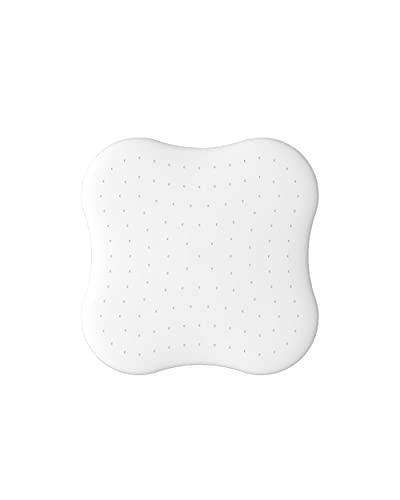
This pad only makes sense if you already own the Cubo Ai smart baby monitor — it does not stand alone. Given that, it adds real coverage: four motion sensors under the mattress pick up your baby’s micro-movements, and Cubo says the coverage is four times wider than similar pads. Install is a one-time job — lift the mattress, lay the pad on the slats, put the mattress back. Nobody sees it, nobody feels it. The clever part is the AI mode: the camera confirms the baby is in the crib, and if the pad senses no micro-motion, you get an alert. Camera and sensor check each other, which cuts down on the panic of a solo sensor.
For stomach-sleeping babies past the four-month mark, the reassurance is the draw — apps let you glance at the live motion feed without walking into the nursery. Parents who hate clipping anything to a newborn like that there is zero skin contact. The pad lasts weeks between battery changes, and the app shows the remaining level so you are not guessing.
The breathing side is where you should keep expectations in check. The pad reports micro-motions per minute, not a breathing rate, so it can flag motion without telling you anything clinical about breathing. Some owners see repeated “no breathing motion” pop-ups even when the baby is visibly breathing on camera, which leads to needless checking. That is a fit issue for the very anxious, not a defect — the sensor is doing what it was built to do, and a still baby is exactly what it is designed to catch. But if you want to read a breath count, a dedicated breathing monitor does that job better.
The case for it
- Four sensors with coverage 4 times wider than similar pads
- Camera AI and pad check each other to reduce false alarms
- Zero skin contact, one-time install under the mattress
- Long stretch between battery changes with app-level readout
The case against
- Requires an existing Cubo Ai monitor, so it is not a standalone fix
- Reports micro-motions, not an actual breathing rate
- Repeated “no breathing motion” pop-ups frustrate anxious parents
The right home: an existing Cubo Ai household that wants under-mattress motion checking layered on top of the camera.
Not the fix if: you are starting from scratch — the pad needs the camera, and a breathing monitor is the tool for actual breath data.
8. EMAY Sleep Breathing Monitor
A tiny probe that watches your nose all night and turns your breathing into a report.
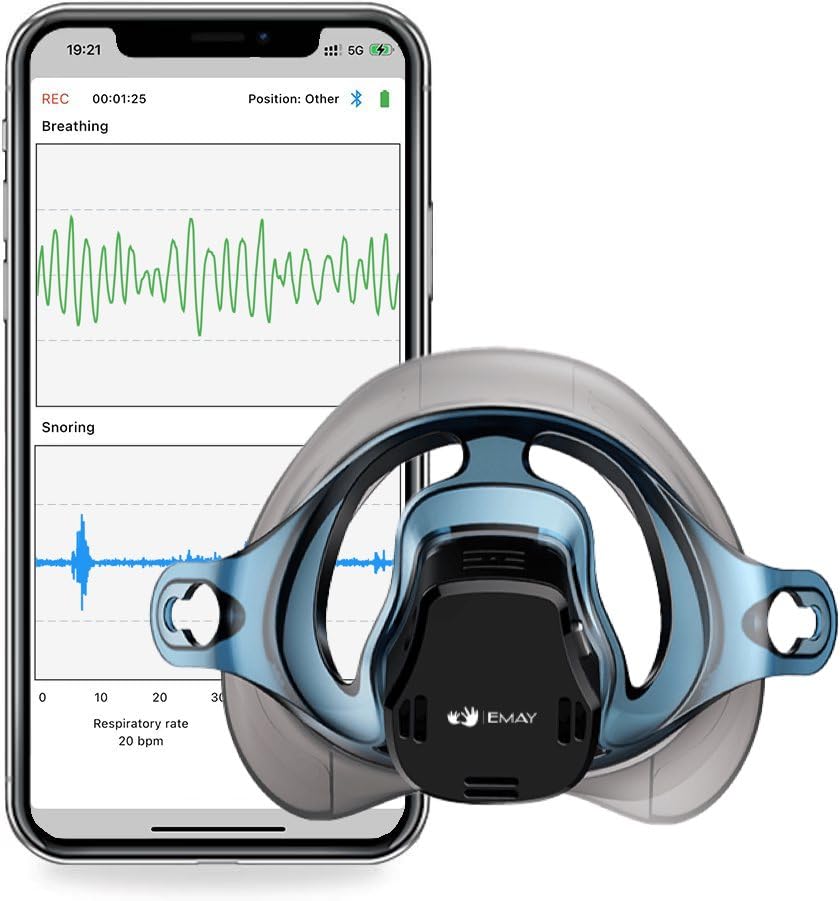
EMAY takes the opposite approach to a mattress pad: it reads airflow directly. Three sensors sit in a nasal probe that measures, records, and analyzes how you breathe, and the companion app turns that into a respiratory report with flow, apnea events, and snoring. It starts recording as soon as you put it on, so there is no countdown to set. The probe weighs just 10 grams and is made of food-grade silicone with three sizes of high-elastic straps. Bluetooth handles the link to your phone, and the whole thing is small enough to travel with.
What people find helpful is the report itself — it breaks down apnea and hypopnea events, detects sleep position, and saves the data so you can show a doctor a multi-night trend instead of a single snapshot. Setup through the EMAY Breathe app is quick, with pairing that connects right away and a full charge from the start. And because it records immediately rather than requiring a full six-hour study, it works even for a short nap. That flexibility is rare in a home breathing device.
The build is where you should slow down. The plastic mount that holds the electronics to the mask is the weak point — one owner had the small plastic ridges snap while plugging the charging cable in, after only a handful of uses. Treat the charge port gently and the price-to-data value holds up. Two more limits are built in: it is designed for nasal breathing, so a mouth breather will not get a clean read, and it cannot be used with a CPAP mask at the same time. It also records breathing data only and is not a breathing aid.
What it delivers: continuous nasal airflow, apnea and hypopnea breakdown, snoring, sleep position, and a report you can hand to your doctor — all from a 10-gram silicone probe.
What to watch: the plastic mount around the charge port is the fragile spot, and it is not for mouth breathers or CPAP users.
Choose it if: you want breathing and snoring data to bring to a doctor and you sleep through your nose.
Look past it if: you mouth-breathe or use a CPAP — neither works with this probe.
9. Babysense 7 Baby Movement Monitor System
The original under-mattress movement alarm, pared down to two pads and one job.
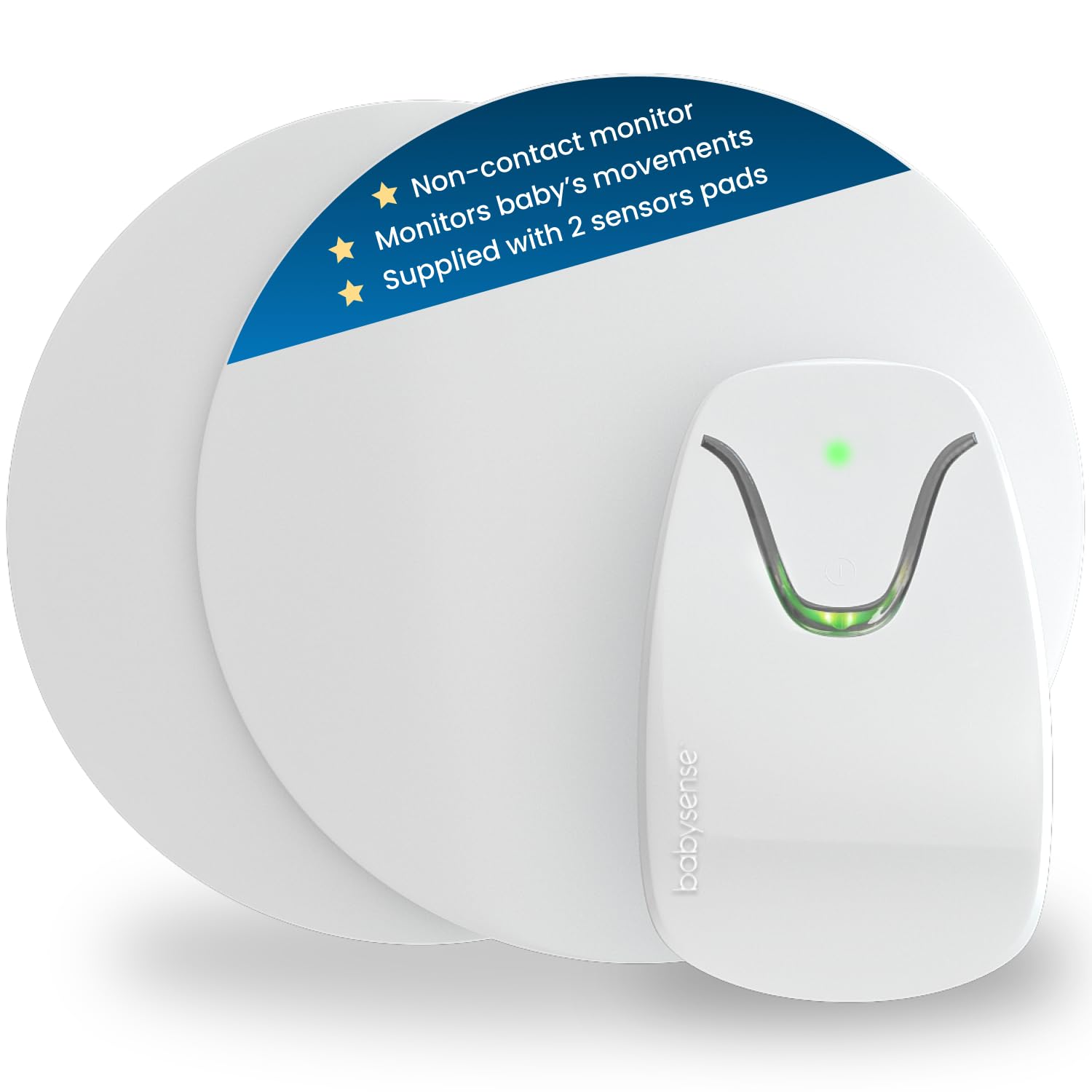
This is the simple version of the Babysense idea: two non-contact sensor pads slide under the mattress, a control unit hangs on the crib, and an alarm fires if no movement is detected within 20 seconds or if the movement slows. That is the entire feature set — no camera, no app, no WiFi. It runs on 24 hours of battery so it keeps working through a power cut. For a parent who wants the movement alarm and nothing else, the stripped-back design is the appeal.
What people value here is how well the sensing holds up through real-world layers. One owner describes a flour-sack test where the pads caught the lift and sounded the alarm, and the same owner ran it for months with no false trips despite a ceiling fan and air conditioning. The two pads cover the full crib, and the control unit can be hung on the side with the included hook. Daily testing is quick, and it works with a basic hard-base crib and a standard mattress.
The catch worth knowing before you buy is the sensitivity cutting both ways. The sensors can also pick up motion from a floor fan or footsteps near the crib, so placement and room setup matter. Memory foam mattresses are not compatible — the data says the pad will not work properly through them, so check your mattress first. A couple of owners saw a false alarm when a baby rolled between the two pads. The alarm is loud enough to wake you, which is the point, though on a very sensitive night the noise can startle you both.
Why it earns its spot
- Two pads cover the whole crib with no wearable contact
- No WiFi or app — just a control unit and an alarm
- 24 hours of battery keeps it alive through a power cut
- Works through padding in real-world conditions
The honest limits
- Memory foam mattresses will not work with the sensor pads
- Floor fans and footsteps can trip the sensitivity
- A roll between the two pads can fire a false alarm
Fits: a parent who wants the movement alarm alone, with no video and no WiFi in the mix.
Check first: your mattress — memory foam is ruled out by the manufacturer.
Know the Specs
Sensor type — movement or breathing
A movement sensor counts micro-motions through the mattress, which is what a crib alarm or bed-exit pad needs. A breathing sensor reads airflow at the nose, which is what a respiratory report needs. The two are not interchangeable, so match the sensor to your question. A pad that reports micro-motions per minute is telling you the body moved, not that the lungs are working at a measurable rate.
Range in feet
For a pager-based bed alarm, range is the spec that decides how far from the bed you can wander and still hear the alert. A 300-foot pager lets you move through the house without losing the signal. Check this before buying if the caregiver is not always in the next room.
Battery life and replaceability
Batteries are measured wildly differently across this category — hours for a crib alarm, nights for an arm band, days for a watch, and up to 15 months for a sealed sensor pad. The value of replaceability depends on where the battery lives: an under-mattress pad sealed with a non-replaceable cell is a harder service job than a pager you can open. Ask which cells are included and which can be swapped.
Installation depth and mattress fit
Under-mattress pads have a depth ceiling, and thick padding can soften the reading. One Lunderg pad is rated for mattresses 13 inches thick or less, and Babysense notes that memory foam will not work with its movement monitor. Measure your bed and read your mattress type before you commit — it is the most common reason a pad underperforms.
Common Questions
What is a non-wearable sleep tracker and how does it work without touching me?
Can a non-wearable sleep tracker detect sleep apnea?
Will an under-mattress pad work through a memory foam mattress?
How much range does a caregiver pager actually need?
Does the movement sensor or the breathing probe give better sleep data?
Do I need WiFi or a subscription for these sleep trackers?
How long do the batteries last on a non-wearable sleep tracker?
Can a bed alarm replace a caregiver for an elderly parent?
Is a hybrid watch like the Scanwatch Nova still considered non-wearable?
How accurate are the sleep stagesfrom a non-wearable tracker?
The Bottom Line
The right non-wearable sleep tracker for most caretakers is the Lunderg Wireless Bed Alarm System — a 300-foot pager that follows you through the house, anti-slip stickers that cut false alarms, and a vibration-only mode that keeps the rest of the household asleep. Every alert lands on your pager, not beside your loved one’s ear. The trade-off is timing: it fires once they are on their feet, so if you need warning the moment they sit up, the Lunderg Under Mattress Alarm is the early-alert upgrade that hides beneath the mattress where a resistant sleeper cannot refuse it.
If your night is about your own sleep rather than someone else’s, the Withings Sleep is the most complete self-tracker — a pneumatic pad under the mattress that reads heart rate and snoring over WiFi with no wearable at all. And if you want a breathing report for a doctor, reach for the EMAY Sleep Breathing Monitor and its 10-gram nasal probe. One honest nudge: the top pick carries a strong score and a deep well of ratings from real caregivers, and the pad-based sleep trackers only prove themselves night after night, so start with the one whose job matches yours.
How we choose
We do not accept paid placement. Every pick is matched to a real buyer and a real use-case; we do not hands-on test units.
Sources
Specifications: manufacturer listings and product documentation. Review insights: verified customer reviews, as of October 2026. Pricing: not shown on this page (it changes often); check the current price via the retailer link.
As an Amazon Associate, Aappliancez earns from qualifying purchases. This does not affect which products we feature.