Disclosure: Some links in this post are affiliate links. As an Amazon Associate I earn from qualifying purchases, at no extra cost to you. Learn more
Specs are compiled from manufacturer listings and verified buyer reviews and can change over time — please confirm the key details on the product page before buying.
You paid good money for those pans, and the last thing you want is a sponge that leaves a web of scratches across the coating. The picks below are all built to scrub hard without tearing up what is underneath — some stay soft in cool water and stiffen up in hot water, others rinse clean so food does not rot inside them, and a few fight the odor that turns a normal sponge into a biohazard by day four. The single most useful thing to know up front: a non-scratch sponge is judged on two things the box rarely explains clearly — whether the abrasive side is gentle enough for coated cookware, and whether the sponge can dry fast enough to keep from smelling sour.
This guide is built by comparing the manufacturers’ published specifications and the patterns across verified customer reviews, so you get each pick’s real strengths and trade-offs instead of marketing spin.
Every option here has a genuinely different job, from a dual-sided scrubbing block that softens in warm water to a compressed cellulose pack that unfolds when it gets wet. Finding the right non-scratch sponges depends on matching the abrasive surface and the drying speed to how you actually clean.
Top Picks
How To Choose The Best Non-Scratch Sponges
Non-scratch does not mean powerless. It means the abrasive part of the sponge is built so that it lifts dried food and grease without cutting into the surface underneath. Get that balance right and one sponge handles your dinner plates, your glassware, and your coated pans without you switching tools mid-wash. Get it wrong and you either ruin a pan’s finish or you spend twice as long scrubbing because the sponge is too timid to do anything.
Match the scrub surface to your cookware
The scrub side is where all the risk lives. A sponge described as safe for non-stick, glass, and painted surfaces is telling you its abrasive layer is coated or softened so it glides instead of gouges. Some scrubbers are stiff when dry and only turn pliable once they meet hot soapy water — which is a real advantage, because you get tough scrubbing on a cold countertop and a gentler touch once the water warms up. Others use a woven fiber or a cloth backing that wipes as it scrubs. If you cook on delicate coatings most nights, give real weight to what the listing says the sponge is safe to touch, and check whether the maker warns you away from anything.
Think about drying speed before you think about pack size
A sponge that stays wet stays smelly. The fastest way to kill the sour-sponge problem is to buy one that gives up its water quickly when you set it down — dense fiber holes or a fast-drying foam both help. Sponges you can throw in the dishwasher get a second life and a real deodorizing cycle, which is worth more than an extra unit in the pack. A big multi-pack only helps if each sponge survives long enough to justify the shelf space, so durability and drying speed matter more than the headline count.
Know what the material is actually doing
Kitchen sponges come in a handful of material families, and each one behaves differently in your hand. Polymer foam can be engineered to change firmness with water temperature. Compressed wood pulp starts thin as a card and swells to full thickness when wet, which is great for storage but surprising if you are not expecting it. Coated foam carries a scrubbing layer bonded to an absorbent core. Woven organic cotton gives a softer, more cloth-like clean. None of these is automatically better — the right one is simply the one whose behavior matches how you wash up.
Side-by-Side Comparison
| Model | Best For | Pack Count | Material | Scratch Safety | Amazon |
|---|---|---|---|---|---|
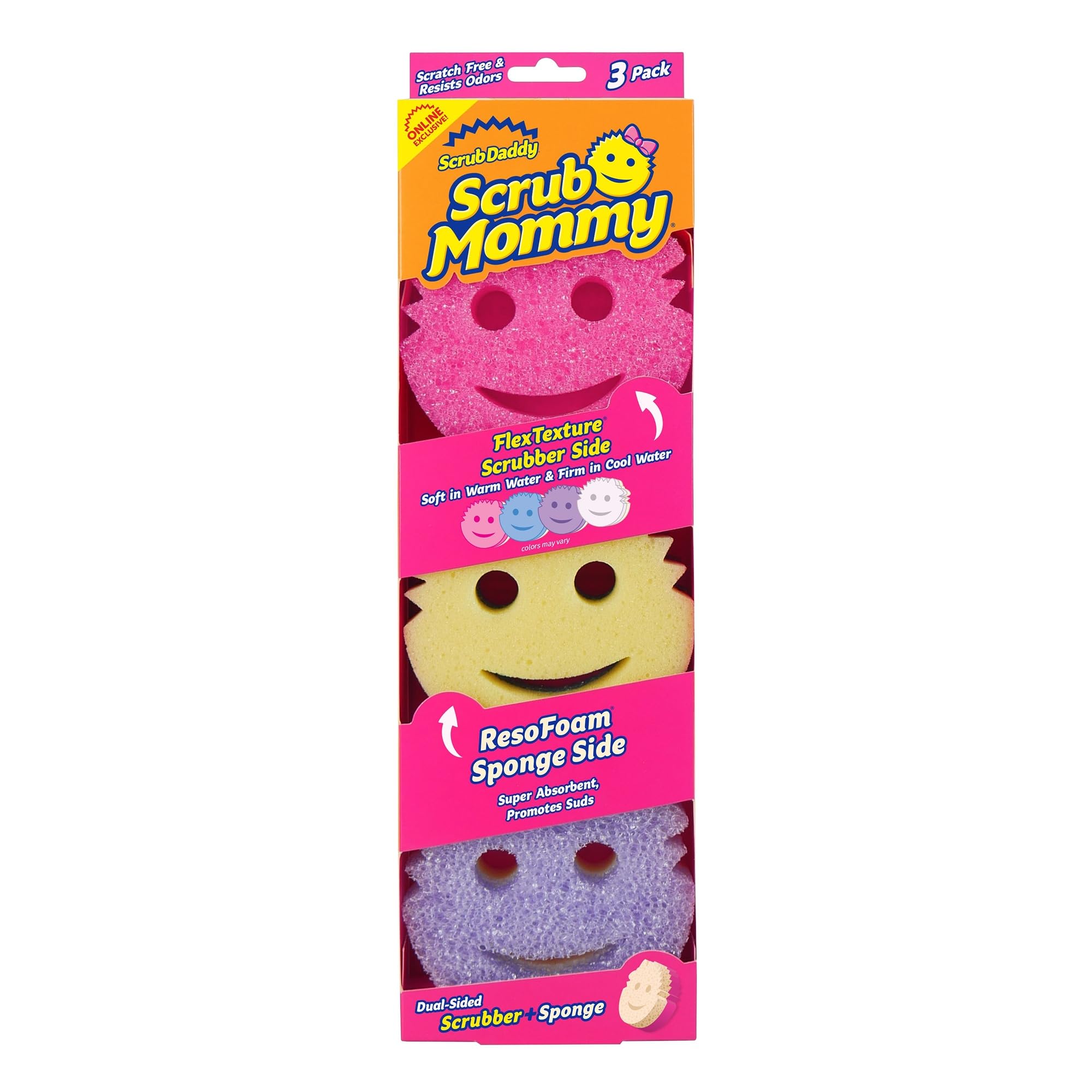
| Scrub Mommy Dual-Sided★ Best Overall | Everyday dishes and mixed surfaces | 3 count | FlexTexture foam & ResoFoam | Safe on glass, stainless, cast iron, non-stick | Amazon |
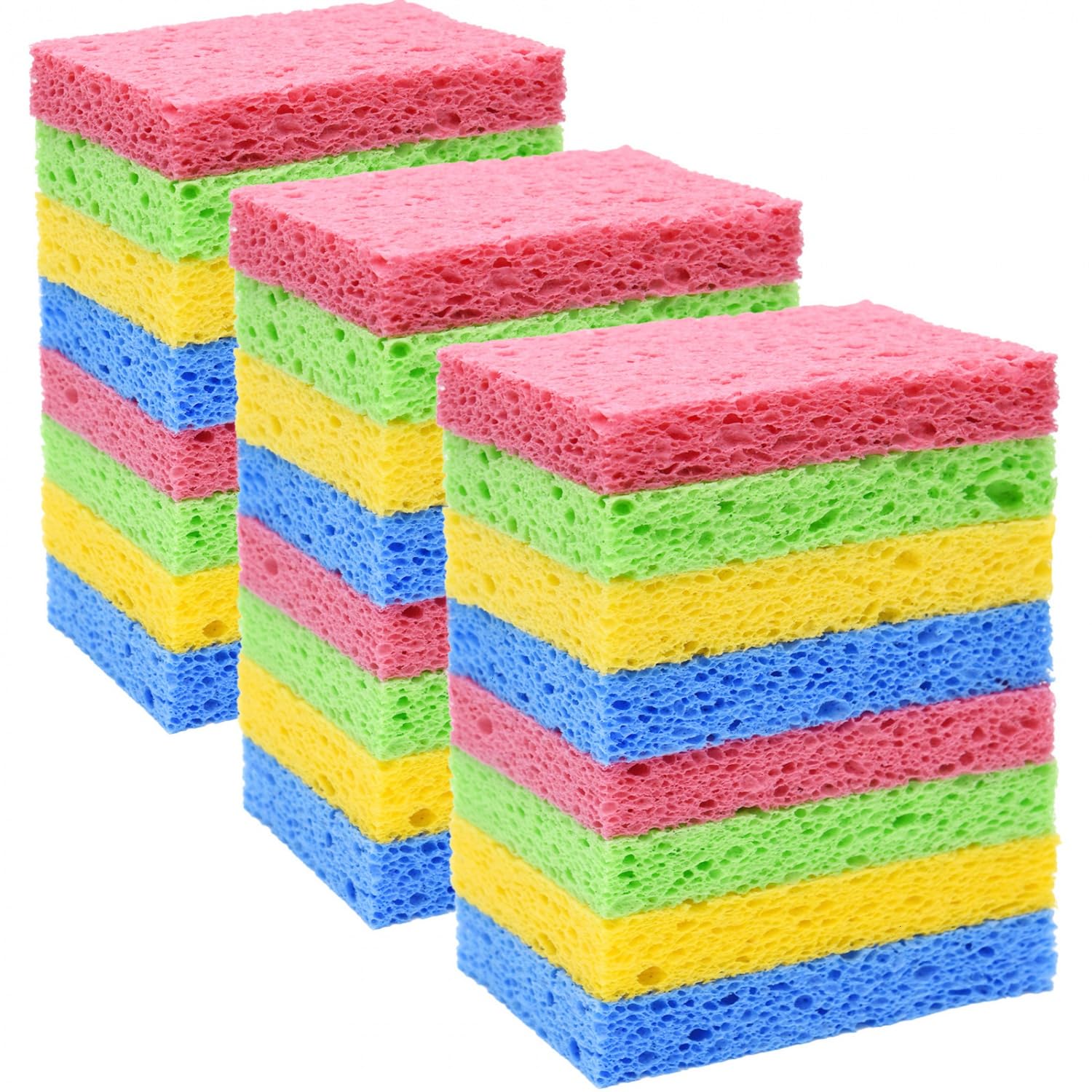
| YoleShy Compressed CelluloseBest Value | Buying in bulk and tight cabinet storage | 24 count | 100% wood pulp | Softens in water, will not scratch | Amazon |
| Elitra Essentials Scrubber | Odor control in a fresh pack of six | 6 count | Foam with acrylic grain | Coated scrub layer | Amazon |
| Scotch-Brite Clean & Rinse | Rinsing clean after sticky, cheesy messes | 8 sponges (4 packs of 2) | Polyurethane or melamine | Non-scratch scrub pad | Amazon |
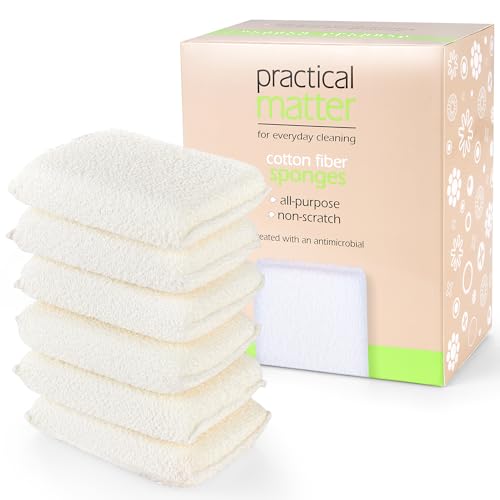
| Practical Matter Organic Cotton | Soft, cloth-like cleaning on delicate items | 6 count | Organic cotton fiber | Soft, scratch-free | Amazon |
Detailed Reviews
1. Scrub Mommy Kitchen Sponges (3 Count)
Our pick — over 4.5★ from 34,000+ verified ratings; the strongest balance of quality and price.
The sponge that turns soft and gentle the moment your water warms up.
If you wash a mix of delicate glassware and stubborn pans in the same sink, this is the one the crowd keeps coming back to — 4.8 stars across 34,000+ owners, and the quality of the foam is what wins people over more than anything else. The trick is in the two-part build. Her FlexTexture foam side stays soft in warm water and firm in cool, so you can lean into a cold, greasy pan and still treat a warm-wet wine glass gently. The spongy ResoFoam on the back lathers up suds for wiping spills rather than scrubbing them.
The scratch safety here is broad. The listing names glass, stainless steel, cast iron, non-stick, copper, chrome, and leather as surfaces it will not ruin, and at 2.08 ounces it has real heft in the hand — noticeably chunkier than the featherweight compressed sponges further down this list. Buyers report it holds up for the long haul: “Love these scrub sponges. They last a long time. Can throw them in top rack of dishwasher as well.” That dishwasher line matters, because it means you get a real deodorizing cycle out of it rather than just rinsing and hoping.
The catch to plan around is the size of the pack relative to the price. You are getting three sponges, where the YoleShy set below hands you 24 compressed ones for a similar outlay — so if you want bulk and do not care about the temperature-shifting foam, that is the smarter pick. Also worth knowing: the smiley shape and the finger grip are genuinely easier to hold than a flat rectangle, but the thick body sits a little tall in a tight sink caddy.
What works in your sink
- FlexTexture foam firms up in cool water and softens in warm, so one sponge handles both a greasy pan and a wine glass
- Built to resist odor and stains for up to 12 weeks with proper care, and it is dishwasher safe for a real deodorizing cycle
- Named safe on over a dozen surfaces including non-stick, copper, chrome, and leather
- The shaped body and finger grip give a firmer hold than a flat block
Where it asks you to compromise
- Three sponges per pack means you restock sooner than the 24-count compressed set below
- A thick, tall body can crowd a narrow sink sponge rack
Reach for this if: you wash a varied sink of dishes and want one sponge that adapts its bite to the water temperature instead of you switching tools.
Look elsewhere if: you want the largest number of sponges per purchase — the compressed cellulose pack is built for exactly that.
2. YoleShy 24 Pack Kitchen Sponges
Twenty-four sponges that arrive flat as cards and puff up the second water hits them.
Storage is the whole story with this set. Each sponge ships compressed into a thin card-like sheet, so the entire 24-count box tucks away in a drawer or under the sink with almost no footprint — and the fact that it is made from 100% wood pulp means it is fully biodegradable and compostable when you are finally done with it. In the water, the fibers go soft and will not scratch your cookware, and the surface is full of fiber holes so it drinks up water fast and dries fast when you set it aside.
On raw quantity, nothing else here comes close. This pack holds 24 sponges, and each one weighs 0.17 kg for the set — compare that against the Elitra six-pack at 0.06 kg and you are getting four times the units. What owners praise most about this set is the quality of the foam for the money, and one buyer, using it for a solid month in the kitchen, reported the sponge still looked new with no peeling, unlike the store-bought ones she was used to. The stated size when expanded is 4.75″ x ~3″ x ~1″ thick, which is a normal, easy-to-hold dish sponge.
Here is the honest wrinkle: thinness. The listing sells them as compact and easy to store, but buyers are split — plenty call the thickness perfect, while others say they arrive much thinner than they pictured. That confusion is real, because these show up looking like cardstock before they ever touch water. If you open the box expecting a full-size sponge, you may think you got the wrong item. It is not a defect, it is the design — but it catches first-timers off guard.
Straight from the dish rack: you get the biggest supply of sponges in this lineup by far, at 24 compressed units, and they expand to a true 4.75″ x 3″ working size once wet.
The expectation to set: they arrive paper-thin and stay thin until they get wet, and that is the single thing that throws new buyers off.
The stockpile play: ideal if you want a deep drawer of sponges, minimal storage space, and a compostable material you can feel good about throwing out.
Skip the surprise: if you want a thick, plush sponge straight out of the package, this is not that — go in knowing they start flat.
3. Elitra Essentials Scrubber Sponge, Pack of 6

Built to stay fresh between washes, so your sink does not turn into a smell.
If the sour-sponge smell is the thing that drives you nuts, this six-pack is aimed straight at that problem. The foam and the scrubber both carry built-in agents to keep each sponge fresher between sessions, and the acrylic grain coating on the top layer is what does the scrubbing — it powers through grease and grime while staying gentle on your cookware and surfaces. Fast-drying construction helps too, since a sponge that releases water quickly never sits around wet long enough to go off.
This is where the closest head-to-head in the whole lineup lives. Against the Scrub Mommy above, the Elitra gives you twice the count — six sponges versus three — and the acrylic grain layer means it can cut into baked-on food that a purely soft wiper would leave behind. What keeps people buying it is the odor control and the useful life. Owners mention getting a solid five to six weeks out of each sponge before it needs replacing, and customers note they do not collect microbes the way a cheap sponge does. One wrote simply that they do not get “that awful stinky sponge smell.”
The one limitation you need to hear before you buy is printed right on the listing: this sponge is not recommended for non-stick cookware or stainless steel appliances. So for all its anti-odor strength, it is not the pick for your coated frying pans — that job belongs to the Scrub Mommy or the compressed cellulose set, both of which are explicitly built to be safe on non-stick. Keep the Elitra for dishes, bathroom scrubbing, and general housework, and hand the delicate cookware to something gentler.
Where it earns its keep: the antimicrobial foam and acrylic scrub layer keep it fresh for weeks, which is exactly what the sink-drawer crowd wants.
The line you must not cross: it is not built for non-stick pans or stainless appliances, so keep it on everyday dishes and bathroom duty.
Suits: anyone tired of sponges that smell sour by mid-week and want a six-pack that holds up longer than the typical store brand.
Not the one for: your non-stick pans — that is the one task this sponge tells you to avoid outright.
4. Scotch-Brite Clean & Rinse Non-Scratch Scrub Sponges

The one that shrugs off melted cheese and egg under nothing but running water.
Some messes do not want to be scrubbed, they want to be rinsed away — and that is exactly where this sponge separates itself from the pack. One side is a non-scratch scrub pad, the other a soft absorbent cloth, so you scour the grease and grime, flip, and wipe the surface clean with the same tool. The clever part is the rinse: food particles do not get trapped, and even sticky things like melted cheese or egg wash off the scrubbing side under the tap. That keeps the sponge itself cleaner between uses and is a direct answer to the sour-odor problem.
It is also the easiest to keep genuinely fresh, because you can toss it in the dishwasher — and unlike the Elitra above, which warns you off non-stick and stainless, this one is explicitly safe for non-stick pans, glass, porcelain, and granite countertops. That combination of rinsing clean and being dishwasher-friendly is why it earns the premium slot. At roughly 4.5 x 2.7 inches it is a comfortable hand-held size, and the eight-sponge supply means you are rarely caught with a stale one. Buyers describe wiping down a fridge until it looks brand new and tossing these in the washer when they need freshening.
Two small things to hold in mind. The soft cloth side can be sliced by a sharp knife if you leave it in the sink with one — that is a real, repeated note worth heeding by keeping knives out of the wash pile until you are ready. And while the scrub pad is gentle on coatings, it is still a scrub pad; treat the very delicate stuff with a soft touch. Neither of these is a reason to pass it up, just the honest boundaries of how it is built.
The rinse-clean payoff: gooey food washes off instead of lodging in the fibers, so the sponge stays fresher and holds its cleaning power for weeks.
One sharp-edged caution: the cloth side can be cut by a sharp knife, so keep blades away from it in the sink.
Best for: anyone who cooks messy, sticky food and is tired of picking cheese out of a sponge’s fibers.
Worth noting: it is the priciest pick here and worth it only if the rinse-clean behavior and dishwasher cycle are things you will actually use.
5. Practical Matter Kitchen Sponge
A woven-organic-cotton sponge that cleans like cloth and refuses to fall apart.
This one feels less like a scrubber and more like a soft cloth with a scrub hidden inside. The outer layer is woven organic cotton fiber built into a textured cleaning surface, wrapped around an absorbent inner core, and it is designed to be gentle on everything from glassware to non-stick coatings. If your main worry is scratching — not scrubbing power — this is the softest-handed option in the lineup, and it is the pick people reach for when they want their dishes treated gently rather than aggressively scoured.
Durability is the real headline. Owners describe a sponge that simply does not disintegrate the way budget ones do; one went looking for a sponge that “didn’t fall apart in a short time” and said this one surpassed expectations. The slightly rough exterior handles decent scrubbing on metal and glass, while the foam interior keeps it soft on dishes. It holds water well, stays flexible, and does not go flimsy. For anyone who cooks on non-stick and glassware night after night, that balance of a non-scratching surface with real staying power is the point.
The thing to weigh honestly is the cost per sponge. This is a six-pack, and each unit carries a premium — enough that even happy owners describe it as pricey per sponge, with some finding it overpriced overall. That is a value judgment, not a defect: those same buyers often say they will rebuy anyway because they last. The material itself is the other honest note — it is organic cotton, and how you feel about a cloth-style clean versus a textured foam scrub is genuinely a matter of taste. If you want the most cloth-like, gentlest sponge and you are willing to pay more per unit for it, this is your pick.
The durable soft-clean: a woven organic cotton surface that scrubs gently and survives far longer than a cheap disposable sponge.
The cost to weigh: you pay a premium per sponge, and some owners feel the price is steep for what you get.
For the gentle handlers: perfect if you want the softest, most scratch-averse sponge and do not mind paying more per unit for the cotton build.
Think again if: budget-per-sponge is your deciding factor — the compressed bulk pack gives you far more sponges for the money.
Know the Specs
Scratch safety versus scrubbing power
The scrub side is the part that can damage a surface, and the safest ones are coated or woven so they glide instead of gouge. A sponge labeled safe for non-stick, glass, and painted surfaces has an abrasive layer built to lift grime without cutting the finish underneath. Watch for any limitation the listing states plainly — some scrubbers are explicitly not for non-stick pans or stainless appliances, and knowing that up front keeps you from learning it the hard way on your best skillet.
How fast a sponge dries
Odor is a wet-sponge problem, so drying speed is a genuine spec, not a detail. Foam that is fast-drying, fiber holes that release water, and sponges you can send through the dishwasher all reduce how long the sponge sits damp. A sponge that dries between uses stays usable far longer than one that never quite gives up its water. When you compare packs, weigh drying behavior and dishwasher compatibility as heavily as the count on the box.
Material behavior you should expect
Different materials behave differently in your hand. Polymer foam can be engineered to change firmness with water temperature. Compressed wood pulp arrives thin and swells to full size once wet. Coated foam bonds a scrub layer to an absorbent core. Woven organic cotton cleans with a softer, cloth-like touch. None of these is better in the abstract — the right one is simply the one whose behavior matches how you actually wash up.
Pack counts and how long they last
A multi-pack only saves you money if each sponge survives long enough to be worth storing. A six-pack of long-lasting sponges can outlast a larger pile of flimsy ones. So look at both the count and the expected useful life: single sponges that hold up for around five to six weeks, or sets that stay fresh for a stretch of weeks with care, change the real math. Buy the count that matches your cleaning pace, not just the biggest number on the page.
Common Questions
Will a non-scratch sponge really protect my non-stick pans?
Why does my kitchen sponge start to smell after a few days?
Do compressed cellulose sponges actually expand to full size?
How often should I replace a non-scratch sponge?
Can I put a non-scratch sponge in the dishwasher?
Is organic cotton better than foam for washing dishes?
Will the rough side of a scrub sponge scratch glassware?
How many sponges should I buy at once?
Does the scrub side soften up when it gets wet?
The Bottom Line
For most sinks, the winner among these non-scratch sponges is the Scrub Mommy 3-Pack, because its FlexTexture foam changes firmness with your water temperature and it is named safe on over a dozen surfaces, from glass to non-stick. If you want the biggest supply for the money and do not mind sponges that start flat, grab the YoleShy 24-Pack. And for keeping a sink drawer stocked with odor-fighting sponges, the Elitra Essentials 6-Pack is the one to reach for. Given how many owners keep reordering the Scrub Mommy, starting there is the low-risk move.
How we choose
We do not accept paid placement. Every pick is matched to a real buyer and a real use-case; we do not hands-on test units.
Sources
Specifications: manufacturer listings and product documentation. Review insights: verified customer reviews, as of October 2026. Pricing: not shown on this page (it changes often); check the current price via the retailer link.
As an Amazon Associate, Aappliancez earns from qualifying purchases. This does not affect which products we feature.