Disclosure: Some links in this post are affiliate links. As an Amazon Associate I earn from qualifying purchases, at no extra cost to you. Learn more
Specs are compiled from manufacturer listings and verified buyer reviews and can change over time — please confirm the key details on the product page before buying.
If you want to watch your glucose without drawing blood from your fingertip every few hours, the catch is simple: a true continuous glucose monitor still needs a doctor’s prescription in most cases. So this guide covers the next best thing — the non-prescription meters, strip kits and at-home body sensors that give you real, readable numbers you can track yourself, today, with no clinic visit.
This guide is built by comparing the manufacturers’ published specifications and the patterns across verified customer reviews, so you get each pick’s real strengths and trade-offs instead of marketing spin.
The gear here splits into two jobs: pocket meters that read your glucose and ketones in seconds, and smart scales that track the body signals behind those numbers. Both live under the umbrella of a non-prescription continuous glucose monitor lifestyle.
Top Picks

How To Choose The Best Non-Prescription Glucose Tracking Gear
Without a prescription, you are not locked into one brand or one sensor. That freedom means you have to match the tool to how you actually test. Someone checking twice a day has very different needs from someone tracking ketones on a low-carb diet.
Sample size and reaction time
Sample size is how much blood or fluid the strip needs, measured in microlitres (µL — a microlitre is one millionth of a litre, an almost invisible drop). A smaller sample is easier on your fingertip and faster to produce. Reaction time is how many seconds you wait for the reading, and a 5-second glucose test keeps the whole check under half a minute.
Measurement range and storage
Measurement range tells you the highest and lowest values the meter can read before it simply says “out of range”. For ketones, a range of 0.1 to 8.0 mmol/L covers normal daily tracking through to higher readings. Individually foil-wrapped strips tolerate room-temperature storage far better than loose ones, which matters if you keep the kit in a bag or a warm kitchen drawer.
What a scale can and cannot tell you
A body composition scale does not measure glucose. What it does is show the slow-moving signals — body fat, muscle mass, water — that shape how your body handles what you eat. Used alongside a meter, it turns one number into a trend line worth acting on.
Side-by-Side Comparison
| Model | Best For | Type | Key Reading Spec | Power / Battery | Amazon |
|---|---|---|---|---|---|
| Freestyle Comfort 16 Cell Battery★ Best Overall | Longer runtime for a portable concentrator | Rechargeable battery pack | 13,400 mAh, 16-cell | Recharges in ~6 hours | Amazon |
| HeartsCare C1 Plus KitAlso Great | Dual glucose and ketone tracking | Fingerstick meter kit | Glucose 0.5 µL / 5 sec | Alkaline battery | Amazon |
| Prodigy Test Strips | Restocking an existing Prodigy meter | Test strips (250 count) | For Autocode / Pocket / Voice meters | — | Amazon |
| CLORIS Body Composition Scale | Home body-fat and muscle tracking | 8-electrode smart scale | 58 body composition metrics | Rechargeable | Amazon |
| Withings Body Scan | Detailed segmental body analysis | Smart scale with handle | Segmental body composition, ECG | USB-C charging | Amazon |
| Withings Scanwatch Nova | All-day heart and sleep logging | Hybrid smartwatch | SpO2 and TempTech24/7 module | 30-day battery | Amazon |
Detailed Reviews
1. Freestyle Comfort 16 Cell Battery
Our pick — 4.0+★ from 100+ verified ratings; the strongest balance of quality and price.
Double the runtime of a standard battery — and double the weight to carry with it.
Some readers of this guide are managing far more than glucose, and for them a portable oxygen concentrator that keeps running all day is the real priority. This 16-cell lithium-ion pack delivers up to 16 hours at setting 1, dropping to 8 hours at setting 2 and 6 hours at setting 3, and its 13,400 mAh capacity is listed as double that of the standard 8-cell version.
The practical difference is being able to leave the house without a charger. It adds roughly 1.5 inches of height when fitted into a compatible carrier with the expansion unzipped, and it removes the need to carry the AC adapter on a full day out. A built-in LED gauge and TEST button let you check remaining charge at a glance. It recharges to full in about six hours on AC/DC or the optional desktop charger, It is FAA approved for in-flight use and rated for 300-plus charge cycles.
The one thing to plan around is weight — 2.1 lbs of battery on top of the concentrator, which is why many buyers pair it with a backpack carrier rather than a shoulder bag. Battery behaviour is the other honest variable: while most days run long, one buyer found it stopped accepting charge after a couple of months, and another got roughly six hours rather than the full rating. Treat heavy use and deep discharges as the things to watch.
Right call for: anyone running a compatible concentrator who wants more hours away from a wall socket.
Weigh it first: 2.1 lbs is a genuine load, and a six-hour day is the realistic floor at higher settings.
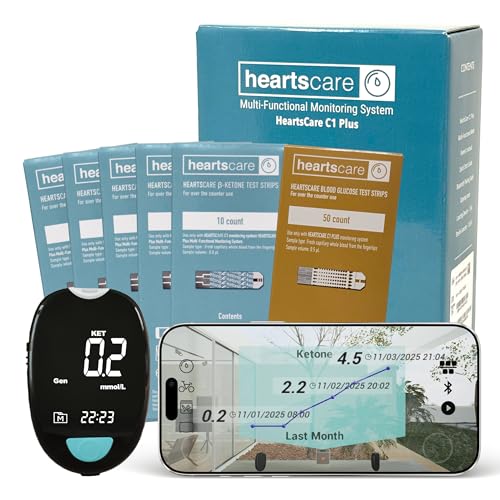
2. HeartsCare C1 Plus Glucose & Ketone Meter Testing Kit
One palm-sized meter that reads both your glucose and your ketones, no prescription needed.
If you want a single device that covers both numbers you care about, this is the one to reach for. The kit arrives with 50 glucose strips and 50 ketone strips — 100 tests in total — so you can start checking the same day it lands. That matters because most meters make you buy a second kit just to read ketones.
The glucose side is built for speed. It needs only a 0.5 µL drop of blood and returns a reading in 5 seconds, with a measurement range of 10 to 800 mg/dL. The ketone side takes a slightly bigger 0.8 µL sample and 10 seconds, and reads across 0.1 to 8.0 mmol/L. In plain terms: one quick fingerstick, one small drop, and you have your number before you have capped the pen. Each strip sits in its own foil packet too, so they hold up in room temperature between 35.6 °F and 86 °F instead of degrading in a warm drawer.
Bluetooth logging through the HeartsHome app is optional rather than required, and that is a real strength. You can test standalone and never touch your phone, or sync trends if you want a chart to show your doctor. The app setup is the slowest part of the whole experience — pairing takes patience and a careful read of the steps, and the strip-versus-code-chip confusion trips up first-timers. Once it connects, logging is quick.
What wins you over
- 100 strips in the box — 50 glucose, 50 ketone — plenty of headroom before you restock
- Fast 5-second glucose reads from a tiny 0.5 µL sample
- Individually wrapped strips tolerate 35.6 °F to 86 °F storage
- Works fully offline; the app is a bonus, not a requirement
Worth knowing first
- Restocking strips becomes an ongoing cost, and it bites hardest if you test ketones often
- The app pairing is fiddly on the first attempt and the manual assumes you follow the steps in order
Go for this if: you want one meter covering both glucose and ketones and you would rather not juggle two devices.
Pause if: you only ever test glucose — the ketone half of the kit would sit unused.
3. CLORIS Body Composition Scale with Handle
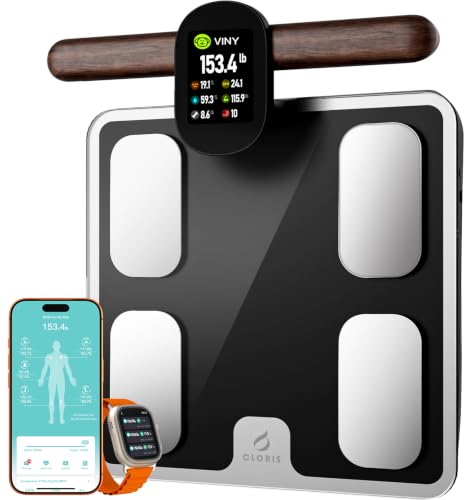
Weight is the least interesting number on this scale — the other 58 are the point.
The number that sells this scale is 58 — the body composition metrics it tracks, from body fat and muscle mass through to visceral fat, body water, protein, bone mass and metabolic age. That is a lot of data for a home bathroom scale. An 8-electrode handle is what makes it possible, sending a gentle current through both hands and both feet rather than just your soles.
Where it earns its place next to a glucose meter is the daily visibility. Body water, muscle and visceral fat all shift slowly around what you eat, and seeing those trends move is far more motivating than watching a single weight figure bounce around. Eight of the most important numbers — weight, body fat, BMI, muscle mass, bone mass, body water, visceral fat and your change since last time — show up on the handle display at eye level, so you are not bending down or hunting for your phone at 6 a.m. The whole thing runs on rechargeable power and syncs to the free Fitdays app, which exports PDF reports you can hand to a trainer or physician.
Build quality is where the praise lands hardest — the 12.2 × 12.2-inch tempered glass platform supports up to 400 lbs and stores profiles for up to 24 users, so a whole household can share it. Adult, Child, Teen and Athlete modes tune the analysis by age instead of applying one formula to everyone. The honest caveat is context: this tells you nothing about your blood sugar directly, so pair it with a meter if glucose is your actual concern.
The real strength: the eye-level TFT handle display puts eight readings in front of you without a phone, which is what makes daily tracking stick.
Side by side: it covers far more ground than a basic scale, and unlike the Freestyle battery above it is an entirely different tool — one reads your body, the other powers a device.
Suits you if: you are working on body composition and want numbers beyond weight without a clinic visit.
Not for: anyone expecting a glucose reading — this measures body makeup, full stop.
4. Withings Scanwatch Nova Hybrid Smartwatch

A watch that looks like a watch but logs your heart and sleep around the clock.
For anyone tracking metabolic health, the useful part of this watch is what it records while you sleep and move — not what it shows on the dial. Its TempTech24/7 module logs a baseline body temperature and the fluctuations around it, which is the kind of overnight trend a meter reading alone can never show you. On-demand SpO2 reads your blood oxygen, and the same sensor logs it overnight for breathing disturbances.
Heart tracking runs 24/7 with high and low pulse alerts, plus overnight heart rate variability for month-over-month trends. The sleep side logs duration, time split between light and deep sleep, interruptions and a Sleep Quality Score. On the activity front it auto-recognises over 40 activities, tracks heart rate zones, estimates VO2 max and includes connected GPS.
The build is where buyers consistently land on the positive: a stainless steel case and band with a buckle clasp that reads as a proper timepiece rather than a fitness band. Battery life is rated at 30 days, and a full charge takes about 2 hours. The honest trade-offs are real but narrow — sleep tracking can miss chunks of data, and the value question is fair for a watch at the premium end. If deep sleep-stage accuracy is your single priority, this is the wrong tool.
Best match: someone who wants continuous overnight heart and temperature context without a screen-heavy gadget on their wrist.
Think twice if: you want forensic sleep-stage detail — logged gaps are the usual complaint.
5. Withings Body Scan Smart Scale
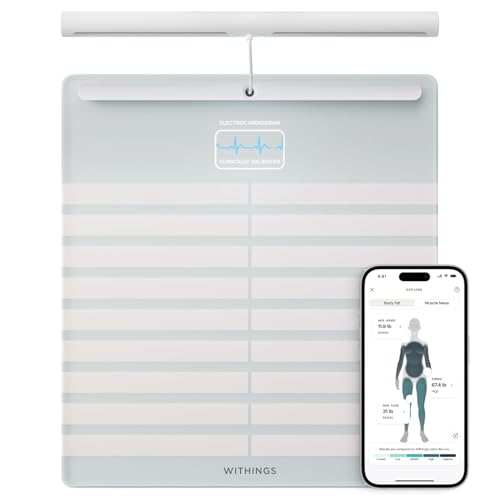
The scale that splits your body into five zones and reads your heart rhythm too.
Where a normal smart scale gives you one overall body-fat figure, this one breaks your muscle and fat mass into five separate body zones, so you can see where change is actually happening. The retractable handle is what enables that segmental reading — you grip it during the measurement and it maps upper and lower body separately. For anyone tracking how their body responds to diet changes, that zoning is the feature that justifies stepping up.
It also packs a built-in ECG that can flag atrial fibrillation and a daily arterial stiffness reading. It also measures foot sweat-gland activity as a read on the skin’s protective function. Everything lands in the Health Mate app and syncs to Apple Health.
Read the details before you buy, because this scale is fussier than most. It needs a full charge before setup, it wants a hard, level floor, and it pairs with the correct app — skip any of those and readings turn inconsistent. The handle cord is the genuine weak point: the retractable wiring can fail and break the upper-body circuit, which shows up as inconclusive readings. Heavier, more muscular builds place more stress on that cord. Weight readings hold up against clinical measurements, and the scale supports four user profiles.
Where it pulls ahead
- Five-zone segmental analysis shows where fat and muscle are actually changing
- Built-in ECG and daily arterial stiffness tracking add cardiovascular context
- Weight accuracy matches clinic measurements
- Supports four user profiles with Apple Health sync
The fine print
- Demands a hard, level floor and a full charge, or readings drift
- The retractable handle cord is the failure point — treat it gently, especially if you are heavily built
Made for: the buyer who wants zone-level body data and heart-rhythm context in one step-on device.
Look elsewhere if: you want a scale you can shove under the sink and forget about — this one rewards careful placement.
6. Prodigy Test Strips

Five boxes, 250 strips — the plain restock that keeps a Prodigy meter running.
If you already own a Prodigy meter, this is the simplest purchase in the whole article: 5 boxes totalling 250 test strips, sized for the Autocode, Pocket and Voice meters. There is no setup, no pairing, no learning curve — you open a box and test.
Runners are the ones this suits best, because 250 strips is enough to carry you a long stretch between orders. The recurring theme in the feedback is straightforward reliability and prompt delivery, with repeat buyers coming back for a second and third time without issue. For a daily tester, that predictability is worth more than any feature list.
The honest caveat concerns consistency. A long-running Prodigy user reported that recent orders were showing 10 to 20-plus point variance from the same blood sample, needing three or four tests averaged together to trust the result, and finding the running cost of strips hard to justify. That is one buyer’s experience rather than a pattern, but if your readings suddenly start scattering, it is worth averaging before you act on a single number.
Why it works: 250 strips means fewer reorders, and repeat buyers keep coming back for exactly that reason.
One honest flag: strip-to-strip variance has been reported by a long-time user, so treat any single outlier reading with suspicion.
Buy these if: a Prodigy Autocode, Pocket or Voice meter is already on your shelf.
Skip if: you own a different brand — these strips only fit Prodigy meters.
Know the Specs
Sample Size and Reaction Time
Sample size is the volume of blood a strip needs, measured in microlitres (µL). A 0.5 µL glucose test needs only a pinprick drop, which is easier to produce on a cold morning than a larger sample. Reaction time is how long you wait for the number — 5 seconds for glucose on the HeartsCare kit, 10 seconds for its ketone strips. Lower sample size and shorter reaction time both make daily testing less of a chore, which is the whole battle.
Measurement Range
Range is the span the meter can read before it gives up. The HeartsCare kit covers 10 to 800 mg/dL for glucose and 0.1 to 8.0 mmol/L for ketones. A wide glucose range matters because it means your meter rarely refuses a reading, no matter what you ate or when you tested. Hematocrit range describes the blood thickness the strips tolerate, and the kit lists coverage across that too.
Common Questions
Can I get a continuous glucose monitor without a prescription?
How accurate are non-prescription glucose meters compared to a lab test?
How much blood does a glucose or ketone strip actually need?
Do I need the app to use a Bluetooth glucose meter?
How should I store test strips so they stay accurate?
Can a body composition scale measure my glucose level?
How many strips do I need for daily glucose and ketone testing?
Do test strips work with any meter brand?
What is the difference between glucose and ketone readings?
The Bottom Line
For most people searching for the non-prescription continuous glucose monitor answer, the HeartsCare C1 Plus kit is the pick to start with — it reads glucose in 5 seconds from a 0.5 µL drop and throws in ketone testing on the same device, all without a prescription. If your goal is body composition rather than blood numbers, the CLORIS scale tracks 58 metrics and wins people over with its build quality. And for overnight heart and temperature trends, the Withings Scanwatch Nova logs them continuously with a 30-day battery. If you already own a Prodigy meter, the strip pack is the straightforward restock — grab it before your current box runs dry.
How we choose
We do not accept paid placement. Every pick is matched to a real buyer and a real use-case; we do not hands-on test units.
Sources
Specifications: manufacturer listings and product documentation. Review insights: verified customer reviews, as of October 2026. Pricing: not shown on this page (it changes often); check the current price via the retailer link.
As an Amazon Associate, Aappliancez earns from qualifying purchases. This does not affect which products we feature.