Disclosure: Some links in this post are affiliate links. As an Amazon Associate I earn from qualifying purchases, at no extra cost to you. Learn more
Specs are compiled from manufacturer listings and verified buyer reviews and can change over time — please confirm the key details on the product page before buying.
You want the snoring to stop keeping you up, and the honest answer is that no pair of headphones will fully cancel a roaring snore the way a plane engine gets silenced. What works is a combination: a soft tip that physically plugs your ear a little, plus a steady stream of sound that covers the racket. The picks below split into three approaches — headbands that sit off the ear canal, true noise-cancelling earbuds, and reusable earplugs with no electronics at all — and the right one for you depends on how you sleep and how loud your bedmate really is.
This guide is built by comparing the manufacturers’ published specifications and the patterns across verified customer reviews, so you get each pick’s real strengths and trade-offs instead of marketing spin.
Some picks will last a full night on one charge while others need the case nearby, and a few are wired with no battery to worry about. Below you will find the full breakdown of the best noise cancelling headphones for snoring.
Top Picks


How To Choose The Best Noise Cancelling Headphones for Snoring
Snoring sits in the low-frequency range, and that is the part most active noise cancelling systems handle least well. The best results come from stacking two defenses: a soft tip or earplug that physically reduces sound entering your ear canal, and a steady cover sound — white noise, rain, a sleep story — that masks whatever gets through.. Start by asking how you sleep. Side sleepers need a design that does not jab into the pillow-side ear, while back sleepers can get away with a more standard earbud shape.
Earbud, headband, or plain earplug
An earbud sits inside your ear canal and can pair passive sealing with active noise cancelling. A headband places thin speakers flat against your ear from the outside, so there is nothing pressing into the canal — a real advantage if you lie on your side. A plain silicone earplug has no battery, no Bluetooth, and no app to fail, and it simply lowers the volume of the whole room.
Check the noise-reduction figure and the fit sizes
Earplugs quote a noise reduction value in decibels, often shortened to dB — that is the amount of sound energy the plug is rated to cut. Earbuds and headbands rarely quote one, so their real-world blocking depends heavily on how well the tip or band seals to your ear. Multiple tip sizes matter more than most buyers expect, because a loose seal lets snoring straight past.
Battery life and what plays all night
You want a single charge that comfortably outlasts your sleep, not one that dies at 4 a.m. and wakes you with a low-battery chime. Sleep-specific earbuds often run in a lower-power mode with built-in sounds, while standard noise-cancelling earbuds stream Bluetooth and drain faster. Decide if you want to hear your own playlist or a built-in sound library.
Side-by-Side Comparison
| Model | Best For | Noise Approach | All-Night Power | Design | Amazon |
|---|---|---|---|---|---|
| Perytong Sleep Headphones Headband★ Best Overall | Side sleepers on a budget | Passive (headband speakers) | 12 hours | Headband | Amazon |
| Soundcore Sleep A20Snore Specialist | Snore masking with sleep tracking | 4-point noise masking | 14 hours (sleep mode) | In-ear buds | Amazon |
| Sleepals Micro Sleep EarbudsTiny Fit | Small ears, tiny fit | Passive, up to 28dB | 4.5 hours | Micro in-ear | Amazon |
| MAXROCK Sleeping Headphones | Wired, no charging | Passive earplug | Wired (no battery) | Earplug + earbud | Amazon |
| Loop Quiet 2 Ear Plugs | Pure noise blocking | Up to 24 dB (SNR) | No battery | Reusable earplug | Amazon |
| Loop Dream Ear Plugs | Side-sleeping comfort | 27 dB (SNR) | No battery | Foam-silicone earplug | Amazon |
| Loop Switch 2 | Adjustable day-to-night use | 20-26 dB (SNR), 3 modes | No battery | Dial earplug | Amazon |
| Soundcore Space A40 | Travel and everyday ANC | Adaptive ANC, up to 98% | 10 hours (50 with case) | In-ear buds | Amazon |
| Soundcore Liberty 4 NC | Strong ANC for the price | Adaptive ANC 2.0 | 10 hours (50 with case) | In-ear buds | Amazon |
| Soundcore Sleep A30 Special | Built-in snore masking | Triple noise-reduction + ANC | 8-10 hours | In-ear buds | Amazon |
Detailed Reviews
1. Perytong Sleep Headphones Wireless Headband
Our pick — 4.0+★ from 51,000+ verified ratings; the strongest balance of quality and price.
A soft fabric band that puts the speakers beside your ear instead of inside it.
The reason this headband works for snorers is simple: the flat, ultra-thin speakers rest against your ear from the outside, so there is nothing jammed in your ear canal to ache at 3 a.m.. It runs more than 12 hours on a charge, which covers a full night with room to spare, and a full recharge takes 2 to 2.5 hours. Bluetooth 5.4 (the newer wireless version, which pairs faster and uses less power) keeps the music stable through the night, and the band stretches to fit most head sizes.
Because it is a headband and not an active noise-cancelling earbud, it does not cancel snoring the way the Soundcore Space A40 does with its ANC circuit. What it does instead is play your own rain or white-noise track right at your ear, which covers the noise well enough that side sleepers keep coming back to it. The fabric is breathable and machine washable — just pull the control pod out first. A USB-C port means the same cable as your phone charges it.
Buyers report that the thin speakers deliver clear sound with real bass for their size, and that they stay put all night unlike a pair of earbuds. The snug stretch helps, though a few buyers with smaller heads found the band a little loose and the speaker pads drift above the ear, so you may need to nudge them back into place now and then.
Why side sleepers swear by it
- No pressure in the ear canal — the speakers sit flat against your ear so lying on your side stays comfortable.
- 12+ hours per charge covers a full night and then some.
- Machine washable fabric keeps it fresh night after night.
- Bluetooth 5.4 pairs quickly and holds a stable link.
Where it falls short
- It does not actively cancel noise — it leans on your own audio to cover the snoring.
- The loose fit on smaller heads can let the speaker pads slide above the ear.
Go for it if: you sleep on your side and want a washable band that covers snoring with your own music for very little outlay.
Look elsewhere if: you need genuine active noise cancellation or a snug fit for a very small head.
2. Soundcore Sleep A20
Purpose-built sleep buds that lean on masking and sealing rather than raw noise cancellation.
The A20 is not an active noise-cancelling earbud, and that is the first thing to understand before you buy. Instead it uses a four-point noise masking system — a mix of built-in cover sounds, twin-seal ear tips that the maker rates at three times stronger passive blocking, and smart volume control — to crowd out snoring. In sleep mode it runs 14 hours on a charge and up to 80 hours with the case. Bluetooth streaming drops to 10 hours, which is where the 4.5-hour charge time and 5.3 wireless version live.
Comfort is the part that wins people over: the Air Wing and 3D shape wrapped in soft material sit flush enough for side sleeping without pressing hard on your ear. A MEMS sensor (a tiny motion sensor) tracks your sleeping positions and movement alongside a real-time clock, so the app can build a picture of how you actually slept.
The catch is reliability. The sound and noise cancelling divide opinion — some nights they seal beautifully and others let the snore through — and a notable share of long-term users see an earbud stop charging or fade to near-inaudible within months. Anker’s warranty replacements are generally easy to arrange, but the recurring gripe is durability, so treat this as a product to buy with the warranty in mind.
The masking formula: for a low-frequency snore, the twin-seal tips plus a steady rain track cover it far better than a single trick would. The 14-hour sleep-mode battery means you are not woken by a dead-bud chime.
The honest caveat: charging and long-term reliability are the weak points — the earbuds are excellent for a few months and the durability record is the most-flagged concern in owner feedback.
The right call for: a side sleeper who wants masking sounds built in and does not want to manage their own playlist.
Think twice if: you want a set that will still be flawless after a year — plan on using the warranty.
3. Sleepals Micro Sleep Earbuds
A micro earbud so small you may forget it is in your ear all night.
At 0.35 inches thick and 0.1 ounces, this is about as unobtrusive as a sleep earbud gets — you get almost no ear pressure even lying flat on your side. The soft ergonomic tips physically reduce ambient noise up to 28dB, a decibel figure that tells you how much sound the plug itself is rated to cut, and they stay put while you roll. There is no active noise cancelling here; the blocking is all passive, like a silicone earplug with a speaker inside.
Inside, 5mm drivers with 160ohms impedance handle your sleep sounds, and the little charging case gives 4.5 hours of playtime per charge plus 28 hours total. Bluetooth connects to your phone for white noise, podcasts or meditation tracks.
The size that makes it great is also its biggest limitation. Fit is genuinely the strong suit here — small, sensitive ears take to it without headaches — but the overall quality picture is mixed, with the tiny buds proving fiddly to insert and remove. A few owners also found the seal lets lighter sounds through, so a very loud snore may still creep past.
What it gets right: side-sleeping comfort in a package that barely registers, with passive blocking rated up to 28dB to take the edge off a snoring partner.
What to weigh: 4.5 hours per charge means it may not last a full night at higher volumes, and the micro size makes it harder to seat correctly.
Grab these if: you have small or sensitive ears and standard earbuds hurt within an hour of side sleeping.
Skip the hassle if: you need all-night battery or an easy one-hand insertion on a dark nightstand.
4. MAXROCK Sleeping Headphones

A wired earplug-and-earbud hybrid that never needs a charge.
This is a dual-function design: part soft silicone earplug, part wired earbud, thrown together for people who cannot fall asleep without a little music. The 3.5mm plug means it works with almost anything that has a headphone jack — a phone, tablet, MP3 player or laptop — and there is no battery to die at 4 a.m. The totally soft silicone flexes into your ear canal and stays there overnight without the pressure of a rigid stem. A 5mm microsphere speaker handles clear treble and mids, ideal for soft music or an audiobook.
Because it plugs the canal like an earplug, it is designed for people sensitive to a snoring bedmate or a restless roommate. The built-in microphone and in-line controls let you take a call or skip a track without opening your eyes, and a bonus zipper case keeps it tidy in a travel bag.
The trade-off is the wire and the sound ceiling. Owners who use it nightly report it survives a year or more of abuse, but the sound is decent rather than audiophile-grade — the sound is decent rather than great, and a stray tug will pull it loose. There is no active noise cancelling, so it blocks by sealing and covering, not by cancelling the snore directly.
Where it earns its keep
- No battery and no charging — a wire means it works all night, every night.
- Soft silicone seal blocks noise like a proper earplug while playing your audio.
- 3.5mm plug fits virtually any device you already own.
- In-line controls and a mic for calls make it a decent travel companion.
What you give up
- The wire limits movement and can snag loose from your ear.
- Sound quality is passable, not premium, and there is no active noise cancelling.
Worth considering for: anyone who wants zero battery anxiety and a sealed-ear feel for a snoring partner.
Not for you if: a cable across the pillow would keep you awake on its own.
5. Loop Quiet 2 Ear Plugs

No battery, no Bluetooth, no app to fail — just a silicone plug that lowers the whole room.
If your real problem is a snoring partner in the same bed, the simplest and most reliable answer is a reusable silicone earplug. Quiet 2 packs up to 24 dB of noise reduction — that SNR figure is the rated amount of sound energy the plug cuts — into a flexible, lightweight silicone body that comes in four tip sizes (XS, S, M, L). That matters because the correct tip size is what makes or breaks a seal, and a snug fit is what actually blocks the snore. They are built to be reused and cleaned night after night.
There is no audio and no cover sound, so this is for someone who wants silence rather than rain loops. You will still hear some awareness of the room — that is normal, and often a plus because you can still catch an alarm — but the distracting edges of a snore get softened considerably.
Getting the size right is the whole game. A too-small tip breaks its seal when you roll onto your side, while the medium or large seals tightly but can feel snug. Treat the sizing as a small experiment over the first few nights and these are deeply comfortable.
The fit story: four sizes means you can keep adjusting until you find a seal, and the flexible silicone stays comfortable even for side sleepers.
What to expect: these muffle and soften a snore rather than fully silence it, and the smooth material can slide out overnight if the tip size is slightly off.
Ideal if: you want a recharge-free, app-free way to take the volume down on a snoring bedmate.
Reconsider if: you want sound playing or need stone-cold silence from a very loud snore.
6. Loop Dream Ear Plugs

Loop’s bedtime-specific plug, built around a cushioned oval shape for all-night side sleeping.
Loop engineered Dream specifically for sleep, and the headline figure is 27 dB of noise reduction — a higher SNR rating than the Quiet 2’s 24 dB, closer to what you need against a snoring partner. The oval foam-silicone tips follow the shape of your ear, and the softer silicone body is designed to reduce pressure on the ear so you can toss, turn and lie on your side without a hotspot.
The kit is generous: four sizes of foam-silicone tips plus four sizes of Double Tips, so you can find a secure seal even in small ears. The included carry case sits by the bed, and the plugs are easy to clean and reuse rather than throwing away foam disposables each morning.
Comfort is the standout — these are repeatedly rated more comfortable than foam for side sleepers. The honest catch is that even 27 dB will not blank out everything; a loud dog bark or a really heavy snore can get through, and the foam tips are a consumable that will need replacing eventually. Budget for fresh tips as part of the cost of owning these.
The winning detail: the cushioned oval shape and soft silicone mean side sleepers who normally ache from earplugs can wear these all night.
The real limit: 27 dB softens and muffles but does not fully silence a very loud sleeper, and the foam tips wear out over time.
Reach for these when: comfort matters as much as blocking, and you want a step up in noise reduction from standard plugs.
Pass them up if: you expect total silence, or you would rather not replace foam tips over the long run.
7. Loop Switch 2

Three levels of blocking in one earplug, switched by a dial you turn inside your ear.
The idea here is range. A manual in-ear dial lets you flip between Quiet, Engage and Experience modes for 20-26 dB of noise reduction that you can change without taking the plug out. Quiet mode is the strongest for bedtime and snoring, while Engage and Experience let more of the world in for daytime use. There are no batteries and no electronics — the whole thing is a clever mechanical filter.
Unlike the single-setting Quiet 2 or Dream above, this one is meant to live in your ears all day. The slimmer body and smaller angled nozzle fit more naturally, and the four ear-tip sizes (XS to L) help you get a real seal, which is exactly what blocks a snore at night.
The adjustability is what divides people. It is genuinely useful to be able to drop the blocking as you wake up, but the jump between the first two settings can feel small, and the tiny carry case is fiddly to open. It is a premium-price plug, so you are paying for that dial and the day-to-night flexibility rather than more raw blocking than the dedicated sleep plugs.
Why the dial earns its place
- Three switched modes let you move from bedtime quiet to daytime awareness in one plug.
- No batteries or electronics — nothing to charge, nothing to fail.
- Four tip sizes and a slimmer body make for a natural, secure fit.
Where the value is debated
- The difference between the first two settings can feel slight.
- The carry case is small and hard to open for a premium-price product.
Choose it for: one plug that handles a snoring bedroom at night and noisy shops or offices by day.
Go simpler if: you only need bedtime blocking and would rather not pay for a dial.
8. Soundcore Space A40

A true active noise cancelling earbud that adapts its blocking to the room around you.
This is a different animal from the sleep-specific picks: a proper pair of active noise-cancelling earbuds. The upgraded ANC system is rated to reduce noise by up to 98% and automatically detects your surroundings to pick the right blocking level, so the same buds work in a quiet bedroom, on a commute or on a flight. Bluetooth 5.2 keeps the link stable, and on a single charge you get 10 hours of playtime, with a quick 10-minute top-up giving 4 hours of listening.
For a snoring bedmate, the ANC handles the steady, low rumble reasonably well and the smaller-than-its-stablemates shape helps you fit them under a pillow side. Real detail is the sound: double-layer diaphragm drivers push strong bass and clear mids, with LDAC for higher-resolution wireless audio. There is a 50-hour total with the charging case when you are traveling.
The honest split is comfort and fit. The compact body is light, but noise cancelling against a sharp snore is not the same as against engine drone, and a share of owners find the seal loosens enough to let sound past. Treat it as an excellent general-purpose ANC earbud that happens to help at night, rather than a dedicated sleep device.
The value read: adaptive ANC rated to cut up to 98% of noise, LDAC hi-res audio and 50 hours with the case make it a strong all-rounder for the outlay.
The nighttime catch: fit is the weak point for sleep — the seal can loosen, and against a sharp snore the cancellation is only partly effective.
Best for: someone who wants one set for the commute, the office and the bedroom, with strong everyday noise cancelling.
Not the pick if: your only goal is snore blocking from a dedicated sleep earbud.
9. Soundcore Liberty 4 NC

Big-driver earbuds with the most aggressive noise cancelling of the Soundcore pair here.
The Liberty 4 NC takes the A40’s adaptive idea and pushes it with ANC 2.0, which makes real-time calculations and adjusts to your ear canals and surroundings for maximum quiet. Where it pulls ahead of the A40 for a snorer is the sheer strength of the blocking — owners who compared the two rank the Liberty’s cancellation higher, and it does a solid job on a steady bedroom hum. The 11mm custom-tuned drivers deliver crisp, detailed sound, with LDAC carrying 3x more data than regular Bluetooth.
Battery is genuinely long: 10 hours on a single charge in normal mode, up to 50 hours with the case. With ANC on you get 8 hours between charges, extendable to 40 with the case, which comfortably covers most nights. Bluetooth 5.3 adds multi-point so you can stay paired to a phone and a laptop at once.
The recurring gripe is the shape. The rectangular bud housing does not seat neatly in every ear, and some find it causes ache after an hour or slips out when you sweat or roll over. If it fits you, it is outstanding value; if not, it is a wrestling match against your pillow.
What wins people over: the noise cancelling is the star — strong enough to silence a vacuum and effective on the low drone of a snore, with 50 hours total from the case.
The fit warning: the blocky housing needs the largest tip you can wear for a real seal, and it can ache or fall out for some ear shapes.
Pick these for: the strongest active noise cancelling in the group at a mid-range price, if they fit your ears.
Try before you commit if: you know you need a rounded bud — the rectangular shape is the deciding factor.
10. Soundcore Sleep A30 Special
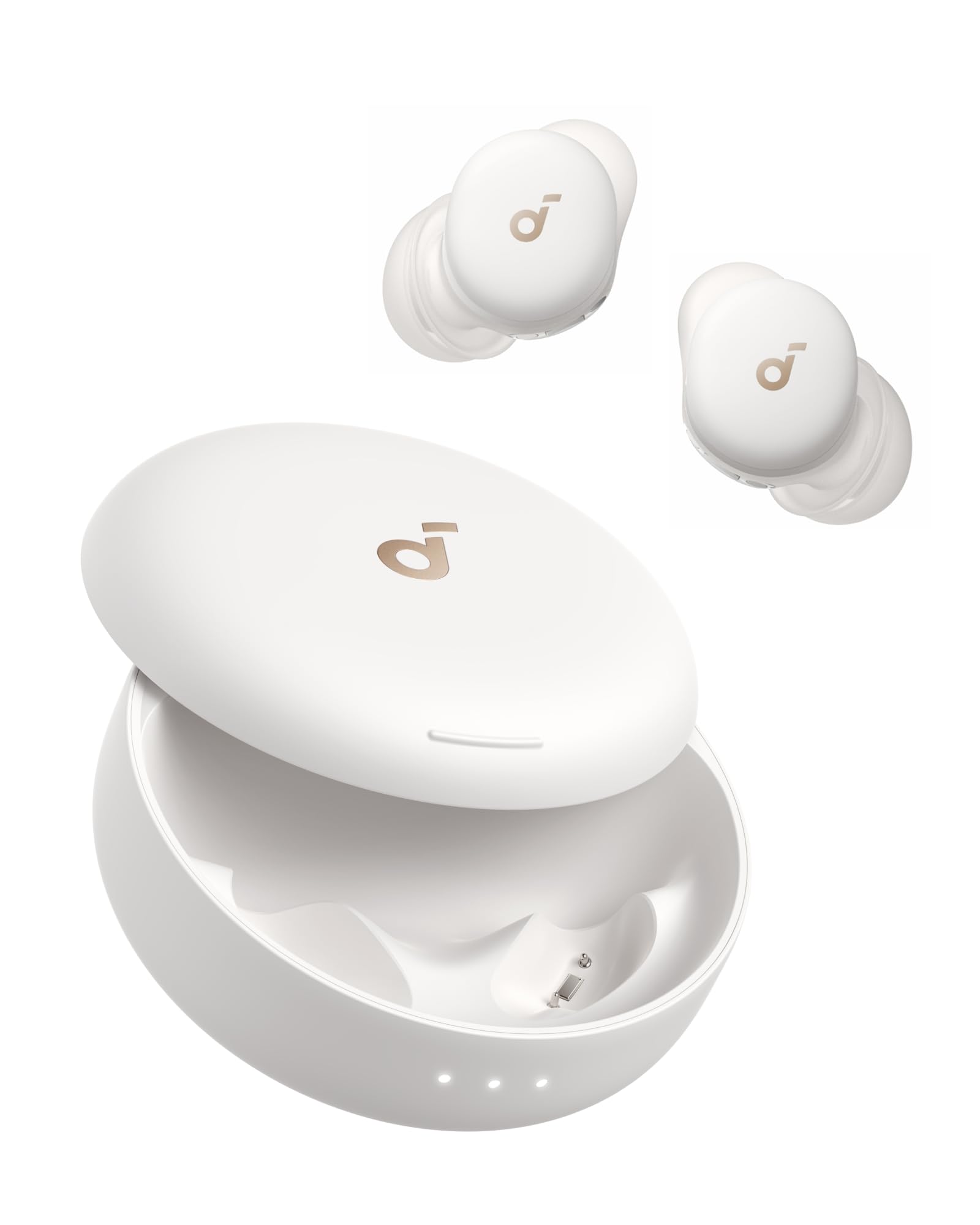
The A20’s premium sibling — smaller, with active cancellation and built-in snore masking working together.
This is the most purpose-built snore earbud here, because it stacks three defenses at once: active noise cancelling, passive isolation from the silicone tips, and smart snore-masking sounds. At just 3 g per bud it sits flush in your ear for side sleepers, which is the key to all-night comfort.
Noise reduction in dB (SNR) Earplugs quote a figure like 24 dB or 27 dB, which is the rated amount of sound energy the plug is designed to cut. That figure only holds if the plug is seated with a proper seal, which is why tip sizing matters so much. Earbuds and headbands rarely publish a dB number, so their real blocking depends on how well the tip or band seals to your ear. Passive blocking versus active noise cancelling Passive blocking is physical — a soft tip or plug lowers the volume of everything entering your ear. Active noise cancelling uses microphones and speakers to generate opposite sound waves that cancel noise, and it tends to work best on steady low-frequency drone like engines and humming appliances. Snoring is a low, rumbling sound, so the two approaches can stack: passive sealing cuts the overall level while ANC and a cover sound handle the rest. Many dedicated sleep earbuds skip ANC and rely on sealing plus masking instead. All-night battery and charge time You want a single charge that outlasts your sleep so you are not woken by a low-battery chime. Sleep-specific earbuds often quote a sleep-mode figure (say 14 hours) that runs longer than their Bluetooth-streaming figure, because streaming drains faster. Charging time matters too — a set that takes a couple of hours to refill needs to go back in the case each morning. Plain earplugs have no battery at all, which is their quiet advantage. Fit style and side sleeping How you sleep decides everything. A headband places thin speakers beside your ear so nothing presses into the canal, which suits side sleepers. An in-ear bud gives you sealing plus optional ANC but can ache if it is too large for your ear. A reusable earplug is the simplest and most reliable for pure blocking. Whichever you choose, look for multiple tip sizes so you can find a seal — a loose fit lets the snore straight past. FAQ
Can noise cancelling headphones actually block out snoring? Partly. Active noise cancelling is strongest against steady low-frequency drone, and a snore does sit in that low range, so good ANC can take a real edge off it. But a sharp, close-range snore is harder to cancel than an engine hum. The most reliable results come from pairing a well-sealed tip with a cover sound — rain, white noise, or a sleep story — so the snore is both lowered and masked.. Is a headband or an in-ear earbud better for a side sleeper? A headband like the Perytong places flat speakers beside your ear instead of inside the canal, so there is no pressure point when you lie on your side. That makes it a natural fit for side sleepers who find earbuds uncomfortable. In-ear sleep buds can also work well if the design sits flush, but you need to get the tip size right to avoid ache. Will earplugs alone stop me hearing a snoring partner? A good reusable plug with a solid seal, like one rated 24 or 27 dB, will noticeably soften and muffle a snore. It rarely silences a very loud sleeper completely, and you will usually still have some awareness of the room. That partial awareness is often welcome because it means an alarm can still get through. How long should a sleep earbud last on one charge? You want it to comfortably outlast a night’s sleep. Sleep-specific models often quote a sleep-mode figure in the 8 to 14 hour range, while their Bluetooth streaming mode drains faster. Standard noise-cancelling earbuds typically offer around 10 hours in normal mode. Check the figure for the mode you will actually use — streaming versus built-in sounds. Do sleep earbuds have active noise cancelling? Some do and some deliberately do not. Models like the Soundcore Sleep A20 skip active noise cancelling and rely on passive sealing plus masking sounds instead. Others, such as the Sleep A30 Special, combine active noise cancelling with passive isolation and snore-masking. Standard earbuds like the Space A40 and Liberty 4 NC lean heavily on active cancellation. Can I sleep with standard earplugs and a phone playing white noise? Yes, and it is a very common combination. A sealed earplug lowers the overall volume of the snore, and a speaker playing white noise or rain masks what little gets through. The upside is no battery in your ears; the downside is you cannot hear your own audio directly, so a bedside speaker is doing the masking work. What tip size should I choose for blocking a snore? Start with the size that seals without causing discomfort, then test it over a night or two. A too-small tip breaks its seal when you roll onto your side, while the largest tip seals tightly but can feel snug. If you are between sizes, many people get the most reliable overnight seal from the medium-to-large option. Are reusable earplugs better than foam for sleeping? Reusable silicone plugs are washable and can be used night after night, whereas foam is thrown away each morning. For side sleepers, a soft silicone or foam-silicone design often stays more comfortable than a stiff foam cylinder. The trade-off is that foam-type or foam-silicone tips can wear out over time and need replacing. Can I still hear my alarm with earplugs or sleep earbuds in? Usually yes, at least partly. Earplugs tend to muffle and soften sound rather than seal the world out entirely, so an alarm at close range typically still gets through. Some sleep earbuds add a built-in in-ear alarm that gently wakes you without disturbing your partner. Test your setup on a low-stakes morning before you rely on it. How long do sleep earbuds and earplugs typically last? Reusable earplugs, cleaned regularly, can last a long time with only the tips needing replacement now and then. Electronic sleep earbuds are more variable — their batteries and charging contacts are the usual weak point over months of nightly use. Choosing a model with a solid warranty makes that long-term risk easier to manage. Final Thoughts: The Verdict
For most people fighting a snoring bedmate, the winner is the Perytong Sleep Headphones Headband, because it puts soft speakers beside your ear for all-night side-sleeping comfort with more than 12 hours on a charge and costs very little to try. If you would rather have masking sounds built in and sleep tracking, the Soundcore Sleep A20 is the specialist pick — just buy it with the warranty in mind. And if you want zero batteries and the simplest, most reliable blocking for a snoring partner, reach for the Loop Dream Ear Plugs at 27 dB with a cushioned shape built for side sleepers. Whichever you choose, get the fit right first — a proper seal does more against a snore than any single feature on the box..
How we choose
We do not accept paid placement. Every pick is matched to a real buyer and a real use-case; we do not hands-on test units.
Sources
Specifications: manufacturer listings and product documentation. Review insights: verified customer reviews, as of October 2026. Pricing: not shown on this page (it changes often); check the current price via the retailer link.
As an Amazon Associate, Aappliancez earns from qualifying purchases. This does not affect which products we feature.