Disclosure: Some links in this post are affiliate links. As an Amazon Associate I earn from qualifying purchases, at no extra cost to you. Learn more
Specs are compiled from manufacturer listings and verified buyer reviews and can change over time — please confirm the key details on the product page before buying.
You want to hear the bird get up, the deer step on the twig, the buddy next to you call the shot — and you still want your ears intact when the shotgun goes off. That is the whole job of hunting ear protection, and in-ear electronic buds do it better than bulky muffs because they leave your cheek free to settle on the stock. The trouble is that almost every pair sold for “shooting” is really built for an indoor range, not a cold, windy, half-day sit in the field.
This guide is built by comparing the manufacturers’ published specifications and the patterns across verified customer reviews, so you get each pick’s real strengths and trade-offs instead of marketing spin.
You can group these picks into two types: passive in-ear plugs that block noise without a battery, and electronic buds that amplify quiet sound while clipping the boom. Each one suits a specific hunter, and one spec often decides whether you get a good morning or a ringing ear. Here is the honest rundown of the noise cancelling earbuds for hunting that actually earn a place in your pack.
Top Picks


How To Choose The Best Noise Cancelling Earbuds for Hunting
Hunting ears have one contradictory job. You need to hear a whisper-quiet sound — a safety click, a bird’s wing, a branch snapping behind you — and you need a sudden 150-plus decibel crack stopped dead in the same half second. That is why a plain foam plug and a plain music earbud both fail. One blocks everything; the other blocks nothing.
What you are really shopping for is a hearing protector that either seals your ear canal passively or does it electronically, then adds awareness on top. Everything else — Bluetooth, apps, cases — is a bonus, not the point.
Start With The NRR, Not The Features
The NRR, or Noise Reduction Rating, is a single number in decibels that estimates how much sound a protector blocks in a lab test. A higher number means more protection, and for gunfire you want that number as high as you can get while still hearing your surroundings.
Passive plugs in this group push up toward 31 dB. Electronic buds with a speaker in them often land lower, because the electronics and venting take up space that foam would otherwise fill. That gap is the single most important trade-off in this whole category.
Amplification And Cutoff Speed
Good electronic buds have two halves. The microphones boost quiet sounds so a distant goose call comes through, and the circuitry clamps down on anything loud, such as muzzle blast, before it reaches your ear.
Speed matters here, because a shotgun report is over in a fraction of a second. One pick in this list compresses loud noise within 0.01 seconds once sound passes 82dB — worth knowing, since slow circuitry lets the peak slip through.
Seal Beats Electronics Every Time
If the ear tip does not seal your canal, none of the electronics matter. Sound leaks around a loose tip and your protection drops away whether the buds are switched on or off.
That is why the picks below ship with multiple tip sizes, and why so many field complaints come down to tips that are too big or too stiff. A snug foam plug inserted the way you would seat a safety plug usually outperforms a loose silicone one.
Wind, Weather, And Battery
Wind noise is the hidden tax on in-ear electronics. Microphones cannot tell a gust from a sound, so a windy ridge can turn your awareness into a roar.
Also check two practical numbers. The IP rating (a two-digit score for dust and water resistance — the first digit covers dust, the second covers water) tells you whether buds survive sweat and rain, so you don’t have to replace them mid-season. Battery hours tell you whether they last a full sit, so you aren’t caught with dead buds. Rush these two and your season gets cut short.
Side-by-Side Comparison
| Model | Best For | Noise Reduction (NRR) | Type | Battery | Amazon |
|---|---|---|---|---|---|
| AKT1 Sport Sound Amplification Earmuff★ Best Overall | All-day field awareness | 25 dB | Over-ear electronic | 2 AAA batteries (included) | Amazon |
| Walker’s 29 DB Rope Hearing Enhancer EarbudsBest Value | Cheapest true in-ear enhancer | 29 dB | In-ear electronic, neck cord | Rechargeable, up to 10 hours | Amazon |
| ZOHAN 035 Bluetooth 6.0 Earmuff | Bluetooth plus range use | 22 dB | Over-ear electronic | — | Amazon |
| ISOtunes Sport Advance | Long-range sessions with Bluetooth | 26 dB | In-ear electronic, neck wire | Up to 10 hours | Amazon |
| AXIL XCOR PRO | True wireless and hat-friendly | — | True wireless electronic | 12 hours | Amazon |
| Elgin Rebel True Wireless | Highest rated passive seal | 31 dB | True wireless passive | 12 hours, 40 hours in case | Amazon |
| 3M PELTOR EEP-100 Ear Plug Kit | Premium electronic plugs | — | In-ear electronic plugs | Up to 16 hours | Amazon |
Detailed Reviews
1. AKT1 Sport Sound Amplification Earmuff
Our pick — 4.5+★ from 500+ verified ratings; the strongest balance of quality and price.
The muff that makes other hunters’ voices sound like actual voices, not robot static.
It earns the top spot because it protects your ears at 25 dB NRR (that is the lab-tested amount of sound it blocks) while letting conversation come through sounding normal. That 25 dB is the highest NRR among the over-ear muffs here.
For a hunter, the sound quality of the amplification is the deal. Digitized passthrough turns a buddy’s quiet “on your left” into garbled noise. This one keeps voices recognizable, so you can talk at a normal level instead of shouting.
The fit is the thing that wins people over, and it works across head shapes. It runs on 2 AAA batteries that come included, so there is no recharge cycle to remember before a dawn start — just swap cells and go.
What holds up in the field
- 25 dB NRR is the top muff figure here, so muzzle blast is well muzzled
- Amplification keeps speech natural instead of tinny, which makes conversations at the range easy
- Memory foam cushions and an adjustable headband fit both large and small heads
- Runs on 2 AAA batteries (included), so no charging hassle before an early hunt
What to weigh before buying
- It is an over-ear muff, so it is slightly bulky and can nudge the stock on a rifle cheek weld
- Quiet ambient sound is amplified less than some rival muffs
- Some units have arrived in used condition, so inspect yours on delivery
Reach for this if: you want one muff that protects well and lets you talk normally, without juggling a charging cable.
Think twice if: you shoot with a low-mounted scope and need a slim profile to keep your cheek on the stock.
2. Walker’s 29 DB Hearing Enhancer Earbuds
A neck-corded enhancer that lets you hear the flush and muffle the shot without muffs on your head.
This sits on your neck on a flexible rubber cord, so nothing presses against your cheek.
It runs up to 10 hours on a rechargeable battery by cable, so a full day of hunting fits. Hi-gain omni-directional microphones pick up sound around you, and the sound-activated compression clamps down on the loud stuff. Three pairs of foam tips in small, medium, and large are in the box.
Here is the honest part: reliability is the most-discussed topic in this listing, and it cuts both ways. Some pairs last through seasons while others fail, and the fit is the real weak spot — the tips run large and can work their way out. Field reports also flag wind noise and battery that runs shorter than the claimed figure in real use.
Where it earns its place: For an entry-level in-ear electronic enhancer, the price-to-capability mix is hard to argue with — 29 dB protection, 10 hours of power, and a neck cord that keeps the buds off your hat.
The right fit: a hunter who wants electronic awareness without muffs and can experiment with tip sizes to get a tight seal.
Skip it: if you hunt in steady wind or expect a sealed, no-fuss plug every single outing.
3. ZOHAN 035 Bluetooth Shooting Ear Protection Earmuff

The earmuff that doubles as a Bluetooth headset so your phone can ride along on the hunt.
ZOHAN pairs 22 dB NRR protection with Bluetooth 6.0 streaming, so you can take a call or listen to audio without pulling the muffs off. Two omni-directional microphones boost quiet sound by up to 4X, which is what lets you hear range commands or a buddy’s voice.
The active circuit clamps on loud noise within 0.01 seconds once surrounding sound passes 82dB — buyers report exactly that, so the muzzle blast gets cut fast rather than slipping through. It is certified to ANSI S3.19-1974 and CE EN 352-1, the two standards named on the box.
Two things temper it. First, 22 dB NRR is the lowest protection figure in this group, so for heavy gunfire you may want to double up with foam plugs. Second, the amplified background audio sounds tinny and fake, fine for voice but not for music, and Bluetooth pairing can be stubborn.
The real draw: a foldable design, a wide headband that spreads weight, and an independent Bluetooth volume knob you can work with gloves on.
Pick this one: if staying connected and protecting moderate noise both matter, and you want a muff that folds into a pack.
Look elsewhere: if your shooting is loud enough that a lower NRR leaves your ears wanting more.
4. ISOtunes Sport Advance Bluetooth Ear Protection

Built for the hunter who is out from dawn to dusk and wants to keep the buds in the whole time.
Its tactical sound control does two jobs at once: it lets conversation and background sound through, then suppresses the percussive crack of a gunshot. Passive isolation comes in at 26 dB NRR, a solid step above the ZOHAN’s 22 dB.
The battery is listed at up to 10 hours per charge on a rechargeable lithium-ion cell, and by field accounts it hits close to that — heavy users report 9 to 10 hours of daily work. Bluetooth 5.0 connects to a phone, and the earphones carry an IP67 rating (dust-tight and able to take water immersion), so sweat and rain are not a worry.
The honest catch is comfort and fit. Foam tips feel rough until they sit right, and the mic picks up wind. Sound quality splits verdicts — some call it good, others awkward and artificial — so go in expecting a protective tool, not an audiophile bud.
What sneaks up on you: the instant loud-noise cutoff and directional mics earn high marks on the range, and outgoing calls come through clear on your end.
Worth it for: long days and wet or dusty conditions, where the IP67 shell and 10-hour battery pull their weight.
Not the one: if a perfect music-listening experience tops your list over protection.
5. AXIL XCOR PRO Wireless Bluetooth Earbuds
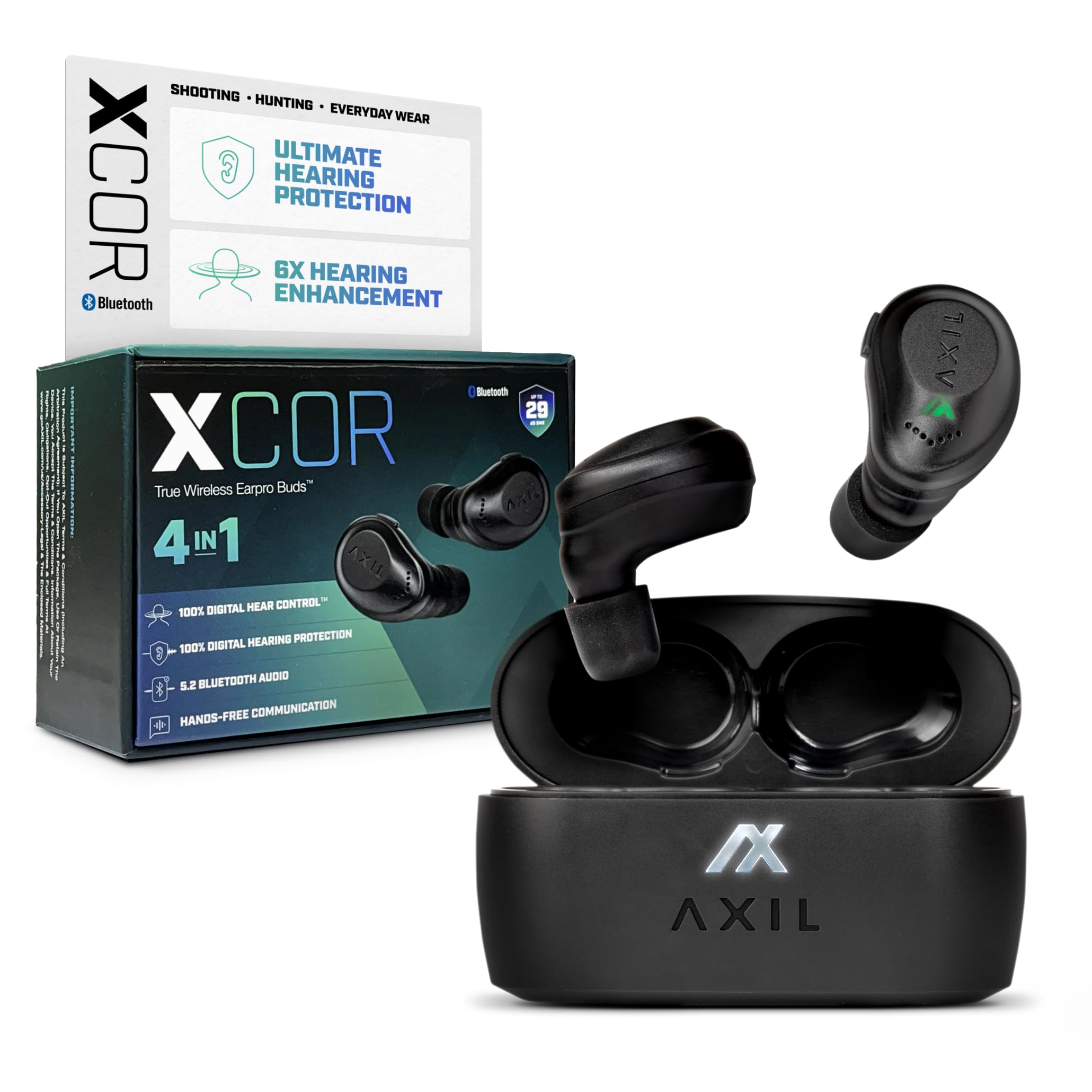
True-wireless buds that let a hat and sunglasses wearers keep protection in without a headband.
These wear inside the ear with no cord or headband, so a wide-brim hat and sunglasses both fit. The HearPRO circuit compresses gunfire over 85dB rather than cutting it off entirely, so you keep awareness of the woods around you.
The battery is listed at 12 hours per charge, and the carrying case recharges the buds between sits. Touch control on the bud handles volume and playback, and Bluetooth pairs to a phone or some two-way radios.
Size down the tips and the fit locks in — multiple tip sizes ship in the box, and the buds stay put during action shooting. The known trade-off is the foam tips: they are the ones that block the most sound, and some find them uncomfortable for long wear. A few report the battery fading after a couple of years, and wind noise is easily picked up on open ridges.
Why hunters rate the awareness: it lets a brim-hatted walker hear a deer step while still muffling a rifle shot into a bearable thump.
Go this route: if a hat or sunglasses rule out muffs and you want the buds truly cord-free.
Rethink it: if long foam-tip wear bugs you or you need the highest possible noise reduction.
6. Elgin Rebel True Wireless Earbuds
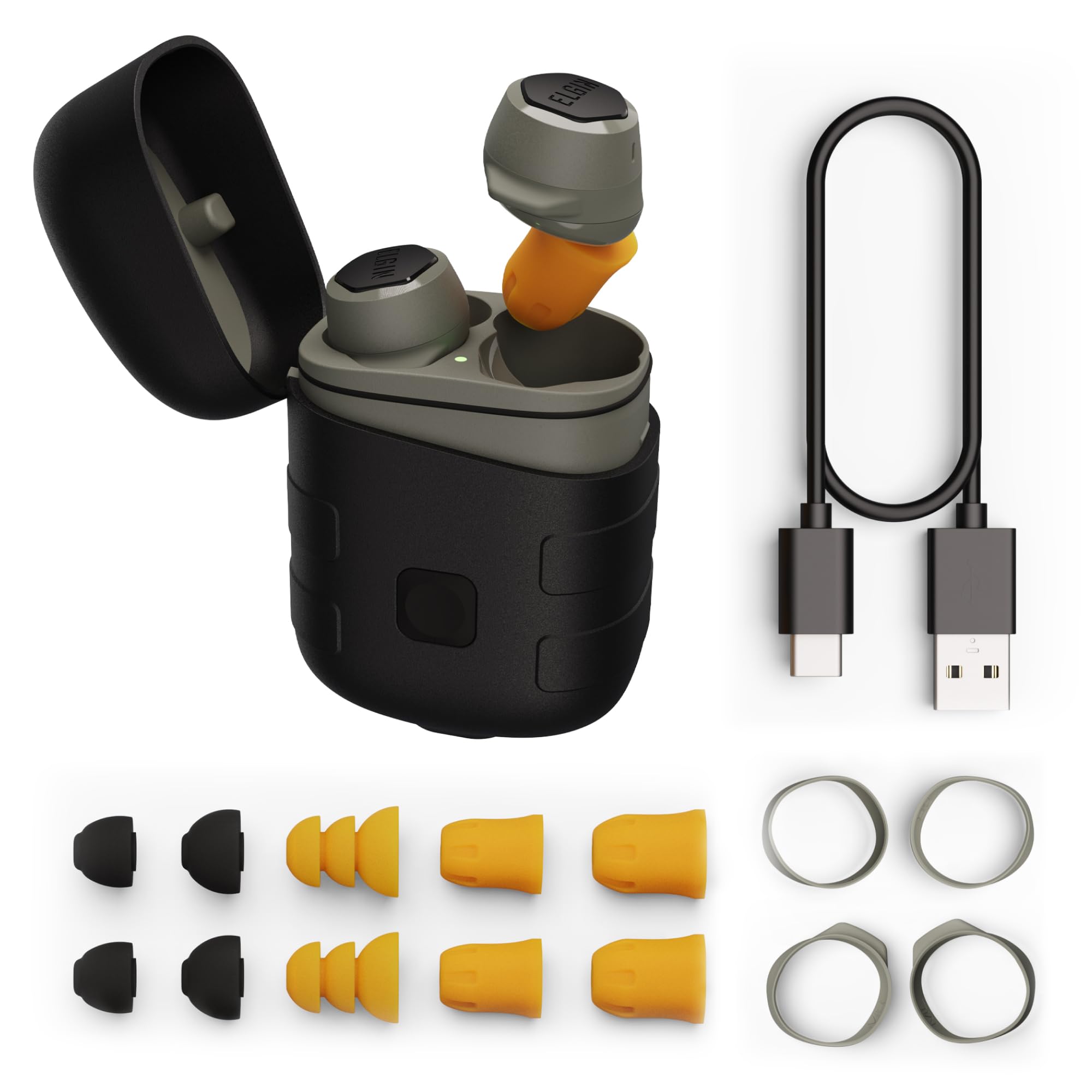
The highest protection number in the group, from a bud that seals your ear like a foam plug.
An ANSI-certified 31 dB NRR is the top figure here — 9 dB above the ZOHAN’s 22 dB and 5 dB above the AKT1’s 25 dB. That is real protection for loud gunfire, and it comes from a passive foam-tip seal rather than a speaker.
Then there is the battery: 12 hours of continuous playback per charge, and up to 40 hours total from the charging case. That is enough for a long day and a backup charge in the truck. Bluetooth 5.3 holds a connection up to 50 feet, and an IP65 rating keeps dust and rain out. The case even packs an integrated LED task light up to 250 lumens.
The honest trade-off is the connection. Pairing can be fiddly, and some report dropouts in noisy plants. Comfort on the supplied foam tips also varies — the largest foam tip, seated like a safety plug, is the trick to good sound. There is no volume control on the buds themselves.
Why it stands out: true-wireless convenience with the protection of a real plug, and a battery that outlasts most competitors here.
Best for: hunters who want top-tier passive protection and marathon battery life in a cord-free bud.
Not ideal if: you need glove-friendly on-bud volume or a pairing process that never hiccups.
7. 3M PELTOR EEP-100 Ear Plug Kit

Small electronic plugs that slip deep into the canal and leave your cheek flat on the stock.
These are in-ear plugs, not muffs, and the small lightweight body helps them disappear against a rifle cheek weld. External microphones let you hear communication and your surroundings without pulling the plugs out, capped at 82 dB.
Power comes from a rechargeable lithium-ion battery rated up to 16 hours of continuous operation — the longest run time in this group — and recharging goes through micro-USB. The kit is IP54 rated (protected against dust and splashing water) and ships with several tip sizes plus a pocket charging case.
Inside a poorly designed indoor range or in a vehicle, these need to be doubled up with muffs. Foam tips wear out over time, and the low volume setting sounds close to off. The charging port has been a weak point for a small number of units.
Craftsman’s choice: for the hunter who moves in and out of noise — walking, calling, then a single shot — the one-button volume and instant cutoff feel built for the field.
Buy this if: you value a low-profile in-ear fit and the longest battery life, and want a proven brand behind it.
skip it if: you need a single plug to handle a loud indoor range on its own.
Know the Specs
Noise Reduction Rating (NRR)
NRR is a decibel figure that estimates how much sound a protector blocks in a lab test. A higher number means more protection, but the number assumes the ear tip seals perfectly — a loose tip drops it in real life. When comparing buds, remember that passive foam plugs tend to post higher NRRs than electronic buds with speakers inside them.
Sound Amplification And Compression
Amplification is the microphone boosting quiet sounds so you hear a bird or a voice. Compression is the circuit clamping down on loud sound so it never reaches your ear at full strength. The faster the cutoff, the less of the gunshot peak slips through; some makers state the trigger point in decibels and the cutoff time in fractions of a second, which is worth checking.
IP Ratings For Field Weather
An IP rating is two digits: the first covers dust, the second covers water. A higher second digit means more water resistance, while the dust digit tells you how sealed the electronics are against grit. For hunting across wet and dusty ground, you want at least a mid-range score on both digits so a drizzle or a drop does not end the season.
Battery Life And Charge Style
Battery hours tell you whether a bud lasts a full sit, and the charge style tells you if you need a cable or can swap disposable cells. Rechargeable buds with a charging case carry their own backup power, so you can top up in the field. AAA-powered muffs skip the charging ritual entirely, so you just swap cells. Match the style to how you actually hunt — a long sit versus quick trips.
Common Questions
Are in-ear electronic buds as protective as over-ear muffs for hunting?
What NRR do I need for hunting with a rifle or shotgun?
Will wind noise ruin the amplification in the field?
Can I wear electronic buds under a wide-brim hat and sunglasses?
How long will the battery really last on a hunt?
Are these safe for water and rain?
Do electronic buds still protect me when the battery dies?
Should I double up with foam plugs under my electronic buds?
What is the difference between passive and active noise reduction here?
Do these buds work with Bluetooth for calls and music while hunting?
The Bottom Line
For most hunters, the best overall pick is the AKT1 Sport Sound Amplification Earmuff because its 25 dB NRR is the highest protection in this group and its speech passthrough sounds natural instead of tinny. If you want the top passive protection with marathon battery life, grab the Elgin Rebel at 31 dB NRR. And for a low-profile in-ear plug that leaves your cheek flat on the stock, the 3M PELTOR EEP-100 is the one to reach for.
How we choose
We do not accept paid placement. Every pick is matched to a real buyer and a real use-case; we do not hands-on test units.
Sources
Specifications: manufacturer listings and product documentation. Review insights: verified customer reviews, as of October 2026. Pricing: not shown on this page (it changes often); check the current price via the retailer link.
As an Amazon Associate, Aappliancez earns from qualifying purchases. This does not affect which products we feature.