Disclosure: Some links in this post are affiliate links. As an Amazon Associate I earn from qualifying purchases, at no extra cost to you. Learn more
Specs are compiled from manufacturer listings and verified buyer reviews and can change over time — please confirm the key details on the product page before buying.
The machine you want is the one whose channel count matches the area you need to treat. A two-channel unit covers one knee or one shoulder. A four-channel unit covers a lower back, or two body parts at once, with eight pads stuck on at the same time. That single number decides more of your daily experience than any brand name, and it is the first thing to check before you buy.
This guide is built by comparing the manufacturers’ published specifications and the patterns across verified customer reviews, so you get each pick’s real strengths and trade-offs instead of marketing spin.
Below you will find the channel counts, program counts, and pad setups side by side, plus the honest limits nobody puts on the box. These are the NMES Machine picks that actually match how people use electrotherapy at home.
Top Picks


How To Choose The Best NMES Machine
Start with the body area, not the feature list. An NMES machine (neuromuscular electrical stimulation — it sends pulses that make a muscle contract without you moving it) is only as useful as the number of pads you can place at once. Everything else is secondary.
Channels decide your coverage
A channel is one independent output, and each channel drives two pads. Two channels means four pads on your skin. Four channels means eight pads. If you are working a single quad after knee surgery, two channels is plenty. If you want both shoulders, or a full lower back, four channels is the honest minimum.
This is the single spec that separates the picks below. A four-channel unit covers roughly double the skin area of a dual-channel one, which is exactly why the four-channel models earn their place at the top of this list.
Preset programs versus manual control
A preset program is a factory-set recipe of frequency (pulses per second) and pulse width (how long each pulse lasts). Presets are fast and forgiving. Manual control lets you dial those two numbers yourself, which matters if a physiotherapist gave you specific settings to follow.
The trade-off is real: preset-heavy units are easier to start with, but a few of them lock you out of changing duration or frequency mid-program. Know which kind of user you are before you commit.
Pads, gel, and running costs
Electrode pads are the part that touches your skin and the part that wears out first. Self-adhesive pads lose grip as they pick up oil and lint. Damp cleaning extends their life; eventually they stop sticking and need replacing. Check how many pads come in the box, because a generous starter kit saves you a reorder in month two.
Power: rechargeable or battery
A rechargeable unit means no scrambling for batteries mid-session. A 9V or AA unit means you can swap in fresh cells anywhere. Both work; pick based on whether you travel with the device or keep it on a nightstand.
Side-by-Side Comparison
| Model | Best For | Channels | Programs | Power | Amazon |
|---|---|---|---|---|---|
| Med-Fit 906A Premier 4 Channel★ Best Overall | Full back and multi-area sessions | 4 (up to 8 pads) | 24 | Rechargeable | Amazon |
| TAMTEC-HANA Sport 2Best for Russian Stim | Simple home use with Russian stim | 2 (4 pads) | 8 | Rechargeable | Amazon |
| TENS 7000 Pro Rechargeable | Clipping on and treating while you move | 4 (8 pads) | 8 modes | Rechargeable | Amazon |
| iStim EV-906 | Sensitive skin and high intensity range | 4 (8 pads) | 30 | 2 AA batteries | Amazon |
| Chattanooga Primera | HAN waveform rehab work | 2 (4 pads) | 14 (8 TENS + 6 NMES) | 9V battery | Amazon |
| Compex Performance 3.0 | Athletes training and recovering | — | 6 | Rechargeable, up to 8 hours | Amazon |
Detailed Reviews
1. Med-Fit 906A TENS EMS Combo
Our pick — 4.5+★ from 350+ verified ratings; the strongest balance of quality and price.
Four channels of coverage in a package that weighs just over a pound.
This one wins on raw versatility. Four independent channels put eight pads on your skin at once, so you can work a lower back and a shoulder in the same sitting. The 24 programs split into 12 TENS routines and 12 muscle-stimulation routines — TENS being the mode that blocks pain signals, NMES being the mode that makes a muscle contract. It holds 4.5+ stars across hundreds of ratings, and reviewers keep returning to the build quality.
It is also genuinely portable. The whole unit weighs 1.1 pounds including batteries, and it is fully rechargeable, so you are not buying cells every few weeks. A large clear display and an extra-large liquid crystal readout keep the settings readable without your glasses. The four channels have independent level control, which means you can push hard on a stubborn area and keep another at a gentle tick.
The honest catch is learning curve. This is a programmable instrument, and the manual leaves gaps — you will be fiddling with frequency and pulse width before you find the setting that suits your body. Powerful enough, in fact, that the shock sensation catches people off guard at higher intensities, so start low. One buyer reports it “relieved 30-year chronic neck muscle tightness after a couple hours, though tender afterward” — the tenderness is the tell that the intensity was high.
The real strengths here
- Four independent channels cover eight pads on one body area
- 24 programs split between 12 TENS and 12 muscle-stimulation routines
- Full rechargeable operation — no battery-buying treadmill
- 1.1 pounds with batteries, so it travels easily
- Large readable display with clear settings
Where it asks patience
- The manual is thin for such a programmable machine
- Frequency ramps do not set individually and reset after programs
- Pin-type leads are awkward to connect one-handed
- High intensities deliver a strong, surprising jolt — dial up slowly
Best fit for: Anyone treating a lower back or two body parts at once, who wants professional-level control on a rechargeable unit.
Think twice if: You want to press one button and be done — the manual-frequency tinkering will frustrate you.
2. TAMTEC-HANA TENS/EMS Dual Channel Unit
The dual-channel home unit that sneaks Russian stimulation into a beginner-friendly shell.
Eight programs, two independent channels, four pads at once. That is the whole pitch, and for a lot of people it is enough. The screen is large, the buttons are soft, the timer is adjustable, and there is a carrying case with compartments in the box. The current draw is where this one earns its keep, though — the intensity range runs deep enough that people who only ever use a fraction of the levels find plenty of headroom.
The standout feature is Russian stimulation (R-stim — a muscular-contraction waveform that is hard to find on consumer units). It matters if you are working on muscle re-education after injury, where the machine has to drive a contraction for you. One family bought it to help with limb neglect and used it with therapist guidance over months. The 8 programs versus the 24 on the Med-Fit is a meaningful drop in variety, and that is the trade you accept here.
Portability is the other reason to look at this. It weighs 3.24 pounds against the Med-Fit’s 1.1, so it is not the pocket companion, but it is self-contained and rechargeable. Settings are clearly marked on the screen for elderly or non-tech users, which is rarer than you would think. The downside is limited program control — you can change intensity but not duration, frequency, or on/off timing on some modes.
What wins people over: Quality is the thing the review pages praise most, and the R-stim mode is the magnet for rehab users.
The honest trade-off: At 3.24 pounds it is a desk or bag unit, not something you clip on and walk around with.
Reach for this if: You need Russian stimulation for muscle re-education and want a unit simple enough for a family member to operate.
Look elsewhere if: You want granular control over frequency and treatment timing — this one decides for you.
3. TENS 7000 Pro 4 Channels
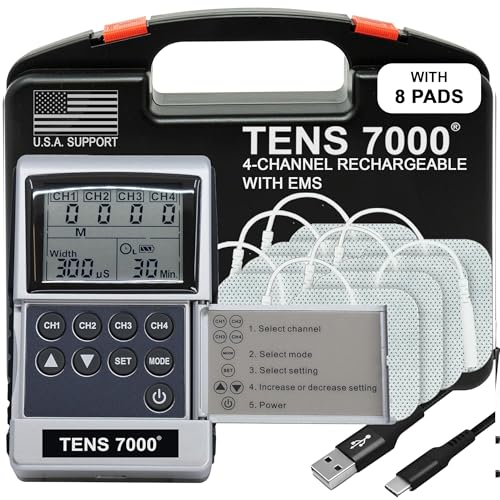
A four-channel stim you can clip to your belt and wear while walking.
This is the pick for people whose pain follows them to work. The unit clips to a belt, so you can run a session while walking the floor, cooking, or standing at a counter. That sounds small until you have used a machine that lives on a desk — being untethered changes how often you actually stick the pads on. It delivers through 4 channels and 8 pads, which puts it in the same coverage class as the Med-Fit above.
You get several long sessions per charge from the rechargeable cell, so you are not hunting for batteries mid-week. One recent buyer moved up from the older battery-powered four-pad version to this one for the rechargeable build and the doubled pad count. The box includes 8 electrodes (the sticky pads that deliver the current) and a carrying case, and the unit feels durable in the hand. Buyers praise functionality most in their reviews, and the 8 pads back that up.
The catch is the interface. There is no screen backlight, so low-light sessions mean leaning toward a lamp. It does not save multi-setup profiles, and it resets channel intensity between sessions — one frustrated buyer counted around 200 button presses to rebuild a setup, with beeps throughout. It also cannot run while charging. None of that is fatal, but it does mean the first week is fiddly.
The one for you if: Your pain does not stay put, and you want eight pads and a belt clip so you can treat while upright.
The catch: Rebuilding your settings each session and a screen that needs decent light — manageable quirks, not deal-breakers.
4. iStim EV-906 TENS EMS

Thirty programs and a hundred intensity steps for people who want fine detail.
The specification that turns heads here is the intensity range. It climbs to 100, and people who had only ever used units that top out at 20 notice the difference immediately — the ramp from gentle tingle to real contraction is far longer and far finer. Four channels and 30 preset programs give you a lot of ground to explore, and the pack ships with 24 electrode pads in two shapes.
The pads themselves are the other selling point. They use a Japanese gel formula designed for sensitive skin, which is why this unit attracts people who react badly to ordinary adhesive. The manual is thorough, covering all 30 programs and pad placement, and the battery gives many uses between charges. It is FSA/HSA eligible, so you can pay with health savings account funds.
Where it asks something of you is power source and packaging. It runs on 2 AA batteries rather than an internal rechargeable cell, so you are back to buying cells. The wires are not color-coded, which slows down pad setup when you are matching leads by feel. And the carrying case has not always made it into the shipment — check the box contents on arrival.
Where it shines: That 100-step intensity ladder and Japanese gel pads make it the pick for skin that reacts to ordinary adhesive.
What to know first: AA batteries, plain wires, and a case that occasionally misses the boat — small papercuts on an otherwise strong unit.
Choose this when: You want fine intensity control and pads that treat sensitive skin gently, and you can live with AA cells.
Pass if: An internal rechargeable battery and labeled wires are non-negotiable for you.
5. Chattanooga Primera TENS/NMES Unit with HAN Waveform

The rehab-world name, with a waveform you will not find on consumer units.
Fourteen programs split into 8 TENS and 6 NMES, and the one that matters is HAN. That waveform mixes low- and high-frequency stimulation in a single session, and it is the reason therapists reach for this box. The 8 TENS and 6 NMES presets cover Continuous, Burst, Modulated, HANS, and NMES modes, which is a more clinical menu than the consumer units above offer. Effectiveness is the thing the reviews praise most, and it is the reason the unit shows up in rehab settings.
The package is complete and practical: carrying case, 9V battery, lead wires, electrodes, and an electrode positioning back belt. A belt clip keeps it on you, and the open-circuit safety feature means the unit will not fire if a pad loses contact. Setup is quick — the manual walks you in within about 15 minutes of opening the box. One family bought it after a pelvic floor therapist used one, and another used it for stroke recovery hand and arm work.
The honest limits are the output count and the pads. Two outputs means four pads, which is short of what the four-channel units above offer — one reviewer returned theirs because a full back treatment needed more coverage. There is no end-of-session alarm, and the included pads have been known to stop sticking within a couple of weeks. The 9V battery works fine but is not rechargeable.
Why rehab users seek it: The HAN waveform and NMES modes give a clinical menu that consumer boxes cannot match.
The limits to weigh: Only two outputs and pads that wear fast — budget for replacements early.
It suits: Anyone doing therapist-guided rehab who needs the HAN waveform and a clinical NMES menu.
It does not suit: Full-back coverage — two outputs will leave you short.
6. Compex® Performance™ 3.0 Muscle Stimulator with TENS Kit

Built for the gym bag, not the medicine cabinet.
Compex targets a different buyer than everything else here. This is a training tool: 6 programs covering 1 Warm Up, 3 Strength, 1 Recovery, and 1 TENS, meant to be used before, during, or after a workout. The redesign brought a water-resistant silicone sleeve, an improved LCD, a center navigation button, and better grip. The USB-rechargeable battery runs up to 8 hours per charge — the longest on this list.
The output range runs from 1 to 100 levels, and users report needing only around 60 for plenty of strength — a sign the ceiling is high. Build quality and the guided interface are what buyers like most, along with fast recovery from soft-tissue strains. One owner used it on a torn calf and reported noticeably faster recovery. The unit comes with a TENS kit included, so it doubles as a pain-relief device between training sessions.
The split in reviews comes from the fixed program menu. Six programs is a small number next to the 24 on the Med-Fit or the 30 on the iStim, and there is no manual frequency control to fall back on. The charging port uses an older mini-USB connector, which limits third-party accessory options, and the port cover has broken on some units. The silicone sleeve also attracts dust through its larger port openings.
Why athletes pick it
- Up to 8 hours of stimulation per USB charge — the longest on this list
- 6 focused programs: Warm Up, 3 Strength, Recovery, TENS
- Water-resistant silicone sleeve and improved grip
- 1–100 intensity levels with strong output even mid-range
Where it holds you back
- Only 6 programs and no manual frequency control
- Mini-USB charging port limits third-party accessories
- Port cover and silicone sleeve openings have proven fragile
Made for: Gym-goers who want warm-up, strength, and recovery programs in one water-resistant unit with up to 8 hours per charge.
Not for: Anyone who wants manual frequency dialing or a broad preset menu — six programs is the whole menu.
Know the Specs
Channels and Pads
A channel is one independent electrical output, and each channel drives two electrode pads. So two channels equals four pads on your skin, and four channels equals eight. More channels means you cover more body area in one session — a lower back plus a shoulder, for instance. It does not mean the machine is stronger; it means it can treat more places at once.
Programs and Presets
A program is a factory-set combination of pulse frequency and pulse width, matched to a treatment goal. TENS programs block pain signals; NMES programs drive muscle contraction. More programs mean more recipes to try without dialing settings yourself. Fewer programs with no manual control means you are locked into the factory menu.
Frequency and Pulse Width
Frequency (measured in hertz, or pulses per second) sets how fast the pulses arrive. Pulse width sets how long each pulse lasts. Together they change the feel from a gentle tingle to a firm contraction. Manual units let you dial both; preset-only units pick for you. Start low and increase slowly — the sensation at high intensity is strong.
Power Source
A rechargeable battery frees you from buying cells and keeps treatment consistent. A 9V or AA unit lets you swap in fresh cells anywhere, which suits travel. Battery life varies widely: some units run several sessions per charge, others stretch to a full week of daily use. Match the power type to where you will use the machine.
Common Questions
How many channels do I need for lower back pain?
What is the difference between TENS and NMES?
Can I use an NMES machine while walking around?
How often do I need to replace the electrode pads?
Is a rechargeable NMES machine better than a battery one?
What does the HAN waveform do that other modes do not?
How many intensity levels do I need?
Can I use these units on sensitive skin?
Do these units work for muscle re-education after stroke or injury?
Will an NMES machine replace physical therapy?
The Bottom Line
For most people, the best nmes machine is the Med-Fit 906A Premier 4 Channel. It gives you four independent channels (each channel is a separate circuit you can set on its own) and 24 programs, so you can treat a lower back or two body parts at once. It also runs fully rechargeable, so no disposable batteries. If you want a belt clip so you can treat while upright, the TENS 7000 Pro Rechargeable delivers four channels and eight pads in a wearable package. And if your therapist works with the HAN waveform (a specific electrical pulse pattern), the Chattanooga Primera is the one to reach for. The Med-Fit backs its 4.5+ stars across hundreds of ratings with four independent channels — more coverage than any other pick here.
How we choose
We do not accept paid placement. Every pick is matched to a real buyer and a real use-case; we do not hands-on test units.
Sources
Specifications: manufacturer listings and product documentation. Review insights: verified customer reviews, as of October 2026. Pricing: not shown on this page (it changes often); check the current price via the retailer link.
As an Amazon Associate, Aappliancez earns from qualifying purchases. This does not affect which products we feature.