Disclosure: Some links in this post are affiliate links. As an Amazon Associate I earn from qualifying purchases, at no extra cost to you. Learn more
Specs are compiled from manufacturer listings and verified buyer reviews and can change over time — please confirm the key details on the product page before buying.
You want circulation support, but you do not want to choke down a gritty pink powder every morning. Capsules solve that, and the four below are the ones worth your money. The real decision is simpler than the shelf makes it look: a single-ingredient amino acid, a beet-root capsule with a printed nitrate percentage, a gummy you actually enjoy, or a broad multi-ingredient stack? Each of these four answers a different version of that question. Picking the wrong shape is the usual reason people quit after three weeks.
This guide is built by comparing the manufacturers’ published specifications and the patterns across verified customer reviews, so you get each pick’s real strengths and trade-offs instead of marketing spin.
Below you get plain-English translations of the label jargon — nitrate standardization, extract ratios, serving sizes — plus honest notes on who each formula actually fits. These four are the nitric oxide supplements for blood pressure support worth starting with.
Top Picks

How To Choose The Best Nitric Oxide Supplements for Blood Pressure
The label on a beet root bottle is doing two jobs at once: telling you what is inside, and hiding how much of it you actually get per day. Those are different things, and the gap between them is where most buyers get burned. Read the four points below before you pick a bottle, because they decide whether a formula fits your routine or sits half-finished in a cabinet.
Read the extract ratio and the milligrams together
A ratio like 20:1 or 30:1 describes how concentrated the beet material is — it means the extract was reduced down from a larger amount of raw root. That ratio says nothing about your dose on its own. You need the milligram figure beside it: the Beet Root Extract 20:1 here lists 600 mg per serving, which is a real number you can compare. A high ratio with no milligram figure tells you almost nothing about what you swallow.
Check what counts as one serving
This is the most common misread on any supplement label. A bottle that says 180 capsules is not 180 doses if a serving is two capsules — it is 90 servings. One capsule formula here asks for three capsules daily, which changes how fast a 120-count bottle empties. Multiply serving size by daily frequency before you judge how long a bottle lasts.
Decide if you want one ingredient or a stack
Single-ingredient formulas keep things clean and easy to reason about — you know exactly what you are taking. Multi-ingredient stacks bundle beet root with things like CoQ10, hawthorn berry, and amino acids so you are not opening four bottles. Neither is better in the abstract. A stack suits someone consolidating; a single ingredient suits someone who wants to isolate one variable at a time.
Be realistic about taste and format
Capsules and gummies avoid the earthy beet flavor that makes powders a chore. Gummies introduce their own variable — flavor — and reviews split on it hard. If you already know you dislike a strong strawberry or earthy note, capsules are the safer format for daily consistency. A capsule or gummy you will actually take daily beats a better-labeled powder you skip.
Side-by-Side Comparison
| Model | Best For | Format & Count | Key Actives | Serving Size | Amazon |
|---|---|---|---|---|---|
| Pure Encapsulations L-Arginine★ Best Overall | Clean single-ingredient support | 90 capsules | L-arginine HCl (free-form) | 2 capsules, 1–3 times daily | Amazon |
| Beet Root Extract 20:1 | Best nitrate transparency | 180 capsules | Beet root 20:1 (600 mg) + black pepper extract | 2 capsules | Amazon |
| PrimeMD Heart Health Nitric Oxide Support | Consolidating a supplement stack | 120 capsules | 26-ingredient blend with CoQ10 (100 mg) | 3 capsules daily | Amazon |
| Vital Beets 30:1 Beet Root Gummies | People who skip pills | 60 gummies | Beet root 30:1 + L-theanine, grape seed, vitamin C | Gummy serving (see label) | Amazon |
Detailed Reviews
1. Pure Encapsulations L-Arginine, 90 Capsules
Our pick — 4.5+★ from 1,000+ verified ratings; the strongest balance of quality and price.
One amino acid, no filler list, and a label you can actually read straight through.
This is the pick for the person who wants to isolate one variable. L-arginine is an amino acid the body uses in the pathway that produces nitric oxide — the signal molecule that tells blood vessels to widen — so a single-ingredient arginine capsule keeps your routine easy to reason about. Pop two capsules between meals, up to three times a day, and nothing else in your stack changes. The formula is free-form L-arginine HCl, meaning the amino acid is already in its standalone, unbound form rather than attached to a larger protein.
What wins people over here is the manufacturing discipline: no common allergens, no artificial ingredients, no GMOs. Pure Encapsulations builds this around leaving things out — no common allergens, no artificial ingredients, no GMOs — and that restraint is exactly what a buyer scanning a supplement aisle for the cleanest possible bottle is looking for. The ingredient list is short and readable, which is rare in a category stuffed with 20-item blends.
The catch is arithmetic. A 90-count bottle with a two-capsule serving and a label that permits up to three servings a day will empty quickly if you go full dose — so plan your reorder before the bottle runs low. If you want maximum ingredient count for your money, the PrimeMD stack below covers far more ground per bottle.
What earns it the top slot
- Clean, short ingredient list with no artificial additives or common allergens — easy to audit.
- Free-form L-arginine HCl in a straightforward two-capsule serving.
- Flexible dosing: 1–3 servings daily, taken between meals.
- Non-GMO and gluten free, which matters if you already screen labels.
Where it asks you to compromise
- A 90-count bottle at two capsules per serving leaves you counting days, not months.
- Single-ingredient means no beet root, no CoQ10, no supporting botanicals.
- The highest cost per capsule of the four here.
Reach for this if: you want one clean amino acid and nothing else in the capsule.
Look elsewhere if: you would rather one bottle cover beet root, CoQ10, and botanicals in a single daily dose.
2. Beet Root Extract 20:1 Concentrated Supplement 180 Caps

The only bottle here that prints its nitrate percentage — and that number is the whole point.
Beets help because they carry dietary nitrates, which your body converts into nitric oxide. Most beet labels wave at that idea without quantifying it. This one states that its 600 mg serving of Beet Root Extract 20:1 is standardized to no less than 4% nitrates. A standardized figure means each batch is held to that minimum, so the active content stays consistent bottle to bottle instead of varying with the harvest. If you want a number to anchor on, that 4% is the most useful printed spec in this whole comparison.
The capsule count is where this separates from everything else. At 180 capsules with a two-capsule serving, you get 90 servings per bottle, and buyers report it provides about 3-4 months of supply — a figure that lines up neatly with a once-daily two-capsule habit. Set that against the Pure Encapsulations 90-count bottle above and the difference is plain: this one is built for the long haul, not a monthly reorder. Black pepper extract at 10 mg is folded in specifically to support absorption. The formula is third-party lab tested in the USA for purity and potency, made in a GMP-certified facility (a facility held to good manufacturing practice standards), and free of gluten, soy, dairy, caffeine, and artificial colors.
Buyers trust it most for purity, with effectiveness close behind — they describe it doing the job they bought it for rather than just tasting like beets. The physical footprint tells you how lean this bottle is: at 0.42 ounces against the Vital Beets gummies’ 8.47 ounces, it slips into a drawer or travel bag without a second thought. The honest trade-off is format. It is a capsule with no flavor to speak of, which is a benefit for most and a downside only if you struggle to swallow pills.
Why it ranks second, barely: a 600 mg standardized serving, a real nitrate floor, and the longest supply in the group make this the most efficient per-capsule buy. It falls just short of the top slot only because a single-ingredient beet capsule leaves out the amino acids and CoQ10 (coenzyme Q10, a compound your body uses for cell energy) that a stack brings.
Small heads-up: it is a capsule, so if swallowing pills is a daily negotiation for you, the gummy below solves that problem directly.
The smart-money pick: best for anyone who wants a documented nitrate level and a bottle that quietly lasts a season.
The one snag: no flavor, no gummy format — pill-swallowers only.
3. PrimeMD Heart Health Nitric Oxide Support
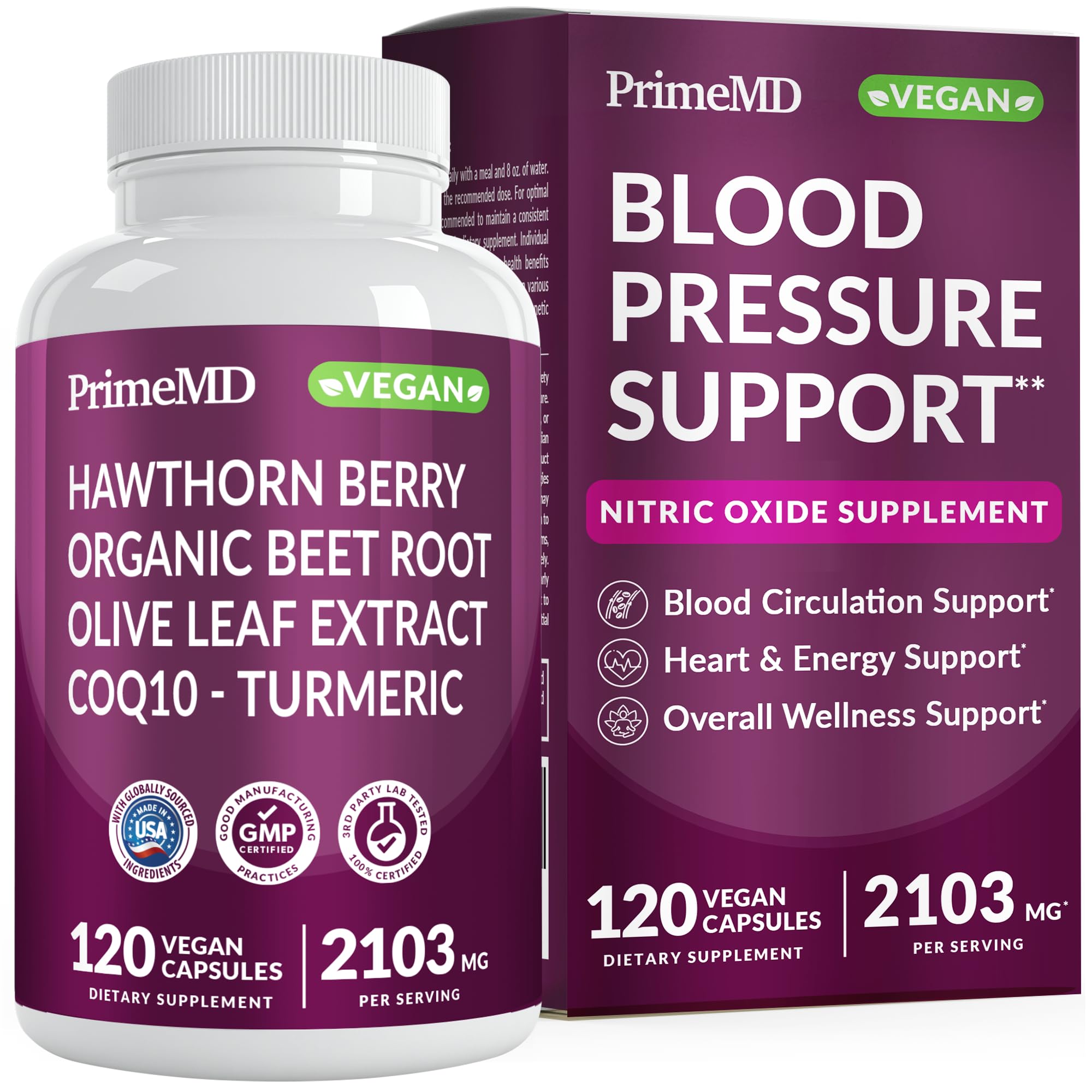
Twenty-six ingredients in one bottle — the closest thing here to replacing your whole supplement shelf.
Most nitric oxide products list three to five ingredients and call it a formula. This one goes the other direction entirely, stacking organic beet root with hawthorn berry, olive leaf extract, garlic, turmeric, L-amino acids, and CoQ10 at 100 mg plus chromium picolinate at 200 mcg. If you are already taking CoQ10 and a beet capsule separately, this consolidates both into one bottle and one swallow. That consolidation is the actual purchase rationale — not that more ingredients automatically beats fewer.
The bottle size tells you how much is inside. At 4.5 x 5.75 x 6.81 inches it is a noticeably larger bottle than the Beet Root Extract 20:1 at 2.5 x 2.5 x 4.5 inches. That extra volume is the 26-ingredient payload, so this one wants a shelf, not a travel pouch. The capsules are made with vegan ingredients in a GMP-certified facility (a plant held to good manufacturing practice standards) and are free of artificial fillers and gluten. Buyers single out the swallowability, which matters given you take three capsules daily with a meal and 8 oz of water.
The trade-off is the serving size and the breadth itself. Three capsules a day from a 120-count bottle gives you 40 servings — a shorter runway than the 180-count beet bottle, so factor that into how often you reorder. Breadth also cuts both ways: if you are trying to figure out what actually works for you, a 26-ingredient blend makes it impossible to isolate one variable. It is a consolidation tool, not a diagnostic one. An occasional note about taste appears in the feedback, though capsules are swallowed whole, so it tends to be the least of the issues.
The stacker’s case: CoQ10 at 100 mg, chromium picolinate, and nineteen-plus botanicals in one daily routine means fewer bottles on the counter and fewer moving parts to forget.
What you give up: 40 servings per bottle at three capsules daily is the shortest supply here, and a formula this broad is the opposite of an elimination test.
Best for the overloaded shelf: anyone over 40 who wants heart-support ingredients bundled into a single bottle.
Pick a simpler formula if: you want to know which single ingredient is doing the work.
4. Vital Beets 30:1 Beet Root Gummies
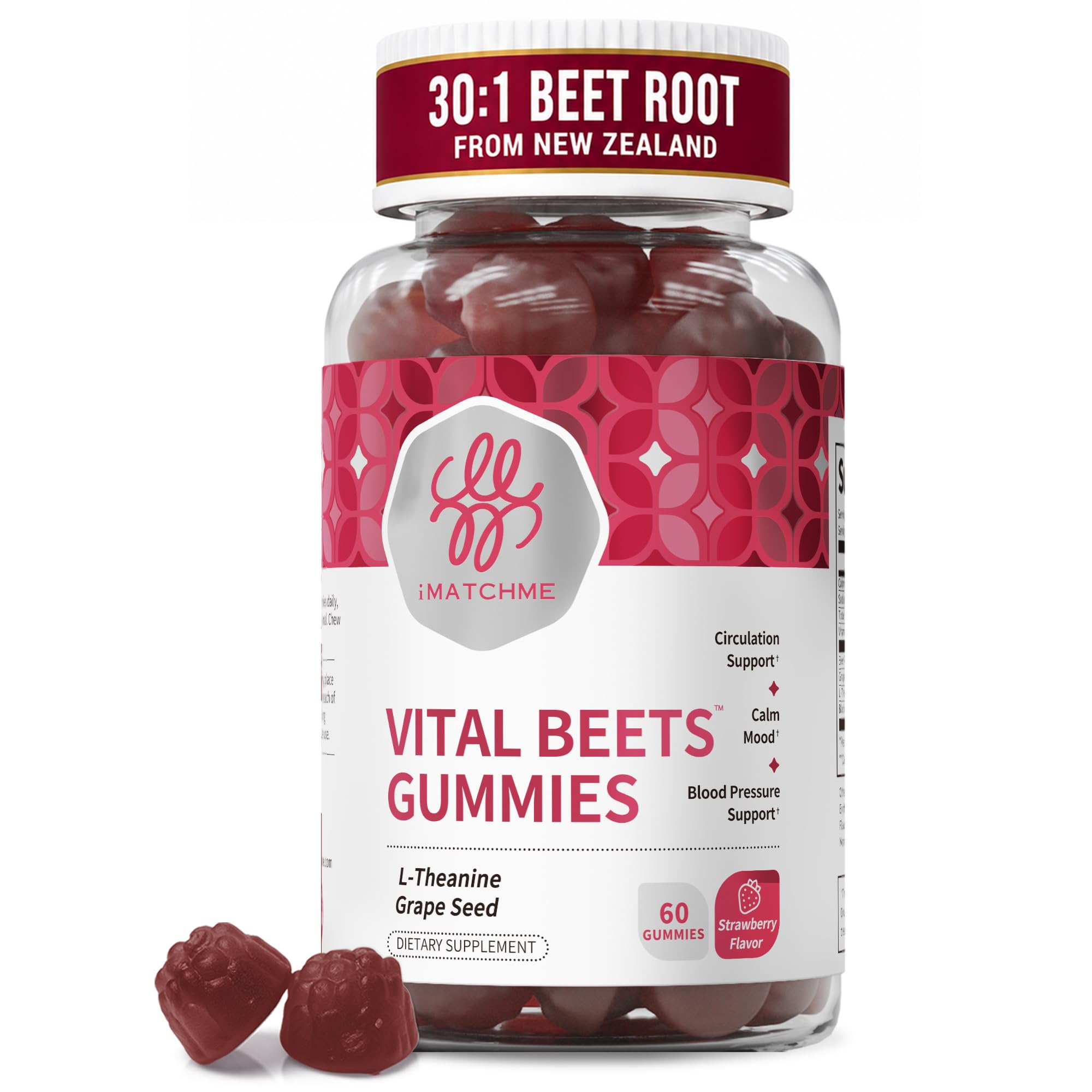
A sugar-free strawberry gummy that makes daily beet intake something you look forward to.
If you have ever opened a beet powder and immediately regretted it, this is the format that fixes the adherence problem. The formula uses a concentrated 30:1 beet root extract sourced from New Zealand, blended with grape seed extract, L-theanine, vitamin C, and black pepper extract. That L-theanine is the reason “calm focus” sits in the name — it is the amino acid associated with a relaxed-but-alert state rather than drowsiness. The gummies are vegan and sugar-free, and the brand recommends taking them after meals rather than right after brushing teeth or using strong mouthwash.
Buyers praise the gummies most for effectiveness and health benefits. Buyers keep taking these gummies past the first bottle, which is the real test of any supplement. The weight says a lot too: at 8.47 ounces against the Beet Root Extract capsules’ 0.42 ounces, this is a jar of chewy gummies, not a pocket bottle. It wants a spot in the kitchen rather than a gym bag.
Here is the honest part. Taste is the single most-discussed aspect of these gummies and the response is genuinely split — some people love the strawberry note, others find the sugar-free finish off-putting. A few describe stomach discomfort. The brand also warns that in warm weather the gummies can soften or stick together in shipping. That does not affect quality, but it does mean you may need to separate them. Compared with the Pure Encapsulations and Beet Root Extract capsules above, this is the least transparent on nitrate content. The 30:1 ratio is stated, but no standardized nitrate percentage is printed, so you are trusting the extract concentration rather than a measured figure.
The adherence advantage: a sugar-free, vegan, strawberry gummy with L-theanine and vitamin C built into a 30:1 beet formula — the easiest of the four to take every single day.
The honest caveats: flavor divides people sharply, and the label gives you an extract ratio but not a standardized nitrate percentage.
Made for the powder-averse: pick this if pills and earthy drinks are why your last supplement bottle went unfinished.
Think twice if: you want a printed nitrate percentage to anchor on, or you are sensitive to sugar-alcohol aftertastes.
Know the Specs
Extract Ratios (20:1, 30:1)
A ratio tells you how much raw beet went into the extract — a 20:1 extract was reduced from roughly twenty parts of root to one part of concentrate. It describes concentration, not your dose. You still need the milligram figure: the Beet Root Extract here lists 600 mg per serving, and the Vital Beets gummies state a 30:1 extract without a milligram-per-serving nitrate figure. Treat the ratio as one half of the story and hunt for the milligrams as the other.
Standardized Nitrate Percentages
“Standardized to no less than 4% nitrates” means every batch is held to that minimum, so the active content should not swing from bottle to bottle. That is different from a label that simply says “beet root” and leaves the nitrate level unstated. If a number like 4% appears, it is the most decision-useful spec on a beet product — it is the only figure that speaks directly to what the beet is there for.
Serving Size vs. Capsule Count
A bottle’s capsule count is not its number of doses. The Beet Root Extract 20:1 lists 180 capsules at two capsules per serving, which works out to 90 servings — owners mention roughly 3-4 months of supply on that basis. PrimeMD lists 120 capsules at three per day, which is 40 servings. Always divide the count by the serving size and multiply by your daily frequency before you assume a bottle will last a season.
Single Ingredient vs. Multi-Ingredient Stack
Pure Encapsulations keeps it to one amino acid; PrimeMD bundles beet root with CoQ10, hawthorn, olive leaf, garlic, turmeric, and amino acids. A single ingredient lets you isolate one variable; a stack lets you consolidate several bottles into one. Neither is superior — the right choice depends on whether you are testing something or maintaining a routine you have already settled on.
Common Questions
What does an extract ratio like 20:1 or 30:1 actually mean on a beet root label?
How long will a bottle of beet root capsules really last?
Is L-arginine the same thing as beet root for nitric oxide support?
Do beet root gummies work as well as beet root capsules?
Why do some beet root gummies stick together in the jar?
Should I take beet root capsules with food or on an empty stomach?
What is the black pepper extract doing in a beet root supplement?
Can I take a nitric oxide supplement alongside my multivitamin or pre-workout?
Why does the PrimeMD bottle look so much bigger than the beet capsules?
What should I do if a beet root supplement upsets my stomach?
The Bottom Line
For most people starting out, the nitric oxide supplements for blood pressure winner is the Pure Encapsulations L-Arginine. A single free-form amino acid (a protein building block in its simplest, ready-to-absorb form) with no artificial additives or common allergens is the cleanest, easiest-to-audit place to begin, and you know exactly what you are taking on any given day. If a printed nitrate percentage and a bottle that lasts a season matter more to you, the Beet Root Extract 20:1 is the smarter buy, with 600 mg per serving standardized to at least 4% nitrates across 90 servings. And for the person who would rather consolidate four bottles into one, the PrimeMD Heart Health stacks CoQ10 at 100 mg with beet root and nineteen-plus botanicals in a three-capsule daily routine.
The gummies earn their place too. The Vital Beets exist for the person who has abandoned powders and pills before, and a supplement you actually take beats a better-labeled one you skip. One nudge worth acting on: capsule bottles here run out on very different schedules, so check the serving math before you commit to a daily habit. A 40-serving bottle and a 90-serving bottle feel identical on the shelf.
How we choose
We do not accept paid placement. Every pick is matched to a real buyer and a real use-case; we do not hands-on test units.
Sources
Specifications: manufacturer listings and product documentation. Review insights: verified customer reviews, as of October 2026. Pricing: not shown on this page (it changes often); check the current price via the retailer link.
As an Amazon Associate, Aappliancez earns from qualifying purchases. This does not affect which products we feature.