Disclosure: Some links in this post are affiliate links. As an Amazon Associate I earn from qualifying purchases, at no extra cost to you. Learn more
Specs are compiled from manufacturer listings and verified buyer reviews and can change over time — please confirm the key details on the product page before buying.
Here is the short answer: the right natural stone sealer is the one matched to your stone’s density, not the loudest bottle on the shelf. A dense quartzite counter needs a penetrating sealer built for tight pores, while a porous travertine floor drinks up a thin water-based formula and still wants more. Buy for your stone type first, then for how much surface you have to cover.
This guide is built by comparing the manufacturers’ published specifications and the patterns across verified customer reviews, so you get each pick’s real strengths and trade-offs instead of marketing spin.
You will see how each formula behaves on real counters and floors, from quick-drying water-based options to solvent formulas that demand open windows. The goal is a confident choice on the best natural stone sealer for the exact slab in your kitchen or the tile in your shower.
Top Picks


How To Choose The Best Natural Stone Sealer
The most common mistake is buying a sealer for the brand name instead of the stone. A thin sealer that soaks into porous travertine will barely penetrate a dense, polished quartzite slab. Match the formula to the stone’s density first, and the bottle’s coverage second.
Dense versus porous stone
Dense surfaces like quartzite and polished granite have tightly packed pores, so they need a sealer built with small molecules that can still get in. StonePro’s Ultimate Pro Sealer is formulated specifically for granite and dense stone, which is why owners of white quartzite reach for it. Porous surfaces like travertine, limestone, and unpolished concrete soak up far more liquid, so you may need more coats to reach the same protection.
Water-based versus solvent-based
A water-based sealer uses water as its carrier, tends to have low or no odor, and cleans up with soap and water. A solvent-based sealer carries the sealing resin in a stronger chemical solvent, which often smells strongly and needs real ventilation — but many users find it penetrates aggressively. Neither is “better”; pick solvent-based if you can open windows, water-based if the stone is a food-prep surface.
Coverage and dwell time
Coverage tells you how far one container stretches, and it varies hugely with stone porosity. Some products specify a square-footage figure, while others leave you judging by feel. “Dwell time” is how long you keep the sealer wet on the surface before wiping the excess — a longer dwell can mean deeper absorption. Products that let you reapply anytime without a strict keep-wet window are easier for a first-timer to get right.
What buyers actually care about
Sealing performance and ease of application dominate owner feedback across this category, and shine runs a close third. Odor shows up repeatedly as a real-world pain — some formulas demand a mask and airflow. Judge a sealer on stain protection and water resistance first; shine is a bonus.
Side-by-Side Comparison
| Model | Best For | Size | Form | Notable Spec | Amazon |
|---|---|---|---|---|---|
| Tenax Hydrex Stone Sealer★ Best Overall | All-round granite and marble | 1 Quart (32 Fl Oz) | Liquid | Water Repellent | Amazon |
| StonePro Ultimate Pro SealerDense Stone Specialist | Dense stone like quartzite | 1 Pint (16 Fl Oz) | Liquid | UV Inhibitors | Amazon |
| Miracle Sealants 511 H2O Plus | Showers, grout, and tile | 1 Quart | Liquid | Odorless, Grout Release | Amazon |
| StonePro Pro Sealer Quart | Marble and tile surfaces | 1 Quart | Liquid | VOC Compliant Worldwide | Amazon |
| STONETECH Bulletproof Sealer | High-traffic floors | 1 Pint (16 Oz) | Liquid | Low VOC, Water-Based | Amazon |
| Tenax Proseal Stone Sealer | Polished limestone and granite | 1 Quart | Spray | Wide stone compatibility | Amazon |
| Armor SX5000 WB | Driveways, patios, pavers | 1 Gallon | Liquid | 0 VOC, Up to 7-10 Years | Amazon |
Detailed Reviews
1. Tenax Hydrex Stone Sealer
Our pick — 4.5+★ from 500+ verified ratings; the strongest balance of quality and price.
The all-rounder that makes unsealed marble resist water for minutes, not seconds.
A quart of clear penetrating liquid made in Italy, and the pick that fits most kitchens because it handles granite, marble, and concrete without fuss. Penetrating means the sealer sinks into the stone’s pores rather than sitting as a film on top — so the surface still feels like stone, not like a plastic coating. The unit count is 32 fluid ounces, and applied yearly on granite that quart stretches across several years of upkeep.
What wins people over is raw sealing performance, with application right behind it — the difference a second coat makes is the part owners keep retelling. As buyers report: “Unsealed marble table stained instantly from water; after first coat water resisted 2.5 minutes (from zero), after second coat water sat 10 minutes with no spotting.” That is a table saved, not a table refinished. A granite vanity that soaked up water discoloration also came right back with two easy coats, and the stone’s color stayed exactly as it was.
The honest catch is the smell. This is a solvent formula, and the strong odor is the most common gripe — the same formula is also flagged as flammable, so keep windows open and flames away while it cures. Water resistance draws mixed notes on very porous surfaces, and it protects against stains without repairing fine scratches or etch marks already in the stone. Think of it as defense, not restoration.
Where It Shines
- Works across granite, marble, and concrete with one bottle
- Two coats visibly slow water absorption on untreated marble
- No color change to the stone after curing
- A quart covers years of annual sealing
What To Brace For
- Strong solvent odor — ventilation is non-negotiable
- Does not fill fine scratches or etch marks
- Mixed results on highly porous surfaces
Go for it: Any homeowner with granite counters, a marble table, or concrete surfaces who wants a proven penetrating sealer in one bottle.
Hold off: If you cannot open a window or run a fan while applying, choose a water-based formula instead.
2. StonePro Ultimate Pro Sealer (1 Pint – 16 Fl Oz)
Built for the slabs that fight back: quartzite, slate, and dense granite.
Here is the size reality — this pint holds 16 fluid ounces, and the comparison facts show it weighs 16 ounces against the Tenax Hydrex at 2 ounces. The bottle measures 4 x 2 x 6 inches, which is compact enough to tuck under a sink between reapplications. The formula uses nano-sized molecules in a hybrid carrier to push deep into tight-pored stone, which is exactly the problem dense quartzite presents.
What the crowd leans on is how straightforward the application is — easy to apply is the aspect owners bring up most. A wipe-on, five-minute dwell, then wipe-off leaves a small bottle covering quartzite counters twice with liquid to spare. The surface stays shiny for months and shrugs off coffee and tomato sauce. Its UV inhibitors keep exterior stone from yellowing, chipping, or peeling, and the low-odor, non-flammable formula suits food-prep surfaces.
Owners contrast it directly with the Tenax Proseal: on quartzite, this is described as outperforming a harder-to-use Proseal with mediocre results, and being essentially odorless so you don’t need to vacate the room. The trade-off is that a solvent-adjacent sealer still calls for ventilation, and one owner reports coating and drying for 3 days before recoating for a granite birdbath. Plan on multiple coats for max protection, especially near the sink.
Penetration power: Nano-sized molecules and hybrid carrier target dense surfaces other sealers bead off — the small 16-ounce bottle still covers counters twice, so little goes far.
The string attached: Low odor is not zero odor, and a job like a granite birdbath can take three days of dry-and-recoat before it seals tight.
Reach for this if: You own white quartzite or dense granite and the last sealer sat on the surface instead of soaking in.
Look elsewhere if: You have a large porous floor and want a gallon that goes the distance.
3. Miracle Sealants 511 H2O Plus Water-Based Penetrating Sealer

The water-based sealer that tames shower grout without choking you out.
Water-based means the carrier is water, so odor stays low and cleanup is easy — a real advantage in a bathroom with no window. The quart bottle weighs 2.2 pounds and measures 2.25 x 5.25 x 7.5 inches, so it sits on a shelf between jobs. It is SCS Certified Indoor Advantage Gold, food-safe, and low-VOC — useful when you seal a kitchen backsplash and cook there the same day.
Owners call it effective on indoor shower stall floors, and the polished look it leaves is a favorite. Applied with a microfiber roller or foam brush, water beads and drains faster on a pebble shower floor, with pebbles shining like new. Two coats 24 hours apart deliver the result you see in the beading. It is water-thin, so it sinks into porous tile and grout fast without a color change, and one quart can cover roughly 400 square feet on a porous surface — expect less on polished stone.
A few notes to plan around: it can run if brushed, so rubbing it in with a saturated cloth reduces waste, and a mask with airflow helps in large areas despite the low odor. On very dense tile it may need many coats to take, and durability over years isn’t proven yet. It prevents staining but won’t darken or alter the look of the stone.
Why it earns the spot: Food-safe, low-VOC, and odorless enough to use indoors, with a grout-release property that keeps tile easier to clean.
What to watch: Highly porous tile drinks it up and may demand several coats, and it runs if you overload a brush.
Your pick if: You’re sealing a shower, grout, or backsplash and want something safe to use indoors without fumes.
Skip it for: A dense polished slab that needs deep penetrating power, where a solvent formula may get further in fewer coats.
4. StonePro Pro Sealer Quart

A full quart of deep-penetrating protection for marble and tile that resists staining.
A solvent-based formula that meets VOC requirements across all districts, cities, counties, states, and countries — so the manufacturer’s claim is that you get high-VOC penetration without the same safety risks. This is a full quart built for countertops, floors, vanities, and backsplashes. Apply over the surface, wipe off the excess with a clean towel, and let it cure.
The working evidence here is sealing performance, the thing owners praise most. Water beads up after application, a wine spill wipes off with no stain, and counters sealed several months down the line still resist liquids. One five-star owner walked a tiled shower and pebble floor through this after a competing sealer failed: two coats and water just beads off the pebbles and grout. Newly installed quartzite that fabricators claimed to seal — but soaked in water and stained — behaved correctly after a full, instruction-following application.
The catch is the smell. You have to seal stone with something, but this one really carries. A kitchen job wants windows wide and a fan running. There is also a caution: the maker’s bottle carries a disclaimer that doesn’t fully guarantee it seals granite, so test on a hidden spot first if you’re unsure. For a large stone job, the quart size goes the distance.
What Owners Prize
- Water beads after application, and wine wipes clean
- Full quart covers counters, vanities, and floors
- VOC compliant formula with UV stability for exterior use
- Works on granite, marble, and quartzite
Fair Warnings
- Strong solvent smell demands ventilation
- Bottle disclaimer leaves granite sealing unconfirmed
- Pro-style work — apply and wipe promptly to avoid streaks
Buy this if: You want a big quart for countertops and floors and can air the room out while it cures.
Pass if: The room lacks ventilation, or you want a mild-smelling indoor formula.
5. STONETECH Bulletproof Sealer (1 Pint / 16 OZ)

The water-based, low-VOC defender that keeps floors smooth instead of chalky.
If shine is your measure, this is the one that keeps it. Shine leads the way owners talk about it, and turning a tired countertop back to its original beauty is the through-line. The pint is 16 ounces and the formula is water-based and low-VOC, which means minimal odor for indoor use. For a marble vanity, plan on three applications with a towel buff between each to dodge dull streaks, and edges go fastest with a square paint-edging applicator.
The application protocol rewards patience. On porous white granite, apply heavily and keep it wet for 10–15 minutes with no dry spots; one coat over a prior sealer did the job, and a second coat had nothing left to absorb. Cure takes 24 hours after a 6-hour dry at 70°F and up. Floors come out smooth rather than chalky, with water resistance and no added color residue. A large marble counter of 8’x2′ ran about 2 hours of sealing time and let dry 6–12+ hours.
The real limit is coverage. On a big floor, 16 ounces barely reached 100 square feet, so a whole-room job wants the larger size or a couple of bottles. Buff generously — streaks can be fixed by rewetting and wiping, but it’s easier to avoid them. It prevents staining, though it won’t stop water from darkening stone.
The takeaway: Low-VOC and low-odor, it restores shine and gives porous surfaces a strong stain and water barrier — and floors seal fast with no slickness.
What to plan for: A 16-ounce pint stretches thin on large floors, and edges need careful buffing to prevent haze.
Best fit: Sealing a marble vanity, granite counter, or stone-tile floor where you want low fumes and a restored shine.
Not for: Whole-driveway or big-patio coverage, where a garden-size container makes far more sense.
6. Tenax Proseal Stone Sealer
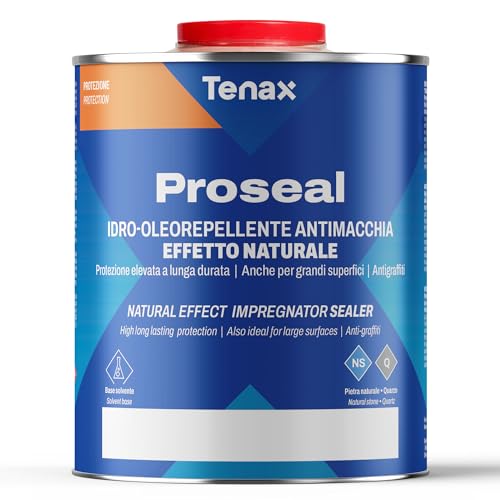
The polished-stone specialist that makes oil bead like water on a waxed car.
Made in Italy and formulated for the broadest stone spread on this list — granite, marble, quartzite, engineered stone, limestone, onyx, concrete, sandstone, slate, terrazzo, travertine, and quartz. It is a 2-pound unit, and the spray form makes it easy to cover awkward areas with an even coat. For polished limestone and granite, this is the pick that shines without dulling the finish.
Owners describe oil beading on marble overnight with zero penetration, and granite sealed without any color change — grey water stains on new counters vanish under it. A granite counter that saw heavy cooking stayed protected for six months, with caked grease cleaning off easily without staining. That is a stronger, more direct line than the all-rounder — the Proseal keeps its bead on polished stone where some thinner formulas fade. Reapply every 6–12 months as a rule.
Fumes are the price. The smell is strong — nail-polish-like — and owners mention feeling light-headed, so open the windows and run a fan. It leaves a slight dullness on some polished surfaces that buffs out with a cloth. Pouring from the fat can with the small lid can get messy, so grab a sponge paint stick for clean, even coats.
The standout: Seals granite and marble against oil and water without altering color, and the bead it creates is the kind owners describe as a waxed-car finish.
The honest downside: Strong fumes that call for real ventilation, plus a slightly awkward can to pour from.
Right for you if: Your stone is polished, high-end, and you want the strongest protection available for it.
Not ideal if: You need fragrance-free application or you’re sensitive to strong solvent odors.
7. Armor SX5000 WB

A gallon of matte sealer that guards pavers and driveways for the long haul.
Silane-siloxane means the sealer reacts chemically below the surface to build a water-repellent barrier — the maker claims it cuts water absorption by up to 95% and lasts up to 7-10 years on pavers and concrete. The gallon weighs 9 pounds and covers up to 175-225 square feet per gallon on a properly cleaned surface. A pump sprayer is the fast way to put it down; this soak-below-the-surface approach is nothing like the wipe-on countertop sealers above.
The proof is in the beading. Quality ranks as the top thing owners praise, and a paver patio that beads water every rain is the everyday picture. A coat absorbs in 2-4 minutes, then you shorten the interval to 5 minutes, and water stands on the surface and pools for 2-3 days after rain with no color change. On a Florida patio, concrete still looked freshly power-washed — no more seasonal cleaning of algae and fungus. The 0 VOC, no-odor, water-based formula cleans up with soap and water.
The honest limits: on an older, porous surface you can see uneven light and dark patches, and wet leaves can leave tea-stain patterns on the surface. Longevity beyond the claimed window isn’t proven in owner hands yet, and a broken sprayer caught one job mid-stream. Do two coats on a clean, dry surface for even results.
Where It Wins
- Water beads and pools for days after rain
- 0 VOC, no odor, cleans up with soap and water
- Coverage up to 175-225 square feet per gallon
- No color change on pavers, brick, and stone
Where To Be Careful
- Uneven patches on old porous concrete
- Wet leaves can leave organic stains
- Long-term longevity yet to be seen on many surfaces
The call: Grab this for driveways, patios, paver walks, or brick — one gallon covers a real outdoor area with no smell.
Not for: Kitchen counters and vanity tops, where you want a wipe-on penetrating formula instead.
Know the Specs
Penetrating versus top-coat
A penetrating sealer soaks into the stone’s pores and forms protection below the surface, so the stone still feels like stone. A top-coat sealer forms a film on top and can change the look and feel. For countertops and floors you want penetrating protection — it won’t chip, peel, or wear away as a film does, and it often lasts years between reapplications.
Silane-siloxane and water-based formulas
Silane-siloxane is a chemistry that reacts inside the surface to become water-repellent — you’ll see it on concrete, paver, and masonry sealers. Water-based formulas use water as the carrier, keeping odor and VOC low, while solvent-based versions use a stronger chemical carrier with more fumes but often deeper penetration on dense stone.
Common Questions
How do I know if my stone needs sealing?
Can one sealer work on both granite countertops and shower tile?
How long does a penetrating sealer last?
What is dwell time and why does it matter?
Will a sealer remove a stain that is already in the stone?
Are solvent-based sealers safe to use indoors?
How much sealer do I need for a kitchen countertop?
Does sealing change the look or color of the stone?
Should I seal a walk-in shower floor differently from a countertop?
Can I apply a second coat later without stripping the first?
The Bottom Line
For most kitchens and bathrooms, the winner on this list is the Tenax Hydrex Stone Sealer — a quart of penetrating protection that visibly slows water absorption on marble and granite and holds a solid reputation across hundreds of owners. If your stone is dense quartzite or a polished slab, grab the StonePro Ultimate Pro Sealer for its nano-sized molecules, or the Tenax Proseal when you want oil beading on polished stone. And for driveways, patios, and pavers, the gallon-sized Armor SX5000 WB is the one to reach for. Whichever you pick, match the formula to your stone’s density and ventilate the room while it cures.
How we choose
We do not accept paid placement. Every pick is matched to a real buyer and a real use-case; we do not hands-on test units.
Sources
Specifications: manufacturer listings and product documentation. Review insights: verified customer reviews, as of October 2026. Pricing: not shown on this page (it changes often); check the current price via the retailer link.
As an Amazon Associate, Aappliancez earns from qualifying purchases. This does not affect which products we feature.