Disclosure: Some links in this post are affiliate links. As an Amazon Associate I earn from qualifying purchases, at no extra cost to you. Learn more
Specs are compiled from manufacturer listings and verified buyer reviews and can change over time — please confirm the key details on the product page before buying.
If you are sealing a gas line, the one thing that matters most is whether the joint holds. A weak sealant on a threaded gas fitting can mean a slow leak you smell before you see. The right pick depends on your job. If you are sealing household gas piping to code, you need a soft-setting paste rated for gas pressure. If you are a mechanic sealing fuel lines and compressor fittings, you need something built for higher pressures and different fluids. This guide separates the two jobs clearly, so you grab the right tube the first time.
This guide is built by comparing the manufacturers’ published specifications and the patterns across verified customer reviews, so you get each pick’s real strengths and trade-offs instead of marketing spin.
Below you will find which paste suits household gas threads, which one survives high-pressure compressor work, and which is built for ethanol fuel lines. Read on for a clear, pressure-and-material-first breakdown of the natural gas pipe sealant options that actually hold a seal.
Top Picks


How To Choose The Best Natural Gas Pipe Sealant
The biggest mistake buyers make is grabbing whatever paste is on the shelf. Thread sealants are built for different jobs, and a formula that seals a water line may not be rated for gas pressure. Before you buy, match three things: the pressure your system runs at, the metal of your pipe, and if you need to take the joint apart later.
Check the pressure rating against your system
Look for the number stated in PSI (pounds per square inch, a measure of how much pressure the seal can take). Household gas lines run at low pressure, so a sealant rated for around 100 psi covers them easily. Compressor and fuel systems run much higher, so you want a paste rated into the thousands of PSI.
Match the paste to your pipe material
Most pastes list the metals they work on, such as galvanized steel, brass, copper, aluminum, and PVC. Always read that list. Some formulas are explicitly not for ABS or CPVC plastic, so confirm yours is on the compatibility list before you open the tub.
Decide between soft-set and fast-dry
A soft-setting paste stays pliable, so you can adjust the fitting after you tighten it. A fast-dry paste sets harder and suits joints that vibrate or that you will not touch again. If you expect to take the joint apart someday, choose the soft-set type.
Side-by-Side Comparison
| Model | Best For | Pressure Rating | Set Type | Volume | Amazon |
|---|---|---|---|---|---|
| LOCTITE 565 Thread Sealant★ Best Overall | High-pressure automotive fittings | Up to 10,000 PSI | Rapid cure | 1.69 fl oz | Amazon |
| RectorSeal No. 5Gas Line Mainstay | Household gas and water lines | Up to 100 psi | Soft-set, slow dry | 8 oz | Amazon |
| Gasoila Venom VM08 | Mixed materials, high heat | 10,000 PSI liquids / 3,000 PSI gases | Soft-set | 8 fl. oz. | Amazon |
| RectorSeal Tru-Blu | Vibration and high-pressure joints | — | Fast-dry, flexible | 8 Oz. | Amazon |
| Gasoila E-Seal E10/E85 | Ethanol fuel line fittings | — | Non-hardening | 1/4 Pint | Amazon |
Detailed Reviews
1. LOCTITE 565 Automotive White Thread Sealant
Our pick — 4.5+★ from 450+ verified ratings; the strongest balance of quality and price.
The white paste that seals fittings running pressures most household jobs never see.
The number that decides this pick is its pressure rating: up to 10,000 PSI, which means it holds on high-stress metal fittings where a basic tape would blow out. That is a much higher ceiling than the RectorSeal No. 5 at up to 100 psi, so if you are sealing compressor lines, oil pressure sending units, or fuel return fittings, this is the one built for that workload. It is designed for metal and tapered pipe threads and replaces both thread tape and traditional pipe dope.
Buyers with hard jobs keep coming back to it. A fourth-generation pipe fitter used it on a home air compressor system running up to 3000 PSI. One review sums it up: “PTFE tape leaked badly on poor-tolerance third-world fittings; Loctite 565 + primer/activator sealed everything with zero leaks after 24hr cure.” That 24-hour cure time (the wait for the paste to fully set) is the real catch here. Running pressure just five minutes after assembly caused leaks in that same account, so you must let it set. Smear it thin, skip the excess, and wipe the outside clean before you tighten.
What wins people over is how cleanly fittings come back apart. The paste stays non-hardening except inside the threads, so a joint you sealed weeks ago still breaks free with a wrench and no hardened residue to scrape. Use it on oil lines, hydraulic fittings, and fuel return lines and it behaves.
Where it pulls ahead
- Rated to 10,000 PSI for compressor and fuel fittings
- Non-hardening in threads so joints break free cleanly
- Replaces tape and pipe dope in one tube
What to plan around
- Needs a full 24-hour cure before pressure; rushing it causes leaks
- Grab an activator if your threads are poorly cut
Reach for this if: you are sealing high-pressure metal fittings on compressors, oil lines, or fuel systems and can let the joint cure overnight.
Think twice if: you need a joint pressurized the same hour, since this formula wants its full cure first.
2. RectorSeal No. 5 25551 Pipe Thread Sealant
The slow-drying yellow paste built for gas and water lines you may need to open again.
Here is a paste that states its gas credentials right on the label: for natural gas and water lines up to 2″ and pressure up to 100 psi, the piping system can go into immediate service. That immediate-use detail is the quiet advantage over the LOCTITE. It is a soft-set, slow-drying compound that will not dry out in the container, so a tub can sit on the shelf between jobs and still be ready.
What it is not is a high-pressure paste. At up to 100 psi it is nowhere near the 10,000 PSI ceiling of the LOCTITE, so keep it for household gas and water, not compressor work. It also has firm rules on pipe material: it works on galvanized steel, iron, brass, copper, aluminum, stainless steel, polyethylene, reinforced fiberglass, and PVC, but you must not use it on ABS or CPVC. Weigh it at 9.6 ounces and it is a full can, six times the heft of the little 1.6-ounce LOCTITE tube, so it covers far more joints.
The review pages back its decades in the trades: “This stuff is great in 45 years never had to go back to redo a piping job because of a leak.” The honest catch is consistency and cleanup. It drips and runs on a vertical pipe before it sets, and it will stain fabric for good, so lay a rag down first. It is also lead-free with no metal fillers and lets you break a joint out without chewing up the threads.
Why the trades keep it stocked: a soft-set, lead-free paste that seals gas and water up to 2″ and 100 psi, stays usable in the tub, and breaks out clean.
Best for: household gas and water piping where you want a fitting you can open later without damaged threads.
Look elsewhere if: you run plastic ABS or CPVC pipe, which this formula is not made for.
3. Gasoila Venom Pro-Grade Pipe Thread Sealant

A thick white paste that shrugs off extreme heat and seals mixed metals in one tub.
Two specs make this one stand out for tough jobs. It seals liquids up to 10,000 PSI and gases up to 3,000 PSI, and it handles a temperature range from -100°F to 600°F. That gas rating is the figure to note, because it is built for demanding gas work where a household paste rated to 100 psi would not be the right tool. At 8 fl. oz. it is a generous tub, several times the little 1.69 fl oz LOCTITE tube, so a single jar lasts through a lot of fittings.
Where it earns its keep is on bad threads. The high-viscosity, soft-setting formula is made for poorly cut or damaged threads, letting you adjust a fitting and take it apart later. A retired diesel mechanic used it on loose-tolerance imported NPT fittings with a wrap of tape and a top coat, and it stopped the minor leaks. The built-in brush cap keeps application controlled, so you are not dripping paste down the side of a pipe. It is certified for potable water and compatible with water, gas, propane, LPG, diesel, steam, and compressed air.
The honest limit shows up on badly corroded, actively dripping pipe. One buyer reports, “It didn’t work on a corroded dripping pipe… it takes so long to dry.” That slow dry is the trade-off: it is a paste that wants time to set, not an instant patch for a failing pipe. On sound threads it seals well, but it is slightly messy to work with, so keep a rag handy.
Pick this one if: you seal gas, propane, or high-temperature lines on mixed metals and want a soft-set paste that tolerates rough threads.
skip it if: your pipe is actively corroded and dripping, since no slow-drying paste is a fix for a failing line.
4. RectorSeal Tru-Blu 31551 Pipe Thread Sealant

The blue paste that holds a seal when the joint shakes, rattles, or vibrates.
Tru-Blu is a fast-dry, flexible-set sealant enriched with PTFE (the same slick material in thread tape, blended into the paste). It is designed for high-vibration environments, so it suits joints on pumps and equipment that move. One buyer sealed a leaking 2″ threaded PVC pool pump fitting after tape failed, coated both threads, and ran the pump within 10 minutes with no leaks over a month of continuous use. That quick-use result contrasts with the LOCTITE above, which wants a full overnight cure.
The real-world range here is broad. It seals stainless, galvanized, brass, black iron, and PVC threads, and One buyer used it on a 1-1/4″ brass-into-plastic filter housing after other sealants failed, and it sealed on the first attempt.. It is PTFE-based, so it lubricates the threads as it seals and lets you nudge the fitting slightly after assembly. A thin coat goes a long way, so the 8 Oz. tub covers plenty of joints.
The trade-off is cleanup. Once it sets it adheres firmly, and getting dried paste out of a fitting takes real effort. A light coat and a wipe of the excess before tightening saves you that work later. It suits thread work in HVAC, plumbing, and vibration-prone joints, and the blue color makes it easy to see where you have already applied it.
The case for it: a PTFE-enriched, flexible-set paste that meets high-vibration joints and spans stainless, brass, black iron, and PVC.
Suits you if: your joint shakes, sits on a pump, or involves a mixed run of metals and PVC.
One caution: dried paste is hard to wash out, so apply it thin and wipe the excess early.
5. Gasoila Thread Sealant for Ethanol E10 & E85
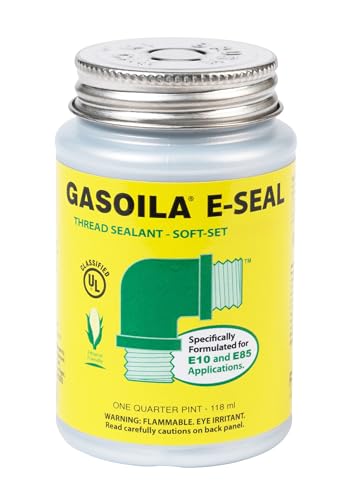
The dark green paste formulated for the fuel line threads a gas pipe paste is not.
This one targets a specific job: ethanol-blended gasoline, including E10 and E85. That matters because fuel systems and gas piping stress a sealant differently, and a formula built for fuel threads holds where a generic paste may not. It is non-hardening and stays pliable even in cold temperatures, so the seal flexes instead of cracking. The brush-in-cap design lets you apply it precisely to a fitting without a dripping mess.
The compatibility list is wide: brass, copper, stainless steel, aluminum, black pipe, tin, and galvanized pipe, across 100 to 600 degrees. One buyer resealed 13 fittings between a fuel pump and three carbs with it and went three years leak-free, after resealing every few months before. Another sealed every fuel fitting on a boat with it. It suits pipe threads, joints, hoses, nozzles, and pump assemblies on compressors, engines, and hydraulic systems.
What you get is a smaller tub at 1/4 Pint, and it is a thick, gritty paste, so a thin coat is all a fitting needs. It is the right pick for fuel work, not for high-pressure compressed-air fittings where a 10,000 PSI paste like the LOCTITE is the better match. The honest catch: stay with the application thin-and-even method, since thick blobs just make extra cleanup.
Made for this job: ethanol-blended fuel line threads on cars, boats, and small engines where the paste must stay pliable.
Not the one for: high-pressure air compressor fittings, where a higher-rated paste fits better.
Know the Specs
Pressure rating (PSI)
PSI means pounds per square inch, a measure of how much pressure a seal is rated to hold. A household gas line runs at low pressure, so a paste rated around 100 psi covers it. A compressor or fuel system runs far higher, so you want a paste rated into the thousands. Always match the rating to your system, not the other way around.
Soft-set versus fast-dry
A soft-set paste stays pliable so you can adjust a fitting after tightening and break the joint out later. A fast-dry paste sets firmer and suits joints that vibrate or that you will not touch again. Pick soft-set when you expect to take the joint apart someday, and fast-dry for permanent, vibration-prone connections.
Common Questions
Is a pipe thread sealant safe to use on natural gas lines?
Can I use PTFE tape instead of a paste sealant on gas threads?
How long should I wait before pressurizing a sealed joint?
Will these sealants work on plastic pipe like PVC or CPVC?
Which sealant is best for a high-pressure air compressor system?
Can I take the fitting apart later after sealing it?
Is there a sealant made specifically for E85 or ethanol fuel lines?
Do I need a primer or activator with thread sealant?
How much sealant should I apply to a fitting?
The Bottom Line
For most jobs that call for a natural gas pipe sealant, the winner is the LOCTITE 565. Its 10,000 PSI rating (pounds per square inch, a measure of pressure) covers demanding compressor and fuel fittings, and it breaks free cleanly when you need to open the joint. If you are sealing household gas piping to code, grab the RectorSeal No. 5, which is stated for natural gas lines up to 2″ at up to 100 psi. And for ethanol fuel line threads where the paste must stay pliable, the Gasoila E-Seal E10/E85 is the one to reach for.
How we choose
We do not accept paid placement. Every pick is matched to a real buyer and a real use-case; we do not hands-on test units.
Sources
Specifications: manufacturer listings and product documentation. Review insights: verified customer reviews, as of October 2026. Pricing: not shown on this page (it changes often); check the current price via the retailer link.
As an Amazon Associate, Aappliancez earns from qualifying purchases. This does not affect which products we feature.