Disclosure: Some links in this post are affiliate links. As an Amazon Associate I earn from qualifying purchases, at no extra cost to you. Learn more
Specs are compiled from manufacturer listings and verified buyer reviews and can change over time — please confirm the key details on the product page before buying.
You want nails that hold cedar boards tight for years and never leave rust streaks down the wood. The short answer: pick a stainless ring-shank for visible cedar, and a hot-dipped galvanized framing nail for the hidden structural work behind the fence line. That split — visible face versus load-bearing frame — drives every pick below.
This guide is built by comparing the manufacturers’ published specifications and the patterns across verified customer reviews, so you get each pick’s real strengths and trade-offs instead of marketing spin.
Below you’ll find five real options sorted by the job they do best, plus the coating, shank, and length specs explained in plain words. The right nails for cedar fence come down to one question: is the board a visible face or hidden framing?
Top Picks

How To Choose Nails for Cedar Fence
Cedar fence work splits into two very different nail jobs, and mixing them up is where projects go wrong. One job is fastening the pickets, rails, and visible faces — the parts a neighbor sees and the parts that stain. The other is the hidden framing that carries the whole fence against wind. Each job wants a different metal and a different shank.
Match the coating to the cedar, not the budget
Cedar contains acids and tannins that react with ordinary bright steel. When plain steel gets damp, it rusts and the rust runs down the board as a brown stain you can’t sand out. Hot-dipped galvanized (steel dipped in molten zinc, so the zinc coating is thick and bonded) handles most treated and structural work. Type 304 stainless steel goes a step further and resists corrosion on the exposed faces. For seaside air, the data here singles out Type 316 stainless as the step up when extra corrosion resistance is needed.
Ring shank versus spiral shank versus smooth
A ring shank is a series of ridges around the nail shaft. Those ridges bite the wood fibers and make the nail far harder to pull back out, which is exactly what a wind-loaded cedar picket needs. A spiral shank is a continuous twist that drives into harder woods and helps near board ends to minimize splitting. A smooth shank pulls easily and is the wrong pick where boards cup and lift over the seasons.
Length and diameter for cedar thickness
Nail length has to reach through the board and into the rail with real bite, but too long a nail punches out the far side. Diameter matters just as much: a thinner shaft such as 0.083 inch leaves less risk of splitting a thin cedar board, while a heavier 0.113 inch shaft suits thickened framing and structural joins. Pre-drilling stays a common tactic on cedar, especially near board ends, no matter which nail you drive.
Side-by-Side Comparison
| Model | Best For | Length x Diameter | Coating | Shank / Count | Amazon |
|---|---|---|---|---|---|
| Metabo HPT Framing Nails 20171SHPT★ Best Overall | Structural framing behind the fence | 2″ x 0.113″ | Hot Dipped Galvanized | Ring Shank / 1,000 | Amazon |
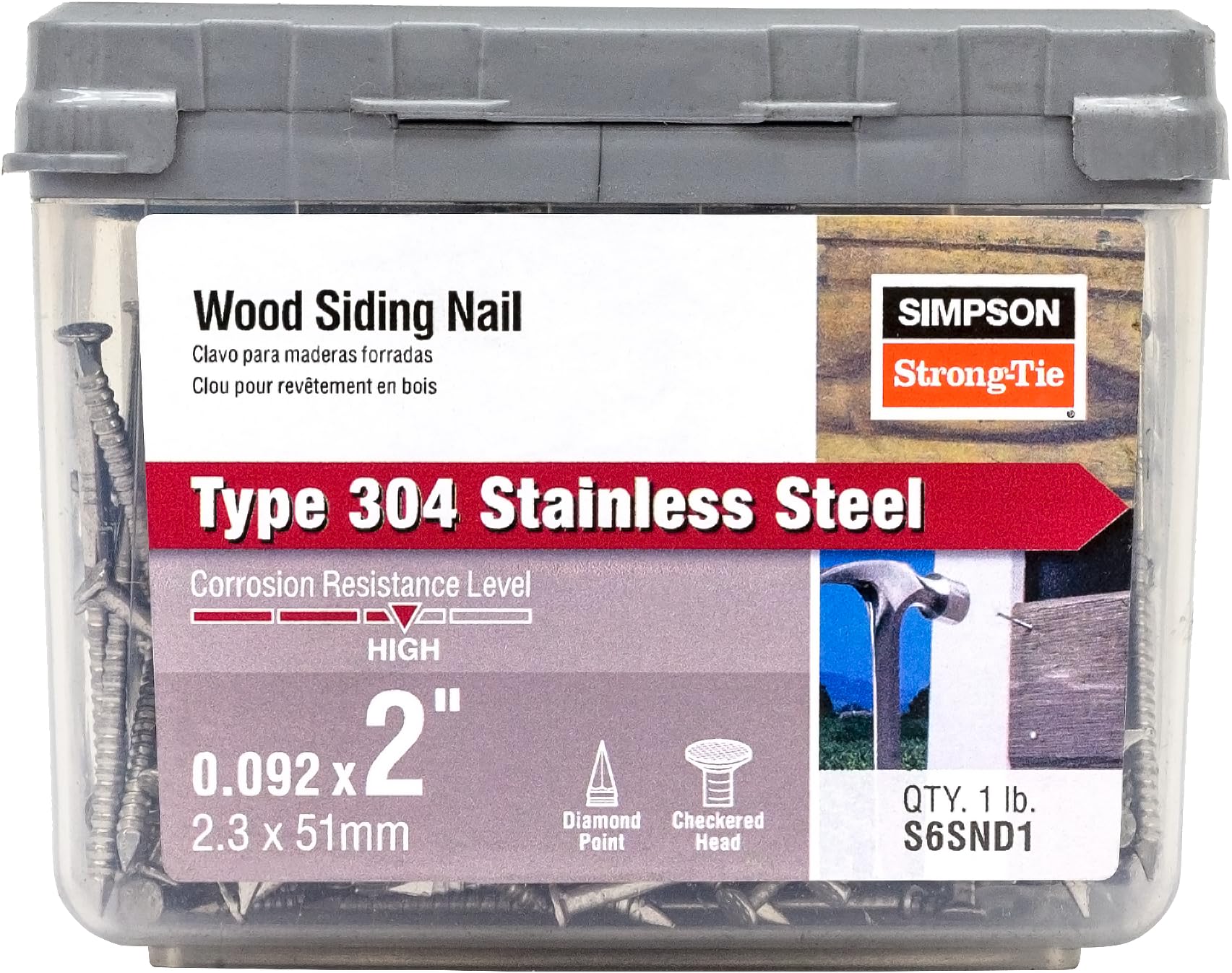
| Simpson Strong-Tie S6SND1Face-Saver Pick | Cedar T&G and shake faces | 2″ x 0.092″ | Type 304 Stainless | Ring Shank / 120 | Amazon |
| Simpson Strong-Tie S8SND1 | Thicker lap and live-edge siding | 2-1/2″ x 0.092″ | Type 304 Stainless | Ring Shank / 196 | Amazon |
| Simpson Strong-Tie S4SND1 | Thin shingles and tight cedar joins | 1-1/2″ x 0.083″ | Type 304 Stainless | Ring Shank / 120 | Amazon |
| Huttig-Grip HGN6OGSTDK5 | Hand-drive fence and deck repair | 2″ (6d) | Galvanized Finish | Spiral Shank / 690 | Amazon |
Detailed Reviews
1. Metabo HPT Framing Nails 2 In. x 0.113
Our pick — 4.5+★ from 500+ verified ratings; the strongest balance of quality and price.
The heavy galvanized workhorse that drives a whole fence frame without a single jam.
Start with the number that carries the fence: a 0.113 inch shaft in a 2 inch length. That thicker diameter is what you want for rails, posts, and any join bearing real load, because a beefier shaft resists bending and pull-out better than a thin siding nail. The hot-dipped galvanized coating puts a thick bonded layer of zinc between the steel and the weather, and the maker recommends it for use in all pressure treated lumber. Wrap all that in a full round head (a wide flat cap that clamps the board rather than sinking through it), and you have a nail that holds cedar framing tight through wet winters.
The coating choice matters most against the nail-gun crowd, and this is the one that syncs with a specific set of tools. It fits most round-head plastic-strip collated framing nailers, and the maker lists compatibility with the Metabo HPT NR83A5, NR83A5(S), NR90AES1, NR90AC5, NR1890DRS, NR83A5Y, and NR83A5S1. Check your gun’s model list before you buy, since a strip collation gun that is not on that list may not feed these reliably. Each box carries approximately 1,000 nails, so a long privacy run is covered without constant restocking.
You get jam-free feeding through a plastic-strip framing nailer, so a long fence run keeps moving. Buyers report clean loading and no jamming, including one who put more than 5,000 nails through a roof deck and subfloor plywood while building a house and hit no nail-related failure. Owners mention running them across 700 feet of privacy fencing with no rust and no backing out as the wood dried and shrank. The honest catch is durability at the thin points — most find the nails strong, but a few note individual and paired nails breaking off, so drive into solid wood and avoid firing into existing nails or knots. Pair it with the S6SND1 for the exposed faces and this covers the structural and visible sides of the same fence.
What wins people over
- 0.113 inch shaft holds framing under wind load
- Hot-dipped galvanized zinc for outdoor and treated lumber
- Reported jam-free feeding in strip nailers
- Roughly 1,000 nails per box covers a long run
Where it gives ground
- Thicker shaft is overkill and split-risk on thin pickets
- Compatibility is limited to the listed Metabo models
- A few note some nails snapping at hard contact points
Reach for this if: you’re framing rails, posts, or structural joins on cedar and running a plastic-strip framing nailer.
Pass it by if: you’re setting thin visible pickets by hand — the 0.113 inch shaft is more bite than those boards need.
2. Simpson Strong-Tie S6SND1 Ring-Shank Wood Siding Nail
The stainless face nail that keeps cedar bright instead of streaking it brown.
For the boards a neighbor actually studies, this Simpson Strong-Tie sidles up at 2 inch length and 0.092 inch diameter in Type 304 stainless steel. Stainless is the coating that will not leave a rust halo on cedar, which is why the makers of these siding nails point to it for exterior work where a clean look matters. The head carries a small checker pattern that is built to blend with the wood grain and cut glare from sunlight, so the nail heads disappear into the board instead of glittering in the sun. An annular ring shank (ridges that bite the fibers) boosts withdrawal resistance, which is what keeps pickets from cupping and lifting as the seasons swing.
The thin shaft is a deliberate trade — the maker engineers it thin so it cracks the cedar less, which is exactly the failure a heavy framing nail causes on a thin board. Customers note driving these into 6 inch cedar tongue-and-groove and finding the design enables fast driving while preventing hammer marks on the cedar. Others use them on lap cedar siding and cedar shake shingles and come away satisfied. Where it asks for care is the driving. The shaft is soft enough that it bends if the blow is off-angle, so a level, dead-on swing — or a pilot hole on hard spots and near board ends — keeps it straight and true.
For a coastal job, the maker steers you toward the Type 316 stainless version for extra corrosion resistance. That is where the 0.092 inch face nail earns its place over the round-head framing nail above: it is the refined, board-friendly choice rather than the structural one. Pick it when the cedar is thin, visible, and deserves the stainless treatment. “Works great with cedar shake shingles” is the kind of note the review pages keep returning to, and it tells you the audience here is finish work, not framing.
Why it earns the callout: Type 304 stainless plus a ring shank and a glare-cutting checker head is a hard combination to beat on cedar you want to look clean for years.
The trade to size: a thin, relatively soft shaft bends on off-angle hits, so it rewards a steady hand or a quick pilot hole.
The smart buy when: the boards are visible cedar and you’d rather not repaint over rust stains.
Heads-up: stainless strength comes with a little give — plan your swing and it goes straight every time.
3. Simpson Strong-Tie S8SND1 Ring-Shank Wood Siding Nail
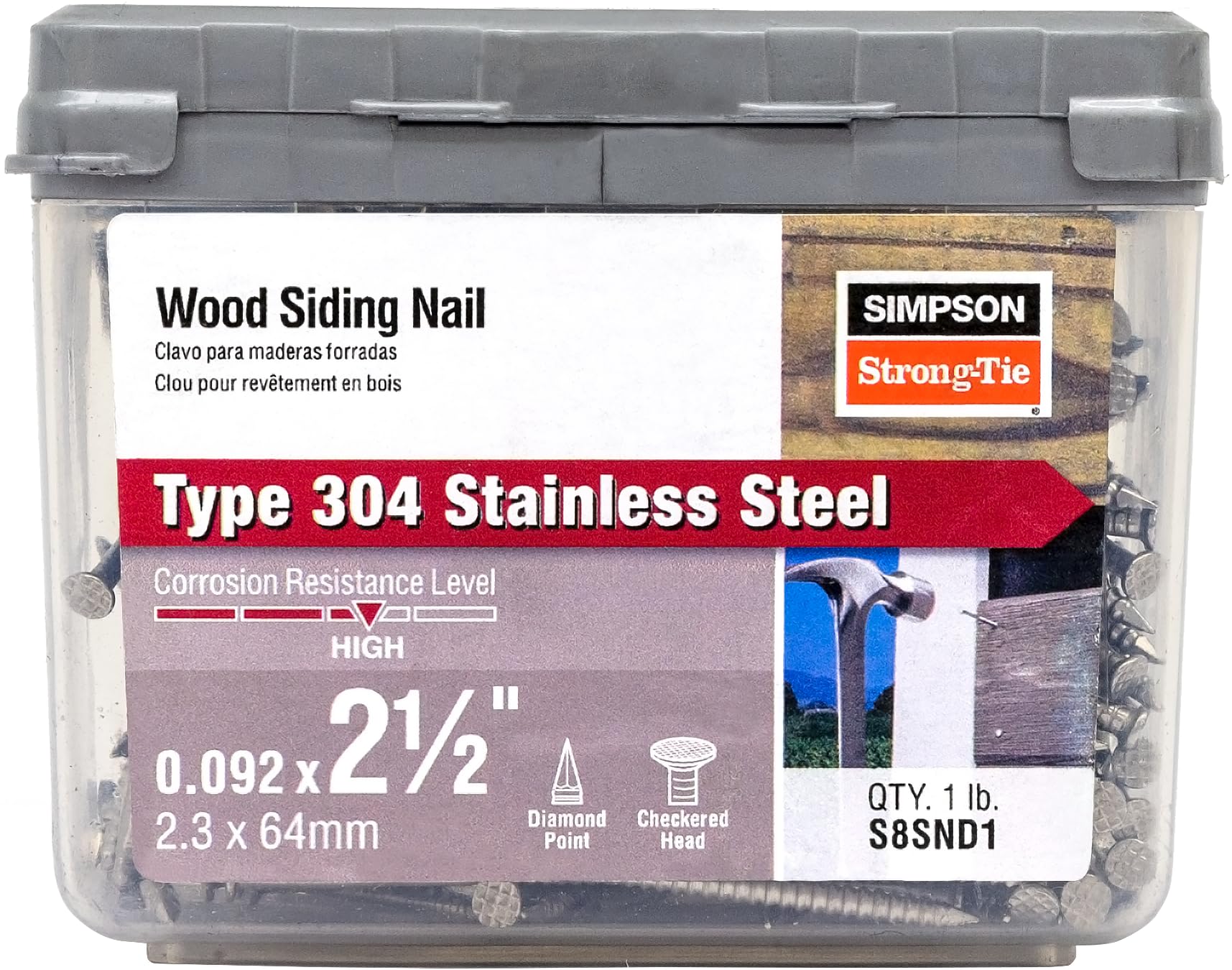
Half an inch longer than the S6SND1 — built to bite through thick lap and live-edge cedar.
Length is the whole reason this one exists: 2-1/2 inches versus the 2 inch S6SND1 in this same Simpson line. When you’re laying thick cedar lap siding or a chunky live-edge board, a shorter nail bottoms out before it grabs the rail — the extra half inch here reaches through and pulls the board down tight. It keeps the same 0.092 inch Type 304 stainless shaft and the same annular ring shank, so the corrosion resistance and the pull-out bite travel with the longer reach. That pairing — stainless face plus ring-shank bite — suits exposed lap siding that needs both a clean face and holding power.
Reviewers point out putting these on live-edge siding on a shop build where the nails stayed exposed and stainless was the only sensible call, and the nails held up through hammering without bending when driven clean. That said, this is a longer, thin nail and it makes its limits known on hard wood: shoppers say that 3 out of 10 would bend on normal 2×4 studs when the swing isn’t dead-on — it will not tolerate a glancing blow. Hit a knot or a buried nail and it folds, and unlike a smooth nail you can’t straighten a ring-shank and keep its grip, so pull and replace. Treat it as a finish nail that rewards a pilot hole on dense spots.
Compared with the round-head framing nail that leads this list, this one is the thinner, longer, stainless cousin for thick exposed boards rather than hidden framing. The head diameter is listed at 0.092 inch in the manufacturer specs, so check that against your board before a wide run. For thick cedar lap or live-edge boards that a 2 inch nail can’t reach through, the extra half inch is the reason to buy it. This is a package of 196, so buy the count your job demands.
Why owners keep coming back
- 2-1/2 inch reach for thick cedar that a 2 inch nail can’t grab
- Type 304 stainless resists rust bleed on exposed faces
- Ring shank bites and resists pull-out
- 196 per pack covers a solid run
What you should know first
- Longer reach is too much for thin pickets — it can punch through
- Bends on off-angle hits and hard studs; wants a straight swing
- Ring shank can’t be straightened after a bend — pull and replace
Make this your pick if: the cedar is thick and exposed and a 2 inch nail keeps falling short of the rail.
Think twice if: you’re fastening paper-thin boards — the longer shaft is more reach than the job asks for.
4. Simpson Strong-Tie S4SND1 Ring-Shank Wood Siding Nail
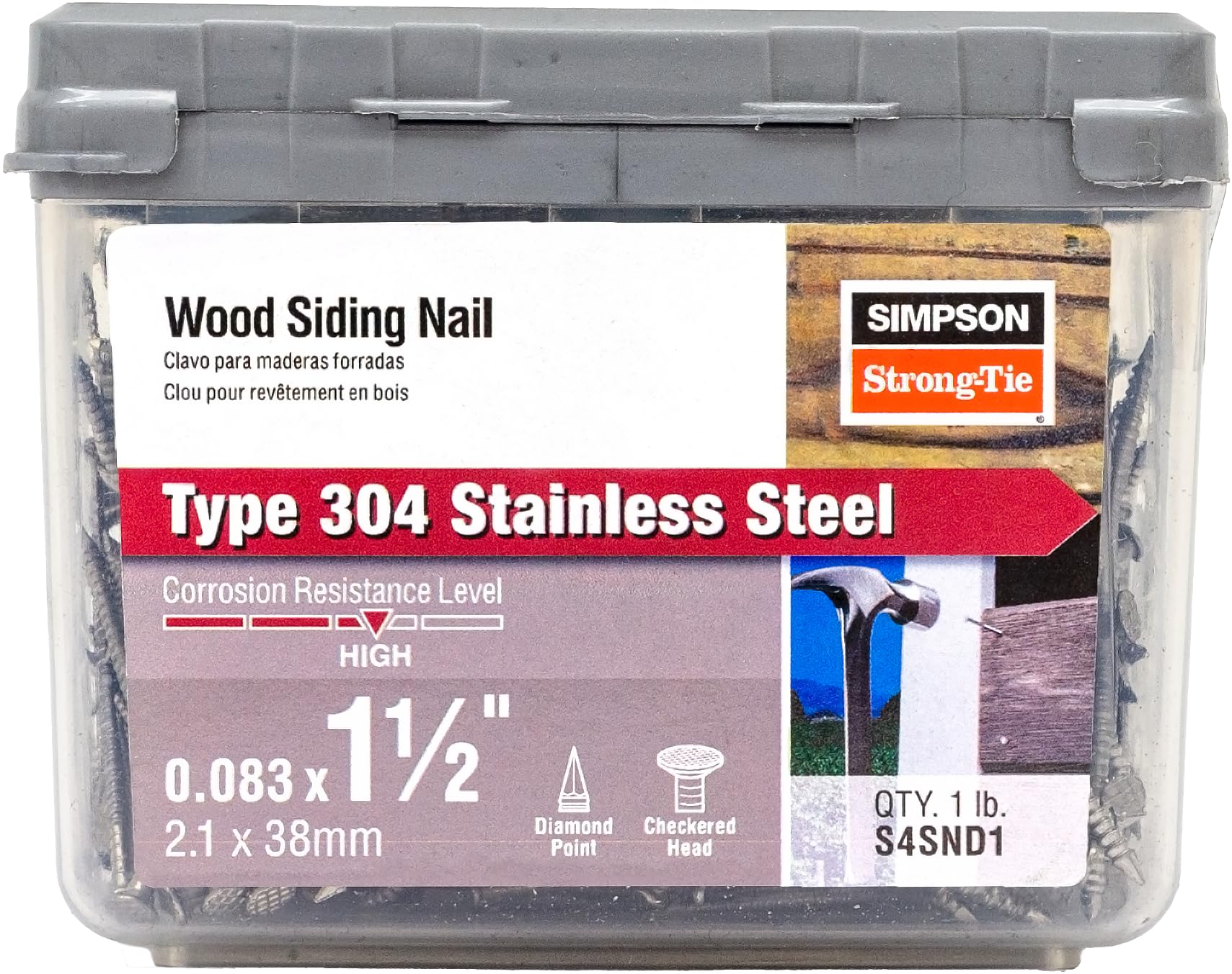
The fine 14 gauge stainless that slides into thin cedar shingles without splitting them.
At 1-1/2 inches with a 0.083 inch shaft, this is the finest nail in the group — the one you reach for when cedar is thin and splits if you look at it wrong. That 14 gauge diameter leaves the smallest footprint in the wood, so shingles, thin pickets, and tight trim take the nail without cracking. It’s still Type 304 stainless with the same annular ring shank, so the corrosion resistance and the hold don’t drop off just because the shaft got slimmer. The checker head keeps it low-profile in the grain.
Where this earns loyalty is grip on those delicate boards. What owners rave about most is the hold — the ring shank bites so firmly that pulling a nail back out can damage the board itself, and one buyer likened it to holding like a Bullmastiff. The stainless prevents rust bleeding into the cedar, which is the whole reason to spend on it rather than a plain galvanized nail. It’s the kind of size that is hard to find on a local shelf, so a full stainless pack is often the only practical way to get this gauge.
There’s an honest limit to keep in view. A coarse or smooth nail of this same short length would be cheaper and quicker to source, and this one costs in part because it is a rarity — a fine stainless ring-shank is a specialty item, not a big-box commodity. The 1-1/2 inch length also won’t reach through a thick rail, so it’s for faces and thin boards, not deep framing. Yield runs around 440 nails per pound in the maker’s own accounting, which gives you a ballpark for how far a pack stretches on a shingle job. On thin, visible cedar, no splits and no rust streaks are worth the specialty price.
Its real job: delicate cedar faces where a fatter nail would crack the board, held by a stainless ring shank that resists both rust and pull-out.
The honest catch: short and fine, so it won’t carry thick framing, and the specialty stainless gauge is a pricier, harder-to-find buy than commodity nails.
Go with it for: cedar shingles, thin pickets, and trim where splitting is the enemy and every face shows.
Keep looking if: you need to pull a thick rail tight — step up in length and this fine gauge won’t reach.
5. Huttig-Grip Fence Deck Nails 2 Inches 6d
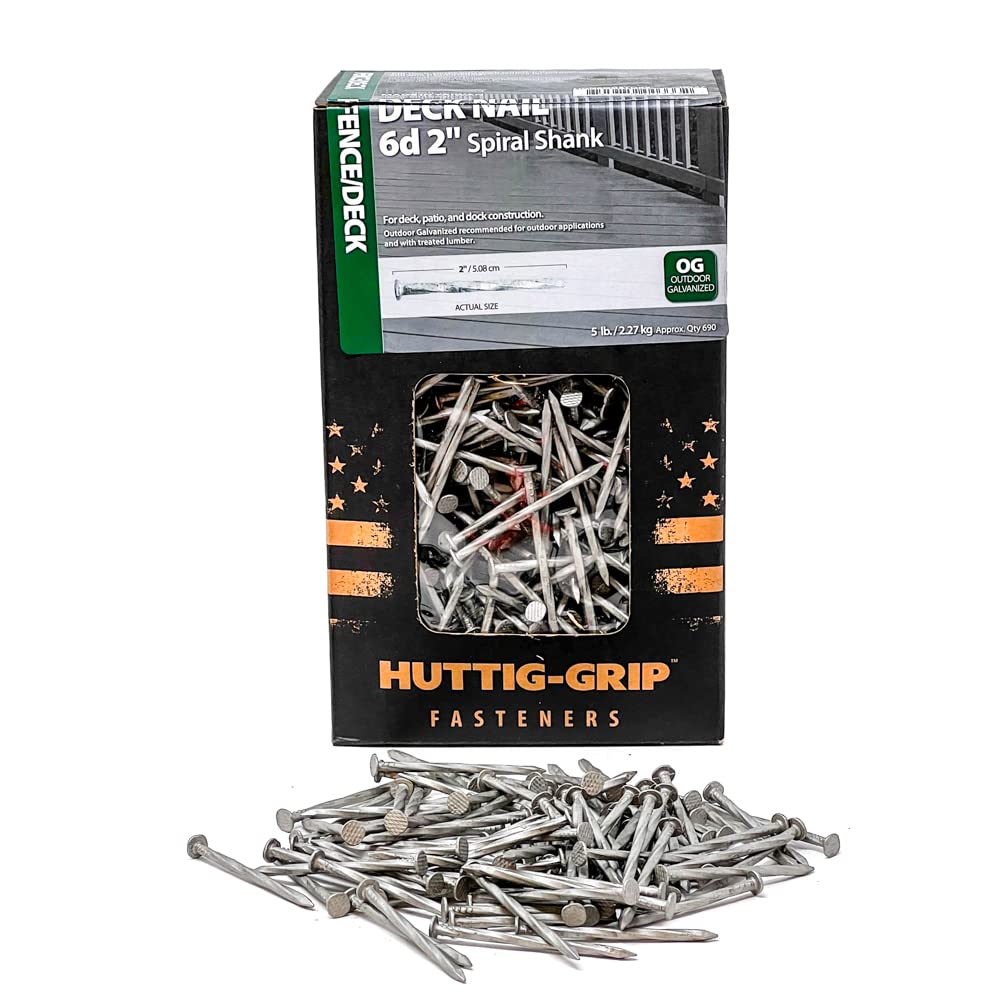
A loose 690-count spiral-shank pack for hand-drive fence and deck repairs.
This one aims at the loose-nail hand driver, not the nail-gun operator — a 5 lb box of 690 flat-head stainless-look galvanized nails in a 2 inch 6d size. The spiral shank is the selling feature: a continuous twist that is built for use with harder woods and near board ends to minimize splitting, which is exactly where a plain nail pries cedar apart. The diamond point starts the drive easily, the flat head seats flush against the surface, and the galvanized finish gives outdoor-grade rust protection. It’s tagged for deck, patio, and fence work alike.
The honest note here is thin, because the track record is thin. There is only a single review to go on, and it’s a rough one: the buyer reports too soft a nail and some glued together into clumps, calling the quality poor outright. With a sample that small you can’t paint a pattern either way, but you can decide if you want to bet a big job on an unproven spiral-shank loose pack. A 690-count pack makes sense for small repairs and deck touch-ups, not a full fencing run.
Where this differs from the stainless options above is simple: it’s galvanized finish, not Type 304 stainless, so on exposed, acid-heavy cedar the rust-resistance edge belongs to the Simpson nails. Use the spiral shank to your advantage on harder stock and near ends, keep a straight, firm swing so a soft nail doesn’t fold, and treat it as the convenient volume pack for hand-driving rather than the finish-grade face nail. For load-bearing or full-run cedar fencing, the stainless Simpson picks are the safer bet.
Reasonable for: hand-driving small cedar repairs and deck touch-ups where a big 690-count galvanized pack saves a trip.
Not the one for: a full visible cedar fence build, where the unproven quality and galvanized (not stainless) finish give up ground to the Simpson picks.
Know the Specs
Coating: galvanized versus stainless steel
Hot-dipped galvanized means the steel is dipped in molten zinc, so a thick bonded zinc layer shields it — this handles treated lumber and structural work. Stainless steel (Type 304 here) resists corrosion further, and the maker points to Type 316 stainless for seaside air where extra corrosion resistance is needed. On cedar, the point is stain: plain steel rusts and streaks the board, so the coating decides whether your fence ages clean or blotchy.
Shank: ring, spiral, and smooth
The shank is the shaft below the head, and its shape rules how hard the nail pulls out. An annular ring shank carries ridges that bite the wood fibers and boost withdrawal resistance, great for wind-loaded pickets. A spiral shank twists continuously, suited to harder wood and near board ends to minimize splitting. A smooth shank pulls easily and is the wrong choice where boards cup and lift over the seasons.
Length and diameter
Length has to reach through the board and into the rail with real bite — 2-1/2 inches on thick lap cedar, 1-1/2 inches on thin shingles. Diameter sets splitting risk: a 0.083 inch shaft on a 14 gauge nail leaves the smallest footprint for delicate boards, while a 0.113 inch shaft holds structural framing. Too long punches out the far side; too thick cracks the picket.
Head shape and finish
A full round head clamps a wide cap across the board and seats it flush. The checker pattern on the Simpson heads is built to blend with the wood grain and cut sun glare, so heads vanish into the cedar. A diamond point starts the drive in most wood; pre-drilling at board ends and on dense knots keeps cedar from splitting no matter the head.
Common Questions
Will galvanized nails rust and stain my cedar fence?
What is a ring shank nail and why does it matter for a fence?
Do I need stainless steel or is galvanized enough?
What length nail should I use on cedar fence pickets?
Will thin nail shafts split cedar boards?
Can I use a nail gun with these fence nails?
Why do stainless nails bend more easily than common nails?
Does the checker-pattern head actually help on cedar?
How many nails will I need for a cedar fence run?
Is spiral shank better than ring shank for harder cedar?
The Bottom Line
For a cedar fence that has to stand up to weather and wind, the nails for cedar fence winner is the Metabo HPT Framing Nails because that thick 0.113 inch hot-dipped galvanized shaft carries the structural rails and posts while feeding jam-free through a plastic-strip framing nailer. If your priority is clean, bright visible cedar with no rust streaks, grab the Simpson Strong-Tie S6SND1 for its Type 304 stainless finish. And for thick exposed lap boards that a 2 inch nail can’t reach, the longer Simpson S8SND1 is the one to reach for. Stainless for boards that show, hot-dipped galvanized for framing, and a length that matches board thickness.
How we choose
We do not accept paid placement. Every pick is matched to a real buyer and a real use-case; we do not hands-on test units.
Sources
Specifications: manufacturer listings and product documentation. Review insights: verified customer reviews, as of October 2026. Pricing: not shown on this page (it changes often); check the current price via the retailer link.
As an Amazon Associate, Aappliancez earns from qualifying purchases. This does not affect which products we feature.